Large Language Models (LLMs) are over-parameterized neural networks trained to predict the next token in a sequence from vast amounts of text.
Technically, they are mathematical frameworks built for statistical pattern recognition — not sentient minds capable of intentional thought.
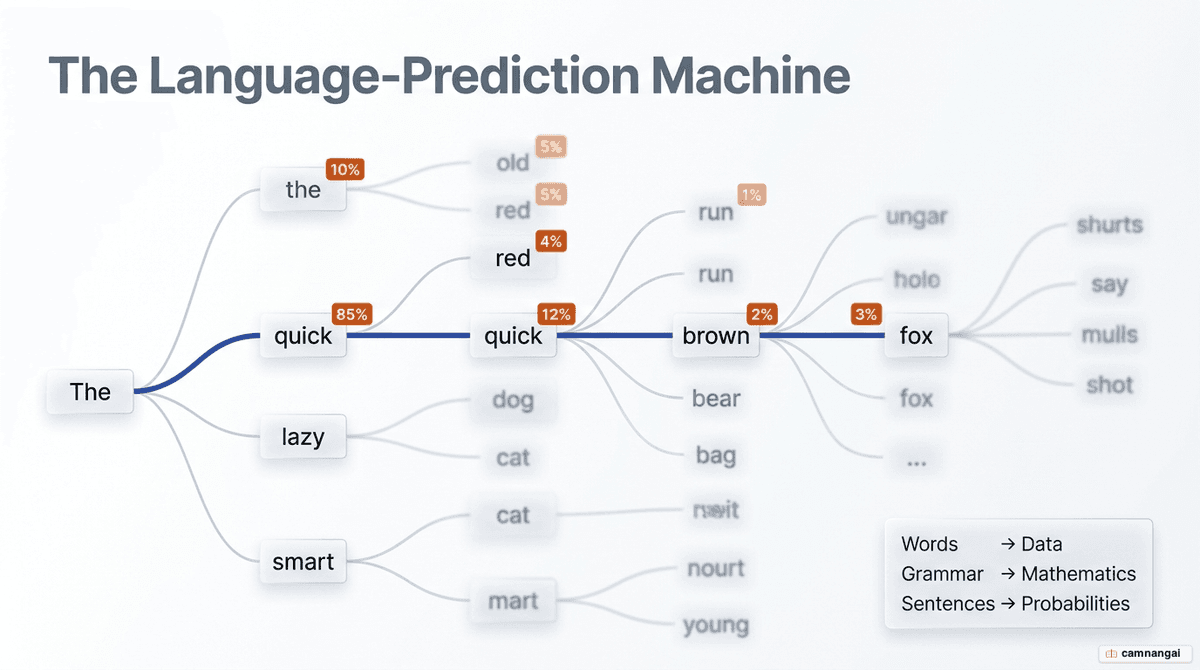
Under the hood, an LLM is the product of analyzing trillions of tokens to build a statistical map of its training corpus, which it then uses to complete text or generate something new. It has no consciousness and no real grasp of the world; what it does well is mimic how people use language. An LLM doesn't reason. It calculates probabilities.
What are Large Language Models, and why are they "large"?
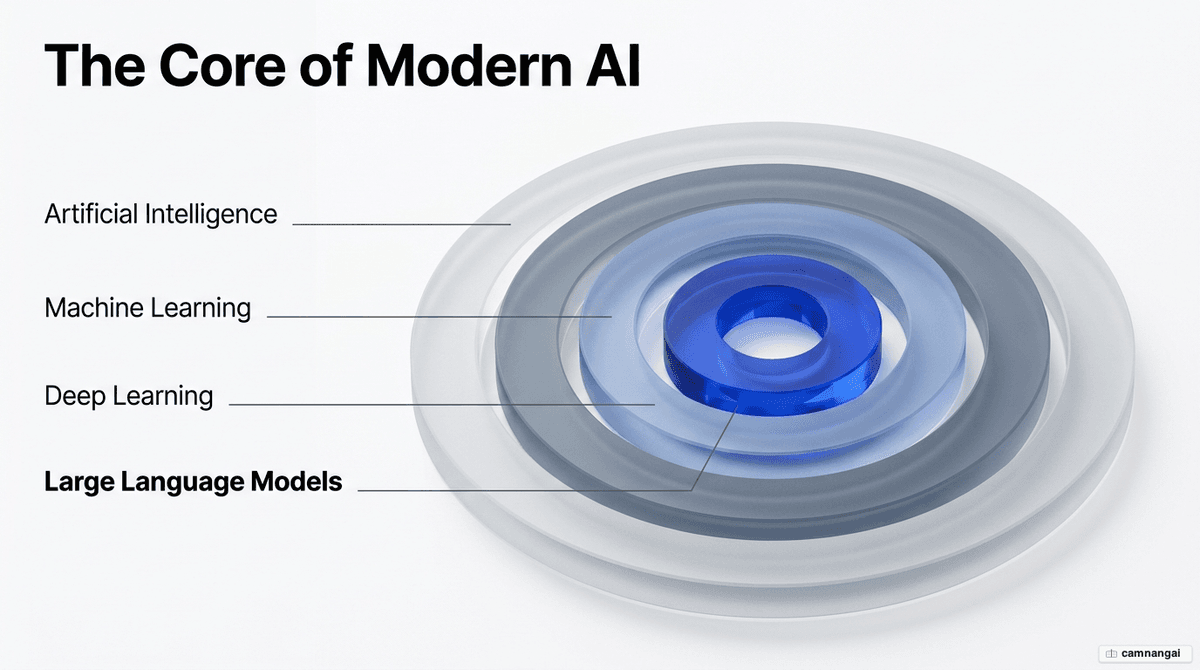
To place LLMs on the map, look at the field's nested layers: artificial intelligence → machine learning → deep learning → large language models, where each layer is a special case of the layer above it. Artificial intelligence (AI) is the broadest layer; machine learning is the branch focused on pattern recognition; deep learning uses artificial neural networks to process unstructured data; and an LLM is a deep-learning network tuned specifically for language.
The "large" comes from two numbers:
- Parameter count. These are the internal weights a model tunes as it learns. GPT-3 shipped with 175 billion parameters; Meta's Llama models typically range from 7 to 65 billion. For contrast, a simple linear regression leans on just two parameters — slope and intercept — to predict a trend.
- Data scale. "Large" is also about exposure. An LLM is like a program that has "read" most of the internet and millions of books, enough to tell a Boeing 787 from an apple — not through physical experience, but through a vast volume of linguistic description.
How do Large Language Models learn?
Machine learning is pattern recognition: a model discovering the relationship between an input and an outcome. Training is a long chain of optimization steps that drive down error.
- Loss function. This is the scoring system that measures the model's failure — a high loss means poor performance, and the goal of training is to minimize it. A good loss function must be specific, fast to compute, and smooth. Raw accuracy is a poor one because it behaves like a staircase — you either predict the token or you don't — so it never hints at how much to adjust. LLMs instead optimize cross-entropy loss, which gives a smooth, continuous gradient toward the right answer.
- Stochastic gradient descent. This algorithm finds the "downhill" direction of the error landscape. Picture a ball rolling through fog, able to see only the slope right beneath it to choose its next step. Rather than digesting the whole dataset at once, it processes small random batches, which makes training feasible at enormous scale.
- Greedy by nature. The algorithm only ever sees the locally optimal next step, never the global picture. The paradox: across billions of parameters, that approach works surprisingly well.
Why does predicting the next token create intelligence?
An LLM's core job is next-token prediction. Given the input "The cat sat on the," the model computes a probability across thousands of tokens and picks the most likely one — say, "mat." Training works through overlapping segments: the model sees "The" to predict "cat," then "The cat" to predict "sat," and so on, reinforcing its weights on every correct guess.
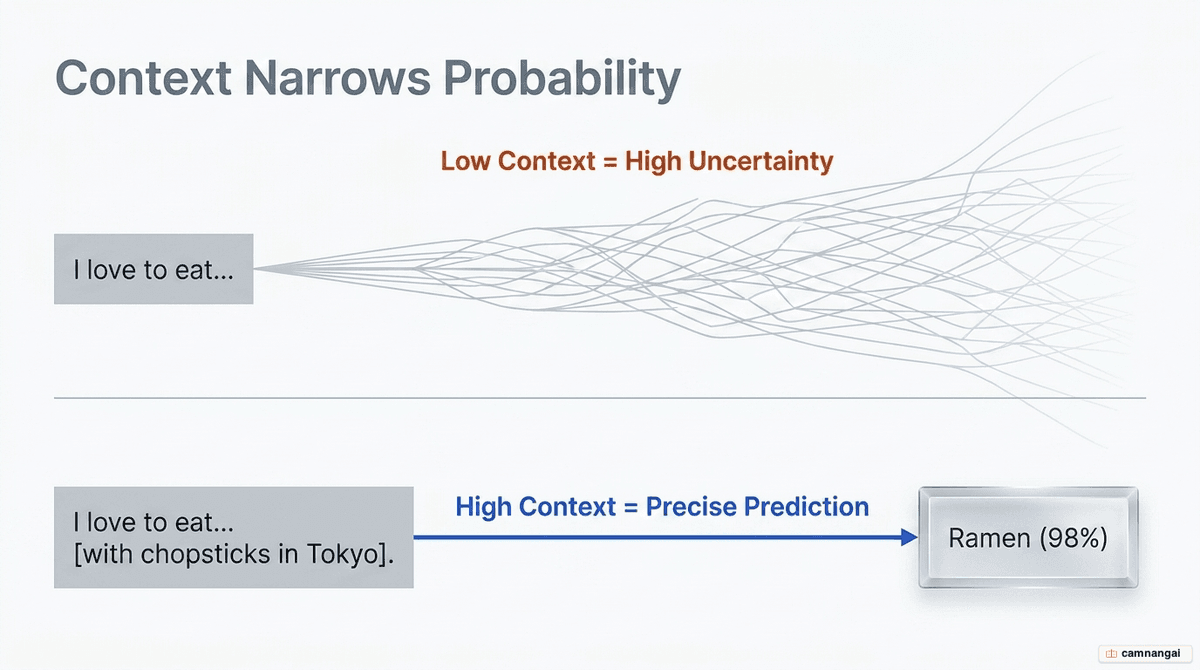
The real power is in how context narrows probability. With "I love to eat," the possibilities are nearly infinite. Add "for breakfast" and "eggs" climbs. Add "with chopsticks in Tokyo" and "ramen" or "miso soup" takes the lead. The more context you give, the more sharply the model narrows the field — which is why longer, more specific prompts tend to return more relevant output. This pattern matching at massive scale produces the illusion of intelligence, even though the model never reasons the way a person does.
What are the phases of training a large language model?
To turn a raw statistical predictor into a useful assistant like ChatGPT, the model goes through a three-stage pipeline built for alignment with human intent.
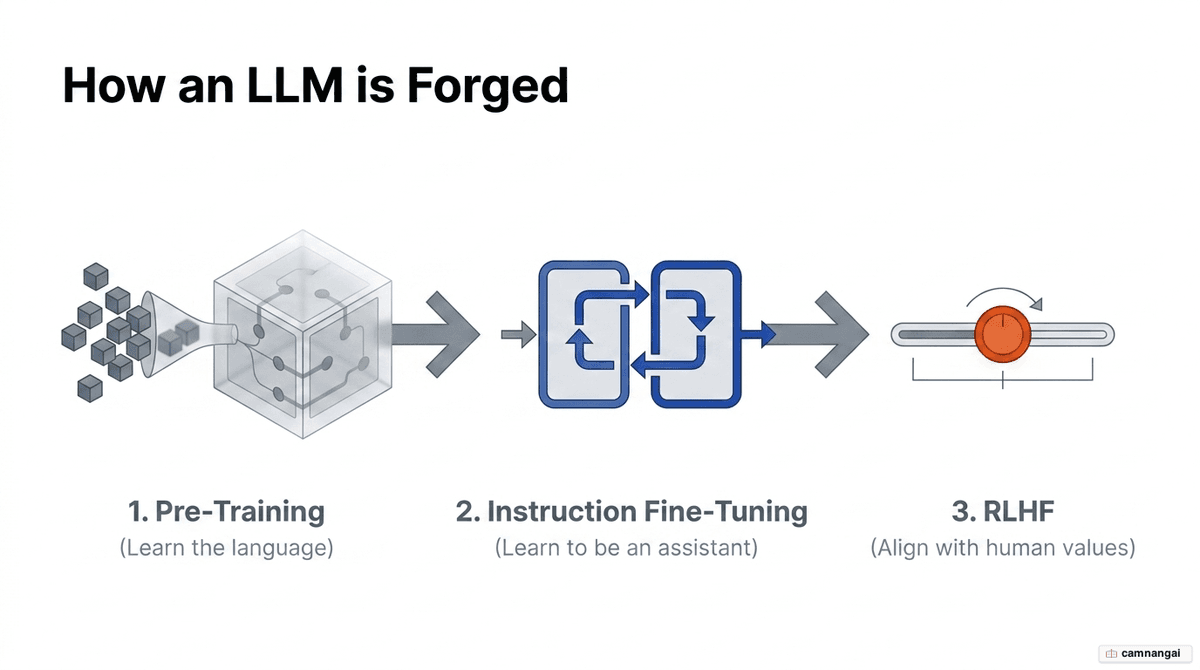
- Pre-training. The most resource-intensive phase. Through self-supervised learning on massive datasets, the model picks up grammar, syntax, and general world knowledge. At this point it is just a "text completer" that mirrors the patterns of the internet.
- Instruction fine-tuning. The model is trained further on a smaller, high-quality set of prompt–response pairs, teaching it to behave like an assistant. It learns that "What is your name?" calls for an answer, not a follow-up question.
- RLHF (reinforcement learning from human feedback). Humans rank model outputs by quality and helpfulness, and that feedback refines the parameters so the model's behavior aligns with human preferences and safety values.
What roles do Transformers and GPUs play?
Today's LLM wave is the marriage of an architectural breakthrough and a hardware leap.
- The Transformer architecture. Older networks like RNNs had to read text sequentially, one word at a time — a severe computational bottleneck. The Transformer removed that sequential dependency, processing an entire block of text in parallel.
- The attention mechanism. This is the heart of the Transformer: it weighs how relevant each word is to the others, regardless of how far apart they sit. That lets the model tell "bow" the gesture in "the singer took a bow" from "bow" the weapon in "a bow for target practice," using only the surrounding words.
- GPUs. Originally built to render pixels, graphics processing units turn out to excel at the parallel matrix math Transformers demand. They compress training time from decades down to weeks.
What work can Large Language Models do?
Thanks to their command of language, LLMs now show up across industries:
- Creation and code. Drafting and summarizing text, plus writing software — developers use platforms like Replicate to integrate models such as Llama 3 for code generation and debugging.
- Customer service. Smart chatbots and virtual assistants that respond in real time.
- Healthcare and research. Summarizing patient records, sifting thousands of papers for trends, and assisting diagnosis from historical data.
- Education. Personalizing learning paths and answering questions across disciplines.
Why do Large Language Models still get things wrong?
A clear-eyed user has to confront an LLM's built-in limits. The crucial point: pattern matching is not reasoning.
- Hallucination. The model is optimized to produce the most probable text, not the most truthful. It has no internal fact-checker, so it can invent figures or nonexistent citations in a strikingly confident tone — precisely because it learned that confident tone from its training data.
- Matching, not reasoning. Models often fail logic puzzles when the constraints shift slightly from the version in their training data. Alter the rules of the classic river-crossing puzzle and the model may still return the standard solution — it is matching the pattern of the famous riddle rather than reasoning over the new constraints.
- Bias. The model absorbs the skewed views baked into internet-scale data.
- Cost and the black box. Training demands enormous energy and expensive GPU infrastructure, and it is genuinely hard to explain why a network with billions of parameters made any specific decision.
How do you use Large Language Models more effectively?
Prompt engineering is how you steer a model's output without retraining it.
- Zero-shot and few-shot prompting. An LLM can perform a new task with no examples at all; supplying a few sample pairs helps it mimic the exact format you want. Ask it to translate "Die Katze schläft gerne in der Box" using only words that start with "F" and you get playful output like "Feline friend finds fluffy fortress."
- Chain-of-thought. Telling the model to "think step by step" forces it to generate intermediate steps as working memory, which lets it solve multi-layered problems — like working out who won the World Cup the year before Lionel Messi was born.
- Grounding. Inject specific documents into the prompt and require the model to answer only from them. This technique — usually implemented as RAG (retrieval-augmented generation) — is the most effective way past the knowledge cut-off and the surest way to cut hallucination.
Where do you start?
An LLM is one link in a chain of foundational concepts. A few related articles unpack each layer:
- What is artificial intelligence? — the broadest layer, containing everything below.
- What is machine learning? — how machines learn from data instead of hard-coded rules.
- What is deep learning? — the multi-layer neural networks that power LLMs.
- What is generative AI? — the layer dedicated to creating new content.
- What is an AI token? — the unit every language model reads and writes.
- What is natural language processing? — the field behind machines understanding human language.
FAQ
Why do LLMs state false information so confidently? An LLM is trained to match the statistical patterns of human language. Because so much of that data is written in a confident tone, the model learns to mimic that authority. It is optimized for probable word sequences, not for fact-checking or logical verification.
What is a "prompt" in the context of AI? A prompt is the text instruction or query you give the model. It is the starting point and context that guides the network toward a specific output, such as summarizing a document or translating a passage.
Can LLMs learn new information after training ends? Standard LLMs have a cut-off date and know nothing about events after their training ended. They can be grounded in new information, though, by feeding up-to-date context or search results directly into the prompt.
What is the "attention" mechanism in a Transformer? Attention lets the model process an entire input at once and weigh the importance of words relative to one another. That is how it resolves ambiguity — deciding whether "bow" means a weapon or a gesture based on the surrounding words.