Machine learning is a branch of artificial intelligence that lets computers learn patterns from data to make decisions without explicit programming.
Instead of following deterministic code, these systems use statistical algorithms to interpret historical information and improve their performance through experience. By identifying complex structures in their training data, machine learning models generalize those patterns to make accurate predictions on new, unseen inputs.
This shift from rigid "if–then" logic to probabilistic modeling lets engineers build systems that adapt as the data changes. From recommending products to diagnosing medical conditions, the core job of these models is the same: turn raw data into usable insight through automated pattern recognition. The machine is not handed the answer — it learns the answer from data.
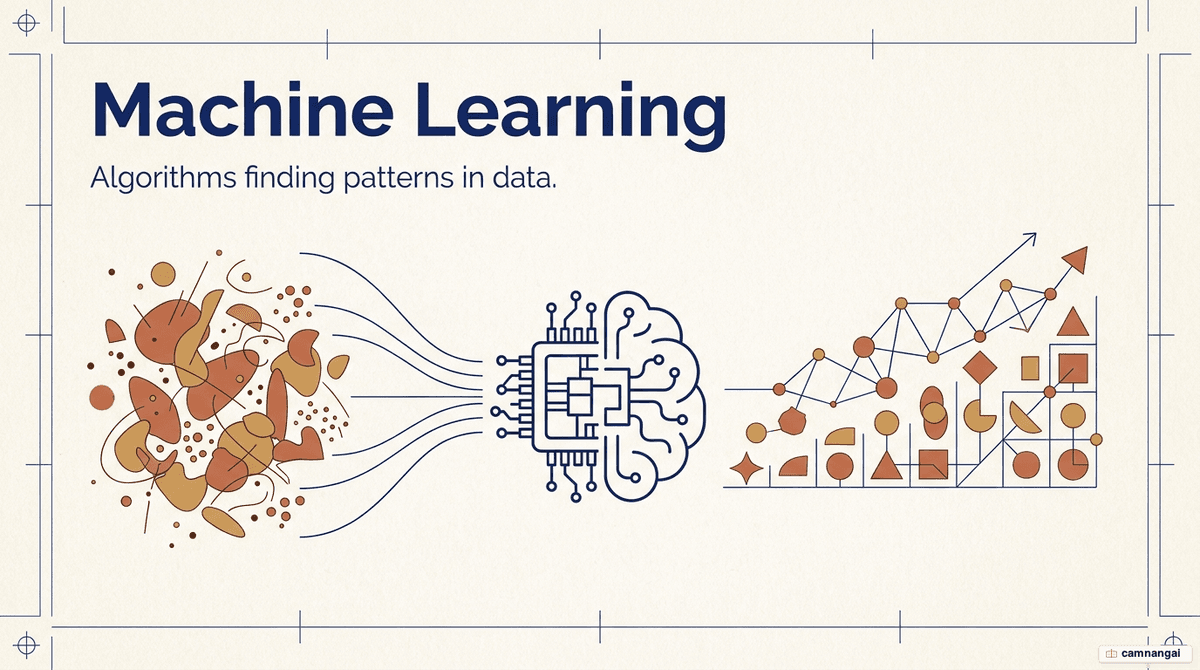
What is the origin and core function of machine learning?
The rise of machine learning marks a strategic move from deterministic programming to probabilistic data modeling. In traditional software, a computer follows explicit, pre-defined instructions; machine learning instead builds algorithms that learn and predict on their own. Arthur Samuel — who built a pioneering checkers-playing program — formally defined the field in 1959 as the study that gives computers the ability to learn without being explicitly programmed.
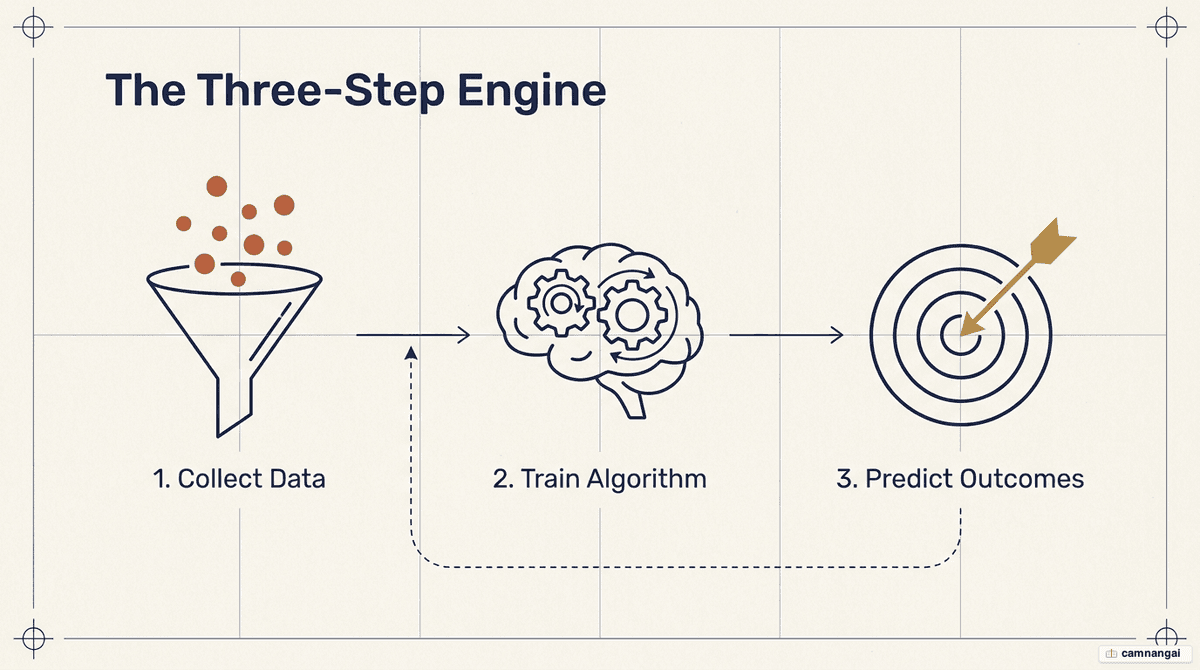
The mechanism relies on training data to build a mathematical model of the world. A useful analogy is a student and a teacher: the labeled data is the teacher, handing the student (the model) the correct answers during training. By working through these examples, the student learns the underlying patterns and eventually becomes capable of solving similar, unseen problems on its own. That learning process splits into distinct approaches based on the nature of the data and the desired output.
What are the primary types of machine learning?
Choosing the right learning approach is the most important architectural decision in any machine learning project — it dictates both the data you need and the math you use. The choice is driven mainly by one data constraint: whether ground-truth labels are available.
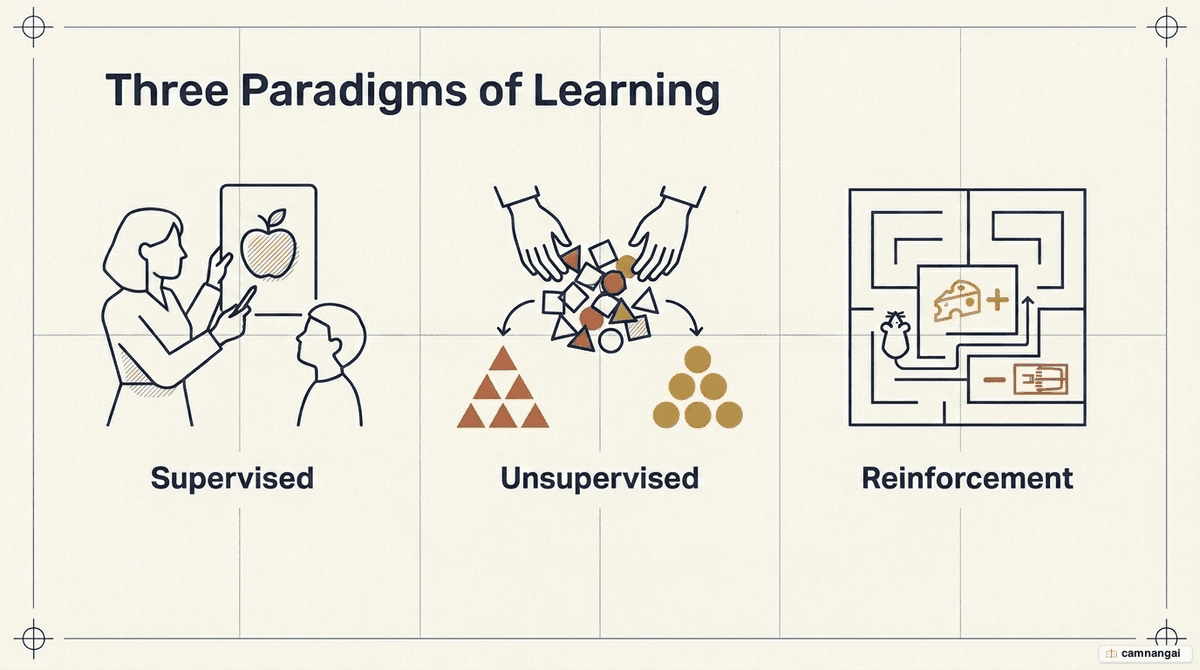
- Supervised learning. The most common paradigm. Models train on labeled datasets where the engineer supplies both input features (X) and the matching output labels (Y), so the model learns the mapping between them. House-price prediction is a standard example: the model uses historical sales to value new listings.
- Unsupervised learning. The algorithm works with unlabeled data to discover structure on its own — finding hidden patterns or groupings, such as clustering fruit by visual similarity without knowing the names in advance.
- Reinforcement learning. An agent learns by trial and error inside a defined environment, earning rewards for good actions and penalties for bad ones, and refining its strategy to maximize total reward — much like a game-playing agent learning a winning path.
These broad methods are implemented through specific models, starting with the split between continuous and categorical predictions.
How do regression and classification algorithms differ?
Supervised tasks split by the nature of the target variable: regression predicts continuous numbers, while classification predicts discrete categories. From an engineering standpoint, that choice sets both the loss function and the estimation technique used to fit the model.
Linear regression models the relationship between independent features — house size, number of rooms — and a continuous dependent variable. Parameters are typically estimated with Ordinary Least Squares (OLS), a distance-minimizing technique that finds the coefficients minimizing the Mean Squared Error (MSE), effectively fitting a straight line through the points.
Classification instead predicts class labels. Logistic Regression and Linear Discriminant Analysis (LDA) are the primary tools for binary and multi-class tasks. Unlike distance-based OLS, Logistic Regression uses Maximum Likelihood Estimation (MLE) — a probabilistic approach that finds the parameters making the observed data most probable under the assumed model. For binary classification, a 0.5 cut-off is standard: probabilities above the threshold map to the positive class. These linear models are foundational, but they often suffer from high variance, which is where ensemble methods come in.
How do decision trees and ensemble methods improve accuracy?
Moving from high-variance single models to stable ensembles is what unlocks production-grade accuracy. Decision trees are the building blocks. They use a greedy method called recursive binary splitting to carve the predictor space into smaller regions — greedy because it picks the best split at each step rather than planning ahead. Stopping criteria like a maximum depth keep the tree from overfitting.
Ensembles improve on single trees by aggregating many of them:
- Bagging and Random Forest. Bagging (bootstrap aggregation) samples the data with replacement to train many trees and average their output. Random Forest goes further by decorrelating the trees: forcing each split to consider only a random subset of features (
m ≈ √p) stops a single dominant predictor from making every tree look alike, which is what actually drives the variance reduction. - Boosting. A sequential process that turns weak learners into strong ones. AdaBoost uses decision stumps (one-split trees) and weights earlier errors more heavily. Gradient Boosting (GBM) fits each new tree to the pseudo-residuals of the previous iteration to minimize the loss. XGBoost refines this further with second-order derivatives, giving a more precise direction for gradient minimization.
How does gradient descent optimize model performance?
Optimization is the engine that minimizes error in any machine learning model — without an efficient optimization routine, a model cannot learn from its cost function.
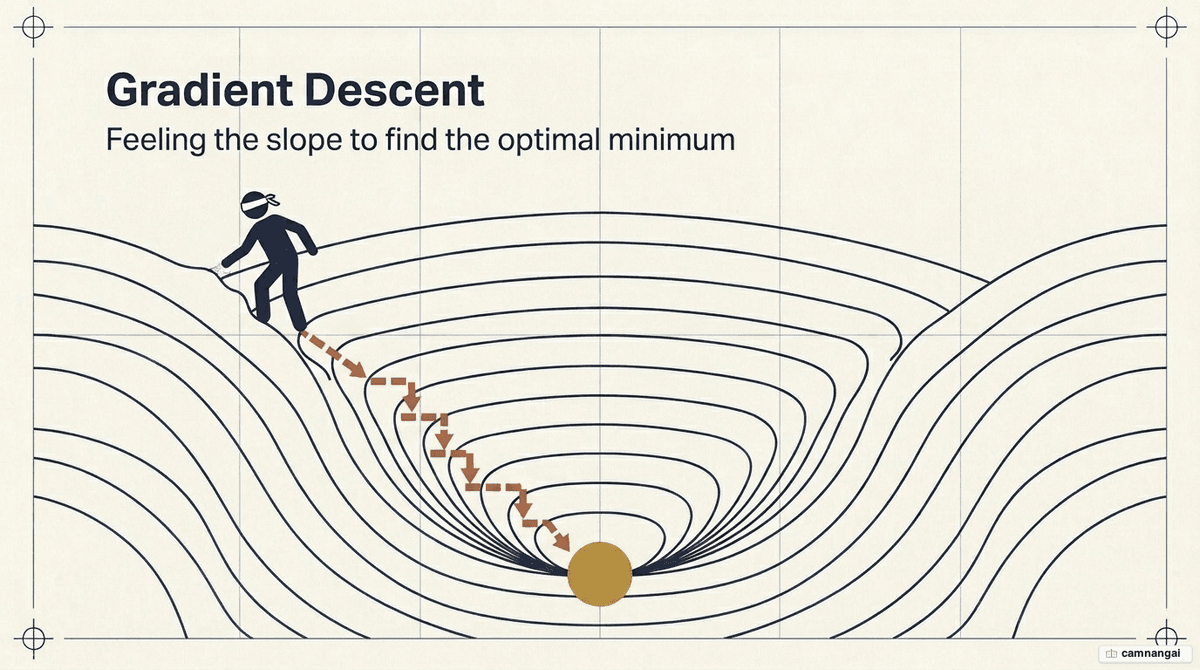
Gradient descent is the main iterative algorithm for updating model parameters (θ). The blindfolded mountain climber captures it well: feel the slope of the ground (the gradient), then step in the direction where it drops. Parameters update with a learning rate (η): θ_next = θ − η·∇J(θ).
The learning rate is a critical hyperparameter. Too large, and the algorithm overshoots the minimum and fails to converge; too small, and convergence is painfully slow. For large datasets, engineers use Stochastic Gradient Descent (SGD), which updates parameters from a single random sample for speed. More advanced optimizers like Adam combine momentum with adaptive learning rates, tuning the step size for each parameter from the mean and variance of past gradients.
What are the limitations and trade-offs of these models?
Reliable deployment depends on understanding where these models break. Linear regression, for one, assumes a linear relationship that rarely holds in messy real-world data, and it is highly sensitive to outliers. It also hits the curse of dimensionality: when the number of features (p) exceeds the number of observations (n), the model picks up noise and overfits.
A senior engineer is always managing the bias–variance trade-off. Overfitting happens when a model learns noise instead of signal. Regularization counters it by penalizing large coefficients:
- Ridge (L2). Shrinks coefficients toward zero to cut variance, keeping every feature in the model.
- Lasso (L1). Can drive coefficients to exactly zero, performing automatic feature selection by dropping uninformative variables.
Optimization methods like gradient descent are also sensitive to feature scale, so Min–Max normalization or standardization keeps large-magnitude features from dominating the learning. Tree-based models, by contrast, are naturally invariant to scaling because they rely on split points rather than distance calculations.
FAQ
What is the difference between Lasso and Ridge regression? Ridge (L2) shrinks coefficients toward zero to reduce variance, while Lasso (L1) can force them to exactly zero — effectively selecting features by dropping the unimportant ones.
Why is data split into training and test sets? The training set teaches the model the patterns; the test set measures how well it generalizes to new, unseen data, which is how you catch overfitting.
When is feature scaling unnecessary? Tree-based models like decision trees and random forests don't need it, because they split on data points rather than distance-based calculations.
What is the OOB error in bagging? Out-of-bag error is estimated from the roughly one-third of data points left out of a given bootstrap sample, giving a built-in test-error rate.