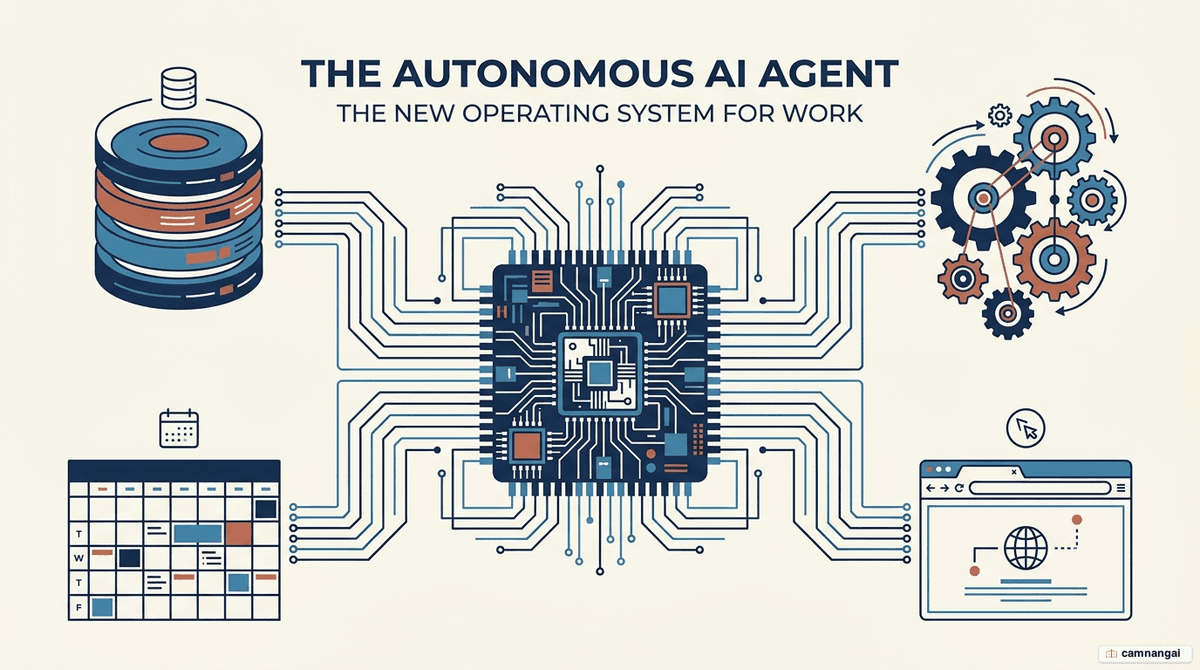
An AI agent is an autonomous software system that uses a Large Language Model (LLM) as its reasoning engine to perceive its environment, make decisions, and use tools to achieve a specific goal.
Unlike traditional AI models that respond to a single prompt and stop, an AI agent operates in a continuous loop. It can break down a high-level objective into smaller, actionable sub-tasks and execute them independently until the desired outcome is reached.
This is a fundamental shift from software as a tool to software as a worker. While a standard LLM is passive — waiting for a human to provide input and then generating an output — an AI agent is proactive. It does not just suggest an approach; it executes the work. By integrating with APIs, databases, and web browsers, agents can interact with the physical and digital world to complete complex workflows that previously required constant human supervision.
In an engineering context, agents solve "control problems." While a standard workflow follows a deterministic, predefined path, an agent must determine its own path. It observes the results of its actions and adjusts its strategy in real-time, effectively automating the "long tail" of tasks that were previously too complex or variable for traditional automation scripts.
What is an AI agent?
An AI agent is "AI with agency." While standard AI interactions are "one-shot" — meaning the user provides a prompt and the model provides a static response — an agent is goal-directed. When given a high-level instruction such as "organize a travel itinerary," an agent does not just list ideas; it identifies the necessary tools, searches for real-time data, and iterates on its plan until the goal is satisfied.
The defining characteristic of an agent is its ability to operate independently of human intervention. It perceives its environment through data streams or sensors, reasons about the current state using an LLM, and acts using available resources. This transition from "passive" to "active" allows agents to handle complex, multi-step workflows. An agent can self-correct; if it encounters an error during a sub-task, it analyzes the failure and attempts a different logical path to reach the objective.
AI agents vs. AI assistants vs. chatbots
The industry often uses these terms interchangeably, but they represent distinct levels of autonomy and technical complexity. The primary difference lies in how they handle "control logic."
| Entity | Purpose | Autonomy | Capabilities |
|---|---|---|---|
| Chatbot | Automate simple conversations | Low (rule-based) | Follows predefined scripts; no memory or tool access |
| AI assistant | Collaborate with users on tasks | Medium (reactive) | Responds to requests; recommends actions; requires human oversight |
| AI agent | Perform tasks autonomously | High (proactive) | Handles complex multi-step workflows; independent decision-making |
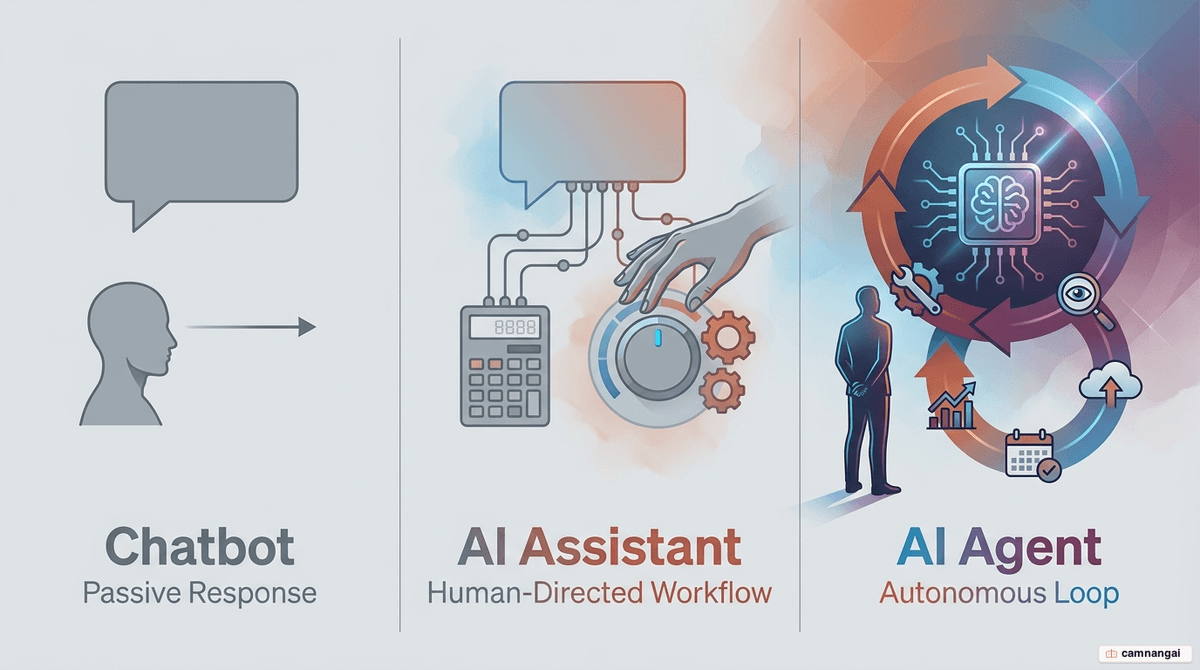
Technical distinction: workflows solve process problems where the path is deterministic and predictable. Agents solve control problems where the system must figure out the path on its own, using an iterative loop rather than a linear script.
What are the components of an AI agent?
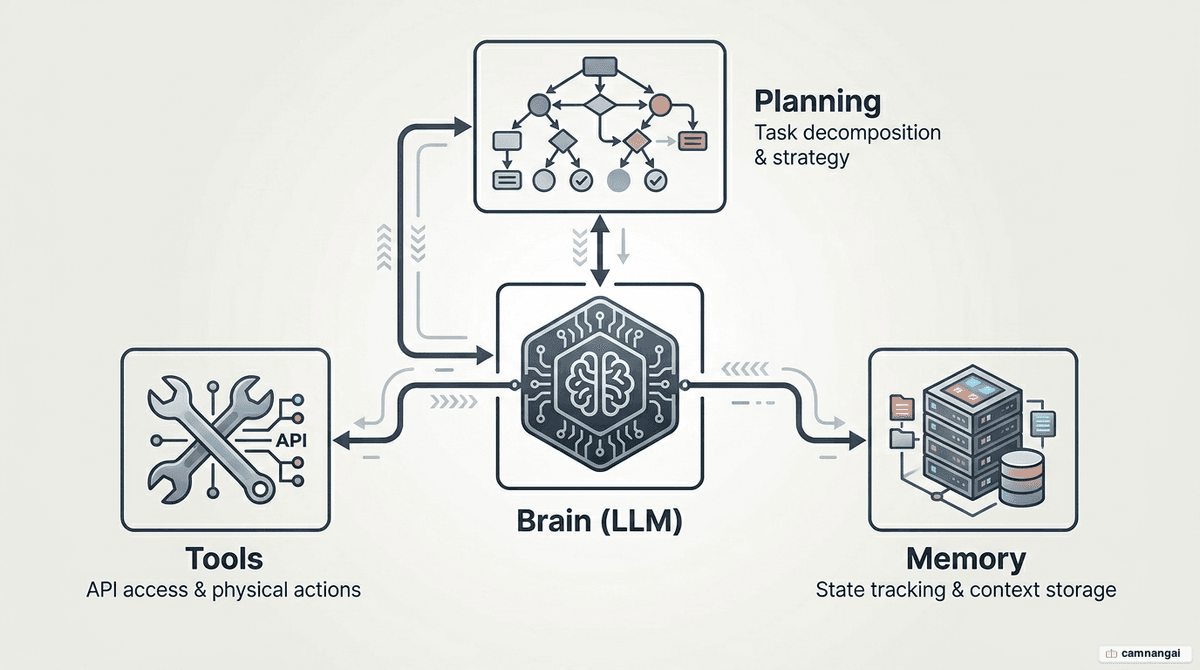
A functional AI agent relies on four primary architectural pillars that allow it to reason and interact with its environment.
Brain (foundation model)
The foundation model, typically an LLM like GPT-4o or Claude 3.5 Sonnet, serves as the reasoning engine. It processes natural language instructions, generates plans, and decides which tools to invoke. It acts as the orchestrator that comprehends the goal and determines the logic required to reach it.
Planning
The planning module allows the agent to perform task decomposition. It breaks down a high-level goal into a sequence of sub-tasks using symbolic reasoning or algorithmic strategies like decision trees. This component ensures the agent can operate over long time horizons by considering dependencies and contingencies.
Memory
Memory provides the agent with context and continuity:
- Short-term memory: often called "working memory," this includes the immediate chat history and the current state of the plan.
- Long-term memory: this uses vector databases or knowledge graphs to store and retrieve historical data, past interactions, and specialized domain knowledge.
Tools (action)
Tools are the mechanisms by which an agent interacts with the world. This includes integration with external APIs, web browsers, and code execution environments. The agent identifies when a task requires a tool, formats the call, and processes the returned data.
How does an AI agent work?
An AI agent operates through a continuous, iterative cycle often described as a "loop." The standard sequence follows these stages:
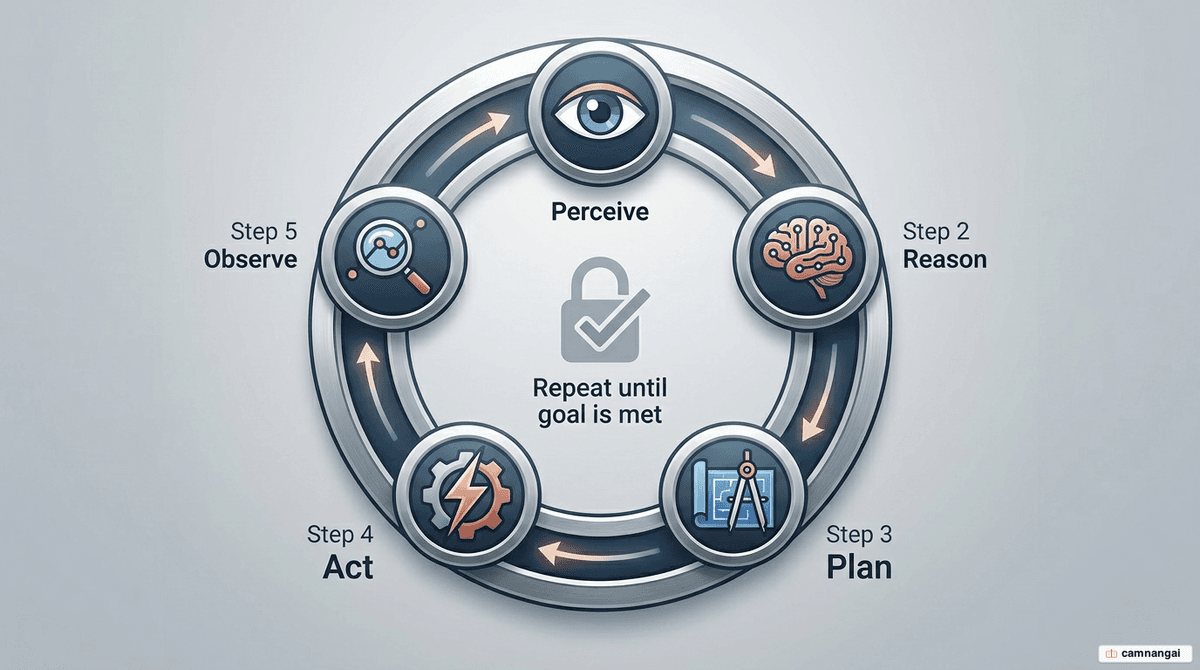
- Perceive / observe: the agent gathers information from its environment, including user goals, data from tools, or current state schemas.
- Reason / think: the LLM analyzes the observed data to determine its current progress toward the objective.
- Plan: the agent identifies the next logical step or sub-task required. It may decide to use a specific tool or ask the user for clarification.
- Act: the agent executes the chosen action, such as running a search query or calling an API.
- Learn / reflect: after receiving the output of its action, the agent evaluates the result. It observes whether the interim result is successful and decides if further iterations are needed.
This loop continues until the agent determines the goal has been achieved or it reaches a predefined "stop" condition, such as a budget limit or a maximum number of steps.
What types of AI agents are there?
AI agents are categorized based on their complexity and environmental awareness:
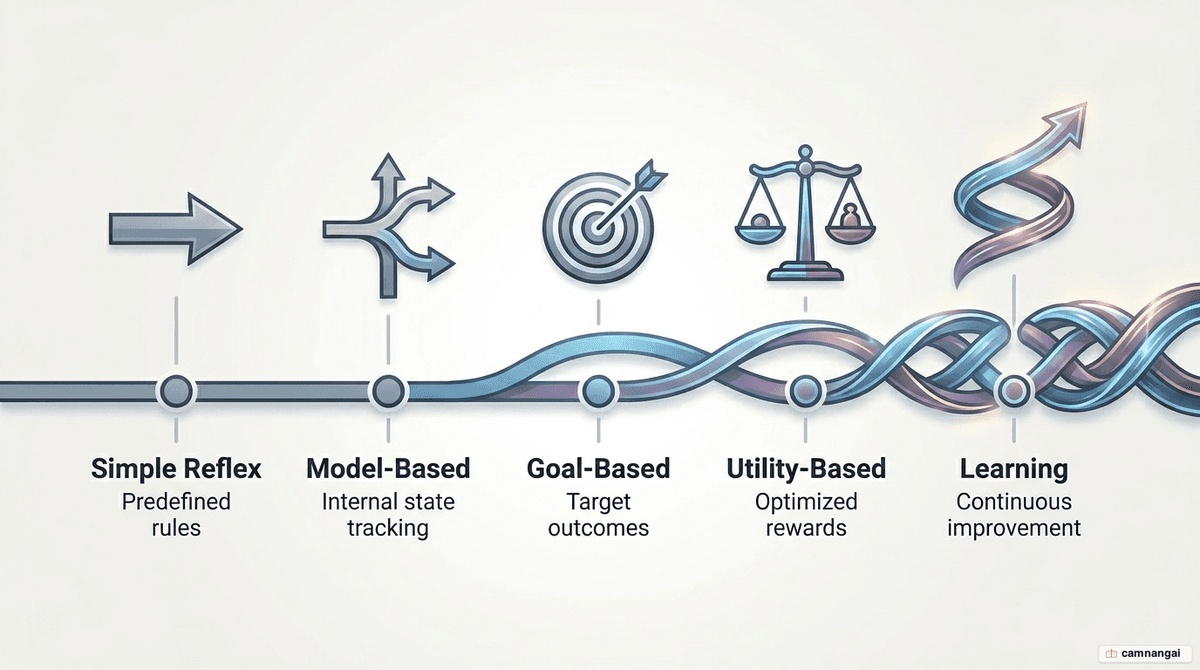
- Simple reflex agents: these act solely on the current perception using predefined "if-then" rules. They are only effective in fully observable environments and have no memory.
- Model-based reflex agents: these use memory to maintain an internal model of the world, allowing them to track the state of their environment even if parts of it are not currently visible.
- Goal-based agents: these use reasoning to select action sequences specifically to achieve a desired outcome, prioritizing the goal over simple rule-following.
- Utility-based agents: these maximize a "utility function" to choose the most efficient or high-value path, measuring success through metrics like time or cost.
- Learning agents: these autonomously improve performance over time through four elements: the learning element (improvements), the critic (feedback against standards), the performance element (action selection), and the problem generator (creating new training tasks).
Common AI agent architectures and protocols
To build reliable systems, engineers use specific frameworks and communication standards:
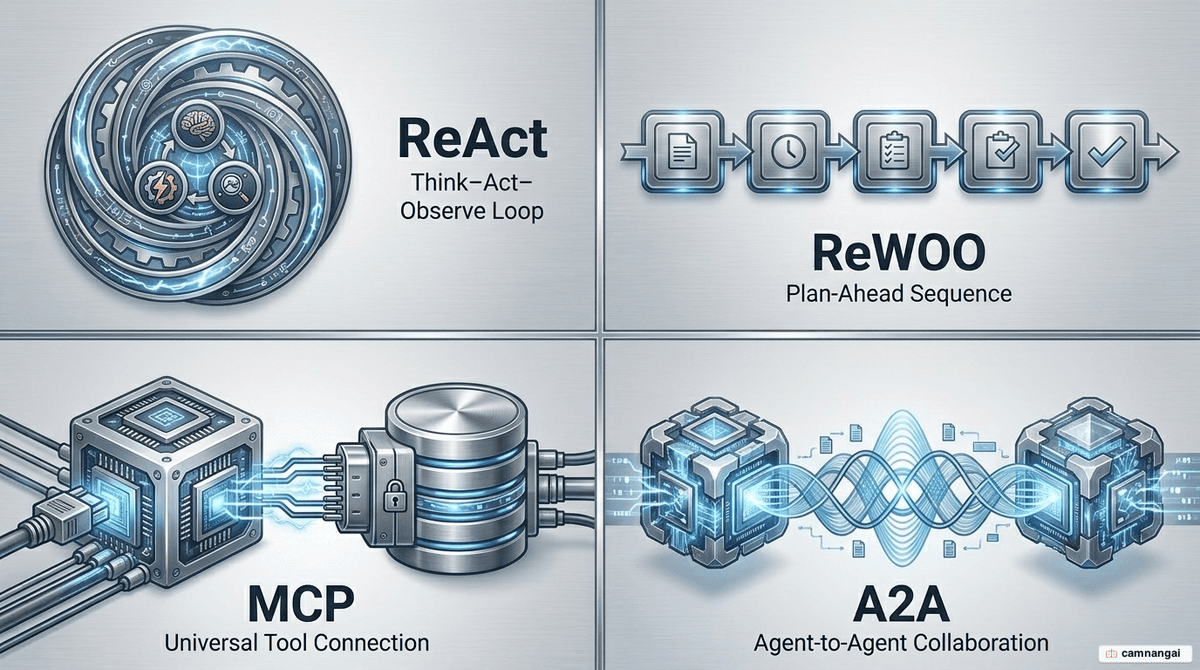
- ReAct (reasoning and acting): a pattern where the agent alternates between verbal reasoning ("Thought") and execution ("Action") to update its context iteratively.
- ReWOO (reasoning without observation): a method where the agent plans the entire workflow upfront. This is preferred for reducing token usage, computational complexity, and latency by decoupling reasoning from observation.
- Interoperability protocols:
- Model Context Protocol (MCP): an open standard for connecting AI models to tools and data sources (the "USB-C for AI").
- Agent2Agent (A2A): a protocol allowing agents from different vendors to securely communicate and coordinate.
- Multi-agent systems (MAS): architectures where specialized "crews" or "swarms" of agents work together, often using hierarchical or collaborative structures.
What can AI agents do in practice?
AI agents are being deployed across various industries to handle complex, multi-step tasks:
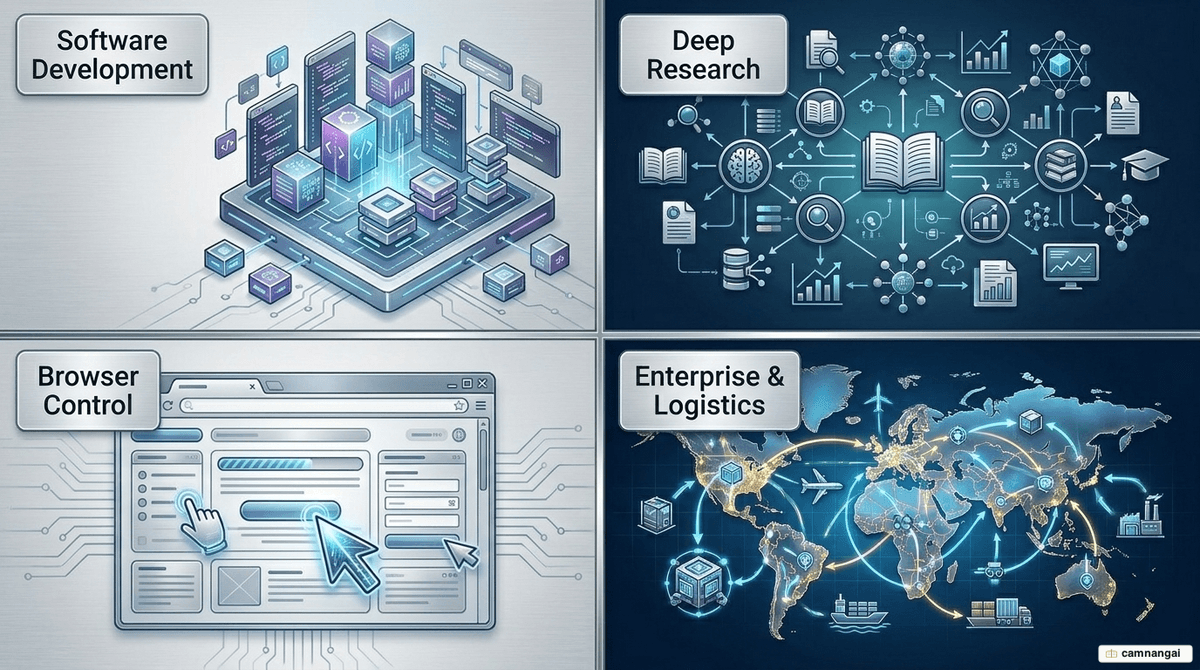
- Software development: agents act as "AI teammates" performing automated code reviews, fixing bugs in CI/CD pipelines, and detecting security vulnerabilities.
- Customer experience: beyond basic chat, agents can autonomously resolve account issues, verify transactions, and provide personalized travel planning by cross-referencing weather, budget, and real-time flight data.
- Supply chain: agents optimize delivery routes in real-time, manage autonomous warehouse robots, and predict maintenance needs based on equipment sensors.
- Research: "deep research" agents navigate multiple websites, cross-reference conflicting data points, and synthesize comprehensive reports without human guidance.
Limitations, risks, and using AI agents safely
Deploying AI agents in production requires a realistic assessment of risks:
- Operational risks: agents can fall into "infinite feedback loops," repeatedly calling the same tool without progress, leading to runaway API costs.
- Security: agents are vulnerable to "prompt injection," where malicious inputs trick the agent into using its tools for unauthorized actions.
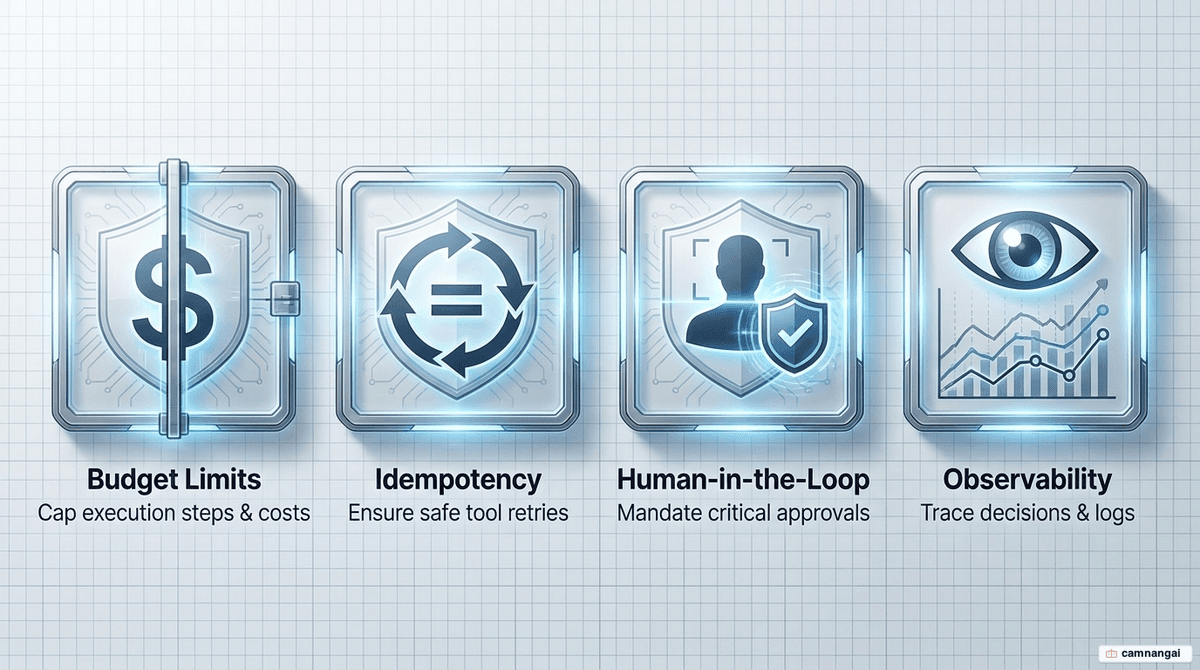
- Safety guardrails: an agent without a budget is a production liability. Engineers must implement budgets, including
max_steps(iteration limits), cost timeouts, and mandatory human-in-the-loop (HITL) checkpoints for high-stakes decisions. - Reliability: because LLMs are non-deterministic, developers must use schema validation (like Pydantic) to ensure inputs and outputs remain structured and valid.
How do you start building an AI agent?
To move from a prototype to a production-ready agent, engineers use frameworks like LangChain, crewAI, or Pydantic-AI. These tools provide structure for memory, state management, and tool validation.
Using pydantic-ai ensures the agent returns structured data rather than free text, which is the core "agentic" engineering pattern for reliability:
from pydantic import BaseModel, Field
from pydantic_ai import Agent, RunContext
from dataclasses import dataclass

# 1. Define the Structured Output (Schema)
class TripItinerary(BaseModel):
    destination: str
    daily_activities: list[str]
    total_cost: float = Field(ge=0)

# 2. Define the Structured State (Memory)
@dataclass
class AgentDeps:
    budget_limit: float

# 3. Define the Agent with Guardrails
travel_agent = Agent(
    'google-gla:gemini-1.5-flash',
    result_type=TripItinerary,
    deps_type=AgentDeps,
    retries=2  # Limit retries for safety
)

# 4. Define a Validated Tool
@travel_agent.tool
async def get_weather(ctx: RunContext[AgentDeps], city: str) -> str:
    """Fetch real-time weather data for a city."""
    # Logic to call weather API via ctx.deps (dependency injection)
    return f"The weather in {city} is sunny."

# result = await travel_agent.run("Plan a trip to Kyoto", deps=AgentDeps(budget_limit=2000))
Minimum viable agent (MVA) checklist:
- State schema: is memory separate from the chat history?
- Stop conditions: are there hard limits on
max_stepsand costs? - Validated tools: are all API arguments checked against a schema?
- Idempotency: can tools be retried without causing duplicate actions?
- Observability: is every decision and tool call logged for debugging?
FAQ
Is ChatGPT an AI agent? No. ChatGPT is primarily a conversational assistant. While it can use tools like a browser, it is typically reactive and requires human prompts for each step. An AI agent is proactive and autonomous.
What is the difference between a workflow and an agent? A workflow is a series of deterministic, predefined steps (a process problem). An AI agent is a loop that decides its own steps to achieve a goal (a control problem).
Do AI agents learn? Agents adapt and "learn" within a specific session by storing interactions in their memory. However, they do not automatically retrain their underlying foundation models based on these experiences.
References
- What Are AI Agents? — IBM
- What Are AI Agents? Definition, Examples, and Types — Google Cloud
- What Are AI Agents? — AWS
- What Are AI Agents? — GitHub
- The Agentic AI Handbook — freeCodeCamp
- What Are AI Agents? Why Do They Matter? — Addy Osmani
- AI Agents in 2026: A Practical Guide
- AI Agents, Clearly Explained