An AI model is a mathematical representation or computer program trained on specific datasets to recognize patterns and make autonomous decisions.
By applying algorithms to relevant data inputs, AI models transform raw information into predictions, classifications, or generated content. Unlike traditional software that follows a rigid, hand-coded script, these models learn the underlying statistical relationships within data to handle complex tasks without explicit human intervention.
You can view the basic mechanics as a training cycle: you expose a mathematical framework to a sample dataset, and the system adjusts its internal parameters to minimize the delta between its predictions and the ground truth. Once training is complete, the resulting model acts as a decision engine — it processes new, unseen inputs and generates high-probability outputs based on the logic it learned.
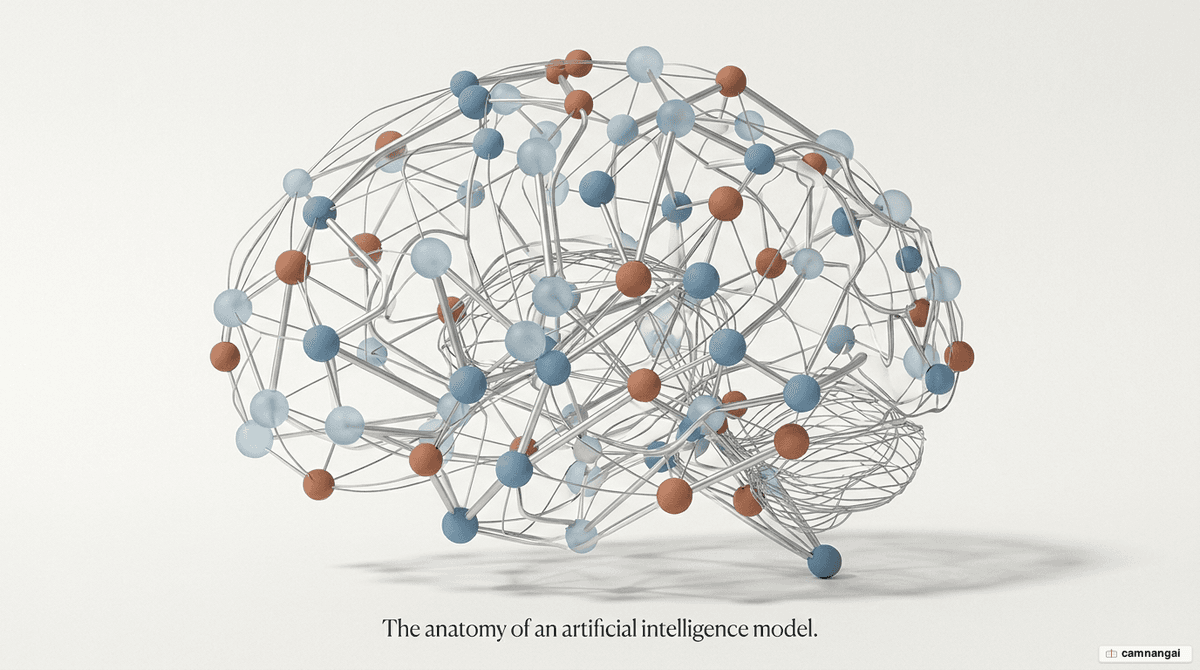
What is an AI model?
From a systems-engineering perspective, an AI model is the trained artifact that results from an algorithm being applied to a dataset. The algorithm is the procedural math (for example, a neural-network architecture); the model is the final, weights-heavy system you run in production. These systems are loosely inspired by biological neural structures, but they operate as rigorous mathematical engines. To grasp the scale, architectures like GPT-3 and BLOOM use over 175 billion parameters to turn inputs into objective assessments.
The checkers and chess programs of the 1950s illustrate the distinction. Unlike a standard script that follows a pre-set sequence of moves, those early decision engines let a program respond dynamically to an opponent's strategy. Modern models work on the same principle, identifying subtle patterns across terabytes of data to solve non-linear problems that hand-coded logic cannot reach.
How is an AI model trained?
Building a production-ready model means following a structured lifecycle:
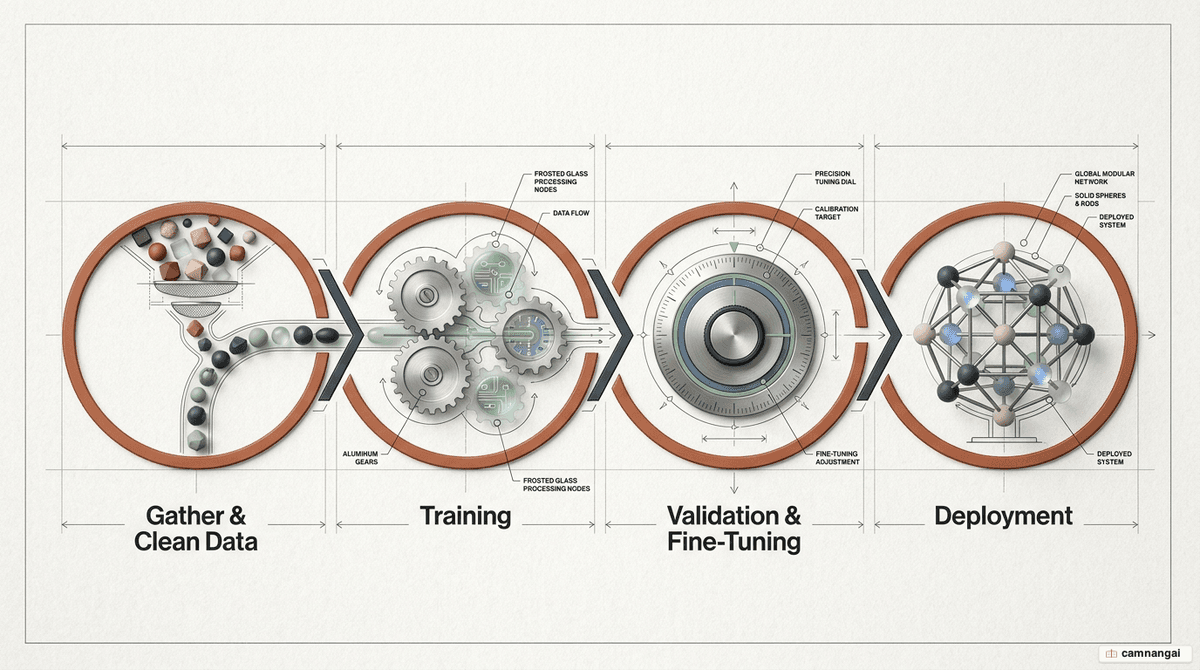
- Data phase. You gather high-quality, representative data, clean it to remove noise (irrelevant or false information), and label it for supervised tasks so the system understands the target variables.
- Training phase. You feed the prepared data into the algorithm. In deep learning, this means forward propagation to ingest data and backpropagation to calculate errors and adjust parameters, with the goal of identifying statistical correlations across the dataset.
- Validation and tuning. You test the model against a separate validation set it has never seen to confirm it generalizes, then perform hyperparameter tuning to optimize the bias–variance tradeoff.
- Deployment and monitoring. Once in production, the model becomes an operational responsibility. You monitor for model decay (performance degrading over time) and data drift (changes in input characteristics) so accuracy doesn't slip.
What are the parameters and weights inside a model?
The internal mathematical architecture is a set of adjustable components organized into hierarchical layers.
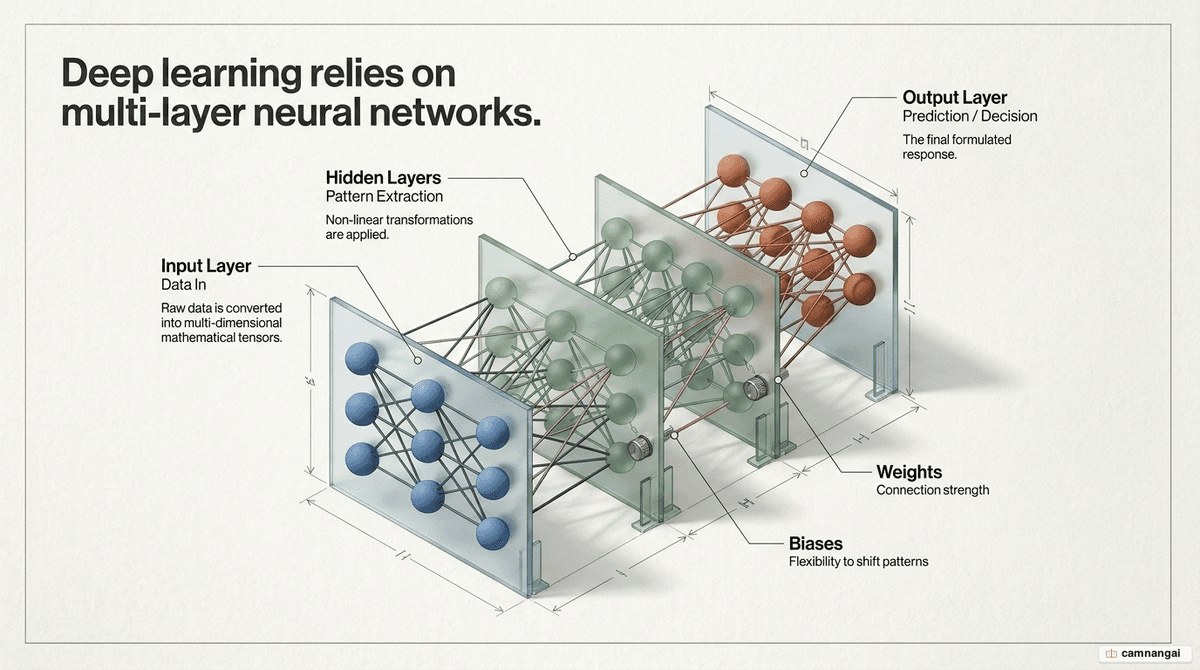
Weights and biases
Weights are the adjustable parameters that determine how much influence one neuron has on another; during training, backpropagation modifies these values to minimize error. Biases are additional values added to the weighted sum, letting the model shift its activation functions — which lets the system capture nuanced patterns even when the input signal is zero.
Layers and activation
Data flows from the input layer through multiple hidden layers, where transformations occur, and finally reaches the output layer. Activation functions (such as ReLU or sigmoid) introduce non-linearity. They are the logic gate that decides whether a given neuron fires, which is what lets the model learn complex, non-binary relationships.
Tensors
All data flowing through these layers is represented as tensors — multi-dimensional mathematical structures (vectors or matrices) that act as the primary vehicle for high-speed computation. From an engineering standpoint, tensors let the model exploit the parallel-processing power of GPUs, which is essential for training deep neural networks.
How does a model turn input into an answer?
Applying a trained model to new data to produce an output is called inference.
Embeddings
You first convert raw data (text or images) into numerical vectors called embeddings, which live in a lower-dimensional space that captures semantic meaning. A "cat" vector, for instance, captures the word's relationship to other animals. Mathematically, generative models use these to predict the joint probability P(x,y) of a data point appearing, while discriminative models focus on the conditional probability P(y|x) to classify inputs.
Tokens and context
The system processes sequences by breaking them into tokens. The context window is the limit of how much data the model can hold in active memory; some flagship models now support windows up to 2 million tokens, letting you process entire technical libraries in a single pass.
Inference
During inference, the model applies its learned weights to the new input tokens. It calculates which output has the highest probability given the patterns it identified during training, producing a prediction, a classification, or a generated response.
What types of AI models are there?
Models are categorized both by learning methodology and by functional performance tier.
Learning methods
- Supervised learning. You use labeled data to teach the model to mimic human decisions (for example, diagnostic image classification).
- Unsupervised learning. The model detects inherent patterns or clusters in unlabeled data (for example, recommendation engines).
- Reinforcement learning. You use a trial-and-error reward system to optimize behavior (for example, autonomous-vehicle navigation).
The model spectrum
An airplane analogy helps categorize models by operational capability:
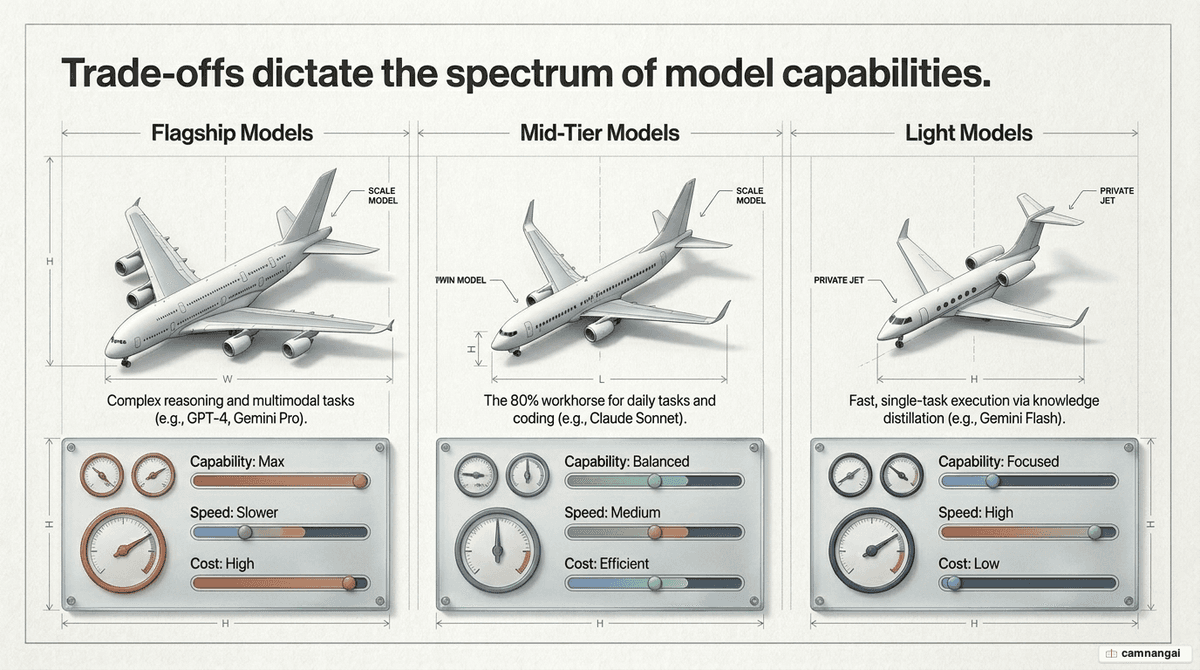
- Flagship models are the fancy commercial airliners. Systems like GPT-5.2, Claude Opus 4.6, and Gemini 3 Pro offer massive capability and multimodality. Grok 4.1 stands out in this tier for a 2-million-token window and a focus on high-EQ, empathetic responses.
- Mid-tier models are the Boeing 737s — the industry's workhorses. Claude Sonnet 4.5 is a prime example, balancing speed and reasoning to handle roughly 80% of standard enterprise tasks efficiently.
- Light models are private jets: small, nimble, and fast. Gemini 3 Flash is optimized for low cost and high speed, retaining 90–95% of the Pro model's capabilities through knowledge distillation — training the small model to copy the outputs of the larger one, so it inherits most of the behavior at a fraction of the size.
- Open-source models like Kimi K2 let you download the architecture to your own hardware, which gives you privacy for sensitive data and eliminates third-party API costs.
- Specialist models are the search-and-rescue helicopters or cargo planes. Sonar, for instance, is a specialist model built on the open-source Llama 3.3 70B architecture and optimized for research and citations.
Why isn't a bigger model always better?
In systems engineering, you respect practical constraints. A flagship model is powerful but carries high latency, large operational cost, and significant energy consumption. For a high-volume task — scanning 1,000 emails a day, say — a flagship model is an over-engineered, expensive solution.
Lighter models, the private jets, are often the better pick for fast, specific trips. And a smaller model you have fine-tuned on a task-specific dataset will frequently outperform a general-purpose giant in that domain while running at a fraction of the cost.
FAQ
What is the difference between AI, machine learning, and deep learning? Picture a castle. AI is the foundation — the science of making computers think. Machine learning is a tower on that foundation, where programs learn from data patterns. Deep learning is a specialized spire within that tower, using multi-layered neural networks to simulate complex, human-like reasoning.
What is a foundation model? These are large-scale systems, like GPT or Gemini, pre-trained on massive, diverse datasets. They serve as adaptable starting points: you can take a foundation model and modify its layers or parameters for specific applications, which sharply reduces the time and compute needed to build from scratch.
What is fine-tuning? Fine-tuning is taking a pre-trained foundation model and training it further on a smaller, specialized dataset. This adapts the model's learned weights to excel at specific tasks — legal document analysis or medical diagnostics, say — without losing its general reasoning ability.
References
- What Is an AI Model? — IBM
- What is an AI Model? — Google Cloud
- Everything About AI Models: Types, Examples, and Beyond — Vishal (Medium)
- What Is an AI Model? — Microsoft Azure
- What Are AI Models? — Databricks
- Understanding the Internal Structure of AI Models — Nestor Almeida (Medium)
- Every AI Model Explained (YouTube)