For most of its history, artificial intelligence did one job: recognition. It sorted an email as spam, mapped a pixel arrangement to the label "cat," scored a transaction as fraudulent or clean. Generative AI turns that problem around.
Generative AI is the family of deep-learning models that create new content — text, images, audio, and code — by learning the probability distribution of data rather than merely classifying it.
It studies how features combine across a massive dataset, then synthesizes entities that never existed yet still carry the statistical signature of the originals.
It spans several distinct model architectures that share one goal: modeling the structure of data instead of just reading it.
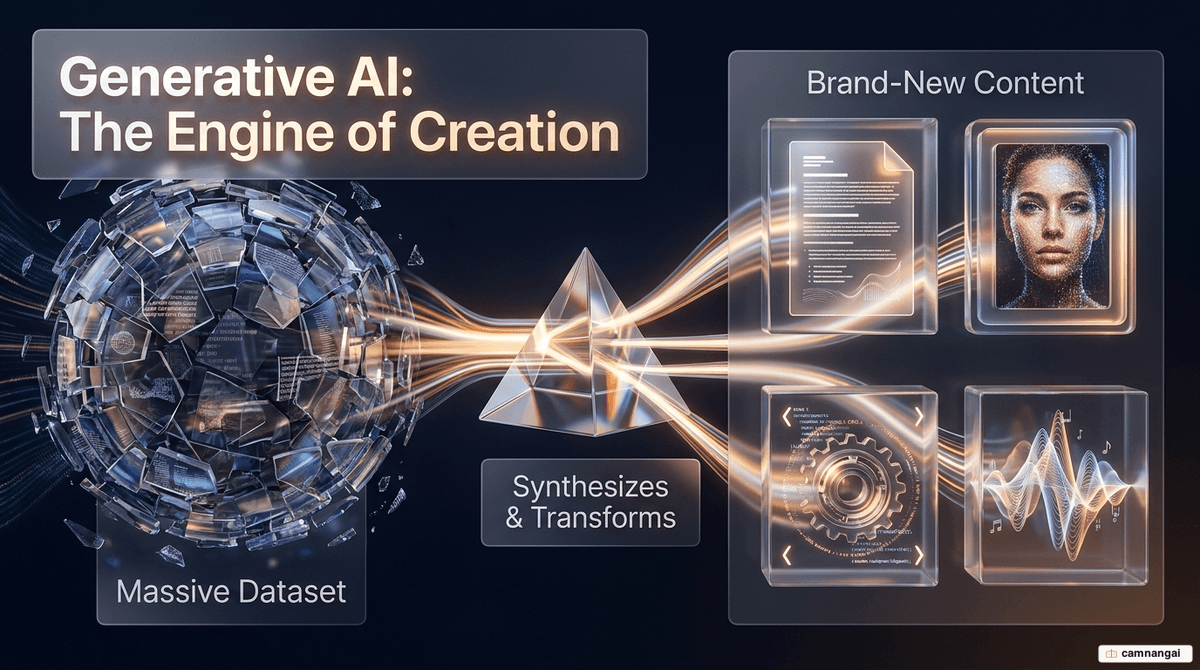
What is generative AI, and how does it differ from traditional systems?
Traditional AI is largely discriminative: it tries to identify the relationship between known and unknown factors. Mathematically, it looks for the conditional probability of a label given a set of features — P(y|x). Show it a pixel arrangement and it maps that to "cat" based on learned boundaries.
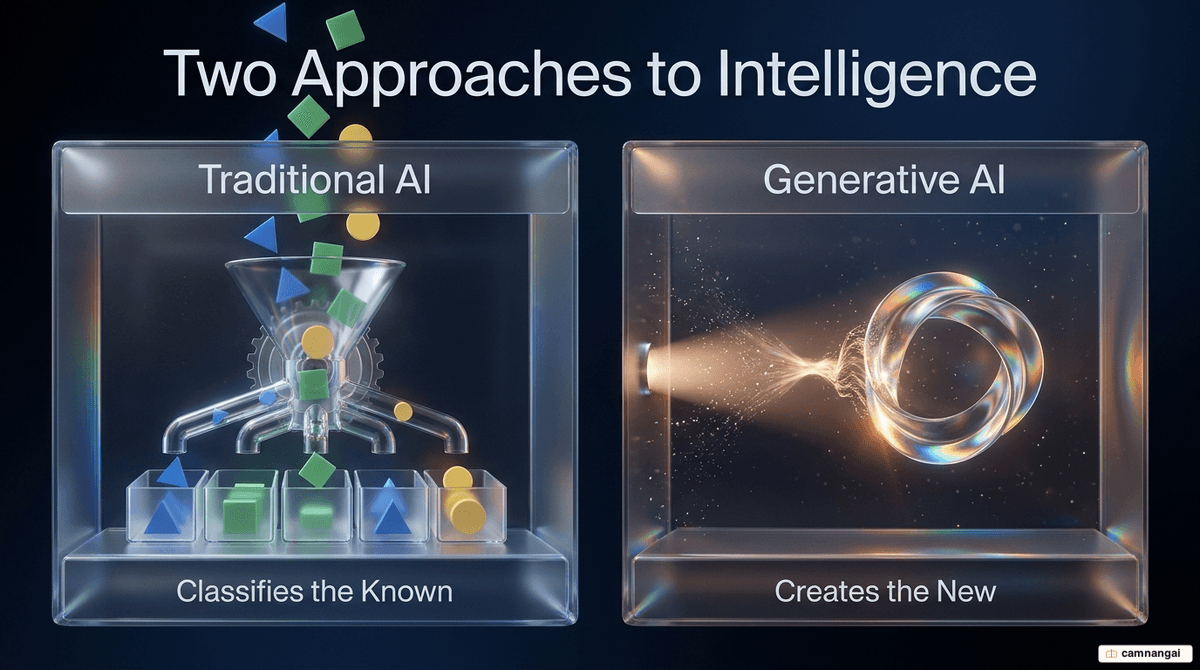
Generative AI goes a step further by predicting features from a label or context. Instead of just identifying a cat, it learns the distribution of features — ear shapes, tail patterns, fur textures — and models the joint probability P(x,y), the likelihood of features and labels occurring together. That lets it produce a novel image of a cat that was never in its training set yet still obeys the learned statistics of "cat-ness."
The practical difference is between a system that identifies patterns and one that models the structure of data. Traditional systems flag anomalies or classify inputs; generative systems synthesize new solutions — moving the technology from classification into de novo molecular design and complex content synthesis.
How did generative AI evolve into its current form?
Modern generative AI is the product of a steady architectural shift, from rule-based scripts toward deep learning structures that handle ever more complex data:
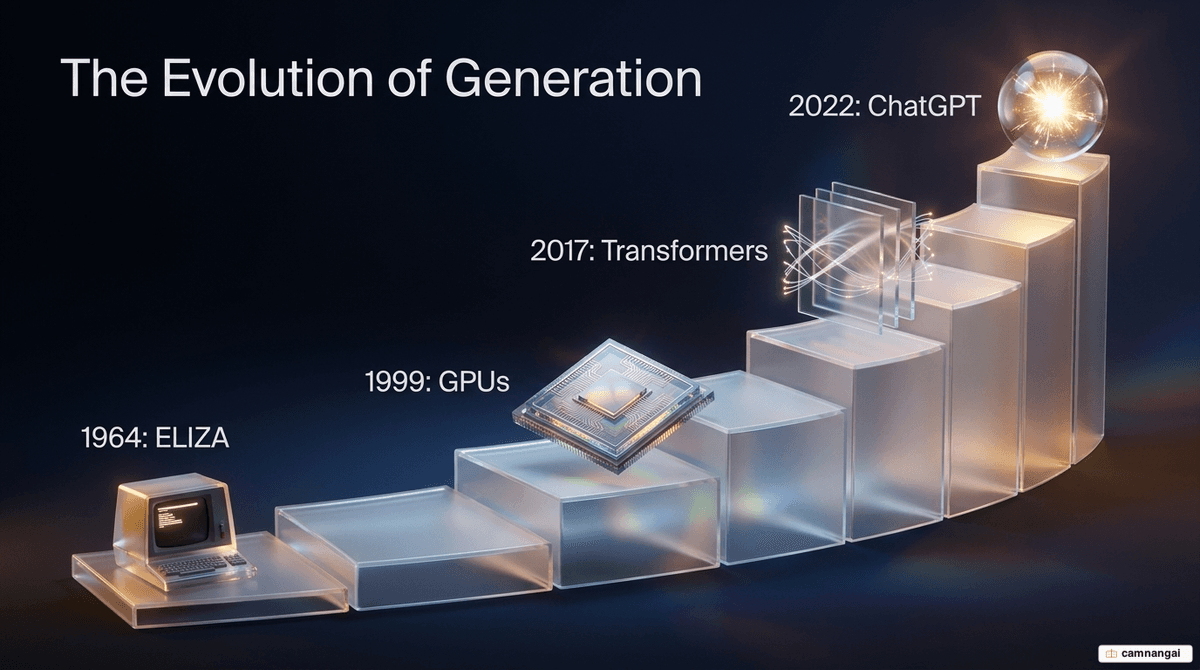
- 1964 — ELIZA. An early "chatterbot" from MIT used pattern-matching scripts to simulate conversation: a primitive, rule-bound ancestor of today's dialogue systems.
- 2013 — Variational Autoencoders (VAEs). The first deep generative models able to produce realistic images and speech, by encoding data into a compressed "latent space" and decoding it back into novel variations.
- 2014 — GANs and diffusion models. Generative Adversarial Networks pit a "generator" against a "discriminator" to drive up fidelity; diffusion models learn to create data by iteratively removing controlled noise.
- 2017 — the Transformer. The paper Attention is All You Need replaced sequential processing with "attention," letting a model weigh every part of a sequence at once, regardless of distance.
- 2022 — ChatGPT. Cheaper cloud compute and front-end interfaces like ChatGPT made internet-scale Large Language Models commercially viable and put them in everyone's hands.
How do generative AI models produce new content?
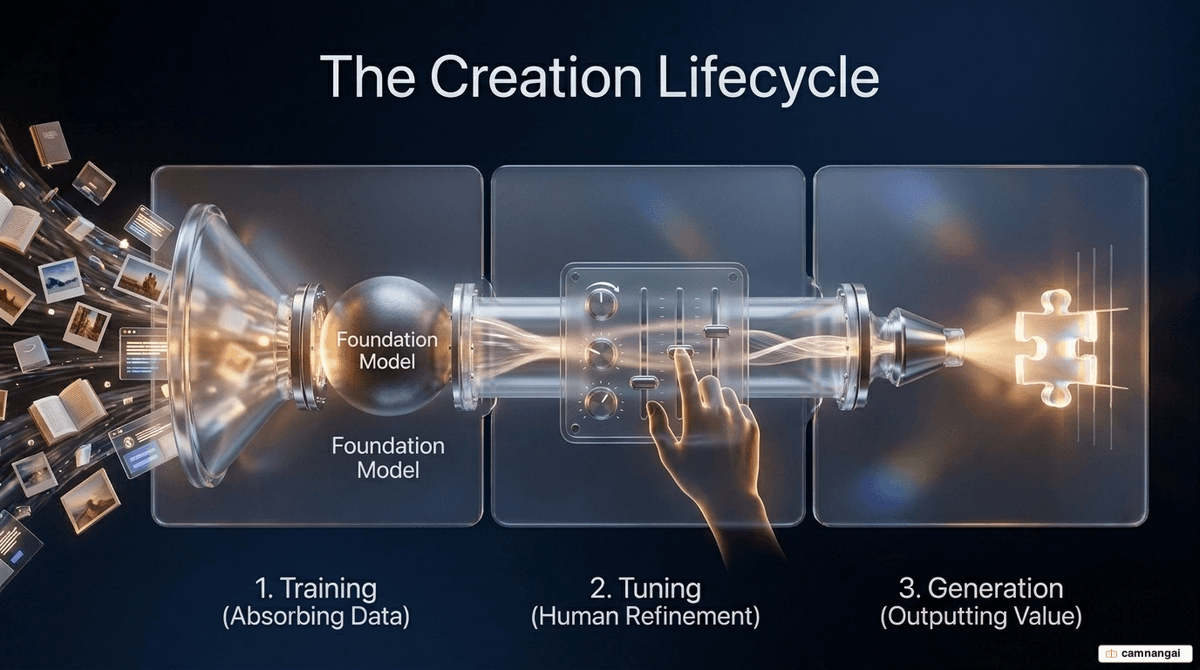
An enterprise AI strategy rests on a three-phase lifecycle: training, tuning, and generation.
The training phase
Generative AI begins with foundation models — deep-learning models trained on vast, generalized, unlabeled datasets. During training, the algorithm runs millions of "fill-in-the-blank" exercises, learning to predict the next element in a sequence, be it a word, a pixel, or a line of code. The result is a neural network of billions of parameters encoding patterns and relationships.
The tuning phase
A foundation model is a generalist, so it needs tuning. Fine-tuning feeds it labeled data for a specific application — customer-service logs, say. Reinforcement Learning from Human Feedback (RLHF) then has human evaluators score outputs, and the model updates its parameters to align with human preferences for accuracy and relevance.
The attention mechanism
Inside Transformer-based models, attention is what enables parallel processing. Rather than reading word by word, the model uses self-attention to focus on the relevant parts of an input sequence simultaneously, capturing context and meaning. Large Language Models (LLMs) are the class of foundation models specialized for language tasks like summarization and contextual embedding.
What are the most effective professional use cases for generative AI?
Generative AI has moved from novelty to a tool for optimizing mission-critical business processes:
- Software development. AI assistants handle code generation, debugging, and modernization. Freshworks cut the time to build complex applications from ten weeks to a single week.
- Healthcare and life sciences. The technology speeds drug discovery via de novo molecular design — Gartner estimates that by 2025, more than 30% of new drugs and materials will be discovered with generative AI. Roche uses synthetic medical data to run clinical research while protecting patient privacy.
- Finance. Institutions deploy generative models for fraud detection in claims and credit cards; JPMorgan Chase uses them to cut false positives and tighten transaction security. Investment firms also offer low-cost, personalized financial advice.
- Media and marketing. Forbes and The New York Times automate parts of content creation, and Coca-Cola has used ChatGPT and DALL·E to craft personalized ad copy and images in real time.
What are the limitations and ethical trade-offs of generative AI?
Deploying generative AI safely takes technical guardrails and a tight loop between human expertise and machine output:
- Hallucinations. These systems are probabilistic, not deterministic. They can produce outputs that are factually wrong but look plausible — as one lawyer learned after filing a brief full of fictional, AI-generated case citations.
- Bias and security. Models mirror the societal biases in their training data. Customizing a model with proprietary data also risks exposing intellectual property if access is not tightly controlled.
- Copyright and cost. Many models were trained on copyrighted or pirated works, fueling ongoing legal challenges. Training is also compute-intensive, with heavy financial and environmental costs.
- The black-box problem. Deep learning is opaque, so the decision-making inside the model is hard to explain — which is why "explainable AI" practices matter for adoption.
How does generative AI reshape organizational design?
Generative AI introduces distributed agency, which reconfigures traditional authority and workplace roles. Here the technology complements human expertise rather than replacing it.
Redefining expertise
Expertise once meant deep domain knowledge alone. Now proficiency also requires the ability to prompt and steer generative systems effectively — while deep domain knowledge stays essential for evaluating and verifying machine output. The strongest teams pair domain experience with the ability to direct the machine.
Modularizing tasks
Generative AI lets work be broken into smaller, modular subtasks, which sharpens coordination and automates routine elements so people can focus on strategy. It also blurs industry boundaries: traditional manufacturers evolve into integrated-solution providers by embedding generative AI into their services.
FAQ
What is the difference between a foundation model and an LLM? A foundation model is a broad class of deep-learning models trained on generalized data to work across modalities like images or text. A Large Language Model is a foundation model focused specifically on language tasks — summarization, translation, and text generation.
Can GenAI-generated content be used in scientific research? Yes, with full disclosure and critical evaluation. Researchers must delineate which parts were AI-generated and remain the final arbiters of scientific rigor. Because the models are probabilistic and error-prone, every AI-generated claim must be verified against established standards.
How does Retrieval Augmented Generation (RAG) improve accuracy? RAG lets a model pull in relevant, trusted data outside its original training set. By supplementing the input with external context rather than changing the model's weights, it reduces hallucinations and grounds output in current, transparent sources.
What is "agentic AI"? Agentic AI refers to autonomous programs that pursue goals on a user's behalf without constant intervention. Unlike chatbots bound by fixed constraints, agentic systems design their own workflows and call other tools to complete complex, multi-step tasks independently.