Deep learning is a subset of machine learning that uses multilayered artificial neural networks to process data and automate decision-making.
You define a system as "deep learning" when the neural network architecture consists of at least four layers: one input layer, one output layer, and at least two hidden layers. While traditional machine learning relies on human-defined rules and manual feature engineering, deep learning architectures automatically discover hierarchical patterns directly from raw data.
In traditional systems, you must manually specify which data features are relevant to a task — such as defining the edges or textures required to identify an object. Deep learning replaces this manual extraction with an automated pipeline of nested mathematical operations. This lets you process unstructured, high-dimensional data, such as images or audio, that lacks a predefined tabular format.
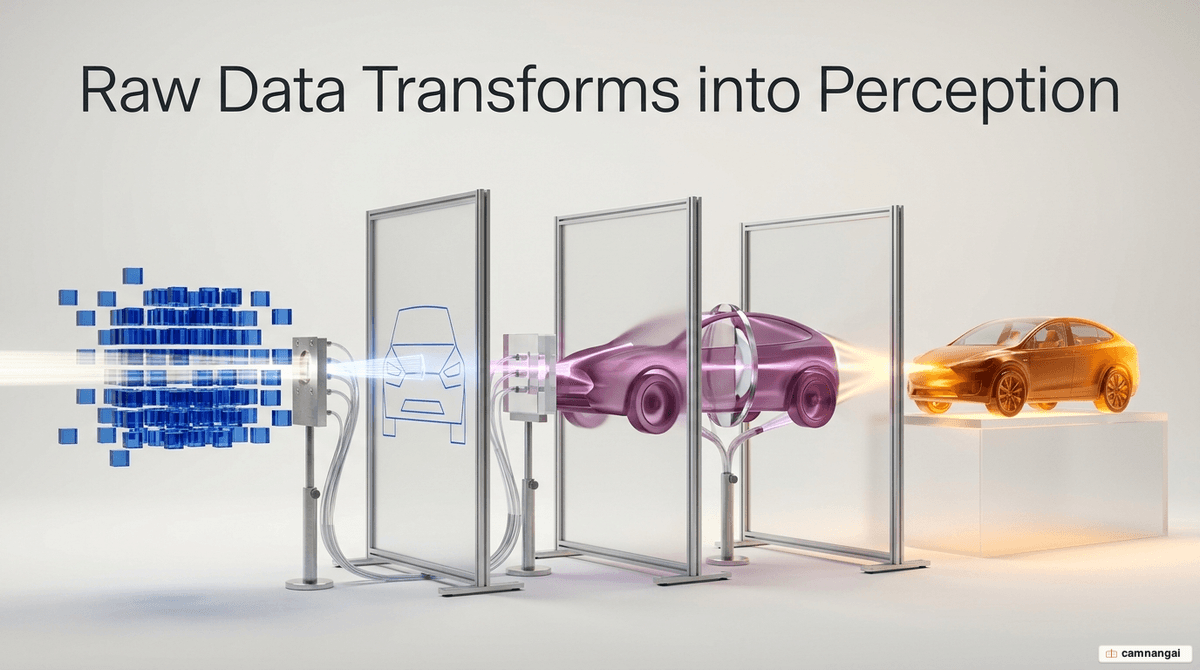
For example, when you deploy a deep learning model for image recognition, the network does not receive a list of "car parts." Instead, it receives raw pixel values. Through successive layers, the model learns to identify low-level edges, mid-level shapes, and high-level objects. This shift from manual intervention to automated feature discovery is the foundation of modern computer vision and natural language processing.
What is deep learning?
The transition from traditional machine learning (ML) to deep learning (DL) is a fundamental change in the machine learning pipeline. In a traditional ML environment, the human engineer is the primary feature extractor. To build a car recognition system, you would have to define features like round wheels, straight door edges, and metallic textures. This approach fails on unstructured data because human-defined rules cannot account for every possible variation in lighting, angle, or occlusion.
Deep learning is a computational engine built from stacked layers of abstraction. The breakthrough 2012 AlexNet model demonstrated what this technology could do in practice: by training a deep network directly on raw pixel data, the team significantly outperformed manual feature-based methods. This proven ability to process millions of inputs and automatically identify optimal patterns removes the human bottleneck from the pipeline. You provide the raw data and the architecture; the model discovers the features required for accurate inference.
How do neural networks actually work?
Neural networks are loosely inspired by biological structures, but you should treat them as a series of nested mathematical equations that map inputs to outputs. Each artificial neuron is a processing node within a distributed network, executing a specific mathematical transformation on the data it receives.
The mathematical neuron (Z = WᵀX + b)
You build a neuron to run a four-step process. First, the neuron receives input vector X from the previous layer. Second, you calculate the weighted sum of these inputs by multiplying them by weight matrix W. Third, you add a bias term b, which lets you shift the activation function to better fit the data. Fourth, the result Z passes through an activation function. Mathematically, this is expressed as Z = WᵀX + b. These weights and biases are the parameters you optimize during training to reduce prediction error.
The hierarchy of layers
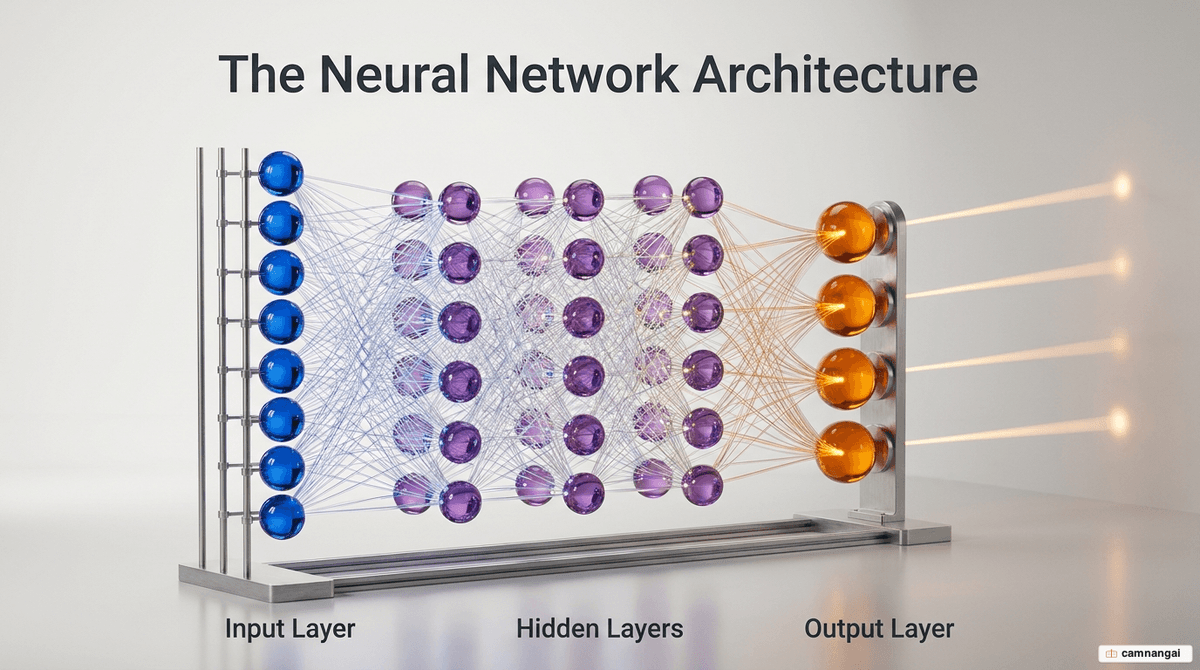
Information flows through three distinct layer categories:
- Input layer: receives raw data. If you are processing 10×10 pixel grayscale images, your input layer will consist of 100 neurons, each corresponding to an individual pixel.
- Hidden layers: the network's computational engines, where learning occurs. In a digit recognition task, Layer 1 captures basic edges, Layer 2 combines edges into strokes or loops, and deeper layers identify complex objects like a "6" or a "9."
- Output layer: yields the final prediction. Depending on the task, this might be a single number for regression or a probability vector for classification.
Activation functions
You use activation functions to introduce non-linearity into the system. Without non-linearity, a network with 100 hidden layers would behave like a single-layer linear regression, collapsing the model's depth.
- ReLU (Rectified Linear Unit): the modern default for hidden layers. It outputs zero for negative inputs and passes positive inputs unchanged. This simple rule fixes the vanishing gradient problem and enables faster training.
- Sigmoid and Tanh: older S-shaped functions. Sigmoid is typically reserved for output layers in binary classification, to provide a probability between 0 and 1.
- Softmax: used in multi-class classification to ensure all output probabilities sum to 1.0.
How do deep learning models learn?
Training is an iterative optimization process designed to minimize a loss function. You adjust the internal parameters (W and b) based on the error of the model's predictions until the system converges on a global optimum.
The training loop
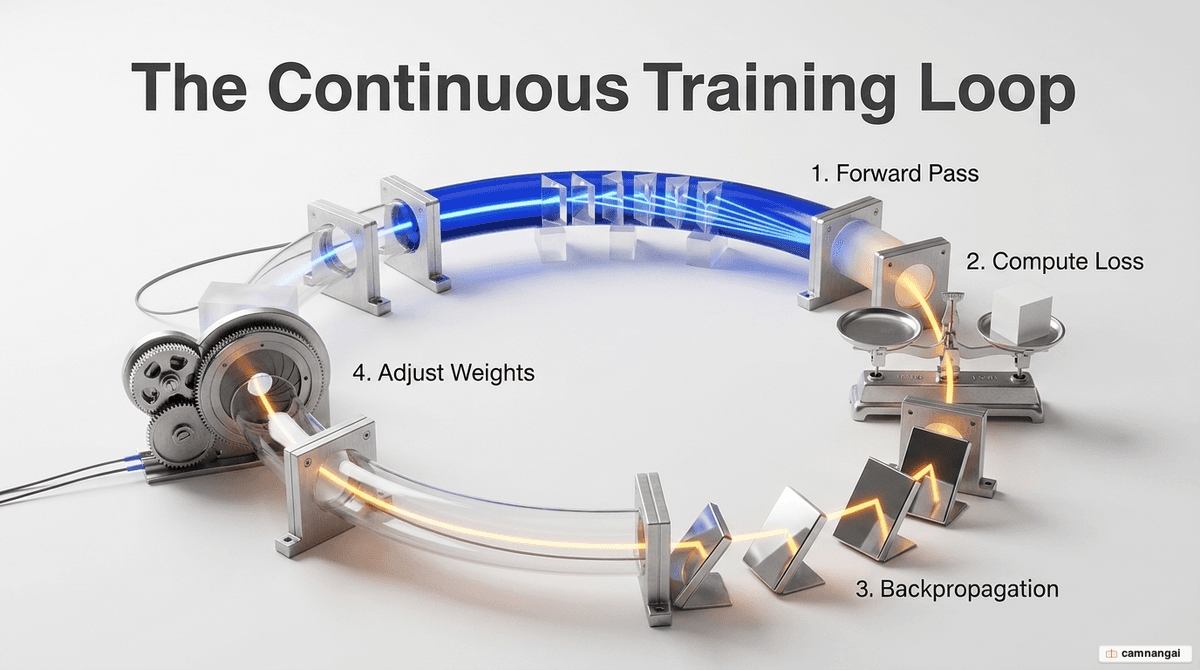
The training process follows a fixed cycle:
- Forward pass: you feed data through the input layer, where the hidden layers transform it to produce a prediction Ŷ.
- Loss computation: you measure the "wrongness" of the prediction using a loss function. You typically use Cross-Entropy for classification and Mean Squared Error (MSE) for regression.
- Backpropagation: you apply the chain rule of calculus to work backward from the error. This lets you calculate the gradient — the partial derivative of the loss function with respect to every weight and bias.
- Optimization: an optimizer uses these gradients to update parameters. Gradient Descent is the foundation, while Stochastic Gradient Descent (SGD) is used for faster updates on mini-batches. Adam is currently the standard optimizer, as it provides adaptive learning rates for each parameter, balancing speed and stability. You may also use AdamW, which decouples weight decay from the adaptive learning rate to improve regularization.
Addressing the gradient problems
Deep architectures are susceptible to gradient instability. The vanishing gradient problem occurs when gradients shrink to zero in early layers, often due to the saturation of Sigmoid or Tanh functions. The exploding gradient problem occurs when gradients grow exponentially, causing unstable weight updates. To mitigate these, you implement:
- Batch Normalization: normalizing layer outputs to a mean of zero and standard deviation of one, to stabilize the training process.
- Residual Connections: you add shortcuts expressed as
y = x + F(x). This lets gradients flow directly through the network, bypassing layers to prevent signal degradation in very deep architectures.
What are the main types of deep learning models?
You select a network topology based on the specific structure of your data. Using an incorrect architecture results in computational waste and poor generalization.
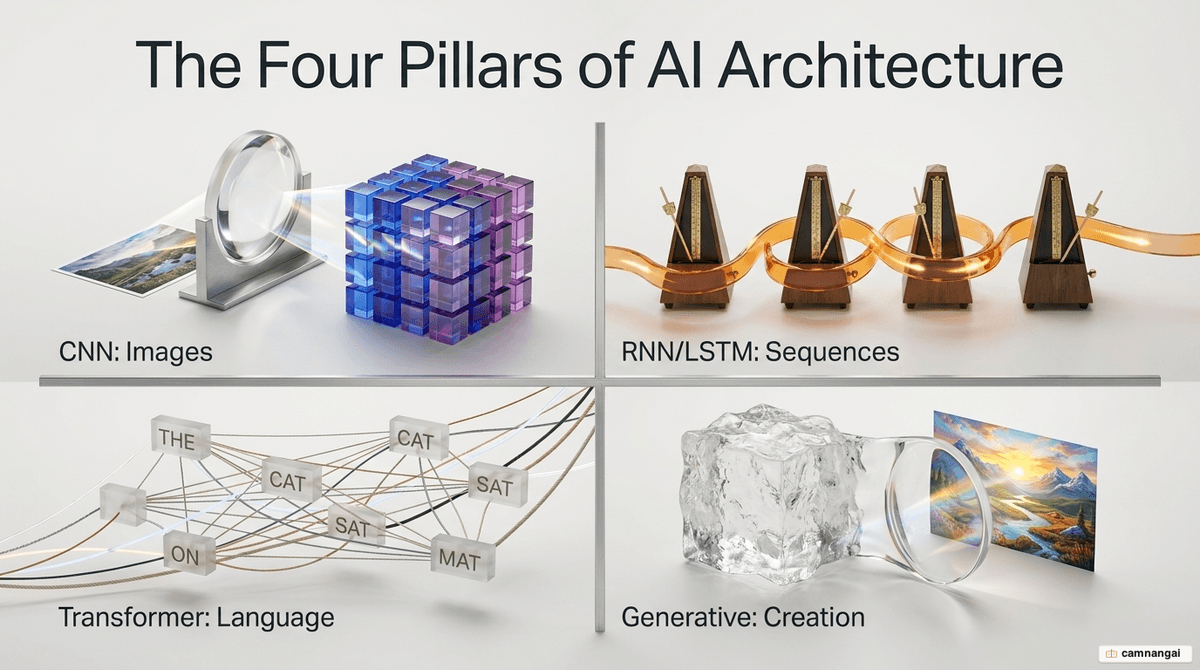
CNNs (Convolutional Neural Networks)
CNNs are the standard for spatial data. You use filters — small 2D arrays — that stride across an image to perform convolutions. This captures local patterns (like the relationship between adjacent pixels) while drastically reducing the parameter count compared to fully connected layers.
RNNs and LSTMs
Recurrent Neural Networks (RNNs) handle sequential data like speech or time-series. They maintain an internal "hidden state" that acts as memory. LSTMs (Long Short-Term Memory) improve on basic RNNs by using gates to decide which information to store or discard, solving the vanishing gradient issues associated with long sequences. However, their serial nature prevents parallelization.
Transformers
Transformers have largely replaced RNNs in natural language processing (NLP) thanks to the self-attention mechanism. This lets the model process all parts of a sequence simultaneously, identifying dependencies regardless of distance. Because you can parallelize transformer training, they scale to massive datasets and models with 8 billion parameters or more.
Mamba models
Mamba is a newer architecture derived from state space models (SSMs) that rivals Transformers for sequential data. It uses a selective prioritizer to discard or retain past information. Mamba offers significantly greater computational efficiency and lower memory overhead than the attention mechanism used in Transformers.
Generative models
Generative Adversarial Networks (GANs) use two networks — a Generator and a Discriminator — competing in a zero-sum game to create realistic data. Diffusion Models generate data by learning to reverse a denoising process, gradually transforming random noise into a coherent output like an image or video. See What is Generative AI? for this broader model family.
Where is deep learning actually used?
Deep learning has moved from theoretical research into production-grade deployments across all major sectors.
- Healthcare: you use computer vision to analyze MRIs and CT scans, often detecting anomalies with higher accuracy than human radiologists. DL also accelerates drug discovery by identifying potential chemical candidates.
- Automotive: autonomous vehicle stacks rely on DL to interpret sensor-fusion data from cameras and LIDAR, enabling real-time navigation.
- Finance: firms deploy DL for high-frequency algorithmic trading and real-time fraud detection, by identifying non-linear patterns in transaction streams.
- Technology: NLP models power virtual assistants like Alexa and Siri. Real-time translation services like Google Translate use Transformers to provide contextually accurate communication across 130+ languages.
When is deep learning the wrong tool?
Deep learning is not a universal solution; it carries significant operational overhead. You should evaluate the constraints of your project before committing to a DL architecture.
One primary constraint is data volume. Deep learning models are data-hungry and prone to overfitting — memorizing noise instead of patterns — on small datasets. If you have limited labeled data, simpler models like Decision Trees or Random Forests often perform better.
Another factor is computational cost. Training deep models requires high-performance GPUs and massive energy consumption. You must also consider the black box problem. Because DL models lack interpretability, they are difficult to use in regulated environments like law or banking, where you must explain exactly why a specific decision was reached. In these cases, a rule-based system or linear model is the superior choice.
FAQ
Is deep learning the same as AI? No. AI is the broad field of intelligent systems. Machine learning is a subset of AI that learns from data. Deep learning is a specialized subset of machine learning that uses neural networks with at least four layers to automate feature extraction.
Why do we need GPUs for deep learning? Deep learning involves billions of matrix multiplications. While a CPU handles tasks sequentially, a GPU has thousands of cores designed for parallel processing. This hardware lets you compute the massive floating-point operations required for training in a reasonable timeframe.
What is the "depth" in deep learning? Depth refers to the number of layers in the network. A deep network must have an input layer, an output layer, and at least two hidden layers. Modern architectures often exceed 100 hidden layers to capture highly complex data abstractions.
What is overfitting? Overfitting occurs when your model memorizes the training data's noise rather than its underlying signal. This produces high training accuracy but poor generalization to new data. You solve it with regularization techniques like Dropout, where you randomly deactivate 20% to 50% of neurons during training.