As a developer or system architect, you know that machines natively communicate through binary code — millions of zeros and ones. The data you actually need to process, however, is unstructured, messy, and human. Natural Language Processing, or NLP, is the specialized subfield of computer science and artificial intelligence (AI) that bridges this gap, enabling computers to interpret and generate human language.
By moving beyond rigid machine code, NLP provides the technical foundation for modern human-computer interaction. It draws on computational linguistics, statistical modeling, and deep learning to help digital devices recognize and understand the nuance of text and speech. As systems scale, the challenge shifts from simple keyword matching to managing the high-dimensional complexity of human expression.
The inherent ambiguity of language means building these systems requires specific architectural trade-offs. To understand how we moved from simple scripts to the massive models of today, you have to look at the machinery behind the text.
What is NLP?
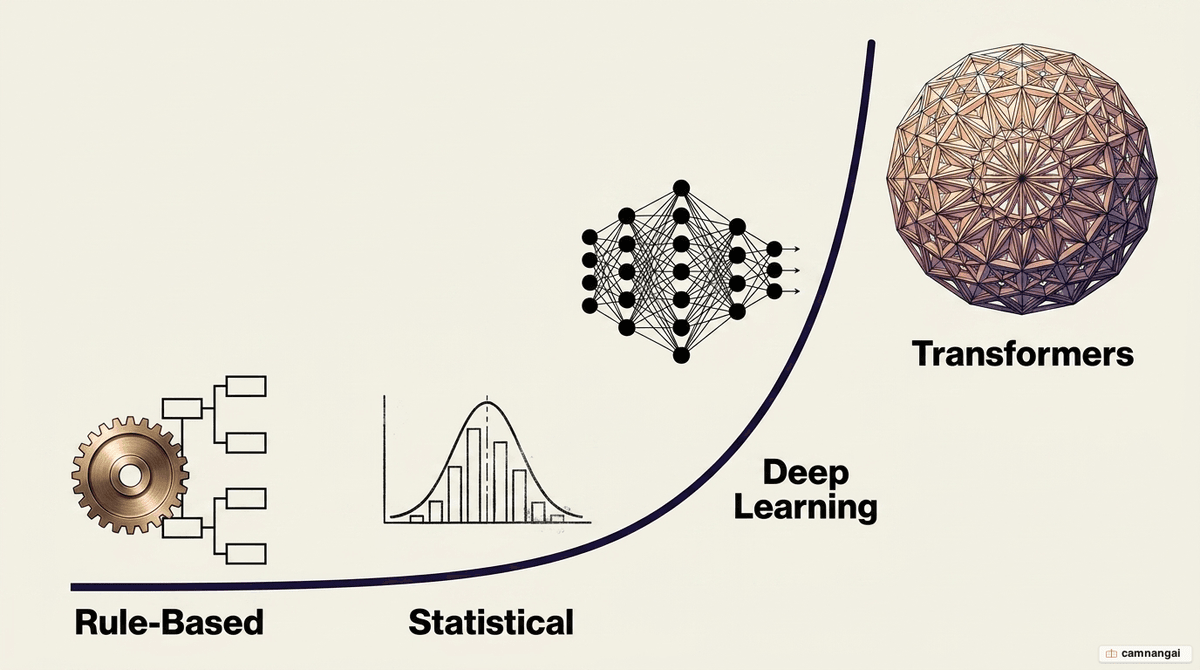
The strategic shift in NLP marks an evolution from pure linguistics to high-performance computer science. The field's origins date back to 1957 with Noam Chomsky's Syntactic Structures, which proposed that machines could learn language by following complex grammatical rules. Early implementations, such as the 1966 ELIZA program, used "rule-based" logic — simple if-then decision trees — to simulate conversation.
Rule-based systems failed to scale because they could not handle the state-space complexity and human ambiguity inherent in language. This led to "statistical" NLP, which uses machine learning to map language elements to probability. Today, we have moved into "deep learning," where neural networks learn directly from massive volumes of raw data. This evolution was necessary because human communication is too nuanced for manual programming; machines must instead learn the "rules" of language through mathematical optimization and massive-scale data processing.
How does NLP actually work?
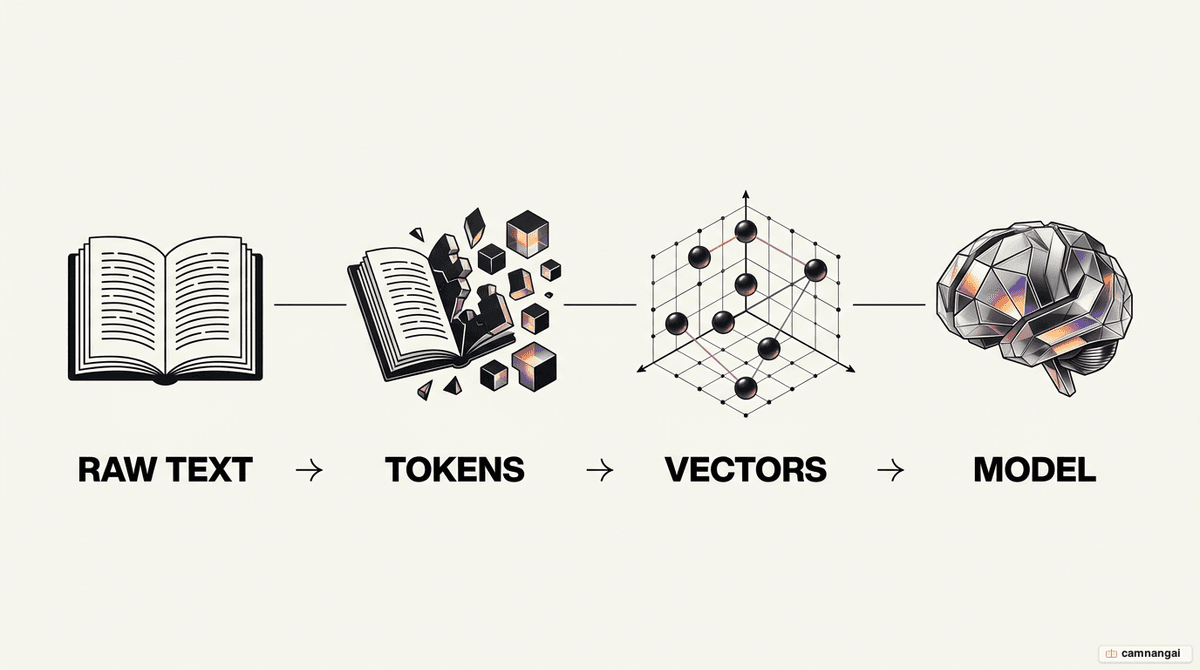
For a computer to "read," it must first convert text into a mathematical format through a structured pipeline of preprocessing and feature extraction. This transformation is what allows for computational efficiency at scale.
Text preprocessing
Raw text is messy and requires normalization before it hits the model. This includes tokenization (splitting text into units), stop word removal (filtering common words like "the" or "is"), and a choice between stemming and lemmatization. Stemming is a fast, heuristic-based chopping of word ends; lemmatization uses vocabulary and morphological analysis to return a word to its dictionary root (e.g., "running" to "run"). This ensures the machine processes only the most meaningful elements of a sequence.
Feature extraction
A major architectural breakthrough occurred in 2013 with Word2Vec, which turned words into vectors — dense numerical representations in a continuous space. This allows for "math kung-fu" where computers calculate semantic relationships. For example, a model can mathematically determine that King − Man + Woman = Queen. Converting symbols to vectors lets computers calculate "semantic distance," objectively measuring how closely related two concepts are by their coordinates in a high-dimensional space.
Analysis and modeling
Once vectorized, systems perform part-of-speech tagging and parsing. Architects often distinguish between dependency parsing, which looks at relationships between words, and constituency parsing, which builds a syntax tree to represent the nested structure of a sentence. These structural insights are vital for understanding intent.
How did NLP evolve into LLMs?
Language is defined by context, but early models like Recurrent Neural Networks (RNNs) struggled with long-range dependencies; they processed words one by one and often "forgot" the beginning of a sequence before reaching the end.
The Transformer breakthrough
The 2017 paper "Attention is all you need" introduced the Transformer architecture, which used "self-attention" to glance at an entire sentence simultaneously. This let the model identify which parts of a sequence were most relevant to the meaning, regardless of their distance from one another.
Scaling to LLMs
This architecture allowed for scaling far beyond what earlier models could reach, and a shift toward general "language modeling." In 2018, BERT was trained for roughly $6,800; by the time GPT-3 arrived, training costs had soared to $12 million. By training a model simply to predict the next word in a sequence, it develops an internal understanding of grammar and facts. This general knowledge can then be transferred to specific downstream applications, moving the industry away from training fragile, task-specific models.
Where do you meet NLP every day?
NLP has become an invisible layer in modern software, functioning as a bridge that reduces human effort and automates the translation of intent into digital action.
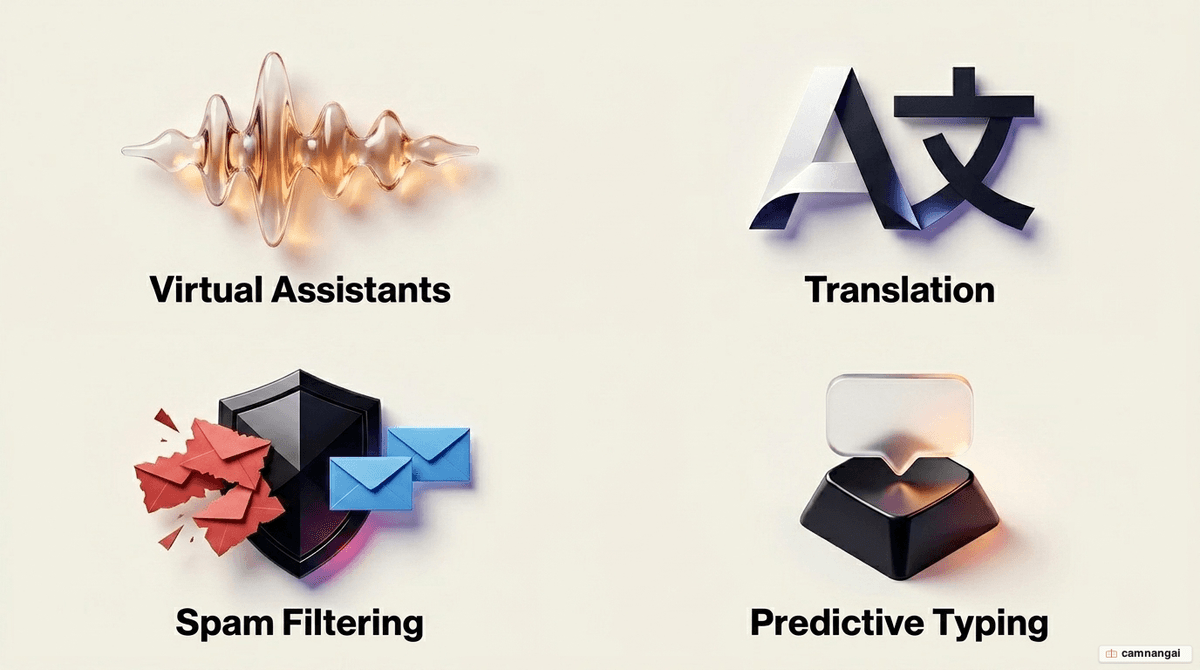
- Virtual Assistants: Siri, Alexa, and Cortana use NLP to interpret voice commands, turning speech into executable machine code.
- Writing Tools: Grammarly uses NLP algorithms to analyze tone and complexity. Similarly, Google Translate supports 101 languages by analyzing deep sentence structures rather than just matching keywords.
- Search and Automation: Google Search uses BERT to understand the intent behind a query. Meanwhile, simple n-gram modeling — a statistical approach that looks at contiguous sequences of items — is still used effectively in spam filters and autocomplete features.
What limitations should you know?
Despite recent successes, inference — the ability to resolve ambiguity through logic and external context — remains the "hard" problem of NLP.
- Ambiguity and Context: Computers often fail at deep inference. In the "Chang the Fisherman" example, humans intuitively know the sea surrounds an island, but a computer may fail to "see" that if it isn't stated explicitly.
- Entity Recognition: Identifying specific entities is a persistent hurdle. In the phrase "Mother Teresa's Mother," a model must perform Named Entity Recognition (NER) to distinguish "Mother Teresa" as a single, unique person-entity rather than a familial role plus a name.
- The Data Bottleneck: Deep learning requires massive amounts of "labeled data." Because this often needs domain experts to manually annotate text, it remains an expensive bottleneck.
- Bias and "Howlers": Models follow the "Garbage In, Garbage Out" (GIGO) principle. If training data is biased, the model will produce "howlers" — errors so illogical they break user trust.
The Turing test alone is insufficient to judge intelligence. While systems like Google's LaMDA can hold convincing conversations, "sentience" is usually a misreading of a model's advanced ability to follow complex statistical rules and next-token probabilities.
How do you get started with NLP?
Modern NLP is highly accessible thanks to robust open-source ecosystems. You can begin building with a few lines of code using industry-standard frameworks.
- Core Libraries: The Natural Language Toolkit (NLTK) in Python is the standard starting point for classical methods. For deep learning, TensorFlow, scikit-learn, and Hugging Face Transformers are essential for deploying state-of-the-art models.
- Fundamental Skills: Master Regular Expressions (Regex) for text cleaning, and brush up on basic math — particularly matrix multiplication and linear algebra.
Starting with classical methods, such as the first five chapters of Jurafsky & Martin's Speech and Language Processing, gives a cleaner learning path. Understanding the "why" of language structures makes the "how" of deep learning architectures much more effective.
FAQ
Is AI sentient? No. While models like Google's LaMDA can hold convincing conversations, they are rule-following statistical systems. They are trained on large datasets to predict the next word in a sequence based on probability, not consciousness or personal experience.
What is a vector? In NLP, a vector is a "bunch of numbers" used to represent a word's meaning. By converting words into these numerical arrays, computers can use matrix math to calculate how similar or different two words are in a high-dimensional space.
Why is data labeling expensive? Deep learning models require thousands of human-verified examples to learn accurately. In specialized fields like medicine or law, this needs expensive domain experts to manually annotate every piece of data, creating a significant cost and time bottleneck.