Open Google Maps and accept the fastest route → artificial intelligence. Let Spotify guess the next song you want to hear → artificial intelligence again. The technology has woven itself into daily life so quietly that most of us are still hazy on what it actually is.
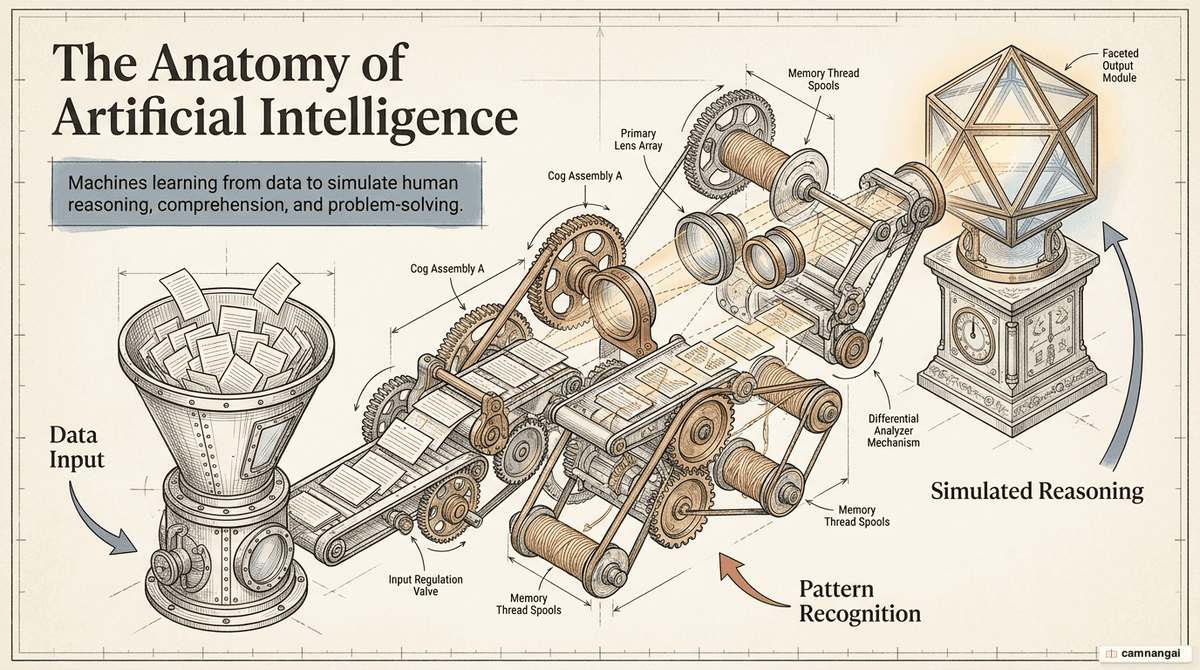
Artificial intelligence (AI) is the set of technologies that let machines simulate human learning, reasoning, and autonomous problem-solving — using data-driven algorithms instead of static, hand-written rules.
It synthesizes vast datasets to perform tasks once reserved for human experts: comprehending language, recognizing visual patterns, generating original content. AI is not a ghost in the machine. It is mathematics applied at scale.
How did artificial intelligence evolve into today's technology?
The trajectory of artificial intelligence from 1950 to the present is the context you need to read today's hype cycles. Understanding these milestones is how you tell an enduring breakthrough from the temporary enthusiasm that has historically triggered "AI Winters" — stretches of stalled funding and research.
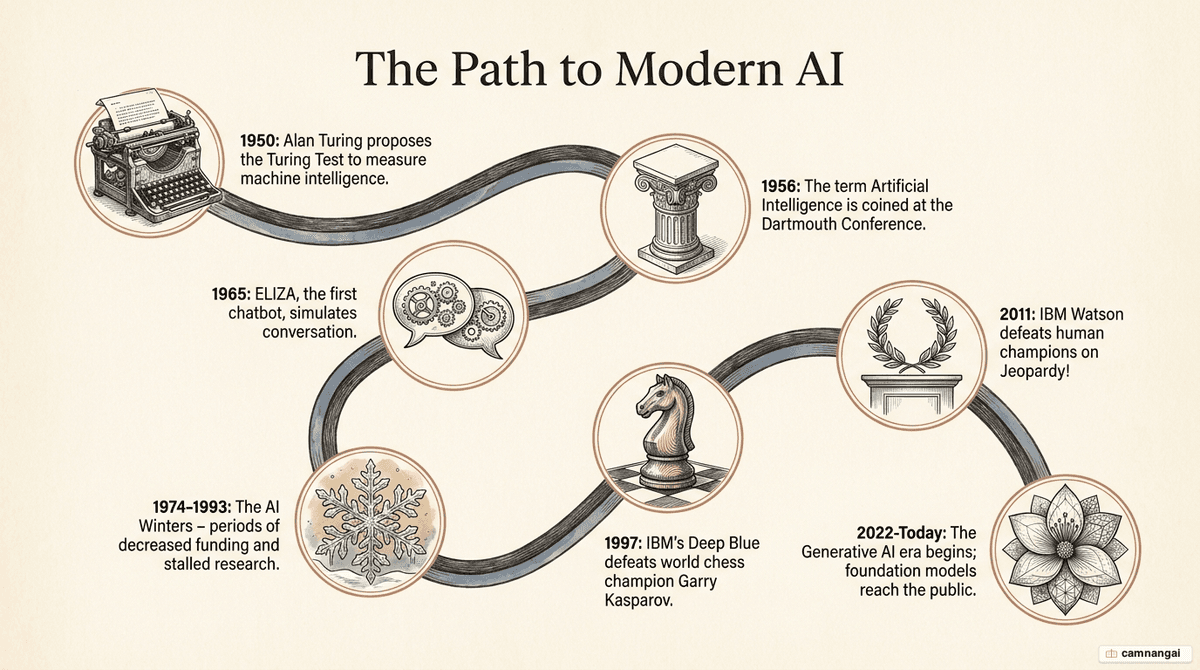
- 1950. Alan Turing publishes "Computing Machinery and Intelligence," introducing the Turing Test to evaluate machine behavior.
- 1956. The Dartmouth Conference establishes AI as an academic discipline. Allen Newell, Herbert Simon, and J.C. Shaw demonstrate the Logic Theorist, the first running AI program.
- 1957. Frank Rosenblatt builds the Perceptron, the first artificial neural network and a direct ancestor of modern deep learning.
- 1965–1980. Early wins like the ELIZA chatbot (1965) give way to the first "AI Winter" (1974–1980), as limited computing power fails to meet expectations.
- 1987–1993. A second AI Winter sets in when the cost of maintaining specialized "expert systems" leads to market disillusionment.
- 1997. IBM's Deep Blue defeats world chess champion Garry Kasparov, proving the power of reactive, rule-based systems.
- 2011. IBM's Watson wins on Jeopardy!, signaling a major leap in natural language processing and unstructured-data analysis.
The "so what" for leadership is a fundamental shift in scalability. Early systems required humans to write a million rules; modern architectures learn by viewing a million examples. That move from rigid logic to statistical learning is what carried AI out of the laboratory and into the mass-market applications that now drive the global economy.
How do machine learning and deep learning relate to AI?
The relationship between AI, machine learning, and deep learning is a set of nested layers: AI → machine learning → deep learning → generative AI. Each layer is a special case of the layer above it, and knowing which one a problem actually needs is how you avoid over-investing in complex architectures for tasks that want simple statistical precision.
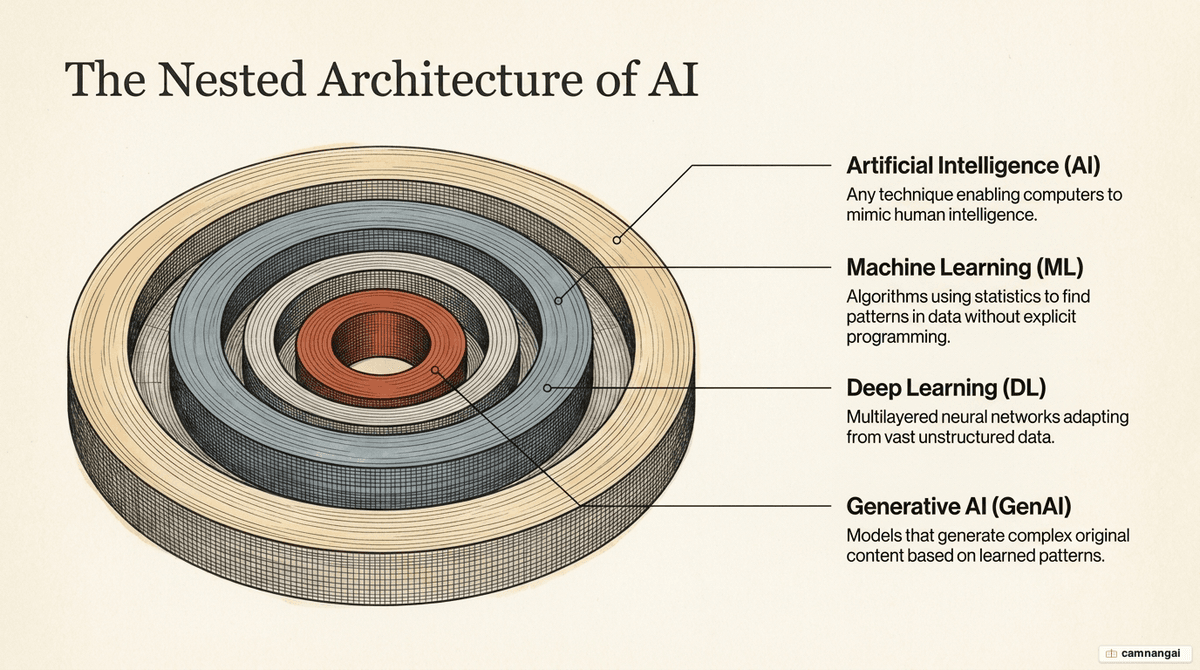
Machine learning sits directly beneath AI: it uses algorithms to make predictions from data patterns without explicit programming. It splits into supervised learning (labeled datasets used to classify information, e.g. fraud detection) and unsupervised learning (finding hidden structure in unlabeled data, such as clustering customers for personalized marketing).
Deep learning is a further subset that uses multi-layered neural networks loosely inspired by the human brain — an input layer, an output layer, and many "hidden" layers in between. Its strategic payoff is automation: traditional machine learning needs humans to hand-define features, while deep learning extracts them on its own. The trade-off is cost. Deep learning is often overkill for small, structured datasets, and it demands massive volumes of unstructured data plus high-performance GPUs to earn its keep.
How does generative AI create original content?
Generative AI is the current frontier — the shift from a tool that categorizes existing information to one that produces original text, images, and code.
At its core sit large language models (LLMs), which operate through a token selection process. A token is a building block of text — a word or sub-word — and the model predicts the next one using mathematical probability. It does not "understand" content; it is a very fast predictor of the most statistically likely next token. Specific architectures made this possible: Variational Autoencoders (2013) enabled content variation, Diffusion models reshaped image generation, and Transformers (2017) enabled the sequenced-data processing behind tools like ChatGPT.
Building a generative model happens in three phases:
- Training. Deep-learning algorithms process petabytes of raw data to create a foundation model. Leaning on an open-source foundation model lets a business skip this multi-million-dollar step.
- Tuning. Techniques like Reinforcement Learning with Human Feedback (RLHF) push outputs toward helpful and safe.
- Retrieval-Augmented Generation (RAG). Connecting the model to live, authoritative outside sources for sharper accuracy.
What are AI agents and agentic AI?
The jump from a standard chatbot to an "agent" is the next phase of productivity. A chatbot answers a prompt; an agent executes a multi-step plan to reach a goal — moving AI from passive assistant to autonomous operator.
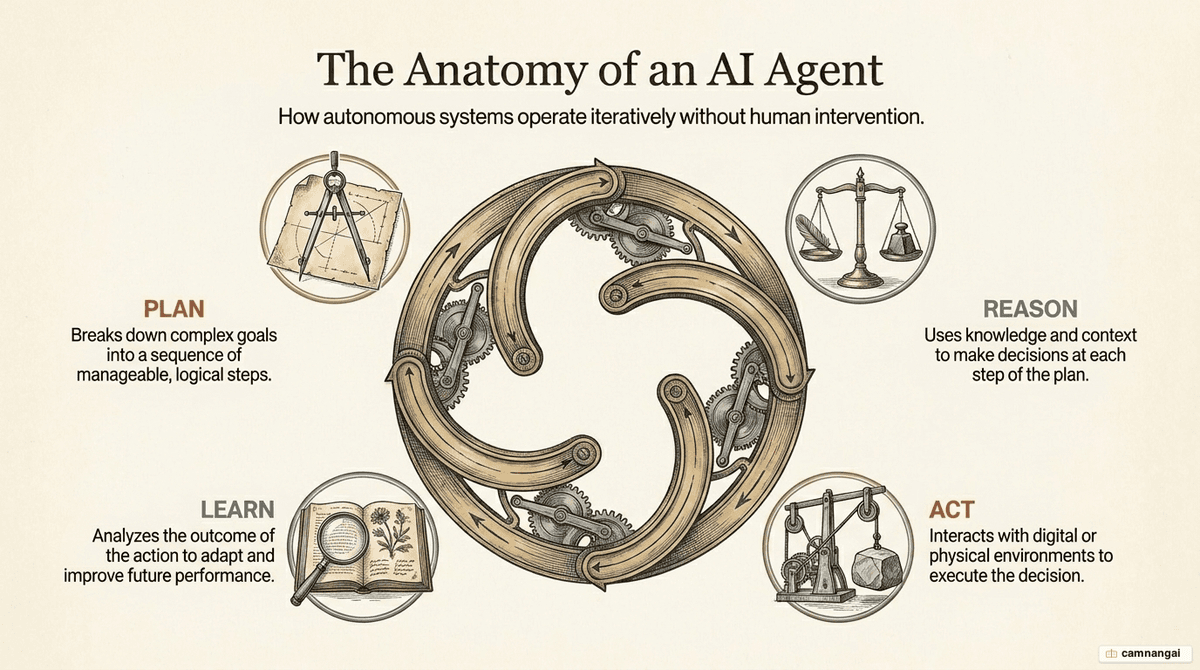
An AI agent is an autonomous program that perceives its environment and takes actions to hit a goal without human intervention. Agentic AI refers to several agents coordinated in an orchestrated system to accomplish complex, high-level objectives. Unlike a standalone LLM, these systems show real agency through four capabilities:
- Plan. Break a complex objective into manageable sub-steps.
- Reason. Use internal knowledge to make decisions at each stage.
- Act. Interact with digital environments via APIs — booking travel, refactoring code, filing tickets.
- Learn and adapt. Improve over time by adjusting to feedback and past experience.
That autonomy lets these systems work at a scale no chatbot could, but it also introduces new oversight risk: as agents gain the capacity to act on their own, governance becomes the binding constraint rather than capability.
What can businesses actually do with AI?
AI adoption is no longer an experiment but a condition of staying competitive. Organizations that lean on it turn raw data into decisions and free people for the creative, strategic work that data alone can't do.
- Automation of complexity. Handling tedious digital work (data entry) and physical work (manufacturing) with 24/7 consistency.
- Accelerated R&D. Predictive modeling that maps the human genome or surfaces new drug candidates faster than traditional methods.
- Customer experience. Conversational agents that answer questions and personalize support across web, app, and chat.
- Digital twins. Virtual simulations of factories or supply chains that measure efficiency and output in real time.
- Fraud detection. Deep-learning models that analyze transaction patterns and flag anomalies instantly.
- Predictive maintenance. Reading sensor data from connected (IoT) equipment to forecast failures before they hit the bottom line.
What are the limitations and trade-offs of AI?
A serious governance framework is the price of deploying AI responsibly. Without clear guardrails, fast rollout can amplify social harm or trigger operational failures.
- Hallucinations. Systems can fabricate information and present it with misplaced confidence and authority.
- Data bias. Because LLMs train on data scraped from the web, they ingest its prejudices — and then reproduce biased outcomes in high-stakes areas like loan approvals, hiring, and predictive policing.
- The "black box" problem. As models grow more complex, it gets harder for humans to retrace how an algorithm reached a given conclusion.
- Computational cost. Training a foundation model takes thousands of GPUs and millions of dollars, a real barrier to entry for smaller firms.
The core tension is balancing deployment speed against transparency and "explainable AI." Narrow AI excels at specific tasks but lacks reasoning and self-awareness, while superintelligence — an entity surpassing all human intelligence — remains purely theoretical. Responsible governance is the final safeguard.
Where do you start?
The best way to understand artificial intelligence is to dig into each of its layers. Related articles on this site unpack the concepts above:
- What is machine learning? — the dominant method for realizing AI today.
- What is deep learning? — the multi-layer neural networks driving the modern wave.
- What is generative AI? — the innermost layer, focused on creating new content.
- What is a large language model (LLM)? — the engine behind ChatGPT and other chatbots.
- What is an AI token? — the unit every language model reads and writes.
Applying AI to your role
Once the fundamentals click, pick the AI path closest to your work:
- Developers — bring AI into how you write, review, and test code.
- Office workers — draft, summarize documents, and process data faster.
- Marketers — produce content and visuals and analyze campaigns.
- Students — study, research, and revise more effectively.
- Business owners — automate workflows and grow the business.
FAQ
What is the difference between a CPU and a GPU in AI? A CPU is built for general computing, while a GPU's architecture is optimized for the parallel processing AI needs. GPUs handle the massive matrix workloads of training and running neural networks far more efficiently than traditional processors.
Is artificial intelligence sentient or conscious? No. AI can simulate conversation and emulate emotion through pattern-matching, but it has no consciousness, self-awareness, or genuine feeling. These are mathematical machines that find statistical relationships in data to predict or generate.
What is Artificial General Intelligence (AGI)? AGI is a theoretical form of AI able to understand, learn, and apply knowledge across a wide range of tasks at a level equal to or beyond human intelligence. No current system has reached it; it remains a goal for future research.
How will AI impact the job market? AI is expected to automate repetitive functions, which may displace some roles, but it is more likely to augment human work. Historically, technological shifts create new industries — SEO and social media management did not exist before the internet boom.