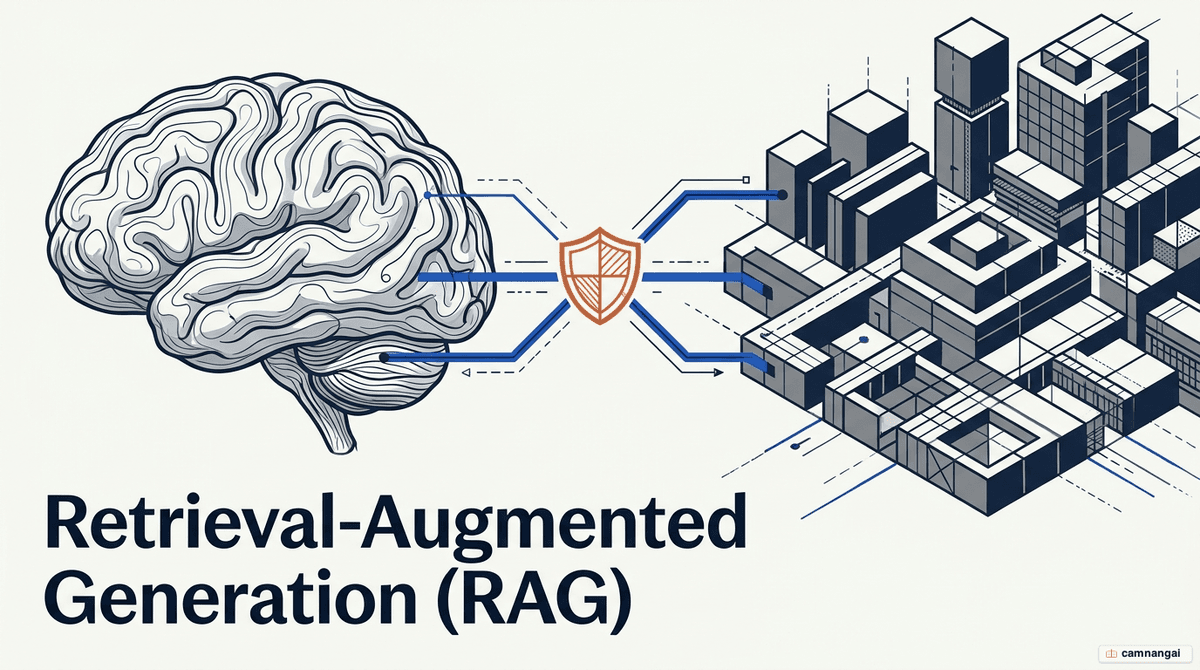
RAG (Retrieval-Augmented Generation) is an architecture that optimizes Large Language Model (LLM) performance by connecting models to external, authoritative knowledge bases.
Instead of relying solely on static training data, you use RAG to find relevant facts and add them to your prompt before the model generates a response. This keeps the output accurate, timely, and grounded in your specific data.
In engineering terms, RAG is the primary mechanism for grounding — anchoring a model's response to verified, factual evidence rather than its internal weights alone. By searching before it generates, RAG turns the LLM from a predictive autocomplete into a reliable, fact-grounded synthesis engine.
Why do LLMs need RAG?
Standalone LLMs frequently fail in production because of "knowledge cutoffs." Models are static; a model trained in 2025 has no inherent knowledge of events in 2026. They also lack access to "private data" — the internal company files, Jira tickets, and Slack messages that make your specific use case valuable.
Because LLMs are essentially advanced autocomplete engines, they work by predicting the next most likely word. When they lack specific facts, they often guess, which produces hallucinations.
Think of a standard LLM as a smart student in a locked room taking a closed-book exam, forced to rely entirely on memory. RAG turns this into an open-book test by handing the student the specific textbooks the query needs. This also mitigates the "Lost in the Middle" phenomenon: research shows model efficiency drops when relevant information is buried in the center of a long context window. RAG lets you optimize retrieval so the model isn't overwhelmed with irrelevant context.
How does RAG work?
RAG makes the system take a "beat" before answering. Instead of responding immediately, it queries a content store for grounding information. The high-level data flow is: User Prompt → Retrieval → Augmentation → Generation.
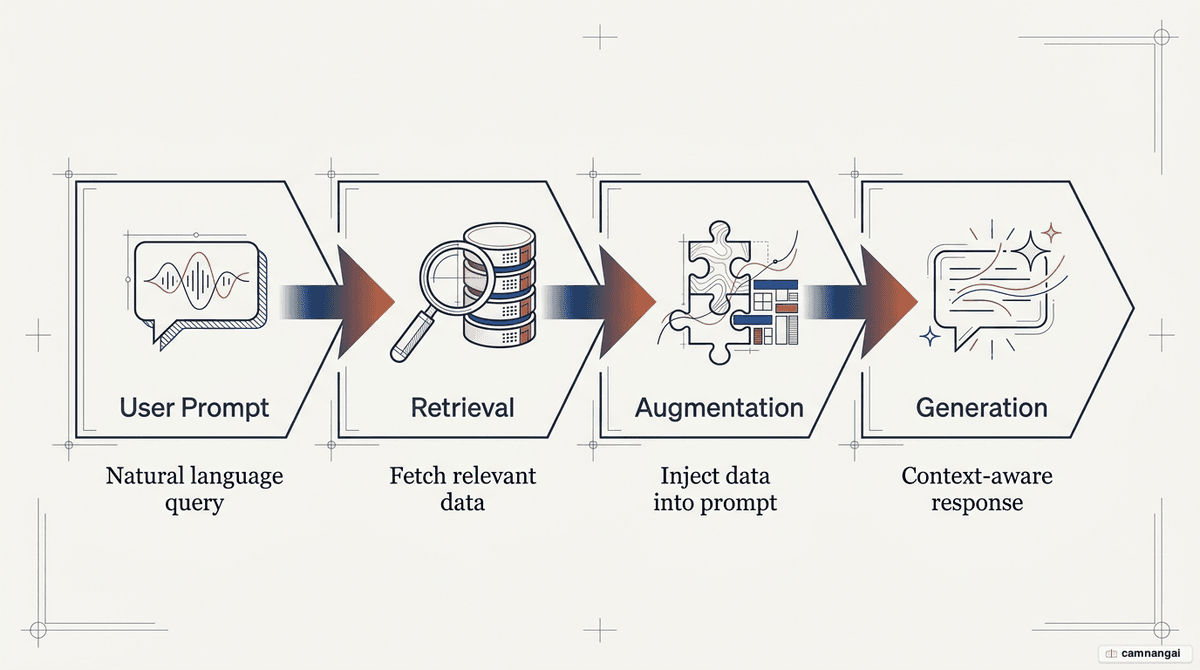
The technical workflow runs in five stages:
- Prompt submission. You submit a query to the integration layer.
- Retrieval. The system queries the knowledge base for relevant documents or data points.
- Integration. The retrieved results return to the coordination layer.
- Augmentation. The system combines your original prompt with the retrieved context.
- Generation. The LLM synthesizes a final, grounded answer from the expanded prompt.
In concrete terms, the system acts as a librarian who finds the exact pages in a library and hands them to the student (the LLM) to read before answering your question.
The core components of RAG
A production-ready RAG system has four primary components:
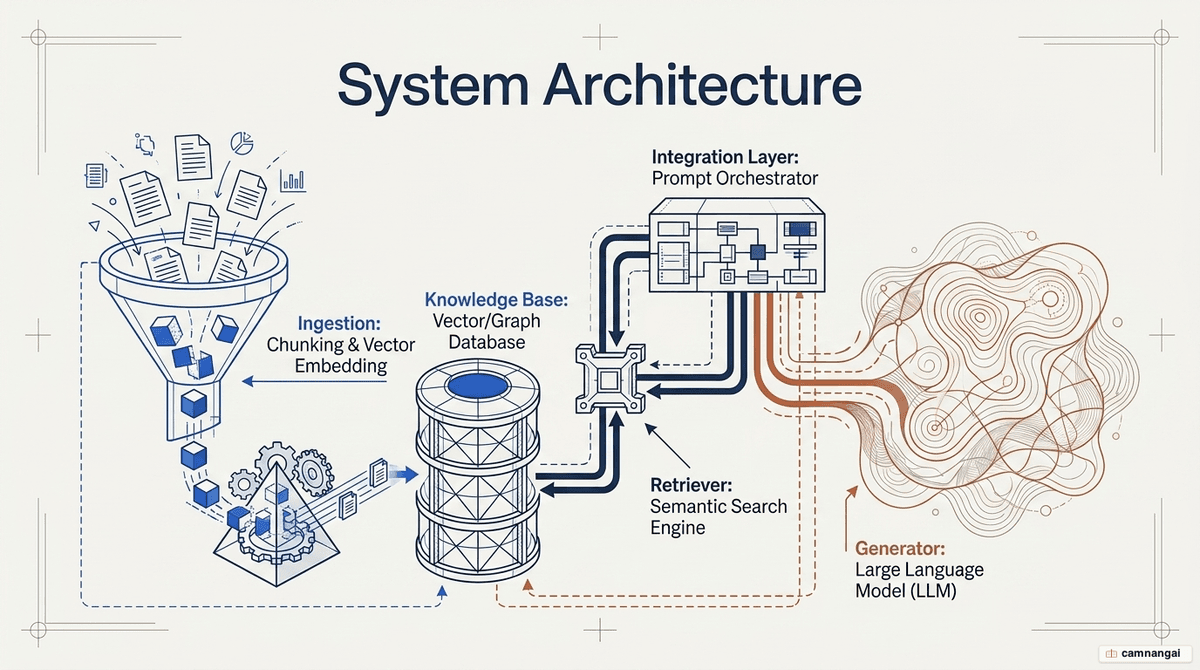
- The knowledge base. Your repository of raw data — unstructured files like PDFs, structured data in SQL databases, and relational data in knowledge graphs.
- The retriever. The AI mechanism that runs semantic similarity searches to locate relevant data.
- The integration layer. The orchestrator that coordinates prompt engineering and augmentation of the query.
- The generator. The LLM (e.g. GPT-4, Gemini) that produces the final response.
The ingestion process
Before retrieval can happen, data moves through an ingestion pipeline:
- Chunking. Breaking text into manageable segments to keep semantic coherence and fit the model's context window.
- Embedding. Converting those chunks into numerical vectors so the system can calculate mathematical similarity between queries and documents.
RAG vs fine-tuning: which should you use?
Both methods improve model performance, but they solve different problems.
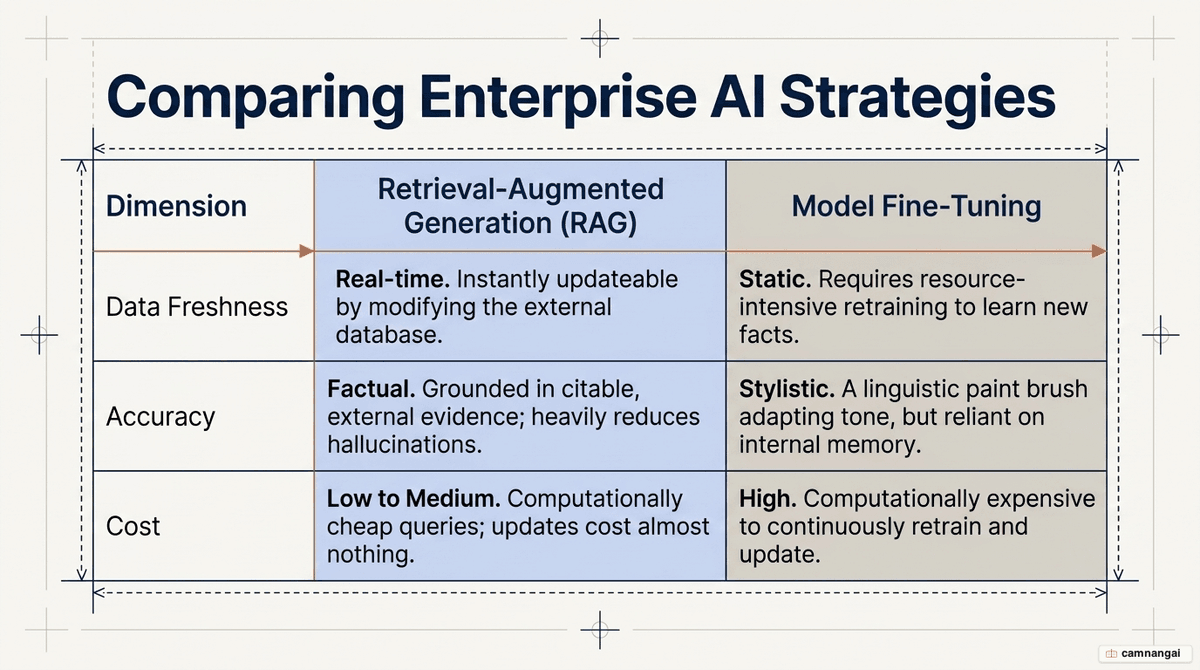
| Feature | RAG | Fine-tuning |
|---|---|---|
| Cost | Lower; no heavy compute for training | Higher; computationally intensive |
| Data freshness | Real-time; connects to current sources | Static; limited to last training date |
| Primary purpose | Access-controlled, timely information | Adapting style, tone, and vocabulary |
| Hallucination risk | Significantly reduced by grounding | Higher; model still predicts on weights |
Fine-tuning is your "linguistic paint brush" — best for domain adaptation or matching a specific brand voice. RAG is the standard for factual accuracy and secure data access.
What is RAG used for?
RAG is currently the foundation for most enterprise AI applications:
- Customer support chatbots. Accurate troubleshooting by accessing internal service manuals.
- Research. Letting financial analysts generate reports grounded in real-time market data.
- Knowledge engines. Internal HR bots that answer specific questions on company policy or benefits.
For example, Experian uses its "Latte" chatbot to navigate complex data broker information. JetBlue's "BlueBot" uses RAG to let teams query corporate data, and it pairs RAG with Role-Based Access Control (RBAC) so the finance team sees different data than the operations team despite using the same underlying model.
Challenges of deploying RAG
- Retrieval quality. If the retriever fetches noise or irrelevant chunks, the LLM generates a poor or off-topic answer.
- Chunking strategies. You must balance keeping related ideas together against staying within token-efficiency limits.
- Data freshness. Vector indexes go stale. You need automated pipelines to update embeddings whenever the source data changes.
- Latency. Each step — embedding, searching, and generating — adds time to the final response.
Advanced RAG techniques
To improve performance in complex environments, you can use advanced optimization methods:
- Hybrid search. Combines semantic vector search (understanding meaning) with traditional keyword or SQL search (finding exact IDs or names) to improve retrieval recall.
- Reranking. Using models like monoBERT or duoBERT, you sort retrieved chunks by strict relevance before augmentation. This is essential for mitigating "Lost in the Middle" by keeping the most critical information at the top of the prompt.
- Sentence-window retrieval. Decouples retrieval and synthesis chunks. The system retrieves a single relevant sentence but gives the LLM a broader surrounding window of text for enough context.
- Agentic and Graph RAG. Agentic RAG uses AI agents to decide when a search is necessary. Graph RAG uses knowledge graphs to map complex entity relationships, which is superior for questions about interconnected data.
Where do you start?
RAG is one link in a chain of foundational language-model concepts. A few related articles unpack each layer:
- What is a Large Language Model (LLM)? — the engine RAG plugs into.
- What is a context window? — the limit that shapes how you chunk data.
- What is an AI token? — the unit every model reads and writes.
- What is artificial intelligence? — the broad layer that contains everything below.
- What is generative AI? — the layer that creates new content.
FAQ
Does RAG require retraining? No. RAG provides external context to a pre-trained model at query time. You can update your knowledge base or add new documents instantly, without the computational cost or complexity of adjusting the model's weights.
Can RAG work with private data? Yes. RAG is the preferred architecture for private enterprise data. It keeps sensitive information in secure internal databases; the LLM only processes the specific data segments relevant to a given query, maintaining a strict security divide.
Does RAG stop all hallucinations? RAG significantly reduces hallucinations by grounding the model in factual data, but it cannot eliminate them entirely. If the retriever supplies low-quality information, or the LLM fails to prioritize that context over its training weights, inaccuracies can still occur.
References
- RAG Explained Simply with a Real Project — freeCodeCamp
- What is RAG (Retrieval Augmented Generation)? — IBM
- What is Retrieval-Augmented Generation (RAG)? — Google Cloud
- What is RAG? Retrieval-Augmented Generation AI Explained — AWS
- What is Retrieval-Augmented Generation (RAG)? — IBM Technology (video)
- What is Retrieval Augmented Generation (RAG)? — Databricks
- Retrieval-Augmented Generation (RAG): From Basics to Advanced — Tejpal Kumawat
- Retrieval Augmented Generation (RAG) Explained with LangChain — David Min