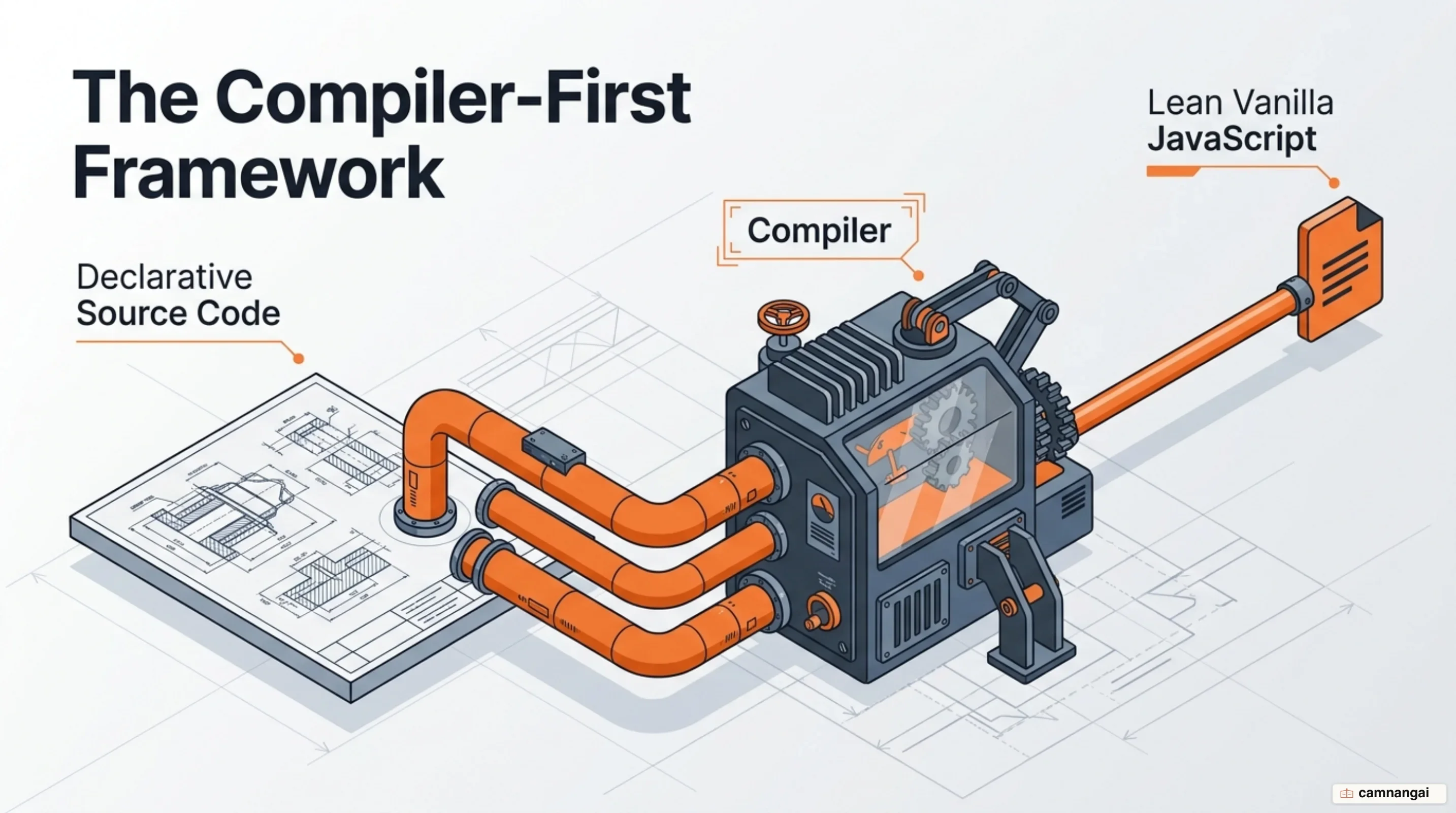
Svelte is a UI framework that shifts the heavy lifting of interface management from the browser to a build-time compiler, converting declarative code into optimized vanilla JavaScript.
Unlike runtime-first frameworks that ship a reconciler or reactivity engine to the client, Svelte performs its primary analysis during the build step. The resulting output consists of targeted imperative instructions that update the Document Object Model (DOM) directly.
This architectural shift ensures that the browser receives specialized code rather than a general-purpose engine. By handling complexity before the page loads, the framework minimizes the amount of JavaScript transmitted to the user.
This approach lets you build efficient web applications with much less runtime overhead.
The framework provides a comprehensive set of primitives for building modern web interfaces, including component logic, state management, and scoped styling. It is a complete toolset for developing interactive elements ranging from individual navigation bars to complex, full-stack applications.
What is Svelte?
Svelte is a tool for constructing user interface components, which represent the interactive
elements of a web page such as forms, comment sections, and navigation menus. While traditional
frameworks manage these elements using a runtime library that stays active in the browser, this
framework is a compiler. It reads files with the .svelte extension and generates the
necessary HTML, CSS, and lean JavaScript required to render the
interface.
The framework covers component-based development end to end. It provides built-in solutions for reactivity, scoped styling, and transitions. Because it operates as a compiler, it can analyze the source code and generate the specific DOM manipulation instructions needed for each component, rather than relying on a generic process to determine updates at runtime.
Svelte sits in an unusual spot in the modern web stack: it prioritizes build-time efficiency over runtime abstraction. You write declarative code and still get the performance of hand-optimized vanilla JavaScript. Being compiler-first is what separates it from the runtime-first libraries that dominate the ecosystem.
Why Svelte is called a compiler-first framework
Svelte earns the compiler-first label because it departs architecturally from runtime-first frameworks like React or Vue. Standard frameworks typically ship a large amount of framework logic — such as a virtual DOM reconciler or a reactivity engine — to the user's browser. Svelte, by contrast, runs its analysis and optimization during the build phase, meaning the framework logic largely evaporates before the application is deployed.
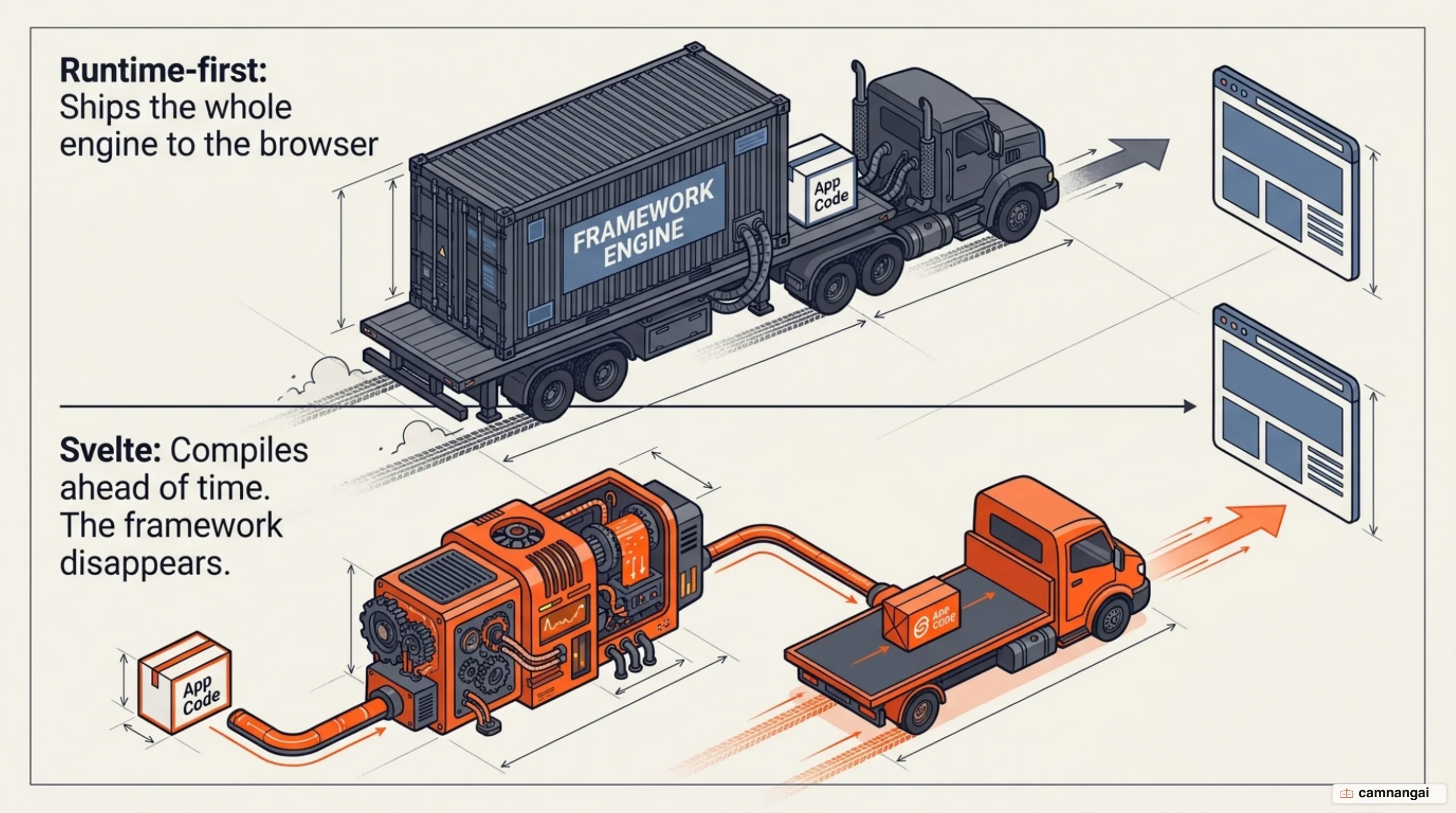
By running its processes at build time, the compiler can identify exactly where variables are referenced and how they impact the UI. It converts declarative component code into imperative JavaScript that targets specific DOM nodes. So the browser receives code that is tailor-made for the specific application, which means smaller bundle sizes and faster execution, because the browser never has to parse a general-purpose framework engine.
This concept is often referred to as the "disappearing framework." During the compilation step, the framework acts as a scaffolding tool that builds the final structure and then removes itself. The code that actually runs in the browser is composed of the application's own logic and the minimal instructions generated by the compiler to keep the UI in sync with the state.
Shifting complexity from runtime to build-time solves several performance bottlenecks inherent in traditional frameworks. It eliminates the need for the browser to parse and execute a large framework library before it can begin rendering the application. This results in a more efficient use of client-side resources, as the browser spends its energy on actual DOM updates rather than framework-level bookkeeping.
What the Svelte compiler does at build time
The compilation process begins by parsing a .svelte document into three distinct "buckets": script
tags for logic, style tags for presentation, and visual HTML tags for the structure. The compiler
generates an Abstract Syntax Tree (AST) to understand the relationship between data and the visual
output. It runs the acorn package to parse JavaScript into an AST and uses css-tree to walk
through the CSS rules.
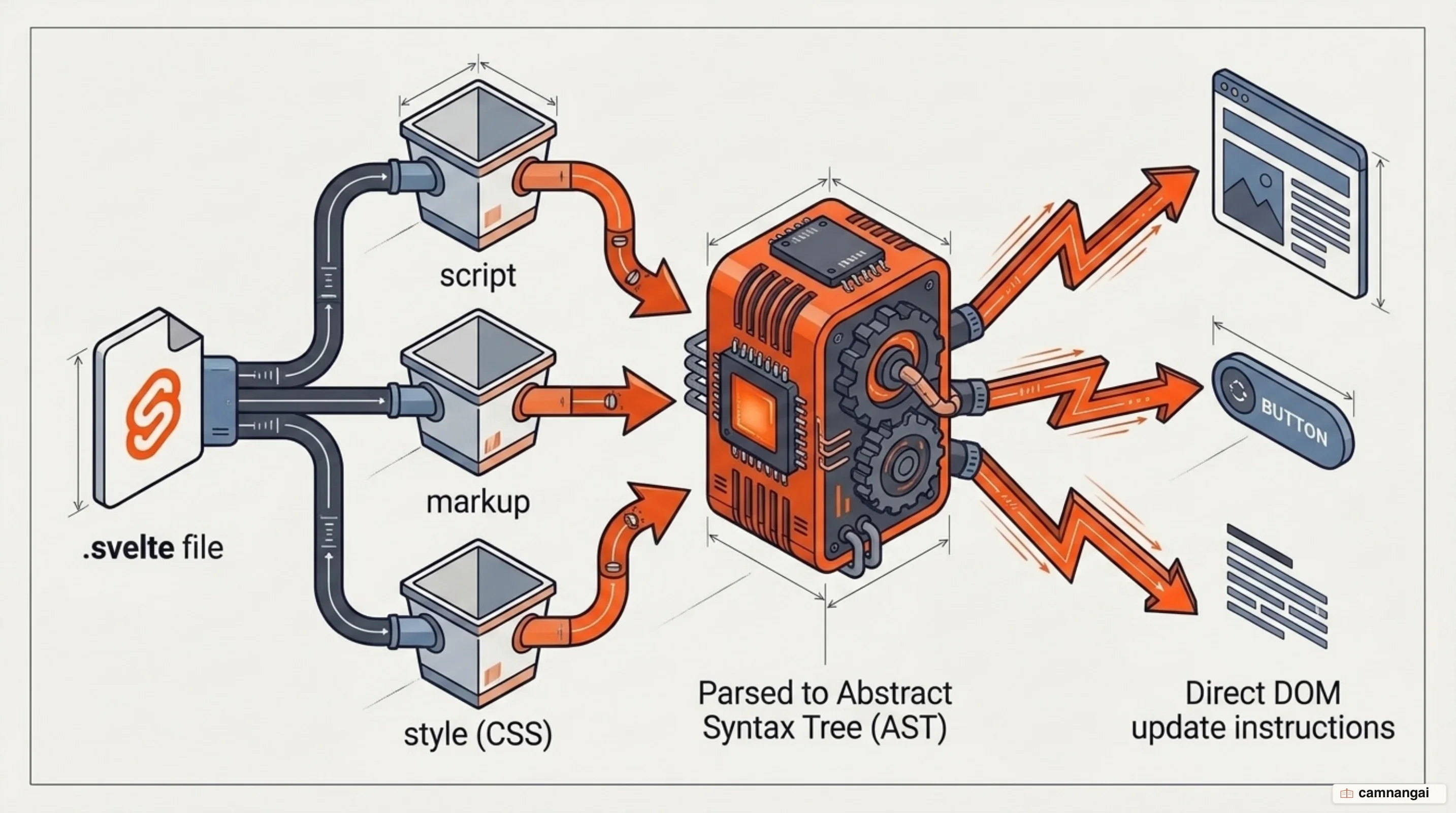
To locate reactive statements and exports (props), the compiler uses estree-walker to traverse the
JavaScript AST. This deep inspection allows the compiler to identify which variables are reactive
and transform high-level syntax into efficient code. During the CSS parsing stage, the compiler adds
unique prefixes to every style rule, which scopes styles to that component and prevents name clashes
without a runtime CSS-in-JS library.
The compiler also generates lifecycle functions such as create, mount, update, and detach. These functions contain the imperative instructions for DOM manipulation.
Instead of a generic engine attempting to determine what changed at runtime, the update function
contains explicit checks for specific variables. When a variable changes, only the corresponding DOM
nodes are modified.
The following code shows a simplified version of the imperative JavaScript the compiler might output for a basic component:
export default function MyComponent({ target, props }) {
  let { name } = props;
  let h1, text;

  return {
    create() {
      h1 = document.createElement("h1");
      text = document.createTextNode(`Hello ${name}!`);
    },
    mount() {
      h1.appendChild(text);
      target.append(h1);
    },
    update(changes) {
      if (changes.name) {
        text.data = name = changes.name;
      }
    },
    detach() {
      h1.remove();
    },
  };
}
Why Svelte drops the virtual DOM
Svelte operates on the premise that the virtual DOM is pure overhead. In a virtual DOM system, the framework creates an in-memory representation of the UI every time state changes. It then compares this new snapshot against a previous one to find differences — a process called reconciliation. This diffing work is extra computation that must be performed in addition to the actual DOM updates, wasting browser cycles on work that could be avoided.
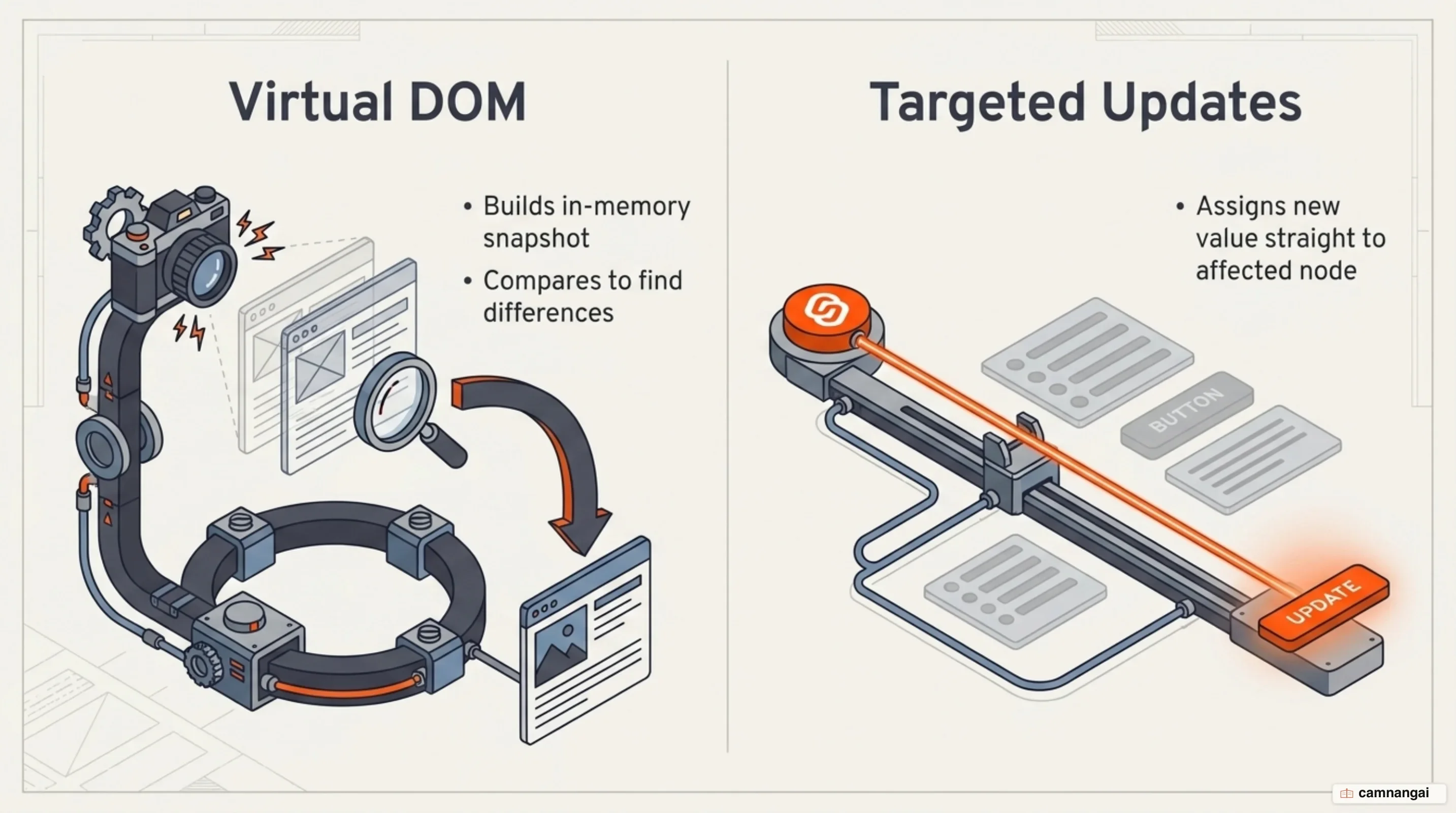
Because Svelte is a compiler, it knows at build time exactly how state transitions affect the UI. It does not need to wait until the application is running to determine which nodes need to change. By skipping the reconciliation loop, Svelte goes straight to the affected DOM nodes. This eliminates the "death by a thousand cuts" scenario where minor, unnecessary computations across many components eventually lead to a sluggish user experience.
In traditional frameworks, developers often manually optimize components using tools like
shouldComponentUpdate to prevent unnecessary re-renders. Svelte's architecture makes these
optimizations unnecessary by default. The compiler-generated code is inherently surgical, only
running the specific lines of JavaScript required to update a specific part of the page.
The efficiency of dropping the virtual DOM is most apparent in high-frequency UI updates, such as dashboards or real-time data feeds. In these environments, the overhead of creating and diffing virtual DOM trees can become a bottleneck. Svelte's approach keeps the browser focused on rendering, so the performance profile stays closer to hand-optimized vanilla JavaScript. The claim is narrower than the slogan makes it sound, though, because on a mostly static page nobody is going to feel the difference; it is the fast-updating screens where the diffing bill actually comes due.
Runes: how Svelte 5 handles reactive state
Svelte 5 introduced runes, which are signal-based primitives that influence the compiler using
function-like syntax. This model provides explicit, universal reactivity that is easier to reason
about as applications grow in complexity. Runes replace earlier implicit patterns, such as the $:
label or top-level variable declarations, with symbols that clearly define the reactivity graph
within the source code.
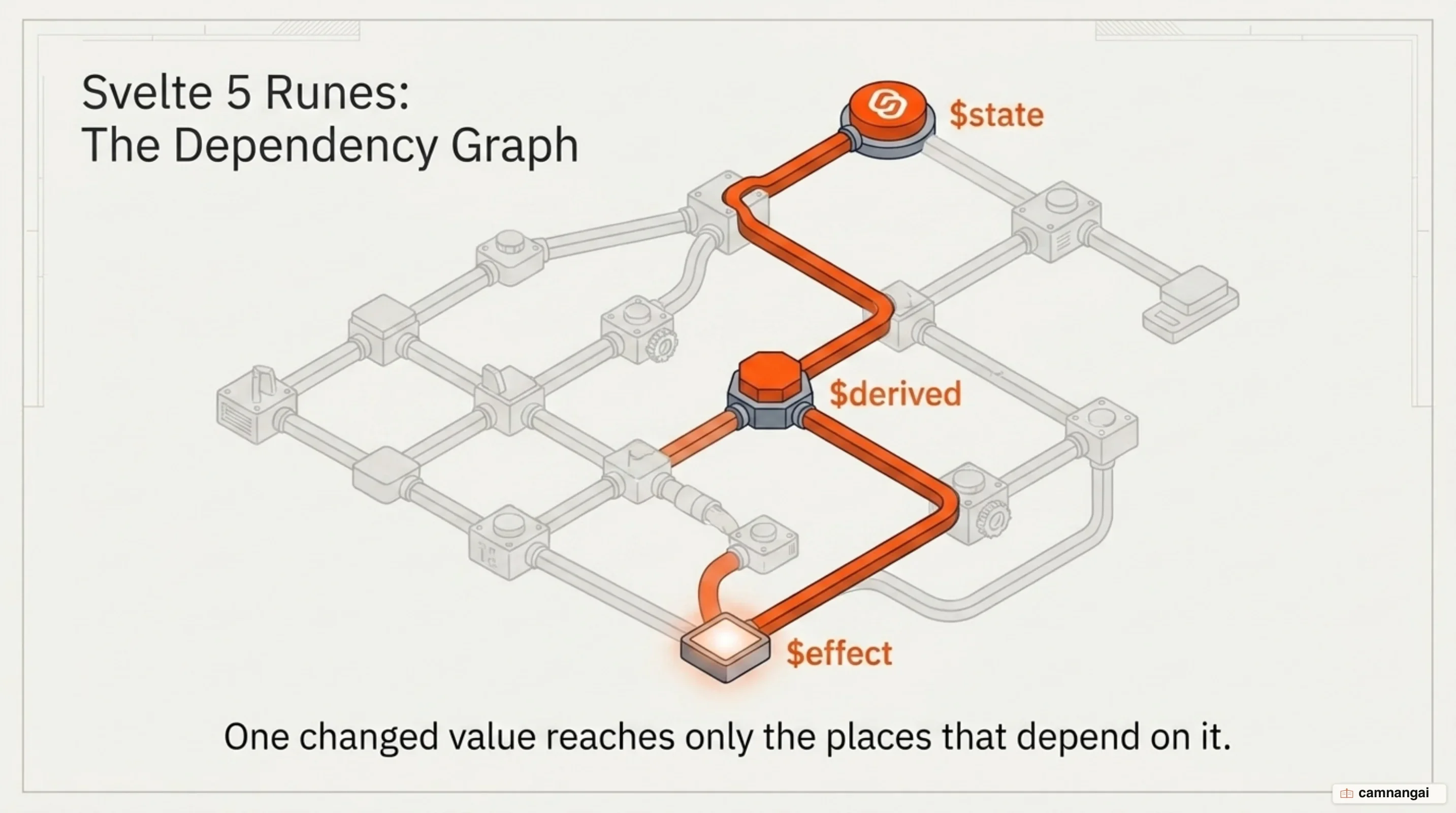
The core primitives include $state for declaring reactive variables, $derived for values that
depend on other state, and $effect for side effects. Unlike earlier versions where reactivity was
limited to the top level of .svelte files, runes are universal. They can be used inside standard
JavaScript or TypeScript files (.svelte.js or .svelte.ts),
allowing reactive logic to be easily shared and refactored across an entire project.
This transition to runes was driven by the need for better type-checking and fine-grained reactivity. Because runes are explicit, the compiler no longer relies on heuristics to determine what is reactive, which makes the framework more predictable. The underlying signal-based engine also means that a change to one value in a large list does not invalidate the entire list. Runes are the change I would point to first if someone asked what is actually new in Svelte 5: the syntax looks odd for about a day, and then the compiler stops guessing.
While Svelte 5's reactivity is powered by signals, these are considered an under-the-hood implementation detail rather than something developers interact with directly. This allows the compiler to maximize both efficiency and ergonomics. When compiling in server-side rendering (SSR) mode, the compiler can optimize away the signals entirely, since they are unnecessary overhead on the server.
The following example illustrates a counter implemented with the $state and $derived runes:
<script>
  let count = $state(0);
  let doubled = $derived(count * 2);

  function increment() {
    count += 1;
  }
</script>

<button onclick={increment}>Count: {count} (Doubled: {doubled})</button>
Single-file components: markup, script and scoped styles
Svelte uses a single-file component (SFC) format where logic, structure, and presentation
coexist in a single .svelte file. This co-location improves developer ergonomics by keeping all
parts of a UI element in one place. An SFC typically consists of a <script> block for logic,
standard HTML markup for the template, and a <style> block for CSS.
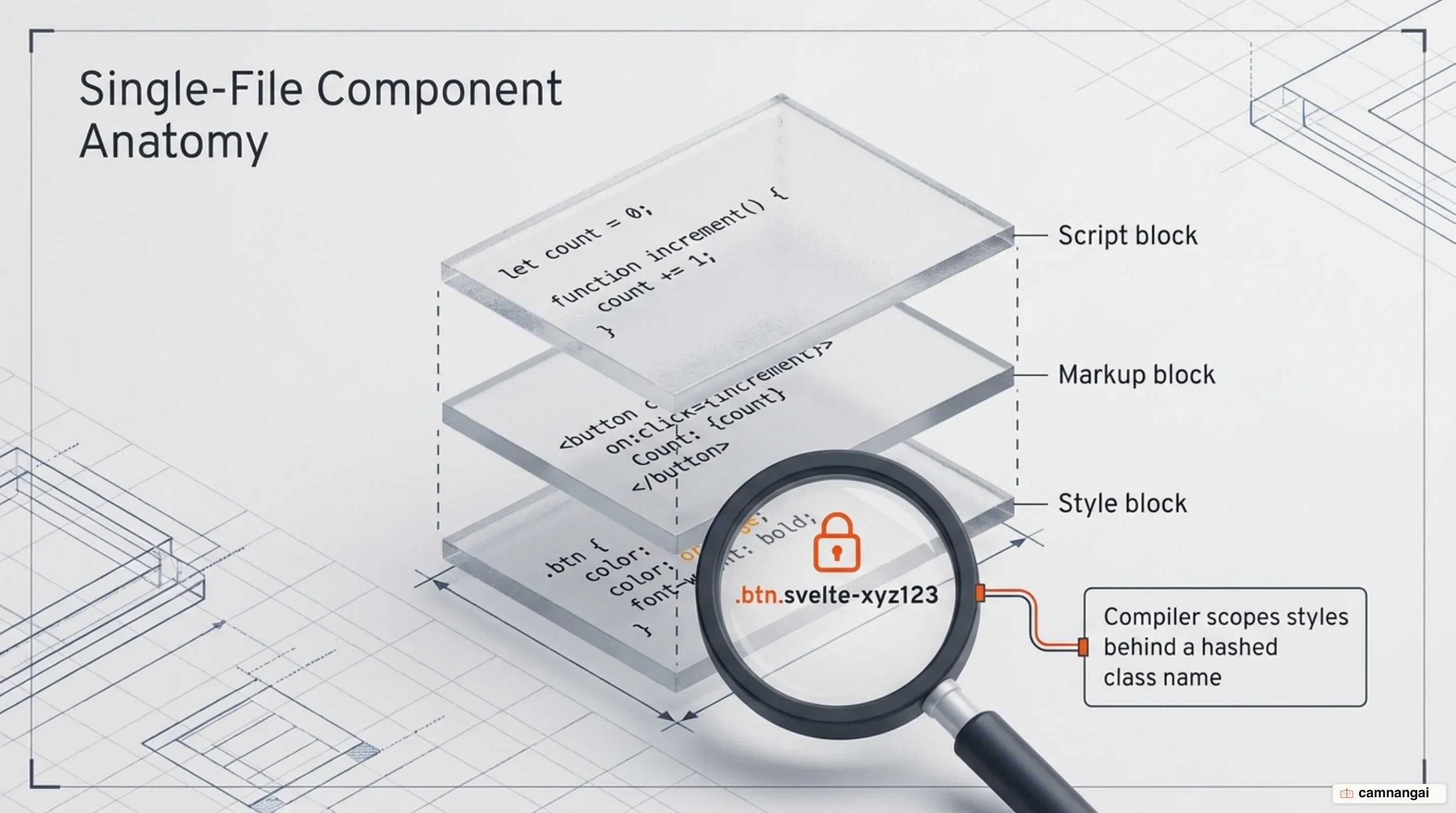
Scoped styling is a primary feature of these components. When styles are defined within a .svelte
file, the compiler automatically scopes them to that specific component by generating and injecting
unique class names. This prevents CSS rules from leaking and affecting other parts of the
application. Svelte achieves this isolation at build time with zero runtime performance cost.
This anatomy pushes you toward self-contained, modular UI pieces. Because styles are
isolated by default, developers can write simple CSS selectors without worrying about global
collisions. If global styles are necessary, the framework provides a :global() modifier, but the
default state is one of strict isolation.
The combination of logic, markup, and styles into a single file reduces the need for complex build configurations to link different parts of a component. This tighter structure lets developers move quickly from a raw idea to a functioning component. The compiler handles the complexity of unbundling these sections and optimizing them for the final production build.
SvelteKit: from components to a full application
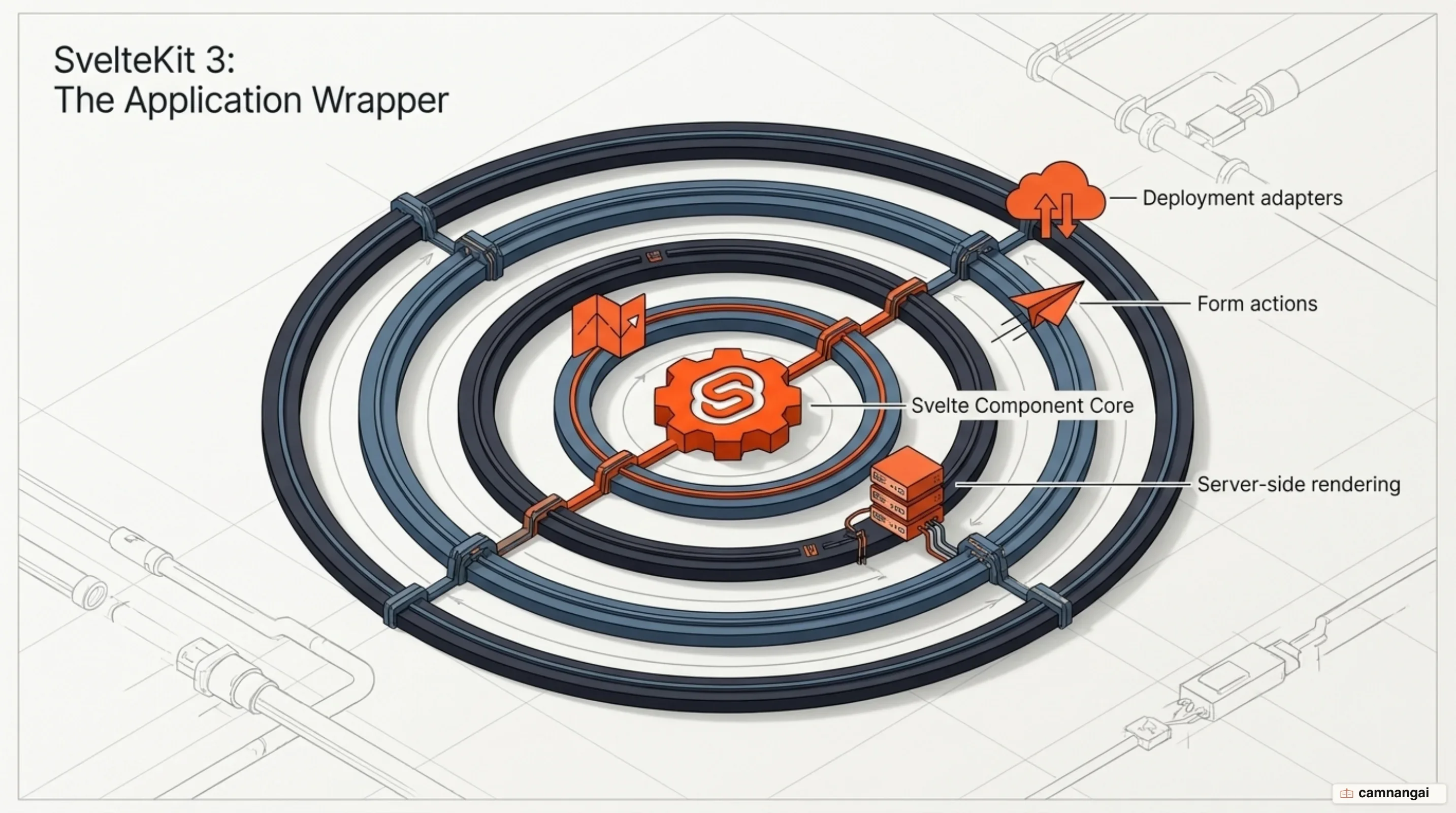
SvelteKit is the official full-stack meta-framework for Svelte, providing the infrastructure necessary to turn isolated components into production-ready applications. It handles features that Svelte alone does not, such as file-based routing, server-side rendering (SSR), and deployment adapters. If Svelte is the engine for the UI, SvelteKit is the chassis that makes it a complete vehicle.
Routing in SvelteKit is determined by the file system. Each directory within the src/routes folder
maps to a URL path, and specific file naming conventions — like +page.svelte and +layout.svelte
— define the UI for those routes. The framework supports server-only data loading via
+page.server.js files, which keeps sensitive logic and database queries on the server.
SvelteKit uses Vite for its development environment, and that is where Hot Module Replacement (HMR) comes from. For production, it uses adapters to transform build output for specific hosting environments, such as Node.js or Vercel. Additional features include form actions for progressive enhancement and built-in support for image optimization and SEO.
The framework is currently evolving toward SvelteKit 3, which introduces deeper architectural
refinements. Recent preview releases have introduced new modules such as $app/manifest and
$app/service-worker to allow for better introspection of build output at runtime. The major update
also replaces the invalidateAll function with refreshAll and improves type checking for error
pages and service workers. Preview is the operative word there, because a rename like
invalidateAll to refreshAll is the kind of change that becomes a search-and-replace across an
app you have already shipped.
How Svelte differs from React
The technical comparison between Svelte and React highlights a fundamental difference in architecture. React uses a runtime reconciler and a virtual DOM to manage updates, meaning the framework is always active in the browser. Svelte is a compile-time framework that converts components into direct DOM instructions, removing the need for a runtime engine.
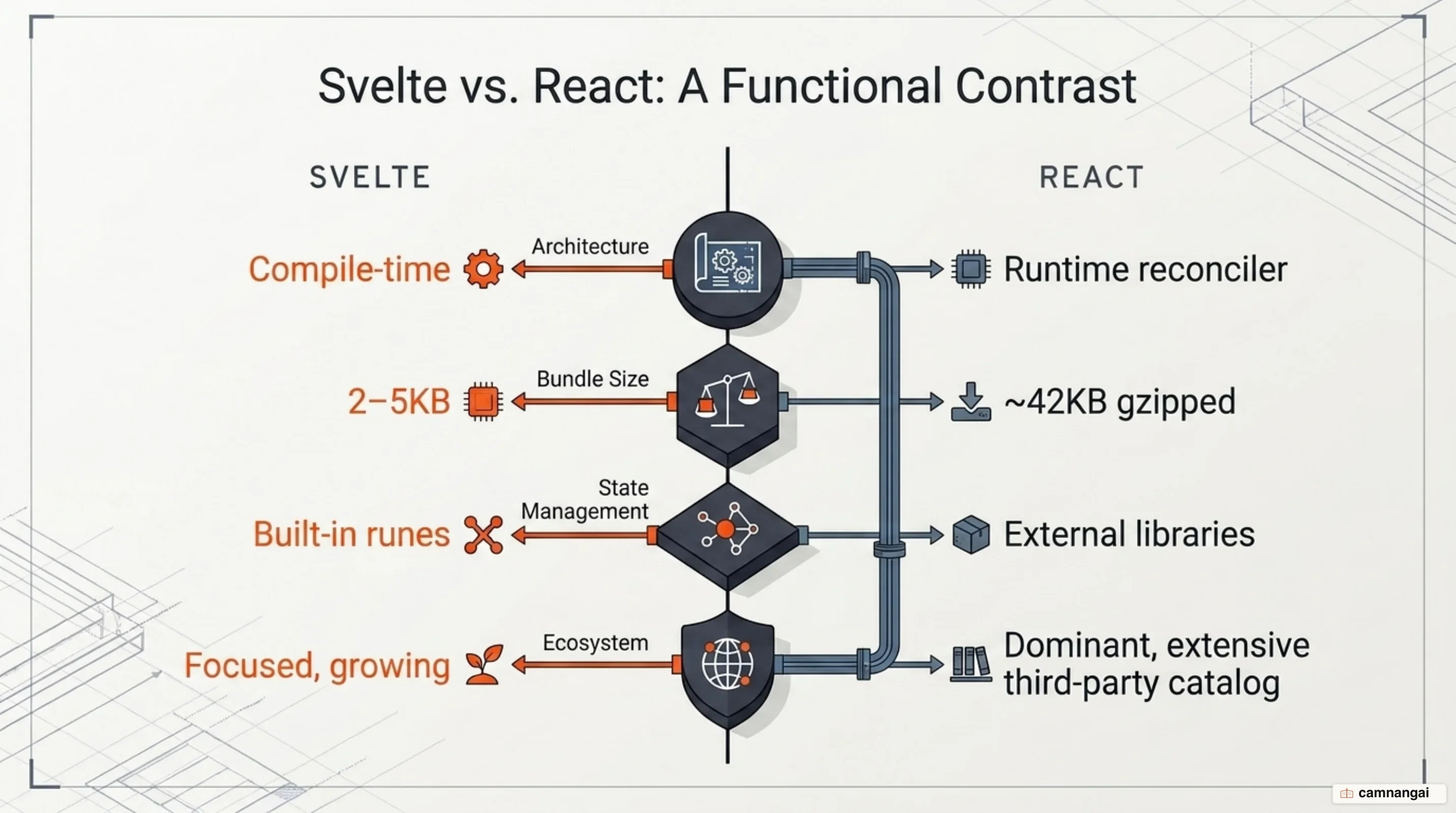
Svelte applications typically have a much smaller initial payload. A minimal Svelte application bundle ranges from 2KB to 5KB, whereas a React application, including React and ReactDOM, starts at about 42KB gzipped. That gap matters most for performance-sensitive projects and for applications targeting users on restricted mobile networks.
State management also differs substantially. React uses the useState hook and setter functions to
trigger re-renders, requiring strict adherence to hook rules and dependency arrays. Svelte 5 uses
the $state rune, allowing for direct assignment like count++. The compiler handles the
underlying complexity of syncing changes to the DOM, so the code you write behaves like standard
JavaScript.
While React benefits from a vast ecosystem of third-party libraries, Svelte focuses on a lower-boilerplate experience by including features like scoped styles and transitions out of the box. Both frameworks support TypeScript, but they cater to different priorities regarding runtime abstraction versus build-time optimization.
When to choose Svelte for your project
Svelte is a good fit for projects where performance, bundle size, and low boilerplate are critical priorities. It is particularly effective for content-heavy sites, performance-sensitive dashboards, and marketing pages where initial load times drive user engagement. Teams that prefer a smaller mental model and a framework that stays close to standard web technologies get the most out of Svelte's single-file components and explicit reactivity.
However, Svelte may not be the ideal fit for every scenario. Projects that require the deep ecosystem of React — such as those needing specialized enterprise UI libraries or React Native for mobile — may find the React ecosystem more supportive. Organizations with a large existing investment in React or Angular may also prefer to keep their current stack and use the internal libraries and hiring pipelines they already have.
References
- Overview • Svelte Docs
- Virtual DOM is pure overhead
- The Svelte compiler: How it works — DEV Community
- Introducing runes
- Introduction • SvelteKit Docs
- What is Svelte? The compiler-first JavaScript framework — Vercel
- Svelte vs. React: How to pick the right frontend framework — Vercel
- What's new in Svelte: August 2026