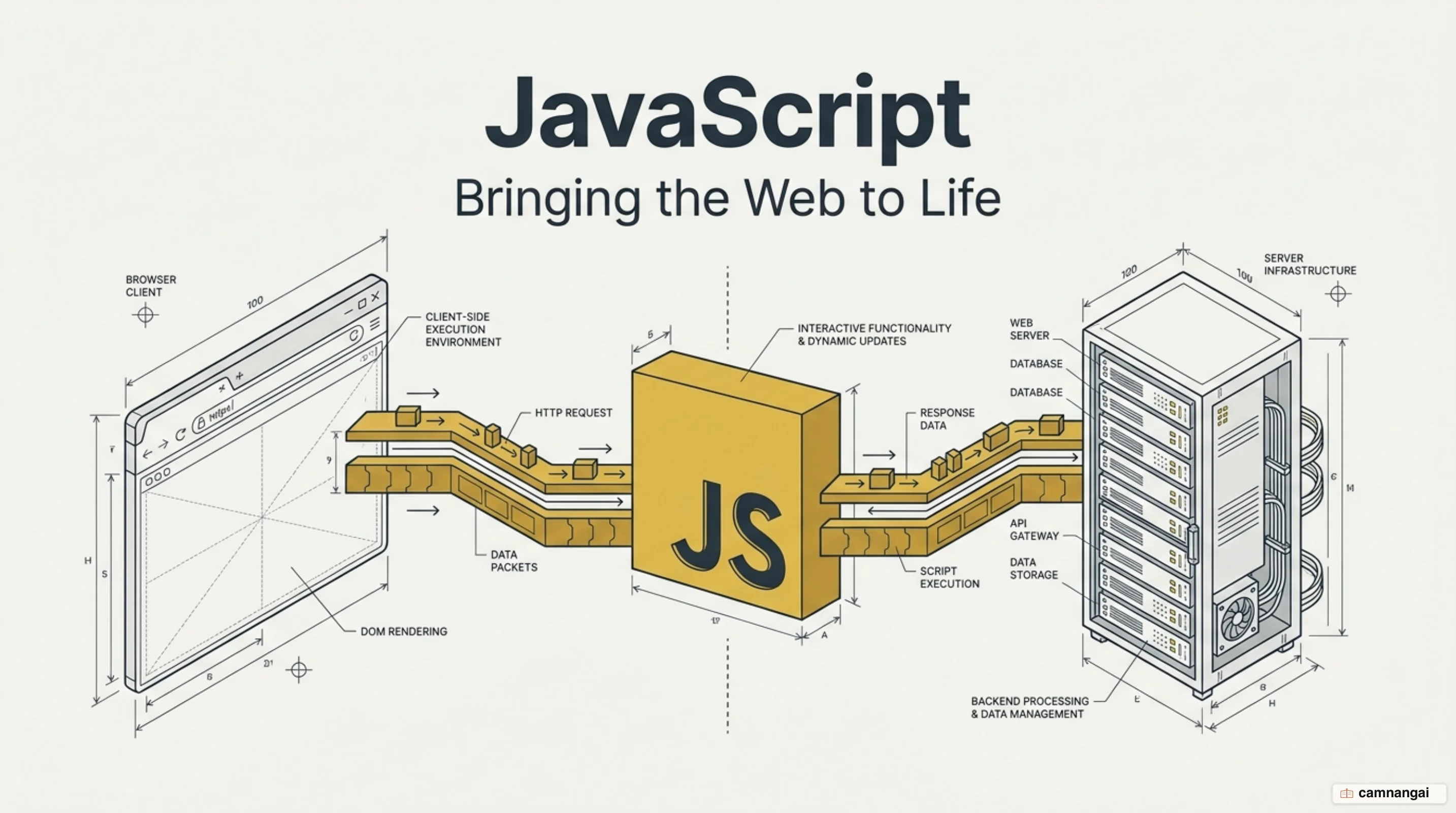
JavaScript is a cross-platform, object-oriented scripting language engineered to provide interactivity within host environments, primarily web browsers.
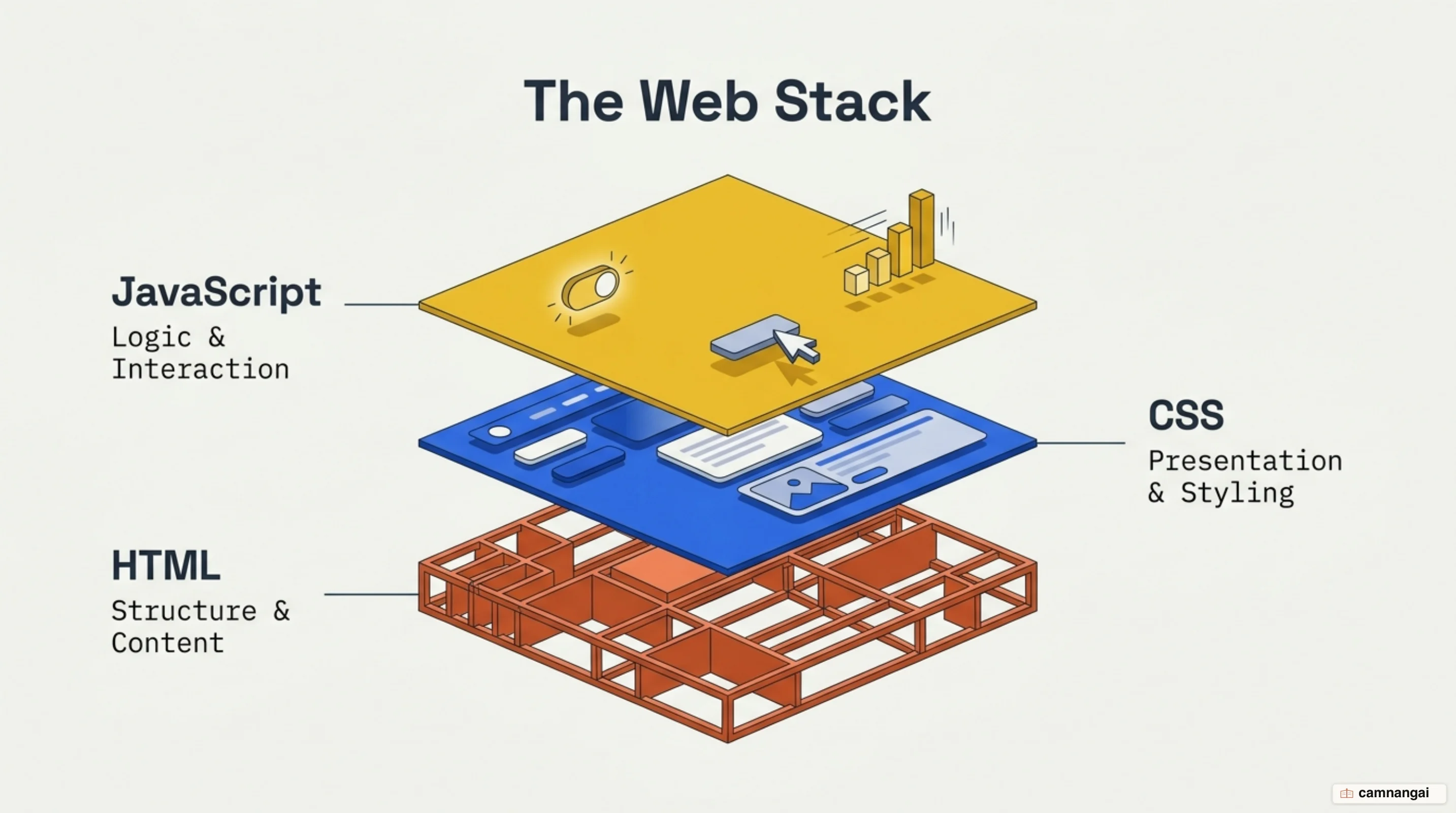
An introduction to JavaScript starts here: the language is the logic layer of the web, the "electricity and plumbing" that drives dynamic behavior. While HTML and CSS manage structure and presentation respectively, JavaScript is the part that actually computes, because it processes data and rewrites the Document Object Model (DOM) while the page is still on screen.
JavaScript is an interpreted language where the core engine is connected to host-specific objects via environment-provided APIs. This integration gives you programmatic control over the interface and system resources. Its versatility has led to its deployment beyond simple browser scripting, enabling high-performance execution in server-side runtimes, mobile applications, and embedded systems.
What is JavaScript?
JavaScript originated in 1995 as a tool for adding client-side functionality to early websites. Since its inception, the language has evolved from a targeted scripting tool into a general-purpose language used in high-concurrency server environments, mobile development, Internet of Things (IoT) hardware, and game engines. While its syntax is heavily based on C and Java to provide a familiar interface for developers, its underlying execution logic is fundamentally distinct.
Performance changed with the arrival of the V8 engine. By optimizing how the core logic executes, V8 gave the language enough headroom to become a viable back-end option, and that single piece of engineering is the reason JavaScript is anywhere near a server today. The language is an interpreted, dynamically typed system that executes code line-by-line, with the engine determining variable types during runtime rather than during a pre-compilation phase.
The core language includes a standard library of built-in objects—such as Math, Array, and Map—alongside standard control structures. These core elements are extended by host environments to perform specialized tasks. For example, browser-based environments provide the DOM for UI manipulation, while server-side runtimes provide file system access and database connectivity.
Where JavaScript runs: browser, server and beyond
JavaScript depends entirely on its host environment, which feeds data to the engine and provides hooks for interacting with external resources. In client-side JavaScript, the browser is the host, exposing the DOM to the script. This enables the language to respond to user events, such as clicks or form inputs, and modify the state of the page without requiring a full page reload.
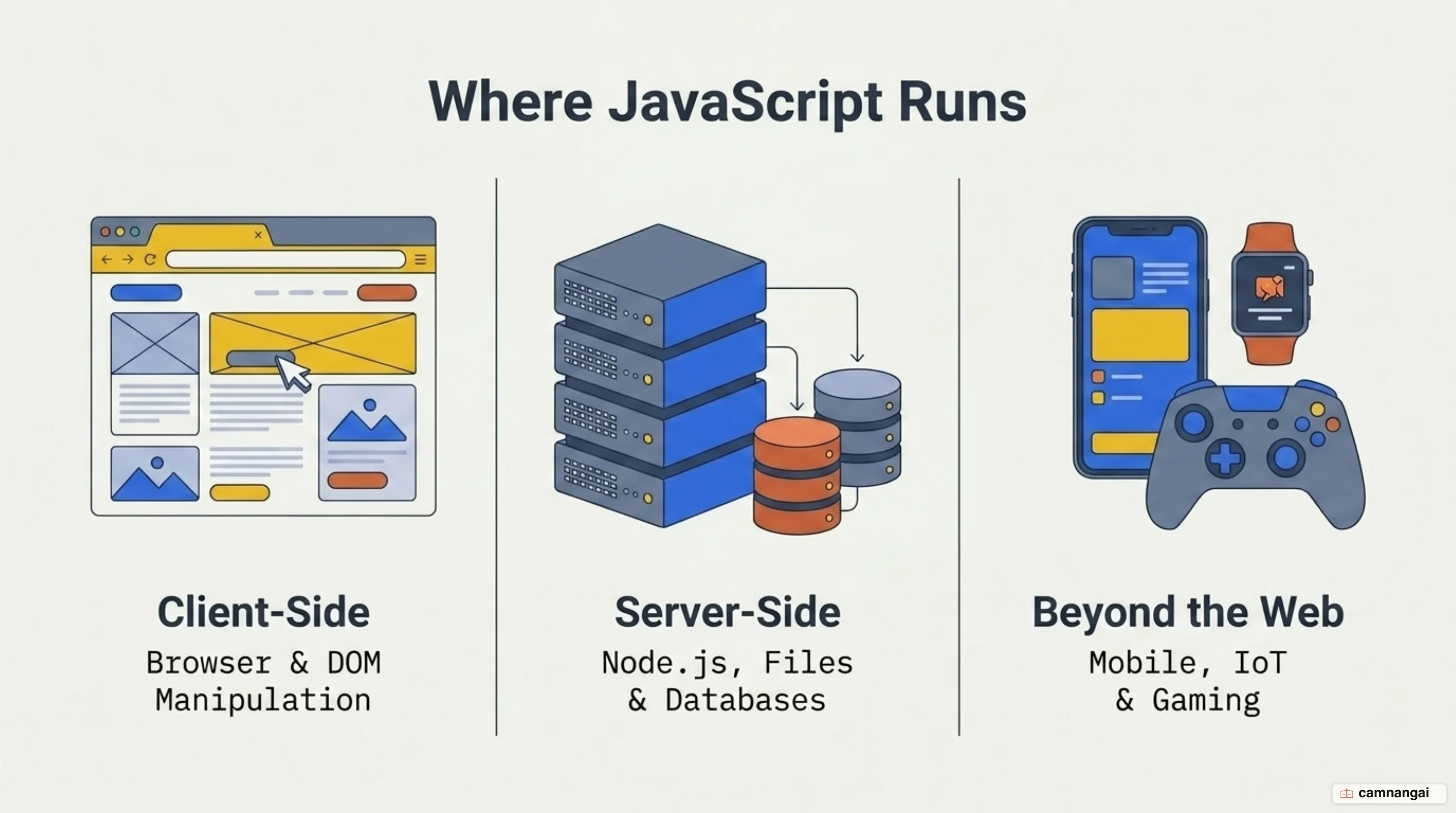
In contrast, server-side JavaScript—most notably through Node.js—extends the core language with objects relevant to server-level operations. These include APIs for communicating with relational databases, performing file manipulations on the server's hard disk, and managing persistent information across multiple application invocations. This gives you a unified development stack where the same logic layer both generates requests and processes responses.
Beyond the traditional web stack, JavaScript is deployed in diverse environments including desktop apps via specialized frameworks, serverless architectures where code is executed in isolated cloud functions, and embedded systems for managing low-level hardware. The engine is the same in every one of them, and only the environment objects change, which is why someone who learns the language once can follow it into places it was never designed for.
How JavaScript differs from Java
JavaScript is not Java. While JavaScript adopted certain naming conventions and expression syntaxes from Java to appeal to developers in the mid-1990s, the underlying logic and architectural implementation of the two languages are fundamentally different. That borrowed name was a pitch to 1990s developers, and I think it has confused more beginners than any other naming decision in the field.
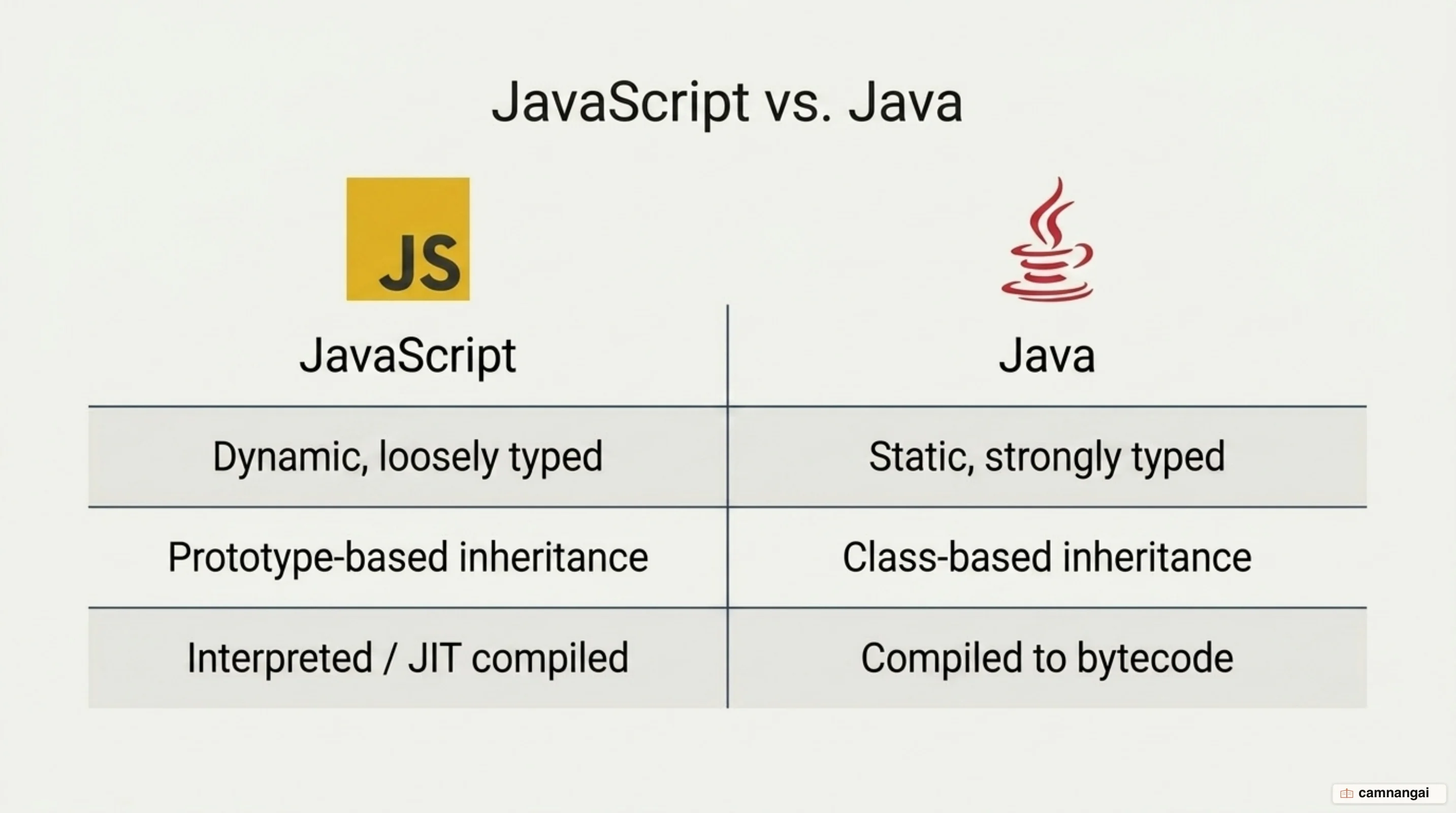
The primary divergence lies in the typing and inheritance models. JavaScript uses a loose, dynamic typing system where variable types are not enforced and can be reassigned at runtime. Java is a static, strongly typed language where types must be explicitly declared and verified at compile-time. JavaScript also uses a prototype-based inheritance model, so properties can be added to individual objects at runtime. Java employs a rigid class-based hierarchy where inheritance is defined through fixed class declarations.
| Feature | JavaScript | Java |
|---|---|---|
| Typing | Dynamic / Loosely typed | Static / Strongly typed |
| Inheritance | Prototype mechanism | Class hierarchy |
| Disk Access | Cannot write to hard disk (browser) | Can write to hard disk |
| Implementation | Interpreted / JIT | Compiled to bytecode |
ECMAScript: the standard behind the language
Ecma International standardizes the language through the ECMA-262 specification. This standardized version, known as ECMAScript, ensures consistent behavior across different browsers and runtimes. The specification is also ratified as ISO-16262, an international standard. While ECMAScript defines the core computational logic, it does not describe the DOM, which is managed separately by the W3C and WHATWG.
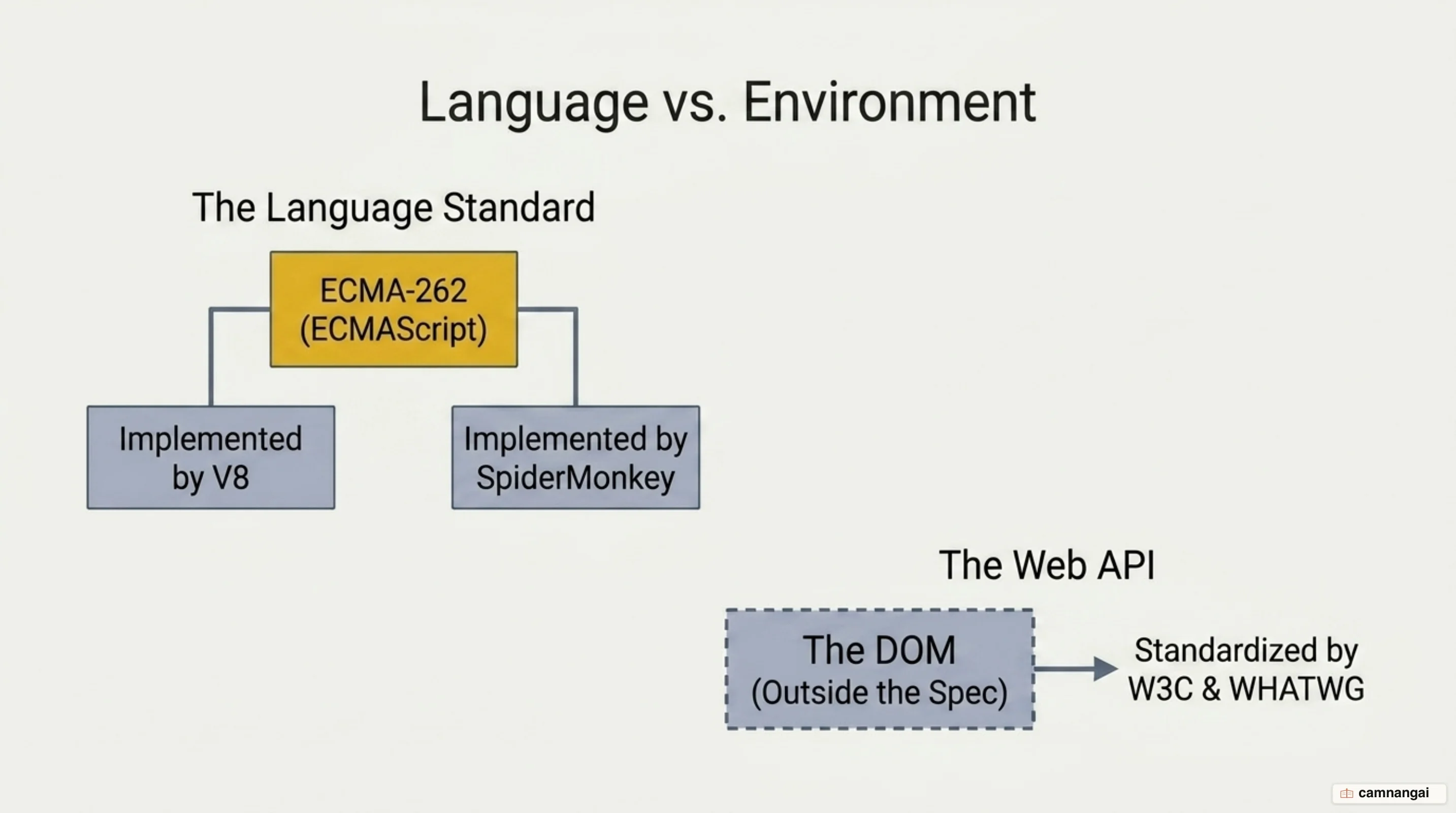
The release of ES6 (ECMAScript 2015) was a major shift in the language's architecture. It marked a transition from "Scope-heavy" legacy patterns to a modern "Module-based" architecture, introducing block-scoped variables and formal class syntax. Following ES6, the standardization process moved to a yearly update cycle (ES7, ES8, etc.), allowing the language to evolve rapidly through a structured proposal and approval pipeline.
Modern engines, such as Chrome's V8 or Firefox's SpiderMonkey, implement these standard features so that the same code behaves the same way everywhere. Because they follow ECMA-262 closely, any company can build its own compliant engine and still run the whole language, which is the reason the web never ended up owned by a single vendor's runtime.
Variables and primitive data types
JavaScript provides three keywords for variable declaration. var is the legacy ES5 keyword and lacks block-scoping, which can lead to unpredictable hoisting behavior. let and const were introduced in ES6 to provide block-level scope. While let allows variable reassignment, const creates an immutable reference — but const does not prevent the mutation of the internal properties of an object stored in the heap. That gap catches people constantly, and the keyword's name is entirely to blame.
The language specifies seven primitive data types:
- Number: 64-bit double-precision floating-point values (IEEE 754).
- BigInt: Used for arbitrarily large integers exceeding the safe limit of +/- 9007199254740991.
- String: UTF-16 encoded sequences of characters.
- Boolean: Logical values representing
trueorfalse. - Symbol: Unique identifiers used to prevent property collisions.
- Undefined: Indicates a variable has been declared but not assigned a value.
- Null: A deliberate representation of a non-value.
For integers beyond the safe limits of the Number type, append the n suffix to the literal to make it a BigInt.
let name = "Simon"; // String
const Pi = 3.14; // Number (Constant)
let x; // Undefined
const largeInt = 9007199254740992n; // BigInt with n suffix
Operators and control flow
JavaScript supports standard arithmetic operators, including addition (+), subtraction (-), multiplication (*), and division (/). It also includes the modulo (%) operator for remainder arithmetic. A significant behavior of the + operator is its overloading; if either operand is a string, the engine performs string concatenation rather than numerical addition.
For equality comparisons, the language provides both double-equals (==) and triple-equals (===). The triple-equals operator is the one to reach for, because it compares strictly and does no type coercion at all. The double-equals operator converts operands to a common type before it compares them, which yields results nobody predicts once the surrounding logic gets complex. Use ===.
Control structures manage execution flow through if/else and switch blocks. Iteration is handled via while and do...while loops, as well as the standard for loop. For modern data structures, JavaScript provides for...of to iterate over values in an iterable and for...in to iterate over the enumerable properties of an object.
Functions, objects and arrays: the three building blocks
Functions in JavaScript are first-class objects, meaning they can be assigned to variables, passed as arguments, and returned from other functions. Architecturally, function calls involve a stack-based scope; the return statement is the only mechanism for data to escape this local function scope. Without an explicit return, a function implicitly returns undefined.
Objects are collections of key-value pairs that work like hashes. Unlike primitives, objects are heap-allocated and accessed by reference. You access properties with dot notation (obj.key) for standard identifiers, or bracket notation (obj["key"]) for dynamic or non-standard keys. Because objects are passed by reference, mutations are visible across all references to that specific instance.
Arrays are a specialized type of object optimized for ordered data. They have a "magic" length property that is automatically updated to be one higher than the highest index. Avoid "sparse arrays"—arrays with uninhabited slots—as they cause the engine to deoptimize the structure from a high-performance array to a standard hash table. Out-of-bounds indexing returns undefined rather than throwing an error, and that silence is a design choice I would not repeat, because the bug surfaces somewhere else entirely, far from where you made it.
Asynchronous code and the single-threaded model
JavaScript operates on a single-threaded execution model, using an event loop to handle concurrency without parallelism. This model allows the engine to queue tasks and poll for completion, ensuring the environment remains responsive during I/O-intensive operations.
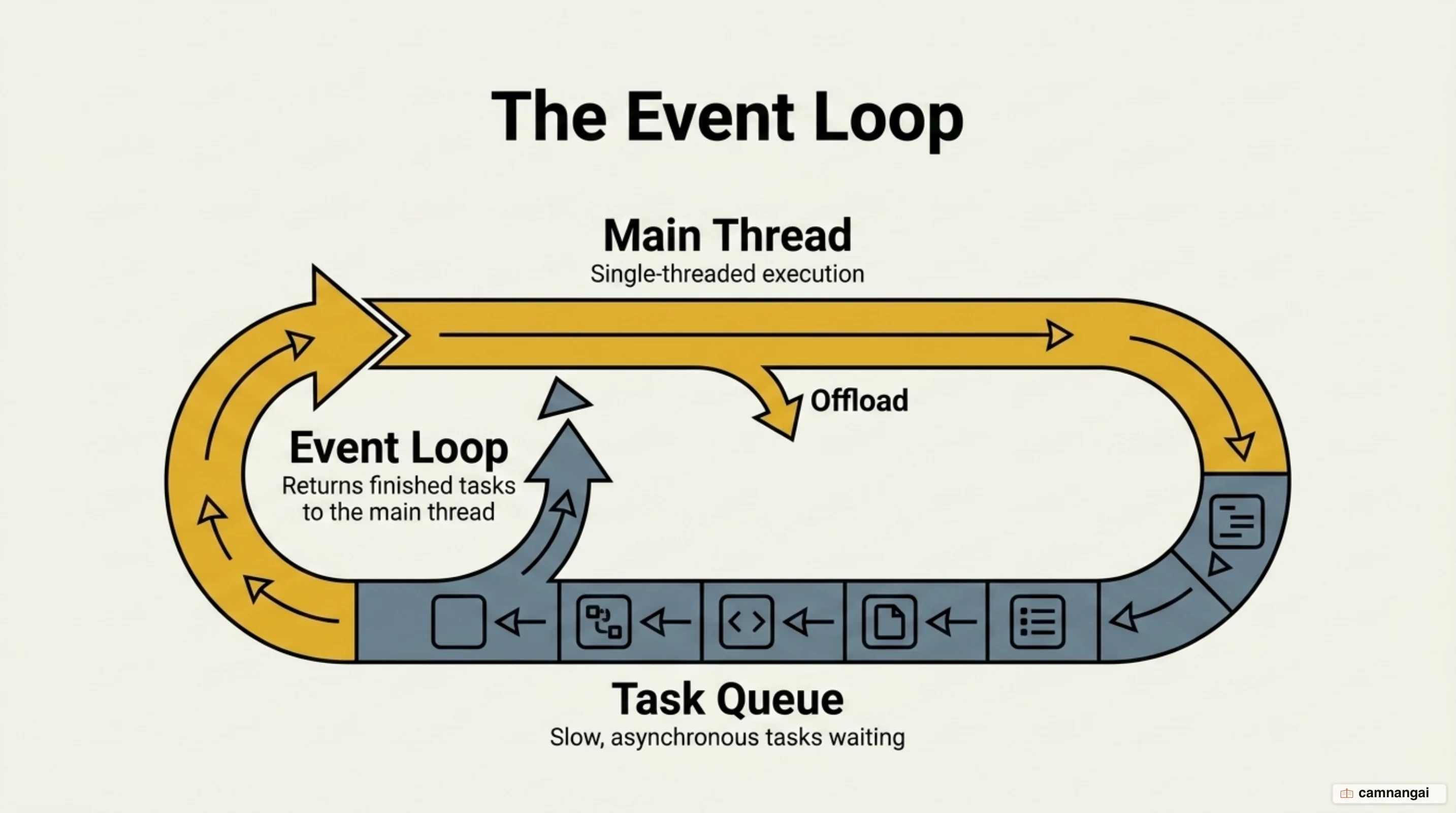
The language provides three idiomatic patterns for managing asynchronous operations:
- Callbacks: Passing a function to be executed upon task completion.
- Promises: Objects representing the eventual completion (or failure) of an async operation.
- async/await: Syntactic sugar for Promises that allows asynchronous code to be written in a synchronous-looking style.
This non-blocking I/O model makes JavaScript efficient for server-side tasks involving frequent database or network requests. However, pure JavaScript CPU-bound tasks will still block the main thread, and while it is blocked every pending request waits with it, so for actual parallelism on computationally intensive operations you delegate the work to workers.
Where should you start learning JavaScript?
To begin implementation, use the JavaScript Console built into every modern web browser (accessible via F12 or Cmd+Option+J). It runs whatever you type immediately using eval logic, returning the last expression you entered to the screen.
In a project, you embed code in HTML documents with the <script> tag, or save it in external .js files. For server-side execution, scripts are run via the terminal using the node index.js command, provided Node.js is installed in the environment.