The difference between closed and open source AI models comes down to who holds the weights and who controls the infrastructure they run on.
With a closed system like GPT-5.6 Sol or Claude Fable 5, you reach the model through an API and the provider keeps absolute control over its parameters. With an open model you download the weights and run them on your own hardware, which puts the internals within reach instead of leaving you at the edge of a prompt box.
Treat the choice as a trade-off across cost, privacy, and operational control rather than a binary hunt for the smartest model available. Open-weight variants now hold roughly 30% of token volume, which makes them a viable path for organizations that need deep integration or face strict data residency requirements.
Closed models give you a software-only stack with near-zero management overhead. Open models demand a hardware-first one.
As the performance gap narrows to a few months, the decision shifts from a capability check to an honest assessment of your own MLOps maturity.
What actually separates closed and open AI models?
The technical distinction breaks down along six dimensions: capability, privacy, cost, ops complexity, fine-tuning, and latency. Closed frontier models still define the ceiling for complex reasoning, but open-weight models are converging on those benchmarks. That convergence shows up in the shift from single-pass generation to agentic inference, which is multi-step deliberation involving planning and iterative refinement, and that capability is now present in trillion-scale open Mixture-of-Experts (MoE) models and proprietary APIs alike.
Choosing a model type decides the rest of your stack. Pick closed and you get a software-only stack where the provider abstracts the underlying complexity and charges per token. An open-weight model forces a hardware-first stack instead: you provision GPU clusters, implement health monitoring, and manage auto-scaling for frameworks like vLLM or TGI.
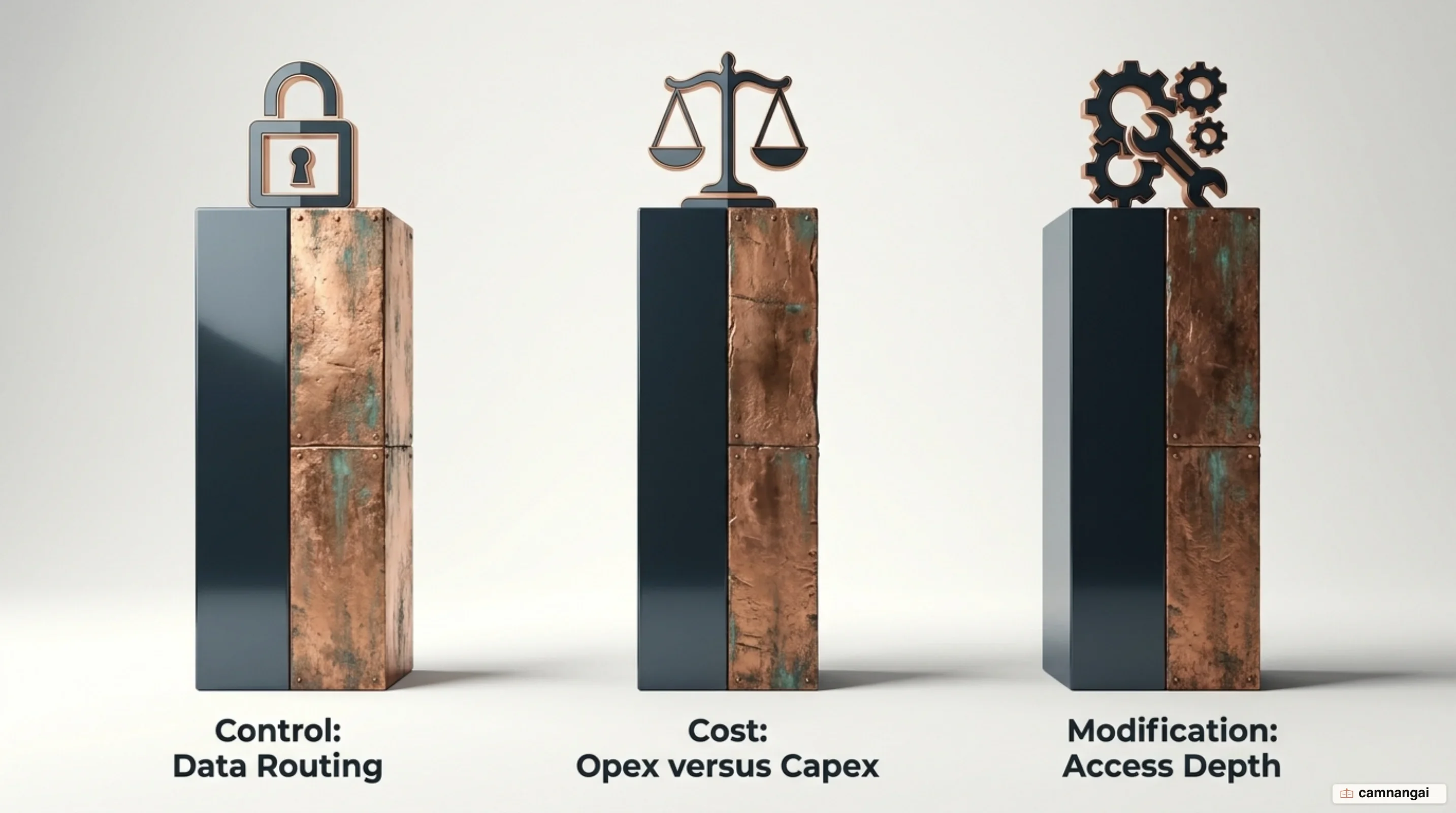
The infrastructure stack contrast
Closed models rely on simple API calls, which is ideal for fast prototyping but rules them out entirely for teams with strict data residency requirements. Open models can be co-located with the data, which is what satisfies HIPAA or GDPR. Open source carries high upfront cost for buying GPUs and running the cluster, but the marginal cost per token at high volume, above 50M tokens per day, drops far below the proprietary alternative.
Why almost no model is truly "open source"
Engineers routinely say "open source" when they mean "open weights". The Open Source Initiative's definition requires more than parameters: the complete source code used to train and run the system, data information detailed enough for a skilled person to rebuild something substantially equivalent, and the weights themselves — all under terms that permit free use, study, modification, and sharing. Most models, Llama and Mistral included, release the final parameters and keep the recipe as a trade secret.
This creates an open-weights gap that limits reproducibility and accountability. You have enough to fine-tune with LoRA or QLoRA, but not the training code needed to reproduce how the model was built. Without the source domains and cleaning methods, auditing the biases introduced during pre-training is close to impossible. You are working with a black box that happens to have accessible knobs.
The four freedoms in AI
The four freedoms of use, study, modification, and sharing are only partially realized in the open-weight ecosystem. Withhold the dataset composition and you remove the freedom to study how a system produces its results. For high-stakes work in finance or healthcare, that opacity stops a team from spotting the garbage-in scenarios that lead to model failure. In practice you treat the model as a pre-built component, not as transparent software.
The license decides what you are allowed to do
Model licenses for Llama, Mistral, and Gemma are not standard Apache 2.0 or MIT agreements. Downloading from Hugging Face does not hand you unlimited commercial rights. Meta's Llama license triggers a mandatory separate agreement once a product passes 700 million monthly active users, and it forbids using the model's outputs to train a competing model — a legal restriction on the technical act of distillation.
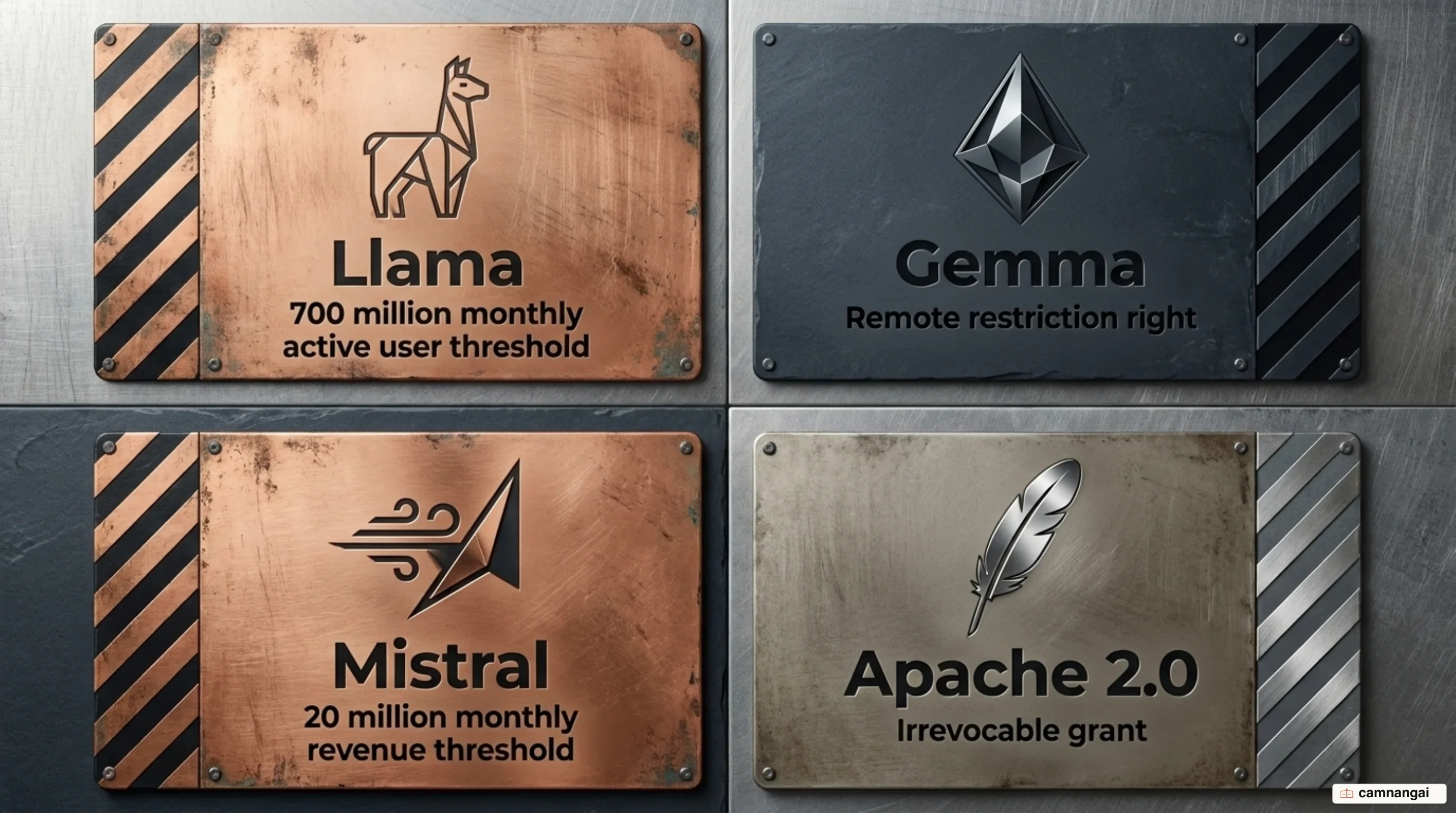
Legal and operational constraints
Acceptable use policies restrict freedom further by banning whole regulated categories, such as offering legal, medical, or financial advice without a professional license. Google's Gemma terms reserve the right to restrict usage remotely — Google can cut you off if it believes the terms have been violated. That is a business-continuity risk with no equivalent in traditional open-source software libraries.
The spread inside the "open" camp is wide. Mistral ships most of its models under genuine Apache 2.0, while placing a revenue threshold on certain models under a modified MIT license. Meta moved the other way in August 2026 with Muse Glimmer, a 30B model released under Apache 2.0 rather than a Llama community license. Kimi K3 ships under a modified MIT license carrying an attribution clause that triggers above 100 million monthly active users.
The regulatory overlay
The EU AI Act's obligations for general-purpose AI (GPAI) providers tighten the picture further. A startup that fine-tunes and redistributes an open-weight model can inadvertently step into the GPAI provider role and inherit strict documentation and transparency duties. Audit the license and the acceptable use policy before embedding a model into production, so you are not silently assuming liability for the original provider's training choices. I would run that audit before the benchmark run rather than after it, because a license clause is the one thing no amount of evaluation will change for you.
How far behind is the open frontier?
The Epoch Capabilities Index puts a number on the capability gap. Since January 2026 the most capable open-weight models have lagged the closed frontier by an average of four months, an eight-point ECI gap — roughly the distance between a primary model and its next point release, such as GPT-5 and GPT-5.5. The gap is narrowing but it has not closed.
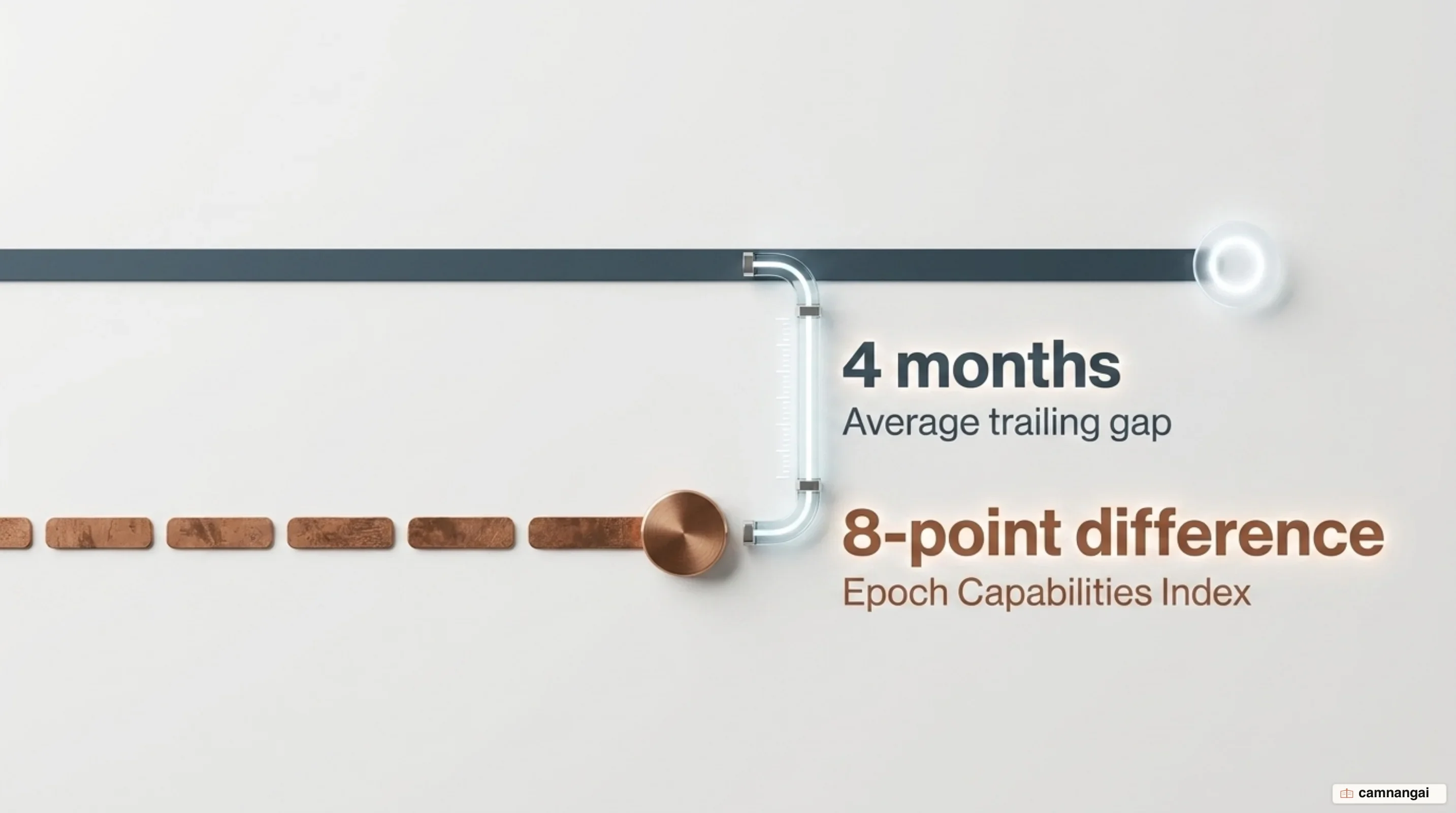
The false parity of hill-climbing
Be wary of hill-climbing, where open-weight models optimize aggressively against public benchmarks. This produces a false parity: a model that looks equal to the frontier on a leaderboard, then underperforms during private integration testing on out-of-distribution data. Frontier labs keep a lead on novel problem-solving that has not yet leaked into the public training sets. Run your own side-by-side evaluation rather than trusting a public scoreboard.
Current leaderboard status
Moonshot AI's Kimi K3, at 2.8 trillion parameters, is the strongest open-weight contender — scoring around 57 on the Artificial Analysis Intelligence Index and ranking third overall, behind only the leading closed models. Its arrival proves that trillion-scale MoE architecture is no longer a closed-source privilege. For most commercial applications short of absolute frontier reasoning, open-weight capability is now good enough to justify the operational overhead of self-hosting.
Which models is the market actually running?
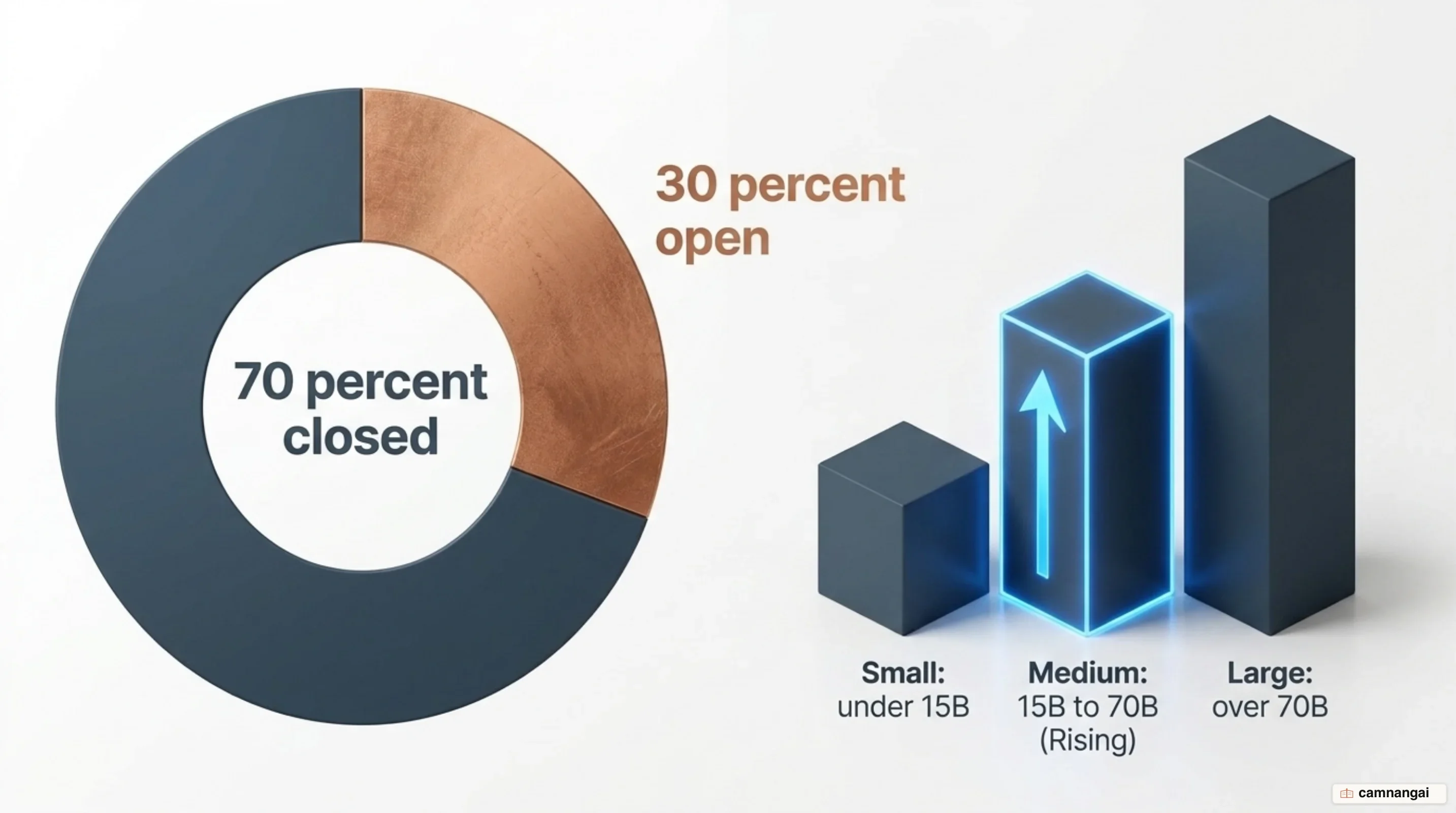
Usage data from OpenRouter splits the market roughly 70% closed to 30% open. Two categories dominate open usage: creative roleplay, at about 52% of open-source token share and plausibly driven by lighter commercial safety filtering, and programming, the fastest-growing professional category as developers move long-context coding work away from expensive APIs. Roleplay being the larger of the two is the part that tends to fall out of enterprise slide decks, but it is where the open-source token share actually sits.
Medium is the new small
The era of small models dominating the open ecosystem is ending. Usage is splitting in two: workloads either move up into a solid medium class of 15B–70B models or consolidate onto the single most capable large model. The medium tier only became meaningful after models like Qwen 2.5 Coder 32B established what the OpenRouter study calls model-market fit — the point where capability finally justifies the VRAM footprint.
Regional and author trends
Global usage splits across North America at 47.22%, Asia at 28.61%, and Europe at 21.32%, with Asia's share more than doubling over the study period. Chinese labs drive much of the open ecosystem's growth, DeepSeek and Qwen above all, and they are reshaping the field through dense release cycles and often more permissive MIT licensing.
Cost and tradeoffs of self-hosting an open model
Self-hosting a trillion-scale MoE model demands serious hardware. Serving Kimi K3 takes 64 or more accelerators; Zhipu AI's GLM-5.2, at 744B parameters, needs over 1 TB of VRAM — an 8×H200 cluster at FP8 precision. Those capital requirements make self-hosting impractical for low-volume applications, where API pricing wins outright.
The fully loaded cost
The hidden costs routinely exceed the instance rental fee. The engineers required to keep a vLLM or TGI cluster healthy typically push the fully loaded cost well above the raw GPU bill. Budget for provisioning, health monitoring, security patching, and the continuous evaluation of new weights against your own benchmarks — work the API providers were absorbing on your behalf.
Where the break-even sits
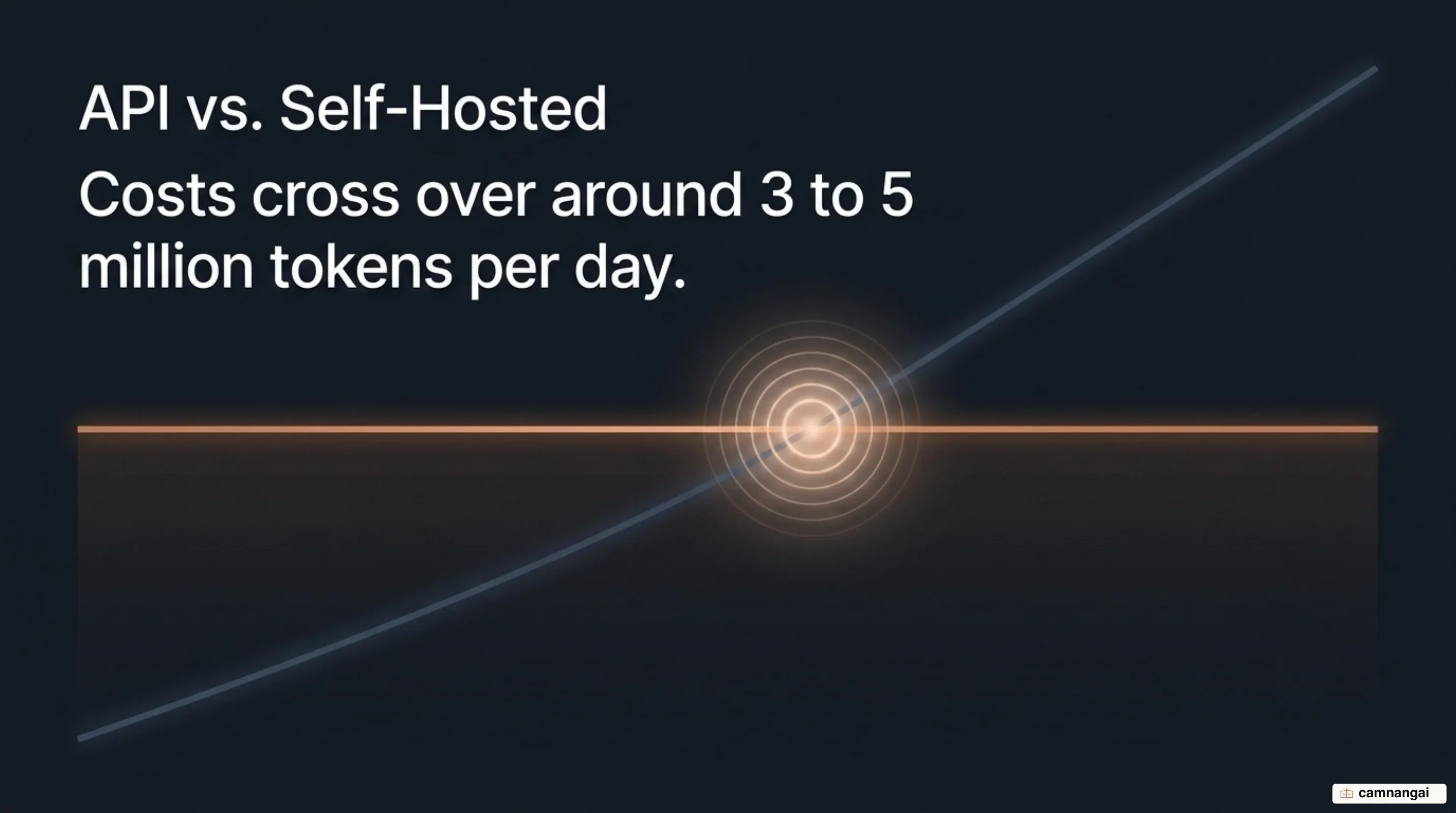
For a 70B model, self-hosting breaks even against API pricing somewhere around 3–5 million tokens per day. Below roughly 100,000 tokens per day, closed APIs are cheaper than GPU infrastructure. Once monthly API spend passes about $5,000, the economics start to favor a self-hosted stack — but only if your team has the MLOps maturity to run it without constant downtime or quality drift. Published serving prices vary enormously across the open frontier, from DeepSeek V4 Pro at $0.435 per million input tokens to Kimi K3 at $3.00, so the model you pick moves the break-even as much as your volume does.
Why this turned into a policy fight
Frontier-caliber open weights triggered an economic argument about margin compression. US frontier labs argue that high-quality open models lower the return on the enormous capital expenditure required to train closed ones, and that if users migrate to open weights the incentive to push the frontier erodes with them. It is a self-interested argument, which does not by itself make it wrong.
Geopolitical dimensions
Geopolitics complicates it. The US government has weighed restrictions on advanced Chinese models like Kimi K3, citing data privacy and the ease of stripping safety guardrails from published weights — once released, a set of weights cannot be recalled. Open-weight advocates push back that restriction hides risk rather than fixing it and concentrates power in a handful of labs; Hugging Face's Clem Delangue has made exactly that argument.
Innovation versus control
The fight is about whether innovation stays concentrated in a few well-capitalized labs or spreads across a global community. Restricting open models could hand the advantage to regions where researchers remain free to build on these architectures. For anyone building infrastructure, the outcome determines how long high-performance, low-cost weights stay available to independent stacks at all.
Should you choose open or closed for your own work?
Score the decision across those six dimensions rather than picking a side on principle. Closed wins when you need to validate an idea within a day, when volume sits under 100,000 tokens per day, or when the task demands the best available multimodal reasoning. Open wins when data cannot leave your VPC under HIPAA or GDPR, when volume has passed a few million tokens per day, or when you need deep fine-tuning on your own data.
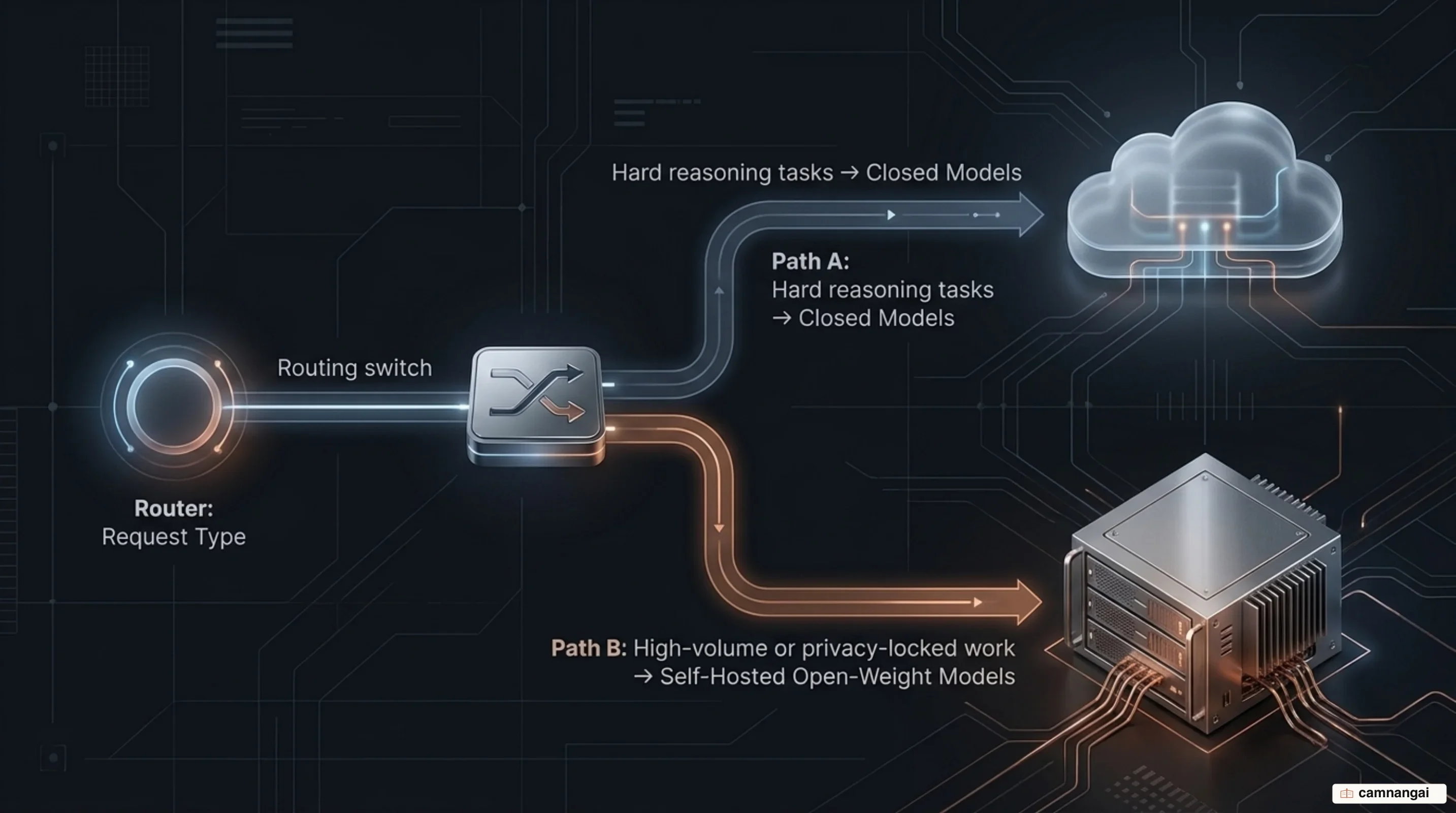
For most teams the real answer is a routing policy: let a closed model handle the hard reasoning at the front, and push repetitive high-volume work onto a self-hosted open model. The boundary between the two moves every few months, so build the system to make swapping models a config change, not a migration project.
References
- The Open Source AI Definition 1.0 — Open Source Initiative
- Open Weights: not quite what you've been told — Open Source Initiative
- Open-Weight AI License Trap: Llama, Mistral, Gemma Terms — Promise Legal
- Open models lag state-of-the-art closed models by 4 months — Epoch AI
- State of AI: An Empirical 100 Trillion Token Study — OpenRouter
- Kimi K3 vs DeepSeek V4 Pro vs GLM-5.2: Compared on Benchmarks, License, and Serving Cost — MarkTechPost
- Open Source vs Closed Source LLMs — Decision Framework (2026) — MyEngineeringPath
- OpenAI is scared of open-weight models. Should the US be? — TechCrunch
- Muse Glimmer — Meta