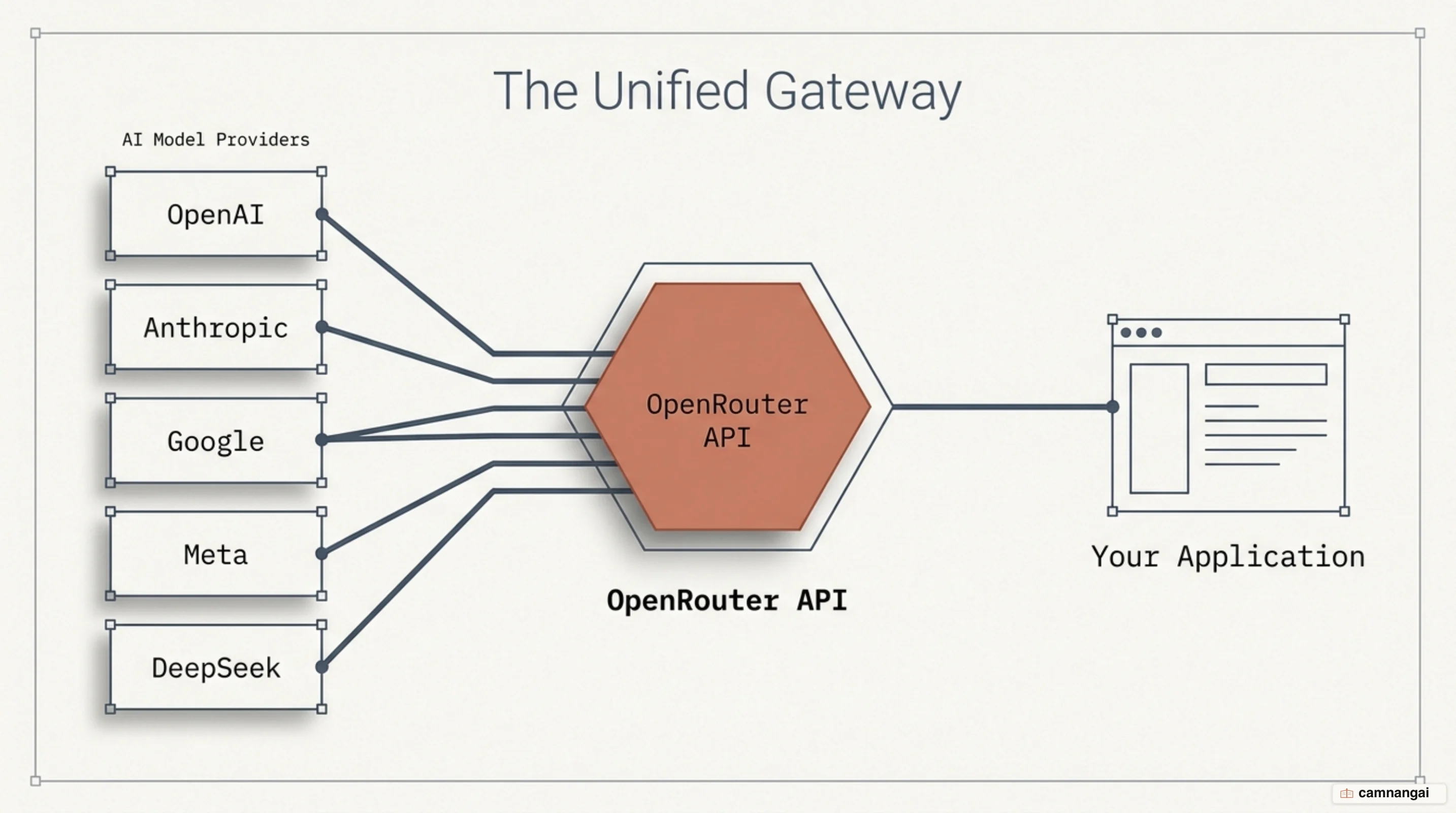
OpenRouter is a unified API gateway that gives you access to hundreds of large language models through a single endpoint. It is a middleware layer that abstracts away the fragmentation of the AI market, so you can reach a large catalog of models without managing dozens of separate provider accounts.
Centralizing inference traffic through one gateway buys you two things: a fallback for when a provider goes down, and the freedom to swap models without touching your application logic. As of mid-2026, OpenRouter processes roughly 25 trillion tokens per week and serves over 8 million users.
What is OpenRouter?
OpenRouter is a normalization layer sitting between your application and a fragmented market of model providers. It exposes a standardized, OpenAI-compatible interface to hundreds of models from dozens of providers, including Anthropic, Google, OpenAI, xAI, and DeepSeek. For infrastructure teams, that turns models into swappable engines rather than architectural commitments.
Founded in 2023, the platform grew quickly alongside the shift toward agentic workloads. A $113 million Series B led by CapitalG, Alphabet's growth fund, put its valuation at roughly $1.3 billion in mid-2026 — up from about $547 million a year earlier. That backing matters mainly as a signal of durability: a gateway that sits in your critical request path is a dependency, and dependencies need to outlive your project.
The routing layer also carries governance controls. You can restrict traffic to providers that meet a data-retention standard, which keeps your data-handling policy consistent even while you experiment with new vendors.
Why does OpenRouter exist?
Using more than one model creates real technical friction. In production, one model is rarely the best fit for every task: a reasoning-heavy agent wants a frontier model, while high-volume summarization belongs on something cheaper and faster. Running both means running two integrations, two billing relationships, and two sets of rate limits.
OpenRouter exists to absorb that operational overhead:
- Rate limits. Distribute load across multiple endpoints instead of hitting a single provider's ceiling.
- Provider outages. Reroute around 503s and regional degradation through automatic fallbacks.
- Billing fragmentation. Replace a pile of separate invoices with one prepaid credit balance.
- Cost accounting. Compare spend across providers that tokenize and bill differently.
On top of that, you can set spending caps per API key — a control most providers still do not offer directly, and the one that stops a looping agent from burning a quarter's budget overnight.
How does OpenRouter route a request?
By default, OpenRouter load-balances between the providers serving a given model, weighted toward lower-priced endpoints. You can override that behavior with routing shortcuts appended to the model slug:
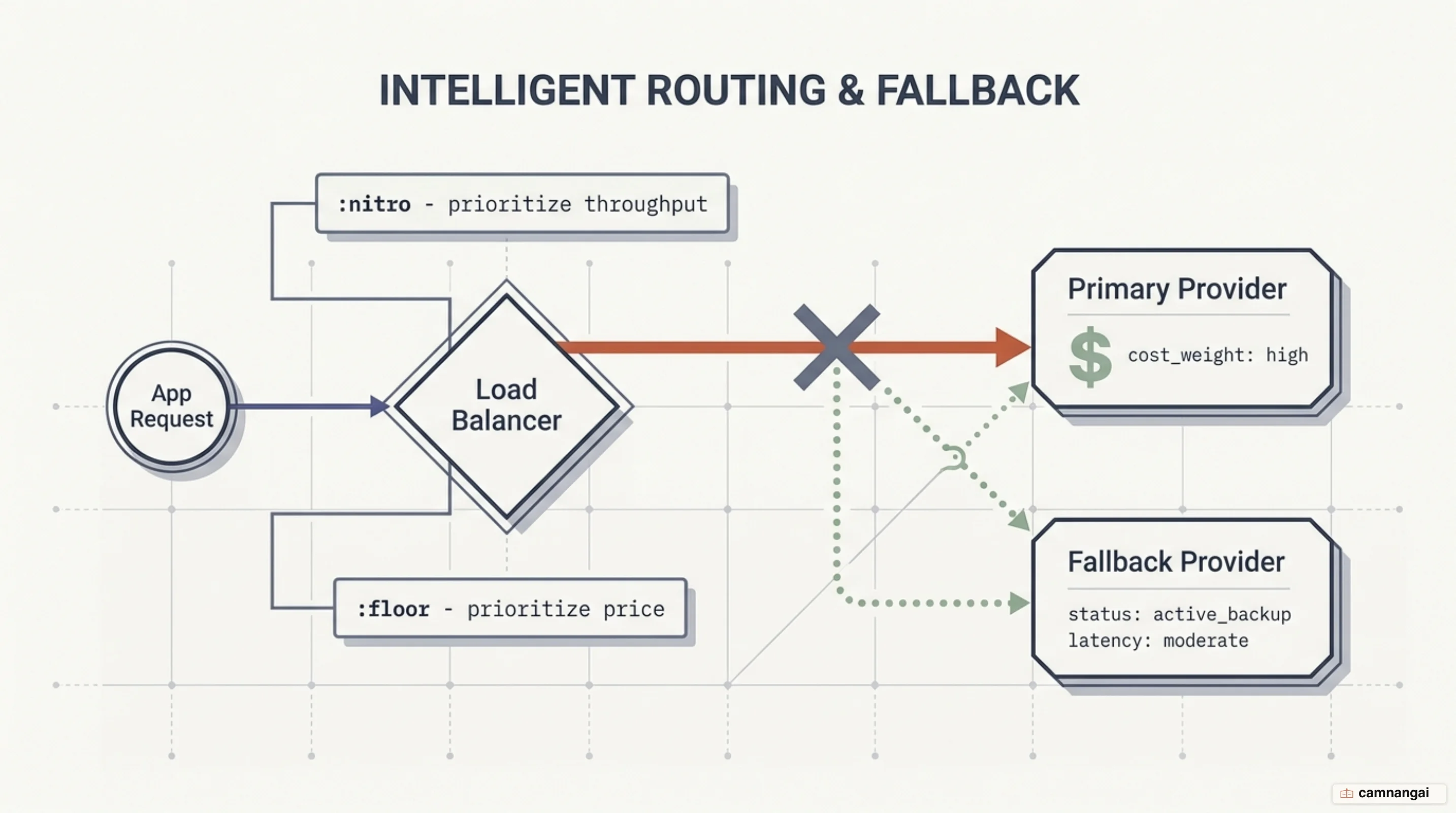
:nitro— prioritize throughput, equivalent tosort: "throughput".:floor— prioritize price, equivalent tosort: "price".
The sort field itself accepts price, throughput, or latency if you would rather be explicit than use a suffix, which is what I reach for in code somebody else has to read six months later.
For model-level fallbacks, pass a models array. If the primary model fails or its providers refuse the request, OpenRouter tries the alternatives in order:
{
  "model": "~openai/gpt-latest",
  "models": ["anthropic/claude-sonnet-5", "google/gemini-3.5-flash"],
  "messages": [{ "role": "user", "content": "Audit this code snippet." }]
}
Routing is also where you constrain data handling. The data_collection field excludes providers that may store your prompts, and the zdr flag restricts routing to Zero Data Retention (ZDR) endpoints only. Both are request-level controls, so you can hold a stricter policy on sensitive paths without splitting your integration in two.
Getting started: API key, credits, first request
There are three integration paths: the REST API at https://openrouter.ai/api/v1, a typed client SDK, and an agent SDK for multi-turn loops. Most teams start with the REST API because it requires no new dependency.
The setup is short. Create a key on the dashboard, add credits, and point your existing client at OpenRouter's base URL.
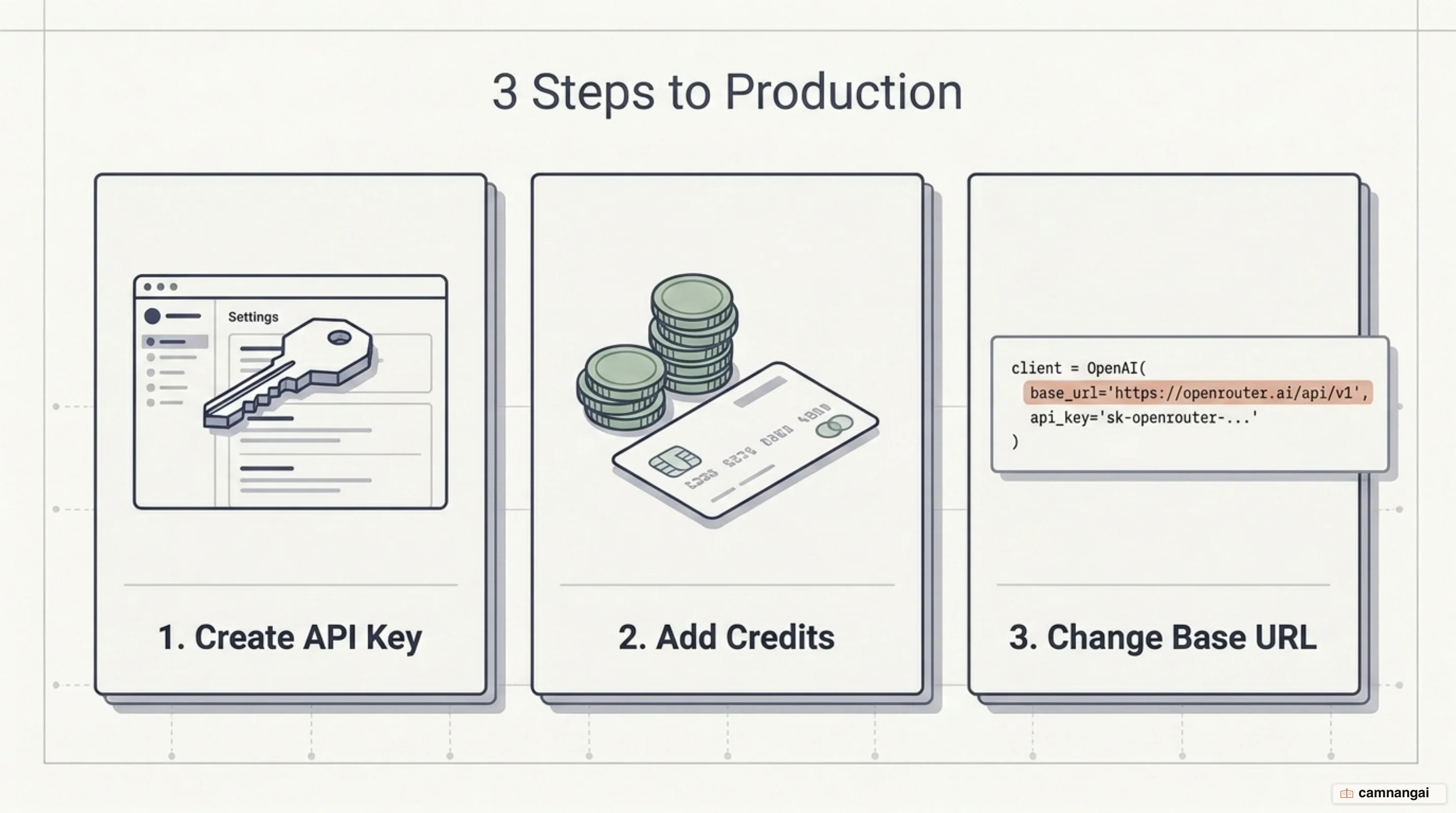
Because the API is OpenAI-compatible, migrating an existing integration means changing three things (the base URL, the key, and the model identifier) and leaving the rest of your code alone:
from openai import OpenAI

client = OpenAI(
    base_url="https://openrouter.ai/api/v1",
    api_key="sk-or-v1-your-key",
)

response = client.chat.completions.create(
    model="~openai/gpt-latest",  # provider/model format
    messages=[{"role": "user", "content": "Explain ZDR routing."}],
)
That ~openai/gpt-latest identifier is a latest-alias: it always resolves to the newest flagship from that provider, so your code tracks model releases without a redeploy. Pin an exact slug instead when you need reproducible output.
What does OpenRouter actually cost?
OpenRouter does not add a markup to provider token rates — you pay the same per-token price you would pay the provider directly. The revenue comes from the top-up step and adjacent services.
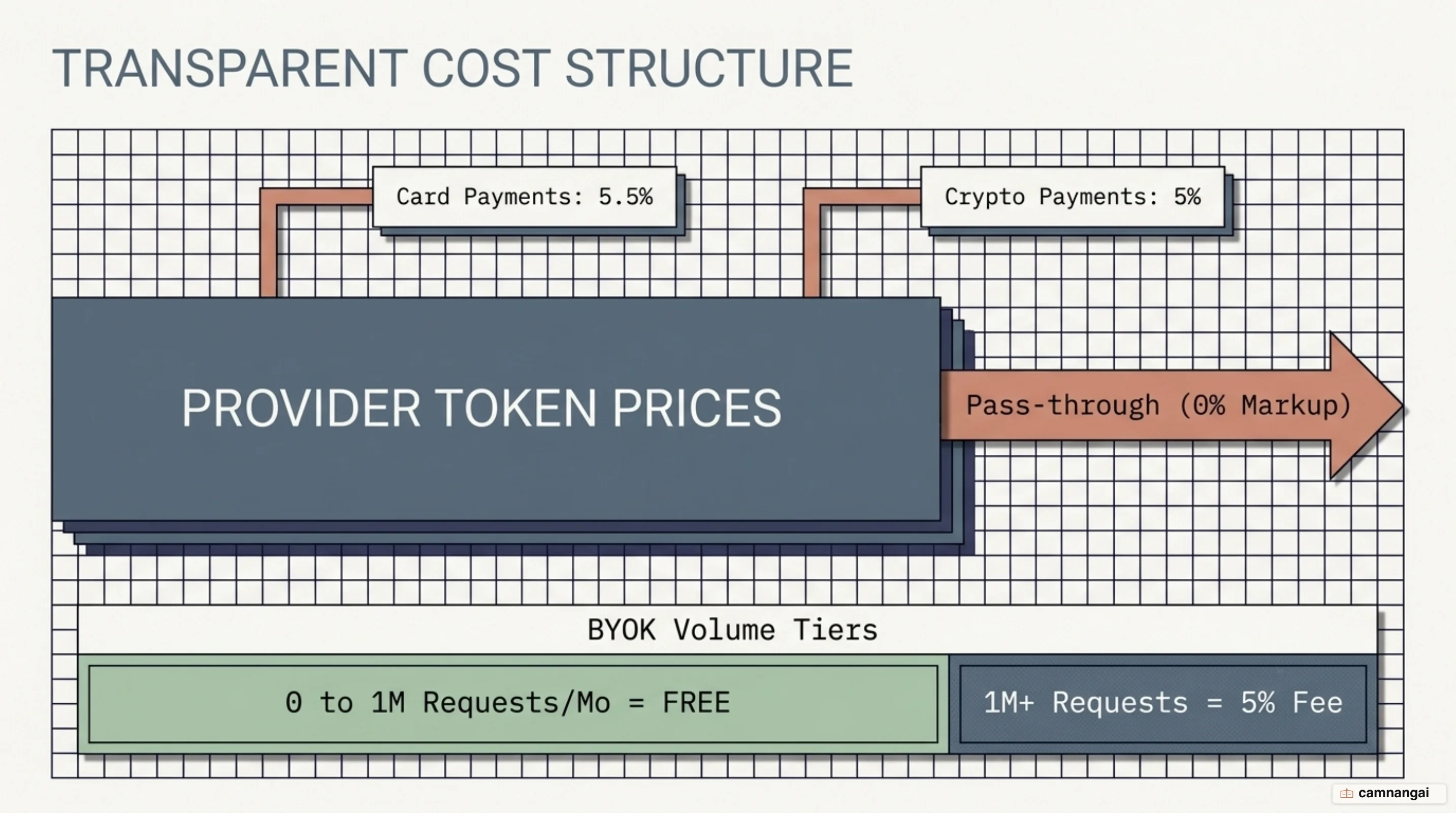
- Credit purchase fee. 5.5% on card payments with a $0.80 minimum, or 5% via crypto. OpenRouter adds the fee on top, so $100 of usable credit costs $105.50 at checkout. At $200,000 of monthly inference, that is roughly $11,000 a month in gateway fees alone.
- Bring Your Own Key (BYOK). Attach your own provider credentials and route through OpenRouter's infrastructure. The first 1 million BYOK requests per month are free; beyond that the fee is 5% of what the same model and provider would normally cost on OpenRouter.
- Logging discount. Opting in to log your prompts and completions earns a 1% discount on usage costs. That is a data-retention trade, not free money — do not take it on sensitive workloads.
Free models carry platform-level caps that scale with your all-time credit purchases:
| Account state | Rate limit | Daily cap |
|---|---|---|
| Under $10 in credits ever | 20 req/min | 50 requests/day |
| $10 or more in credits | 20 req/min | 1,000 requests/day |
When should you not use OpenRouter?
Three cases deserve a hard look before you commit.
- Latency-critical paths. Every request takes an extra hop. For a chat interface the overhead is negligible; for a system with a tight response budget, measure it against a direct call before you decide.
- Compliance and data residency. Your prompts leave your network and transit third-party infrastructure. ZDR routing narrows the exposure, but your effective policy becomes OpenRouter's policy plus the routed provider's, and you are responsible for auditing both. If your regulator cares where inference happens, read the terms before production.
- Single-model scale. The 5.5% fee compounds. Once you have settled on one model at steady high volume, that fee can exceed the engineering effort the gateway was saving you.
There is also a concentration risk. If OpenRouter is down, every model behind it is unreachable, even when the underlying providers are healthy.
Is OpenRouter or a self-hosted gateway the right call?
If you are prototyping, or running several models in parallel and want to switch between them without a redeploy, OpenRouter is close to the default choice. You are buying flexibility and failover for 5.5% and a small latency cost, and I would take that trade in most cases without much agonizing.
The threshold for leaving is specific rather than philosophical: you have converged on one model, your traffic is steady and large, and compliance requires inference to stay inside infrastructure you control. At that point a self-hosted gateway such as LiteLLM makes more sense — no platform fee, in exchange for owning the operational burden yourself.
References
- OpenRouter Quickstart Guide
- Provider Routing — OpenRouter Documentation
- LLM Gateway: What It Is and How to Choose One — OpenRouter Blog
- What is OpenRouter? A Guide with Practical Examples — Codecademy
- OpenRouter: A Guide With Practical Examples — DataCamp
- OpenRouter Pricing 2026: Plans, Costs, and Hidden Fees — TrueFoundry
- OpenRouter vs Direct API: Pricing, Latency, and Limits — Folding Sky
- OpenRouter more than doubles valuation to $1.3B in a year — TechCrunch
- OpenRouter raises $113M Series B — Hacker News