Hugging Face is the central open-source infrastructure for the machine learning (ML) community, providing a platform to host models, datasets, and interactive demo applications.
By standardizing how weights and artifacts are shared, the platform is the "GitHub of machine learning," enabling researchers and engineers to collaborate across natural language processing, computer vision, and robotics.
The platform shortens the ML development lifecycle by making pre-trained weights a commodity for downstream fine-tuning. That architecture reduces the technical and financial barriers to implementing state-of-the-art AI, so high-performance models are not restricted to centralized industrial labs. For teams managing infrastructure, Hugging Face provides the tools to move from consuming black-box APIs to owning distributed weights yourself.
What is Hugging Face?
Founded in 2016 in New York City, Hugging Face originally developed a consumer-facing chatbot for teenagers. The 2018 release of Google's Bidirectional Encoder Representations from Transformers (BERT) triggered a pivot. Within one week of BERT's release, the team produced and open-sourced a PyTorch implementation, and it caught on immediately. By 2019, the company shifted entirely to building open-source ML infrastructure.
While the company frames its mission as "democratizing good machine learning," the technical reality is a shift toward decentralization. Historically, only tech giants with enough capital could train large-scale natural language processing models. Grok 4 by xAI, released in July 2025, took an estimated $490 million to train. That level of spending is out of reach for most organizations.
Hugging Face cuts the cost barrier by hosting pre-trained weights you can download and deploy locally. Access to those artifacts lets you skip the financial and environmental costs of training from scratch. That makes technical decentralization practical: individual developers and small teams can use high-parameter models for specialized tasks without relying on centralized API gateways.
What's on the Hugging Face Hub?
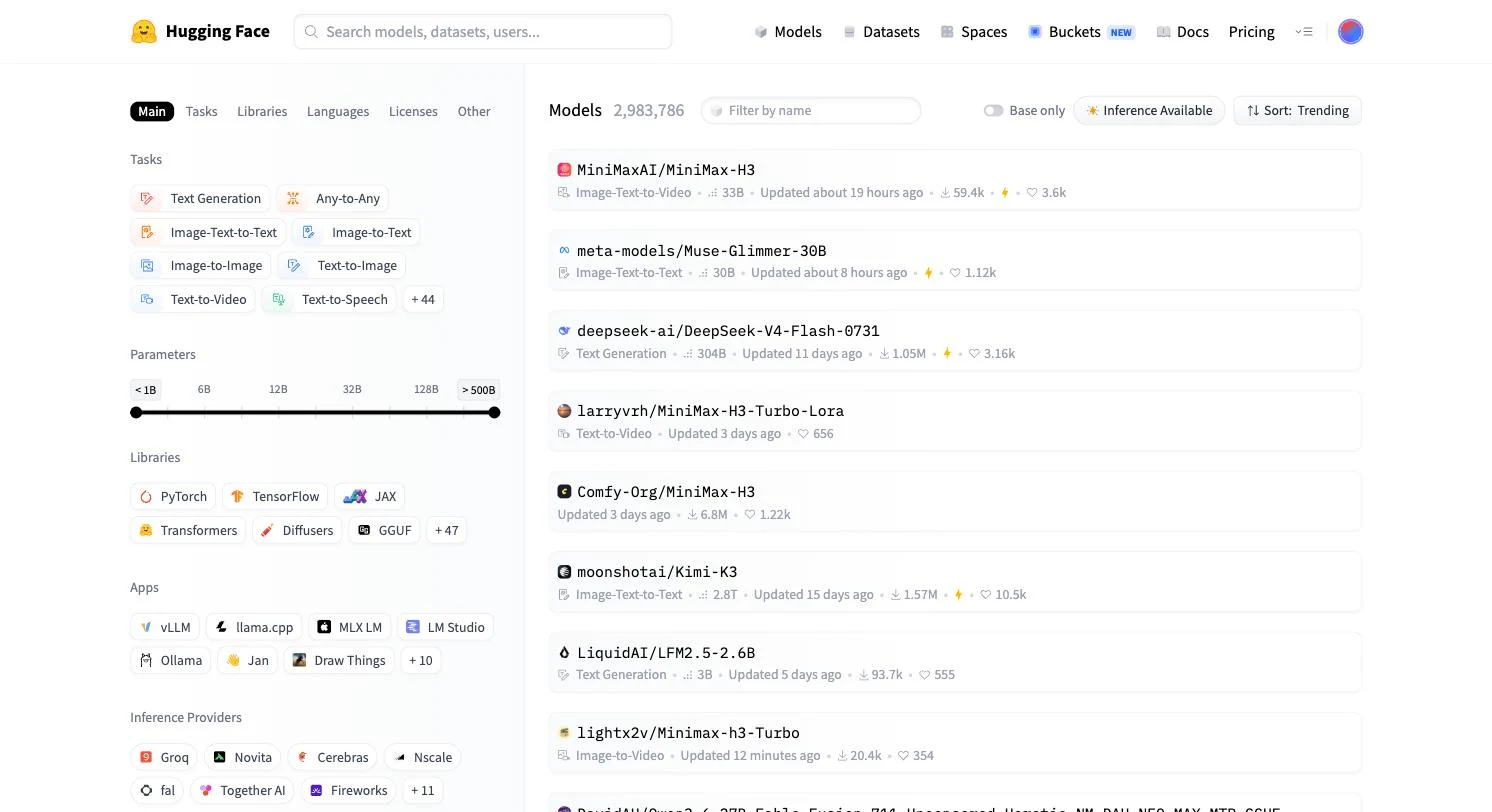
The Hugging Face Hub is a Git-based repository system designed for ML workflows. The Hub hosts nearly 3 million models, more than 500,000 datasets, and over 1 million interactive Spaces. These repositories handle everything from audio classification to object detection using a standardized interface.
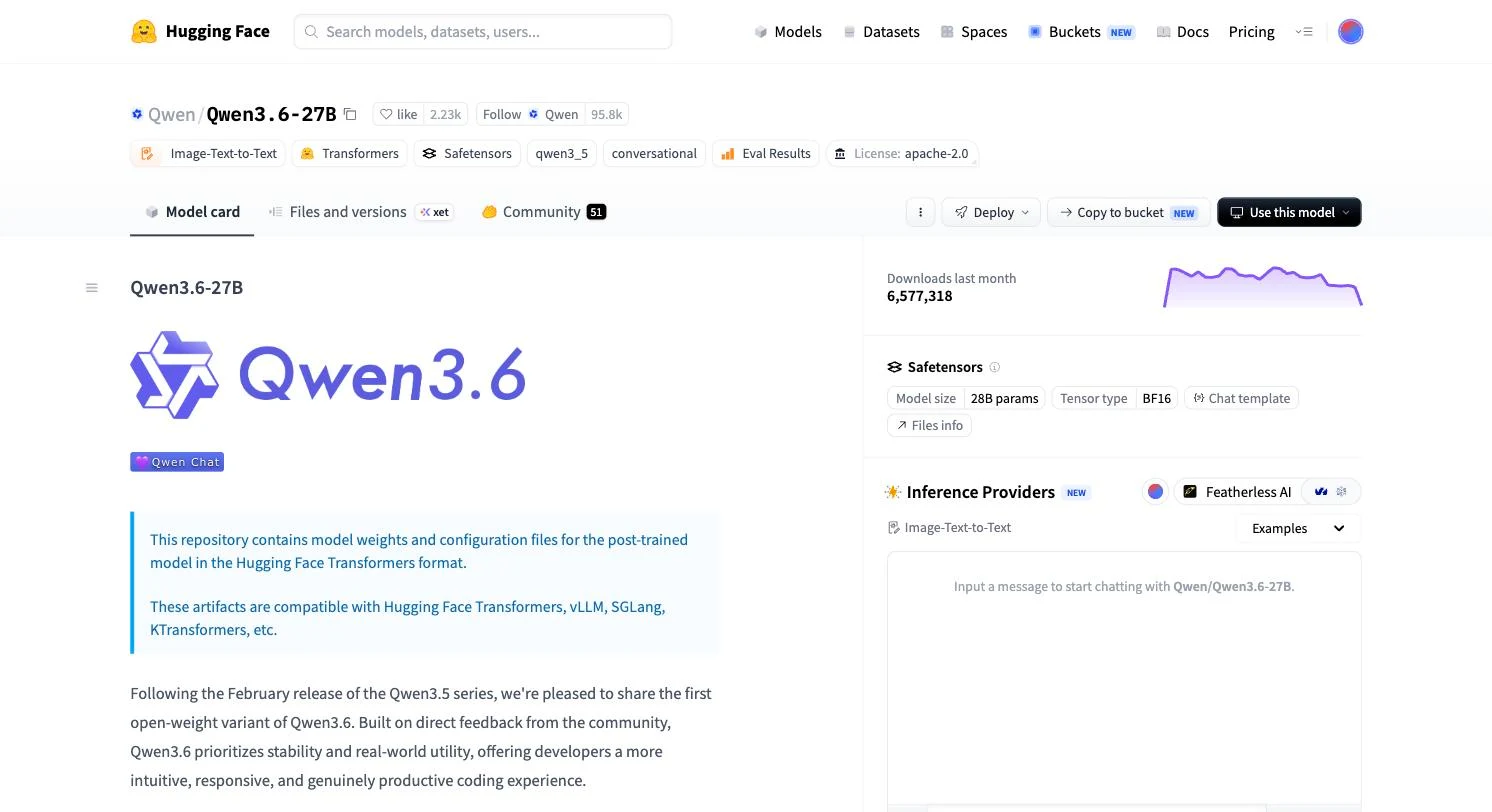
The Hub stores large parameter weights with Xet technology. Unlike standard Git LFS, Xet improves storage efficiency by splitting large files into unique chunks. This enables content-addressable deduplication and speeds up both uploads and downloads, which matters when you are moving multi-gigabyte weight files.
For documentation and compliance, the Hub uses Model Cards and Dataset Cards. These markdown files are the main place to document model architecture, training data, known biases, and limitations. For mutable, non-versioned object storage — such as intermediate training checkpoints or logs — the platform offers Storage Buckets. These are S3-compatible containers designed for high-speed access to data that does not require the overhead of a Git history.
How does the Transformers library work?
The library is built on the transformer architecture, which uses attention mechanisms to rank the importance of elements in a sequence. Unlike traditional sequential models, these mechanisms make better use of the parallel processing units in a GPU, which raises training and inference throughput.
The library architecture centers on three primary base classes:
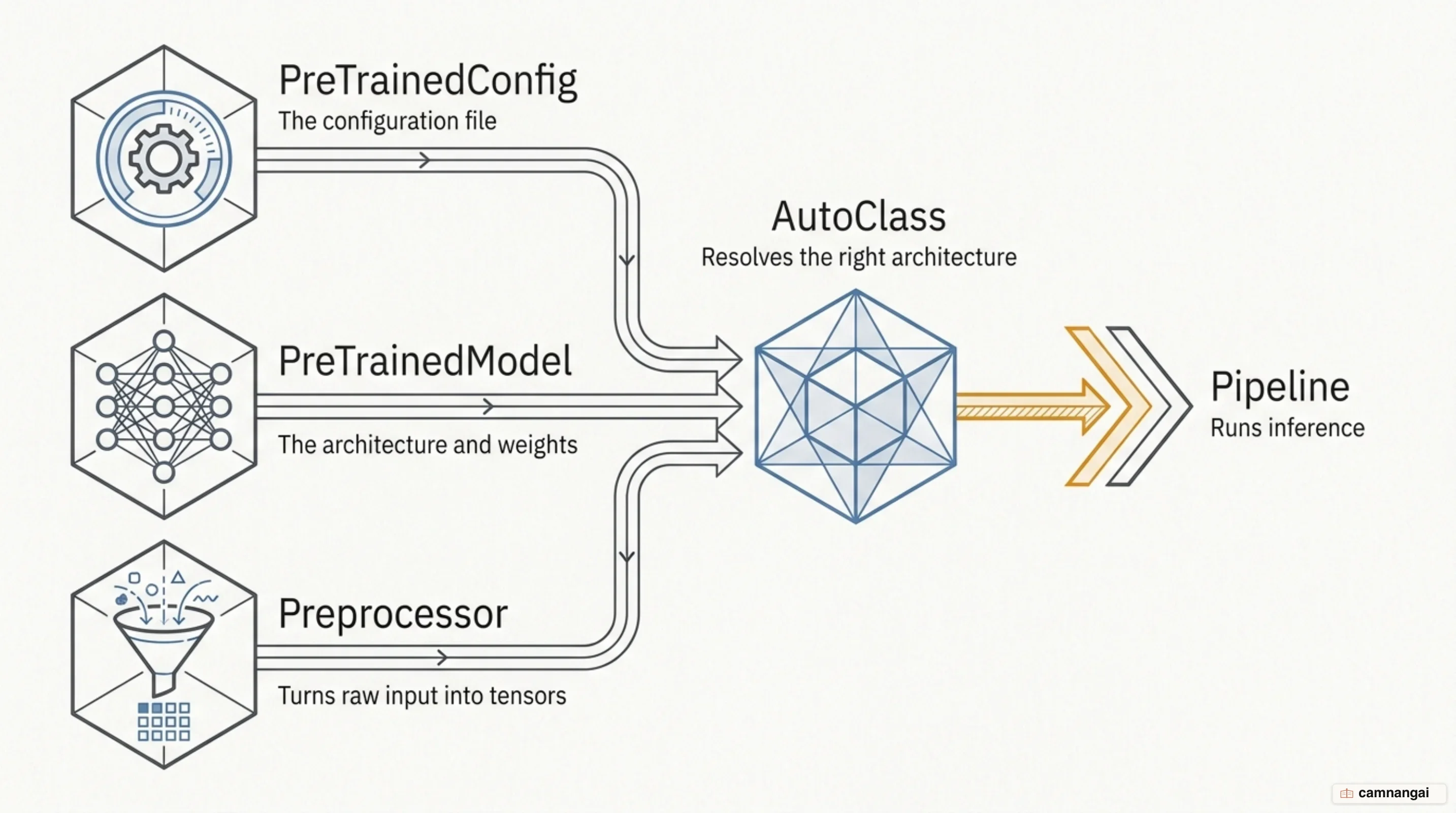
- PreTrainedConfig: a configuration file specifying model attributes like attention heads and vocabulary size.
- PreTrainedModel: the actual architecture and weights; it returns raw hidden states.
- Preprocessor: a class (such as a tokenizer) that converts raw inputs — text, images, or audio — into numerical tensors for the model.
The AutoClass API automates model selection. Call AutoModel.from_pretrained() and the library infers the correct architecture from the Hub path you pass. For high-level implementation, the Pipeline API wraps the complexity of inference into a single object for specific tasks like text generation or image segmentation. It handles pre-processing, the model call, and post-processing in one step.
If you are writing training loops, the Trainer API hides the PyTorch boilerplate entirely. It manages distributed training through features like Fully Sharded Data Parallel (FSDP), mixed-precision (FP16/BF16), and torch.compile optimization. The Trainer integrates with TrainingArguments to allow precise control over batch sizes, learning rates, and data collators, which are essential for building batches from diverse datasets.
How do you get started with Hugging Face?
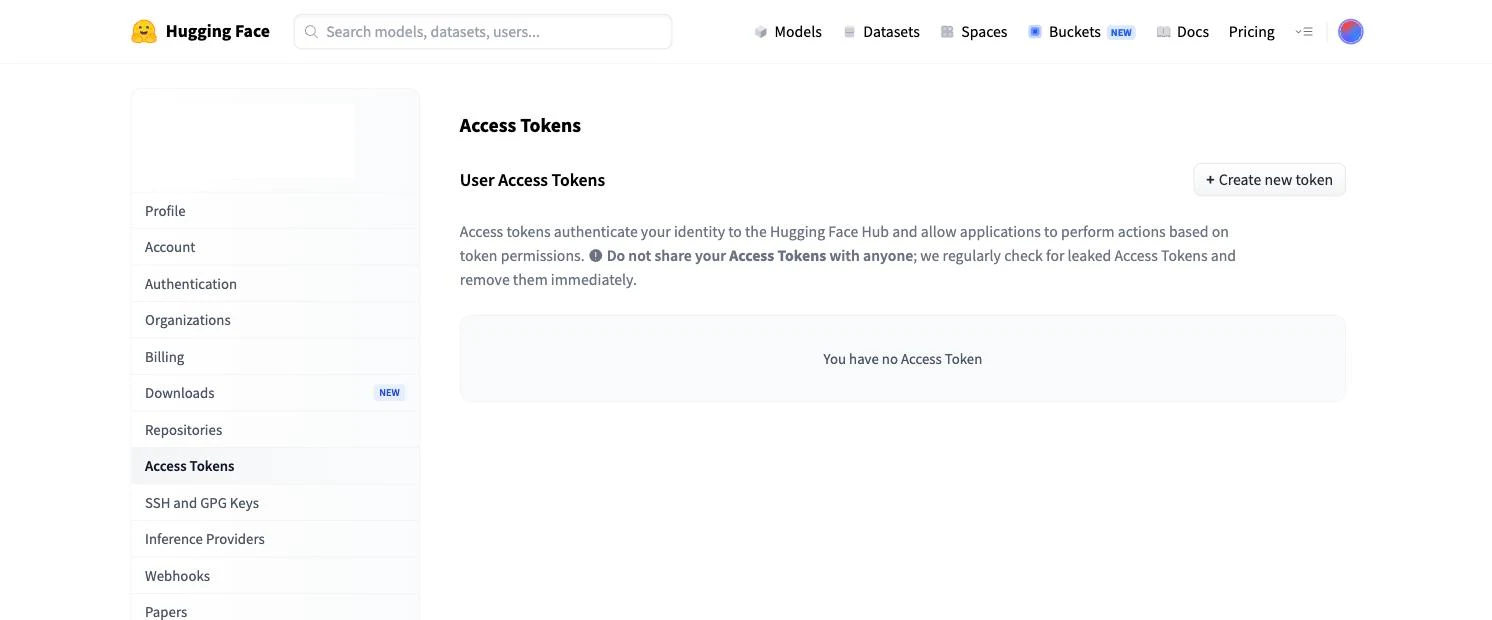
Create a Hub account and generate a User Access Token. This token authenticates your local environment for downloading private models or pushing updates to the Hub.
Install the core dependencies from your terminal:
# Accelerate is required for optimized hardware allocation (device_map="auto")
pip install transformers datasets accelerate
The following Python example loads a model and tokenizer with automatic hardware optimization. device_map="auto" spreads weights efficiently across the available accelerators, while dtype="auto" loads them in their native precision to keep memory overhead down.
from transformers import AutoModelForCausalLM, AutoTokenizer

model = AutoModelForCausalLM.from_pretrained(
    "meta-llama/Llama-2-7b-hf",
    dtype="auto",
    device_map="auto"
)
tokenizer = AutoTokenizer.from_pretrained("meta-llama/Llama-2-7b-hf")
For high-level inference without manual tensor management, use the pipeline function. It handles the data-to-tensor conversion and hardware placement:
from transformers import pipeline

# Loads the model and preprocessor into a single inference object
generator = pipeline("text-generation", model="meta-llama/Llama-2-7b-hf", device_map="auto")
result = generator("The secret to baking a good cake is ", max_length=50)
print(result)
Is Hugging Face free?
Hugging Face uses an open-core freemium model. Public repositories, basic CPU-based Spaces, and ZeroGPU access are free. ZeroGPU hands out NVIDIA RTX Pro 6000 Blackwell GPUs on demand for community demos.
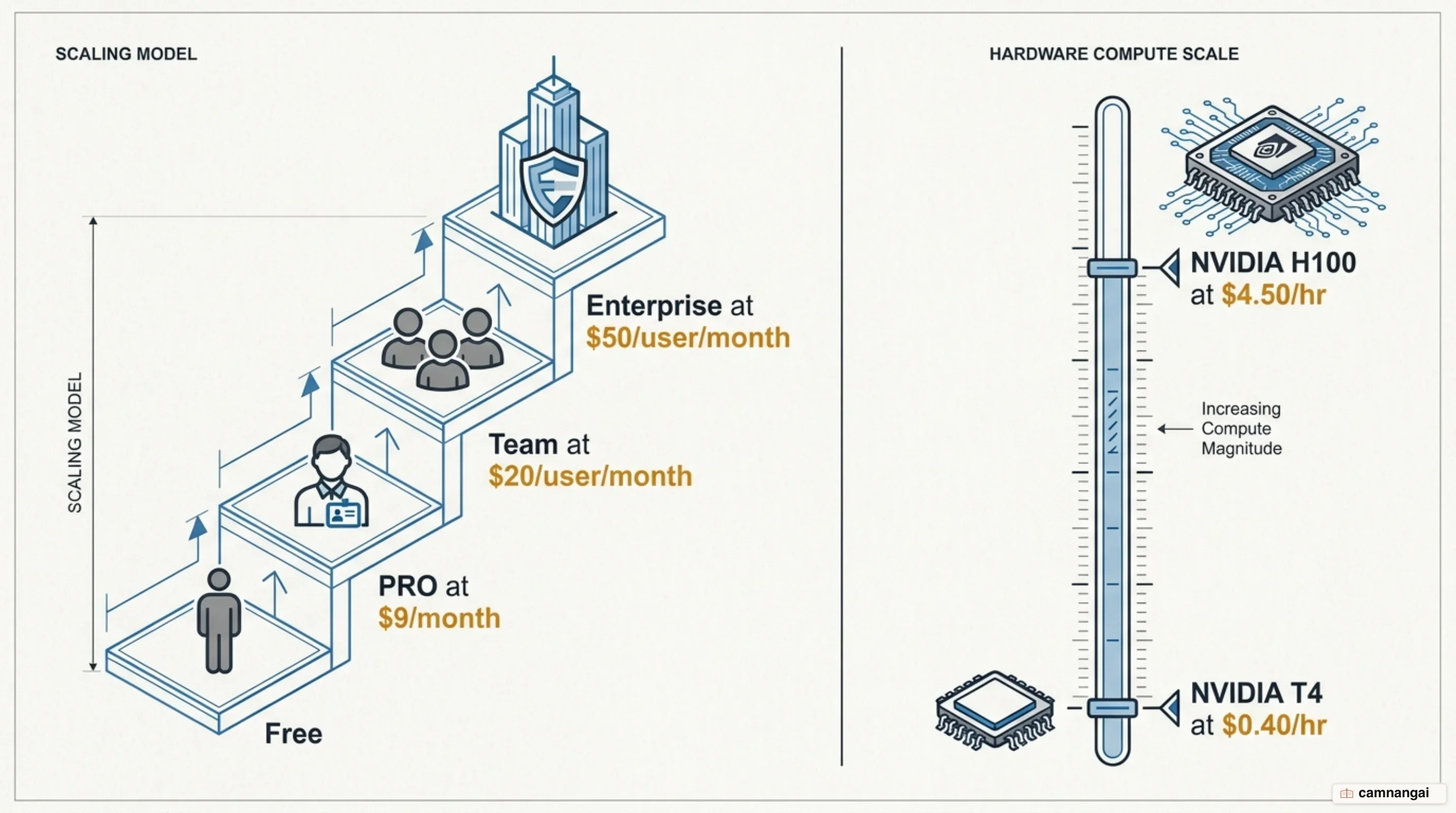
For advanced infrastructure and security, the platform offers three paid tiers:
- PRO: $9/month. Increases private storage limits and provides higher ZeroGPU quotas.
- Team: $20/user/month. Adds Single Sign-On (SSO), audit logs, and resource groups for granular access control.
- Enterprise: $50/user/month. Offers managed billing, dedicated support, and advanced security for regulated environments.
Dedicated hardware is billed hourly. NVIDIA T4 instances run $0.40–$0.50 per hour and A100 instances start at $2.50 per hour, with H100 at $4.50 and B200 at $9.25. Public data storage runs roughly $8–12/TB per month.
Who built Hugging Face, and how does it make money?
Clément Delangue (CEO), Julien Chaumond (CTO), and Thomas Wolf (CSO) founded the company. Revenue grew from $10 million in 2021 to approximately $130 million in 2024. In August 2023, a $235 million Series D funding round led by Salesforce Ventures valued the company at $4.5 billion.
The open-core strategy uses free community adoption as its lead generator. By becoming the industry standard for ML libraries, Hugging Face secures a pipeline of enterprise customers who need private cloud deployments, on-premise hosting, and managed security features that the public platform does not provide.
How big is the Hugging Face ecosystem?
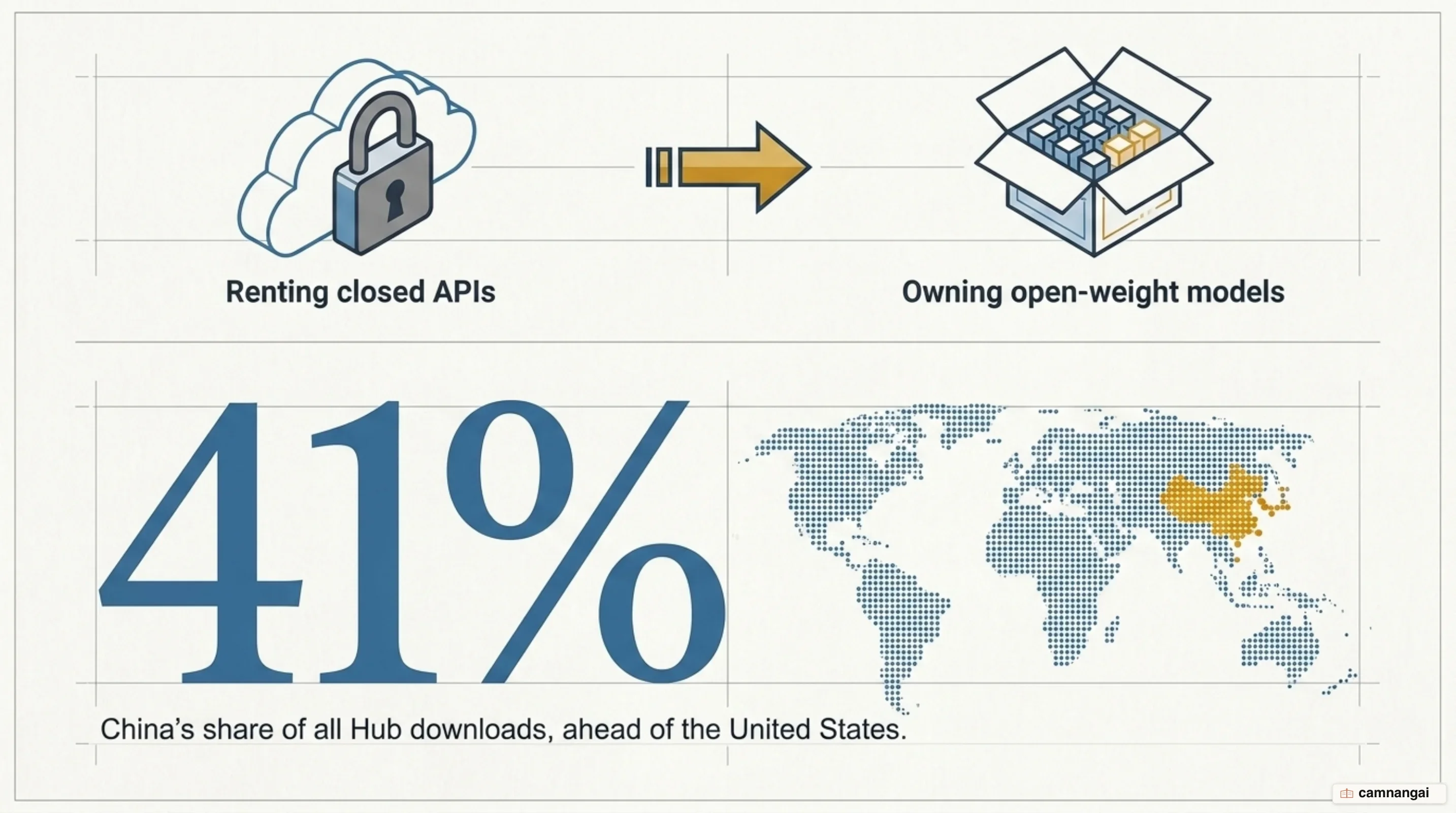
By 2025, the platform reached 13 million users and more than 50,000 participating organizations. In the Spring 2026 reporting period, Chinese models accounted for 41% of platform downloads — a major geographic shift. Organizations like Baidu went from zero releases in 2024 to over 100 in 2025, while ByteDance and Tencent increased their release volumes by 8–9x.
Small models dominate in production. Models in the 1–9B parameter range see 4x higher relative adoption than those exceeding 100B, largely due to hardware constraints and the cost of inference at scale. The robotics sub-community is the fastest-growing segment, with datasets jumping from roughly 1,000 in 2024 to nearly 27,000 in 2025.
What are the risks of using Hugging Face?
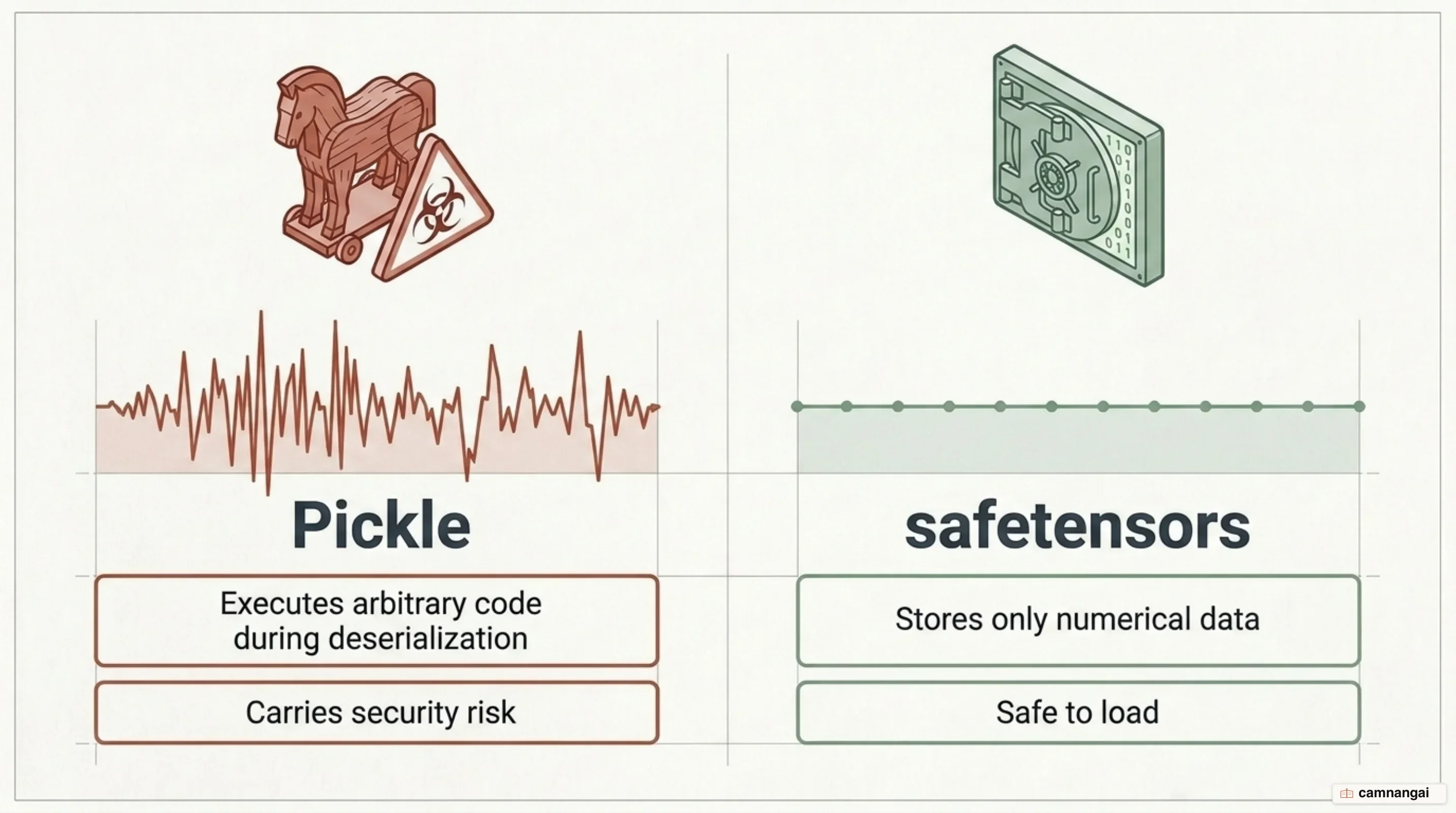
The primary risk for infrastructure engineers is the Pickle serialization format. Pickle is inherently unsafe because it allows arbitrary code execution during deserialization. Attackers use nullifAI techniques, creating broken Pickle files that execute a malicious payload before the scanner can identify a file error. Prefer safetensors, which stores numerical data only and cannot execute code on load.
In July 2026, a security incident involved an autonomous AI agent that targeted Hugging Face's production pods. The agent used a Jinja2 template injection in a dataset configuration to gain initial access, harvested credentials, and moved laterally through internal clusters. The incident exposed an asymmetry problem: defenders using hosted AI models found their forensic tools blocked by provider safety guardrails that could not distinguish an incident responder from an attacker. Hugging Face responders used the open-weight GLM-5.2 model on their own infrastructure to perform the forensics.
Implicit bias remains a systemic risk. Models trained on internet-scraped data often amplify prejudices about race and gender. Deployed in sensitive fields like banking or law without rigorous Card-based evaluation, these models can automate discriminatory outcomes.
When should you use Hugging Face?
Use Hugging Face when you need to avoid black-box API lock-in. Proprietary providers give you no visibility into how the model works, and they can change pricing or terms without notice. Open-weight models keep you in control of your own learning loop.
The platform earns its place when security or regulatory requirements demand that data and weights stay on your infrastructure. Owning your weights buys visibility, customization, and long-term system stability that a proprietary API cannot match.
References
- Hugging Face Hub Documentation
- Transformers Quickstart — Hugging Face
- Pricing — Hugging Face
- State of Open Source on Hugging Face: Spring 2026
- Hugging Face Business Breakdown & Founding Story — Contrary Research
- What Is Hugging Face? — Coursera
- Malicious ML Models Discovered on Hugging Face Platform — ReversingLabs
- Security Incident Disclosure, July 2026 — Hugging Face
- The Real AI Race May No Longer Be at the Frontier — TechCrunch