Python is an interpreted, object-oriented, high-level programming language defined by its dynamic semantics.
When you evaluate what is Python, you are looking at a general-purpose technology built for extensibility and readability, serving as a primary tool for everything from local automation scripts to globally distributed web platforms.
You will often deploy Python as a "glue" language. Its high-level built-in data structures and dynamic binding make it a good fit for connecting separate software components into one system. That versatility is why it became a standard for Rapid Application Development, where the priority is getting from concept to working prototype quickly.
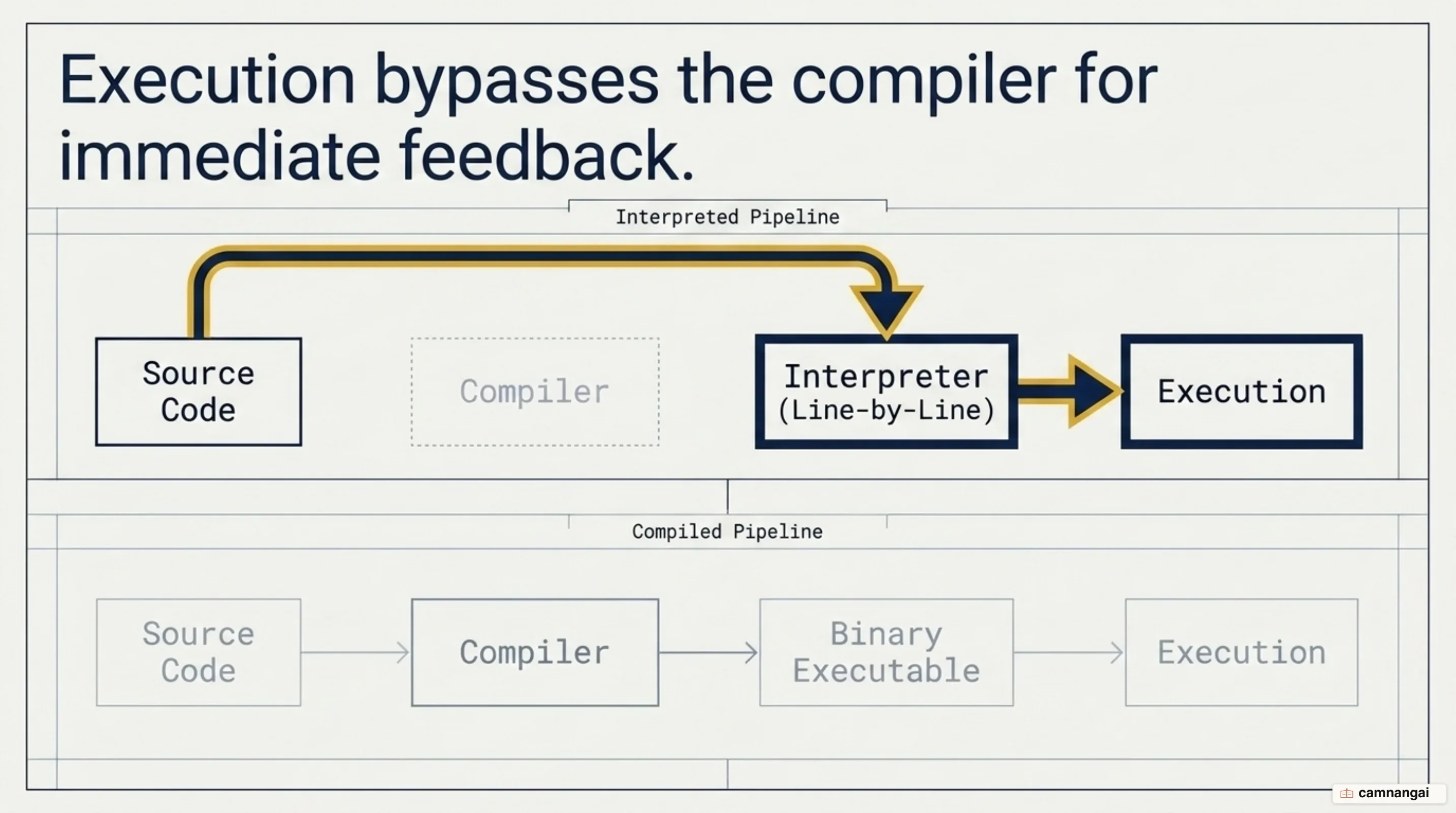
The core technical advantage is development velocity. Because the language removes the compilation step, the edit-test-debug cycle is fast. If a process hits a logical error or invalid input, the interpreter raises a manageable exception rather than a segmentation fault.
You spend your time on the problem instead of on the language's own plumbing.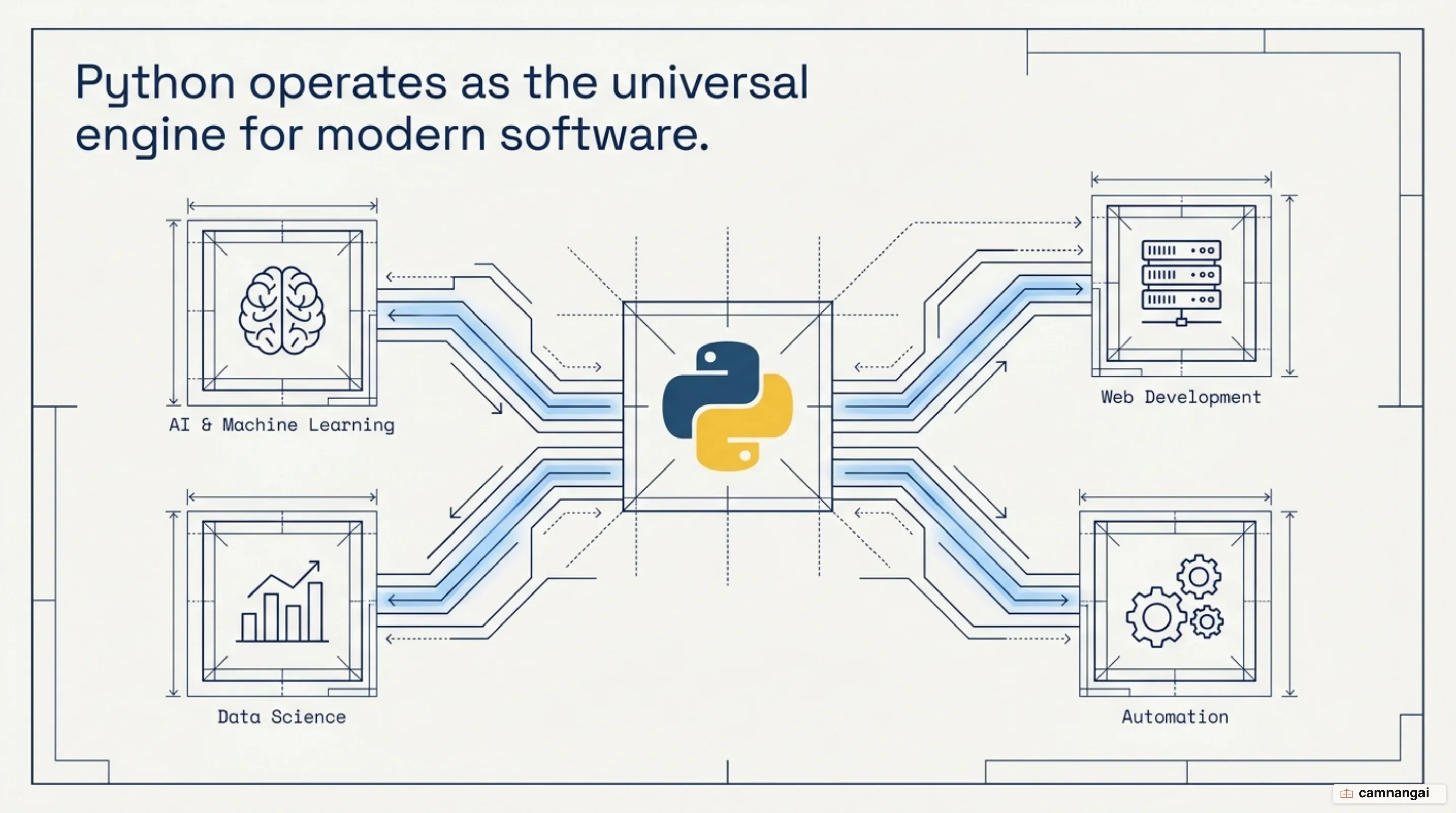
What is Python?
The language dates back to the 1989 Christmas holidays, when Guido van Rossum, a programmer at Centrum Wiskunde & Informatica (CWI), began work on a hobby project to stay productive over the winter break. His goal was a successor to the ABC language that would fix its lack of extensibility while keeping its highly readable syntax. He released the initial version, 0.9.0, to USENET in 1991.
Today the technical roadmap and intellectual property of the language are managed by the Python Software Foundation (PSF). As an independent non-profit and the copyright holder for Python versions 2.1 and newer, the PSF exists to advance the technology and support its adoption. This governance model keeps the language a community-driven open-source project on stable long-term footing.
Python ships under the PSF License, a permissive framework that supports commercial use. Under it you may use the language in proprietary products, distribute modified binaries, and sell software incorporating Python, provided the original copyright notices stay intact. That licensing is a large part of why Python spread so widely through enterprise environments.
Architecturally, the language is built for portability across different computing environments. Python code is cross-platform by default, running on Windows, macOS, and various Linux and Unix distributions without platform-specific modifications. A team can maintain a single codebase that behaves consistently regardless of the underlying operating system.
What does Python code look like?
The defining characteristic of Python's syntax is whitespace indentation for grouping statements.
Where other C-style languages rely on curly brackets {} or keywords to define logical blocks,
Python requires indentation. The visual structure of the source directly reflects its execution
logic, which forces a consistent layout across an entire team.
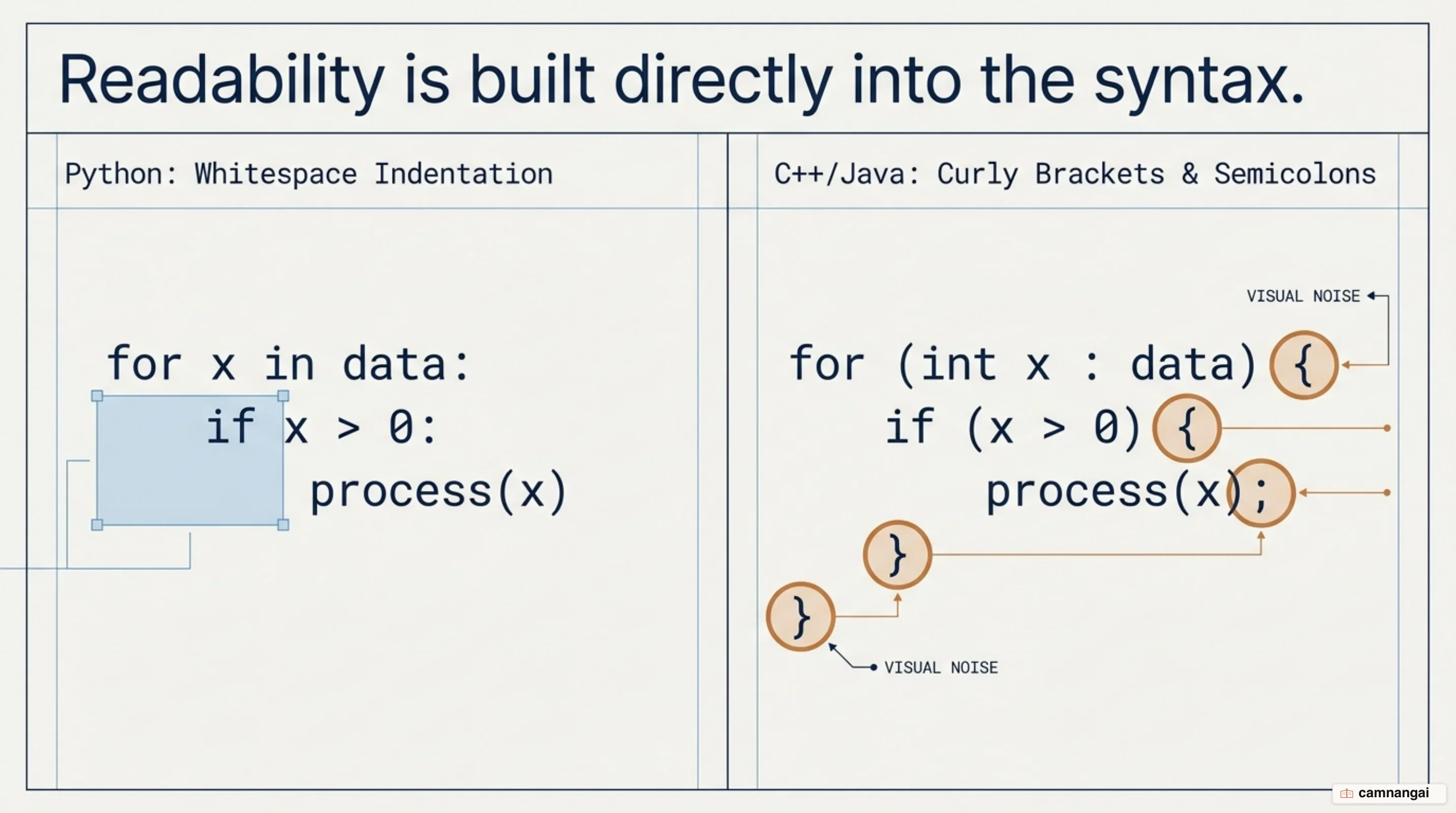
This focus on readability is a deliberate technical choice aimed at reducing the cost of program maintenance. An English-like syntax that minimizes boilerplate lets you concentrate on decomposing the problem rather than on managing the punctuation and ceremony of a lower-level language.
Python also emphasizes modularity. The language supports a full system of modules and packages,
which pushes you toward organizing code into reusable components. That modularity is backed by the
interpreter's introspective capabilities, which let the system inspect its own state — such as
viewing the available methods on an object via dir() — at runtime.
def process_data(data_list):
    # Python uses indentation to group statements
    filtered_results = []
    for item in data_list:
        if item > 10:
            filtered_results.append(item * 2)
    return filtered_results

# Simple list operation demonstration
numbers = [5, 12, 8, 20]
print(process_data(numbers))
Interpreted and dynamically typed: how Python runs
Python is an interpreted language, meaning the execution engine processes your source line by line. That gives you an immediate feedback loop: the moment an error appears, the interpreter halts and provides a traceback to the exact line of failure. It removes the latency of a separate compilation phase, which is a real bottleneck in statically compiled languages like C++ or Java.
The language uses dynamic typing and dynamic semantics, so you do not declare variable types like
int or string up front. The runtime determines the type from the value assigned to the variable.
This speeds up work on data pipelines and complex logic, since it removes the type-management
overhead that statically typed systems require.
As a high-level language, Python puts a substantial layer of abstraction over the machine. You are not required to manage memory allocation, deallocation, or the processor's register state. The interpreter handles memory through automated garbage collection, which leaves you free to work on application-level features rather than hardware constraints.
The combination of an interpreted execution model and high-level abstraction produces an environment optimized for developer productivity. A statically typed, compiled language may win on raw execution speed for specific CPU-bound tasks, but Python's model minimizes the time it takes to get a production-grade prototype in front of someone.
The standard library and PyPI: what comes with Python
Python follows a "batteries included" philosophy, giving you an extensive standard library that handles a wide range of tasks out of the box. It covers internet protocols such as HTTP, SMTP, and FTP, along with modules for string processing, regular expressions, and operating system interfaces for filesystems and system calls.
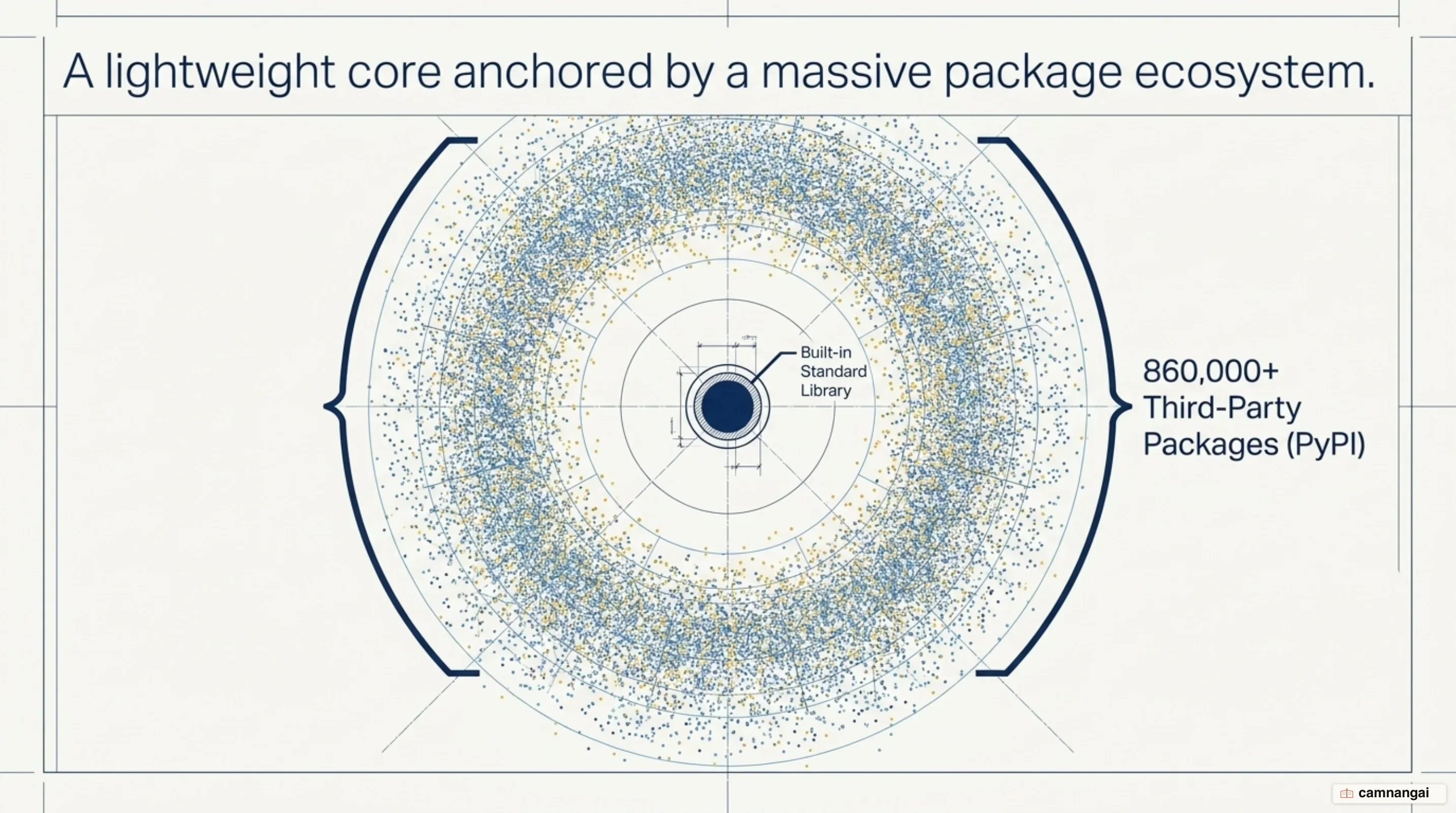
The ecosystem extends through the Python Package Index (PyPI), which hosts more than 860,000 projects. These let you pull in specialized functionality — OpenCV-Python for computer vision, or Requests for web communication — without building the tooling yourself. Almost any technical requirement already has a tested, modular solution available.
The architecture rests on modules and packages, where a module is a single source file and a package is a collection of modules. That hierarchy promotes a clean design that matters once an application grows. It encourages reuse across projects, so a team can maintain a consistent set of internal tools and libraries.
Specific examples of the library's reach include built-in support for XML-RPC, logging utilities, and unit testing frameworks. By standardizing these, Python gives developers a reliable foundation for building everything from network applications to internal engineering tools, and cuts the number of external dependencies a project needs.
What is Python used for?
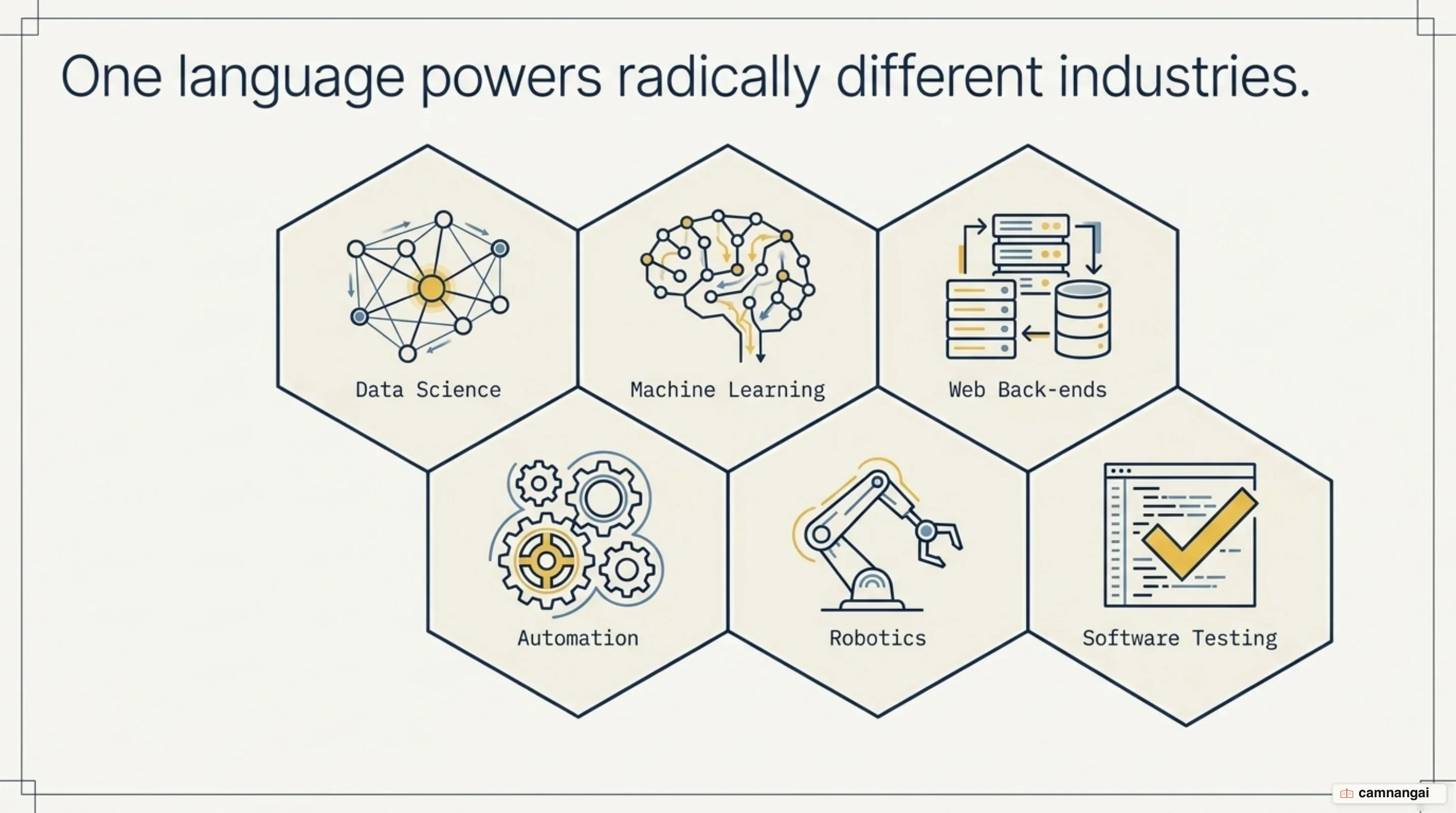
Data analytics and science
In data science, Python abstracts away the complexity of high-throughput data pipelines. You can use NumPy for numerical computation and Pandas for data cleaning and manipulation. These tools let analysts turn large, unstructured datasets into structured formats suitable for forecasting and market analysis.
Beyond data manipulation, Python is a standard for statistical visualization. Matplotlib and Seaborn generate 2D and 3D graphics — histograms, heatmaps, pie charts — directly from your data structures. Those visualizations are how you identify trends in large datasets and communicate findings to people who will not read the code.
Interactive environments like Jupyter Notebooks changed how data science gets done. They let you combine executable code, text, and visualizations into a single repeatable document. That matters in corporate environments where reproducibility of an analysis is a requirement for auditing and long-term project stability.
Machine learning and AI
Python is the lingua franca of artificial intelligence, a status the 2025 GitHub Octoverse data supports: more than 1.1 million public repositories now import a large language model (LLM) SDK. Its position rests on frameworks like TensorFlow, PyTorch, and scikit-learn, which provide the building blocks for training neural networks and implementing machine learning algorithms.
Modern AI projects have shifted from experimental research toward production implementations. The Octoverse data shows a move away from exploratory Jupyter Notebooks toward package-based Python codebases. AI features now get integrated directly into everyday enterprise software through standard Python SDKs.
Python also makes pre-trained models accessible through libraries like Keras for deep learning and SpaCy for natural language processing. Rather than architecting a neural network from scratch, you assemble these modular pieces to get image recognition or sentiment analysis working with a modest amount of code.
Web development
For web work, Python is a primary tool for server-side back-end logic. You can deploy a full-stack framework like Django to build large, secure platforms handling everything from authentication to database communication. Micro-frameworks like Flask take the lighter approach, giving you specialized APIs and microservices without the architectural bulk.
Python's role in web architecture is the plumbing: URL routing, data security, and communication between the server and the database. Platforms such as Instagram, Quora, and Netflix run Python-driven back-ends serving millions of concurrent users. These frameworks ship with mechanisms to protect against common vulnerabilities like SQL injection and cross-site scripting.
The language also supports web-centric libraries like Requests and Beautiful Soup, used for interacting with web APIs and scraping unstructured data. That makes Python a practical part of the modern web stack, connecting your applications to the broader ecosystem of services and data sources.
Automation and scripting
Automation, or scripting, means writing Python to handle repetitive manual tasks. You can automate DevOps workflows — renaming thousands of files, converting data formats, running log analysis. Automating these operations cuts the rate of human error and frees up real time.
In IT and system administration, Python scripts manage server configurations and monitor system health. A developer can write a script to check for errors across multiple log files, or send email alerts when a system parameter crosses a threshold. That capability is what keeps high-availability systems running without someone watching them.
Python also lets non-programmers simplify their own workflows. A short script can track crypto prices, update a list from inventory data, or fill out online forms. This accessibility turned Python into a personal convenience tool well outside the boundaries of software engineering.
Robotics and hardware
Python is a primary language for robotics and hardware control, used by hobbyists and industrial manufacturers such as iRobot. It is the default language of the Raspberry Pi platform, which is where a great deal of hardware prototyping happens. In industrial settings, Python programs collaborative robot arms working in tandem on manufacturing lines.
The Boto3 SDK, the AWS SDK for Python, lets you manage cloud infrastructure from your code. You can configure Amazon EC2 instances, S3 storage, and DynamoDB databases through it. That bridges physical hardware control and cloud infrastructure management in one place.
In robotics, Python usually handles high-level logic and coordination while performance-critical work goes to C++. This glue role is what lets engineers at NASA and the Jet Propulsion Laboratory use Python for research while keeping the speed needed for real-time hardware interfacing.
Software testing and prototyping
Developers use Python to hold code quality steady through automated testing. Frameworks like Unittest, Robot, and PyUnit let you write test cases that verify application behavior on every run. Wiring those tests into CI/CD (continuous integration and delivery) pipelines with Jenkins or Travis CI is how you keep new changes from introducing regressions.
Python is a preferred language for prototyping because a team can put a working model in front of a client quickly. That loop supports rapid iteration on feedback. Once the prototype holds up, the team decides whether to keep the Python codebase or port the performance-critical sections to a lower-level language.
The language also covers build control and bug tracking. Developers use Python to manage a project's lifecycle from initial scaffold through deployment. Its ability to integrate with almost anything else makes it a natural choice for the internal utilities and test harnesses that modern engineering requires.
Why did Python become the default language of AI?
Python's position in AI rests on its prototyping loop. AI research is iterative and demands constant experimentation with complex mathematical models. Python's readability lets researchers concentrate on the logic of an algorithm rather than the implementation details of the language, and that reduction in overhead is what speeds the work up.
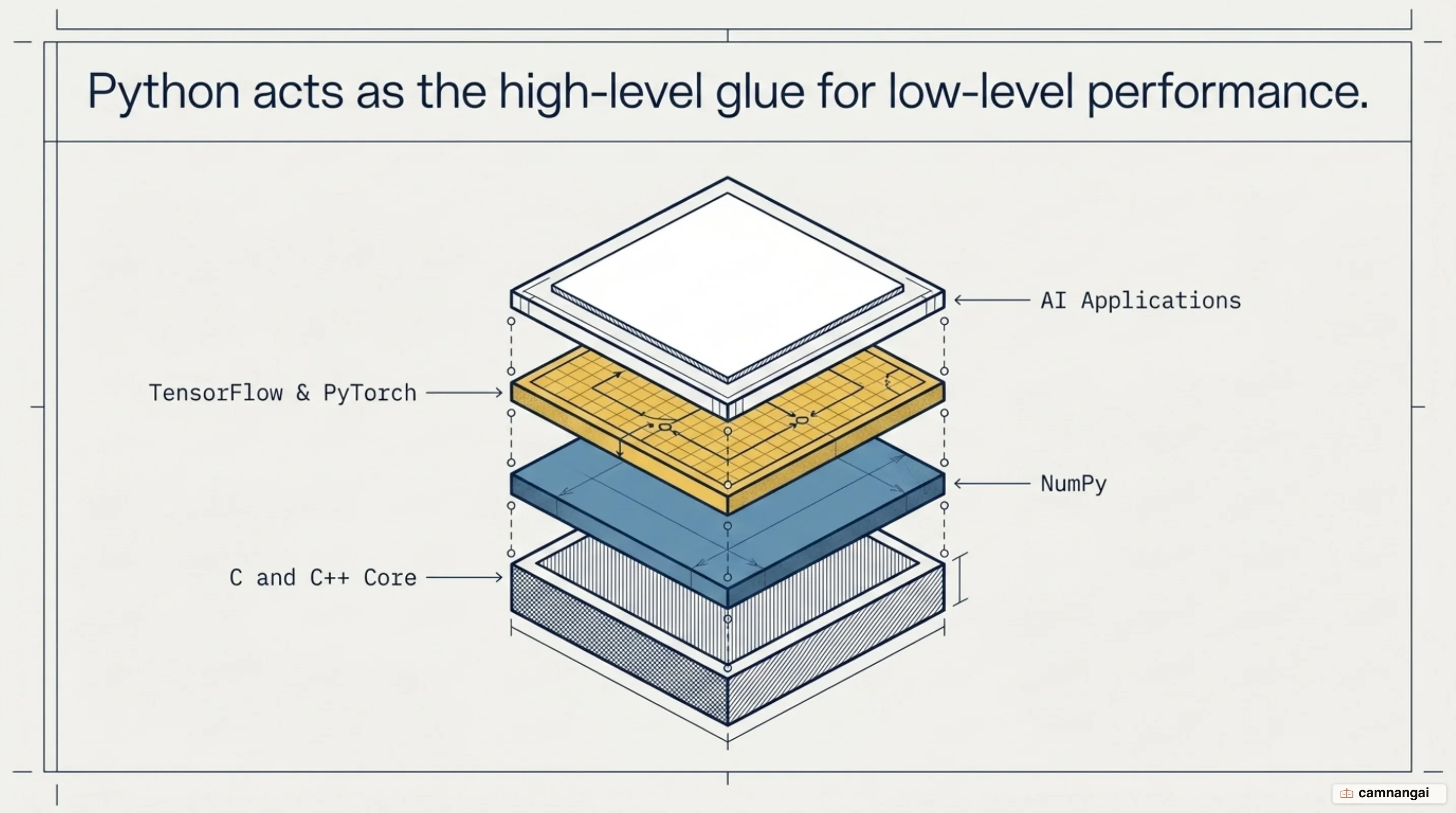
The language is backed by a specialized library ecosystem offering modular, pre-tested components for deep learning and language processing. Keras provides a streamlined API for building neural networks; SpaCy supplies pre-trained models that handle the messiness of human language. Engineers assemble sophisticated systems by connecting high-level components instead of writing the math themselves.
The 2025 Octoverse data shows AI moving out of the notebook and into production. It is no longer confined to experimental Jupyter files but deployed in production-grade Python codebases. The industry has matured, and Python has held up as a stable environment for moving models from the lab into real applications.
AI has also started maintaining the ecosystem it occupies. Half of all open source projects now have at least one maintainer using GitHub Copilot. That creates a self-reinforcing cycle: Python remains the primary environment for building AI, and those AI tools in turn make Python development faster for the next group of engineers.
When is Python the wrong choice?
Python is a poor fit for environments with hard performance constraints. As an interpreted, high-level language it carries more memory and execution overhead than something like C++. For 3D game engines, real-time signal processing, or core operating system components where latency is measured in milliseconds, C++ or Rust remains the better architectural choice.
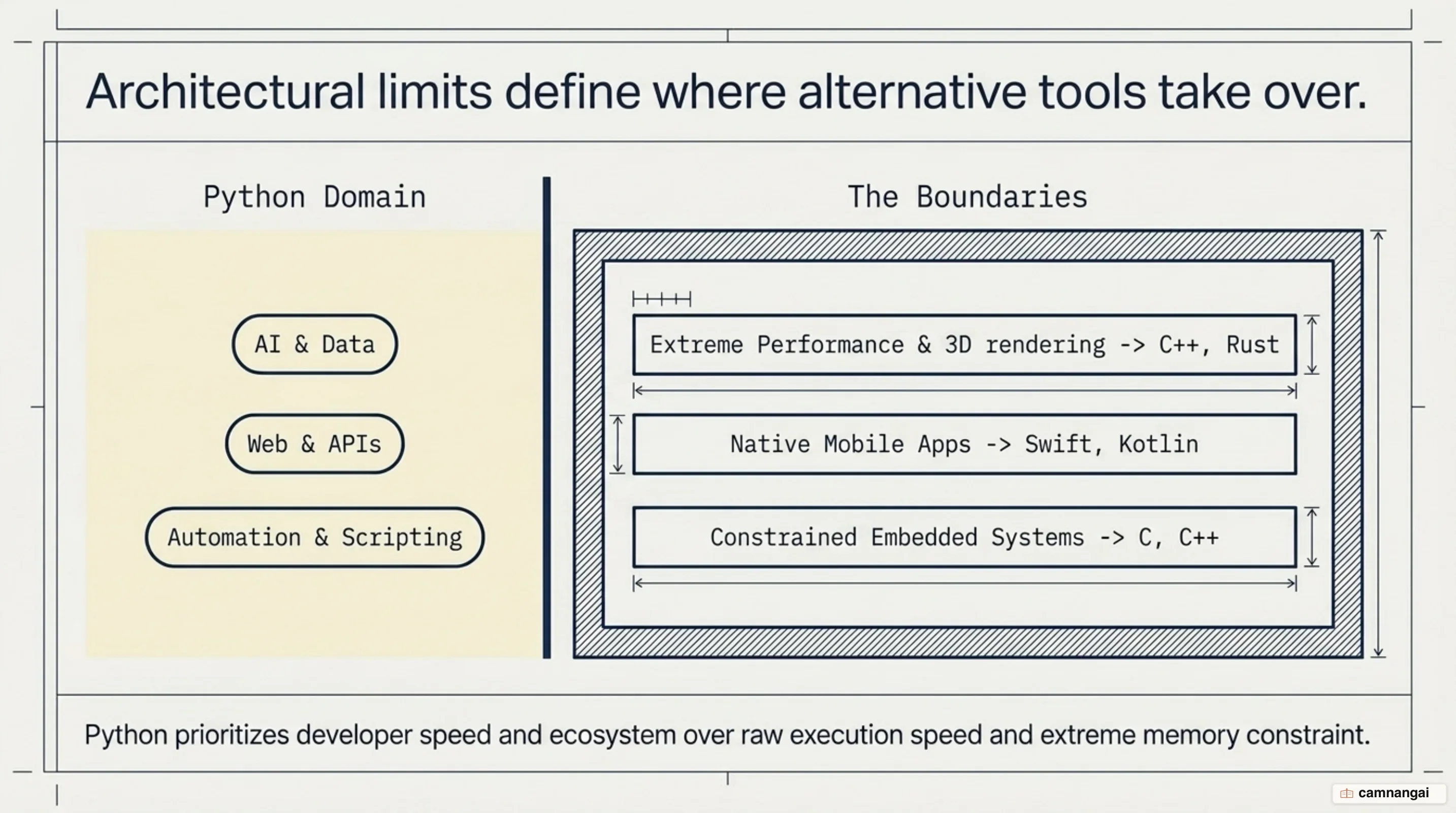
Mobile development is the second problem area. To run on iOS or Android, Python needs third-party layers such as Kivy. Those layers add wrapper latency that can make an app feel less responsive than one written in Swift or Kotlin. If your goal is a native, high-performance mobile experience, the extra layers work against you.
Historically, Python's ability to use multiple cores was limited by the Global Interpreter Lock (GIL), which prevented multiple threads from executing Python bytecode at the same time. The subinterpreters added in Python 3.14 provide a route to genuine multi-core parallelism, but the language still takes more architectural effort to reach high-concurrency performance than languages designed for parallelism from the start.
What does Python 3.14 bring?
Python 3.14 introduces deferred evaluation of annotations through PEP 649 and PEP 749 (a PEP is a Python Enhancement Proposal, the design document behind each language change). Annotations used to be evaluated eagerly at definition time, which cost runtime performance. They are now stored in annotate functions and evaluated only when something needs them for introspection, which improves startup time and trims the memory footprint of large codebases.
The release also adds template strings, or t-strings, via PEP 750. This is a mechanism for custom
string processing that returns a Template object rather than a plain string. It lets you tell the
static parts of a string apart from the interpolated values before they are combined — useful for
sanitizing input bound for SQL queries or HTML.
Multi-core parallelism arrives in the standard library through subinterpreters, defined in PEP 734.
The concurrent.interpreters module lets you run multiple isolated instances of the interpreter
inside a single process. That supports an actor-style concurrency model where interpreters run in
parallel without contending for the Global Interpreter Lock.
The tail call interpreter delivers a 3-5% performance gain on the standard benchmark suite. It replaces the traditional large C switch statement with small C functions for individual opcodes. The optimization currently requires Clang 19 or newer on x86-64 and AArch64 architectures, so it is not universal yet, but it closes part of the gap with lower-level languages at no cost to the high-level interface.
Where should you start learning Python?
The official Python Tutorial in the standard documentation is the ground truth, and it is where you should start. If you want something more structured, the University of Michigan's "Python for Everybody" on Coursera builds a solid foundation in data structures and databases. Platforms like Dataquest and edX cover similar ground with more interactivity.
The most reliable way to actually learn the language is narrower than any of that: find one small,
repetitive task in your own day and automate it with the standard library. Use the REPL — the
interactive shell you get by running python with no arguments — to test pieces as you go. Learning by doing is what these resources
all emphasize, and a task you actually needed done is the version of it that sticks.
References
- What is Python? Executive Summary — Python.org
- General Python FAQ — Python Documentation
- What is Python? — AWS
- What Is Python Used For? A Beginner's Guide — Coursera
- 11 Real World Applications for Python Skills — Dataquest
- Python AI: Why Is Python So Good for Machine Learning? — Netguru
- What's New in Python 3.14 — Python Documentation
- Octoverse 2025: AI Leads TypeScript to #1 — The GitHub Blog