DevOps is the combination of cultural philosophies, practices, and tools designed to increase an organization's ability to deliver applications and services at high velocity.
By evolving and improving products at a faster pace than organizations using traditional software development and infrastructure management processes, you can better serve customers and compete more effectively in the market. This speed enables you to innovate faster, adapt to changing markets, and grow more efficient at driving business results through technical excellence.
In a traditional environment, development and infrastructure management often function in isolated silos, where development teams prioritize feature delivery while operations teams focus on stability and uptime. Transitioning to a DevOps model replaces these silos with a unified workflow, using automation to handle tasks that were historically manual and slow. This methodology emphasizes the removal of historical barriers, often merging these disciplines into a single unit where engineers develop a range of skills across the entire application lifecycle.
Under this model, you focus on automating every stage of the software development lifecycle (SDLC) to reduce manual handoffs and waiting periods. By using a specific technology stack and integrated toolchains, engineers can independently accomplish tasks like provisioning infrastructure or deploying code—actions that previously required complex cross-team coordination. This increases both velocity and reliability, ensuring that security and quality assurance are integrated throughout the process rather than being addressed as final hurdles.
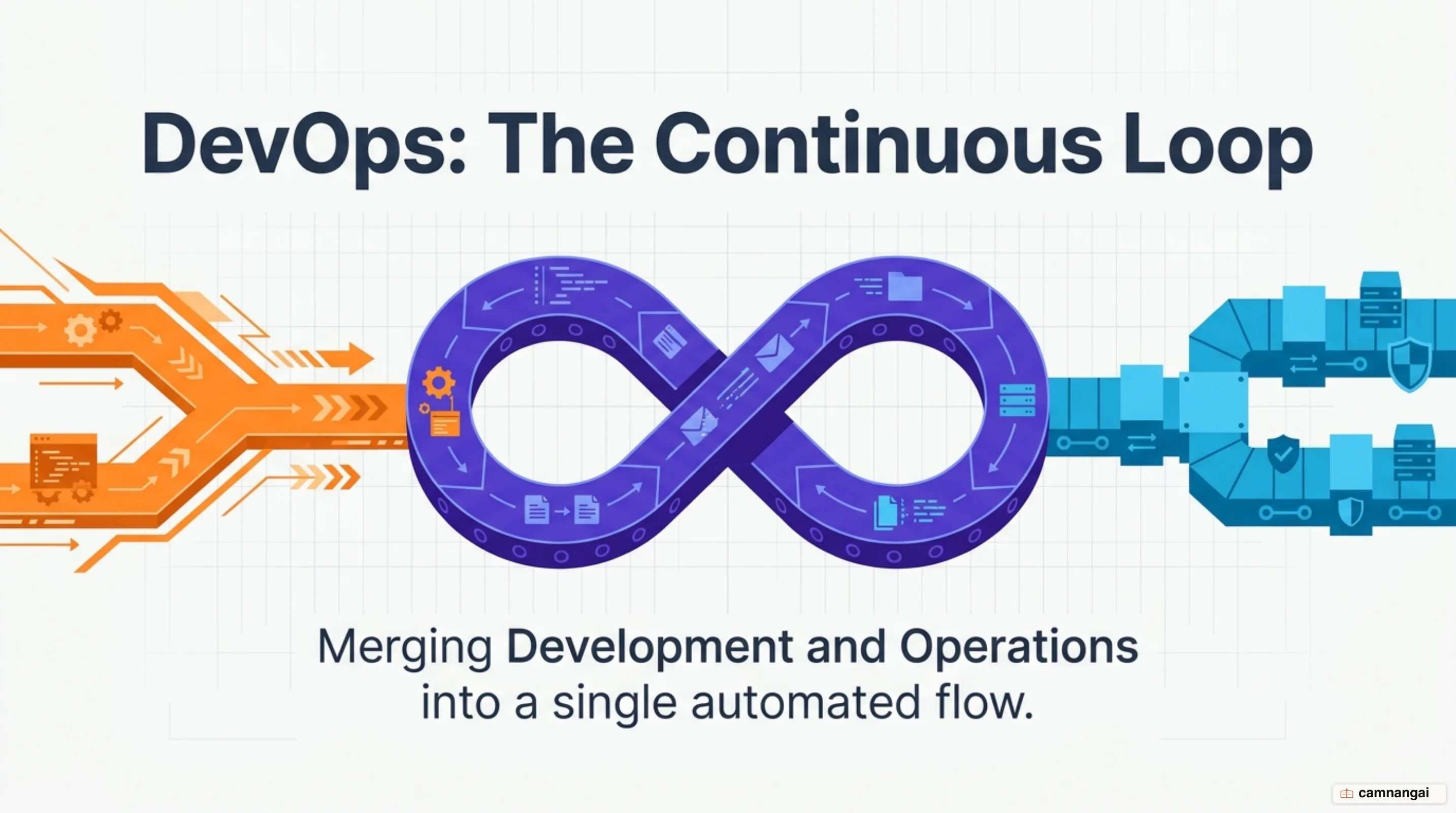
What is DevOps, and what problem did it emerge to solve?
The DevOps movement emerged in the mid-to-late 2000s as a response to the inherent friction within the traditional software development lifecycle. Historically, development teams were incentivized to deliver new features quickly, while operations teams were tasked with maintaining system stability and uptime. This created the "silo problem," or the "wall of confusion," where these two groups functioned as separate disciplines with distinct priorities. The formalization of the movement was marked by the 2009 DevOpsDays conference in Ghent, which focused on aligning these disparate groups to improve organizational efficiency.
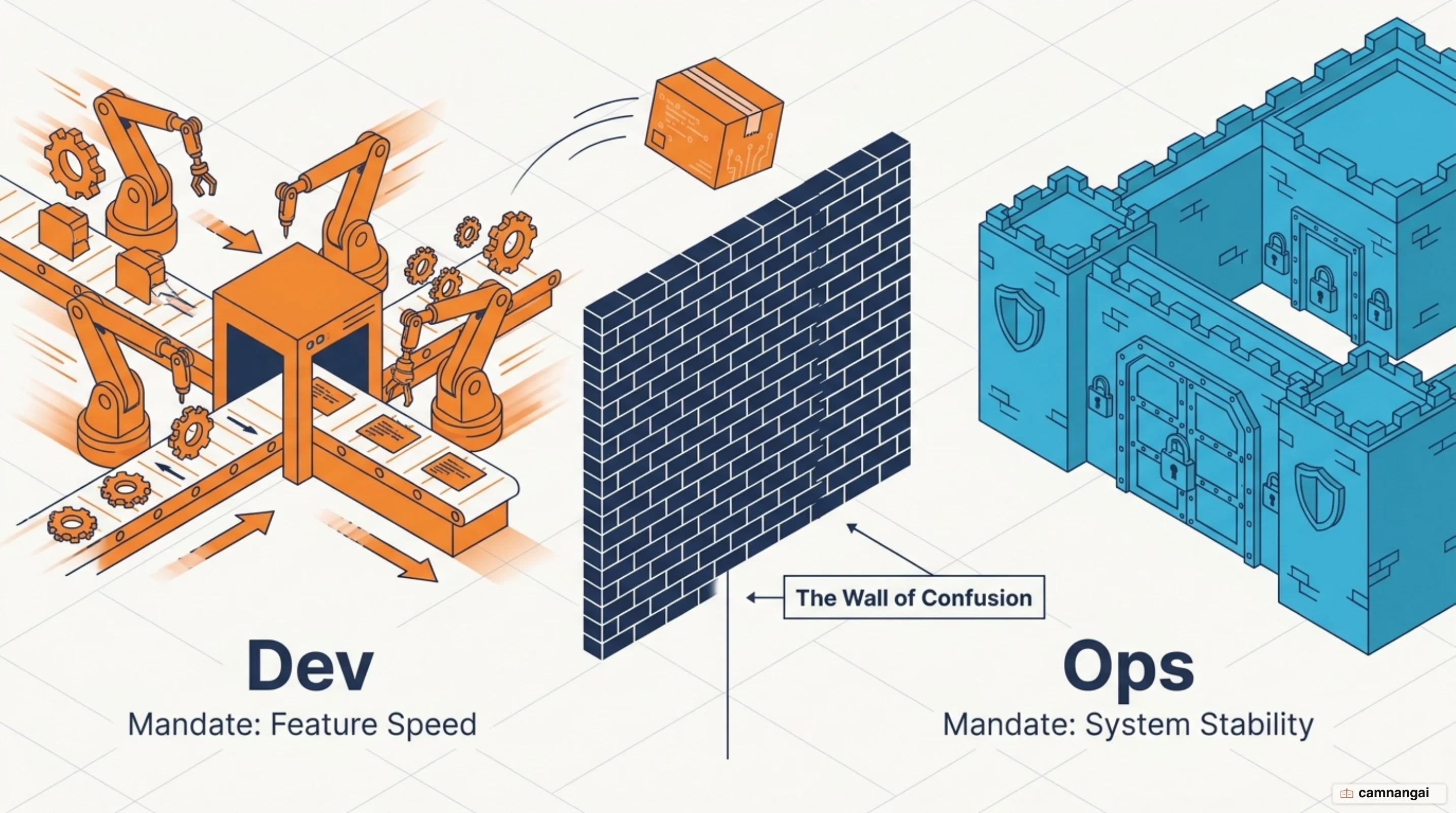
Before the widespread adoption of DevOps, the software delivery process was largely manual and linear. Development teams would complete a large body of code and "hand it off" to operations for deployment, often with little communication regarding the runtime environment. If issues arose during deployment, manual delays were common as teams waited for availability or struggled to diagnose problems across silo boundaries. This approach resulted in slow release cycles, frequent errors in production, and significant downtime, which became unsustainable as software became a primary business driver.
Software and the Internet have transformed every part of the business value chain, from logistics and communications to customer interaction. In the modern market, software is no longer a support function; it is the core component of the product itself. Consequently, organizations must transform how they build and deliver software in a manner similar to how physical goods companies revolutionized their delivery through industrial automation in the 20th century. DevOps provides the framework for this transformation by treating software delivery as a continuous, automated pipeline.
To remain competitive, you must address the inefficiencies of manual handoffs and fragmented ownership. DevOps solves the silo problem by fostering a culture where development and operations collaborate throughout the entire lifecycle. This collaboration ensures that code is written with the production environment in mind and that infrastructure is ready to support rapid updates. By aligning success metrics across the entire team, organizations can achieve the speed necessary to respond to customer needs without sacrificing the stability of their services.
What stages make up the DevOps lifecycle?
The DevOps lifecycle is typically represented as an "infinity loop," reflecting a continuous, iterative workflow that differs significantly from linear, step-by-step models. This loop ensures that feedback from the production environment directly informs the planning of the next iteration, creating a closed-loop system of constant improvement. This model works better than a linear one because it treats software as never "finished" but instead a living system that requires ongoing refinement.
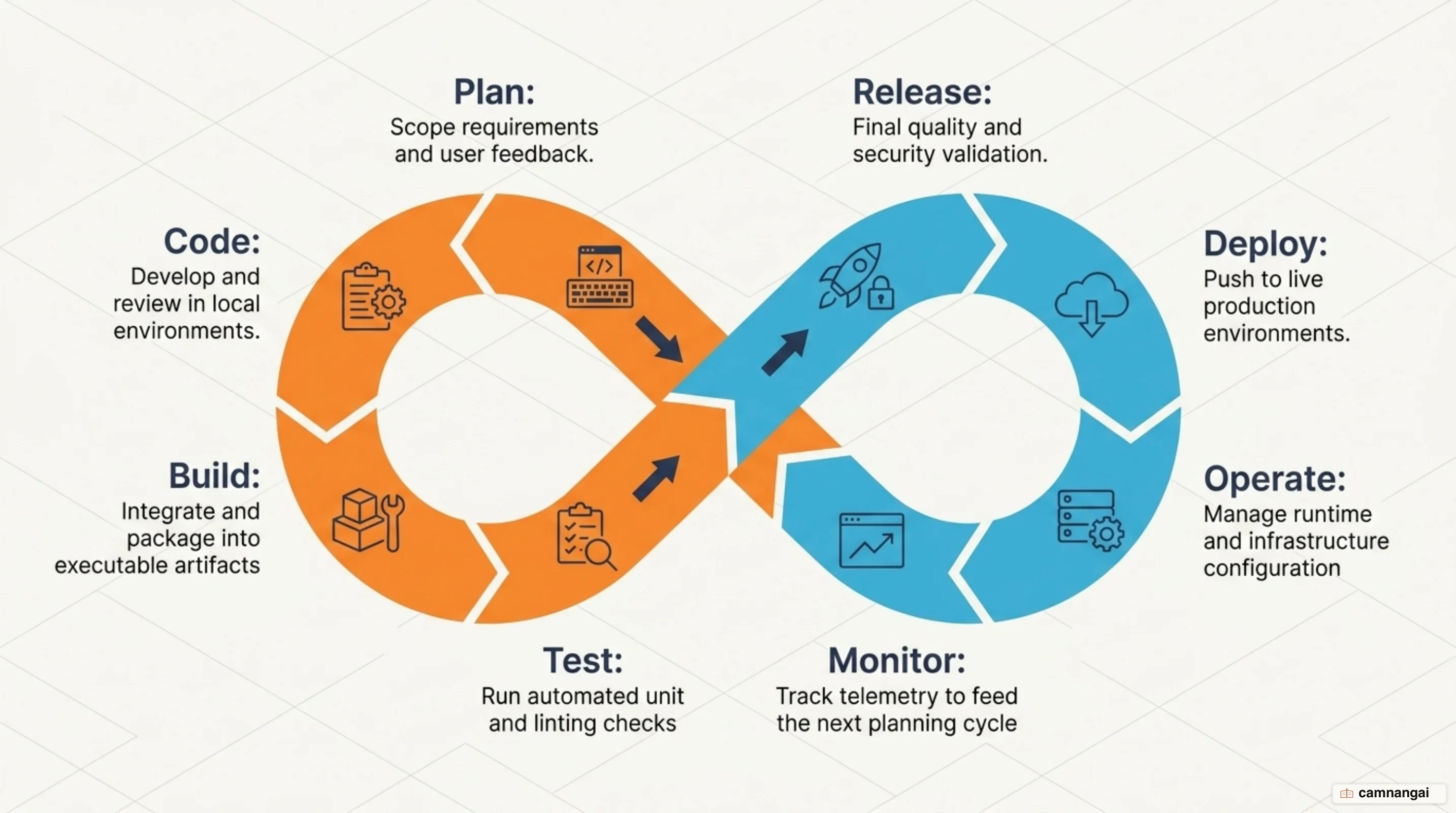
The front-half of this lifecycle focuses on translating requirements into validated artifacts. This includes the rigorous use of version control and automated build processes to ensure that every change is tracked and verifiable. By moving testing and security activities earlier in this loop—a principle known as "shifting left"—you can identify and remediate defects when they are least expensive to fix. This proactive approach reduces the risk of complex failures occurring during the final stages of the release process.
The back-half of the lifecycle manages the delivery and maintenance of the application in live environments. This involves the automated provisioning of infrastructure and the use of sophisticated monitoring tools to gain visibility into system health. In a mature DevOps organization, these phases are supported by "self-service" capabilities, allowing developers to deploy and operate their services without waiting for external approvals. This autonomy is critical for maintaining high velocity while ensuring that systems remain compliant and secure.
Ultimately, this iterative lifecycle enables the delivery of small, frequent updates rather than occasional, large-scale releases. Frequent updates make each deployment less risky because the scope of change is limited, making it easier to identify the root cause of any issues. This continuous flow of value allows the organization to scale and adapt to market demands with minimal friction.
1. Plan
Teams scope out features and requirements for the next release, drawing on user feedback and stakeholder input to create a backlog. This backlog is a prioritized list of improvements and bug fixes that guide the upcoming development cycle.
2. Code
Developers write code to meet the backlog requirements. Technical activities in this phase include Test-Driven Development (TDD), where tests are created before the code itself, and peer code reviews to maintain quality and security standards.
3. Build
New code is integrated into the master code base through an automated process. This phase involves compiling and packaging the code into executable files. These packaged outputs are typically stored in a binary repository for reuse in later stages of the lifecycle.
4. Test
Continuous, automated testing occurs to ensure the application meets all functional and non-functional requirements. This includes unit tests of isolated code fragments and linting programs that analyze the code for syntax or security errors before it proceeds.
5. Release
The release stage involves final quality assurance and compliance checks. The software is assigned a unique version number for tracking and prepared for the production environment. If defects are found, the team intercepts them here before users are impacted.
6. Deploy
The project is pushed to a production environment. Organizations often use "canary" or subset deployments to verify stability among a small group of users before rolling out the update to the entire user base.
7. Operate
Operations teams manage the software in the live environment to ensure uninterrupted service. This includes optimizing resource utilization, managing storage and compute postures, and defining desired state configurations to prevent performance degradation.
8. Monitor
Teams collect and analyze performance data, logs, and user feedback. This observability provides the technical insights necessary to inform the "Plan" stage for the next iteration, ensuring the development cycle remains data-driven.
The core practices of DevOps
To achieve high velocity and reliability, DevOps relies on several technical practices that automate the management of applications and infrastructure. These practices are designed to replace manual, error-prone tasks with repeatable, code-driven workflows. By standardizing these processes, you can ensure that environments are consistent and that the software release process is entirely predictable.
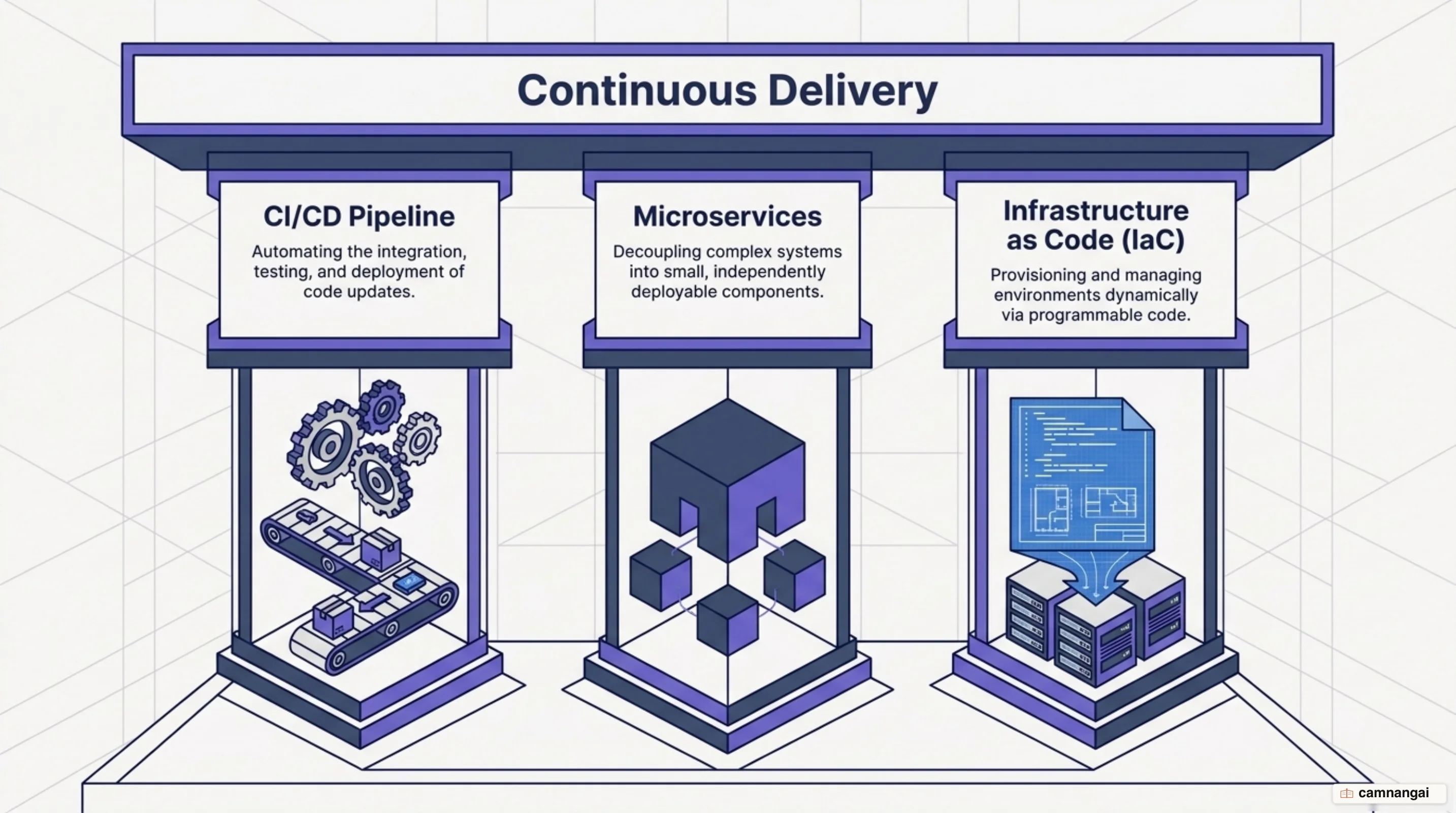
One of the most transformative practices is the transition from manual configuration to automated, version-controlled systems. In traditional models, servers often became "snowflakes"—unique environments with manual tweaks that were impossible to replicate. DevOps practices eliminate this risk by emphasizing immutable infrastructure, where environments are replaced rather than modified. This ensures that the environment used for testing is identical to the one used in production, significantly reducing "it works on my machine" issues.
Decoupling systems through architectural shifts also lets teams work independently. Coordination overhead is often the primary bottleneck in large organizations; by reducing the need for cross-team synchronization, you can accelerate the delivery of individual components. When paired with robust monitoring, these practices create a safety net that allows for rapid innovation while maintaining a high level of system availability and user trust.
Continuous Integration and Continuous Delivery (CI/CD)
Continuous Integration (CI) is the practice of regularly merging code changes into a central repository, triggering automated builds and tests to identify bugs immediately. Continuous Delivery (CD) expands this by automatically preparing every validated change for release. This ensures a deployment-ready artifact is always available, allowing for frequent and reliable updates to the production environment.
Infrastructure as Code (IaC)
Infrastructure as Code is the practice of provisioning and managing IT resources using high-level descriptive coding languages and version control. Instead of manual setup, engineers interact with infrastructure via APIs and declarative scripts. This eliminates configuration drift and allows for the rapid, repeatable deployment of standardized environments across development, testing, and production.
Microservices Architecture
Microservices is a design approach that builds an application as a set of small, independent services, each scoped to a single purpose and communicating via well-defined APIs. This architecture reduces coordination overhead, as separate teams can own, update, and scale individual services concurrently, increasing the overall agility and resilience of the system.
Monitoring and Logging
Monitoring and logging involve capturing and analyzing real-time data from applications and infrastructure to understand performance and user experience. Active observability is critical for 24/7 services, as it allows teams to perform root-cause analysis and react proactively to system anomalies or unexpected changes in resource consumption.
DevOps culture: why tooling alone isn't enough
DevOps is primarily a cultural philosophy; implementing automation tools without a fundamental shift in mindset will not achieve the desired results. It requires a change in how teams interact, moving away from "handing off" work toward shared responsibility across the entire lifecycle. In a DevOps culture, developers and operations teams align on common goals, sharing accountability for both the velocity of development and the reliability of the production environment.
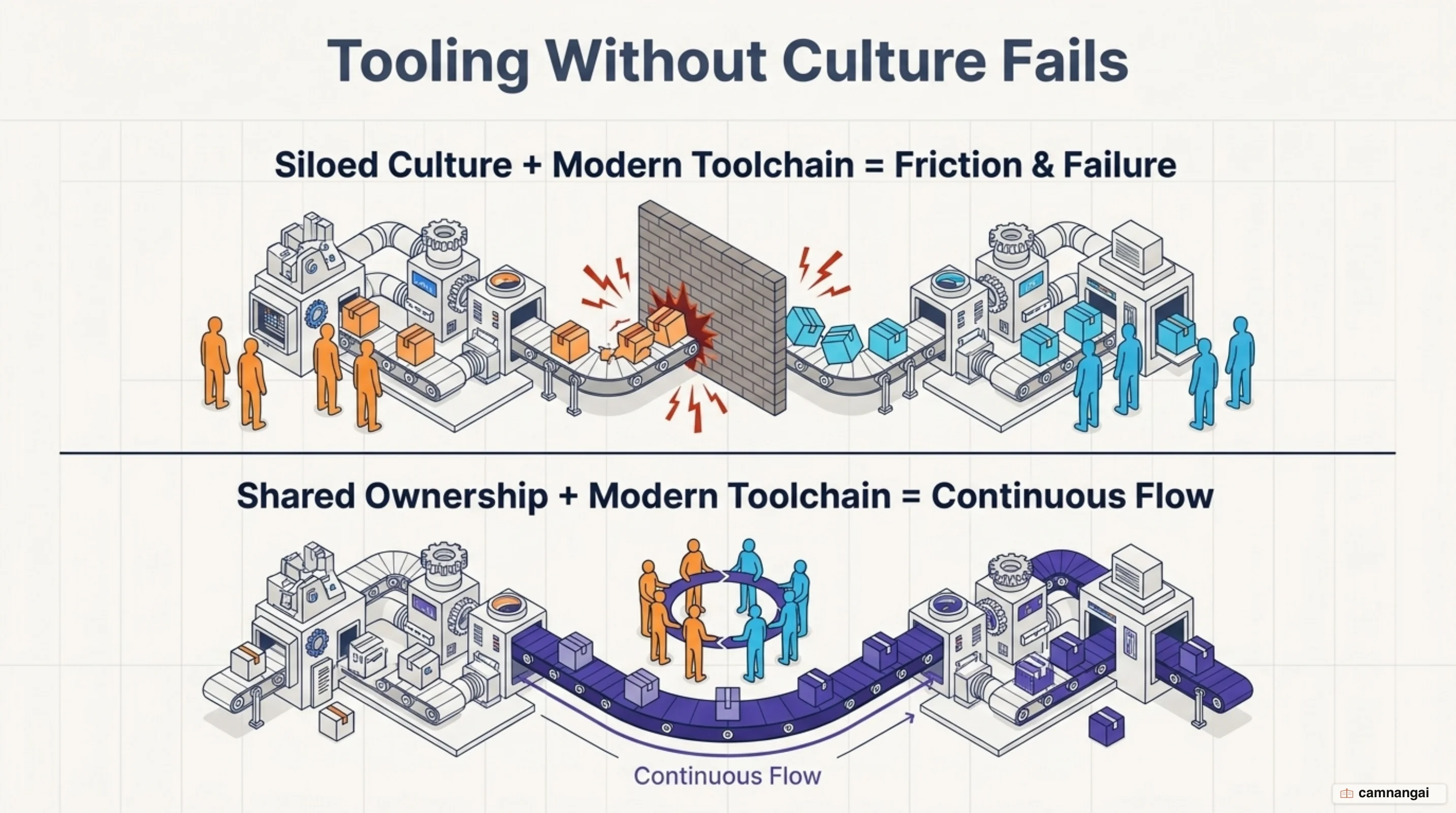
To adopt this culture, organizations must break down traditional silos and reorganize personnel into cross-functional, autonomous units. These teams work on a project from inception through feedback without waiting for external approvals or handoffs. This autonomy is built on values of transparency and communication, usually through shared access to project tracking systems, wikis, and chat applications to ensure all stakeholders—including security and business teams—have full visibility.
A central element of this cultural shift is the "shift-left" principle, which integrates activities like testing and security earlier in the process. This is driven by the reality that the cost of fixing a bug increases exponentially as it moves closer to production. When every team member takes ownership of quality and security from the start, the organization can move faster while maintaining control over the final output.
The culture also has to emphasize continuous improvement and learning. Teams use feedback loops from real-world usage to refine their processes and products. This mindset encourages engineers to think about the end customer's needs and how their specific technical contributions solve those needs, rather than focusing strictly on their siloed job descriptions.
What categories of DevOps tools are there?
Effective DevOps implementations require a specialized toolchain that supports automation and asynchronous collaboration. These tools are categorized based on their function within the lifecycle, helping teams manage complex, high-velocity environments at scale. You pick them for how well they integrate into one automated pipeline that reduces manual intervention, more than for any individual feature.
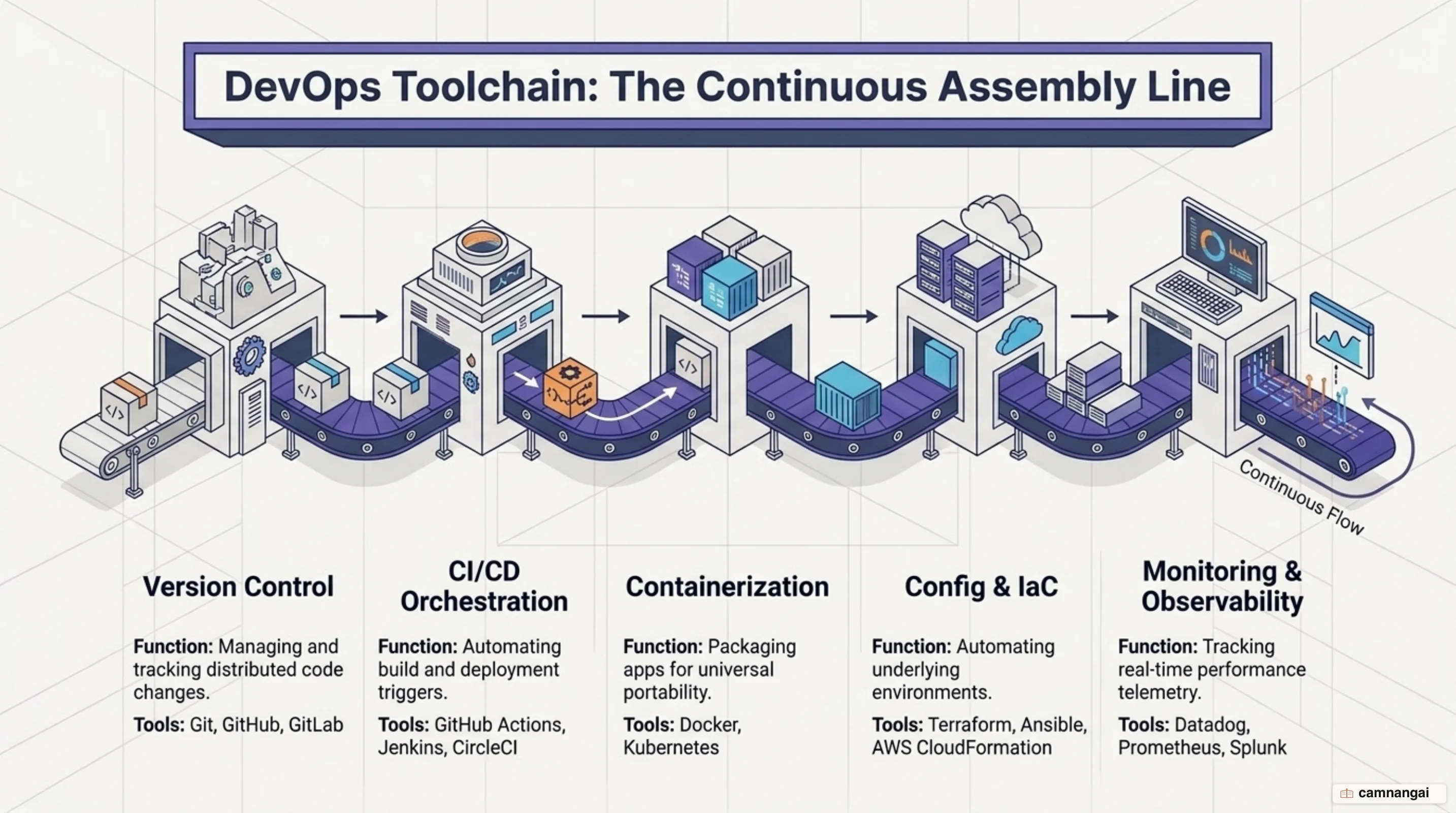
The modern toolchain focuses on declarative management, where you define the desired state of a system and the tools ensure that state is maintained. This approach is essential for managing hundreds of microservices or large-scale cloud environments where manual oversight is impossible. These tools also provide the "versioned truth" for the entire system, ensuring that every change—whether to code or infrastructure—is documented and reversible.
Version Control and CI/CD Pipelines
Version control systems like Git and GitHub allow multiple developers to manage and track code changes collaboratively. CI/CD pipeline tools, such as Jenkins, GitHub Actions, and CircleCI, automate the building, testing, and packaging of this code. These tools ensure that every commit is validated through a standardized process before it is prepared for deployment.
Containerization and Orchestration
Containerization tools like Docker encapsulate applications into portable packages that run consistently across any platform. Orchestration tools, most notably Kubernetes, manage and scale these containers in distributed systems. These technologies are vital for microservices, as they improve resource efficiency and simplify the management of complex, multi-component applications.
Configuration and Infrastructure Management
Infrastructure as Code (IaC) tools like Terraform and AWS CloudFormation allow teams to provision resources through versioned scripts. Configuration management tools such as Ansible, Chef, and Puppet automate the setup and maintenance of system settings. Together, these tools ensure IT environments remain consistent, compliant, and free from manual configuration errors.
Observability and Feedback Tools
Observability and monitoring tools, including Prometheus, Grafana, Datadog, and Splunk, provide real-time visibility into system performance. They gather metrics, logs, and traces to help teams detect issues proactively. Continuous feedback tools like surveys or heat mapping help teams gather user insights to inform future development cycles and strategic planning.
What does DevOps deliver, and how do you measure it?
DevOps delivers significant business value by improving speed, delivery cadence, reliability, and scale. By automating the release process, organizations can respond to customer needs faster and build a sustainable competitive advantage. Reliability is improved through automated testing and real-time monitoring, ensuring that high-velocity updates do not compromise the user experience or violate compliance standards.
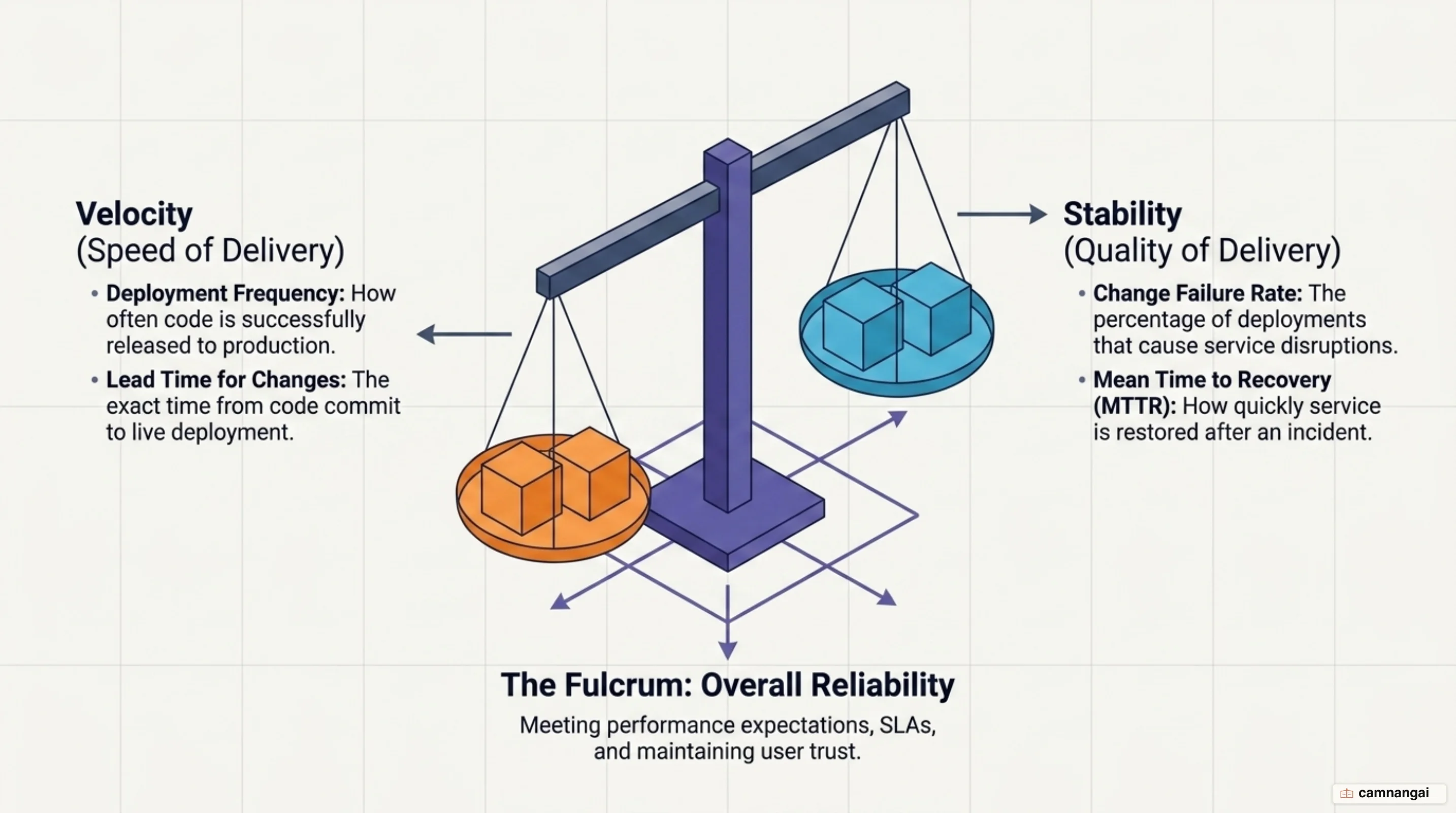
To measure the effectiveness and maturity of a DevOps implementation, technical leaders use the DORA metrics. These metrics provide a quantitative framework for balancing speed and stability, ensuring that an increase in one does not lead to a degradation of the other. By tracking these data points over time, you can identify bottlenecks and justify further investments in automation and process improvement.
- Deployment Frequency: This measures how often code is successfully released to production. Higher frequency indicates efficient workflows, robust automation, and a mature CI/CD pipeline.
- Lead Time for Changes: This tracks the time from a code commit to a successful production deployment. Shorter lead times indicate streamlined testing cycles and the removal of manual approval bottlenecks.
- Change Failure Rate: This is the percentage of deployments that result in service disruptions or require remediation. A lower rate suggests higher quality and more effective automated testing practices.
- Mean Time to Recovery (MTTR): This measures the speed at which service is restored following an incident. Faster recovery reflects effective observability, resilient incident response, and automated remediation processes.
- Reliability: This measures the consistency and stability of systems in meeting performance expectations and service-level goals. Reliability is explicitly linked to Service Level Agreements (SLAs), ensuring that the system remains dependable under changing conditions.
How do DevSecOps and SRE differ from DevOps?
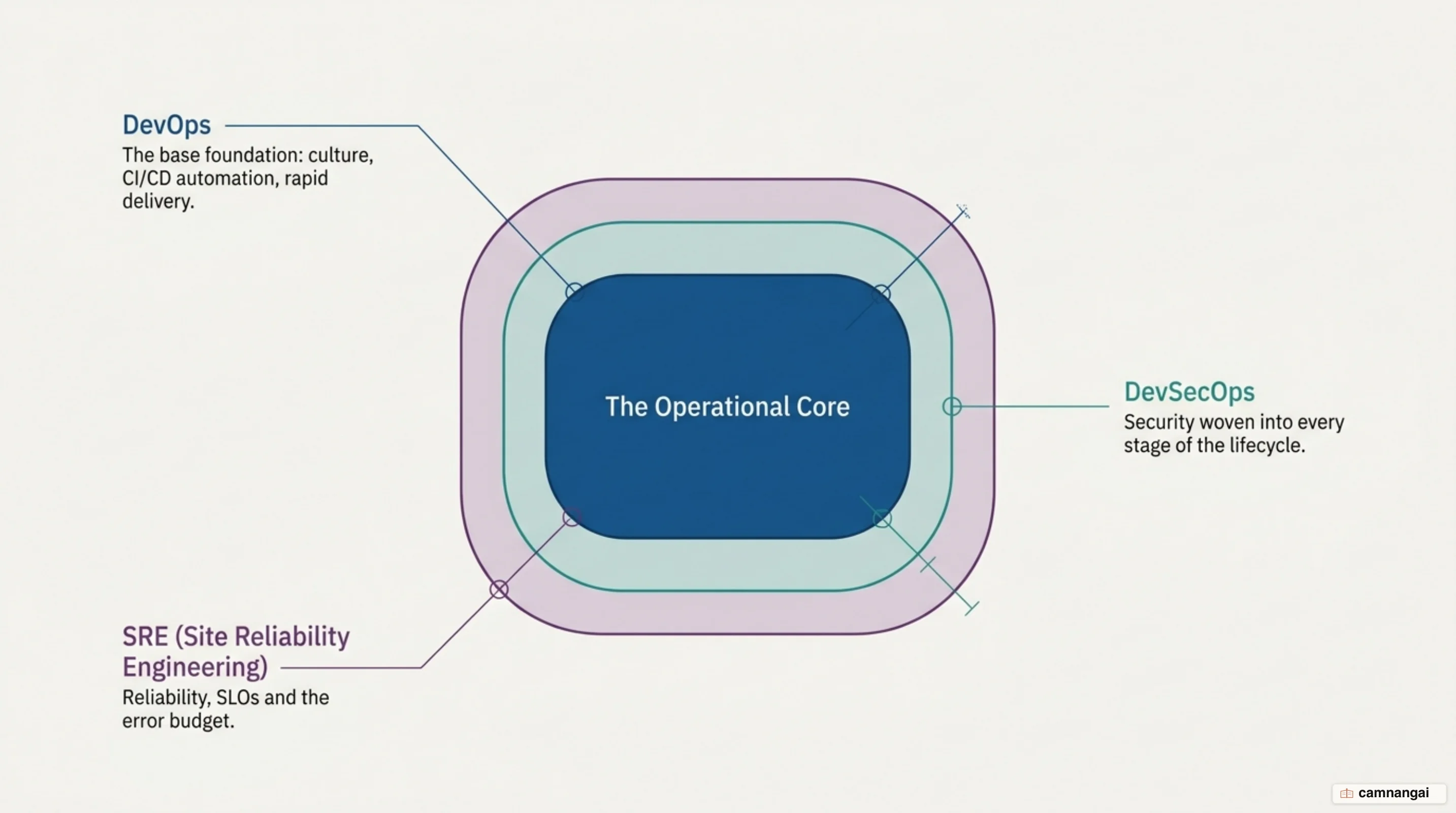
As DevOps has matured, specialized disciplines have emerged to address the complex requirements of modern IT, specifically regarding security and operational stability at scale.
DevSecOps: Security as a Standard
DevSecOps is the integration of security practices and security teams into every stage of the DevOps lifecycle. In traditional models, security was an afterthought tacked onto the end of the development cycle. DevSecOps uses automated security testing—such as static and dynamic analysis—to identify vulnerabilities as code is written. This "shift-left" approach makes security fixes faster and less expensive, ensuring a strong security posture without sacrificing delivery speed.
Site Reliability Engineering (SRE)
Site Reliability Engineering (SRE) is a discipline that applies engineering principles to operations tasks, essentially treating operations as a software problem. SRE acts as a bridge between development and operations, focusing on transforming the classical system administrator into an engineer who uses automation to replace manual tasks. A key concept in SRE is the "error budget," which defines an acceptable level of operational risk. This budget acts as a mechanical governor: if the budget is exhausted due to instability, the team must prioritize reliability over new feature deployments to maintain the standards defined in SLAs.
Common myths and barriers when adopting DevOps
Several myths persist that can discourage organizations from beginning their DevOps journey. A common misconception is that deep programming mastery or expert-level Linux skills are mandatory for every team member. In reality, a basic understanding of programming concepts and the ability to navigate file systems is sufficient to start. Furthermore, you do not need prior IT experience to contribute effectively, as soft skills like communication, collaboration, and problem-solving are as critical as technical expertise in a DevOps environment.
However, organizations face significant technical and structural barriers during adoption. Updating outdated infrastructure is often the most difficult hurdle, as legacy systems frequently lack the APIs and compatibility required for automation. These environments were not built for rapid iteration, often requiring extensive reengineering or parallel operations before DevOps practices can be successfully introduced.
The transition to Infrastructure as Code also presents a steep learning curve. Teams must be trained not only in new coding languages but also in version control and test automation for infrastructure. Mistakes in IaC can have wide-reaching consequences, making it essential to treat infrastructure code with the same rigor as application code. Managing the complexity of hundreds of independent microservices also requires a level of monitoring and pipeline maturity that many organizations struggle to implement in the early stages.
Finally, "tool sprawl" is a pervasive barrier where organizations prioritize the acquisition of tools over the development of people and culture. This results in a collection of disconnected technologies that cause inefficiencies and detract from the core principle of team accountability. A successful transition requires prioritizing a clear organizational structure and aligned processes over the simple implementation of a specific technology stack.
Where should you start with DevOps?
To start with DevOps, you must gradually modify your existing processes and pragmatically address your technology constraints. It is essential to fix broken or inefficient processes before attempting to automate them; automating a flawed workflow merely "automates chaos." Focus on upskilling your team in fundamental collaborative practices, such as version control and peer code reviews, to build the necessary foundation for shared ownership and transparency.
The transition should be incremental and data-driven. Start by identifying the manual bottlenecks that cause the most friction and introduce automation where it provides immediate value, such as in the build or testing phases. By steadily building an effective pipeline and promoting a culture of shared accountability, you can improve operational efficiency while delivering high-quality, secure software at scale.