Large Language Models (LLMs) provide massive reasoning capabilities but are limited by static training data and fixed knowledge cutoffs. To bridge the gap between foundation models and private enterprise data, systems engineers implement retrieval-augmented generation.
Authoritative RAG use cases ground generative models in verifiable enterprise knowledge bases, eliminating the hallucination risks inherent in standalone probabilistic generation.
By architecting a pipeline that retrieves relevant facts from external sources before the model generates an output, engineering teams ensure that AI responses are accurate, current, and auditable across business workflows.
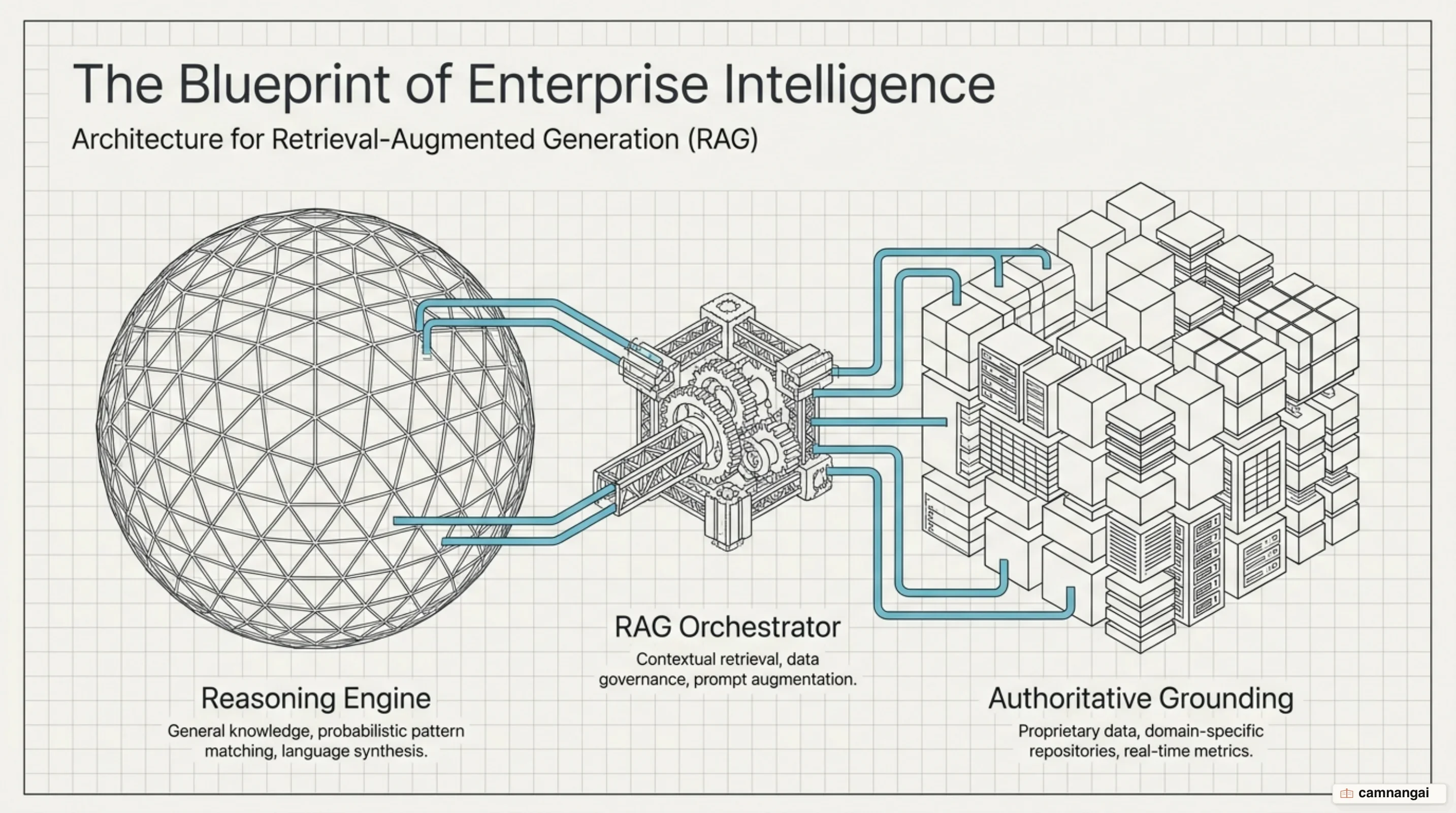
Why enterprises need RAG instead of LLMs alone
Standalone LLMs are fundamentally probabilistic engines, predicting token sequences based on historical patterns in their training corpora. This introduces severe limitations in production:
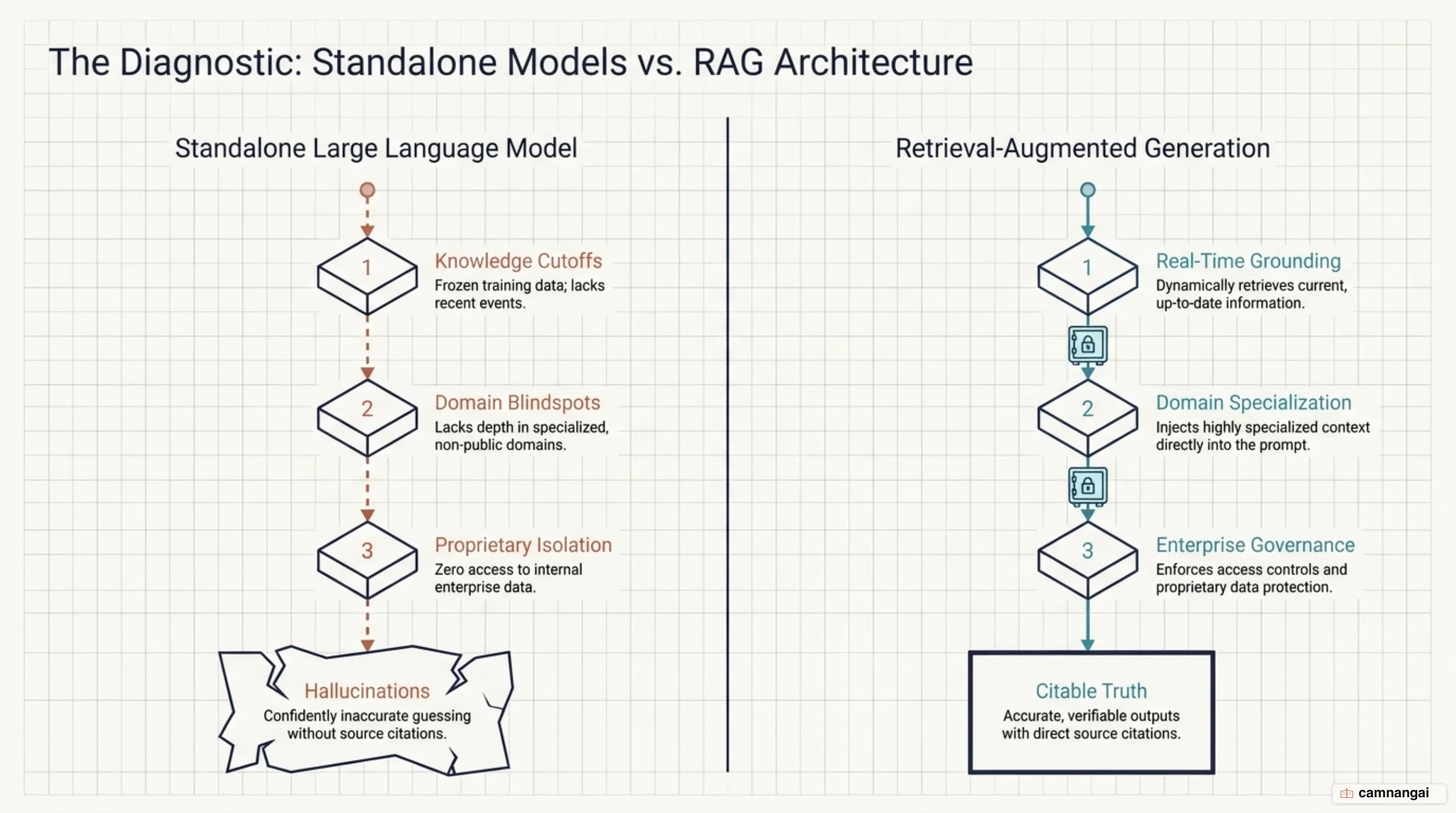
- Knowledge cutoffs: Models cannot answer questions on events, regulations, or technical changes finalized after their training concluded.
- Absence of proprietary context: Corporate wikis, client interactions, and internal architectures are deliberately excluded from public foundation models.
- Hallucination under uncertainty: When prompted with specialized queries, ungrounded models frequently fabricate plausible-sounding answers with high confidence.
When comparing RAG or fine-tuning, RAG provides distinct architectural advantages:
- Granular access control: Knowledge is stored externally in a vector database, allowing role-based access controls (RBAC) to restrict what data is retrieved for each user role.
- Deterministic source attribution: Every response can cite the exact source document, page, or paragraph, providing the audit trail required by legal and compliance frameworks.
- Inference cost efficiency: Rather than stuffing entire document collections into an expansive context window, RAG isolates only the most relevant passages, minimizing token consumption and inference latency.
- Security perimeter: Proprietary intellectual property remains in dedicated infrastructure and is never baked into model weights where it risks data leakage.
1. Enterprise knowledge search and technical assistants
The primary internal application of RAG is transforming fragmented repositories into queryable technical knowledge engines. Internal portals connect directly to documentation, engineering runbooks, and company policies to answer employee queries with citation-backed precision.
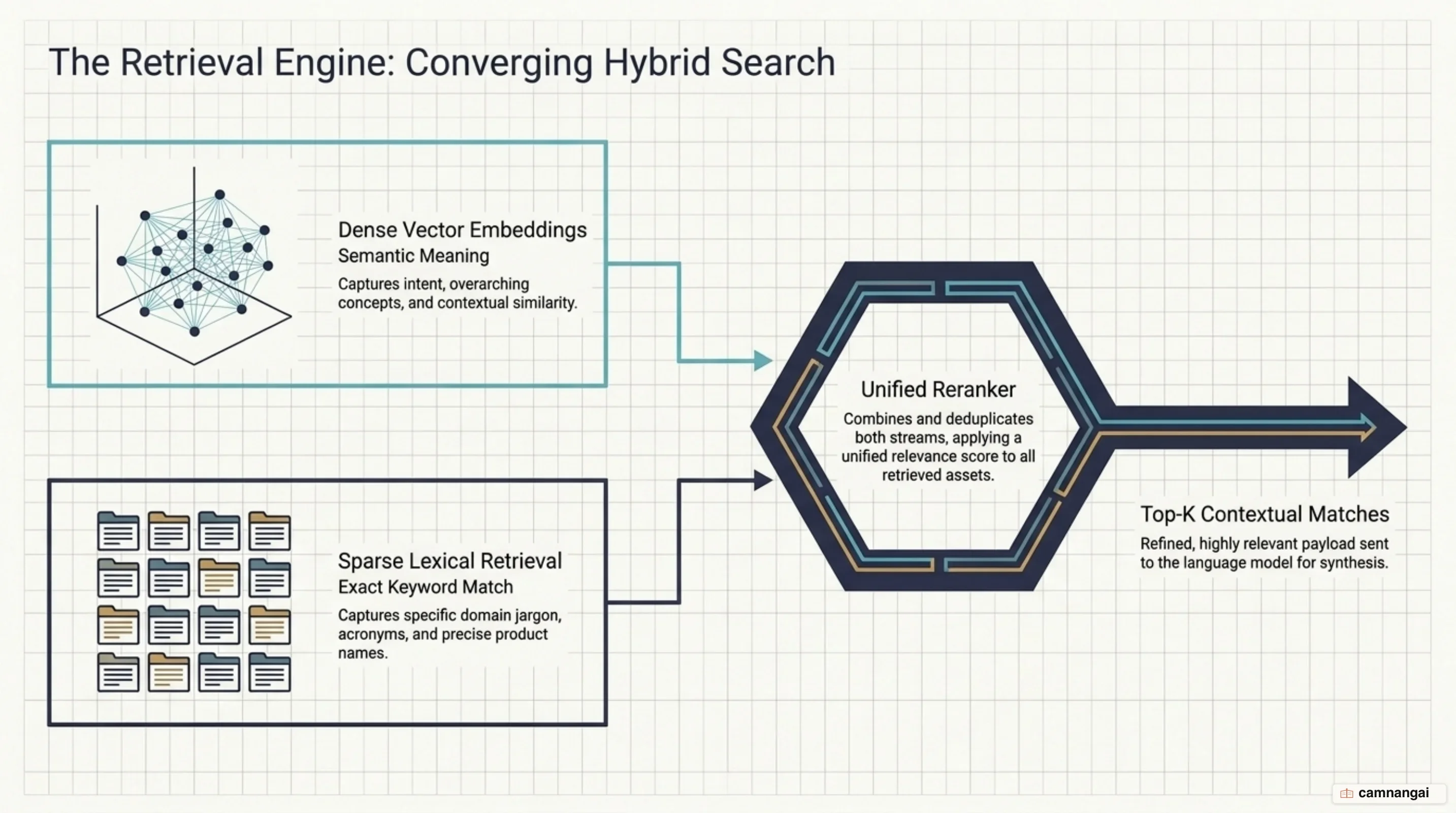
To navigate specialized terminology, acronyms, and part numbers, production systems combine dense vector embeddings with sparse keyword indexing in a hybrid search configuration. JetBlue deployed "BlueBot" to partition internal knowledge queries across operational departments: maintenance crews inspect repair logs while financial analysts query filings within the same interface. Similarly, Experian's "Latte" assistant surfaces verified guidelines to streamline technical prompt design and developer workflows.
In automotive operations, Cycle & Carriage utilizes RAG across thousands of technical repair guides and customer support logs. The system enables front-line service personnel to resolve complex mechanical diagnostic inquiries by retrieving authoritative manufacturer documentation in sub-second latency.
2. Customer support automation and IT helpdesks
External-facing support systems use RAG to replace rigid decision trees with natural conversational agents grounded in real-time inventories and service manuals. Whenever policies or catalogs change, engineers update the underlying vector index asynchronously without requiring model downtime.
Support agents pull current product specifications, warranty conditions, and troubleshooting steps to resolve tier-1 and tier-2 customer tickets automatically. Because every claim includes direct references to official documentation, customers receive verifiable answers rather than vague summaries.
In internal IT helpdesks, RAG assistants resolve credential resets, network configuration errors, and workstation software setups. By retrieving incident histories and runbooks, the platform resolves routine support tickets instantly, freeing systems administrators to focus on critical infrastructure tasks.
3. Complex document analysis: Legal, financial, and clinical workflows
In high-stakes professional environments where factual inaccuracies carry severe legal or financial consequences, RAG provides deterministic grounding:
- Legal discovery: Systems parse contracts, statutes, and precedent libraries to surface relevant clauses and accelerate legal drafting with verified citations.
- Financial intelligence: Analysts query multi-year financial statements, market reports, and regulatory filings to synthesize investment insights reflecting current market developments.
- Clinical workflows: Healthcare systems cross-reference clinical research and institutional treatment protocols against anonymized patient histories, ensuring diagnostic support strictly adheres to verified medical guidelines.
4. Multi-modal RAG: Handling tables, slides, and rich documents
Enterprise documentation rarely consists of uniform text paragraphs. Financial statements, architecture diagrams, and slide decks contain semi-structured tables and charts that break traditional text-only embedding pipelines.
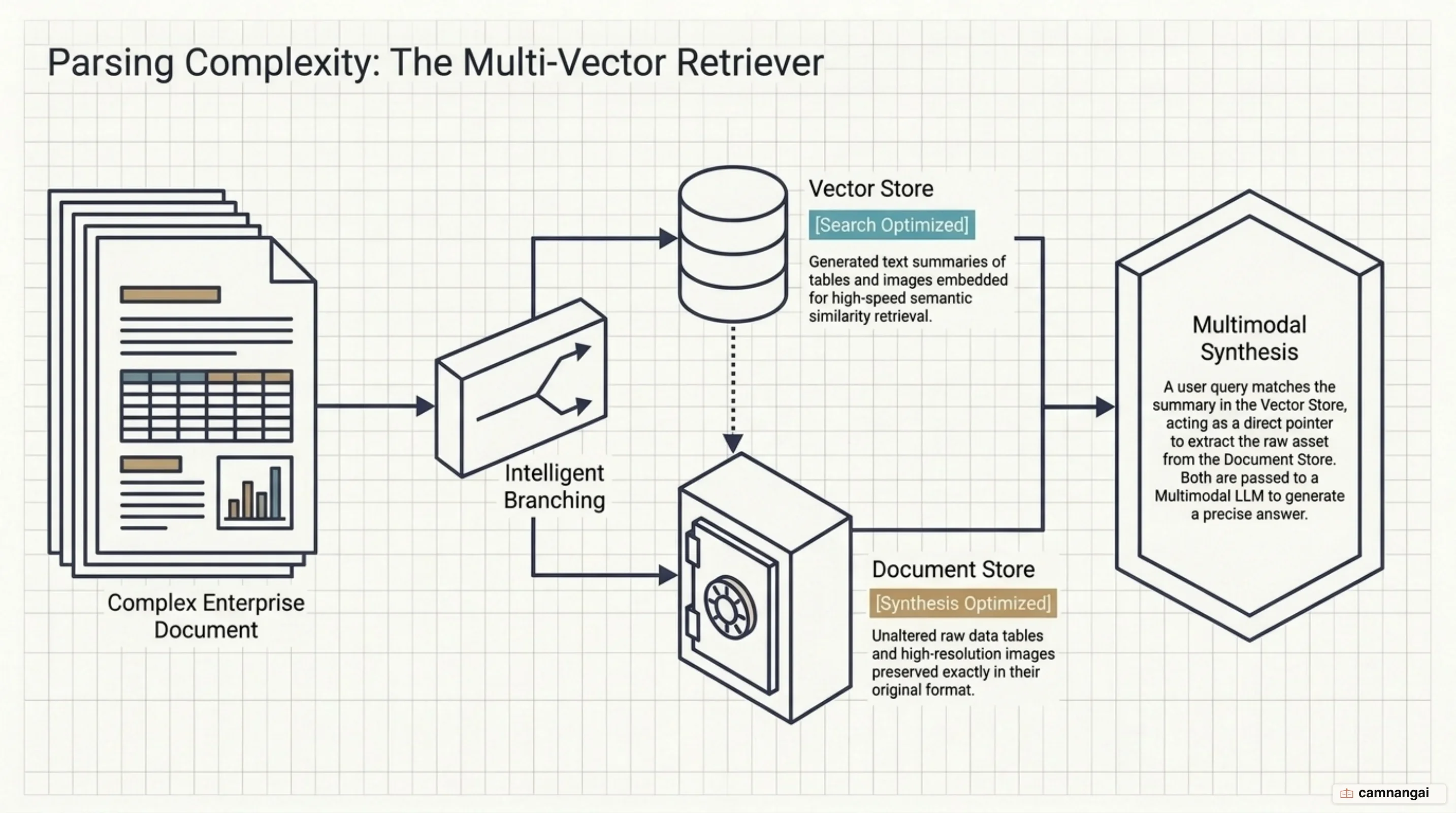
To handle these formats, engineers deploy multi-vector retrievers:
- Visual layout parsing: Vision models segment document pages into text blocks, tabular layouts, and diagrams.
- Contextual summarization: Multimodal models generate dense textual summaries capturing the relational data within complex tables and charts.
- Decoupled retrieval: Text summaries are indexed in the vector store for semantic search, while the original raw tables or high-resolution images are passed directly to the generator prompt to preserve numeric precision.
5. RAG for agentic workflows and tool calling
The technical frontier of information retrieval has moved from static pipelines to Agentic RAG. While standard RAG follows a rigid single-step retrieval pattern, agentic architectures treat retrieval mechanisms as specialized tools orchestrated by reasoning loops.
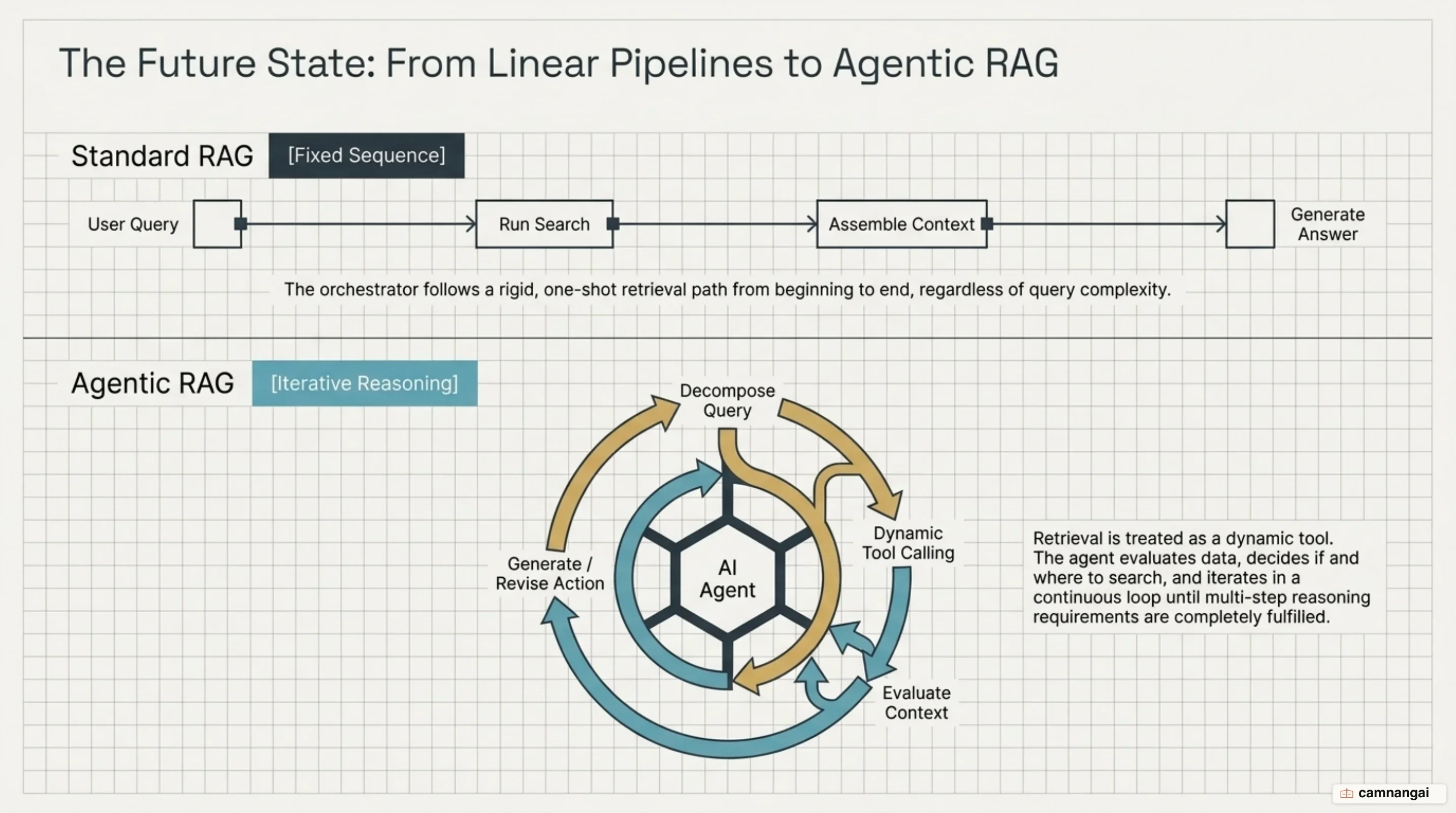
Autonomous agents dynamically evaluate user queries to determine whether retrieval is necessary, select appropriate datastores (such as vector indexes, relational SQL databases, or external APIs), and verify the relevance of returned chunks. For multi-faceted inquiries, agents decompose prompts into dependent sub-queries, execute iterative searches, and trigger downstream workflow actions once sufficient grounding context is confirmed.
Key criteria: When should you build RAG?
Engineering teams should evaluate RAG implementation against specific architectural constraints:
- Dynamic data volatility: When reference data changes daily or hourly, RAG eliminates the latency and compute overhead of recurring retraining.
- Mandatory factual grounding: When business operations demand source transparency and zero tolerance for fabricated claims.
- Operational cost targets: When selective context retrieval provides a more cost-effective inference profile than stuffing large context windows.
Before moving to production, teams must establish quantitative ground truth evaluation pipelines to measure retrieval precision and generation fidelity continuously. RAG serves as the foundational architectural anchor for enterprise reliability, ensuring AI systems remain robust, explainable, and production-ready.
References
- What is RAG? - Retrieval-Augmented Generation AI Explained - AWS
- What is RAG (Retrieval Augmented Generation)? | IBM
- Retrieval-Augmented Generation (RAG) | Pinecone
- What is Retrieval Augmented Generation (RAG)? | Databricks
- Top Use Cases of Retrieval-Augmented Generation (RAG) in AI
- Multi-Vector Retriever for RAG on tables, text, and images
- Design and Develop a RAG Solution on Azure - Azure Architecture Center | Microsoft Learn