In the context of high-dimensional vector data, Anomaly Detection is the mathematical process of identifying data points that deviate significantly from the rest of a dataset.
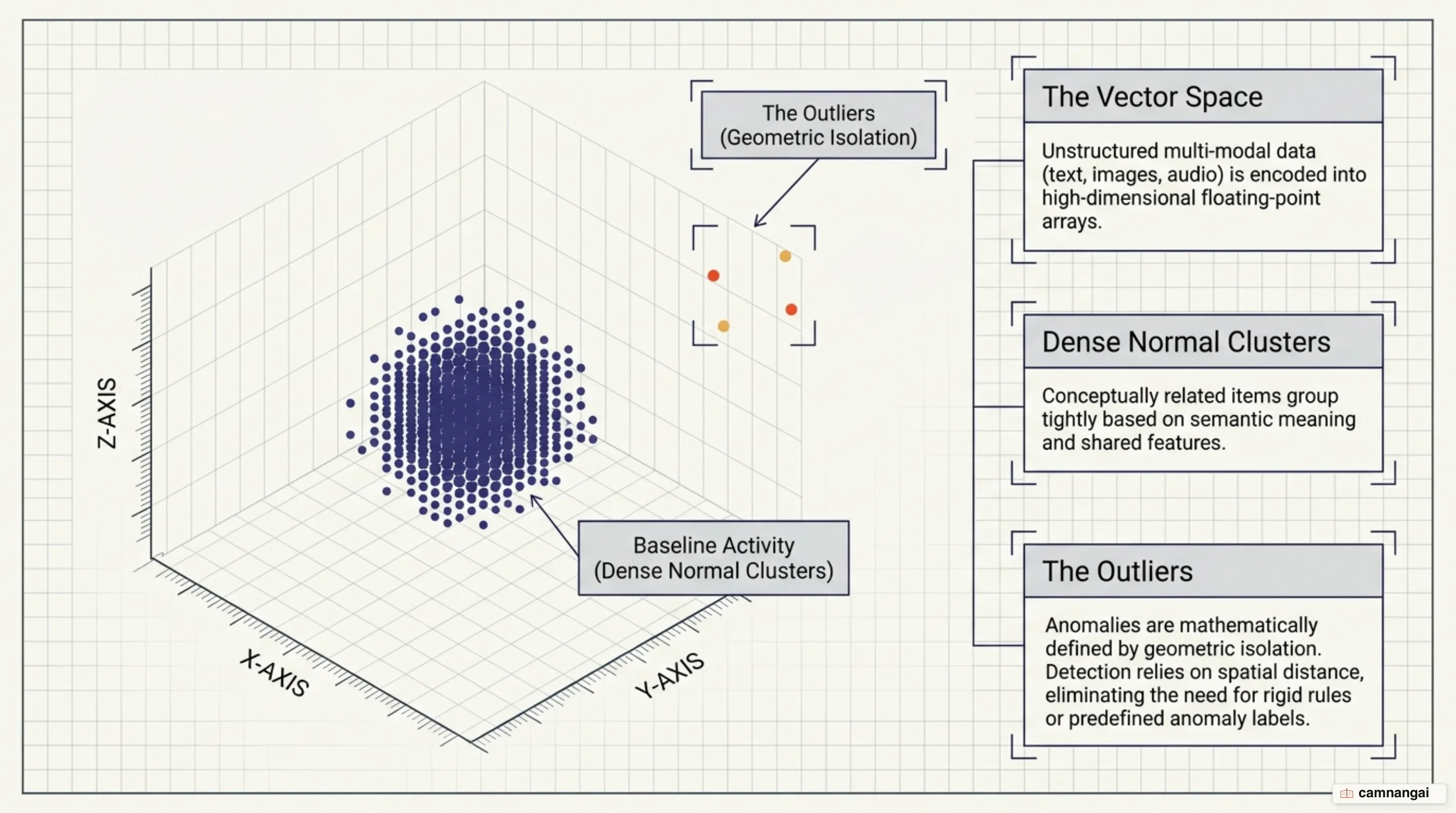
Rather than relying on simple thresholds, we define anomalies as vectors that occupy sparsely populated regions of a high-dimensional vector space. These outliers represent patterns—whether suspicious financial transactions or anomalous system logs—that are statistically or semantically distinct from the "normal" data distribution.
For senior systems engineers, this represents a fundamental shift from traditional rule-based systems to modern vector embeddings approaches. While rule-based logic relies on pre-defined, static heuristics, embedding-based detection draws on the latent features of unstructured data to identify sophisticated forgeries that manual systems were never designed to catch. By mapping data into a latent space, we can treat the identification of outliers as a spatial distance problem, allowing for detection that scales with complexity rather than human headcount.
Why traditional outlier detection fails on unstructured data
Traditional fraud detection and outlier systems rely heavily on manual review and static, rule-based heuristics. For modern financial institutions, this manual process has become an "impossible challenge" as data scale increases. Manual review takes approximately 30 minutes per application, a pace that is fundamentally incompatible with modern sub-second processing requirements. Furthermore, human analysts often reach inconsistent conclusions on similar datasets, leading to significant compliance risks and a lack of systematic reliability.
The scale and sophistication of modern deception have rendered legacy systems obsolete. Recent data indicates that fraud now appears in 1 in 16 documents, and AI-generated forgeries saw a 5x growth between April to December 2025. Static rule-based systems fail to adapt to these evolving tactics, such as deepfakes or coordinated fraud rings, which produce signals too subtle for human reviewers or rigid, column-based rules to identify.
From a database architecture perspective, unstructured data like multi-page financial documents or images present a "Fat Object" problem. In traditional databases, objects grow in complexity as properties are added, leading to massive overhead and performance degradation. Manual feature engineering becomes untenable when dealing with thousands of potential features in unstructured data. Vector Embeddings solve this by providing a compact, automated feature representation that preserves semantic meaning without the overhead associated with "fat" database objects.
How vector spaces turn anomaly detection into a distance problem
In a vector space, data is represented as mathematical structures—specifically, arrays of numerical values where both direction and size are significant. By transforming raw data into these embeddings, we can treat the identification of outliers as a geometric distance problem. Vectors that represent "normal" data will cluster together based on semantic or contextual similarity, while anomalies will appear at a significant distance from these dense clusters.
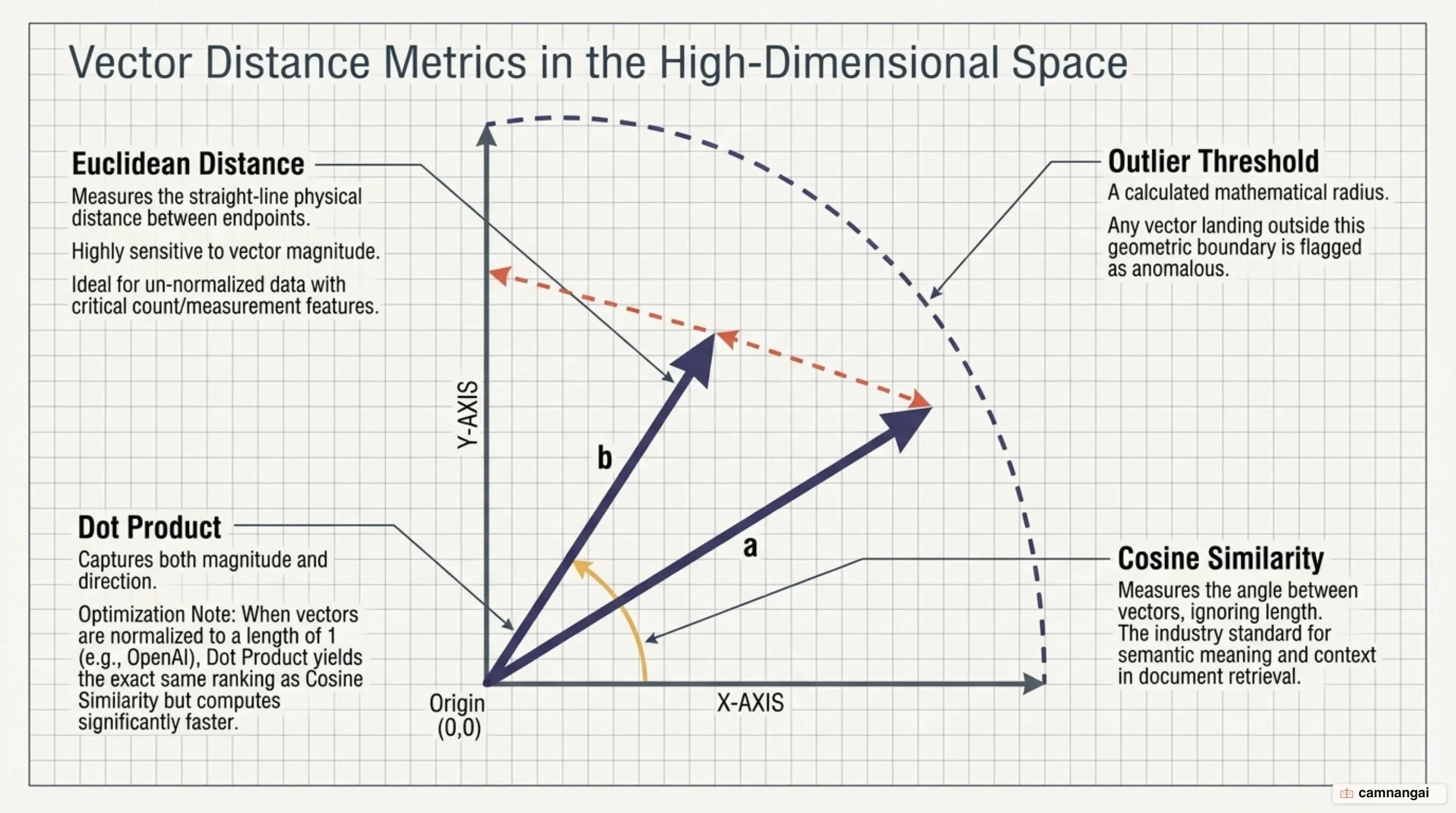
The choice of similarity metric is critical for determining how "distance" is measured between these points. These metrics define how the search engine assesses the proximity of a query vector to the existing dataset.
| Metric Name | Vector properties considered | Ideal Use Case |
|---|---|---|
| Euclidean Distance | Magnitude and Direction | Measuring absolute differences in counts or measures (e.g., image/speech). |
| Cosine Similarity | Only Direction | Semantic search and document classification where content matters more than magnitude. |
| Dot Product | Magnitude and Direction | Large Language Models (LLMs) and recommender systems where popularity/quality signals matter. |
The "Rule of Thumb" for engineering these systems is to always match the index's similarity metric to the one used during the model's training phase. For instance, if a model like all-MiniLM-L6-v2 was trained using Cosine similarity, the vector database index must be configured for Cosine similarity to ensure accurate results. Using mismatched metrics will result in degraded detection performance and unreliable anomaly scores.
Core algorithmic strategies for detecting outliers on embeddings
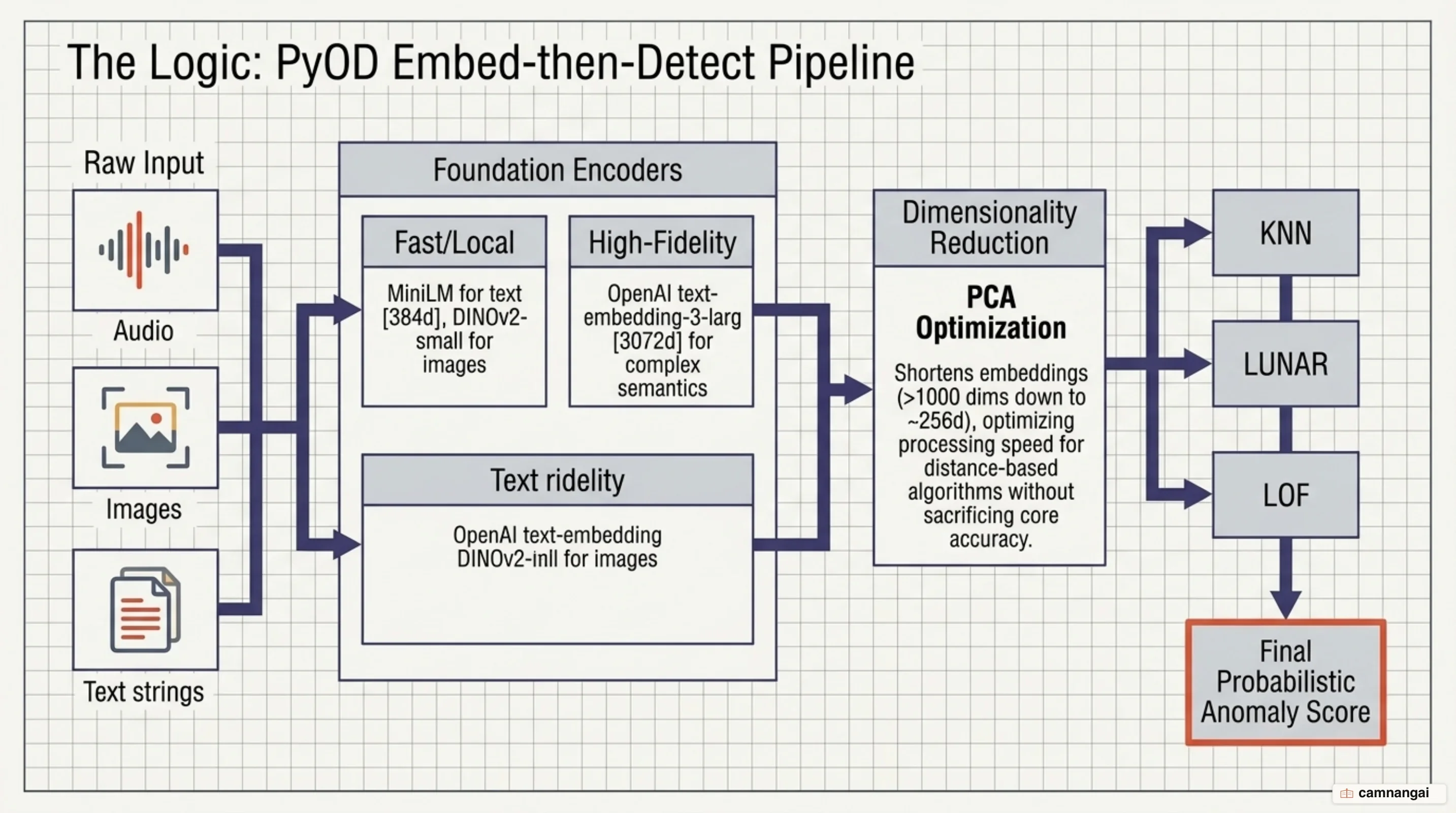
Modern systems typically use an "Embed-then-Detect" pipeline approach. By chaining a foundation model encoder with a specialized detector, engineers can achieve higher accuracy than end-to-end methods. This modularity allows the encoder to focus on feature extraction while the detector (such as LUNAR) focuses exclusively on the geometry of the embedding space. LUNAR is frequently the preferred detector as it is the top performer in high-dimensional benchmarks like NLP-ADBench.
from pyod.models.embedding import EmbeddingOD

# Implementation of an Embed-then-Detect pipeline
# Using all-MiniLM-L6-v2 as the encoder and LUNAR as the detector
# Standardization is enabled to match NLP-ADBench preprocessing requirements
clf = EmbeddingOD(encoder='all-MiniLM-L6-v2', detector='LUNAR', standardize=True)
clf.fit(train_data)

# Generating anomaly scores for new data
# Higher scores indicate higher relatedness distance (outliers)
scores = clf.decision_function(test_data)
labels = clf.predict(test_data)
To maintain performance and avoid the "curse of dimensionality," specific pre-processing requirements must be met. Applying a StandardScaler (Standardization) to embeddings ensures they have zero mean and unit variance, matching the pipelines used in high-performance benchmarks like NLP-ADBench. Additionally, for embeddings exceeding 1000 dimensions, using PCA (Dimensionality Reduction) is recommended to avoid distance-based performance degradation in detectors like KNN or LOF.
For complex environments, a MultiModalOD strategy can be deployed. This approach fuses anomaly scores from different data types, such as combining text embeddings from a document with tabular transaction logs. By running separate detectors per modality and fusing their scores through maximization or averaging, the system can catch anomalies that appear legitimate in one modality but are revealed as fraudulent in another.
Production architecture with vector databases: baselines to real-time queries
A production-grade architecture for Anomaly Detection requires a coordinated stack of managed services to handle reasoning and extraction. Systems like those built by Inscribe use Amazon Bedrock for model coordination, employing Claude for high-level reasoning and Llama for entity extraction. Amazon Textract provides the initial OCR and text extraction. Critically, the stack includes Amazon SageMaker AI to run proprietary forensic models in parallel; these models handle pixel-level image analysis and layout anomaly detection that general-purpose LLMs might miss.
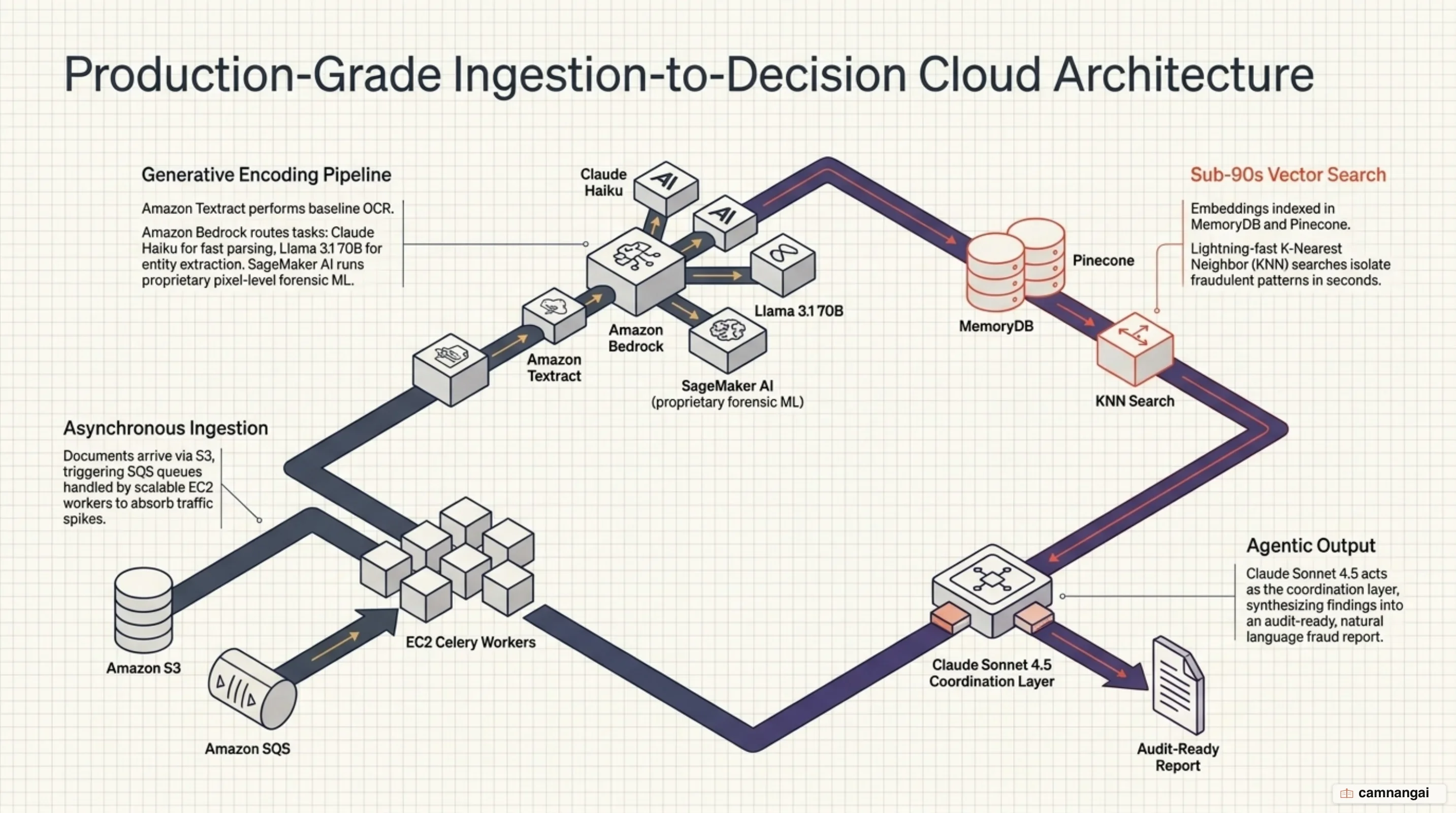
The data plumbing flow begins with ingestion into Amazon S3. Documents trigger processing jobs queued via Amazon SQS and are consumed by Celery workers on Amazon EC2. This asynchronous architecture allows the system to scale automatically during spikes, maintaining consistent latency whether processing ten or ten thousand applications. Using SageMaker ensures that specialized forensic signals are processed alongside foundation model insights for a layered defense.
The vector layer is managed through differentiated storage and caching. Vector Databases like Amazon MemoryDB serve as the primary vector storage, supporting the K-nearest neighbor (KNN) searches required to identify historical similarities. ElastiCache for Valkey handles transient state, rate-limiting, and worker metadata to ensure system throughput. Finally, observability is maintained via Amazon CloudWatch, which tracks inference latency and model drift to ensure the system remains accurate as fraud tactics evolve.
Real-world applications: fraud detection, cybersecurity, and quality control
Modern embedding-based anomaly detection has delivered measurable financial and operational results:
- Document Fraud (BHG Financial & Logix): BHG Financial achieved a 90%+ reduction in manual review time. Logix Federal Credit Union reported over $3 million in savings within eight months by surfacing forgeries that escaped manual inspection.
- Coordinated Fraud Rings (BCU): By using cross-application pattern detection to spot similarities across unrelated applications, BCU prevented $5.6 million in potential losses.
- IT Threat Detection and Search: Pinecone uses these methods to identify anomalous sensor occurrences and IT threats by identifying data points that lack relatedness to the established baseline of normal operations.
When to use vector embeddings for anomaly detection (and when not to)
Deploying an embedding-based architecture is the standard recommendation for high-volume, unstructured data environments (such as processing images, long-form text, or multi-source logs) where traditional rules cannot adapt. The ability to identify semantic similarities allows these systems to catch sophisticated deepfakes and patterns that rule-based engines miss entirely.
However, this approach is inappropriate for simple tabular data where classical statistical methods are significantly cheaper. Furthermore, engineers must be cautious when vector magnitude is the primary signal; if a model is forced into Cosine similarity, critical signals regarding the intensity of an event may be lost. The ultimate engineering advantage of an agentic, modular approach is that it allows for the adoption of new models, including OpenAI's text-embedding-3, without rebuilding the core vector infrastructure, ensuring the system remains future-proof.
References
- How Inscribe uses Amazon Bedrock to stop document fraud in seconds — AWS Machine Learning Blog
- Text and Image Detectors (EmbeddingOD & MultiModalOD) — PyOD Documentation
- Vector Embeddings for Developers: The Basics — Pinecone
- Vector Similarity Explained — Pinecone
- What is a vector database? — Cloudflare Vectorize Docs
- Vectorize and Workers AI — Cloudflare Vectorize Docs
- Vector Embeddings — OpenAI API
- New Embedding Models and API Updates — OpenAI