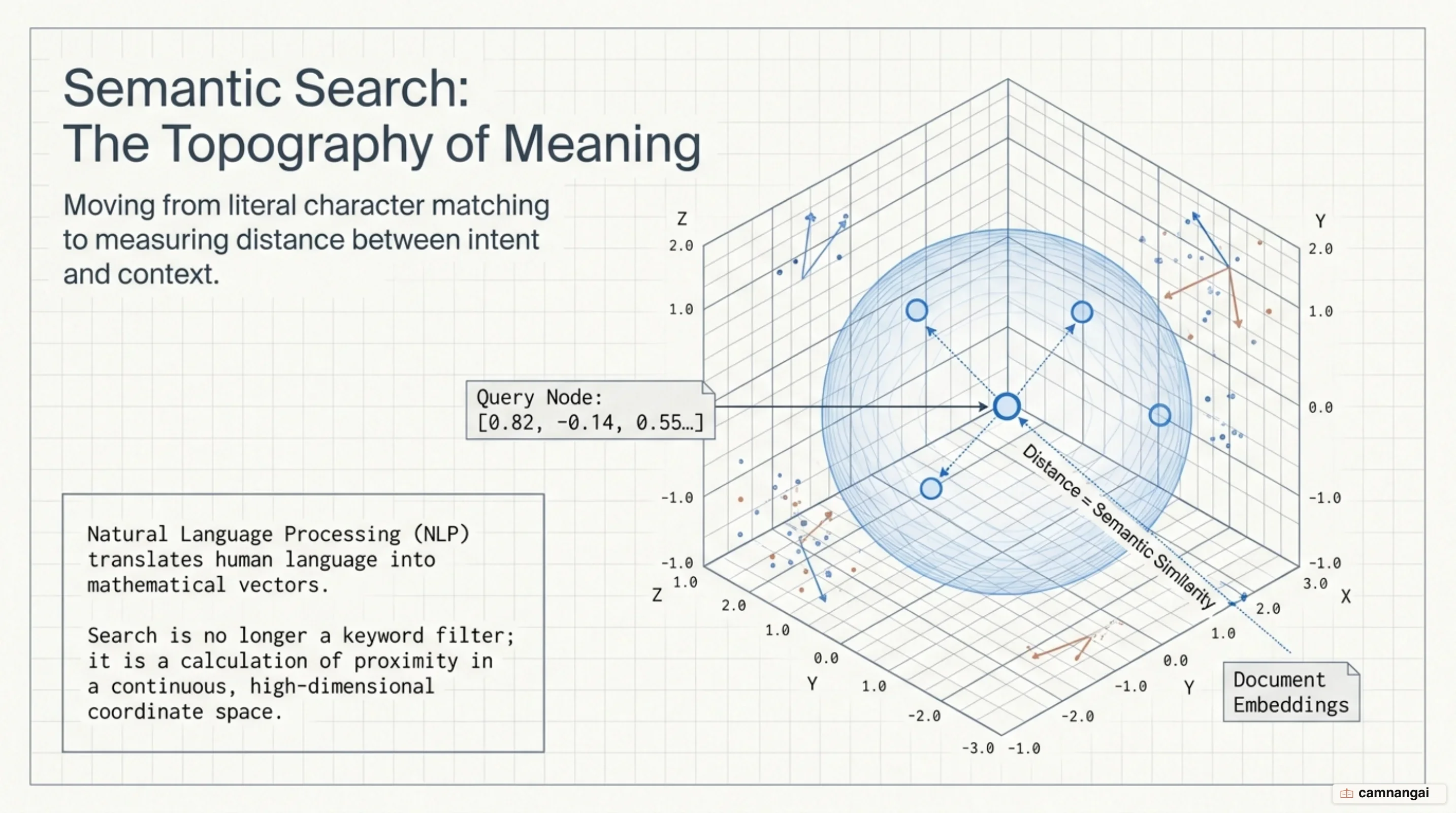
Semantic search is a retrieval methodology that identifies information based on intent and contextual meaning rather than literal character matching.
Unlike legacy lexical systems that rely on exact token overlaps, semantic search uses machine learning models to map data into a shared high-dimensional vector space. By representing text as continuous numerical vectors, the engine executes a vector similarity search across a high-dimensional index to identify relevant results, even when the query and the document share no common terminology.
In a production environment, this architecture allows the system to resolve the conceptual relationship between disparate terms like "how to catch" and "fishing." Instead of matching strings, the system calculates mathematical proximity—often using cosine similarity—to determine which documents are most semantically aligned with the user's information need. This shift from keyword matching to mathematical representation enables modern search infrastructure to handle synonyms, polysemy, and complex natural language queries with significantly higher precision than traditional sparse retrieval methods.
What is semantic search and how does it differ from keyword search?
The fundamental distinction in retrieval engineering lies between sparse/lexical retrieval and dense/semantic retrieval. Traditional keyword search (sparse retrieval) represents documents as high-dimensional vectors where the dimensionality equals the entire vocabulary of the corpus. These vectors are "sparse" because most values are zero; a single document contains only a fraction of the total possible words. Algorithms like TF-IDF and BM25 operate on this principle, excelling at finding exact matches but failing when users employ synonyms or phrasing—such as "canine" vs. "dog"—that lacks token overlap.
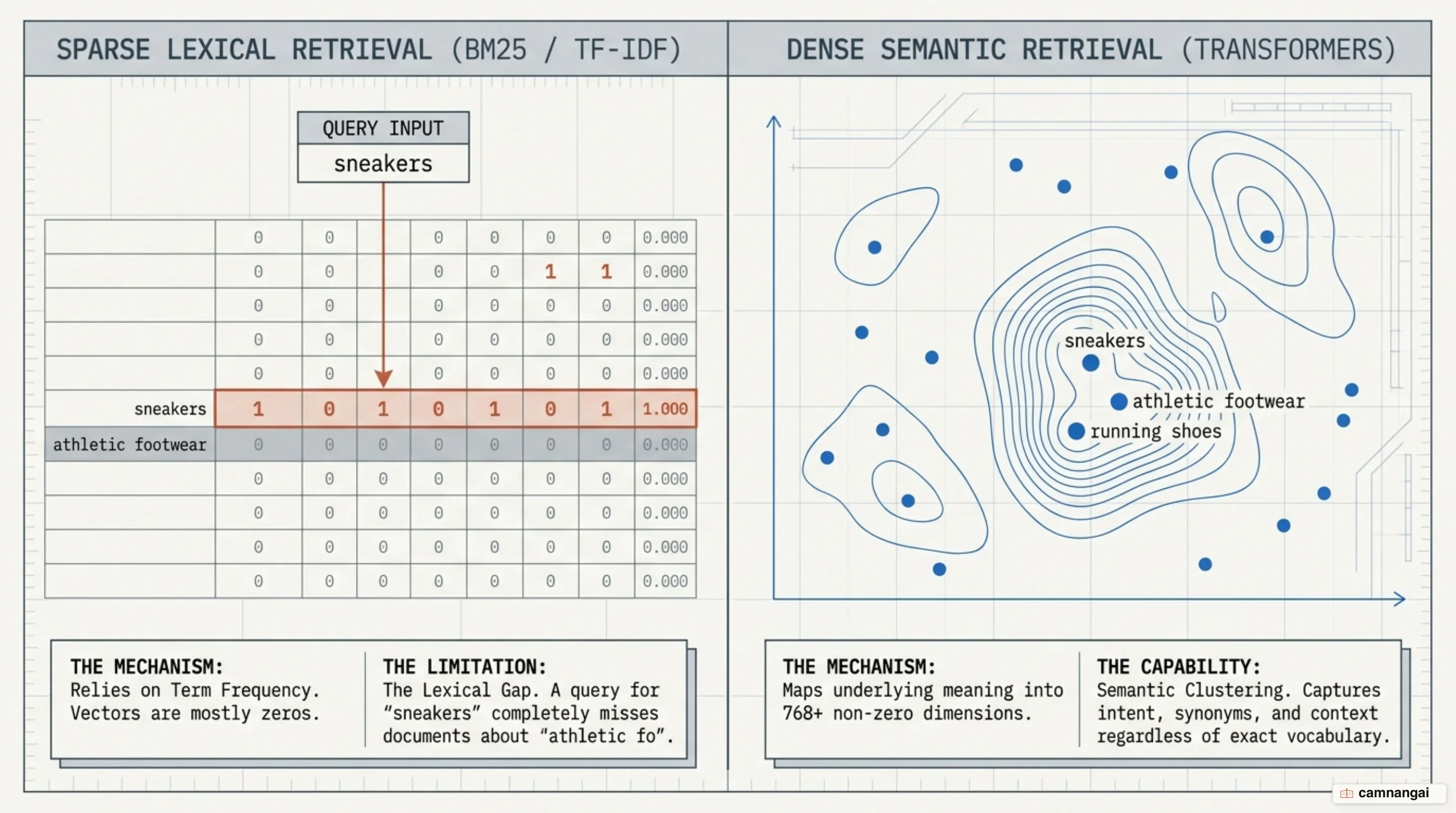
Dense retrieval, the backbone of semantic search, uses continuous numerical representations generated by Transformer-based models via vector embeddings. These "dense" vectors typically occupy 768 to 1536 dimensions, where every value is a non-zero float representing an abstract feature of the text's meaning. Because these models are trained on massive datasets, they capture the relationships between concepts, allowing the system to bridge the gap between "how to catch" and "fishing." This architectural approach transforms search from a string-matching task into an optimization problem of finding the nearest neighbors in a continuous vector space.
The current industry standard for sparse retrieval is the BM25 scoring mechanism. BM25 refines the basic TF-IDF model by incorporating the Binary Independence Model, which treats document relevance as a probabilistic ranking problem. It calculates scores based on term frequency, but introduces a k1 parameter to calibrate term frequency saturation and a b parameter for document length normalization. This normalization penalty, which weighs a document's length relative to the average, ensures that longer documents are not unfairly rewarded simply for containing more tokens. This probabilistic approach makes BM25 significantly more resilient than basic lexical matching for technical keyword retrieval.
How it works: From raw text to high-dimensional vector space
Converting raw text into actionable vectors requires Transformer models (such as BERT or E5) to map inputs into a high-dimensional space (e.g., 768 or 1024 dimensions). A critical architectural decision in this stage is distinguishing between symmetric and asymmetric search:
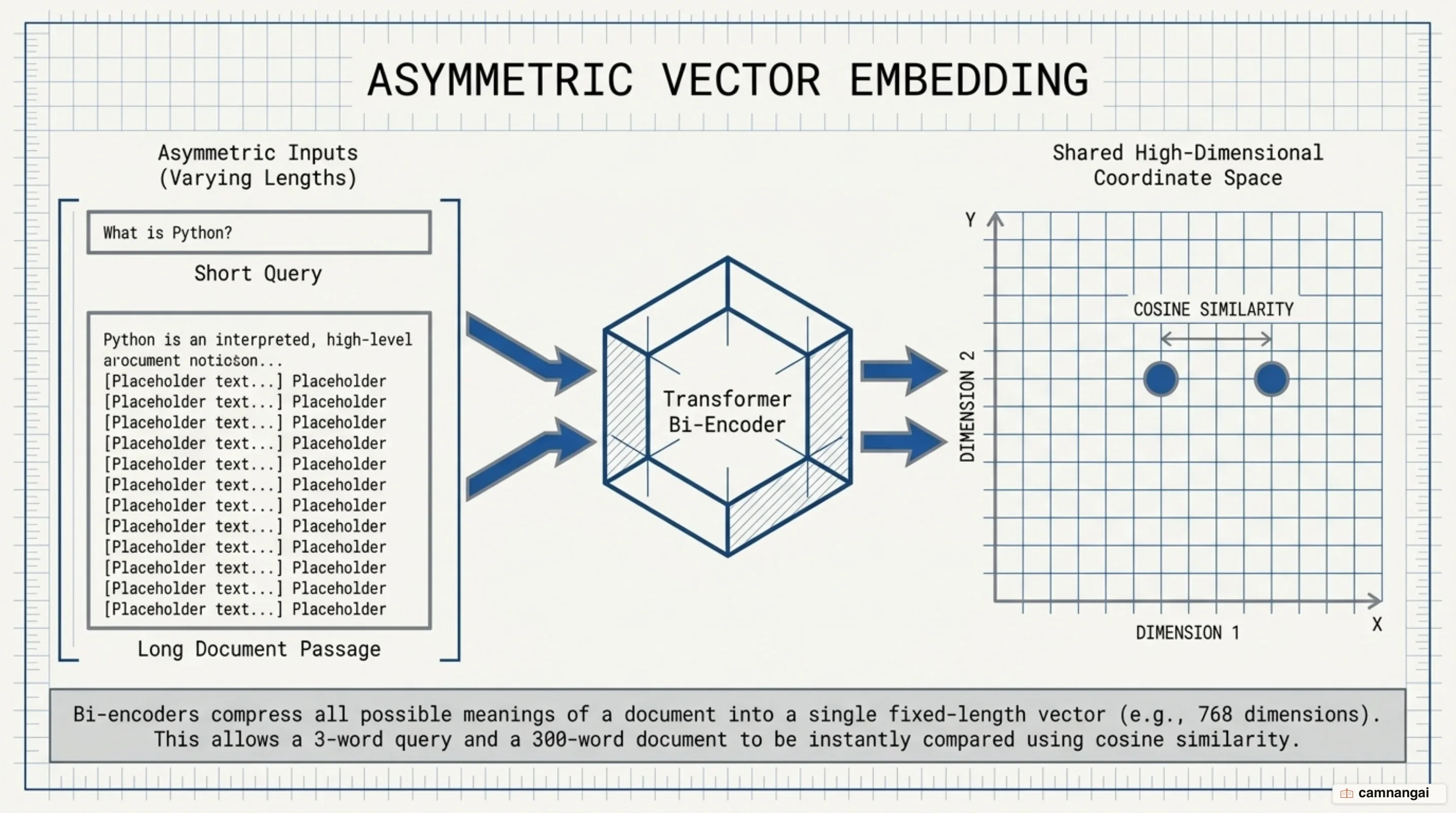
- Symmetric search is used when the query and the corpus entries are of similar length, such as finding similar questions in a community forum.
- Asymmetric search is the standard for most production applications, where a short query is used to retrieve a long paragraph or document. For these tasks, models must be tuned to place short questions and long answers in the same conceptual neighborhood.
Once text is embedded, similarity is measured using metrics like Cosine Similarity (the angle between vectors) or Dot Product (considering both magnitude and direction). To scale this across millions of vectors, engineers must implement Approximate Nearest Neighbor (ANN) indexing using libraries like Annoy or HNSW. ANN indices allow for sub-millisecond retrieval by pre-clustering the vector space, though they introduce a trade-off: higher speed and lower memory consumption come at the cost of slight precision loss (recall). In distributed systems, this often involves sharding the index across multiple nodes to handle the memory overhead associated with keeping high-dimensional vectors in RAM.
The following Python example demonstrates the input_type distinction required for high-quality asymmetric retrieval using the E5 model family:
from sentence_transformers import SentenceTransformer

# Load E5-large for high-dimensional representation
model = SentenceTransformer('intfloat/e5-large-v2')

# Documents and Query
docs = ["Python is a high-level programming language.", "Guidelines for fishing salmon."]
query = "How to catch salmon in the north?"

# In asymmetric search, we must specify input_type to ensure proper alignment
# 'passage' is used for the corpus, 'query' for the search string
doc_embeddings = model.encode(docs, prompt="passage: ")
query_embedding = model.encode(query, prompt="query: ")

# The embeddings are now ready for a similarity search in a vector DB
Two-stage architecture: Bi-encoders and cross-encoder rerankers
Production-grade search systems rely on a two-stage pipeline to balance the trade-offs between latency and precision, storing candidates in a vector database. The first stage employs Bi-Encoders, which encode queries and documents independently. Because document vectors are pre-calculated and indexed, the system can perform a vector similarity search in under 100ms. However, Bi-Encoders suffer from information loss because they must compress the entire conceptual meaning of a document into a single fixed-length vector, and they lack token-level query-document interaction during the initial retrieval.
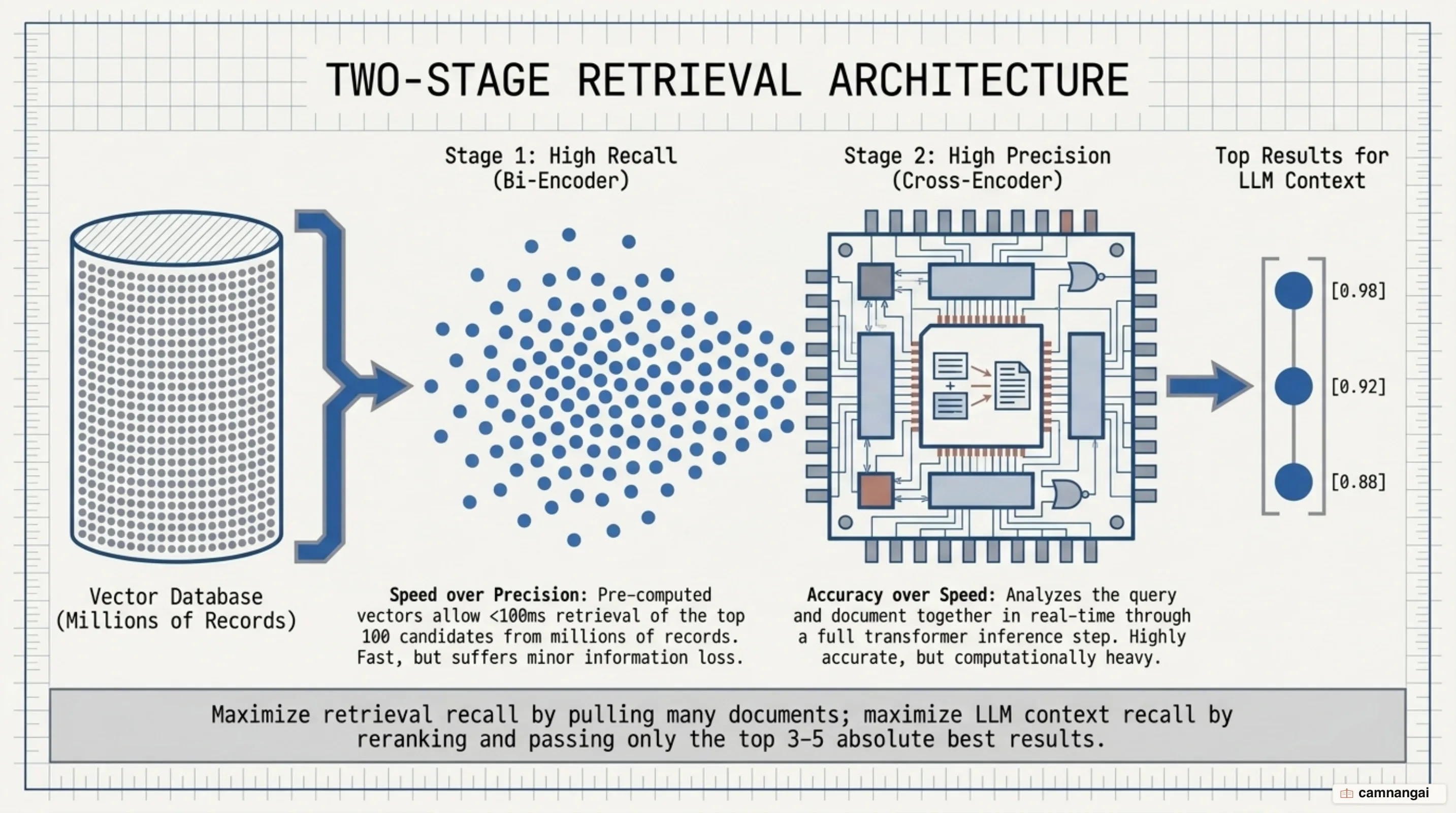
The second stage mitigates this loss by using Cross-Encoders, also known as rerankers. Cross-Encoders perform joint token-level attention, processing the query and a document pair simultaneously. This allows the model to deeply evaluate the interaction between every token in the query and every token in the document. This depth is computationally expensive: reranking 40 million records with a model like BERT on a V100 GPU would take over 50 hours, compared to the millisecond speeds of a Bi-Encoder. Consequently, the Bi-Encoder acts as a wide net to retrieve the top 50–100 candidates, which are then passed to the Cross-Encoder for high-precision re-ordering.
This two-stage approach is vital for solving the "Lost in the Middle" phenomenon in Large Language Models (LLMs). Research demonstrates that LLM recall degrades significantly when the relevant information is buried in the center of a long context window. By using a reranker to minimize the total number of documents—ensuring that only the highest-density, most relevant information is placed at the top of the context—engineers can maximize the quality of RAG systems and prevent the LLM from missing critical facts.
Where pure semantic search falls short
Despite its advantages, pure dense retrieval has distinct failure modes, particularly with Out-of-Domain (OOD) data. Models often struggle with exact matches for product SKUs, serial numbers, specific technical acronyms, or unique identifiers that were not well-represented in the model's training set. Because these tokens often lack semantic context, the model may fail to map them to the correct neighborhood, leading to poor retrieval for highly specific technical or inventory-based queries.
Semantic search is also susceptible to "semantic drift." This occurs when a passage is conceptually near a query in the vector space but is factually irrelevant or wrong for the specific intent. For example, a search for a specific legal code might return a passage with similar linguistic structure and meaning that actually refers to an entirely different jurisdiction. In scenarios involving domain-specific terminology or technical codes, the precise lexical matching of BM25 is often superior to the fuzzy conceptual mapping of dense vectors.
The production standard: Hybrid search and Reciprocal Rank Fusion
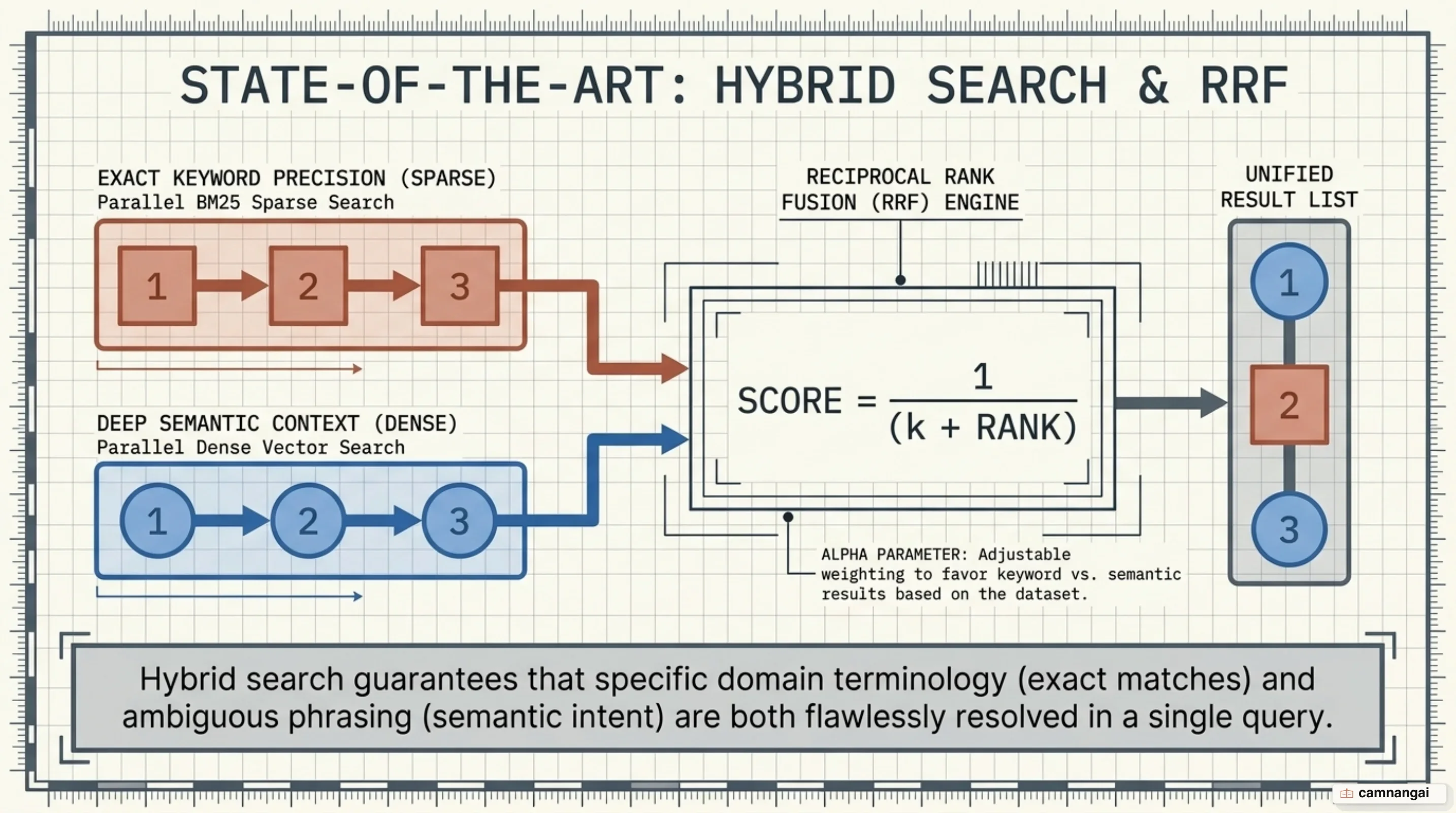
The industry standard for production retrieval is Hybrid Search, which executes a BM25 sparse query and a Vector dense query in parallel. By combining these methods, the system handles both conceptual natural language and exact technical matches. To merge these disparate results into a single ranked list, engineers apply the Reciprocal Rank Fusion (RRF) algorithm. RRF calculates a final score for each document by summing the reciprocal of its ranks in the individual lists:
Score = sum(1 / (k + rank(d)))
In this formula, rank(d) is the position of the document in a specific list, and k is a constant—typically set to 60 in production (as seen in Weaviate's implementation). This constant k is critical; it prevents a single high ranking in one list from dominating the fusion result, ensuring a more balanced combination. While rankedFusion focuses strictly on the position, relativeScoreFusion uses min-max normalization to preserve the relative distance between scores, allowing a document that significantly outperforms others in its list to retain its importance in the final ranking.
Engineers tune the balance of these two methods using an alpha parameter. An alpha of 0.5 weights keyword and vector results equally, while higher values favor semantic similarity. This tuning is empirical and depends on the dataset; a technical documentation site may require a lower alpha (e.g., 0.45) to bias results toward exact lexical matches for code snippets and acronyms.
{
  "hybrid": {
    "query": "SR-X991-B firmware update instructions",
    "alpha": 0.45,
    "fusionType": "relativeScoreFusion",
    "vector": [0.12, 0.05, 0.88, "..."],
    "score": true
  }
}
Choosing the right retrieval architecture for AI applications
Selecting a retrieval architecture is a matter of balancing precision and scale:
- Pure vector search is appropriate for basic similarity tasks involving general vocabulary.
- For RAG applications that require precision with technical terms, SKUs, or specialized domain OOD vocabulary, Hybrid Search with RRF is the mandatory standard.
- For systems where maximum precision is prioritized over latency, adding a Cross-Encoder Reranker as a final stage ensures that the LLM receives the most relevant information at the top of its context window, effectively neutralizing the "Lost in the Middle" recall degradation.
References
- Pinecone Learn: Semantic Search: Measuring Meaning From Jaccard to Bert
- Google Cloud: What is semantic search, and how does it work?
- Sentence Transformers: Semantic Search with Sentence Transformers
- Pinecone Learn: Rerankers and Two-Stage Retrieval
- Weaviate Blog: Hybrid Search Explained
- Weaviate Blog: Unlocking the Power of Hybrid Search - A Deep Dive into Weaviate's Fusion Algorithms
- Cohere: Semantic Search with Embeddings