Recommendation systems are industrial-grade information filtering engines designed to predict user preference for items within a vast corpus.
Modern recommendation systems have transitioned from basic matrix factorization to deep learning architectures that map entities—users, items, and context—into low-dimensional, dense vector spaces. These embedding spaces allow the system to capture latent structures and semantic relationships that traditional heuristic-based filtering cannot reach.
To handle the computational complexity of searching millions of candidates in real-time, engineering teams implement a multi-stage pipeline, typically bifurcated into retrieval and ranking stages. This separation allows the system to balance the "recall vs. precision" trade-off: using highly efficient approximate search to identify candidates, followed by deep learning models for fine-grained scoring.
Why Modern Recommendation Systems Rely on Vector Embeddings
The architectural shift toward deep learning allows for the representation of entities in an Embedding Space (E = R^d), where the dimensionality d is significantly smaller than the total corpus size. In this setup, proximity between vectors represents latent structural similarity. Engineers must balance dimensionality carefully: increasing parameter count improves model expressivity but makes the model harder to train and significantly more expensive to serve at runtime.
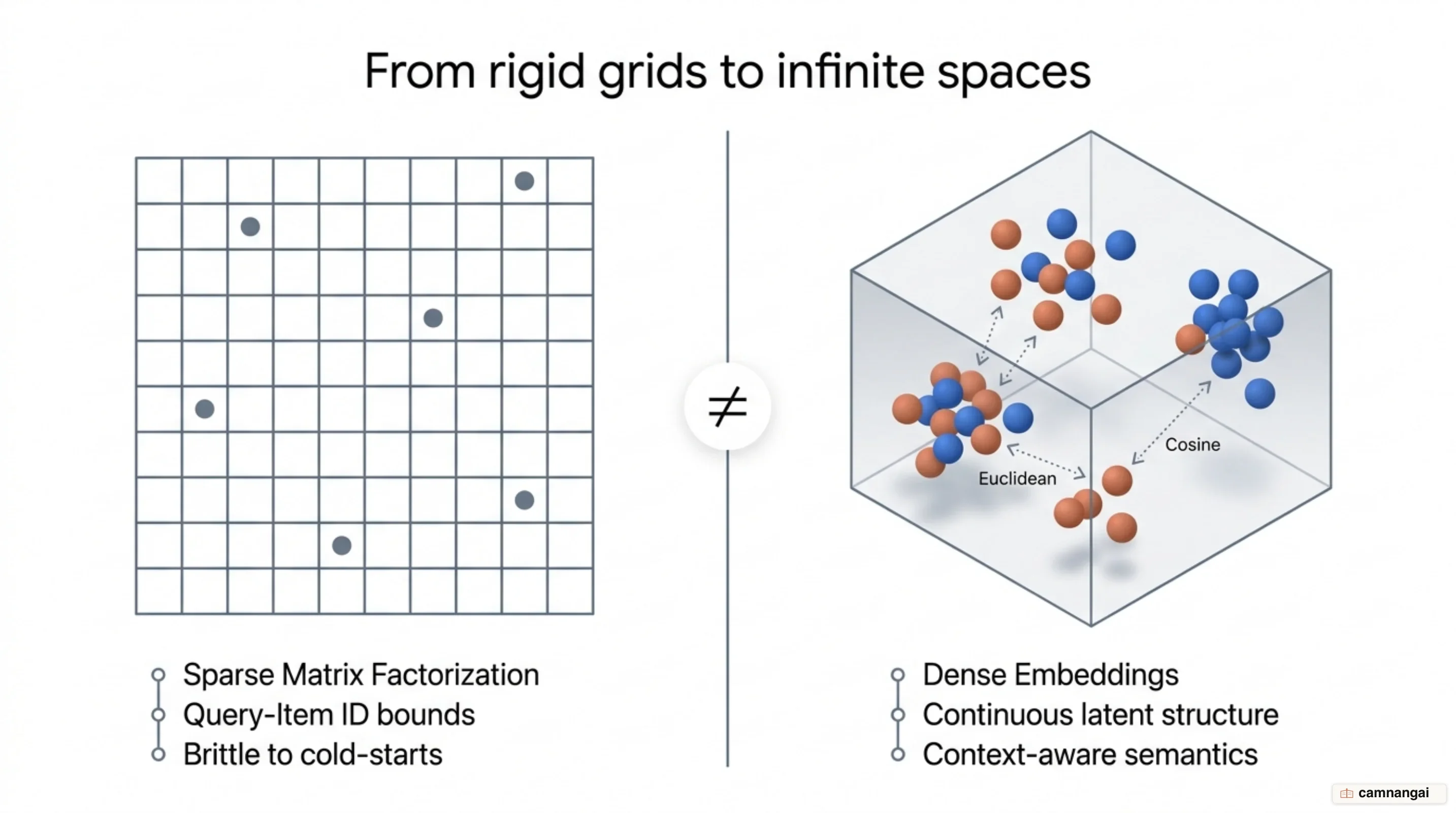
The choice of similarity measure s: E × E → R directly defines the retrieval bias of the system:
- Dot Product: Defined as
s(q, x) = ⟨q, x⟩. This metric is sensitive to the embedding norm (magnitude). Because items appearing frequently in training sets (popular items) tend to develop larger norms, the dot product is the preferred metric when the business objective is to capture and reward item popularity. - Cosine Similarity: Calculated as the cosine of the angle between vectors:
s(q, x) = cos(q, x). By normalizing for magnitude, it captures purely semantic similarity, making it ideal for niche relevance where item frequency should not dominate the result set. - Euclidean Distance: The geometric distance
s(q, x) = ||q - x||. Unlike the dot product, Euclidean distance is less sensitive to the frequency of the items, offering a balanced retrieval that prioritizes items physically positioned near the query in the manifold.
The Two-Tower Architecture: Bridging Users and Items
The Two-Tower model is the industry standard for large-scale candidate retrieval. It generalizes matrix factorization by replacing fixed ID lookups with non-linear feature mapping functions. Specifically, the item embedding matrix found in these models is functionally equivalent to the weights of the Softmax layer in a standard deep neural network.
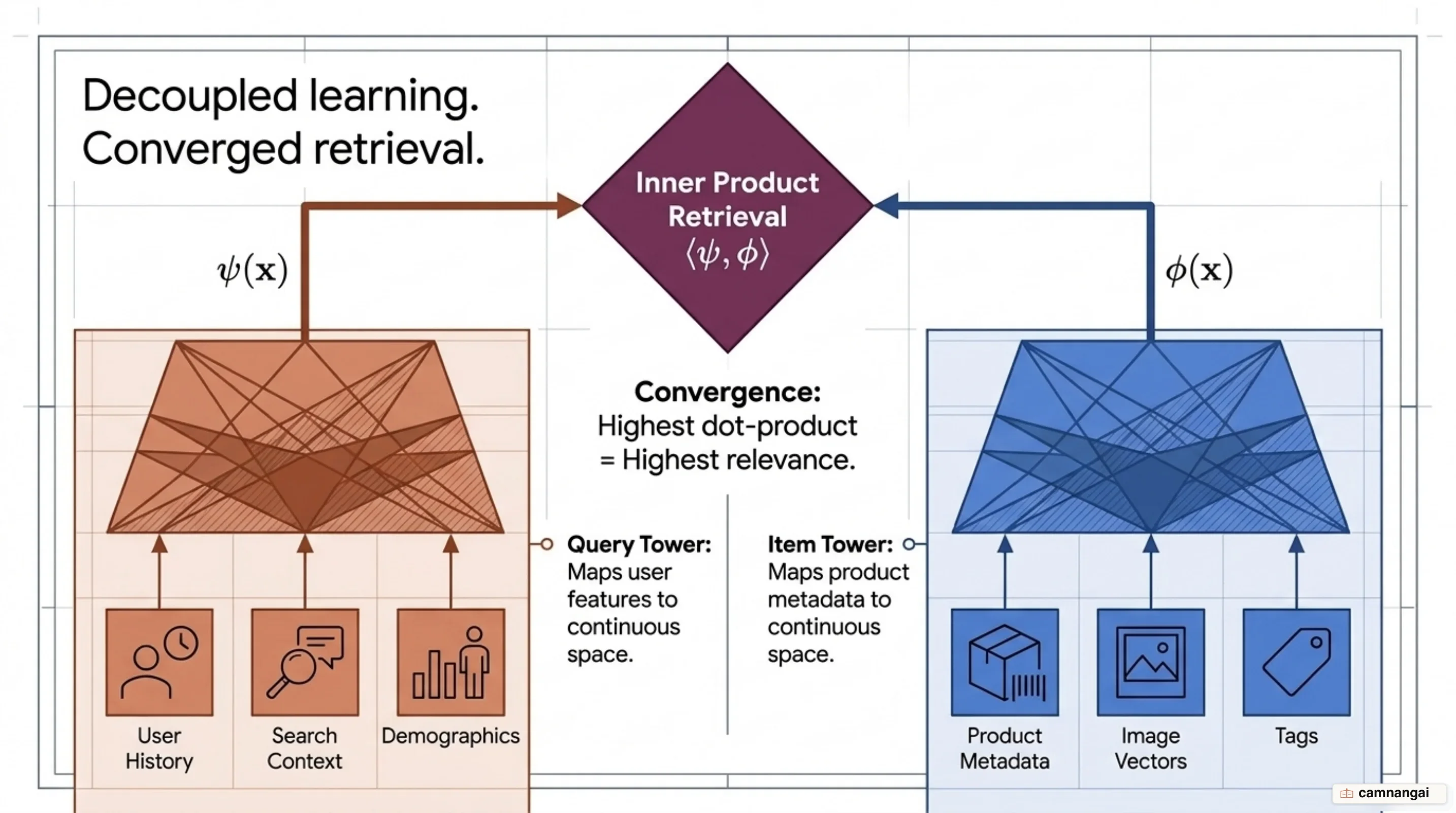
The architecture separates representation into two distinct sub-networks:
- The Query Tower (
ψ(x)): Transforms user features (ID, historical interactions, demographic context) into a dense query vector. - The Candidate Tower (
ϕ(x)): Transforms item metadata, text, and categories into an item embedding vector.
The model computes affinity through the inner product ⟨ψ(x_query), ϕ(x_item)⟩. A critical engineering advantage of this architecture is the decoupling of the towers during serving. While the Query Tower runs live inference on incoming requests, the Candidate Tower embeddings can be pre-computed offline and indexed in a vector database, converting retrieval into an ultra-low-latency nearest-neighbor search.
The following Python snippet illustrates a minimal Two-Tower retrieval structure using TensorFlow Recommenders:
import tensorflow as tf
import tensorflow_recommenders as tfrs

embedding_dimension = 32

# Query Tower: Maps user identifiers to dense vectors
user_model = tf.keras.Sequential([
    tf.keras.layers.StringLookup(vocabulary=unique_user_ids, mask_token=None),
    tf.keras.layers.Embedding(len(unique_user_ids) + 1, embedding_dimension),
])

# Candidate Tower: Maps item features into the shared embedding space
item_model = tf.keras.Sequential([
    tf.keras.layers.StringLookup(vocabulary=unique_item_titles, mask_token=None),
    tf.keras.layers.Embedding(len(unique_item_titles) + 1, embedding_dimension),
])

# Retrieval Task: Computes metrics and loss over candidates
metrics = tfrs.metrics.FactorizedTopK(candidates=items.batch(128).map(item_model))
task = tfrs.tasks.Retrieval(metrics=metrics)
The Multi-Stage Pipeline: From Candidate Generation to Ranking
To maintain a strict latency budget (typically under 100 ms) while scanning catalogs containing millions of items, industrial recommendation systems rely on a four-stage design pattern:
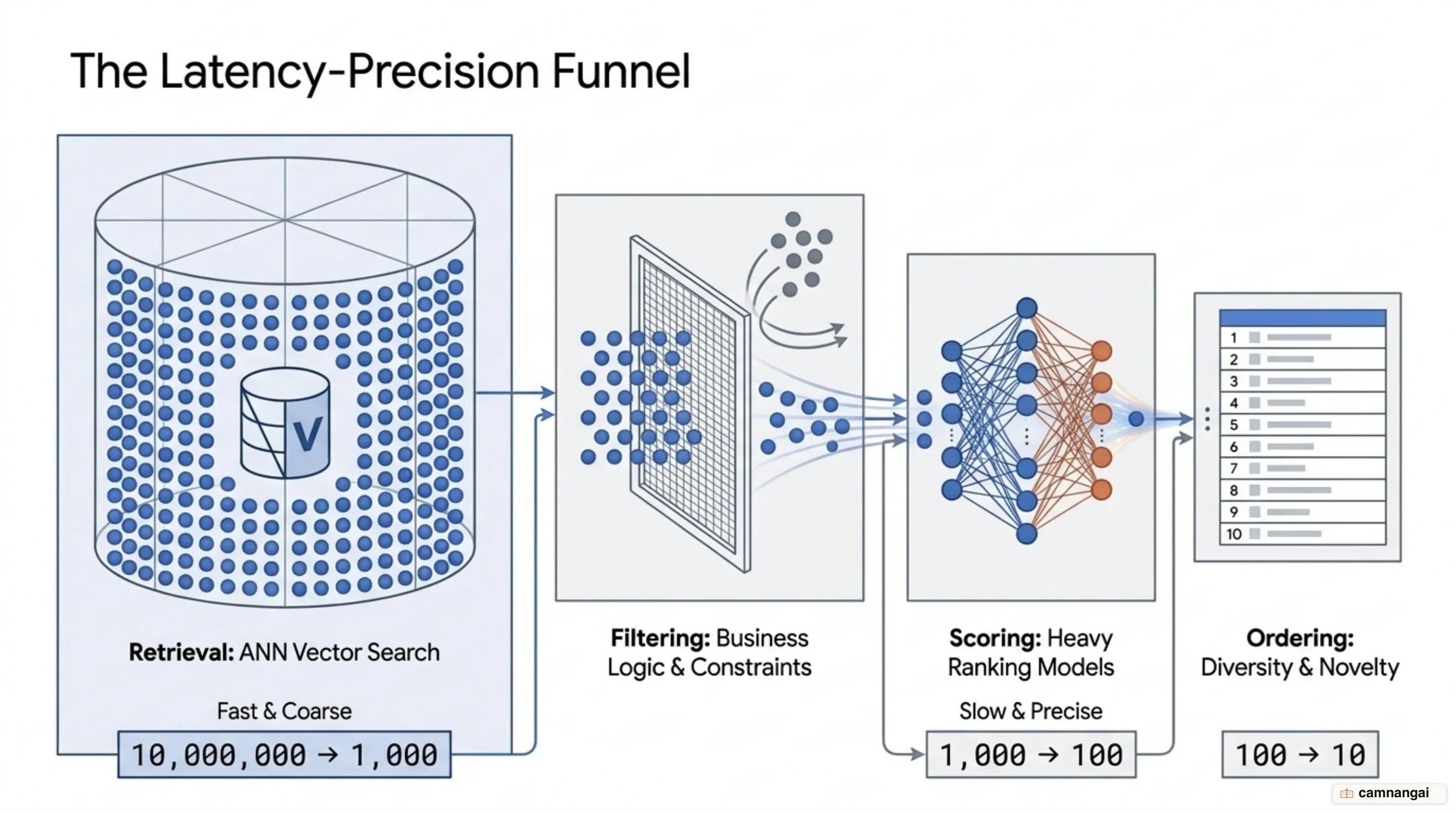
- Retrieval (Candidate Generation): Prioritizes efficiency over precision to narrow millions of items down to hundreds of viable candidates using vector embeddings and approximate search.
- Filtering: Applies deterministic business logic that machine learning models cannot easily capture, such as removing out-of-stock inventory, filtering out age-restricted content, or deduplicating recently viewed items.
- Scoring (Ranking): Favors precision over efficiency. This stage uses complex deep learning models (such as DLRM) and hundreds of dense features to predict engagement probabilities (such as Click-Through Rate or Conversion Rate) for the remaining candidates.
- Ordering (Re-ranking): Applies global business constraints, including category diversity, freshness boosts, and promotional rules, before returning the final payload to the client.
Approximate Nearest Neighbor (ANN) and the Role of Vector Databases
At production scales, exhaustive pairwise vector comparison (O(N) brute-force search) is computationally infeasible within a real-time request loop. Systems instead deploy Approximate Nearest Neighbor (ANN) indexing algorithms, such as HNSW (Hierarchical Navigable Small World) or ScaNN, which reduce query complexity to O(log N).
A significant engineering challenge in vector search is handling metadata filtering alongside similarity search. When a query includes strict filters (such as in-stock status or geographic availability), standard graph traversal can suffer from severe recall degradation. Modern vector search engines address this through predicate-aware indexing algorithms and hybrid filtering pipelines, ensuring high recall even under restrictive boolean constraints.
Dedicated vector databases provide the operational infrastructure needed to scale these indexes, handling automatic re-indexing, distributed sharding, and real-time updates without taking the retrieval layer offline.
Engineering Challenges: HPS and Real-Time Infrastructure
Scaling an embedding-based recommendation platform introduces several infrastructure bottlenecks that standard web stacks cannot handle directly:
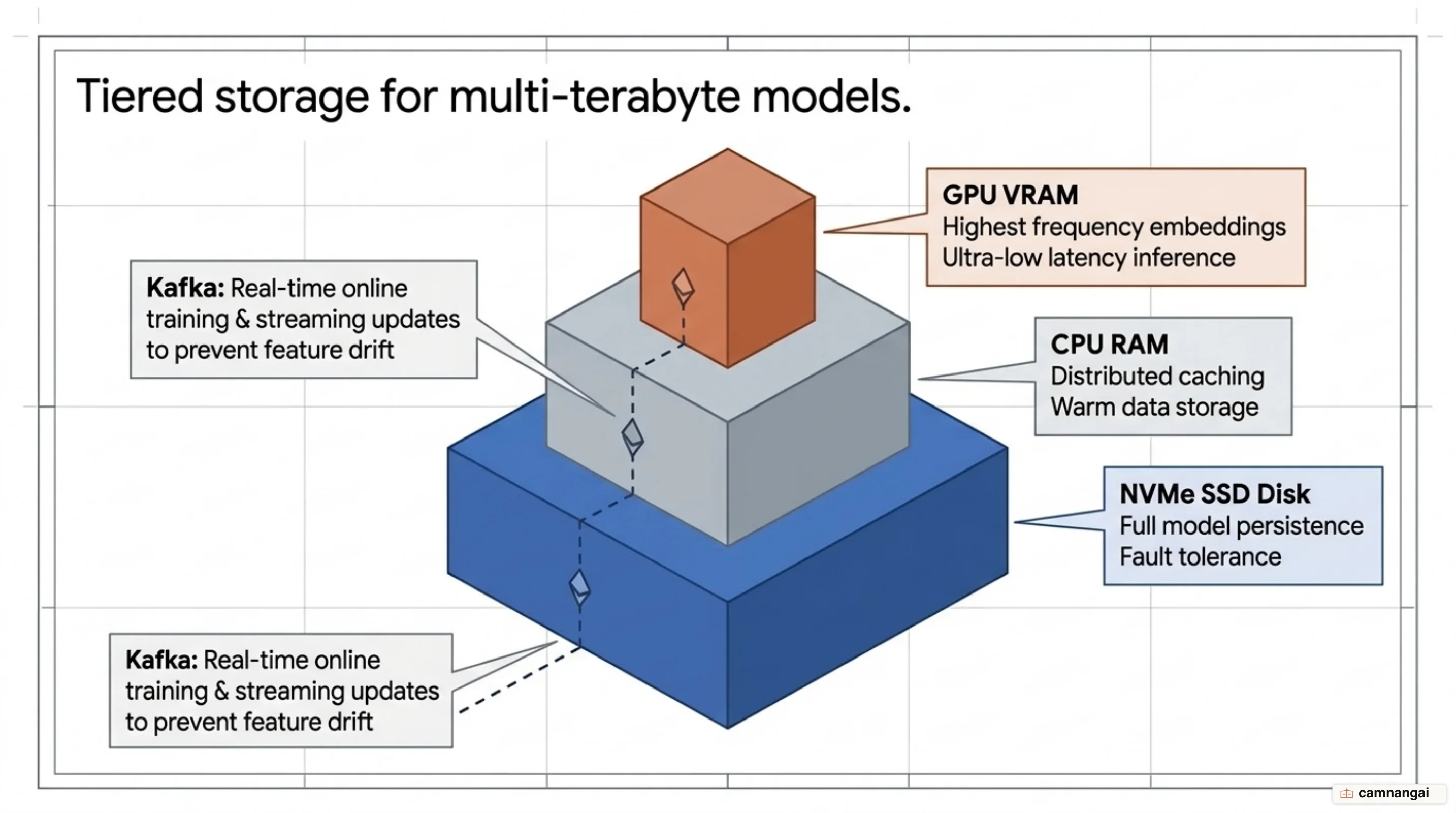
- Hierarchical Parameter Server (HPS): For large-scale models where embedding tables reach terabytes in size, the parameters cannot fit within GPU VRAM. HPS patterns tier storage across multiple layers: GPU cache for frequently accessed hot embeddings, host CPU/Redis memory for warm vectors, and SSD storage for full table persistence and crash recovery.
- Cold-Start Resolution: By using feature-based item towers rather than static ID lookup tables, the system can infer embeddings for brand-new items immediately upon ingestion using their content metadata, resolving the cold-start barrier.
- Real-Time Streaming Updates: To prevent feature drift and capture immediate user intent, production pipelines stream user interactions through message brokers like Apache Kafka directly into inference engines (such as NVIDIA Triton), updating dynamic user vectors in real-time.
When to Build an Embedding-Based Recommendation System
The decision to adopt a full embedding-based architecture should be dictated by catalog scale and real-time responsiveness requirements:
- Offline (Batch Processing): Sufficient for periodic workflows (such as weekly email recommendations or static homepage carousels) where catalog size is moderate. Recommendations can be pre-computed offline and cached in a key-value store like Redis, avoiding the overhead of vector infrastructure.
- Online (Multi-Stage Retrieval): Essential for dynamic platforms (such as e-commerce, streaming media, and social feeds) where inventory changes rapidly and user intent shifts across sessions. These workloads justify the operational investment in Two-Tower models and dedicated vector databases.
- Metric Selection: Choose Dot Product if the goal is maximizing raw engagement by prioritizing historically popular items. Shift to Cosine Similarity or Euclidean Distance if the platform values long-tail discovery and niche semantic alignment.
References
- Candidate Generation Overview — Google Developers
- Deep Neural Network Models for Recommendation — Google Developers
- Recommending Movies: Retrieval (Two-Tower Architecture) — TensorFlow Recommenders
- System Design for Recommendations and Search — Eugene Yan
- Vector Search Overview — Google Cloud Documentation
- Vector Similarity Explained — Pinecone
- Search and Recommendation Concepts — Qdrant
- Offline to Online: Feature Storage for Real-time Recommendation Systems — NVIDIA Technical Blog