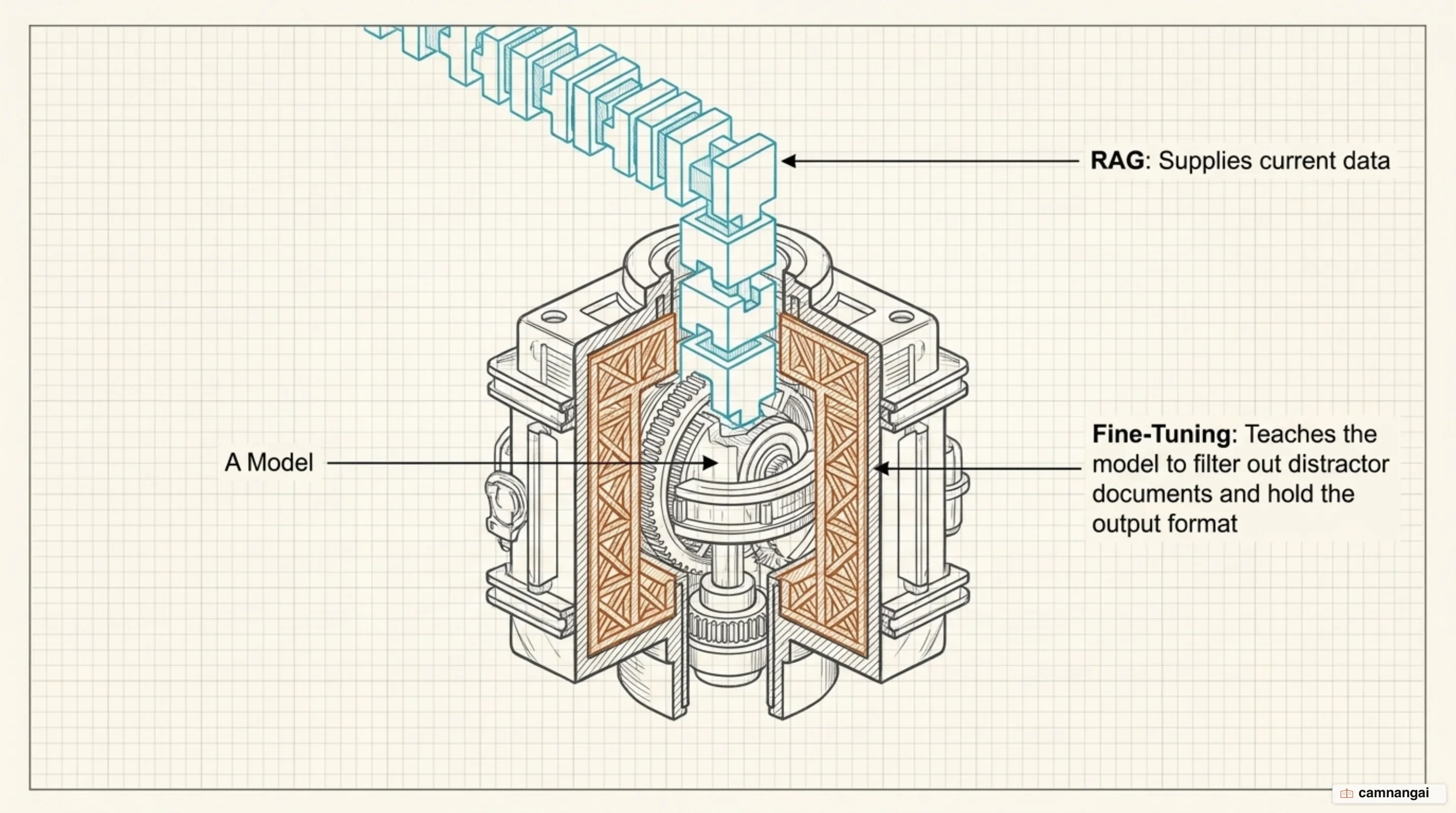
Choosing between RAG or fine-tuning dictates your entire system architecture, depending on whether you need to inject external knowledge or fundamentally change a model's behavior.
If your application needs up-to-the-minute facts, proprietary databases, or specific documents outside the original training set, retrieval-augmented generation (RAG) is the correct path. If instead you need the model to follow a strict persona, master a complex classification task, or stick to a specialized formatting style where it already has the necessary background knowledge, fine-tuning is the better lever.
Treat this optimization as a loop you go around, not a deployment you do once. Start by establishing a baseline with evaluations and prompt engineering before moving to more resource-heavy methods. This iterative loop — run evals, refine prompts with relevant context, then identify whether fine-tuning is required — prevents you from over-engineering a solution where a simpler prompt would do.
Your first priority in that loop is writing evals that measure model output against a test dataset representative of your production environment. Define what accuracy looks like before you start writing instructions. Running those evals against your baseline tells you whether a failure comes from missing information or from not following instructions. That quantitative starting point is the only thing that justifies moving to more expensive strategies later.
Weigh accuracy against the specific cost of failure for your use case. There is a vast difference between a mediocre text summary and a logic error that issues an incorrect financial refund. Identify whether the model already has the knowledge and simply needs behavioral correction, or is hallucinating because the facts are missing.
Two methods that solve two different problems
RAG and fine-tuning are often framed as competitors, but they address distinct requirements: retrieval-augmented knowledge on one side, behavioral optimization on the other. RAG is a search engine for your model, letting it consult external information such as private regulatory filings or current news that was never in its training data. Fine-tuning excels at specialized tasks like classification, translation that has to carry nuance, and consistent formatting. Reach for fine-tuning when the model already has the core knowledge but needs a task-oriented response style that cannot be reliably prompted.
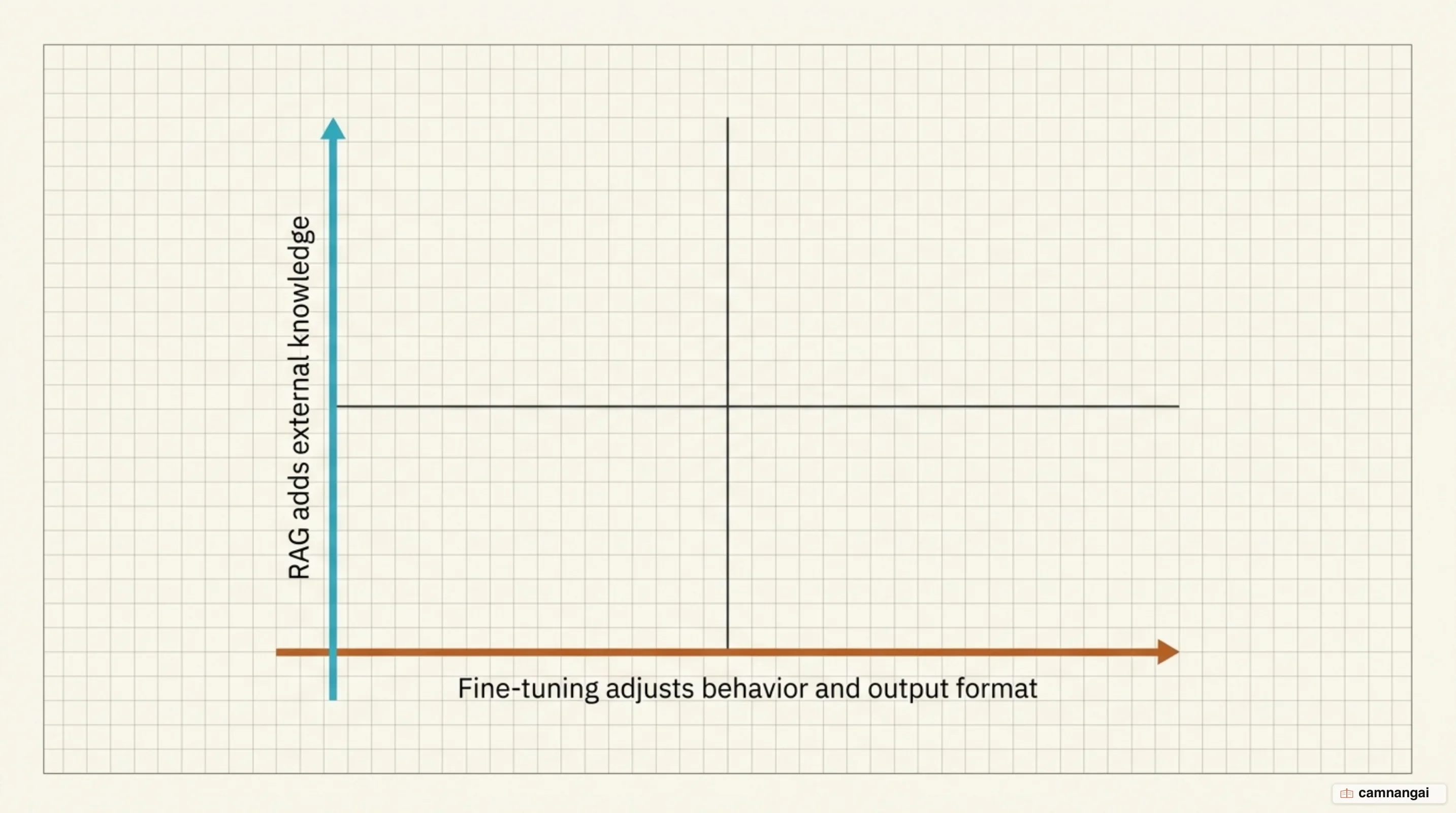
The useful mental model is the knowledge-versus-behavior divide. Fine-tuning is the right choice when the model needs to handle more example inputs and outputs than can realistically fit in a context window, letting it master a proprietary style through thousands of human-generated ground truth examples. Traditional RAG systems, meanwhile, run into a context problem. When you break a massive knowledge base into smaller chunks for retrieval, individual chunks frequently lose their surrounding context, which makes them hard to use once retrieved.
Advanced implementations solve this with contextual retrieval, which prepends explanatory context to every chunk before it is embedded or indexed. Without it, a retriever might surface a chunk stating that revenue grew by 3% while the model has no idea which company or quarter it refers to. Situating each chunk within the broader document makes the retrieved information immediately usable and semantically accurate for the generation phase.
Consider a financial document retrieval system. An original chunk might state a percentage growth figure, which is useless for a query about Q2 2023 performance if the date lives in a different chunk. Contextualizing it rewrites the chunk to say it comes from a regulatory filing covering that company's Q2 2023 performance. The subject and the time period always stay with the chunk, so the retriever can find the right information even when query and data sit thousands of lines apart in the source document.
When is RAG the right choice?
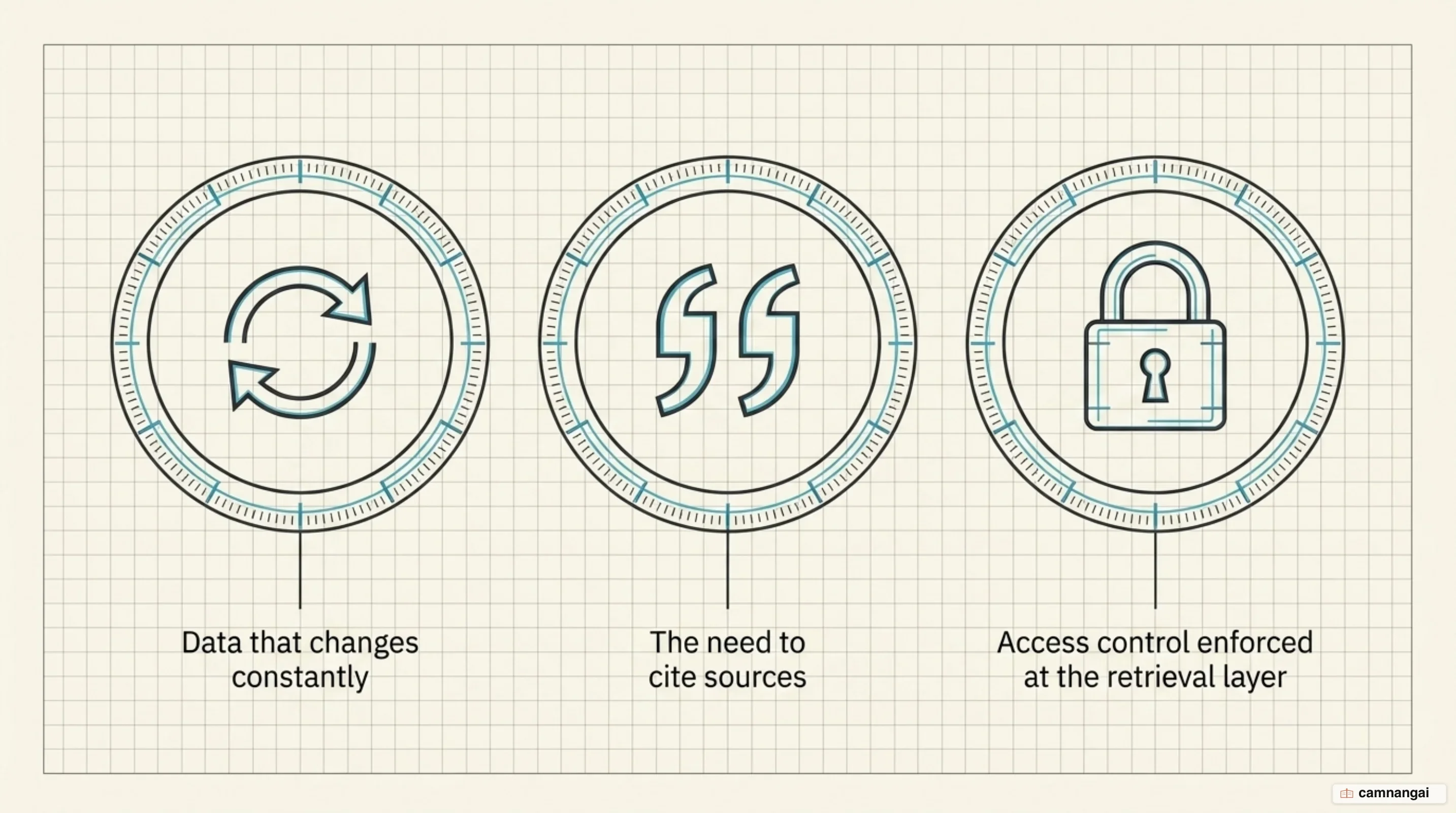
RAG is not optional when your knowledge base is dynamic, frequently updated, or exceeds the practical limits of a context window. If your knowledge base is larger than 200,000 tokens — roughly 500 pages of text — you need a scalable retrieval solution. You can technically include smaller knowledge bases directly in a prompt, but RAG remains the standard for enormous, growing libraries of facts. Updating a vector database is near-instant; fine-tuning a model to incorporate new facts is slow and computationally expensive.
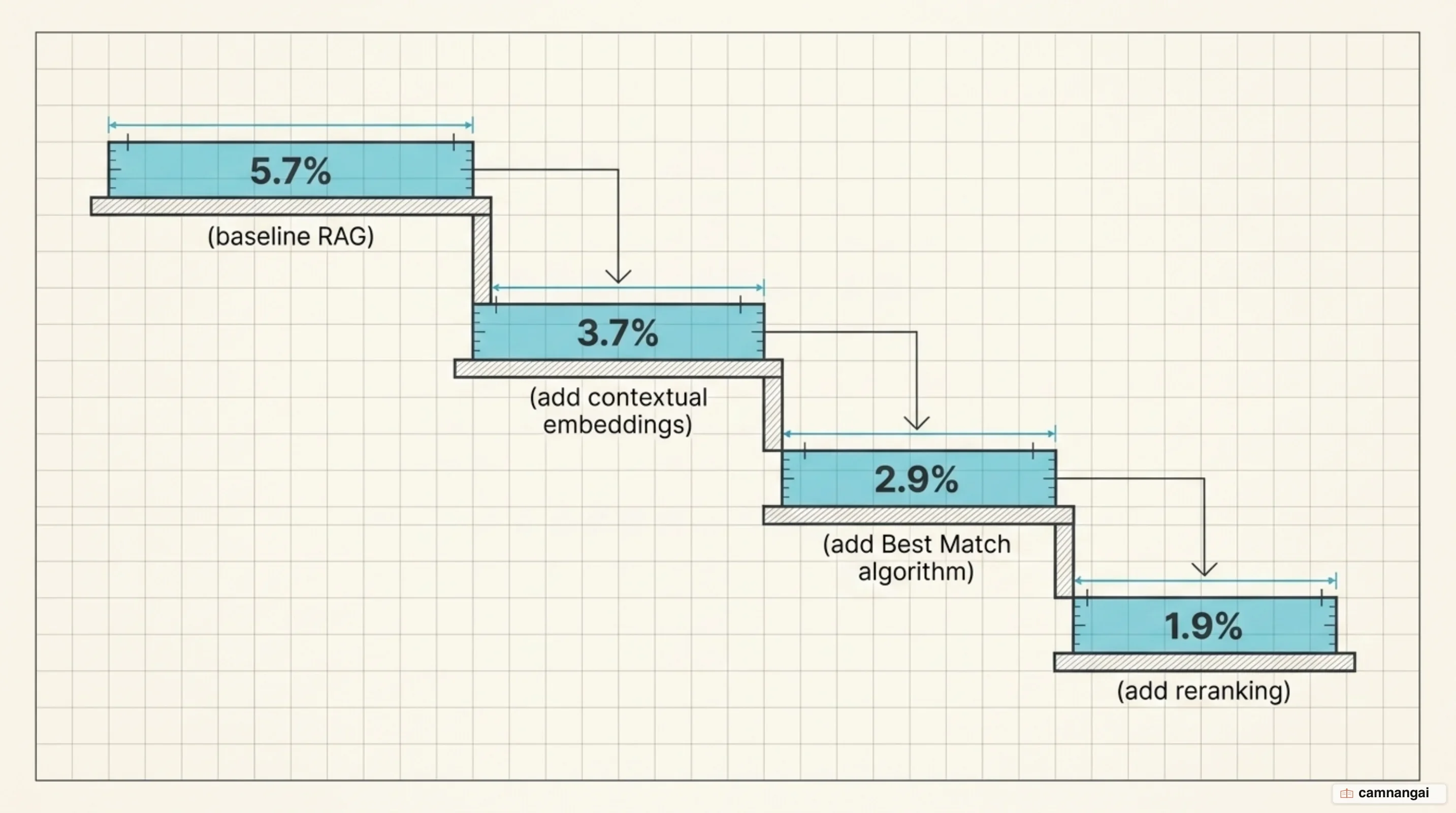
For production-grade accuracy, implement contextual retrieval, which combines contextual embeddings with contextual BM25. It pairs semantic similarity with exact lexical matching. An embedding model might surface general information about error codes, while BM25 locates a specific technical identifier such as "TS-999". Exact lexical matching sounds like a solved problem, and it mostly is, right up until the query is an error code that an embedding model will smear into something merely nearby. Combining the two techniques reduces retrieval failures by 49%. Adding a reranking step cuts the failure rate by as much as 67% compared with traditional RAG.
The preprocessing flow requires a fast model, such as Claude 3 Haiku, to generate 50 to 100 tokens of explanatory context for every chunk in your corpus. That context is prepended to the chunk before embedding. The process is unusually cost-effective when paired with prompt caching, which loads a reference document into the cache once and reuses it for every chunk generated, bringing the one-time generation cost to roughly $1.02 per million document tokens.
When designing the retrieval prompt, use a structure that clearly situates the chunk within the
whole document — typically <document> and <chunk> tags instructing the model to write a short,
succinct context explaining how the chunk fits the source material. That situating text exists to
improve search retrieval, so every indexed chunk carries the core identifiers needed to match a
user's query. It also stops the model from refusing to answer because the context looks
incomplete when the relevant facts are present but fragmented.
When does fine-tuning actually pay off?
Fine-tuning is your primary tool for optimizing latency, reducing costs, and enforcing complex behavioral rules. One planning constraint matters up front: OpenAI is winding down its fine-tuning platform, which is no longer accessible to new users. Existing users can still create training jobs for several months, and fine-tuned models remain available for inference until their base models are deprecated. If I were picking a provider today, that wind-down would move OpenAI down my list, though it is a constraint on where you fine-tune rather than on whether fine-tuning is the right lever. Fine-tuning lets you train a model on proprietary data without including it in every request, and it shortens prompts, which cuts token costs and delivers lower-latency responses at scale.
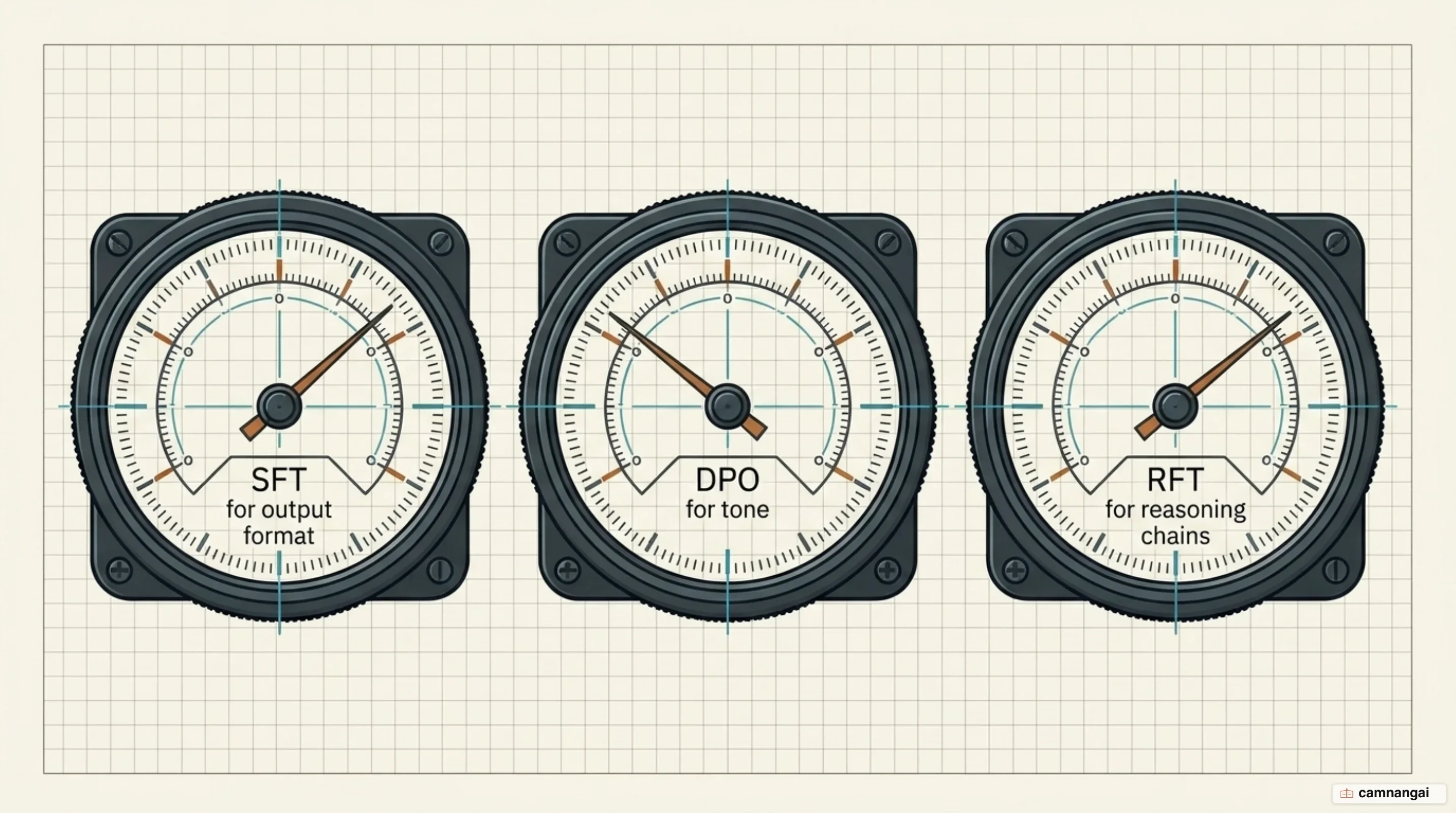
Several specialized methods serve different engineering goals. Supervised Fine-Tuning (SFT) suits classification, translation where nuance matters, and correcting instruction-following failures by supplying ground truth examples of how the model should respond. Direct Preference Optimization (DPO) refines tone and style by comparing correct and incorrect responses. Reinforcement Fine-Tuning (RFT) targets hard reasoning tasks and is built for reasoning models such as o4-mini.
RFT works by reinforcing the model's chain of thought on difficult domain-specific tasks. The model generates a response, an expert grader scores the result, and the system reinforces the internal reasoning steps that produced the high-scoring output. That makes it the strongest option for medical assessments built on diagnostic guidelines, or for identifying relevant passages in legal case law. Reinforcing the underlying logic rather than the final answer produces reasoning a base model cannot replicate through prompting alone.
Fine-tuning pays off when you can train a smaller, faster model — a mini or nano variant such as gpt-4.1-mini — to perform at the level of a much larger model on a specific task. That efficiency gain matters most in high-volume production applications where inference cost is the primary concern. Give the model thousands of examples of the task and it internalizes the required behavior, removing the need for long descriptive instructions in every API call.
Cost, latency and accuracy: the numbers that decide
Measured performance and operating cost decide the trade-off between long context and RAG. On a filtered question set, long context correctly answered 56.3% of questions against 49.0% for RAG under strict exact-match scoring. Under a looser evaluation that credits F1 scores for open-ended responses, the gap widened: long context produced better answers in 3,433 cases and RAG in 1,843, out of 13,628 questions. Long context is generally stronger for narrative synthesis, while RAG holds its ground on specific query types. Long context wins under both scorings there, which is the honest read of the quality data; cost is where the comparison stops being one-sided.
RAG stays competitive on cost despite the overhead of building a vector database. The one-time cost to generate contextualized chunks is roughly $1.02 per million document tokens. Once the index exists, prompt caching can cut ongoing API costs by up to 90% and improve latency by more than 2x by reusing frequently accessed context. That makes RAG an affordable way to give a model access to millions of tokens of data without paying the per-request cost of filling a full context window.
Reranking is the final component of accuracy optimization — a filter between retrieval and generation. You retrieve the top 150 potentially relevant chunks first, then pass them through a reranker that scores them against the specific prompt and selects the top 20 for generation. Combining contextual embeddings, BM25, and a reranker drives retrieval failure rates as low as 1.9%, down from 5.7%.
Latency deserves attention when you build these pipelines. Reranking adds a step at runtime, though modern rerankers score chunks in parallel to limit the impact. For most enterprise applications the extra latency is a fair trade for the accuracy gain and the lower hallucination risk. Narrowing the context before it reaches the generation model also cuts the total tokens the model must process, which offsets part of the latency the retrieval steps introduce.
Do long context windows make RAG obsolete?
Ultra-long context models — Gemini-1.5 supports up to 10 million tokens — have led some to question RAG's future. The headline result is that long context generally outperforms RAG on question-answering benchmarks, particularly on well-structured realistic long texts such as novels or research papers. In cohesive narratives, the model's ability to synthesize dense information across an entire document produces better comprehension. For knowledge bases under 200,000 tokens, it is often more effective to include the whole corpus in the prompt and use prompt caching to manage cost.
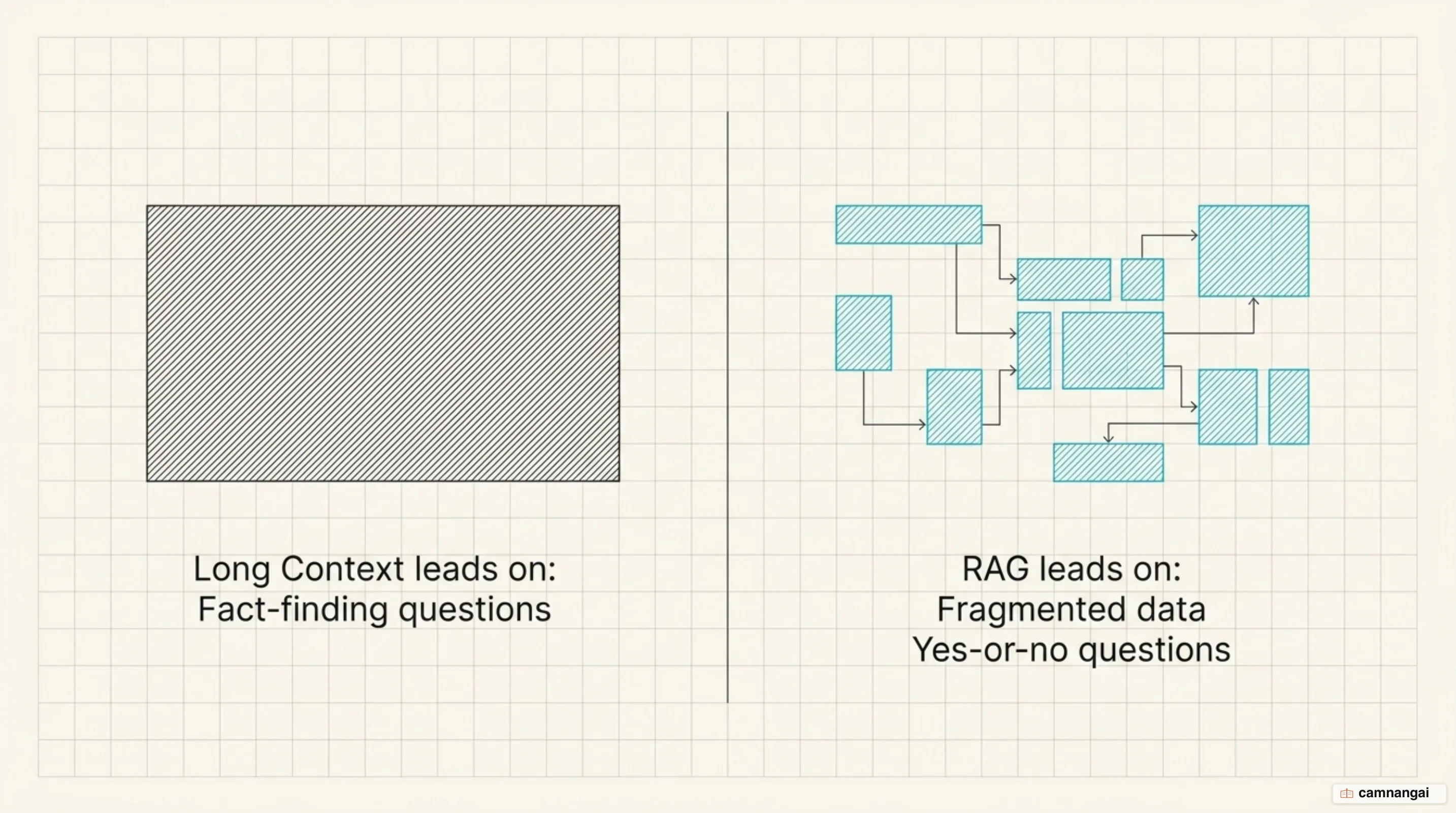
Realistic context and synthetic context behave differently. Synthetic contexts are built by concatenating unrelated segments or injecting noise to simulate length, which can produce the lost-in-the-middle effect where the model struggles to locate relevant facts. Long-context models are increasingly resistant to that noise, but RAG still excels on fragmented information and dialogue-based contexts where relevant facts sit across disjointed sources. RAG is the precision tool that isolates the exact relevant segments.
RAG also remains the only genuinely scalable option for knowledge bases growing into the hundreds of millions or billions of tokens. Even the largest context windows have limits, and as a company's corpus grows, the cost and latency of processing the entire library for every query become prohibitive. For fragmented information and general yes-or-no questions, retrievers are often better at finding the needle than a brute-force long-context pass.
In practice, long-context models are best for deep reasoning over a specific, cohesive document, while RAG is a high-speed retrieval layer over vast amounts of data. For narrative subjects — film, song, novel analysis — long context provides the complete picture. For technical or data-oriented topics, RAG's ability to pinpoint exact lexical matches wins. Treat the two as complementary tools, with RAG as the search engine that feeds the most relevant data into the model's context window.
Using both: how RAG and fine-tuning complement each other
The systems that hold up best stack the benefits of both. A standard hybrid architecture uses a RAG pipeline to retrieve the most relevant information and passes it to a fine-tuned model for synthesis, so the model has the most current facts and delivers them in a specialized format or tone. Delivering the top 20 chunks to the model is the optimal balance, providing enough context without overwhelming the generator.
Reranking is the bridge in that combined architecture, filtering initial retrieval results down to the essentials. An initial retriever pulls the top 150 chunks using embeddings and BM25, then a reranker identifies the top 20 most important chunks for the final response. This keeps relevant information from being lost in a long context window and ensures generation rests on the highest-quality data available.
Another approach is Self-ROUTE, a hybrid that uses a self-reflection mechanism to choose between a RAG path and a long-context path based on the query. By analyzing query type, the system decides whether the question needs a broad search across a massive database or deep reasoning over one document. That lets you balance performance against computational cost in real time.
The strongest configuration stacks all of it: contextual embeddings, BM25, reranking, and long-context processing. Contextual retrieval situates chunks within their document to reduce retrieval failures, while a fine-tuned reasoning model processes those chunks with chain-of-thought logic. The integrated approach produces systems that are both knowledgeable and consistently specialized — a level of reliability neither method reaches in isolation.
How to choose for your own project
Define your primary requirement first. Choose RAG if you have a massive, constantly changing library of facts the model must reference with precision. Choose fine-tuning if you mainly need the model to follow a complex output format or adopt a specific persona. For systems needing both broad knowledge and specialized behavior, a hybrid that retrieves the top 20 contextualized chunks and processes them through a fine-tuned model is the most effective path.
Accuracy is an iterative problem, not a one-time configuration. Never commit to a fine-tuning job or a multi-layered retrieval pipeline until you have an evaluation baseline and have exhausted prompt engineering. Start with evals, add complexity only where the measurements justify it, and you will find out which of the two you actually needed.
References
- Optimizing LLM Accuracy — OpenAI
- Model optimization — OpenAI
- RAG vs Fine Tuning: Enterprise Decisions for AI Models and AI Systems — Databricks
- RAG vs Fine-tuning: Pipelines, Tradeoffs, and a Case Study on Agriculture
- RAFT: Sailing Llama towards better domain-specific RAG — Meta AI
- Introducing Contextual Retrieval — Anthropic
- Long Context vs. RAG for LLMs: An Evaluation and Revisits
- RAG vs Large Context Window: Real Trade-offs for AI Apps — Redis