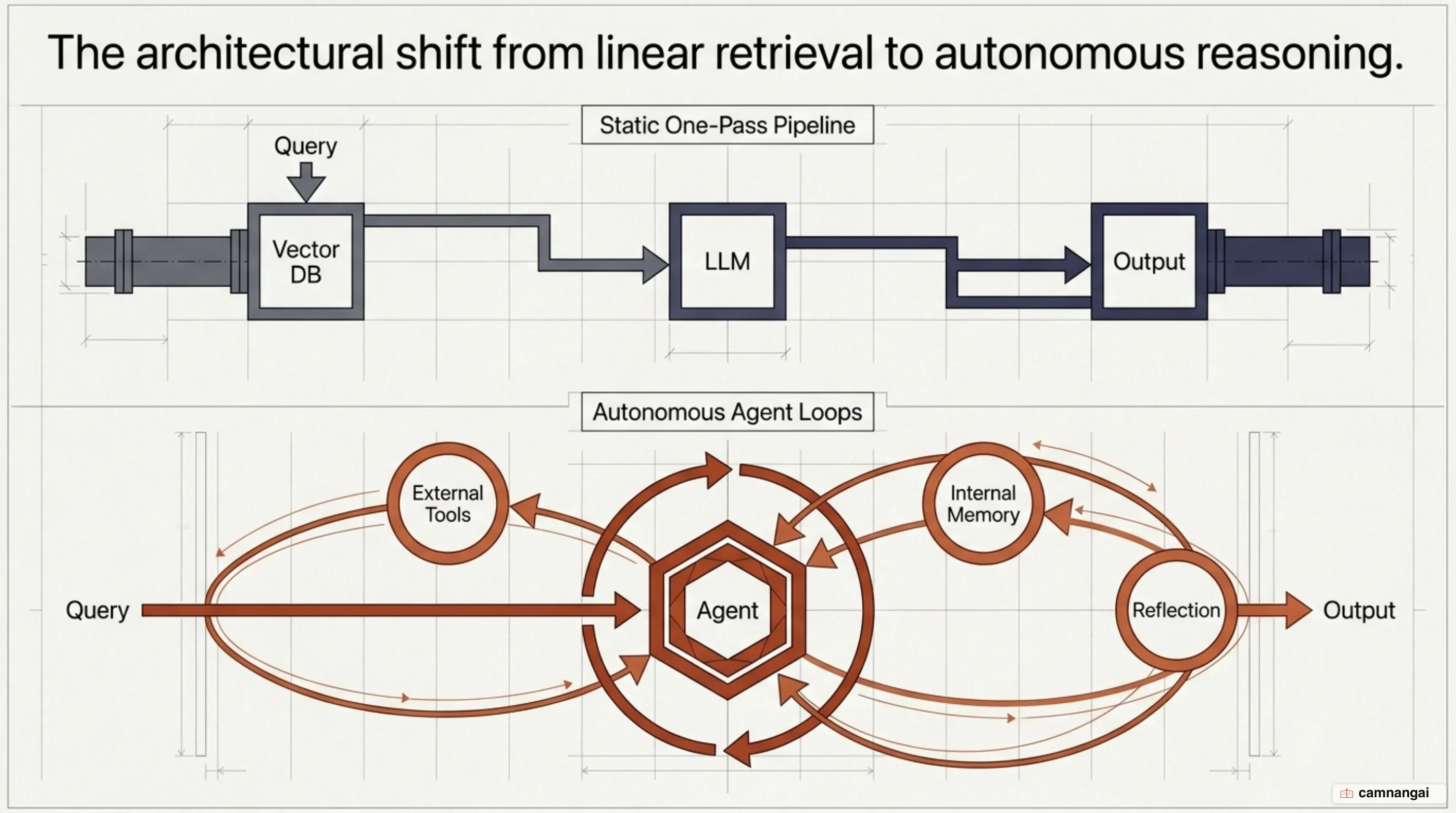
When evaluating RAG vs Agentic RAG, the fundamental distinction lies in execution control and system autonomy. Traditional Retrieval-Augmented Generation operates as a static, single-pass linear pipeline: your system embeds a user query, executes a single similarity search against a vector store, injects the retrieved document chunks into a prompt context, and passes that context to a Large Language Model to generate a response.
Conversely, Agentic RAG replaces this deterministic chain with an autonomous, iterative loop. An LLM operates as an agent that utilizes tools, explicit reasoning steps, and continuous self-evaluation to dynamically fetch, assess, rewrite queries, and re-retrieve information until it verifies that the collected evidence is sufficient.
Traditional RAG performance depends entirely on one-shot retrieval accuracy, whereas Agentic RAG introduces multi-step planning, dynamic tool selection, and self-reflection loops to resolve complex enterprise queries.
Why Traditional RAG Hits a Wall with Complex Queries
The standard implementation of naive RAG relies on a linear execution chain: vector embedding, similarity search, single top-$k$ retrieval, and prompt injection into an LLM generation step. When a user submits a query, your system converts the input into a vector embedding, calculates distance metrics against an index, and returns the nearest document chunks. While effective for simple, direct factual lookups, this rigid pipeline breaks down in production when handling complex or poorly structured prompts. Because naive RAG is a deterministic, one-shot sequence, it lacks any mechanism to evaluate whether the retrieved context is relevant, complete, or factually applicable before sending it to the model.
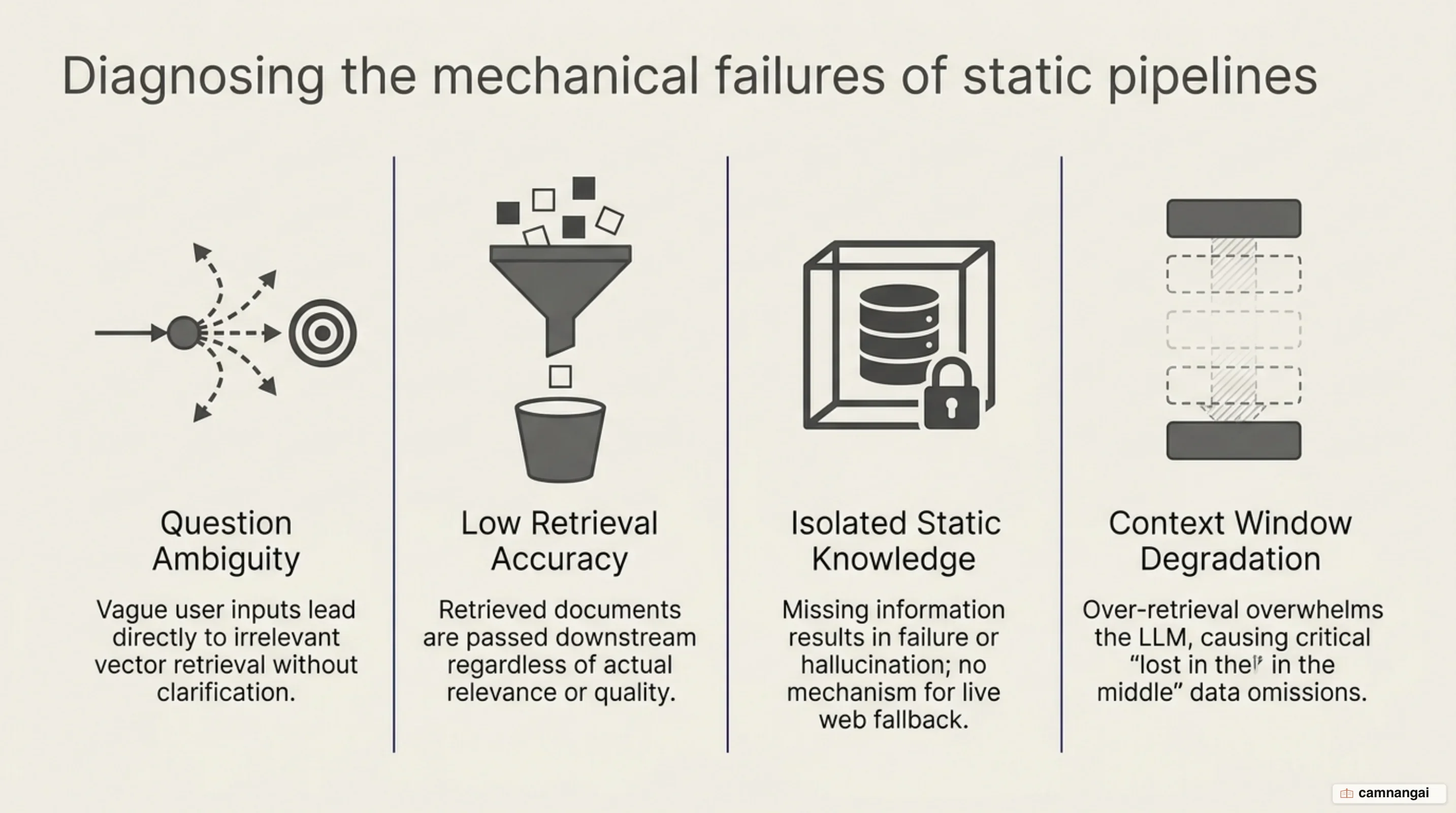
The structural limitations of single-pass retrieval manifest across four primary failure modes in enterprise production. Question ambiguity presents the first hurdle; user prompts frequently lack specific domain keywords, causing distance algorithms to retrieve passages that share semantic density but fail to address the user's underlying intent. Low retrieval accuracy further degrades outputs when vector databases pull passages containing distracting or non-pertinent data alongside the target facts. Furthermore, naive RAG is tightly coupled to a single static vector store. If an incoming query requires data residing in a relational database, an external web API, or a live messaging stream, a linear chain cannot pivot to alternative data sources or trigger external API calls.
Attempting to resolve retrieval gaps by increasing the top-$k$ chunk count creates severe architectural trade-offs. Standard vector indices operate under strict dimension and capacity parameters—such as performance-optimized p1 pods storing up to 1M 768-dimensional vectors for sub-100ms latency SLAs, or storage-optimized s1 pods holding 5M 768-dimensional vectors with higher query latencies. When you attempt "over-retrieval" to capture missing context, the inflated volume of injected text quickly saturates model context windows. This pattern inflates token costs, increases processing time, and induces model attention degradation—frequently referred to as the "lost in the middle" phenomenon—where LLMs fail to utilize critical tokens buried deep within large context payloads.
What Is Agentic RAG? Three Core Capabilities
Agentic RAG transforms information retrieval from a passive, single-pass lookup into an active, iterative decision-making workflow. Instead of executing an unbranching pipeline, Agentic RAG places the retrieval process inside an AI agent loop driven by models capable of tool execution and structured reasoning. This framework utilizes iterative cognitive paradigms such as the ReAct (Reason + Act) loop cycle. Within this cycle, the agent systematically executes three phases: Thought, where the LLM reasons over user goals and current state; Action, where the agent invokes a tool or executes a target search query; and Observation, where the agent inspects tool feedback to adjust its strategy. This cycle repeats autonomously until the system gathers sufficient verified context.
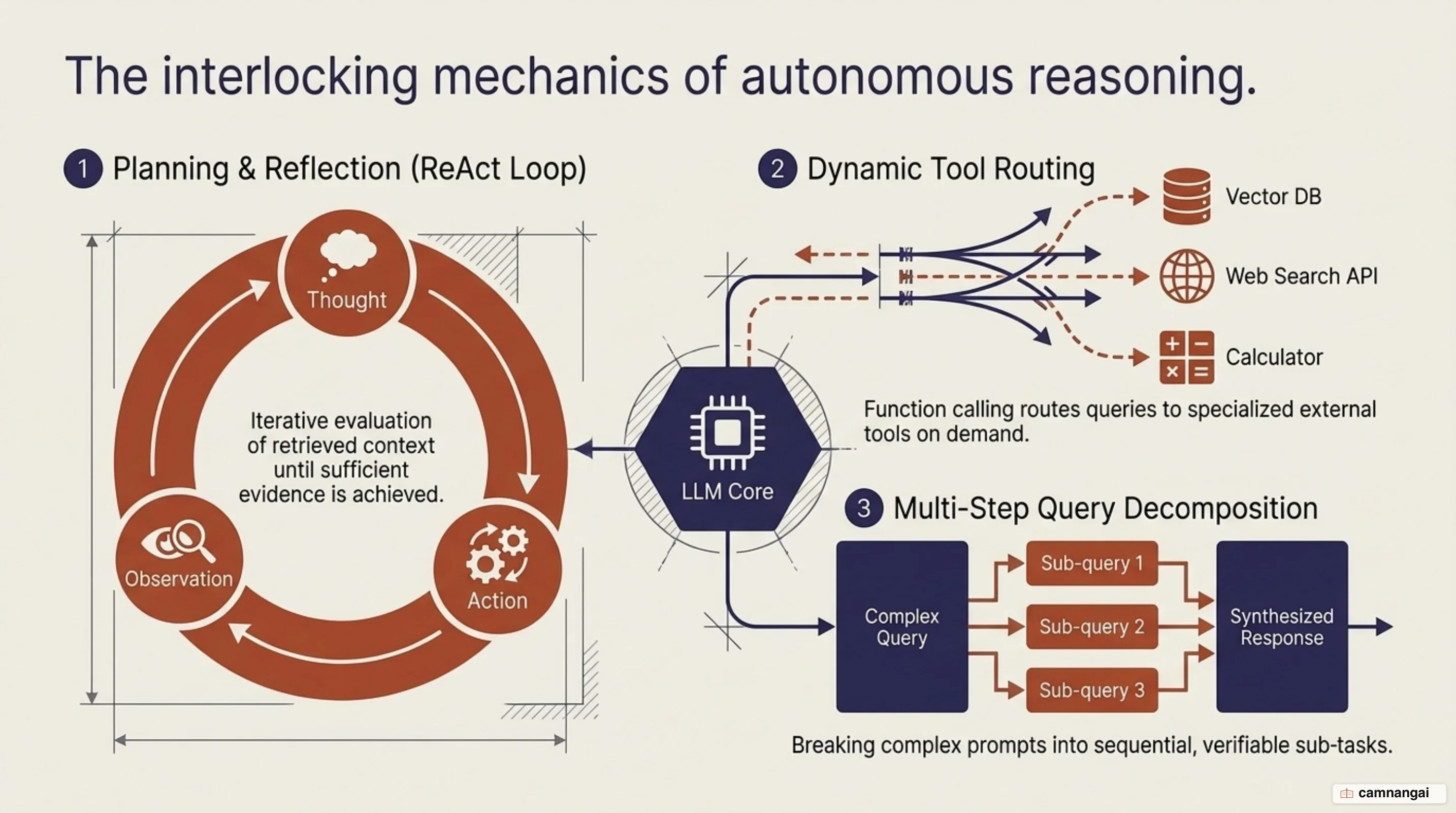
The foundational strength of Agentic RAG lies in dynamic tool integration via model function calling capabilities. Rather than binding your application to a single vector index, the core agent orchestrates with programmatic access to a diverse toolkit. The system can dynamically route queries across vector search engines, web search APIs (such as Tavily or SerpAPI), domain-specific repositories (such as arXiv, GitHub, or TechCrunch APIs), and execution utilities like code interpreters and calculators. By treating data stores as tools, the agent determines at runtime which system is best suited to satisfy specific contextual requirements.
Complementing tool usage are iterative reasoning and context validation loops that ensure output accuracy. Agents maintain state across execution steps, storing retrieved facts in short-term memory to decide whether additional evidence is necessary or if query parameters require reformulation. Before delivering a final response, the system grades retrieved passages and generated text against verification criteria. By validating semantic relevance and checking for factual support prior to output generation, Agentic RAG prevents hallucinations and guarantees that delivered answers remain grounded in authoritative source context.
4 Common Architectural Patterns of Agentic RAG
Implementing Agentic RAG requires selecting structural patterns aligned with system complexity and retrieval requirements. Frameworks such as LlamaIndex and LangChain/LangGraph formalize these architectures into four distinct operational designs. The simplest pattern is Single-Agent Query Routing, where an agent functions as an initial decision gatekeeper. Using model function calling, the router evaluates query intent and metadata to forward requests to the optimal knowledge source—such as an OpenSearch vector index, a PostgreSQL database, a public web API, or directly to an LLM when external retrieval is unnecessary.
To overcome prompt ambiguity and vocabulary mismatches, systems employ Query Transformation and RAG Fusion. In this pattern, the agent expands a user's initial prompt into multiple derivative queries reflecting different technical perspectives. The architecture executes parallel vector searches for each transformed query and aggregates the returned document sets. It then applies Reciprocal Rank Fusion (RRF) algorithms to rerank and deduplicate context, ensuring that passages appearing consistently across disparate searches receive higher priority in the final prompt context.
Corrective RAG (CRAG) introduces self-corrective resilience by placing a lightweight retrieval evaluator between vector lookup and generation. When vector searches return ambiguous or low-confidence results, CRAG triggers secondary web search tools to fetch supplementary context. Crucially, CRAG performs knowledge refinement by partitioning retrieved documents into granular "knowledge strips." The evaluator scores each strip individually, filtering out irrelevant noise before recomposing the clean text into the generation context. For enterprise scale, Multi-Agent Systems deploy hierarchical orchestrators—such as a master LlamaIndex AgentRunner managing domain-specific AgentWorker instances—to coordinate retrieval across dedicated enterprise data boundaries.
from typing import Literal
from pydantic import BaseModel, Field

class GradeDocuments(BaseModel):
    """Binary score for evaluating document relevance to a user query."""
    binary_score: str = Field(
        description="Document is relevant to the question: 'yes' or 'no'"
    )

def grade_documents_node(state: dict) -> Literal["generate_answer", "rewrite_question"]:
    """Conditional edge routing based on retrieval evaluation grade."""
    # Grading logic evaluates retrieved context against question
    if evaluation.binary_score == "yes":
        return "generate_answer"
    return "rewrite_question"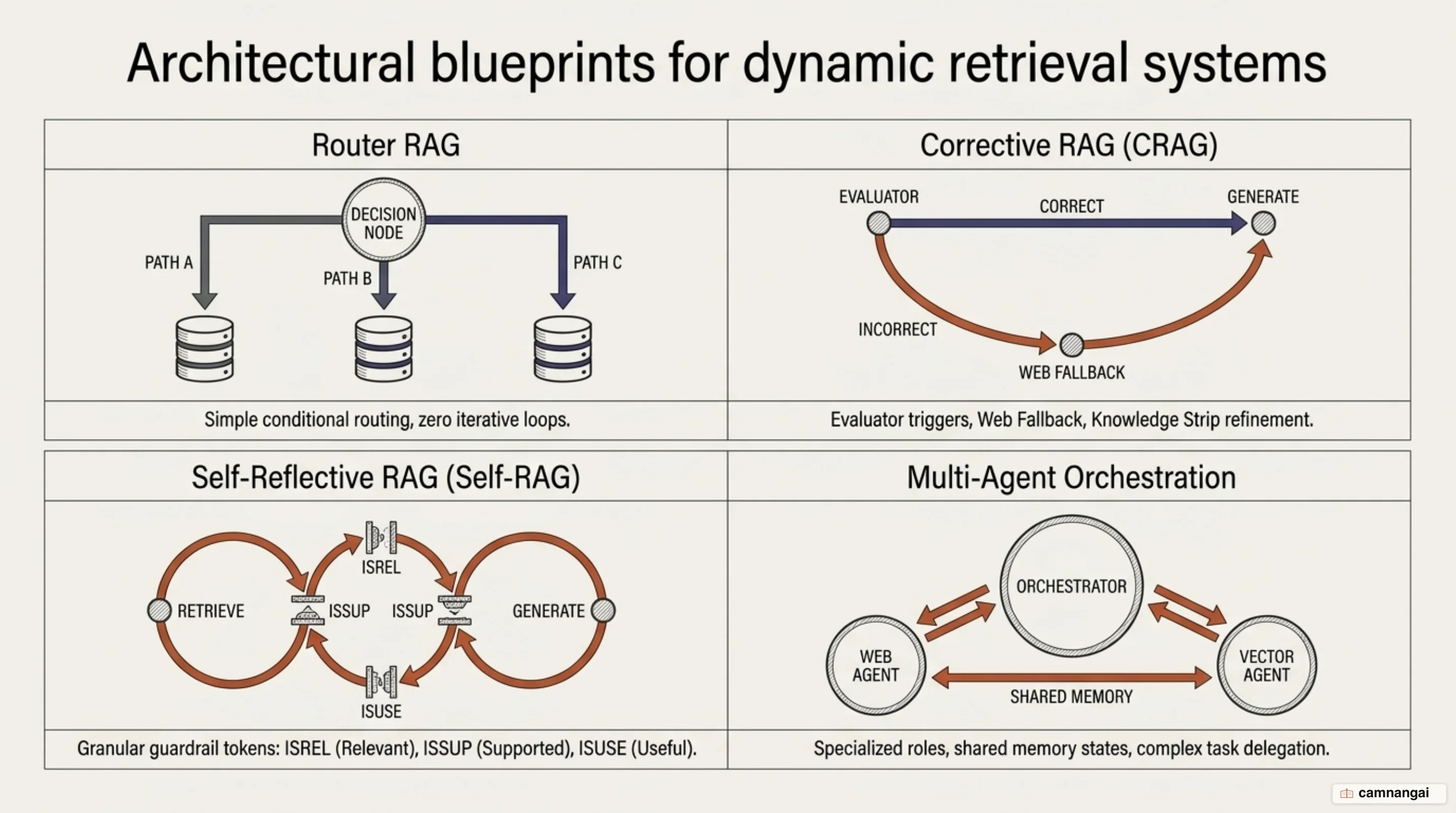
State Machines and Self-Correction: The Core of Agentic RAG
Moving from simple sequential chains to dynamic agentic architectures requires state machine control frameworks, such as LangGraph. While linear chains execute steps in a rigid, one-way order, state machines manage execution through a centralized State object that passes through discrete Nodes connected by Edges and Conditional Edges. Nodes perform functional tasks—such as executing LLM inferences, querying vector databases, or rewriting user prompts—while conditional edges inspect state attributes at runtime to route execution dynamically, trigger retries, or terminate the loop when requirements are met.
Self-Reflective RAG architectures embed specialized reflection tokens, derived from Self-RAG research, directly into state graph decision nodes to evaluate generation and retrieval quality. The Retrieve token assesses prompt structure to determine whether external vector lookup is necessary. The ISREL (Is Relevant) token grades whether retrieved passages contain semantic relevance to the input query, filtering out non-pertinent text blocks. The ISSUP (Is Supported) token validates whether factual claims in generated responses are supported by retrieved context to prevent hallucinations. Finally, the ISUSE (Is Useful) token evaluates overall response quality and utility, outputting a discrete integer score from {5, 4, 3, 2, 1} to measure how effectively the response answers the user's initial prompt.
The self-correction cycle executes through a state graph loop that systematically recovers from retrieval failures. Execution begins at a generate_query_or_respond node. If tool calls are requested, control transitions to a retrieve node, followed by a grade_documents conditional node. If retrieved context fails ISREL grading, the state branches to a rewrite_question node, which reformulates the query's semantic intent and routes execution back to generate_query_or_respond for a secondary retrieval attempt. Once context passes relevance grading, control routes to generate_answer, where ISSUP checks verify factual compliance before returning the final response.
from typing import Literal
from pydantic import BaseModel, Field

class GradeDocuments(BaseModel):
    """Binary score for evaluating document relevance to a user query."""
    binary_score: str = Field(
        description="Document is relevant to the question: 'yes' or 'no'"
    )

def grade_documents_node(state: dict) -> Literal["generate_answer", "rewrite_question"]:
    """Conditional edge routing based on retrieval evaluation grade."""
    # Grading logic evaluates retrieved context against question
    if evaluation.binary_score == "yes":
        return "generate_answer"
    return "rewrite_question"
The Cost of Autonomy: Latency, Token Overhead, and Infinite Loops
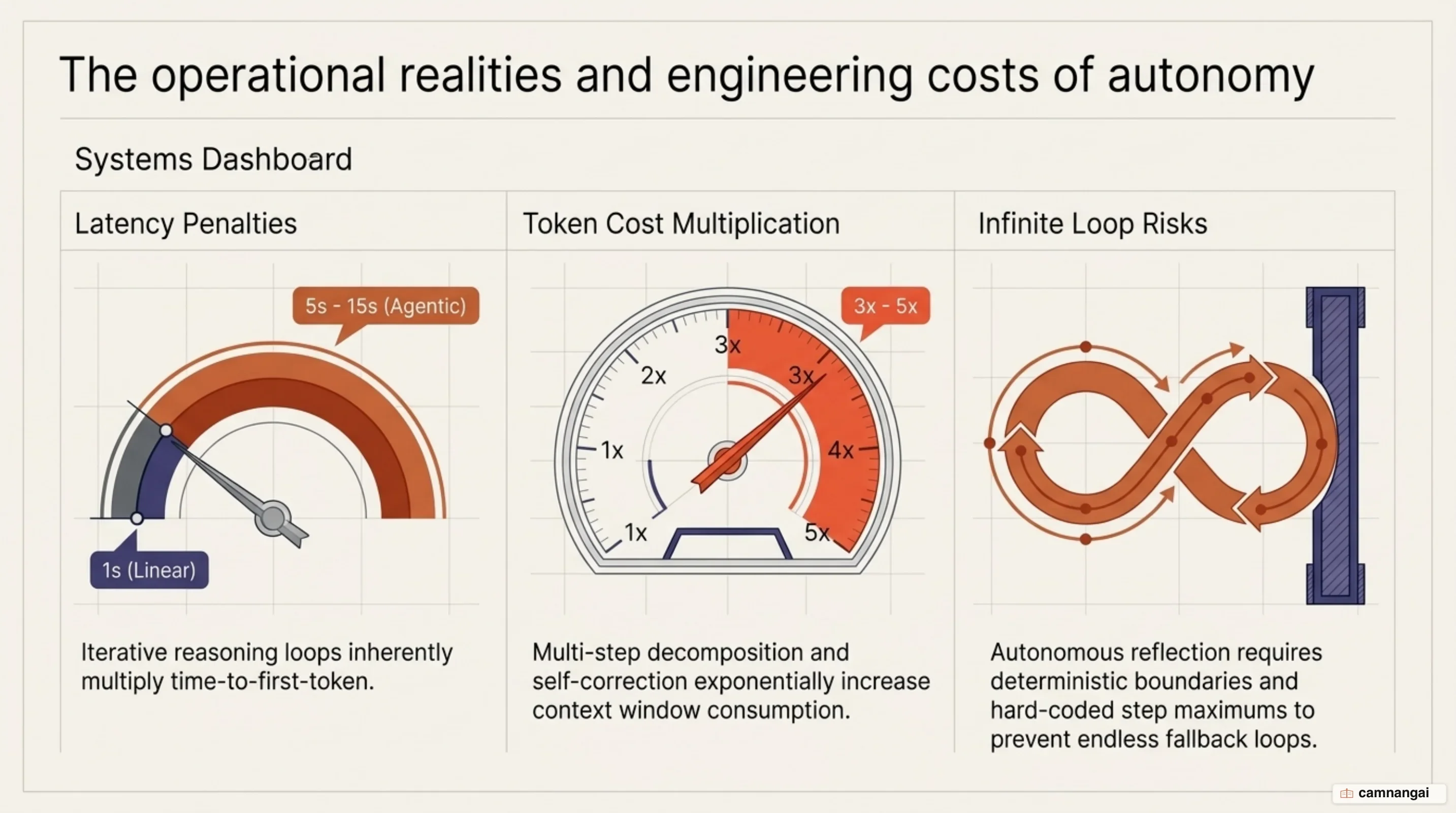
While agentic loops resolve the structural failure modes of naive retrieval, introducing system autonomy creates operational trade-offs across latency, financial expenditure, and system stability. Shifting from a single-pass vector lookup to an autonomous graph trades processing speed and token efficiency for contextual accuracy. Systems engineers must quantify these overheads when designing production SLAs to prevent performance degradation under heavy user concurrency.
Latency penalties constitute the most immediate operational cost when transitioning to Agentic RAG. Standard single-pass vector retrieval typically completes execution within 1 second. In contrast, multi-step agent workflows require sequential LLM inference turns for query planning, tool selection, context grading, question rewriting, and response generation. This sequential processing pushes end-to-end response times to between 5 and 15 seconds per request, making unoptimized agentic architectures unviable for real-time customer-facing applications requiring strict sub-second SLAs.
Token consumption and financial costs scale non-linearly due to reflection cycles and multi-query expansions. Running self-critique functions requires generating multiple structured sub-prompts for every user query turn. Evaluation functions calculate weighted critique scores by applying distinct empirical weights to output dimensions: assigning heavy weights to relevance (3.0) and suitability (2.0), moderate weights to details (1.5), and lower weights to clarity (1.0) and coherence (0.5). Multiplying these structured LLM evaluation calls across iterative search loops drastically increases total token throughput per request.
A severe operational failure mode in agentic systems is the infinite execution loop. If an agent continuously receives low-confidence search results that fail minimum document grading thresholds, it can enter an unbounded search-and-rewrite cycle. These endless loops drain token budgets, produce high API costs, and lead to context window pollution. To ensure production safety, system architects must enforce strict max-step limits, implement fallback routing logic, and define deterministic termination boundaries within the state graph.
When to Keep RAG Simple vs. When to Upgrade to Agentic RAG
Maintain a traditional, simple RAG architecture when serving well-bounded internal documentation, direct factual Q&A systems, and applications with strict latency constraints under 1 second. If your domain knowledge resides in a static, structured vector database where standard semantic search achieves acceptable retrieval precision, introducing autonomous agent loops adds unnecessary latency, token expense, and system complexity without providing tangible accuracy gains.
Upgrade to Agentic RAG when application queries are ambiguous, multi-faceted, or require information synthesis across heterogeneous data sources—such as combining relational SQL databases, vector indices, and real-time web APIs. Agentic architectures are essential when production requirements demand verified contextual accuracy, automated query reformulation, hallucination guardrails, and dynamic multi-step reasoning capabilities.
References
- EP230: RAG vs Agentic RAG — ByteByteGo
- What Is Agentic RAG? From LLM RAG to AI Agents — Weaviate
- Self-Reflective RAG with LangGraph — LangChain
- Build a Custom RAG Agent with LangGraph — LangChain Docs
- Agentic Strategies Guide — LlamaIndex Documentation
- Create an Agentic RAG Application with LlamaIndex and Mistral on Amazon Bedrock — AWS Machine Learning Blog
- Advanced RAG Techniques — Pinecone Learning Center
- Corrective Retrieval Augmented Generation (CRAG) — arXiv:2401.15884