LLM Chaining breaks complex multi-step processes into discrete subtasks where the output of one step becomes the input to the next, trading network latency for execution control and task accuracy.
When designing AI systems, you face a foundational choice: Should you orchestrate multiple LLM calls in a sequence, or can a single, well-crafted monolithic prompt handle the task?
While monolithic prompts work for simple tasks, LLMs tend to drop instructions, hallucinate details, or fail on strict output formatting constraints when loaded with high prompt complexity. Decomposing these workflows into explicit steps allows focused attention on narrow transformations, but it transforms your application into a distributed system with real operational overhead.
You must establish a pragmatic engineering baseline: always default to a single prompt or simple retrieval-augmented setup, and only decompose into a multi-step chain when single-prompt failure modes are quantitatively proven through systematic evaluations.
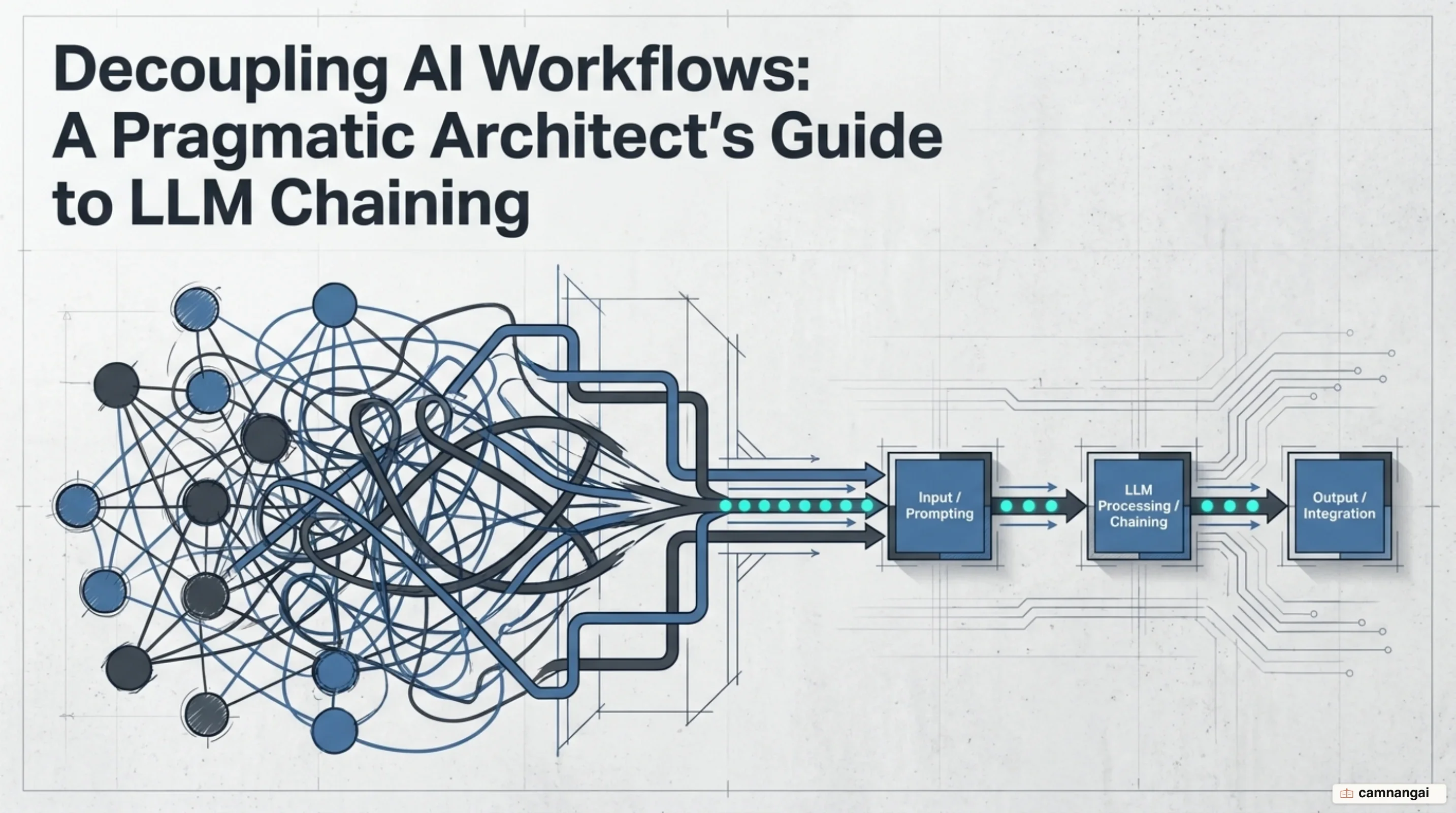
The Core Dilemma: Single Monolithic Prompt vs. LLM Chain
Monolithic prompts attempt to handle intent recognition, data extraction, synthesis, formatting, and safety checks inside a single LLM call. As prompt length and task requirements expand, models experience cognitive load degradation. They frequently drop specific instructions, generate ungrounded details, or fail when forced to combine free-form qualitative analysis with rigid output formatting constraints like valid JSON schemas.
An orchestrated chain replaces a single unconstrained model invocation with deterministic code paths that execute bounded subtasks in sequence. Instead of expecting one context window to absorb all instructions and context, LLM Chaining isolates individual operations—such as filtering harmful content, extracting verbatim quotes, or generating structured summaries—passing verified outputs step-by-step downstream.
The quantitative trade-offs between these paradigms dictate system design. A single API call minimizes network round-trips (N = 1), maintaining a baseline latency of network transit, queue wait, and model inference. In contrast, an N-step sequential chain accumulates latency linearly:
Latency_total = ∑ (T_network,i + T_queue,i + T_inference,i)Chaining also introduces token amplification costs: re-injecting upstream outputs into downstream prompts across N hops increases aggregate context token volume, multiplying API inference spend. You intentionally trade this latency and token overhead for execution determinism, granular error isolation, and precise operational control.
Ultimately, you must treat LLM Chaining as a distributed system design choice rather than a prompt engineering trick. Once you split a task across multiple API calls, you inherit distributed systems problems: contract management between hops, latency accumulation, and failure handling across stochastic software boundaries.
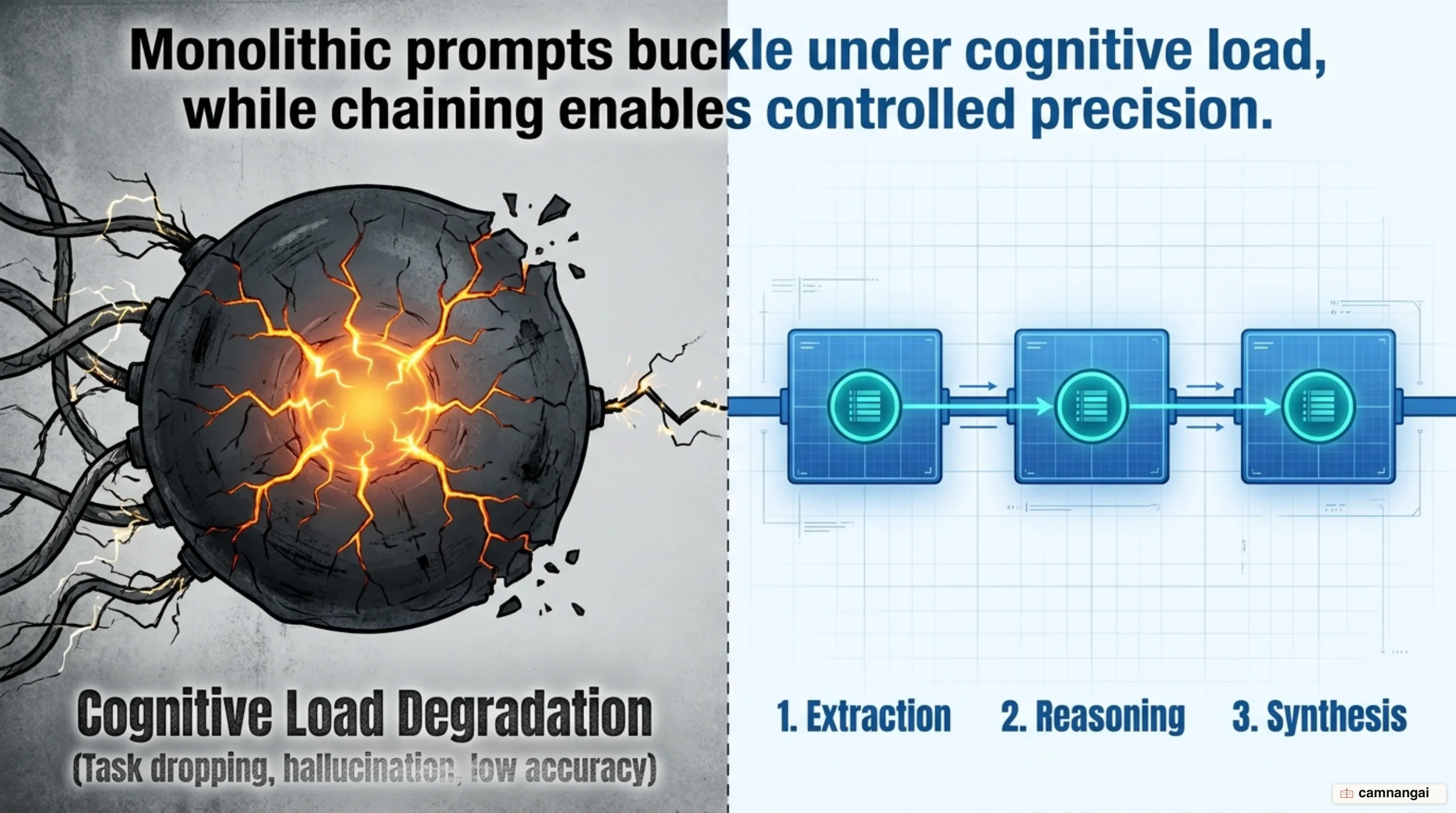
Why Chain: Specialization, Cognitive Load Reduction, and Control
The primary technical drivers for workflow decomposition are task specialization, attention management, and programmatic state control. Narrowing the context window and instruction set for a specific LLM call dramatically reduces cognitive load and attention degradation. For example, forcing a model to extract verbatim quotes in step one before synthesizing a response in step two yields far higher accuracy than requesting simultaneous search, extraction, and synthesis in one prompt.
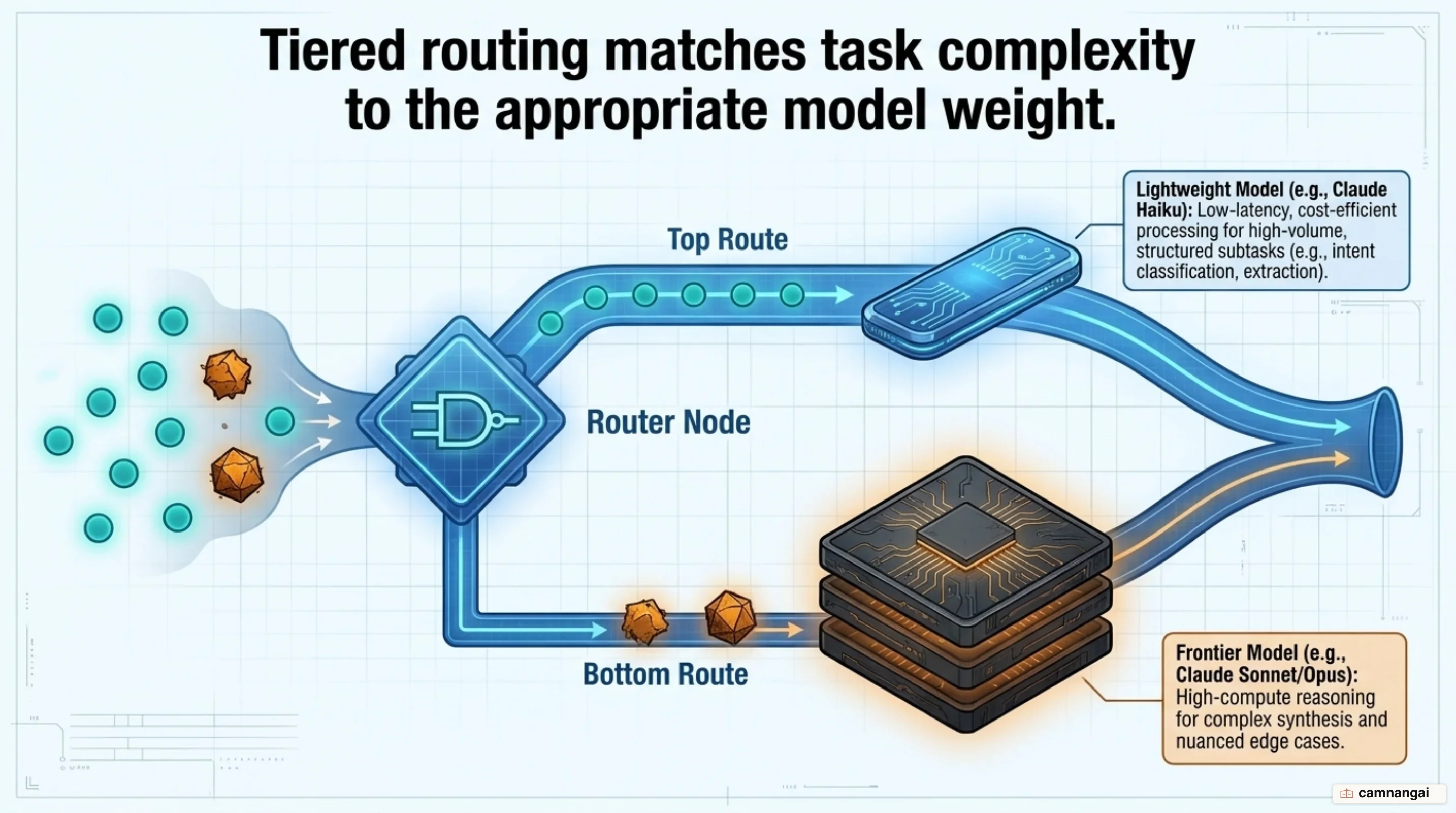
Chaining unlocks economic and performance optimizations by matching subtasks to model tiers. High-volume, straightforward steps—such as query classification, sentiment detection, or initial guardrail screening—can be routed to smaller, low-latency, cost-efficient models like Claude Haiku. You can reserve larger, expensive reasoning foundation models like Claude Sonnet strictly for complex generation and deep analytical steps.
Optimizing the Agent-Computer Interface (ACI) between chain boundaries is essential to minimize token overhead and execution drift. For example, returning structured code inside JSON requires string-escaping quotes and newlines, adding unnecessary token overhead and parsing risk compared to plain text or Markdown wrappers. Similarly, enforcing absolute filepaths rather than relative filepaths across multi-turn step transformations eliminates pathing drift when downstream models operate outside the root execution directory.
Programmatic gates inserted between steps provide operational control that monolithic prompts cannot match. By validating intermediate step outputs with programmatic regex checks, custom validators, or API calls, you can halt execution, attempt localized retries, or route to fallback handlers before bad data compounds downstream. For instance, if an initial toxicity check yields an ambiguous confidence score between 0.4 and 0.6, execution can pause for a human review callback before proceeding to response generation:
# Prompt Step 1: Quote Extraction
Input: Document text + User Question
Task: Extract exact verbatim passages relevant to the question. Wrap in <quotes></quotes>.
Output: <quotes>Subtask output passed to Step 2</quotes>

# Prompt Step 2: Answer Synthesis
Input: Document text + <quotes>Extracted Passages</quotes> + User Question
Task: Synthesize a concise answer strictly using the provided quotes.
The Hidden System Costs: Latency Accumulation, Cascading Failures, and Interface Drift
Introducing multi-step chains creates non-obvious engineering costs that can impair production stability if unmonitored. Latency accumulation is the most immediate operational penalty. Each hop incurs network connection overhead, serialization delays, and sequential token inference time. A chain of 4 sequential API calls creates a cumulative latency floor—often adding 1,500ms to 4,000ms of end-to-end processing time—that may violate real-time user interface SLA requirements.
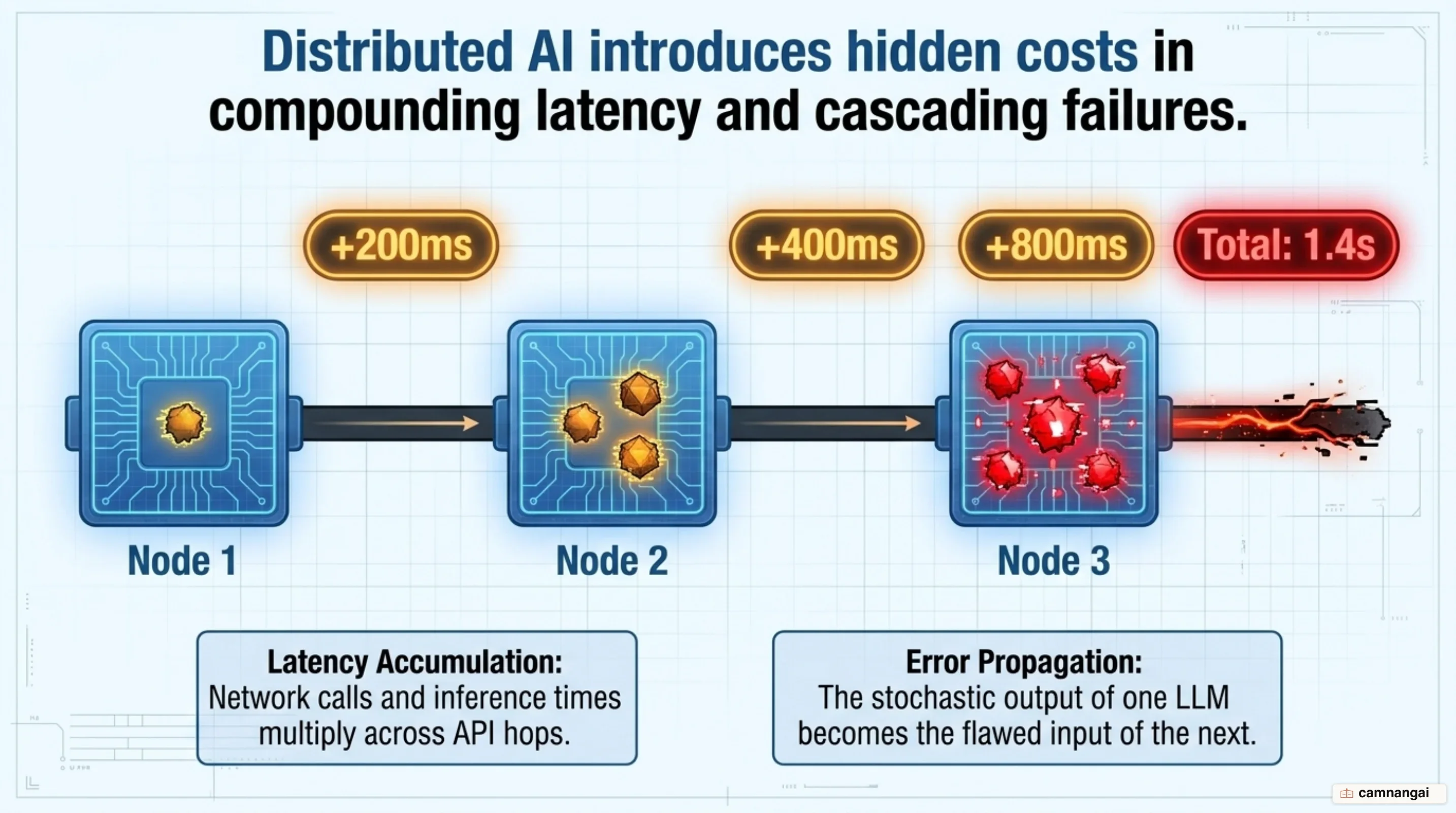
Cascading failures represent a subtle risk in chained architectures. Because downstream models ingest upstream text as ground truth, minor hallucinations, missed classifications, or subtle formatting drift in Step 1 compound exponentially as execution progresses. A slightly malformed quote or incorrect intent label generated early in the pipeline degrades every subsequent model's prompt context, leading to total downstream failure:
[User Input] ──► (LLM 1: Classification Failure)
                        │ (Propagates invalid intent)
                        ▼
                 (LLM 2: Irrelevant Extraction)
                        │ (Amplifies corrupted context)
                        ▼
                 (LLM 3: Degraded Output Generation)
Interface drift occurs because text is the fragile runtime interface between stochastic components. Minor prompt adjustments or foundation model version updates in an upstream step can silently alter output formatting, extra line breaks, or schema structures, breaking downstream regex matchers and structural parsers.
Debugging stochastic failures across a sequence of 4 to 5 model calls requires substantial logging and tracing infrastructure. Troubleshooting an intermittent failure requires full visibility into step-level prompts, temperature settings, exact input context, raw token outputs, and step-level latency metrics, paired with deterministic offline evaluation benchmarks.
The SPLIT Decision Framework: Five Criteria for Workflow Decomposition
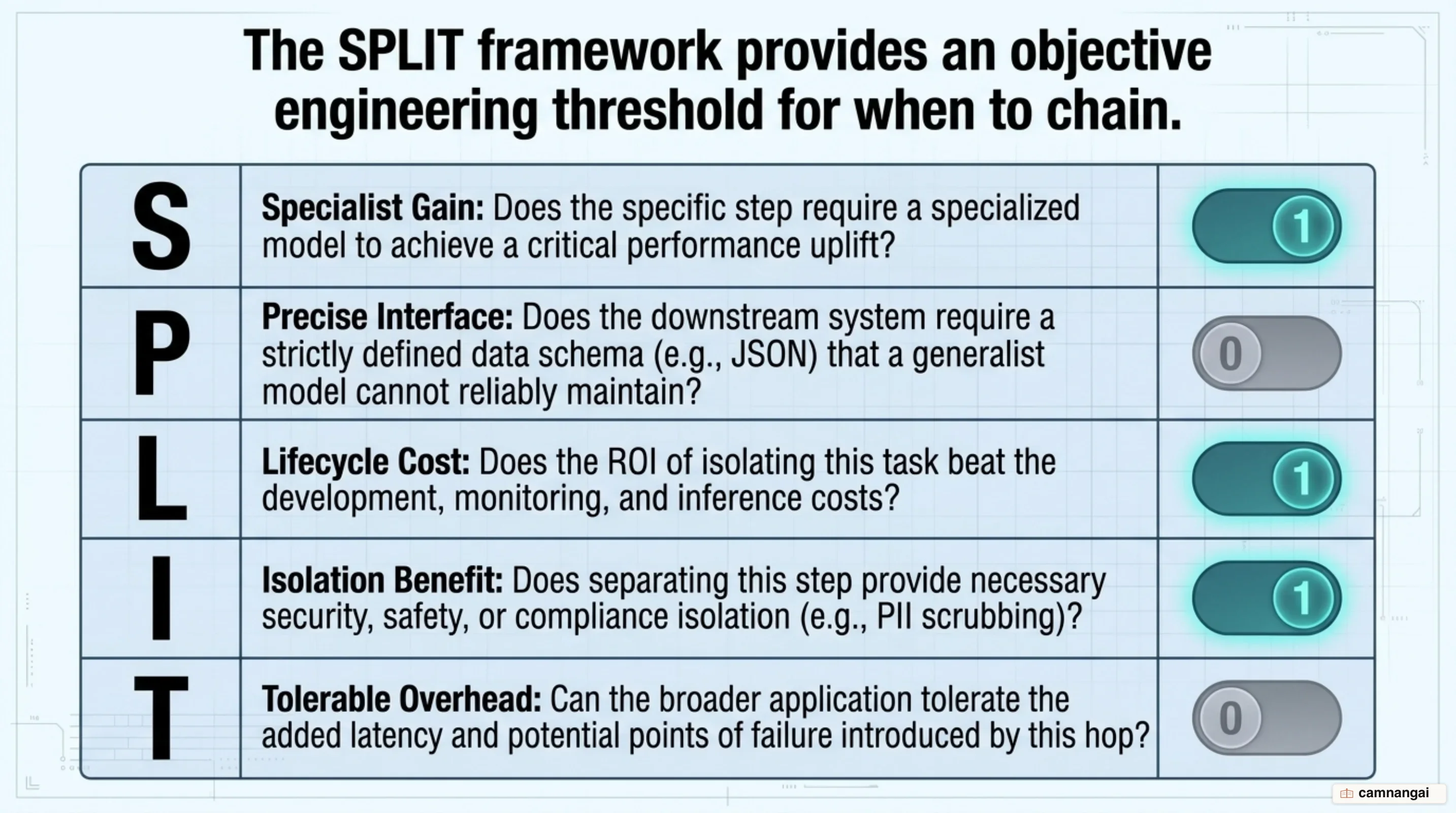
Before decomposing a monolithic prompt into code, evaluate the architecture using the 5-point SPLIT decision framework:
- S - Specialist Gain: Is there a measurable, critical accuracy improvement by using a specialized model or focused prompt for this specific subtask?
- P - Precise Interface: Does the subtask require or output a rigid, typed schema (e.g., validated JSON) that a monolithic prompt struggles to maintain?
- L - Lifecycle Cost: Does the combined token cost, development overhead, and execution latency justify the performance uplift over a single-prompt baseline?
- I - Isolation Benefit: Does isolating this step provide distinct advantages for security, content moderation, PII scrubbing, independent unit testing, or compliance?
- T - Tolerable Overhead: Can the user experience and downstream architecture tolerate the added latency and operational maintenance of an extra system hop?
Scoring these criteria quantitatively prevents premature optimization and software over-engineering. If a single prompt achieves acceptable accuracy with low latency, and splitting the task into three hops yields only marginal accuracy gains at the cost of significantly higher latency and complex error handling, the SPLIT scorecard indicates you should remain with the single prompt.
Use the SPLIT framework as a gate in your architecture review process. Require technical teams to document baseline evaluations of a single-prompt implementation before approving the operational debt of a multi-step chain.
| SPLIT Criterion | When to KEEP a Single Prompt | When to ADOPT LLM Chaining |
|---|---|---|
| Specialist Gain | Generalist model hits 90%+ quality across the entire task. | Single prompt suffers noticeable accuracy loss on specialized subtasks. |
| Precise Interface | Free-form text output (summaries, creative copy, emails). | Rigid, typed schema (JSON, Pydantic) required by downstream software. |
| Lifecycle Cost | Low latency (under 1–2 seconds) and constrained token budget are critical. | Higher overall latency acceptable to ensure process auditability. |
| Isolation Benefit | No regulatory segregation or multi-tiered guardrail requirements. | Explicit security isolation needed for PII scrubbing or guardrails. |
| Tolerable Overhead | Real-time interactive UX (chatbots, voice agents) sensitive to TTFT. | Asynchronous batch processing, report generation, or offline analysis. |
Common Architectural Patterns: Sequential, Cascade, Router, and Refinement Loops
Sequential Pipeline: A linear execution model (LLM_1 → LLM_2 → LLM_3) where each step consumes the transformed text of the prior model. This pattern excels at structured content generation, multi-stage document transformations, translation pipelines, or quote extraction followed by synthesis:
[Input] ──► (LLM 1: Context Extraction) ──► (LLM 2: Synthesis) ──► (LLM 3: Formatting) ──► [Output]Cascade (Filter & Escalate): In a cascade, high-volume inputs are initially processed by small, low-latency models; if confidence scores or validation checks fall below defined thresholds, the request escalates to a larger foundation model:
                               ┌─► [Confidence Passed] ──► [Return Fast Result]
[User Input] ──► (Haiku Model) ──┤
                               └─► [Confidence Failed] ──► (Sonnet Model) ──► [Return Result]
Router / Dispatcher: In a router pattern, an initial classifier LLM or programmatic rule inspects the incoming user payload and routes execution to specialized downstream prompts, domain-specific tools, or targeted sub-chains:
                               ┌─► [Technical Intent] ──► (Code Diagnostic Chain)
[User Query] ──► (LLM Router) ──┼─► [Billing Intent]    ──► (Account Lookup + Tool)
                               └─► [General Support]   ──► (Knowledge Base Chain)
Refinement / Evaluator-Optimizer Loops: A generator model creates an initial output, an evaluator model critiques it against explicit quality criteria, and actionable feedback loops back for iterative correction until quality thresholds pass or maximum loop limits are reached:
            ┌──────────────────────────────────────────────────────────┐
            ▼                                                          │
┌─────────────────────────┐     ┌──────────────────────────┐           │ (Critique / Feedback)
│ LLM Generator           │────►│ Evaluator (LLM / Tool)   │───────────┤
└─────────────────────────┘     └──────────────────────────┘           │
                                              │                        │
                                      [Quality Passed?]                │
                                              │                        │
                                             YES                       NO
                                              ▼                        │
                                       [Ship Output] ──────────────────┘
Parallelization (Sectioning & Voting): Parallelization uses fixed, pre-defined execution paths running simultaneously. Sectioning splits independent subtasks across distinct model calls (e.g., core generation running concurrently alongside guardrail screening), while Voting executes the same prompt across multiple calls to aggregate consensus.
Essential Production Infrastructure: Schema Contracts, Observability, and Fallbacks
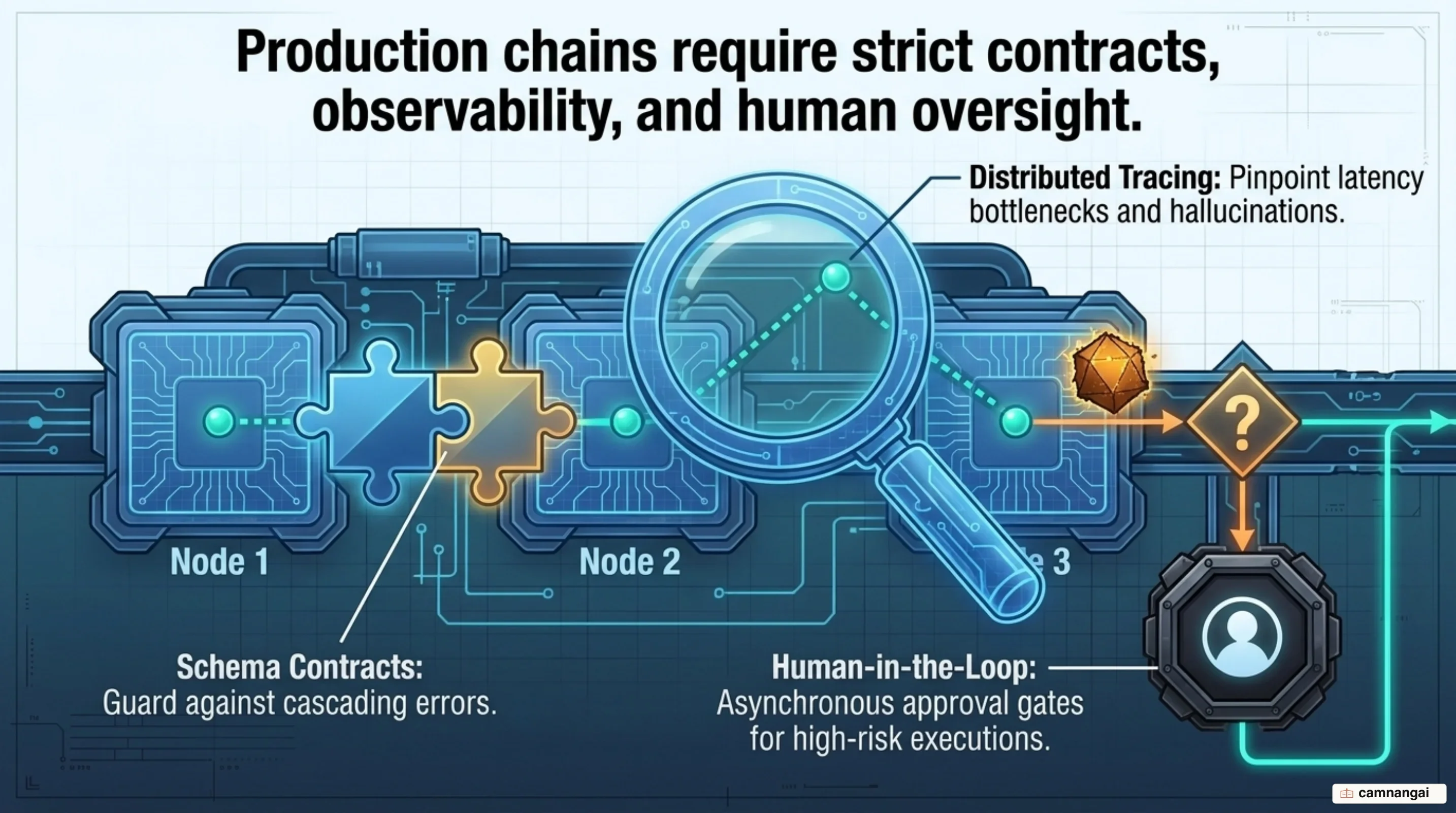
Operating multi-step LLM chains in production requires strict interface contracts at every model boundary. You must enforce runtime schema validation using tools like Pydantic or JSON Schema to validate data before passing it to subsequent stages. If an upstream LLM produces malformed data, schema validation fails immediately at the boundary, preventing corrupted context from propagating downstream.
The following Python Pydantic implementation models an explicit runtime schema contract, enforcing strict structural and value validation rules at the boundary between pipeline hops:
import json
import re
from typing import List
from pydantic import BaseModel, Field, ValidationError

class IntermediateExtraction(BaseModel):
    intent: str = Field(description="Classified user intent")
    confidence_score: float = Field(ge=0.0, le=1.0)
    extracted_entities: List[str] = Field(min_items=1, description="Extracted key entity strings")
    requires_human_review: bool = False

    @field_validator('intent')
    @classmethod
    def validate_intent_format(cls, value: str) -> str:
        if not re.match(r'^[a-z_]+$', value):
            raise ValueError("Intent must be a lower_snake_case string without special characters")
        return value

class FinalResponseSchema(BaseModel):
    user_message: str
    action_taken: str
    metadata: IntermediateExtraction
Comprehensive observability and distributed tracing are mandatory. You must log input prompts, raw generation outputs, step-level token consumption, hop latencies, and execution metadata for every stage of the chain. Distributed tracing allows you to pinpoint exact execution bottlenecks, cost spikes, and failing hops across complex multi-step flows.
Resilient systems require explicit error handling and fallback patterns. Implement step-level retry mechanisms for transient API errors. When handling ambiguous or high-risk execution states—such as intermediate toxicity scores between 0.4 and 0.6—you can integrate state machine workflow orchestrators like AWS Step Functions. Using the waitForTaskToken callback pattern, the orchestrator pauses workflow execution, emits a unique task token, and dispatches an asynchronous human review request. Upon review, calling the SendTaskSuccess API returns the token and resumes workflow execution based on human approval:
[Step Functions Workflow] ──► (Task: Emit Task Token & Notify) ──► [State Paused]
                                                                        │
[Operator Reviews & Approves in Management Dashboard] ──────────────────┘
                                │
                                ▼
              (Call API: SendTaskSuccess + Task Token)
                                │
                                ▼
              [Step Functions Resumes Next Pipeline Hop]
Start Simple: An Incremental Adoption Roadmap Without Over-Engineering
Always begin your application architecture with the simplest viable solution: a single, well-crafted prompt backed by comprehensive evaluation benchmarks (evals). Optimize this prompt using retrieval augmentation and in-context examples, measuring baseline task performance before writing orchestrator code.
Introduce LLM Chaining incrementally—adding individual hops only when concrete failure modes, severe cognitive load degradation, cost bottlenecks, or schema drift quantitatively justify task isolation. Maintain explicit step interfaces, enforce runtime schema contracts, and avoid heavy framework abstractions when simple API calls and basic code paths suffice.
References
- LLM Chaining: A Pragmatic Decision Framework — Vikash Rungta (Chain Of Thought)
- Building Effective Agents — Anthropic
- Prompt Chaining — DAIR.AI Prompt Engineering Guide
- Prompt Engineering: Decompose Complex Tasks into Simpler Subtasks — OpenAI
- Patterns for Building LLM-based Systems & Products — Eugene Yan
- Building Generative AI Prompt Chaining Workflows with Human in the Loop — AWS Machine Learning Blog