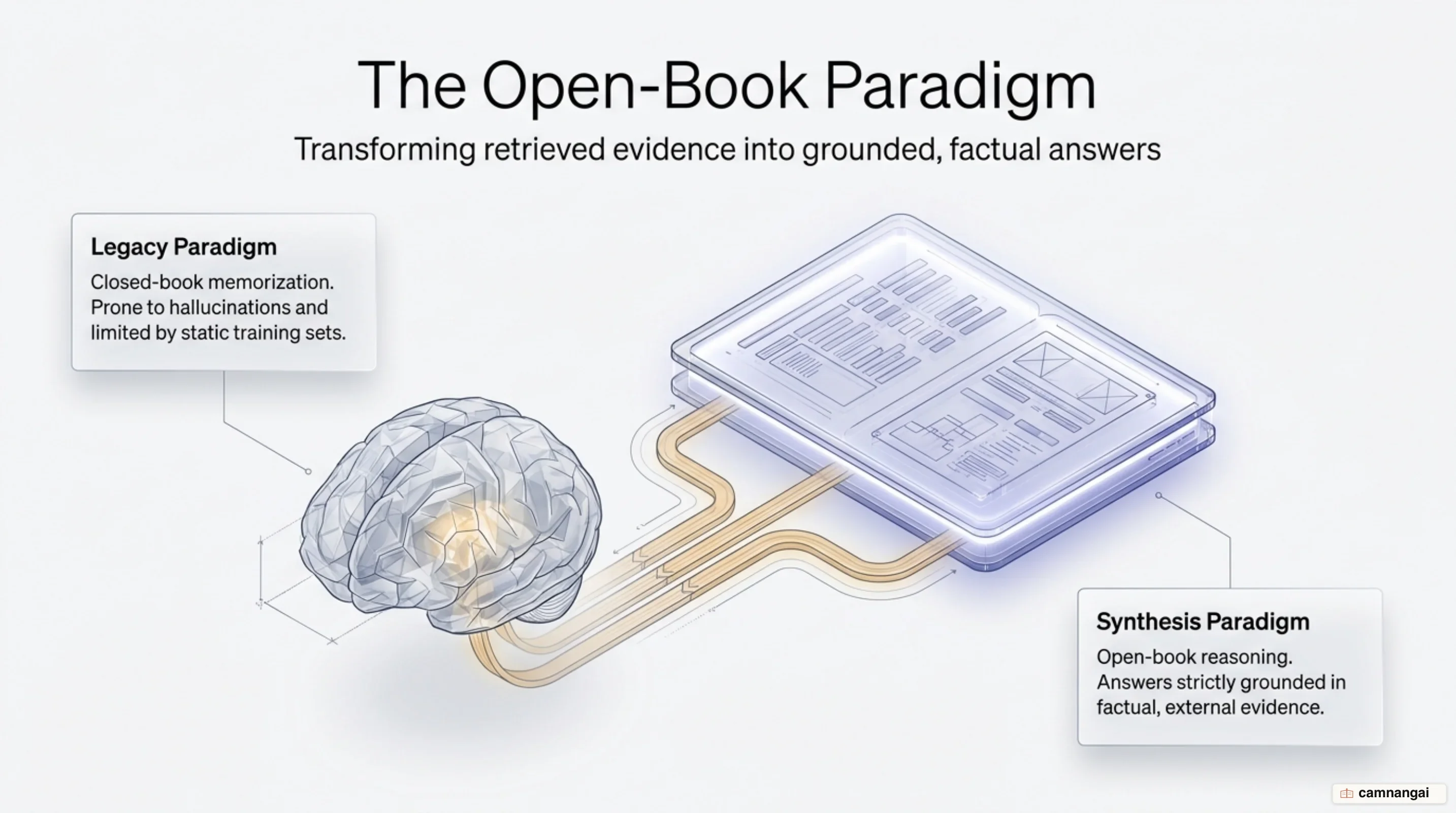
In the architectural landscape of Retrieval-Augmented Generation, the system operates through a structured "Search-Ask" framework. The "Ask" component, or Generation in RAG, is the definitive phase where retrieved evidence is synthesized into a coherent response. While Large Language Models (LLMs) are peerless at linguistic synthesis, their reliability hinges on the distinction between parametric knowledge (long-term memory stored in model weights) and non-parametric knowledge (short-term memory provided via message inputs).
For a Senior Architect, the goal of the generation phase is to transition the model from a student guessing based on latent training data into a grounded reasoning engine taking an "open-book exam." By injecting precise, external context into the prompt, we minimize the model's reliance on its internal weights for factual recall, thereby ensuring the response is anchored in the provided source of truth.
Effective generation requires a disciplined approach to context injection. Without a grounded synthesis strategy, even the most relevant retrieval becomes a liability as the model struggles with reasoning errors. The following sections detail the mechanics of transforming raw chunks into high-fidelity, grounded answers.
What is the Generation Phase in RAG?
The generation phase is the final transition in a RAG pipeline, converting isolated "top-K" retrieved chunks into a synthesized answer. There is a fundamental difference between model fine-tuning and RAG: fine-tuning is an optimization for style, tone, or specialized task-following, whereas RAG is the gold standard for factual recall. When a model relies solely on its training weights to fill informational gaps, it risks hallucination; RAG mitigates this by grounding the generator in external data.
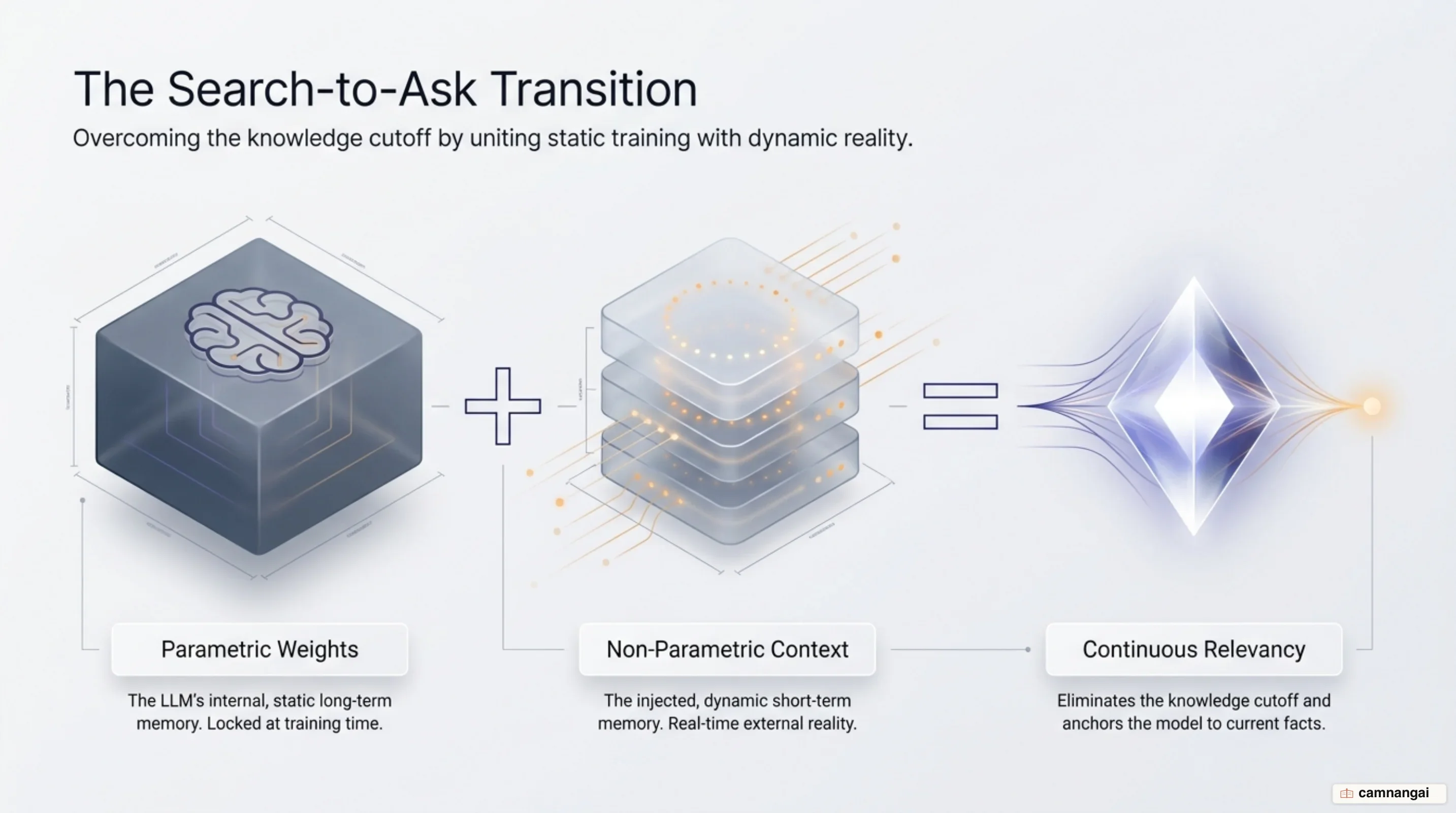
During this phase, the generator processes the retrieved context window to reconcile conflicting data points and form a unified narrative. The role of the generator is not merely to summarize, but to act as a reasoning layer that evaluates the evidence provided. This ensures that the output is a direct product of the non-parametric knowledge base rather than a hallucination derived from outdated training sets.
A critical failure mode in generation occurs when the "Ask" step lacks sufficient data or the model lacks the reasoning capability to synthesize it. Therefore, the generator must be architected to prioritize grounded evidence, using specific synthesis strategies to manage how information is presented to the LLM's context window.
Prompt Augmentation: Injecting Retrieved Context into the Generator
Traditional RAG often suffers from the "context conundrum," where the chunking process destroys the semantic integrity of the data. When a document is split, a chunk stating "revenue grew by 3%" becomes useless if it loses its association with the entity (e.g., "ACME Corp") or the timeframe ("Q2 2023"). To resolve this, Contextual Retrieval suggests prepending 50–100 tokens of explanatory context to each chunk.
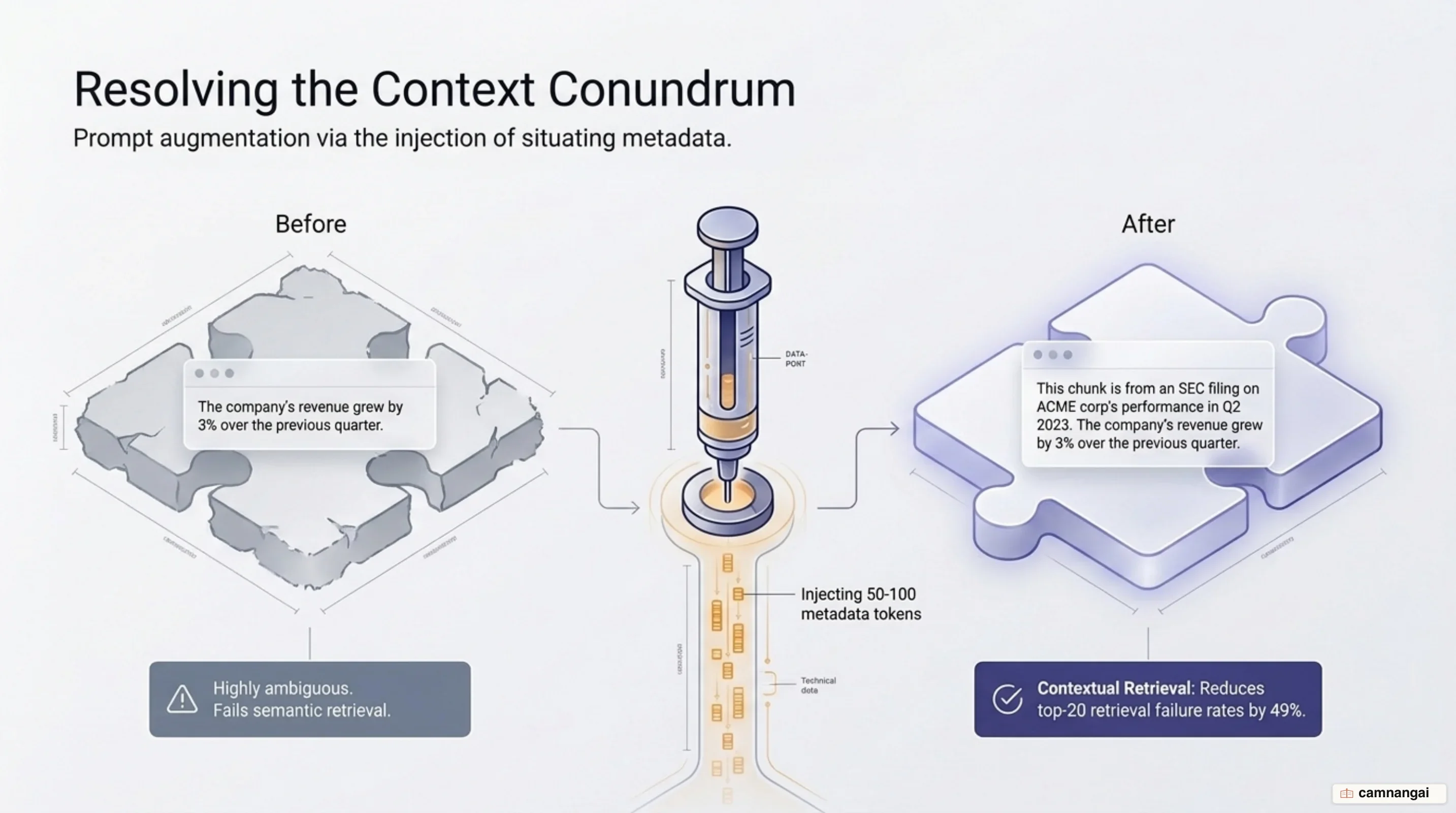
In production systems, this contextualization must be applied to both the vector and lexical indices. By creating Contextual Embeddings and Contextual BM25, architects can reduce retrieval failure rates by up to 49%. While embeddings capture semantic relationships, BM25 is essential for exact lexical matches, such as unique identifiers or technical error codes. To keep this pre-processing cost-efficient, a high-throughput model is used to generate the metadata, situating each chunk within the broader document.
The following prompt template is used for high-volume contextualization:
<document>
{{WHOLE_DOCUMENT}}
</document>
Here is the chunk we want to situate within the whole document
<chunk>
{{CHUNK_CONTENT}}
</chunk>
Please give a short succinct context to situate this chunk within the overall document for the purposes of improving search retrieval of the chunk. Answer only with the succinct context and nothing else.
Response Synthesis Strategies: Compact, Refine, and Tree Summarize
Response synthesis governs how the LLM interacts with retrieved nodes. Selecting the correct mode is an architectural decision balancing latency, cost, and accuracy:
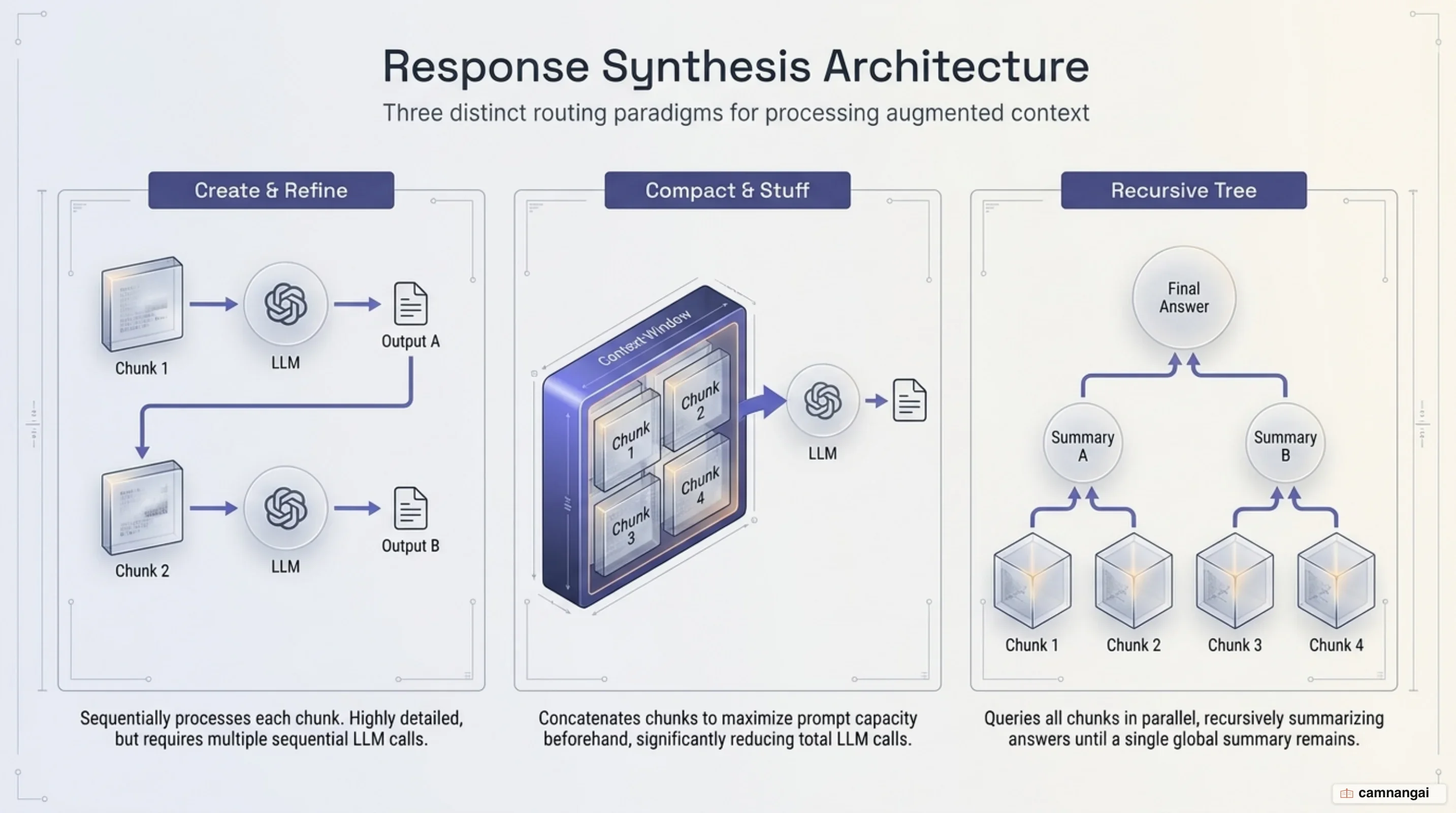
- Refine: A sequential process where the LLM makes a separate call for each chunk. The first chunk generates an initial answer, and each subsequent call "refines" that answer based on the new evidence provided. It is the most thorough but also the most latency-intensive strategy.
- Compact: A pre-processing optimization for the Refine logic. It packs (concatenates) as many chunks as possible into a single context window to minimize API calls. If the concatenated blocks exceed the window, it falls back to the sequential "Refine" process.
- Tree Summarize: A recursive strategy ideal for summarization. The system concatenates chunks and generates summaries; if multiple summaries exist, they are recursively summarized until a final, singular answer is reached.
The following Python snippet demonstrates initializing a synthesizer with ResponseMode.COMPACT:
from llama_index.core.response_synthesizers import ResponseMode
from llama_index.core import get_response_synthesizer

response_synthesizer = get_response_synthesizer(
    response_mode=ResponseMode.COMPACT
)
Grounding Responses: Hallucination Mitigation and Source Attribution
Reliable generation requires constraints that prevent the model from drifting into its parametric knowledge. "Structured Answer Filtering" is a key pattern where the synthesis module identifies and discards retrieved nodes that are irrelevant to the user query before generation begins. This reduces the noise the model must process, lowering the risk of reasoning errors.
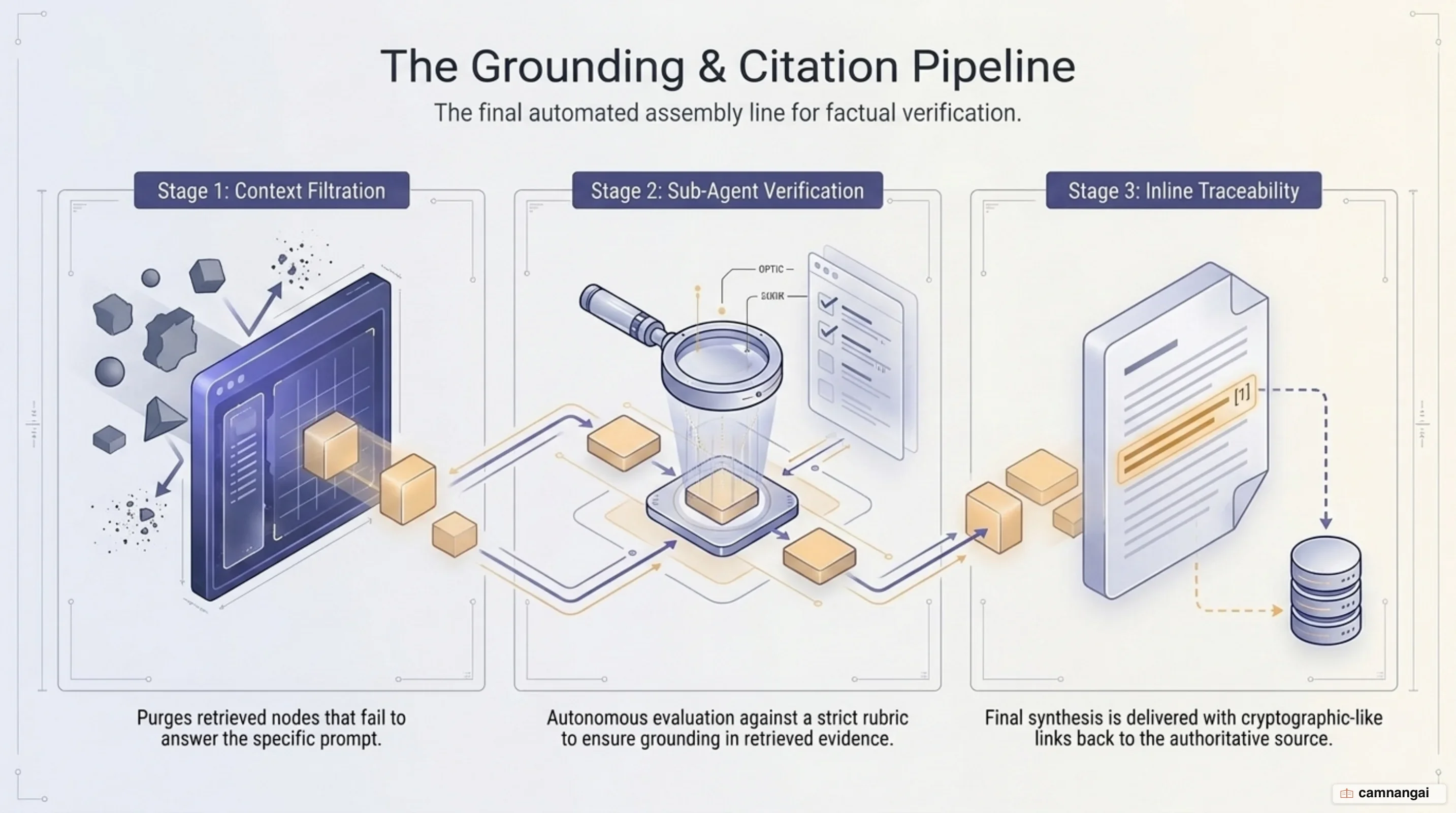
Advanced architectures implement rubric-checked grounding. In this pattern, a grader sub-agent evaluates the generator's output against a specific rubric to ensure the response is strictly supported by the retrieved evidence. If the grader detects ungrounded claims, the generator is forced to revise. Furthermore, the generator must be instructed with negative constraints: if the evidence is insufficient, it must state "I don't know" or "I could not find an answer" rather than attempting a guess.
Latency and Cost Trade-offs: Streaming, Caching, and Generator Selection
The generation phase is the primary driver of production costs. Architects must weigh the performance of frontier models like GPT-4o ($0.0025/query) against cost-optimized models like GPT-4o-mini ($0.00015/query). Additionally, implementing Contextual Retrieval carries a one-time setup tax when generating metadata across large document corpuses.
To optimize performance, Prompt Caching can reduce latency by over 2x and decrease costs by up to 90% for repetitive contexts. A standard high-performance flow involves retrieving an initial pool of 150 chunks to ensure high recall, then using a reranker to distill these into the "Top-20" chunks for the generator. To improve the user experience during this multi-step process, streaming intermediate results can significantly reduce perceived latency.
Production Pitfalls and Failure Modes in RAG Generation
Failures in RAG systems are categorized as search-step failures (missing information) or ask-step failures (reasoning errors). When the correct context is present but the answer is wrong, it is an ask-step failure. This often indicates that the model is being distracted by noise or lacks the reasoning depth for the task, necessitating a move to more capable models.
For a production-ready system, the "Top-20" setting for retrieved chunks is a balanced sweet spot. Research indicates that while more chunks increase the probability of including the answer, they also increase the risk of model distraction. By combining Contextual Retrieval with a reranked distillation, architects maximize accuracy while maintaining model focus.
References
- Retrieval-Augmented Generation (RAG) Architecture — Pinecone
- What is Retrieval-Augmented Generation (RAG)? — AWS
- Retrieval-Augmented Generation (RAG) Architecture — IBM Think
- What is Retrieval-Augmented Generation (RAG)? — Databricks
- Contextual Retrieval in AI Systems — Anthropic
- Retrieval-Augmented Generation (RAG) Tutorial — LangChain
- Response Synthesizer Module Guide — LlamaIndex
- Question Answering Using Embeddings — OpenAI Cookbook