AI engineering is the systemic transition from isolated code assistants to fully orchestrated, agentic development lifecycles.
By 2026, the focus has moved beyond simple code generation to the management of autonomous agents that collaborate across the entire software development lifecycle (SDLC). While these agentic workflows make the act of building software significantly cheaper, they have shifted the primary engineering cost from the creation of code to its verification and integration.
Here is the part that catches engineering leads out: a faster coder does not make a faster company. While individual coding tasks might improve by 40%, total organizational gains often stay below 10%, because the manual work around the code — planning, review, and deployment — is where the queue forms. The challenge is no longer the volume of code produced, but the capacity to verify that output without overwhelming your infrastructure.
The numbers below come from delivery telemetry and one randomized controlled trial, and they do not flatter the tooling.
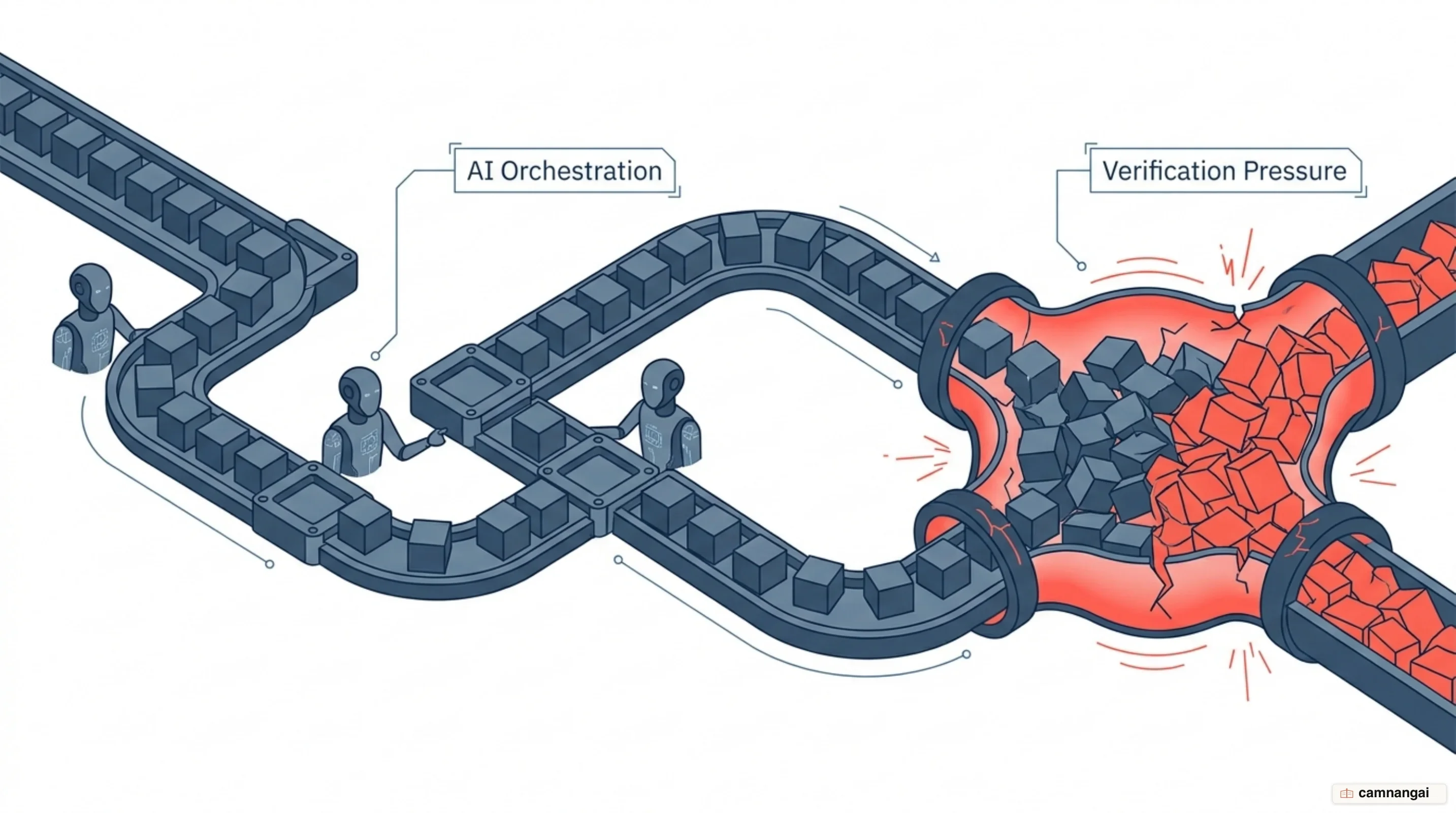
What does AI engineering mean for product development?
AI's job in the SDLC has been rewritten three times in four years. Through 2023 and 2024, teams used TuringBots, Forrester's label for AI coding tools, for code generation and unit tests, and little else. By 2025 the same tools had drifted into documentation and design assistance. In 2026 they run the lifecycle: agentic software development, where autonomous agents work across analysis, design, build, test, and delivery as one collapsed pipeline.
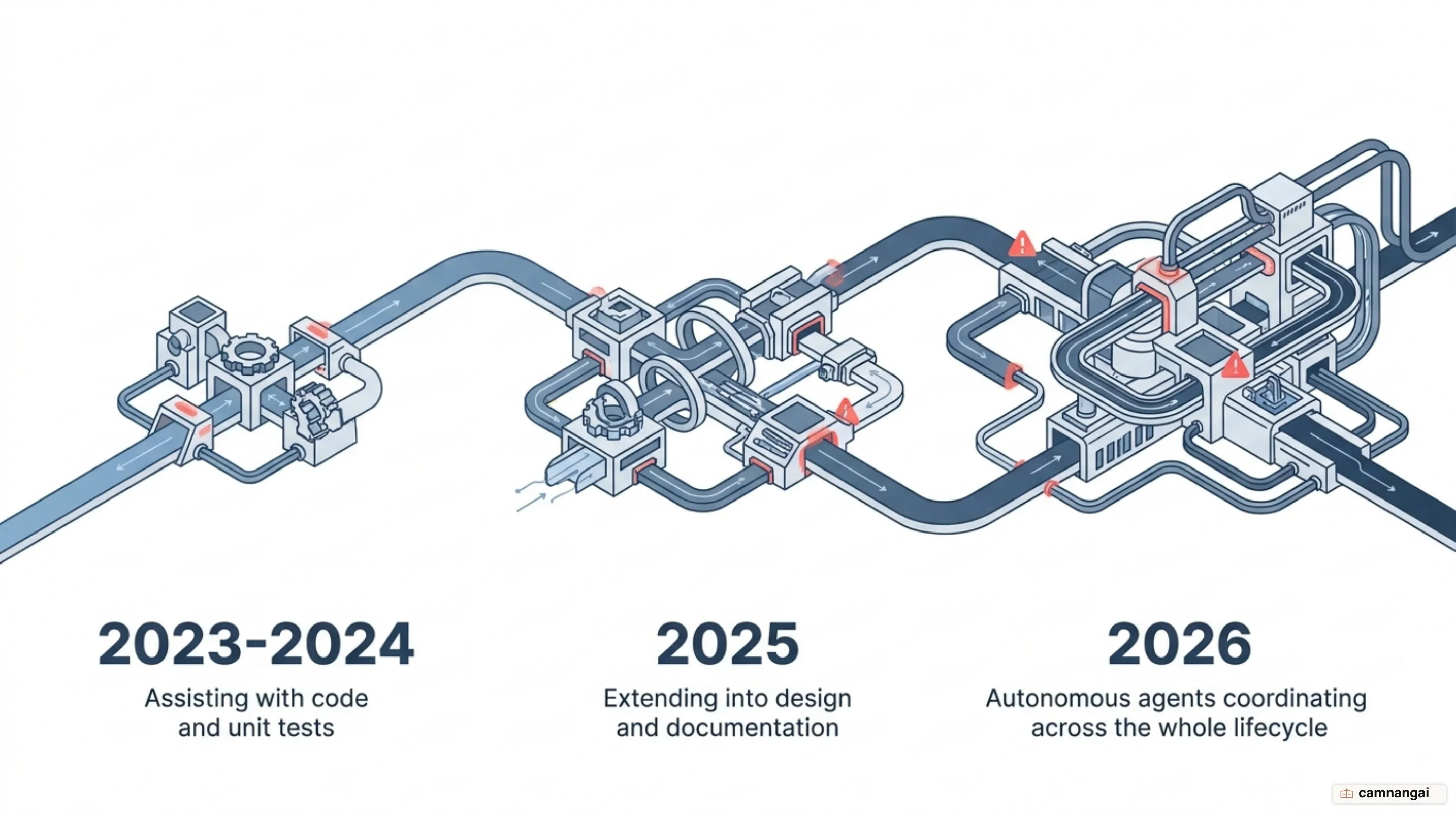
These platforms do more than suggest snippets, because they break a high-level intent into technical artifacts and hand the pieces to specialized agents, which is what makes end-to-end automation plausible rather than a slide. However, point that capability at one segment of the lifecycle and you get the Productivity Paradox instead of a win. When you improve coding speed by 40% but leave the rest of the pipeline as manual checkpoints, the downstream bottlenecks absorb the surplus, and the net improvement rounds to nothing.
The fix is structural and unglamorous: redesign the SDLC so agents are first-class participants in one pipeline, rather than a plugin bolted onto the editor. The organizations getting through this transition favor integrated platforms that carry a request from requirement analysis all the way to production deployment, because fragmented point-solution tools drown in the sheer volume of artifacts that autonomous systems generate.
Who decides what: the new division of labour between people and agents
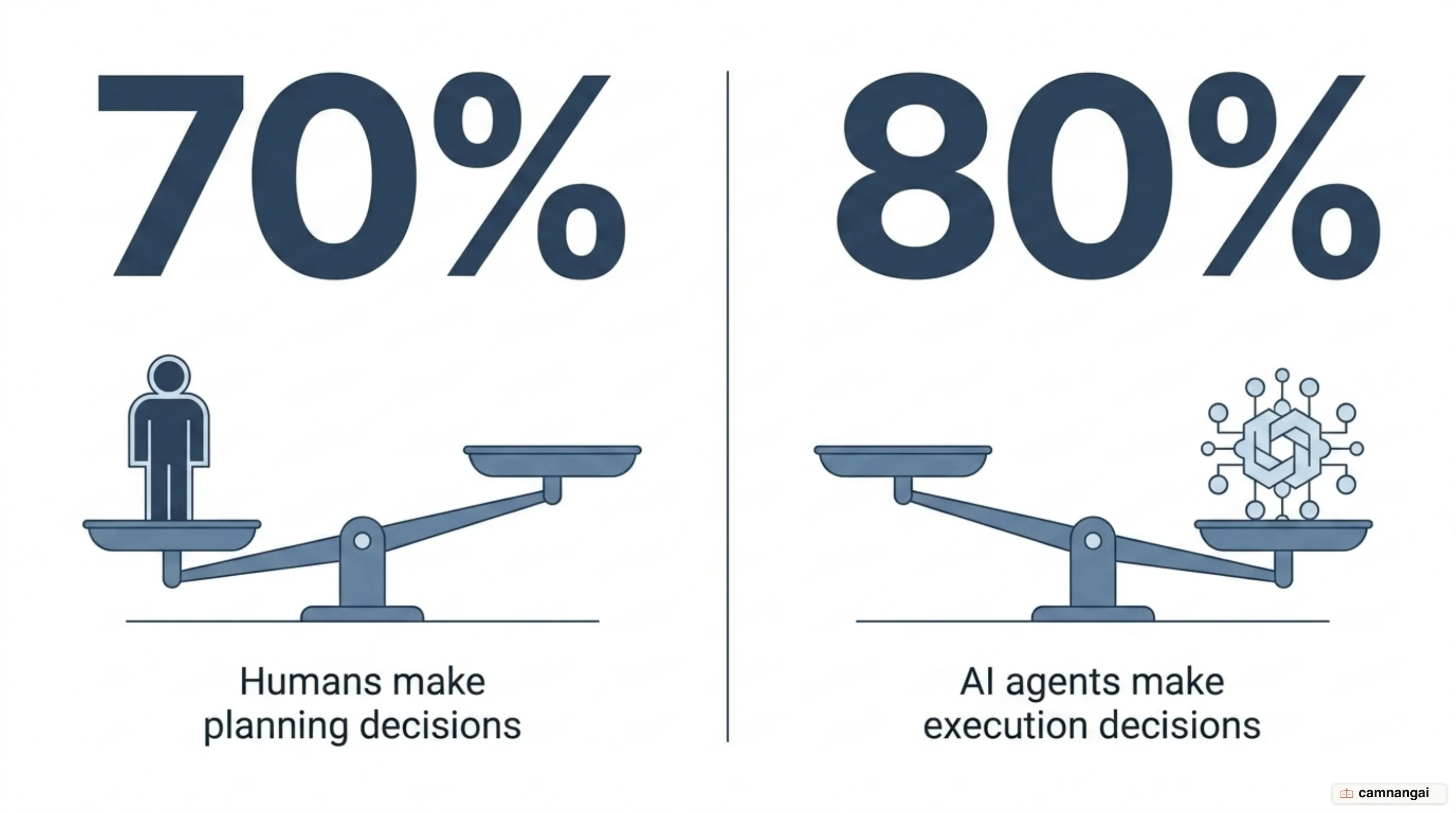
Telemetry from agentic sessions splits the decisions cleanly. Humans make roughly 70% of the planning calls, the what and the why of a feature, while agents make 80% of the execution calls: which files to modify, which logic to implement, which CLI commands to run. That is a clean line, with intent on one side of it and implementation on the other.
What predicts a good session is domain expertise, not coding depth. A novice prompt triggers about five actions and returns 600 words of output, while an expert prompt, one that supplies precise framing and states its verification requirements, triggers chains of 12 or more actions and averages 3,200 words. Same model, same day, and the whole difference is the constraints and context the person brought to it.
Also, management occupations post verified success rates that rival or exceed those of software engineers, because directing an agent is specify-and-verify work, which is what managers already do all day. And because agents are absorbing the implementation-heavy tasks, the labor market is starting to pay for whoever can define the problem space and name the edge cases that the AI engineer might otherwise let the model ignore during execution.
- Humans make 70% of planning decisions (intent).
- Agents make 80% of execution decisions (implementation).
- Expert prompts trigger 12+ actions vs. 5 for novices.
- Managerial direction skills correlate with higher verified success rates.
Discovery and prototyping: what happens when building gets cheap
Producing a working artifact now costs almost nothing, so discovery has changed shape around rapid prototyping. You can now test an idea in an afternoon instead of arguing about it for a sprint, and epics completed per developer are up 66.2%. That is the good news, and it arrives attached to Acceleration Whiplash, where high throughput at the start of the process turns into large, unmanaged quality costs at the back.
Oversight is where the bill lands, because developers now work through 67.4% more pull request (PR) contexts and 17.7% more task contexts every day. While that does not always end in burnout, it is a system running hot. Starting work has never been easier, but finishing it costs exactly what it always did.
You can see the strain in stalled work, where 26% more in-progress tasks show no activity for seven or more days. Agents open threads faster than people can close them, because human review capacity is fixed. So watch workflow completion metrics ahead of activity dashboards and sentiment surveys, because completion tells you what is stuck while the other two tell you what feels busy.
From PRD to spec: when the document becomes the source of the code
Spec-Driven Development (SDD) inverts the usual arrangement, where a product requirements document (PRD) states the intent and the code remains the source of truth. Using frameworks like the GitHub Spec Kit, specifications become executable artifacts that directly generate the implementation. This process begins with a constitution step to establish project-wide principles, such as testing standards and UX consistency, which then govern all subsequent agent actions.
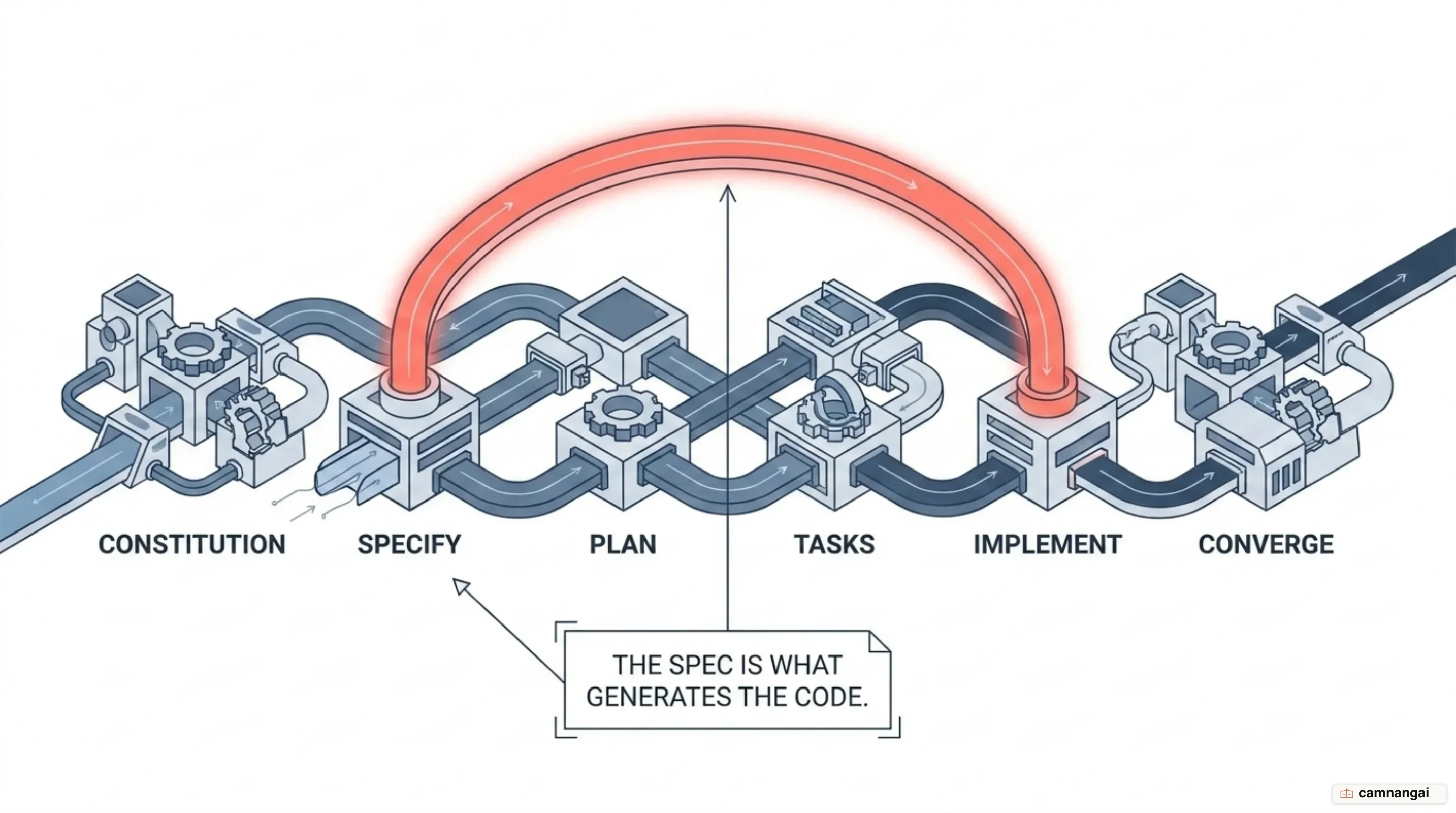
From there the cycle runs specify, plan, tasks, and implement. The spec is the authority and the code is a byproduct of it, which is a strange thing to say out loud to engineers and also the point: an agent working under a written constitution cannot quietly invent an architecture nobody agreed to.
Verification closes the loop through converge reports, which grade the generated codebase against the spec and the implementation plan and flag whatever is still missing, so the run continues until the system reports as fully converged. Requirements stop being a document somebody read once and become the executable truth the codebase is measured against.
/speckit.constitution: Establish governing project principles./speckit.specifyand/speckit.plan: Define requirements and technical architecture./speckit.tasksand/speckit.implement: Generate and execute actionable work items./speckit.converge: Assess the codebase against the spec and append remaining work.
The bottleneck has moved to review and QA
Delivery telemetry is blunt about where the pipeline is buckling. Median time in PR review has surged 441%, mostly because pull requests themselves grew 51.3%, and a reviewer's head does not scale with the diff. Whatever your organization's bottleneck used to be, it is now the speed at which code gets verified rather than the speed at which it gets written.
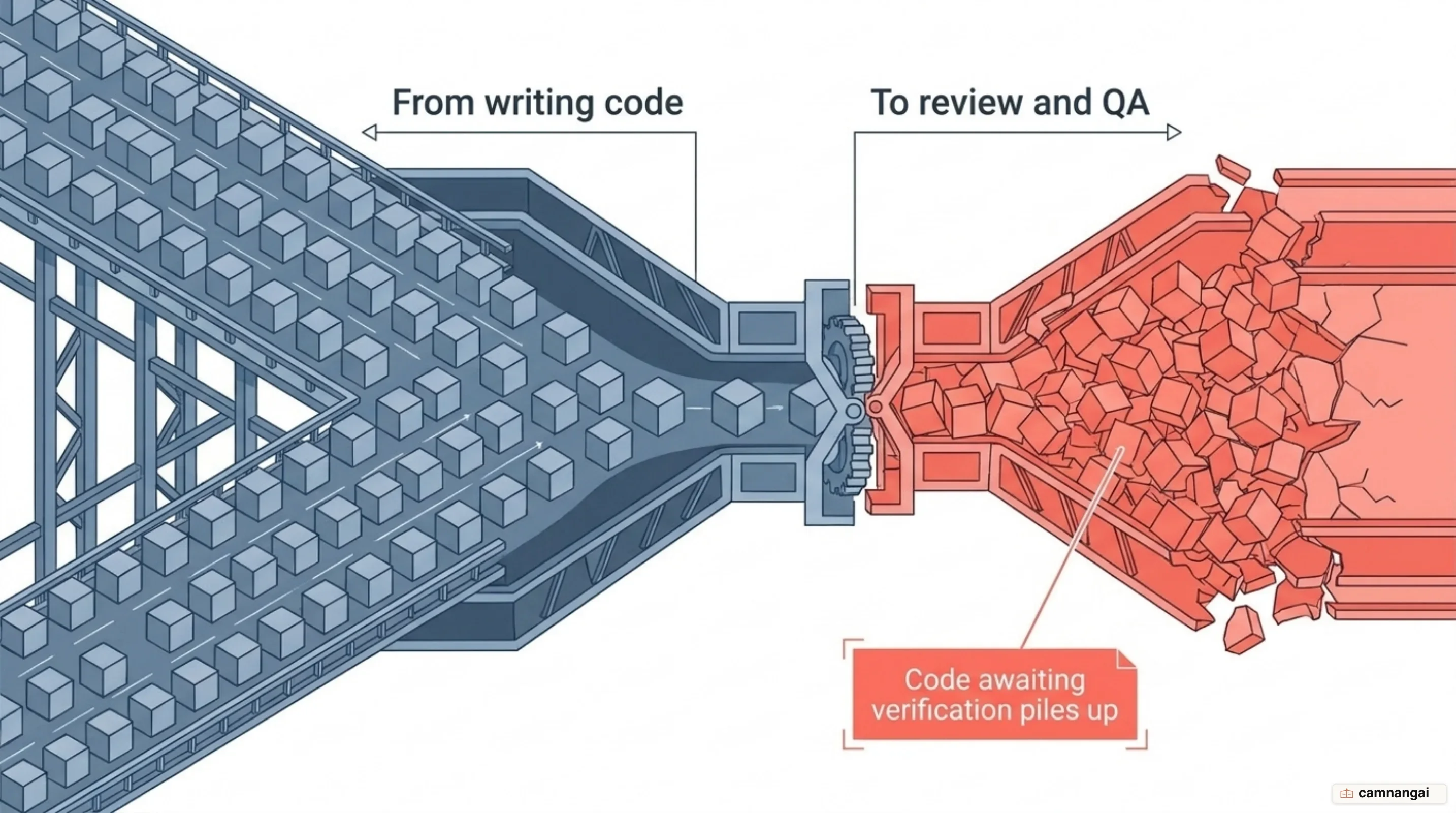
The risk is measurable too. Incidents per PR are up 242.7% and bugs per developer are up 54%, so the probability of a production incident has more than tripled for every merged change. Agents propagate a mistake faster than human detection catches it, and the pile of code awaiting verification grows faster than the number of people with enough context to verify it.
In an agentic SDLC, testing and governance matter more than the act of coding. Trust is the rate limiter on delivery once autonomy goes up, which is why the strongest teams hold AI-generated artifacts to a higher standard than human-written ones, the reverse of what most people assume when they switch the tools on. Automated safety nets and auditability are what keep fast local generation from collapsing production stability.
Why local speed does not become team speed
The randomized controlled trial is the result I would put in front of anyone selling a 10x story. While experienced open-source developers believed AI tools sped them up by 20%, they actually took 19% longer to complete their issues. The gap is filled with correcting hallucinations and with the friction of fitting generated code into a large, high-quality codebase that has opinions of its own.
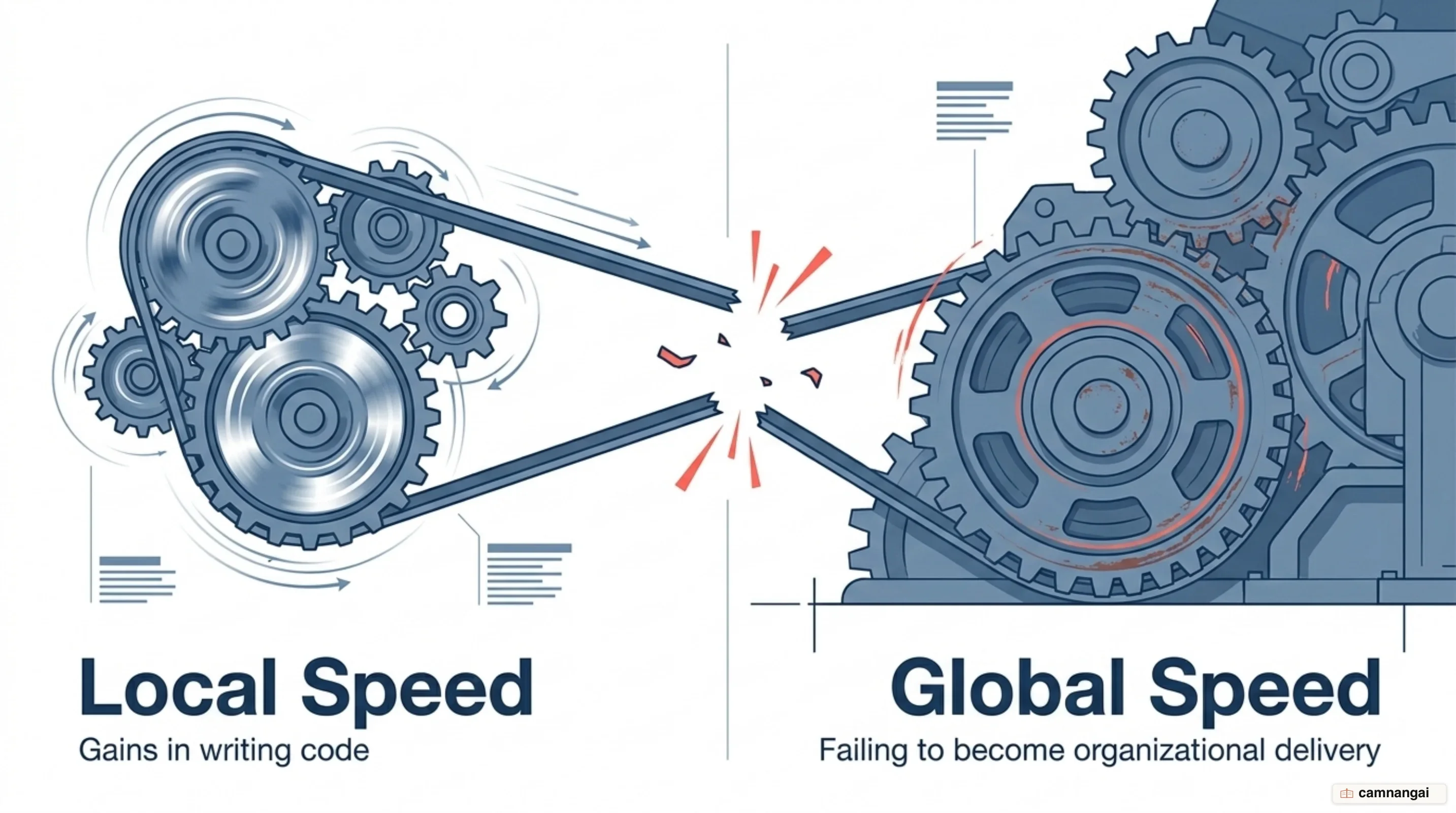
That implementation lag is the same force behind the 26% rise in tasks stalling for a week or more. The speed a developer feels in the editor is real to them and invisible in the delivery data, because the rework and the context-switching arrive later, often to someone else. AI systems are good at leading you down an implementation path that looks finished and needs a person to untangle it.
So separate the self-contained tasks from the ones that need deep context before you hand anything to an agent. Current benchmarks reward work that ignores long-term maintenance, but in production the overhead of supervising an agent often outweighs the generation it saved. A perceived 20% speedup that nobody checked against real implementation times and completion rates is not a metric, it is a mood.
Team structure: PM-to-engineer ratios and the new roles
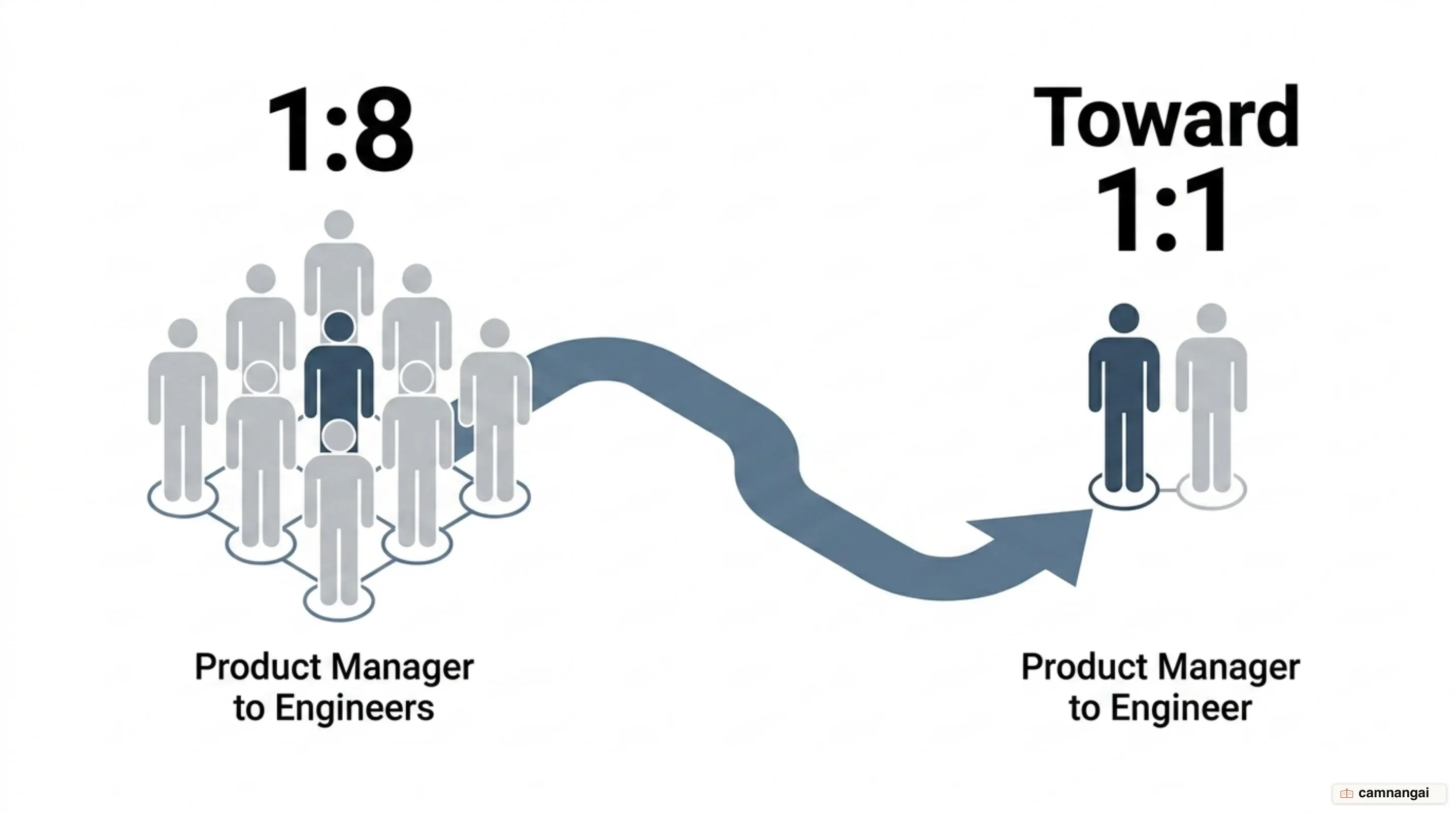
Team composition is moving because of AI engineering, not alongside it. The traditional ratio of one Product Manager (PM) to eight engineers is heading toward 1:1, which is capacity planning rather than headcount inflation: agentic workflows run on high-quality intent and requirements, and somebody has to produce them. As writing code becomes a commodity, the value concentrates in whoever defines the what and the why.
New roles are filling the blurred space. The "Product Builder" is a generalist working across design, code, and product strategy, and it is already replacing the associate product manager track. The PM shifts from roadmap owner to "architect of impact," wiring business outcomes like revenue growth to specific product drivers that an agent can then implement.
Delivery research sorts teams into seven archetypes by performance and culture, from the "Legacy Bottleneck" trapped by older systems to the "Harmonious High-Achievers" sustaining an excellent cycle with AI support. Adoption amplifies whatever a team already is, so sound process accelerates while a weak one descends into chaos faster than before, with better-looking commit messages.
Which makes collaboration, not tooling, the constraint worth budgeting for. Most of the friction in this data comes from poor coordination between human supervisors rather than technical failures by the agents, and the teams that handle it treat business acumen as a core engineering competency, so the extra velocity points somewhere that matters to the business.
Limits and governance: when the organisation says no
Institutional pushback is growing as the legal and quality risks come into focus. Oracle's interim policy for the OpenJDK community permits AI for research and debugging, but bans AI-generated output from official contributions outright. The reasoning is intellectual-property uncertainty plus a second problem that gets less attention: agents produce credible-looking code that is insecure or hard to maintain, and reviewing it becomes a burden dropped on volunteers.
That line is the most practical answer anyone has published to the question of where AI belongs in a pipeline: assisting judgment is permitted, replacing authorship is not. The move to AI engineering is a redesign of the delivery system rather than a tool purchase, and the organizations getting value from it are the ones that decided, explicitly, which decisions a human still signs.
References
- Agentic coding and persistent returns to expertise — Anthropic
- Agentic Software Development Takes The Lead: From Code Assistants To Orchestrated SDLC Agents — Forrester
- DORA Report 2025 Key Takeaways: AI Impact on Dev Metrics — Faros AI
- Measuring the Impact of Early-2025 AI on Experienced Open-Source Developer Productivity — METR
- Spec Kit: Toolkit for Spec-Driven Development — GitHub
- The New Reality of AI in Product Management — Productboard
- How Product is Changing in 2026 — Ant Murphy
- Oracle bans AI-generated contributions to OpenJDK — Techzine Global
- Why product managers must become product builders in 2026 — LogRocket