The generic "data scientist" posting has been breaking apart into specialist engineering titles, and two of the pieces get treated as interchangeable when they are not: the Machine Learning (ML) Engineer and the AI Engineer. Both roles run on the same mathematics, but their objectives, their daily work, and the layer of the stack they answer for are genuinely different.
The core distinction in the AI engineer vs ML engineer comparison lies in your relationship with the model weights.
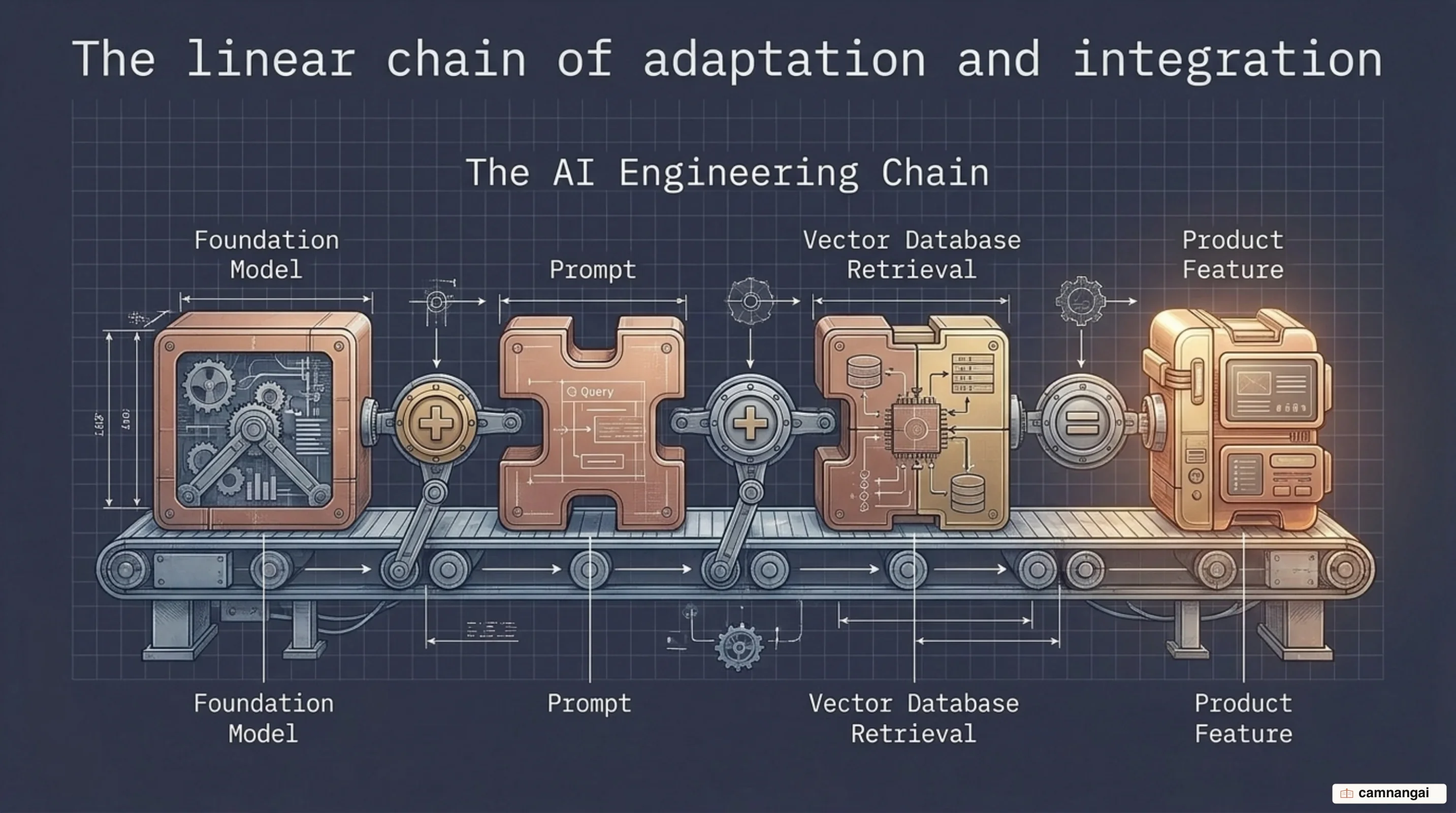
If you are an ML Engineer, you own the production model lifecycle: training, fine-tuning, and operating predictive systems that are often built from the ground up, and you answer for whether those systems stay statistically reliable. If you are an AI Engineer, your focus is model adaptation, because you wire existing foundation models into shippable software using APIs, retrieval-augmented generation (RAG) pipelines, and prompt engineering, and almost everything you feed them is unstructured.
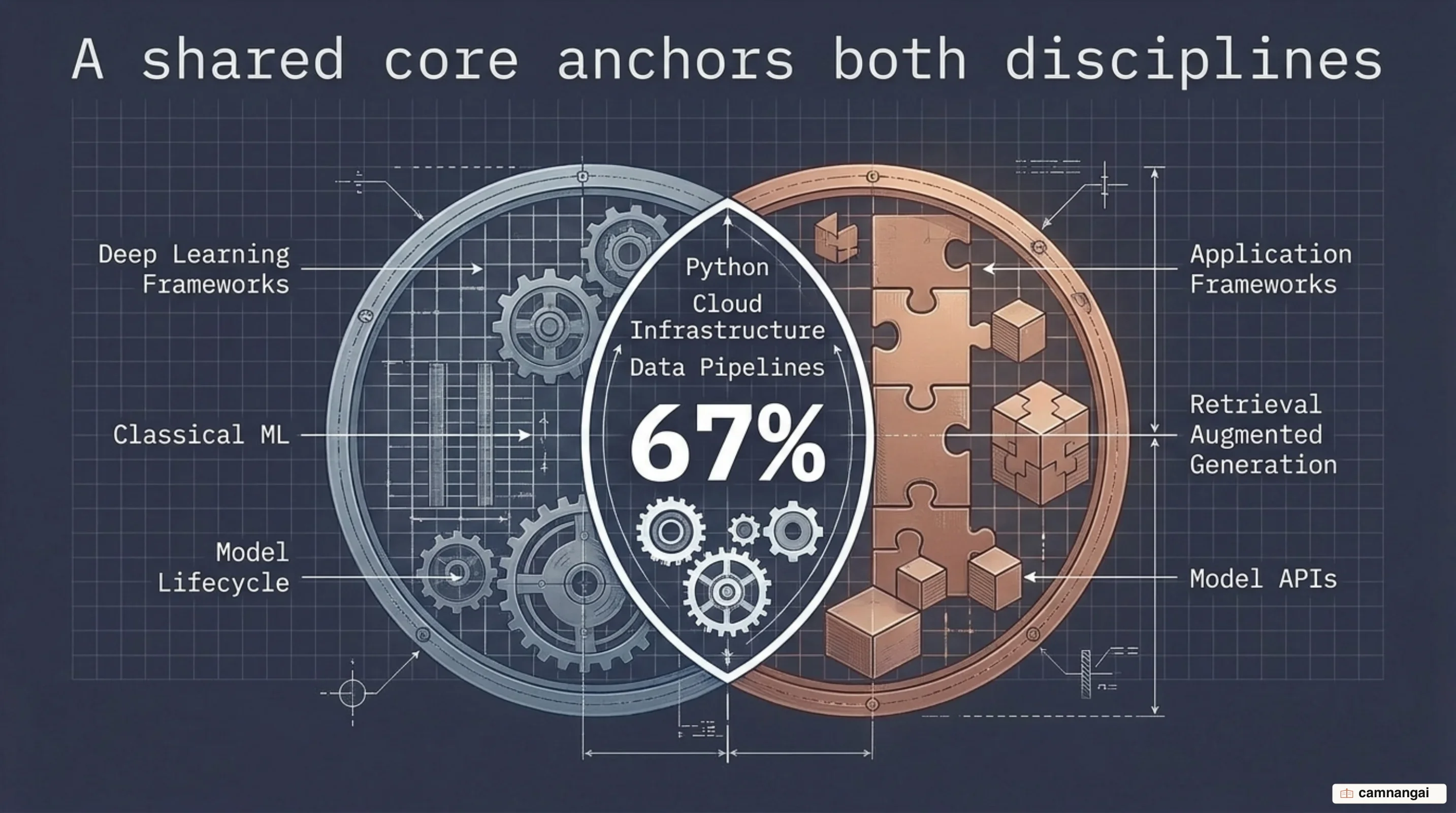
These roles share a 67% skill overlap, so the fundamental engineering requirements are close, yet the remaining third of the stack is where the career forks. ML Engineers command a median US base salary of $165,000, roughly 13.8% above the $145,000 median for AI Engineers — a depth premium for the research and mathematical knowledge that low-level model development and infrastructure management demand. The pay favors one side of that line, while the growth favors the other. The AI Engineer title is the faster-growing role, driven by the accessibility of pre-trained models that allow software engineers to ship intelligent features without requiring a PhD in neural networks.
Where do AI engineers and ML engineers actually differ?
What separates the two roles is a "shift right" in applied AI. Implementing an AI-driven task used to require a dedicated research team and a multi-year cycle of data collection and architecture design, whereas today you can get a functional result in an afternoon out of API documentation and a few well-constructed prompts.
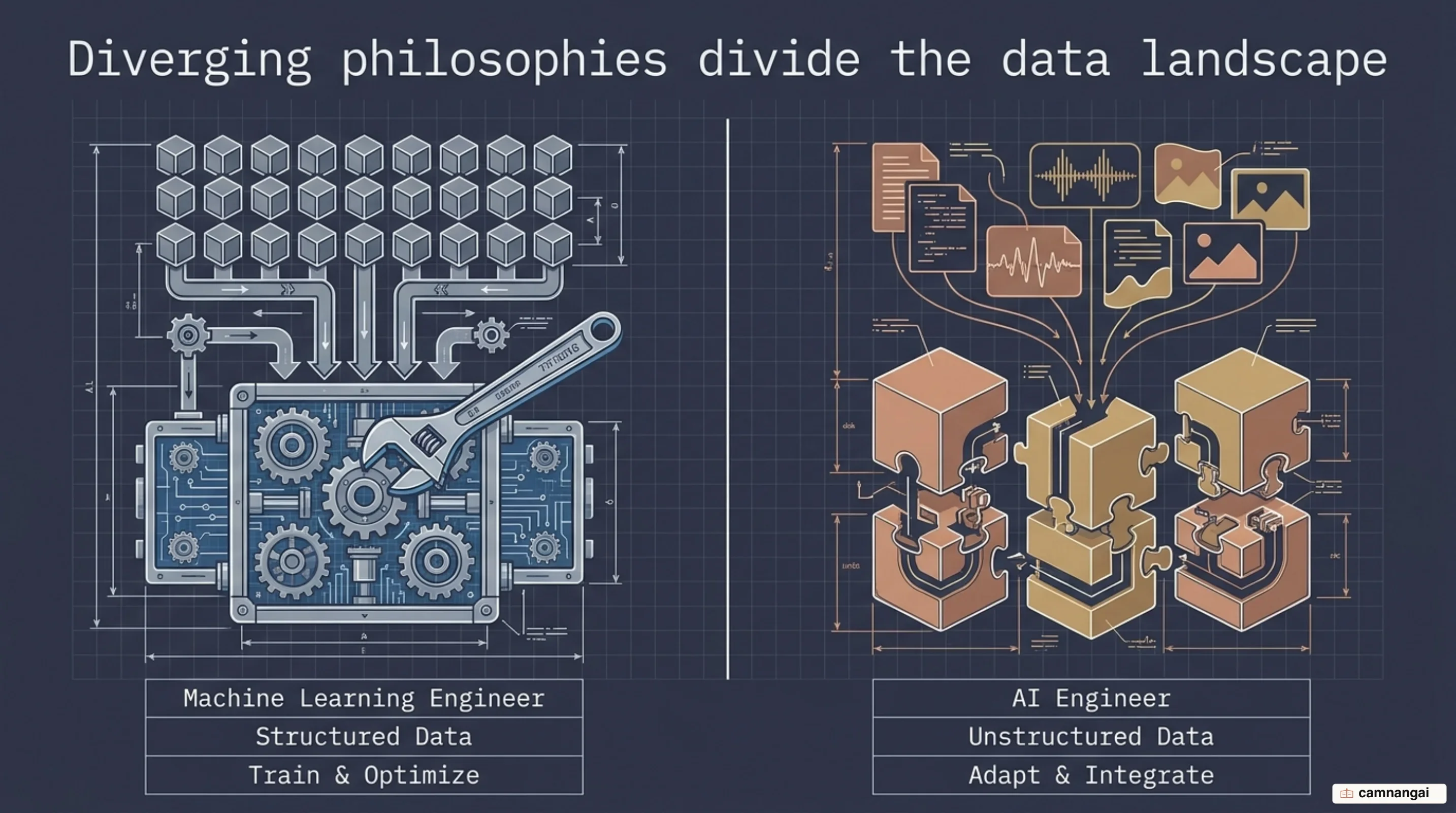
That shift did not move the ML Engineer, whose objective is still the creation of task-specific systems. You work largely with structured datasets, tabular data in neat rows and columns, to solve narrow problems like fraud detection, churn prediction, or price optimization.
The AI Engineer works a layer up, on foundation model adaptation, and does not typically train models from scratch. Instead you take a general-purpose model trained on trillions of tokens of unstructured data, whether text, images, or audio, and adapt it to one business context. Traditional machine learning is waterfall, because the laborious data collection has to finish before a single model version exists. AI engineering runs closer to "fire, ready, aim": you prompt an existing large language model (LLM) to validate a product idea on day one, and only spend on data refinement or fine-tuning once the feature has shown it deserves the money.
The risk profile is not comparable either. Pre-training a model like InstructGPT can consume up to 98% of a project's overall compute and data resources, so a small mistake in that phase turns into real financial loss and months of setback. Because AI Engineers bypass the phase by renting "AI research as a service" through an API, they can validate products 1,000 to 10,000 times more cheaply than traditional ML workflows. The research burden shifts to providers like OpenAI, Meta, or Google, and so does a fair amount of control over what you are building on, which is the half of the bargain that tends to get noticed late.
The consequences stack up from there. ML Engineers optimize for predictive accuracy and reliability on a specific task, while AI Engineers optimize for generative capability and how well it lands inside a product. ML engineering sits on structured, tabular records, whereas AI engineering sits on natural language, pixels, and audio. Latency changes shape entirely too, since traditional ML models are usually lightweight and tuned for high-throughput inference, while autoregressive models emit tokens one at a time and your users feel that directly.
The three layers of an AI system, and who owns which
The AI stack has three layers: application development, model development, and infrastructure. Which of those you answer for on a Tuesday afternoon describes your job better than your title does, though the "API line" between them stays permeable in both directions: model specialists move right to build atop APIs, and application engineers move left to host open-source models themselves.
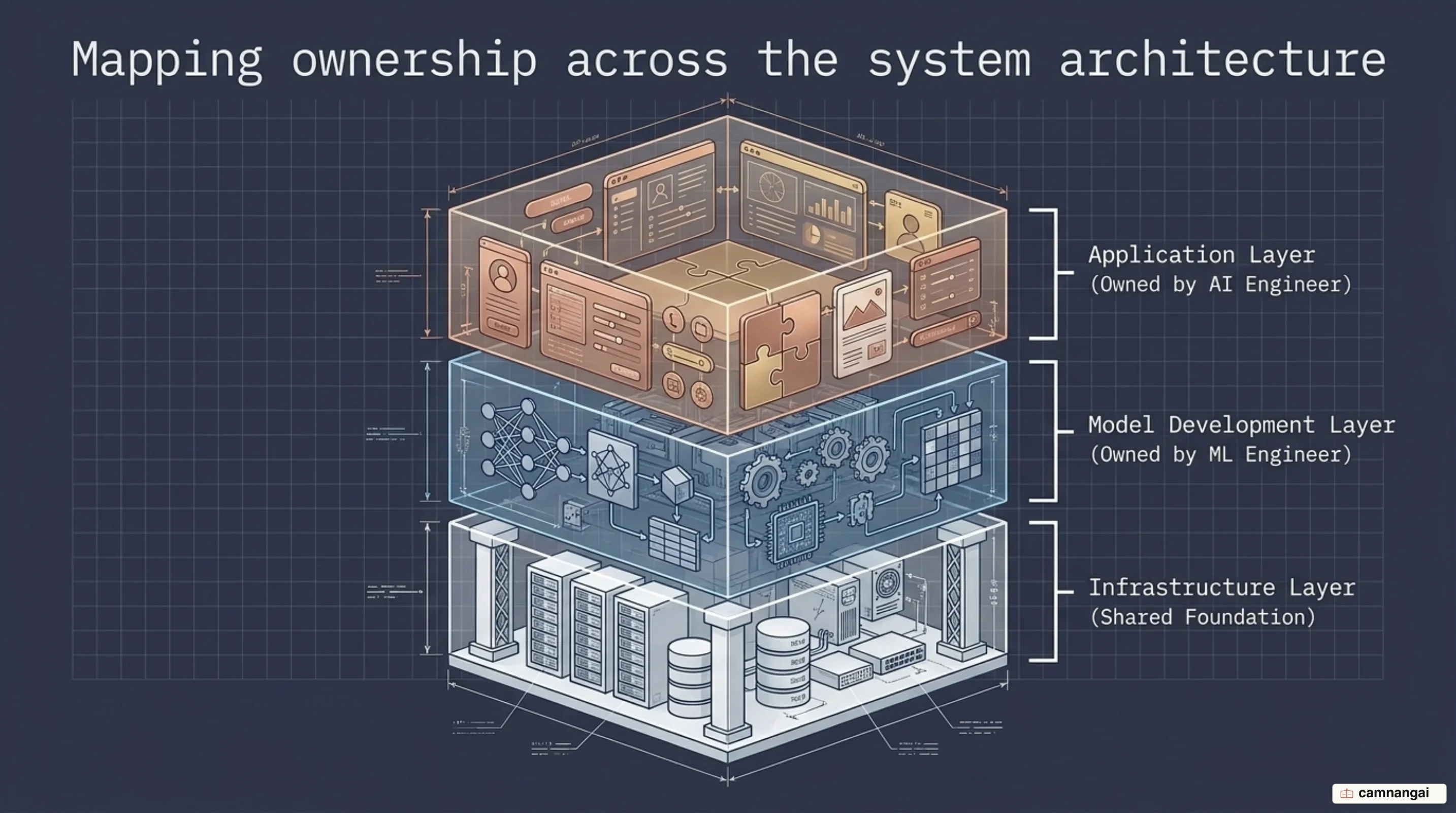
The application layer belongs to the AI Engineer. You build the interfaces and the logic through which users meet the intelligence, which means prompt logic, context managed through retrieval pipelines, and giving the model the tools it needs to actually do something, such as calling an external database or an email API. It is software atop intelligence, and the ability to put a working demo in front of someone and iterate on what they say back counts for more here than the ability to write a custom loss function.
The model development layer belongs to the ML Engineer. This is the traditional heart of machine learning, where you select neural network architectures, pre-train from scratch, and fine-tune model weights, alongside dataset engineering and inference optimization. It asks for a working understanding of gradient descent, regularization, and the architectures themselves, convolutional networks for vision and transformers for language. AI Engineers do light fine-tuning sometimes, but they rarely touch the heavy mathematical work or the algorithm selection this layer runs on.
The infrastructure layer is shared, though it splits by scale. Both roles manage resource allocation and monitoring, but ML Engineers concentrate on training clusters and model lifecycle management, where the jump from 10 GPUs to 1,000 GPUs creates a genuinely different synchronization and memory problem. AI Engineers concentrate on serving instead: vector databases, distributed inference, and memory systems that survive long-context interactions.
What an ML engineer does day to day
Your routine circles the production model lifecycle. It starts with a business problem and moves into gathering, cleaning, and verifying structured datasets, which is the slow part and the part that decides everything downstream. You experiment with algorithms, from logistic regression to gradient boosting to small neural networks, in frameworks like scikit-learn or PyTorch, because the point of all of it is to get a model out of a notebook nobody can reproduce and into a system that runs itself.
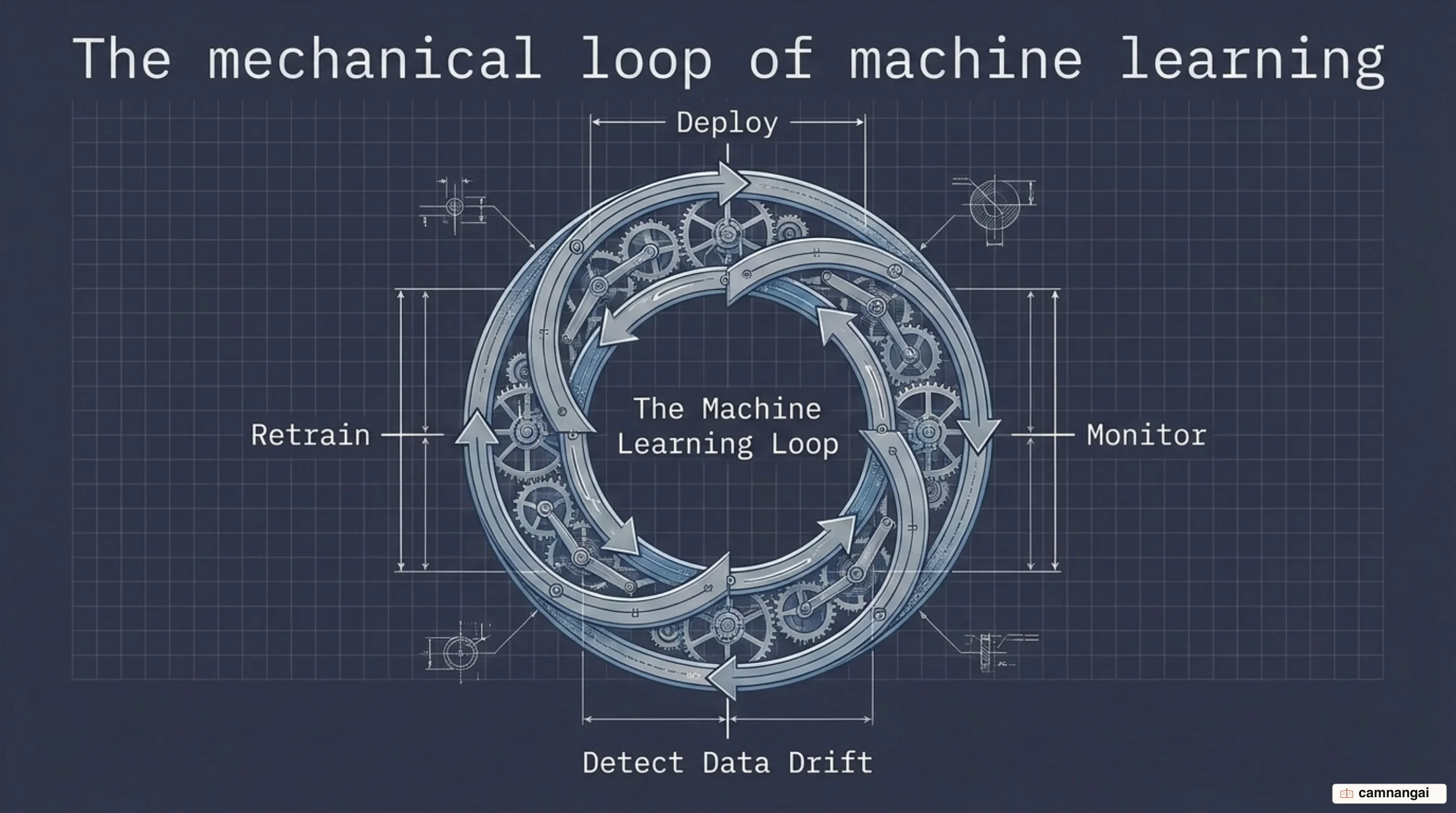
A large share of the job is dragging the organization up the MLOps (machine learning operations) maturity ladder. Level 0 is manual and script-driven, and it usually ends in a handoff where software engineers rewrite experimental code to make it production-ready, which nobody enjoys on either side. Level 1 is pipeline automation, and Level 2 automates continuous integration, delivery, and training end to end, so the system retrains and redeploys itself when the data profile shifts, without anyone intervening. Most of the value an ML Engineer adds is in that climb, and almost none of it shows up in a demo.
In production you are the reliability engineer for models. You watch for concept drift, where the statistical properties of live input data wander away from the training distribution and quietly decay predictive quality while not one line of code changes. MLflow tracks your experiments and model registries, and a metadata store keeps the pointers to prepared data, validation anomalies, and computed statistics. The scoreboard is how stable the predictions stay over months, rather than the elegance of any single model.
What an AI engineer does day to day
The day looks like product engineering rather than research. You ship LLM-powered features such as autonomous agents or RAG-based search, and most of the code orchestrates foundation models, building a pipeline that pulls relevant documents out of a vector database using embeddings and then drops them into a model's prompt as context.
Evaluation is the part that catches people out. In traditional ML you compare a prediction against clear ground truth, since the transaction was either fraudulent or it was not, but foundation models produce open-ended output and a summarizer or a chatbot has no single correct response to check against. So a large share of your week goes into designing and running evals, systematic tests that use other models or human judgment to score response quality and safety. The stakes are concrete: when Google launched Gemini Ultra, moving the prompting technique from five examples to chain-of-thought with 32 took its MMLU (Massive Multitask Language Understanding) score from 83.7% to 90.04%, which means the model did not change while the evaluation method did.
Your toolkit differs from the traditional ML stack too. Python is still the anchor, but you will be in TypeScript or JavaScript a lot, alongside orchestration frameworks like LangChain or LlamaIndex. You also own the cost of autoregressive generation, because at 10ms per token a 100-token response burns a full second of latency, against the roughly 100ms users expect from a normal web interaction. Closing that gap through quantization, caching, and parallelism is your problem, and the model provider is not going to solve it for you.
Skills and hiring: how far do the two roles overlap?
The hiring market shows a 67% overlap in the top skills required for these roles, one of the highest between any two distinct AI/ML titles. Python is the standard on both sides, appearing in 68% of AI Engineer postings and 65% of ML Engineer postings, and cloud platform experience transfers about as well at 34–36%. Past the foundations it forks fast, because PyTorch appears in 42% of ML Engineer postings against 22% of AI Engineer ones, while LangChain shows up in 25% of AI Engineer postings and effectively nowhere on the ML side.
| Skill category | AI Engineer | Machine Learning Engineer |
|---|---|---|
| Primary tools | LangChain, OpenAI API, vector databases | scikit-learn, MLflow, Apache Spark |
| Specializations | RAG, prompt engineering, agents | Computer vision, statistics |
| Languages | Python, TypeScript | Python, C++, Java, JAX |
| Focus | LLM application adaptation | Production model lifecycle |
The salary data puts the depth premium on the ML side, and it widens the lower into the stack you go. Against a $165,000 ML Engineer median, proficiency in JAX carries a median of $204,000 and C++ reaches $186,000, both of them markers of high-performance numerical work in autonomy, robotics, and research infrastructure. The AI Engineer premiums point somewhere else entirely, because distributed systems skills command a median of $183,200 and Apache Spark proficiency reaches $170,000. The money on that side of the line is in operating inference at scale, not in prompting.
Geography and employer profile split as well. ML Engineer roles are more US-anchored at 44% of postings and cluster in product-tech companies like NVIDIA, Waymo, Adobe, and Spotify, while AI Engineer demand is spread wider at a 34% US share and leans toward consulting firms such as Accenture and PwC running enterprise LLM rollouts. India is the second-largest market for both, at roughly 13% of postings. Neither role is a way into the industry, and this is the pair of numbers I would put in front of anyone retraining: entry-level positions are 5.8% of AI Engineer postings and 4.8% of ML Engineer ones, while senior and staff roles take 38% and 42% respectively.
Why job titles don't tell you what the work is
A job title will not tell you what you would actually do. Plenty of companies are reluctant to adopt the AI Engineer title, either because it is unproven or because they would rather hire generalists who can handle both the generative AI work and ordinary software engineering. So the generative AI work gets posted under Software Engineer, Data Scientist, and Machine Learning Engineer, and in a lot of organizations the existing ML team simply absorbed foundation model work without anyone changing a header.
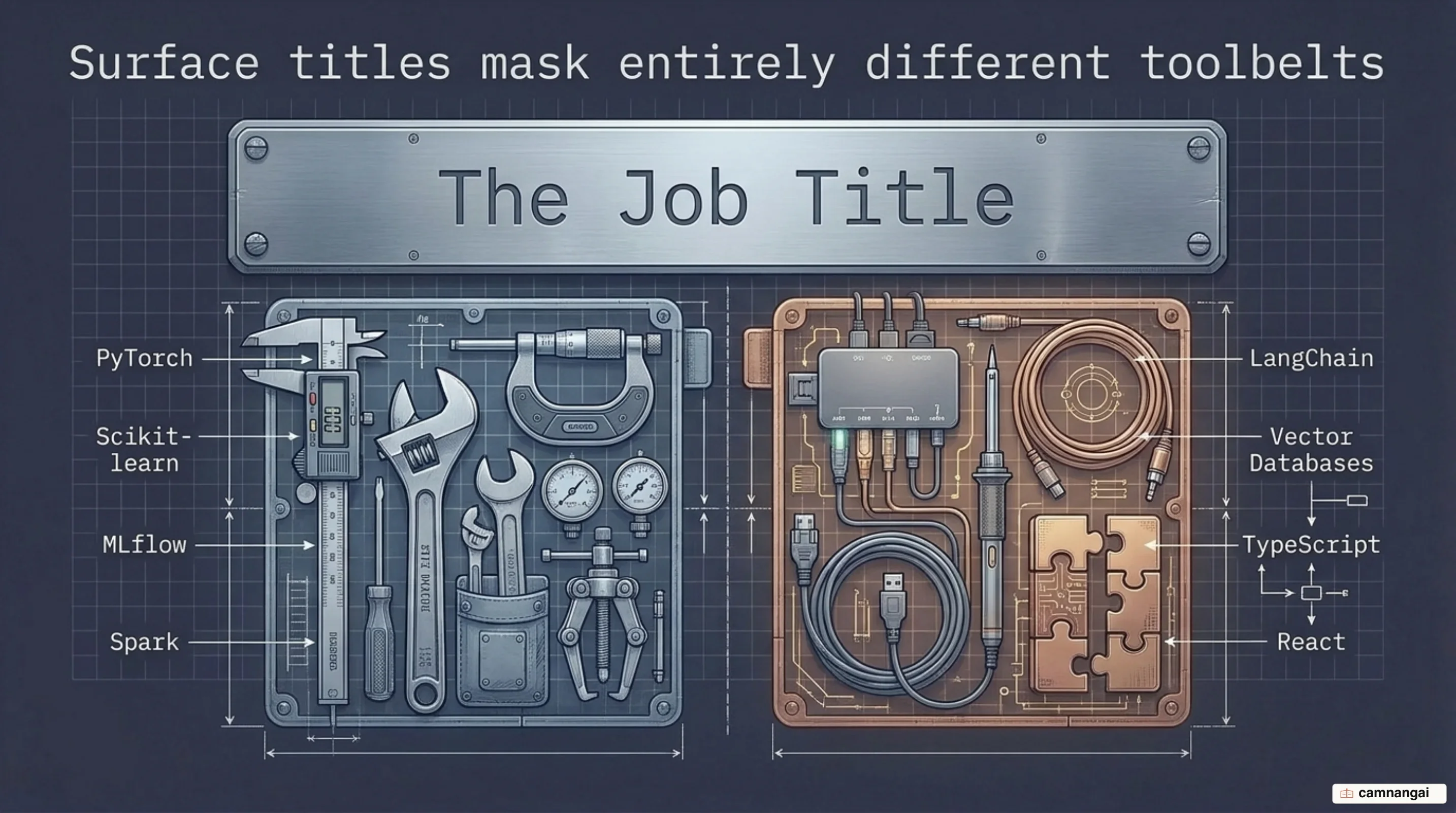
Real listings bear this out. Generative AI work has been posted as Machine Learning Engineer at Quora and Capgemini, as Data Scientist at IBM, and as Software Engineer at Elastic and Mozilla. A company advertising "Software Engineer — Generative AI" usually wants exactly the generalist that title implies: someone who can build the LLM feature and also improve the software around it.
Audit the tools in the job description instead. If a posting mentions vector stores, embeddings, RAG, or LangChain, it is functionally an AI Engineer role whatever it is called, and if it focuses on statistics, feature engineering, model training, or MLOps pipelines, it is an ML Engineer role. In the interview, ask where the API line falls: will you build and train models, or build software that consumes them? Ask about the hardware scale as well, because a team running 10 GPUs faces different engineering problems than one managing a thousand.
Which path should you take?
It comes down to whether you want to own model depth or product velocity. If you are a full-stack or backend developer who wants to ship intelligent features quickly, the AI Engineer path is the more efficient route, because your existing skills in APIs, databases, and interfaces stay valuable and the adaptation layer goes on top without a detour through deep-learning research first. If your background is statistics or research and you want to own the underlying intelligence, ML Engineering rewards depth in PyTorch, JAX, and low-level performance work, with higher median pay and more openings in autonomy, robotics, and finance.
At a 67% overlap, the decision is less permanent than it looks. Master Python and one cloud provider, then specialize in the third of the stack that matches what you actually want to be debugging at 2am: a model that has quietly drifted, or a prompt pipeline that returns confident nonsense. For the wider picture of the newer role, see what an AI engineer does.
References
- The Rise of the AI Engineer — Latent.Space
- The AI Engineering Stack — The Pragmatic Engineer and Chip Huyen
- MLOps: Continuous delivery and automation pipelines in machine learning — Google Cloud
- AI Engineer vs Machine Learning Engineer: Close, but $20K Apart — InterviewStack
- ML Engineer vs. AI Engineer: Two Roles Shaping the Future of AI — University of Manchester
- The Shift from ML Engineering to AI Engineering — Bryan Anthonio
- ML career Q&A: ML Engineer vs. AI Engineer — Susan Shu Chang