An AI engineer builds, evaluates, and operates production systems that run on foundation models.
Unlike traditional machine learning roles that often center on training models from scratch, your work happens at the application layer. You take pre-trained intelligence — large language models (LLMs) — and orchestrate it into working software that solves specific business problems.
The role marks a shift toward "Software 3.0," where logic is no longer purely hand-coded but a blend of human-written code and model-generated reasoning. You are a builder rather than a researcher. You own the design of the systems around the model, so the final product stays reliable, observable, and efficient in production.
Grounding your work in existing models lets you move far faster than traditional machine learning workflows. You focus on retrieval pipelines, agentic workflows, and evaluation frameworks. By engineering the system harness rather than the model's internal architecture, you make the AI deliver consistent results inside real software constraints.
What is an AI engineer?
An AI engineer owns the design, evaluation, and production operation of systems built on foundation models. You apply versatile pre-trained models to build working products such as retrieval-augmented generation (RAG) systems and autonomous agents. Rather than researching model architectures, you focus on how to use those models to solve specific problems.
AI researchers spend years designing novel architectures and training models on massive clusters. AI engineers are product-facing. Companies shipping AI products prioritize engineers over researchers, because the hard part is orchestrating model logic into a stable software system, not creating the model. You are the one who moves a project from research experiment to production feature.
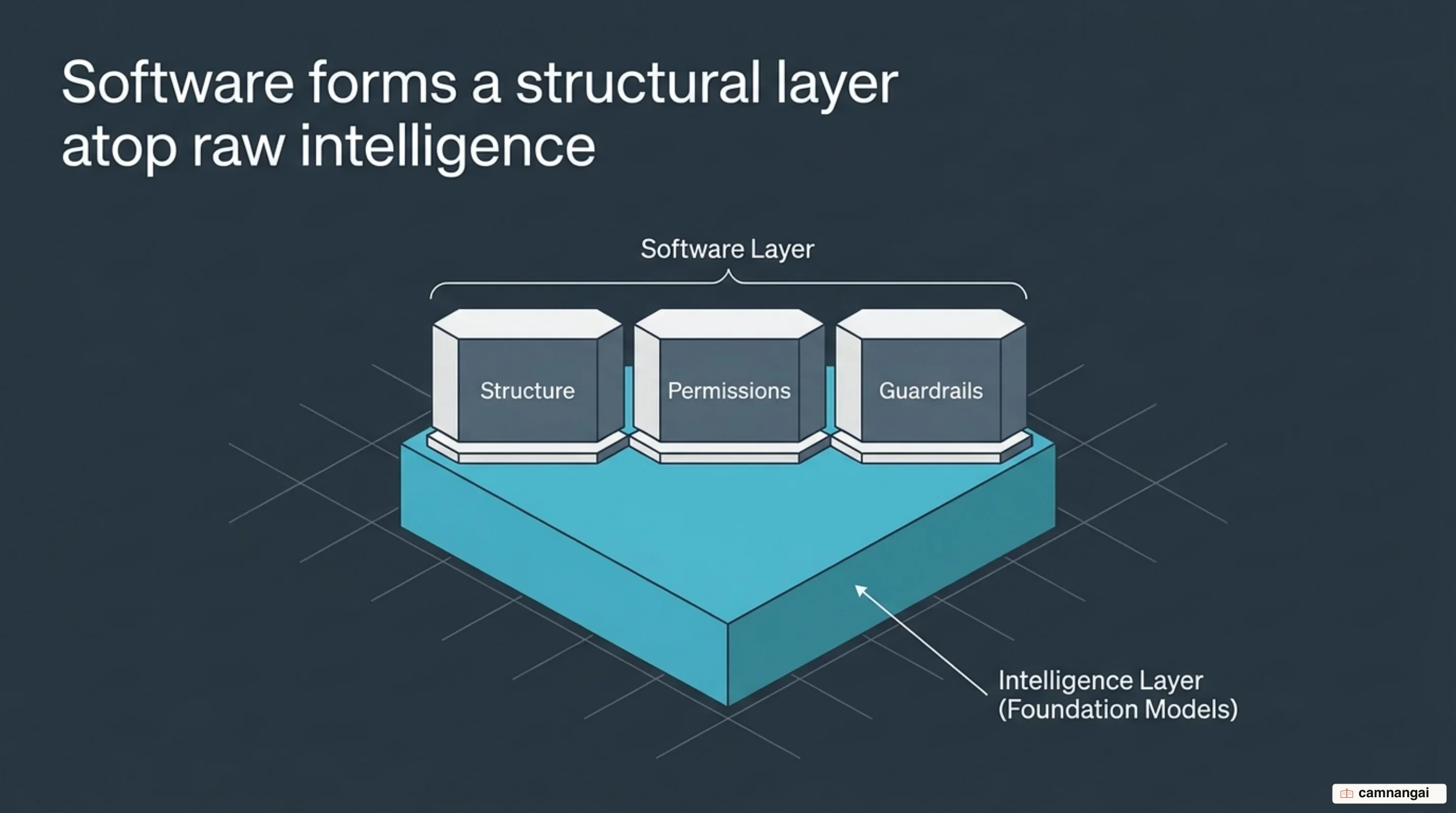
The discipline is rooted in the "Software 3.0" idea, where applications combine traditional human-written code with LLM-generated logic. This creates a "software atop intelligence" architecture. The software layer provides structure, permissions, and guardrails; the intelligence layer provides reasoning. You sit between the two, managing how deterministic code and probabilistic model output interact.
In practice, your work means building the harnesses that manage context, persistent state, and continuous improvement loops. By owning the whole lifecycle — from prototype to production monitoring — you keep the model grounded. You are a systems designer, not a "prompt engineer" — your job is making the AI behave predictably inside a broader application stack.
Why the role appeared now
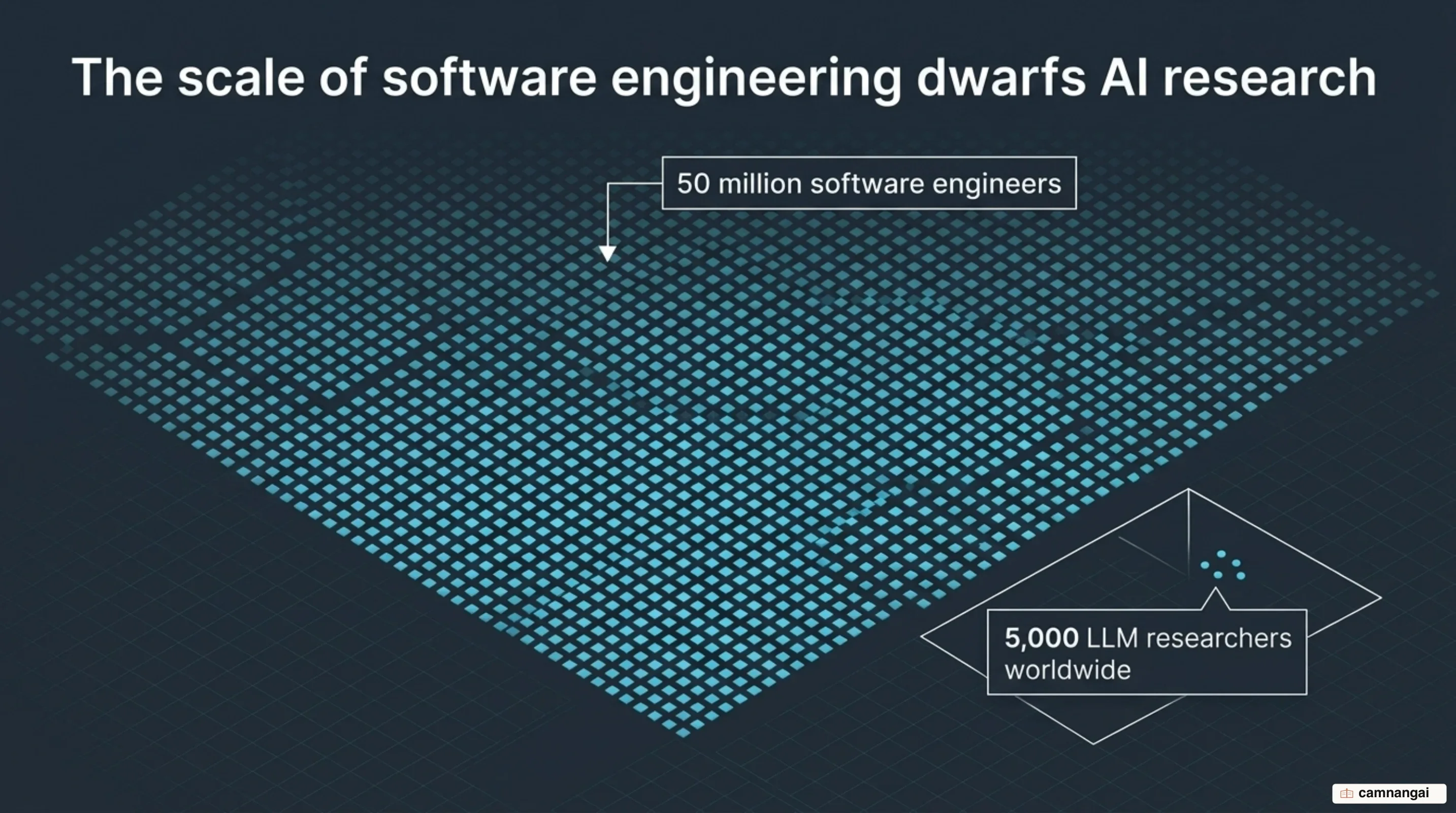
The AI engineer emerged from a "once in a generation shift right" of applied AI. Tasks that needed a dedicated research team and years of work in 2013 now need API documentation and a spare afternoon. That turned AI from a research-heavy experimental field into an accessible component of the standard software stack — available to the world's roughly 50 million software engineers, against only about 5,000 LLM researchers.
"AI research as a service" made the transition possible. Major labs now provide foundation model capabilities through APIs. Organizations no longer need to hire scarce research talent to build intelligence; they can rent it instead. This lets engineers use high-level reasoning without a PhD in neural network architecture.
The rise of foundation models as few-shot learners fueled the role too. These models show emergent capabilities you discover by spending time with them in a specific domain. Add the heavy GPU accumulation at well-funded labs, and there is now a large amount of available intelligence that needs engineers to put it to work. The bottleneck is no longer the model — it is the engineering that makes the model useful.
Finally, the modern AI workflow shifted from waterfall to agile. Traditional machine learning required laborious data collection before a single model could be trained. An AI engineer can instead prompt an LLM and validate a product idea almost immediately. That "fire, ready, aim" workflow makes validating an idea roughly 1,000 to 10,000 times cheaper than the traditional path, so you can afford to iterate on products.
How an AI engineer differs from an ML engineer
The distinction between an AI engineer and a machine learning (ML) engineer comes down to the systems they build and the data they handle. ML engineers build task-specific, predictive systems. They work with structured data — rows and columns in database tables — to solve narrow problems like predicting house prices, detecting fraudulent transactions, or tuning recommendation engines.
AI engineers work with foundation models and generative AI. Where ML is a task-specific slice, AI covers the broader mimicry of human-like thinking. You mostly work with unstructured data: text, images, audio. Instead of training a narrow model for one purpose, you adapt versatile foundation models that can write code, summarize documents, and generate content at the same time.
Data scale separates the two as well. ML engineers work with datasets ranging from thousands to hundreds of thousands of records that fit in a database table. AI engineers work with models trained on trillions of tokens. Because training networks that size is too expensive for most organizations, your job begins where the training ends: adapting and integrating those models into applications.
An ML engineer's process runs from defining a use case to preparing data to training a model. Your process jumps straight to adaptation. You use prompt design and integration frameworks to plug pre-trained models into real workflows. ML is grounded in predictive accuracy for specific variables; AI engineering lives in the messier world of unstructured data and broad generative reasoning.
What an AI engineer actually does
The daily reality mixes debugging, building, and evaluating. A typical morning might start with a quality drop in a customer support chatbot. You analyze the retrieval layer of a RAG pipeline to see whether a recent document update broke the chunking strategy, then adjust how information is indexed and retrieved to restore accuracy.
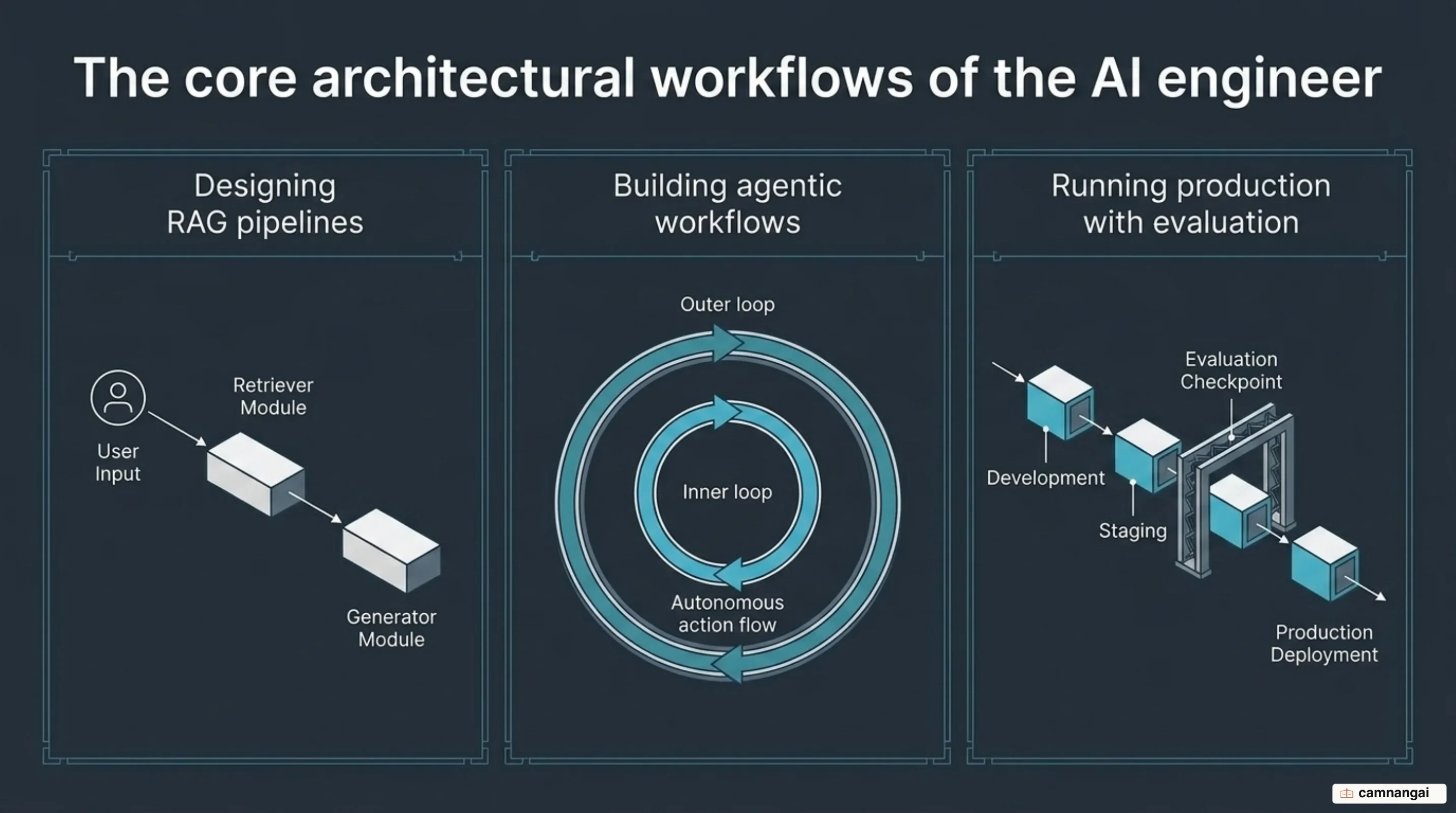
A big part of the role is loop engineering: managing the tension between autonomous agents and human oversight. You build an inner execution loop where the agent performs tasks, and an outer loop where you set direction and make decisions. Engineers are locomotive engineers now: the job is keeping the locomotive on the rails.
You also own harness engineering — building the infrastructure around a model that makes it reliable. You design the workflows, manage context windows, and set the permissions a model needs to interact with other tools. The harness also holds persistent state and the improvement mechanisms that let the system learn from its own output over time.
Beyond infrastructure, you build function-calling agents that take real actions — querying a database, issuing a refund. You write evaluation tests that measure the accuracy of those actions and deploy updated pipelines to staging. That work is the difference between a chatbot and a working part of a software factory that delivers measurable return.
The skills the market is hiring for
An analysis of 889 unique AI engineer job listings from January 2026 shows a heavily Python-centric role, with Python appearing in 82.5% of listings. The role is backend-heavy: nearly half of AI-first roles explicitly require backend skills, about a third mention frontend, and roughly a fifth expect full-stack. FastAPI shows up in 10.7% of listings as the usual way to expose AI functionality to the rest of the product.
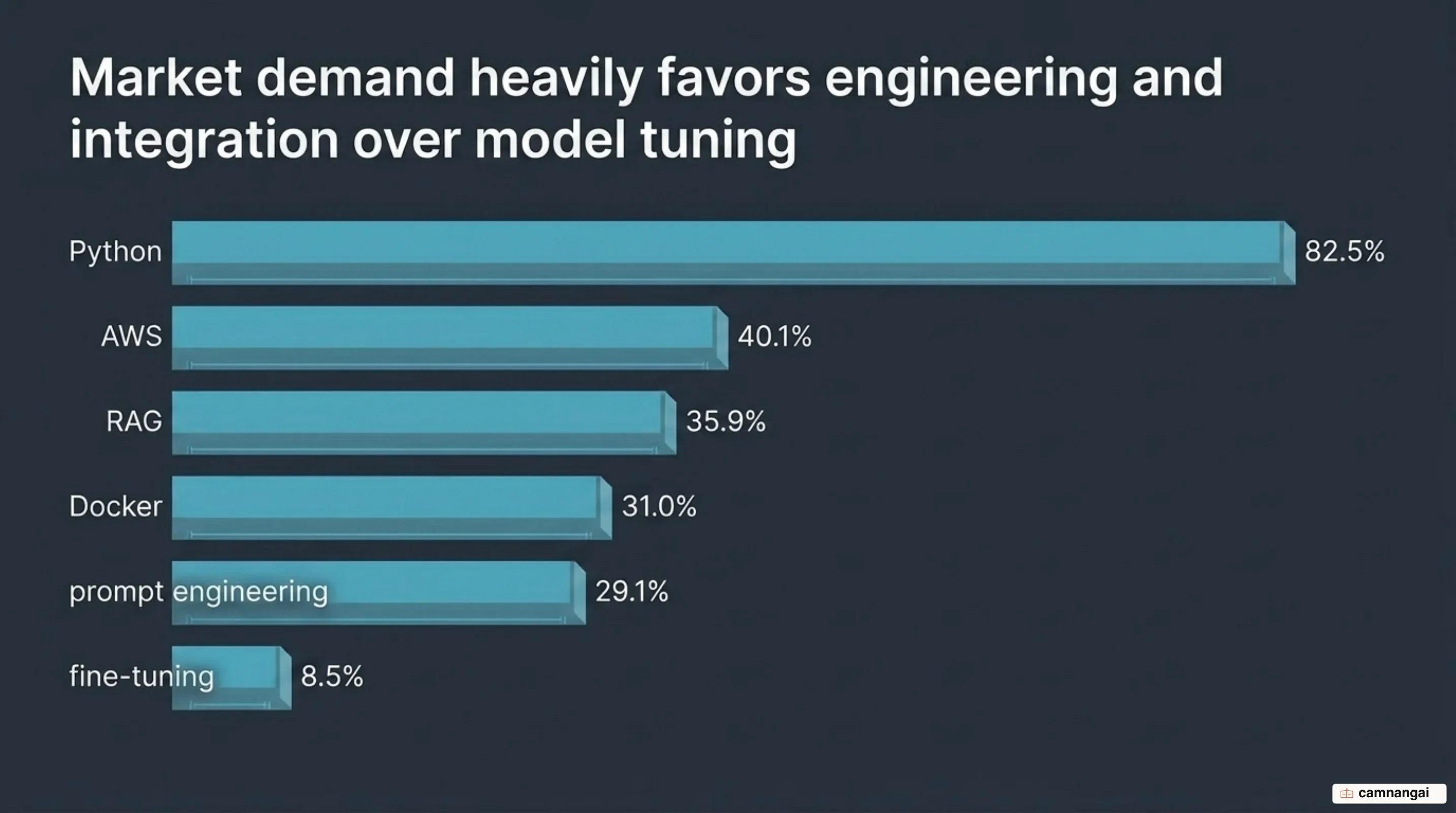
Technical demand is led by three areas: retrieval-augmented generation, prompt engineering, and cloud infrastructure. RAG is mentioned in 35.9% of roles, making it the most requested architectural pattern for enterprise AI. Prompt engineering appears in 29.1%, though it reads as an integrated system-design skill rather than a standalone job. LLM integration accounts for 25.4%, agent work for 14.4%, and fine-tuning for only 8.5% — companies would rather orchestrate existing models than retrain them.
Agent skills are becoming their own category: portable, on-demand knowledge that encodes the practices, quality gates, and workflows senior engineers rely on. Companies increasingly want engineers who maintain those written procedures for agents to execute, and who handle the edge cases the AI cannot manage yet.
The market also expects a cloud-native approach. Alongside Python and generative AI tooling, AWS appears in 40.1% of listings, Docker in 31.0%, CI/CD in 29.3%, Kubernetes in 29.1%, and vector databases in 10.8%. The clearest signal in the whole dataset is that 95.6% of positions are production-focused. Companies want builders who can containerize a prototype and deploy it as a scalable, observable service.
The path to becoming an AI engineer
Becoming an AI engineer follows a four-phase roadmap. Phase 1 covers Python foundations: variables, object-oriented programming, and version control. Phase 2 moves into LLM and app development, where you learn to work with model APIs and build services with FastAPI. Phase 3 introduces data and math foundations. Phase 4 finishes with RAG pipelines and autonomous agents.
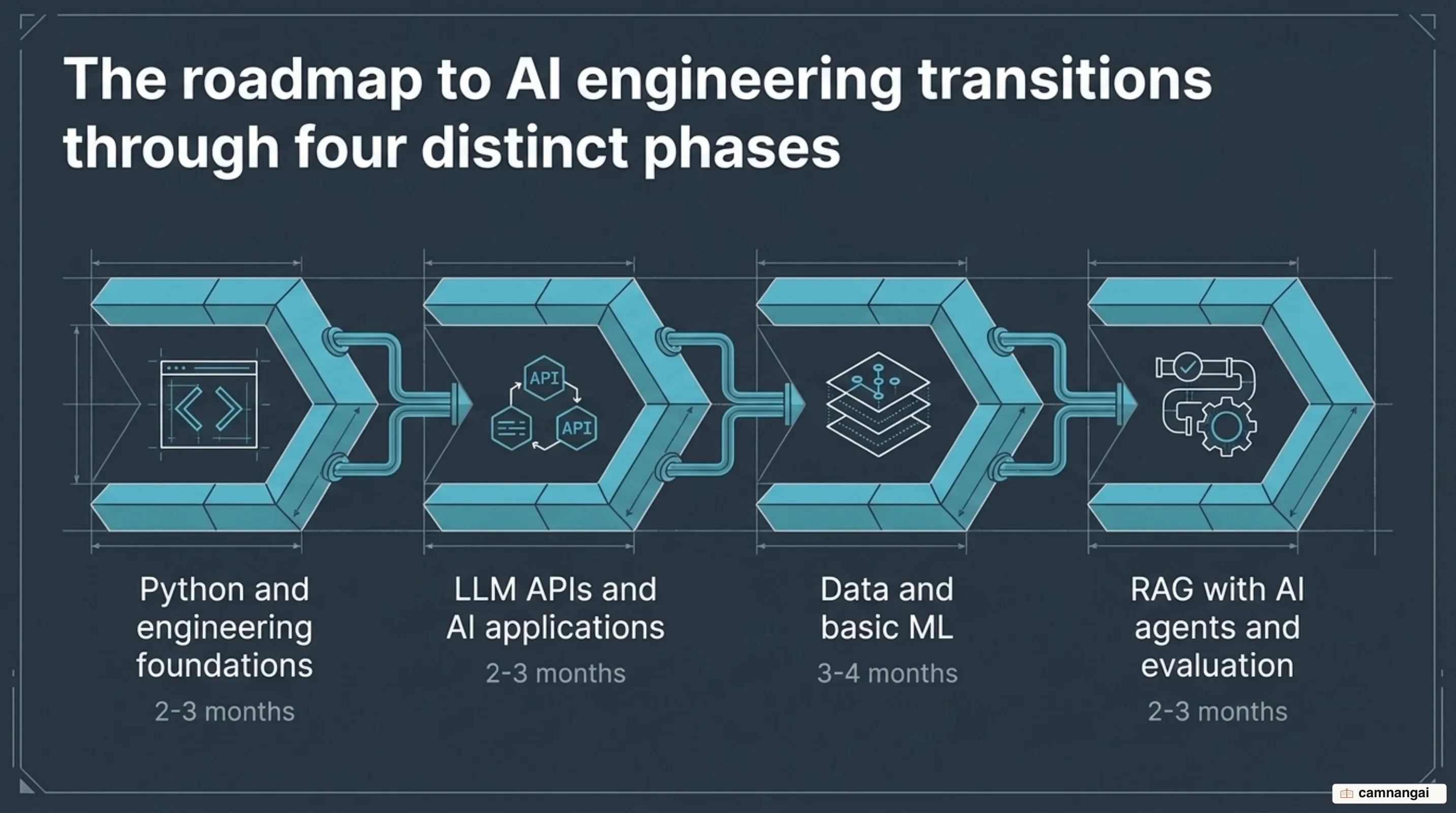
The timeline depends on where you start. Software engineers moving into AI can expect to be job-ready in three to five months. Starting from scratch generally takes 8 to 12 months. These are timelines to become a competitive candidate with a portfolio, not an expert — the goal is to move from "works in a notebook" to "runs in production."
Programming fundamentals are non-negotiable. Master variables, data structures, and error handling before touching AI-specific tools. As you progress, the focus shifts toward deployment. Learning Docker to containerize your applications and FastAPI to serve them is what separates a hobbyist from a professional, because it makes your projects portable and ready for real use.
The final stage is what connects the pieces of an AI system. You generate embeddings, store them in vector databases like ChromaDB or Pinecone, and build RAG systems that give LLMs access to proprietary data. By the end you should have a portfolio of deployed projects that show you can build, evaluate, and monitor AI-driven software.
Demand, pay, and where the role is heading
Pay is strong. Median salaries for AI engineers in the United States sit around $142,000, with senior roles at $220,000 or more in total compensation. At large tech companies, total compensation including equity runs from about $280,000 at Google and Microsoft to over $500,000 at OpenAI and Scale AI. The premium over non-AI peers is real but modest — roughly 6.2% at staff level.

The clearest industry trend is the rise of the forward-deployed engineer (FDE). Demand for the role is projected to climb 2,100% by the end of the year, and the share of companies planning to hire FDEs jumped from 5–10% at the start of 2026 to 70% by mid-year. Roughly 17,000 FDEs work in the U.S. market, but only about 2,000 have the expertise to consistently deliver meaningful return. Palantir invented the model and employs a large share of them — some clients buy Palantir's technology specifically to get access to its engineers.
Enterprises are increasingly building FDE teams in-house rather than buying the capability. The reason is competitive rather than technical: hand your proprietary business processes to an AI firm, and that firm is positioned to compete with you.
The software factory is where the role goes next. Instead of shipping individual AI features, engineers maintain and tune long-running agent systems that automate a business process end to end. The pressure that comes with it is provable value — stakeholders want systems that generate revenue or replace expensive manual work, not demos.
Where to start
Do not over-study the theory of how a model is trained. Even Peter Steinberger, the "ClawFather" behind OpenClaw, makes a point of keeping himself in the outer loop — the design, direction, and oversight of the system are the job.
The most effective way to learn is to build something real. Connect an LLM to a data source and deploy it as a live application with Docker and FastAPI. That hands-on work builds a portfolio proving you can ship reliable AI-powered features, which is worth more to an employer than a certificate.
References
- The Rise of the AI Engineer — Latent Space
- 5 Trends That Defined AI Engineering at World's Fair 2026 — Latent Space
- AI Engineer Roadmap — roadmap.sh
- What Is an AI Engineer? 2026 Role, Skills and Responsibilities Based on 1,000+ Job Descriptions — AI Shipping Labs
- ML Engineer vs. AI Engineer: Two Roles Shaping the Future of AI — University of Manchester
- How to Become an AI Engineer in 2026: A Self-Study Roadmap — KDnuggets
- How to Become an AI Engineer in 2026 (A Complete Roadmap) — Dataquest
- Forward-Deployed Engineers Are the AI Industry's Latest Talent Obsession — TechCrunch