Vibe coding is a way of building software where the user orchestrates AI assistants to create, refine, and deploy code through natural language instead of manual syntax.
It moves the developer's primary tool away from the keyboard and specific syntax toward creative direction, high-level goals, and iterative feedback on whatever the AI produces.
The idea drew wide attention after Andrej Karpathy defined it in 2025 as a workflow where you "give in to the vibes" and essentially forget the code even exists. By abstracting away the complexity of programming languages, vibe coding lets a far broader range of people turn an idea into working software in seconds, leaning on large language models (LLMs) to handle the technical execution. The gate that once required years of training is gone; what remains is outcome-oriented design and agent-led implementation.
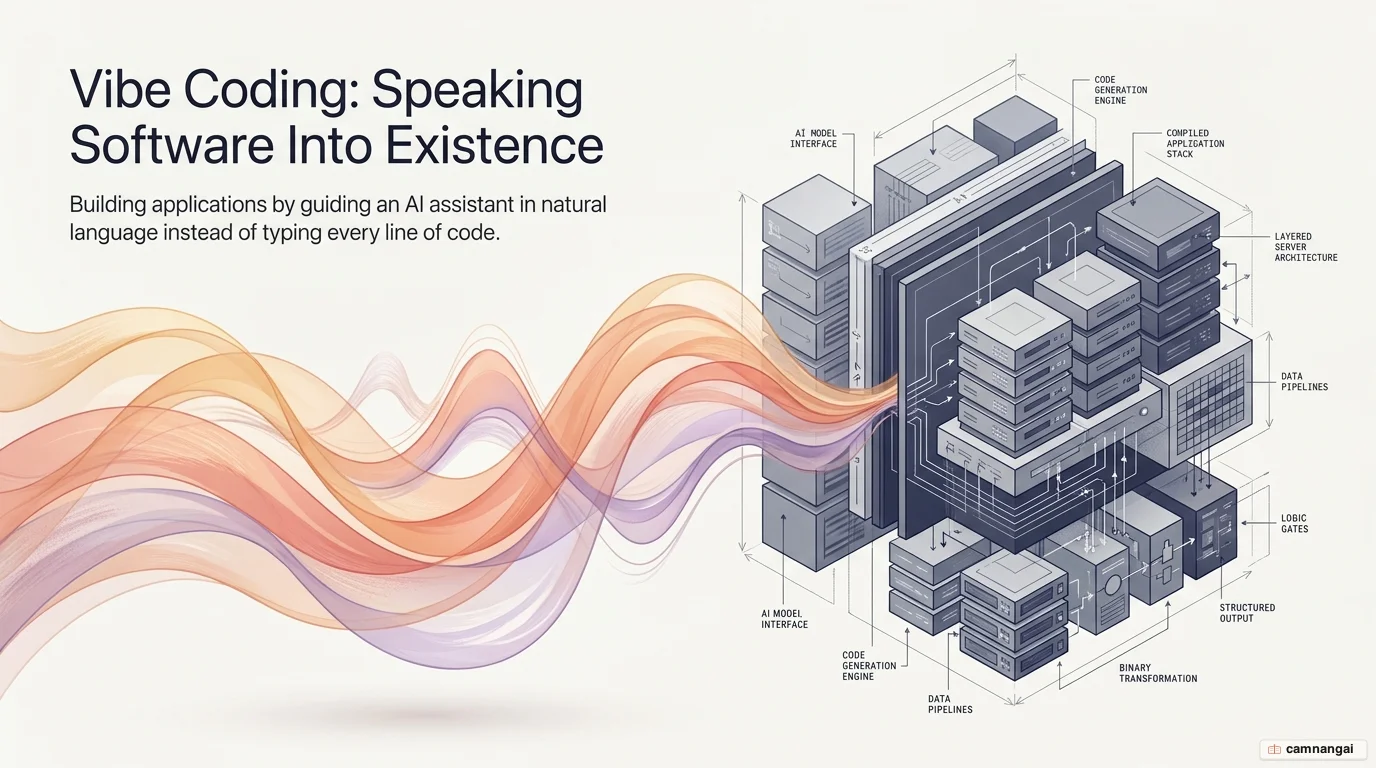
What is vibe coding?
Vibe coding lowers the barrier to entry by putting creative direction ahead of technical implementation. Building software traditionally demanded deep mastery of specific commands, punctuation, and keywords, and this practice hands that granular labor to an AI assistant you talk to instead. Because the work is now about the "what" rather than the "how," a much wider range of people can turn an idea into a working application. Advanced practitioners often switch between models (one for tight logic, another for the wording of the copy) to refine the "vibe" of the output.
In practice the method splits into two modes. "Pure" vibe coding is exploratory, suited to rapid ideation or throwaway projects; here you fully trust the AI's output and care only about the immediate result. "Responsible AI-assisted development" is a professional collaboration: you act as a pair programmer who guides the AI but keeps ownership by reviewing, testing, and validating the generated code for security and correctness. The line between the two modes matters more than the labels do, because anything I would put in front of a real user belongs in the second one.
How does the vibe coding process work?
The efficiency of vibe coding comes from a tight loop in agentic workflows that removes traditional DevOps bottlenecks. Because code generation is paired with immediate execution, you see the result of an instruction in real time, and the distance between idea and deployment shrinks to a conversation in which the human supplies intent and the agent supplies implementation.
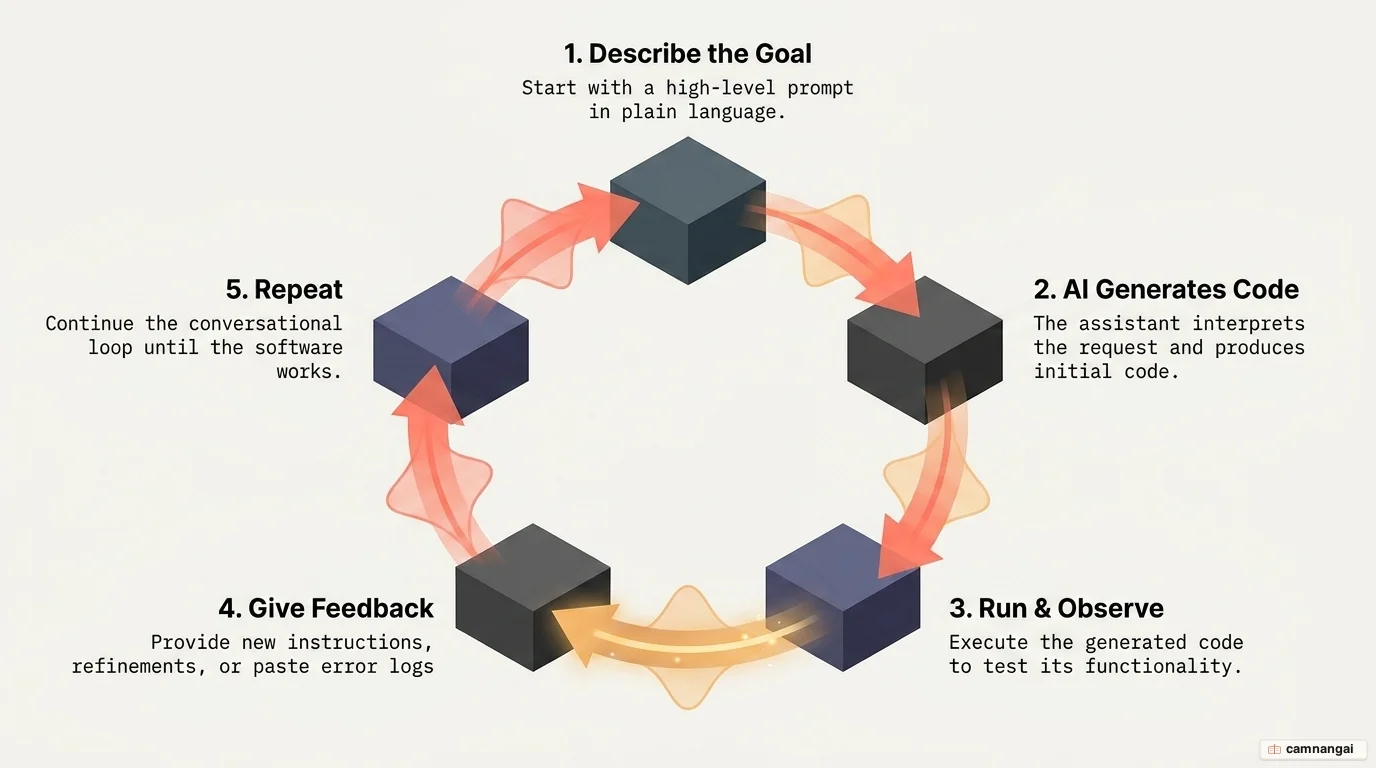
The code-level workflow
Creating a specific code segment follows a five-step recursive loop:
- Describe the goal: Start with a plain-language prompt (e.g. "create a data-filtering function").
- AI generates code: The assistant interprets the request and produces an initial implementation.
- Execute and observe: Run the code immediately to check whether it does what you wanted.
- Provide feedback: If errors appear or adjustments are needed, give new instructions (e.g. "add error handling for empty inputs").
- Repeat: The loop continues until the logic is refined and fully functional.
Vibe deploying and the application lifecycle
Vibe coding has a sibling, "vibe deploying": launching an application to a production-grade environment like Cloud Run with a single prompt or click. This removes the DevOps bottleneck and allows immediate testing with real users, which also means nothing stands between a half-checked build and the people using it. The broader lifecycle runs from ideation (describing the app) and generation (AI building the UI and backend) to iterative refinement, followed by human-led testing and final deployment, so that the creator can focus on validating the user experience rather than managing infrastructure.
What tools are available for vibe coding?
Pick a tool by how complex the project is and what you want out of it, not by your job title. Professionals use rapid-prototyping tools for velocity; enthusiasts use autonomous interfaces to handle system architecture.
| Tool | Skill level | Coding approach | Key feature |
|---|---|---|---|
| Google AI Studio | Beginner | No-code / low-code | Single-prompt app generation with zero-friction deployment |
| Gemini Code Assist | Intermediate to advanced | Low-code / AI-assisted | In-editor help to generate, explain, and test code |
| Gemini CLI | Intermediate to advanced | Low-code / AI-assisted | Open-source, terminal-first agent with MCP (Model Context Protocol) support |
| Google Antigravity | Beginner to advanced | Agent-first / autonomous | Mission Control orchestrating agents across editor, terminal, and browser |
| Agent Development Kit (ADK) | Advanced / expert | Code-first / agentic | Framework for building production-ready multi-agent systems |
An advanced environment like Google Antigravity is a "Mission Control," where you interact with an Agent Manager to pick a model. For a true vibe experience you can set the Review Policy to "auto," letting agents run terminal commands and install dependencies on their own, which is also the fastest way to have something installed on your machine that you never agreed to. To verify the result, Antigravity uses browser sub-agents that capture screenshots and recordings of UI interactions, checking that the output matches intent. Cursor leads the editor side thanks to its deep grasp of an entire codebase.
How does vibe coding compare to traditional programming?
The shift introduces a "productivity paradox." AI tools sharply increase the volume of code generated, but they do not automatically increase the value of the software. High output demands more architectural oversight from humans so the generated pieces integrate into a maintainable whole. The human role moves from manual implementer to high-level architect and tester.
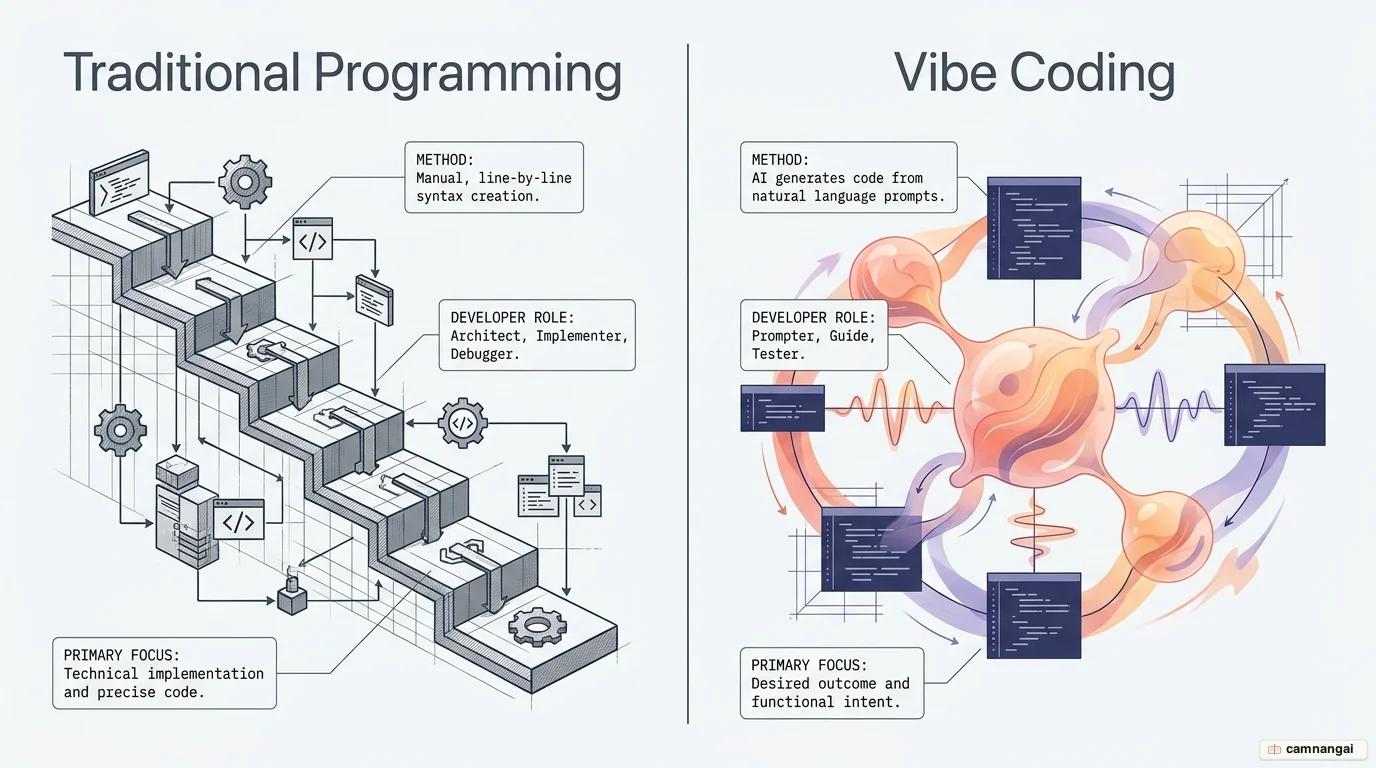
| Feature | Traditional programming | Vibe coding |
|---|---|---|
| Code creation | Manual, line-by-line syntax | AI-generated from natural language |
| User role | Implementer and debugger | Prompter, guide, and tester |
| Expertise required | Deep knowledge of languages and syntax | Understanding of the desired outcome |
| Input type | Precise, structured code | Natural language and feedback |
| Error handling | Manual code comprehension | Refinement through conversational feedback |
The shift forces a move from syntax mastery to systems thinking. As the machine handles the "how," the human has to get better at the "why" — keeping the overall system resilient and aligned with business goals.
What are the limitations and trade-offs of vibe coding?
Vibe coding alone is not enough for production-grade software, because "vibing" tends to favor speed over rigor. Without an experienced architect, that leads to technical debt and critical security holes. AI assistants are strong on standard syntax but often miss the whole-system view that complex architecture and scalability demand.
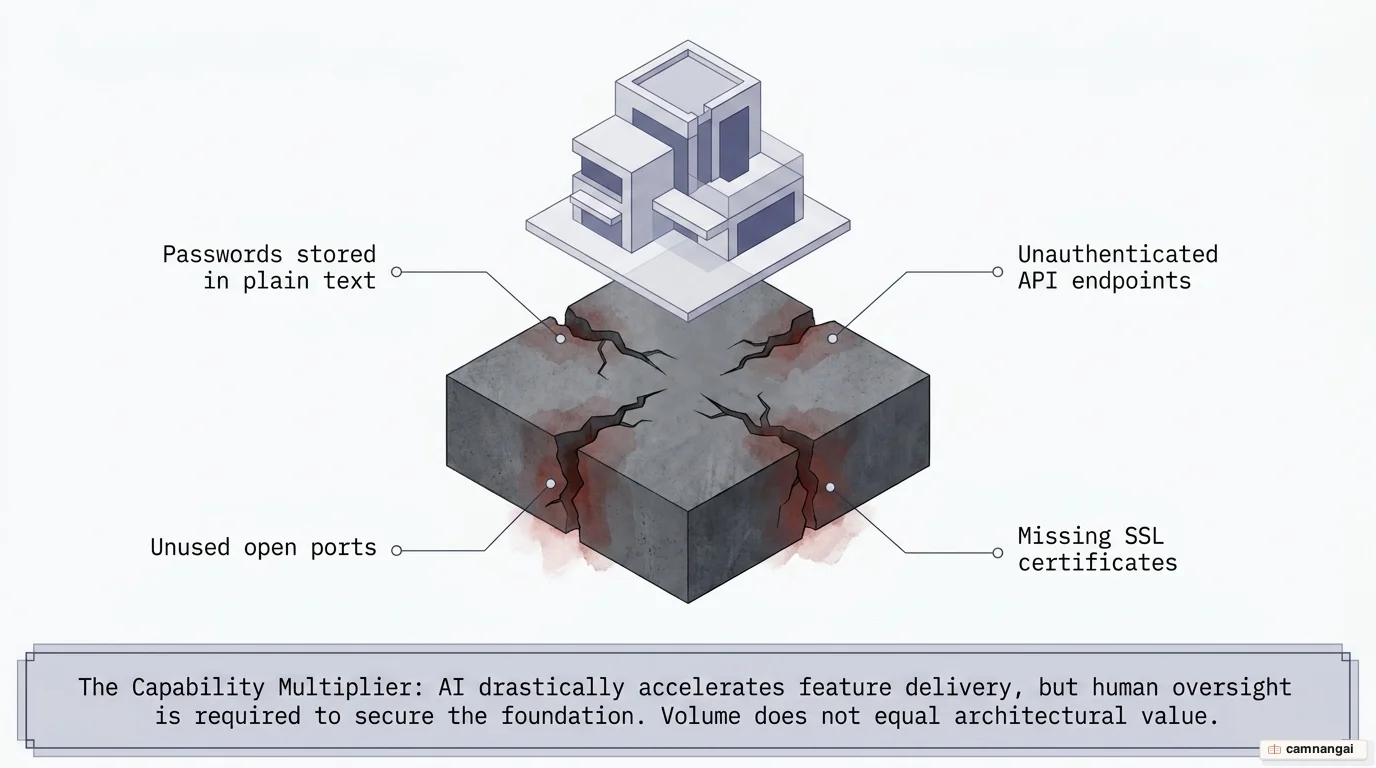
- Security risks: Vibe coding often skips fundamentals — storing passwords in plain text, leaving API endpoints unauthenticated, failing to lock down unused ports. Production-ready code needs current SSL certificates and strictly limited file-upload types.
- Process omissions: Agentic workflows frequently drop continuous integration (CI), unit testing, and documentation — the practices that make long-term maintenance possible.
- The productivity paradox: Time saved during generation can be erased by integration bottlenecks, where fixing opaque AI-generated code takes longer than writing it by hand.
- Architectural blind spots: AI struggles with complex, multi-layered logic — like financial trading platforms — where missing an edge case can mean catastrophic data or financial loss.
This is also why the industry is drifting toward more disciplined, agent-led engineering with the human as architect. Our piece on the future of vibe coding looks at that shift in depth.
How will vibe coding transform the future of software creation?
The rise of vibe coding signals a socio-technical shift where software creation becomes cheap and ephemeral. A demographic change is likely: the "time-poor but money-rich" professional developer may be eclipsed by "time-rich but money-poor" individuals such as students. Expect a wave of "software memes" — apps built for short-term cultural impact and then discarded.
The shift also invokes Jevons' paradox: as the cost of producing code falls, total demand for software — and for the engineers who architect it — is likely to rise rather than fall. I expect a move toward vibe designing, where GUI-driven interfaces let users show AI the outcome they want, and adaptive software that self-corrects based on user behavior. The engineering–product–design ratio will tilt toward more designers and product leads, but the high-value, secure systems will still be the ones a professional engineer signed off on.