Model training is the process of optimizing a transformer decoder network to predict the next token in a sequence using a massive corpus of data.
What you are really running is a stochastic computation graph whose only objective is to minimize a loss function, so that the model's internal parameters are refined until the system generates statistically plausible continuations of any input string you hand it. That single loop is what carries raw compute all the way to a deployed assistant, through an orchestrated sequence of pre-training, supervised fine-tuning, and preference alignment.
As an engineer, you have to read this not as a single event but as a series of hardware-intensive stages, because each one demands its own architectural decisions, from managing high-performance interconnects in multi-node clusters to tuning the token-to-parameter ratio. Strip the marketing language away and what remains is mechanical, defined by data quality, scaling laws, and whatever the underlying silicon will tolerate.
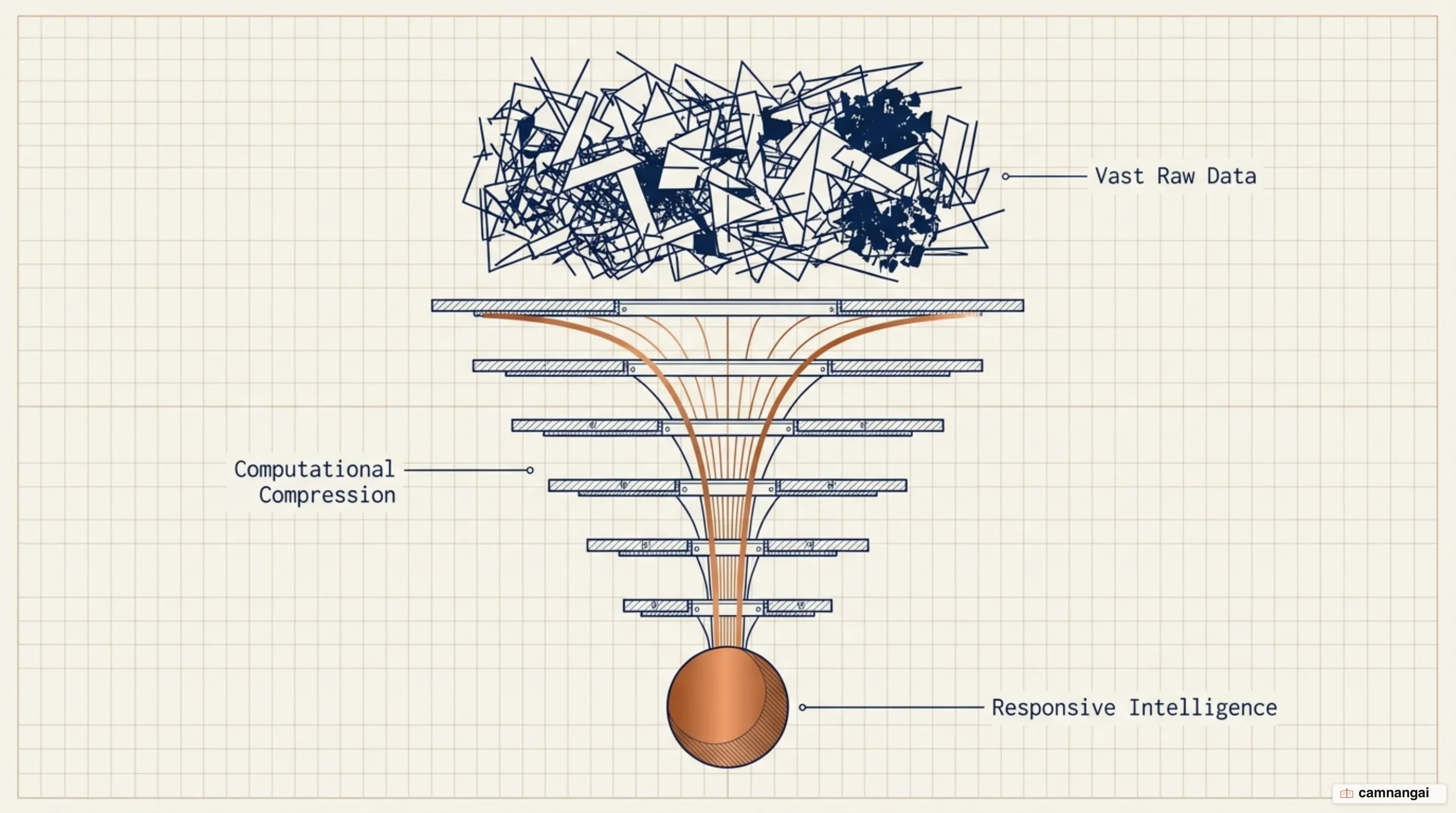
What is model training?
Model training begins with a transformer decoder network, the standard architecture for modern large language models. The process starts with tokenization and embedding mapping, where raw text is decomposed into discrete units and converted into fixed-length vectors. Those embeddings then travel through a series of transformer layers, each one a self-attention mechanism sitting alongside a parallel fully connected network. In a decoder-only setup the layers mix information across the sequence, so the processed embeddings that come out represent the contextual meaning of the input rather than a bag of words.
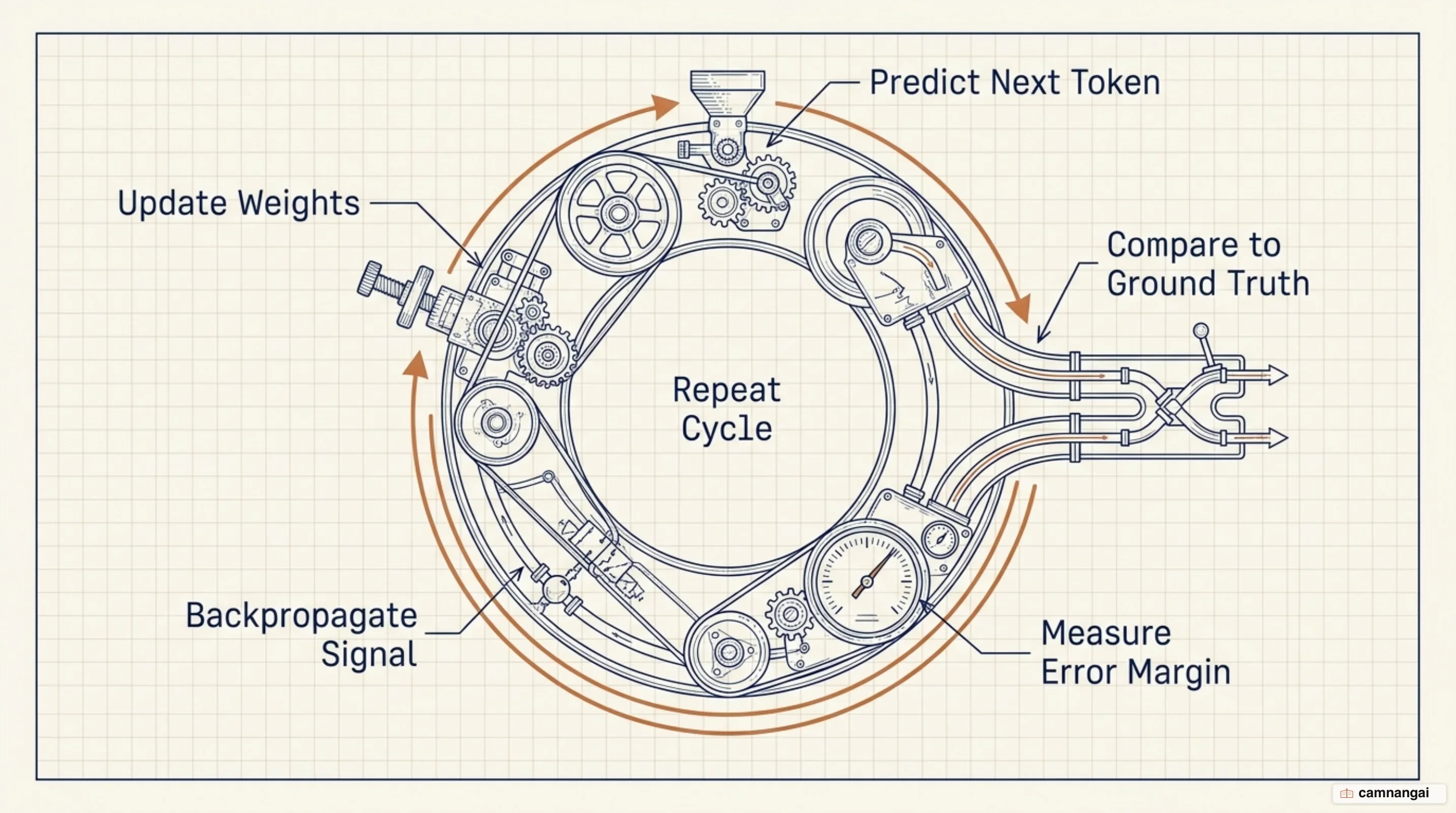
The prediction step is narrower than most people expect, because the network looks only at the output embedding of the last token in the partial sequence. That embedding is projected through a linear transformation and a softmax to produce a probability distribution over the entire vocabulary, and by sampling from it the model selects the next token and appends it to the string, repeating the process autoregressively. This is the whole trick behind a model extending a prompt into a coherent multi-token answer: it feeds its own output back in, and it never plans further ahead than one token.
Underneath sits a single mathematical objective, which is to minimize the negative log-likelihood loss function. Every partial sequence in the corpus passes through the model, the predicted distribution is compared against the ground-truth token, and the gap between them drives a parameter update through backpropagation. Nobody hands the model a grammar or an arithmetic table, so its weights absorb the statistical regularities and reasoning patterns of the training data only because predicting the next token well turns out to require them.
Where does training data come from, and how is it cleaned?
High-scale training needs massive text corpora, which you typically aggregate from web-scraped sources like Common Crawl, from specialized academic collections such as arXiv and PubMed, and increasingly from synthetic data generation (SDG). Modern SDG uses a Generate-Critique-Filter pipeline, where a teacher model generates raw samples, a reward model critiques them for attributes like helpfulness or correctness, and a final filter keeps only the high-quality outputs for the training set.
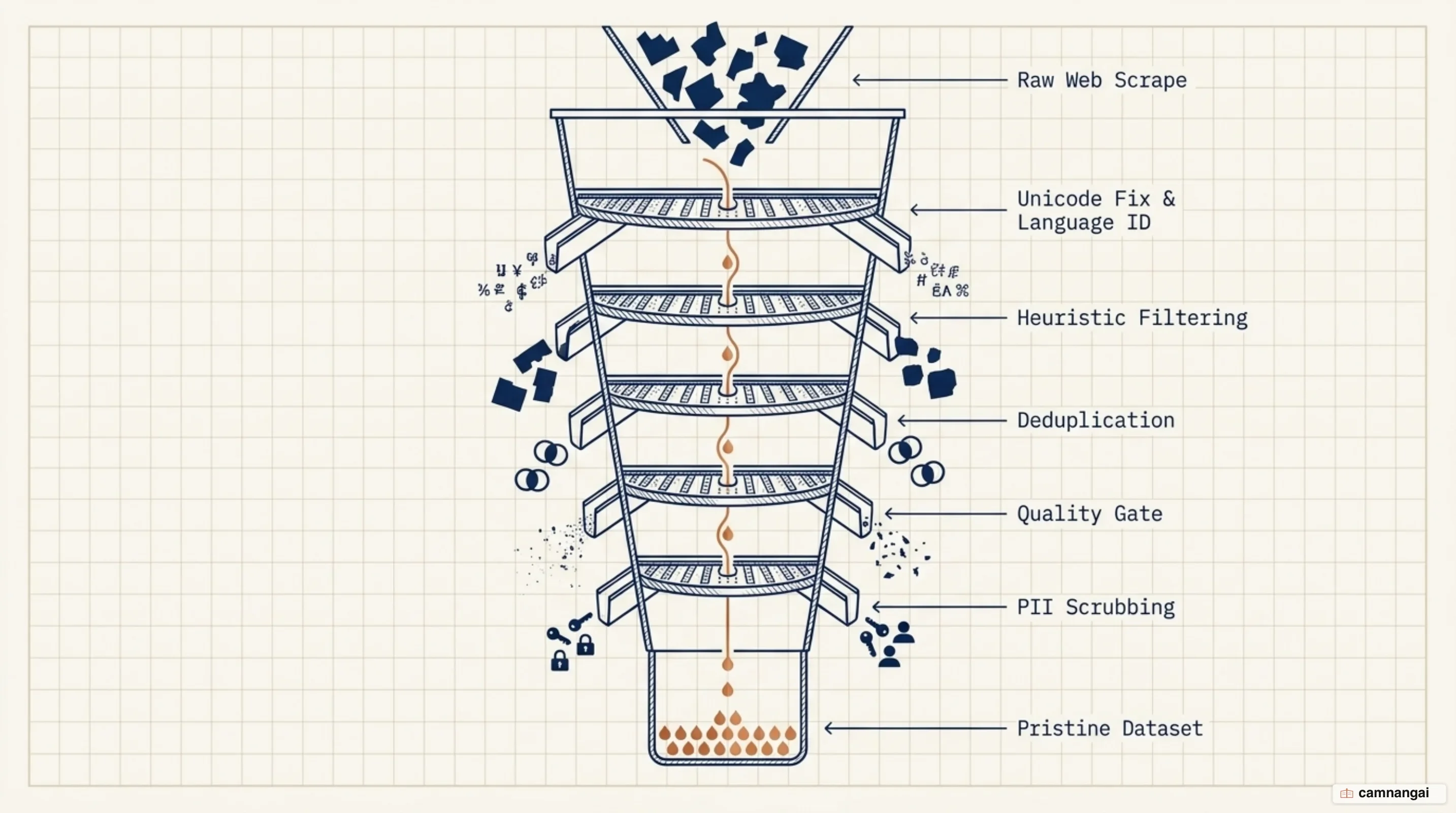
Everything after that is unglamorous cleanup, and it decides how good the model gets. Unicode fixing repairs garbled sequences, while language identification isolates the target monolingual data. Heuristic filtering then prunes the set with rule-based metrics, including word count filters, boilerplate string removal, and n-gram repetition filters that catch artificially generated or low-quality content. Safety is its own stage, because you have to deploy a model like the AEGIS Safety Model to sort content into critical risk categories and keep the training set compliant.
Deduplication is where the engineering gets hard, and it comes in exact, fuzzy, and semantic flavors. Exact deduplication is a hash lookup, whereas fuzzy deduplication uses MinHash and Locality-Sensitive Hashing (LSH) to find near-duplicates. The step people underestimate is what follows, because you then have to turn the resulting similarity matrix into a graph and pull out its connected components, or you delete part of a duplicate cluster and keep the rest. Semantic deduplication goes further again, using embedding models and k-means clustering to strip out documents that say the same thing in different words.
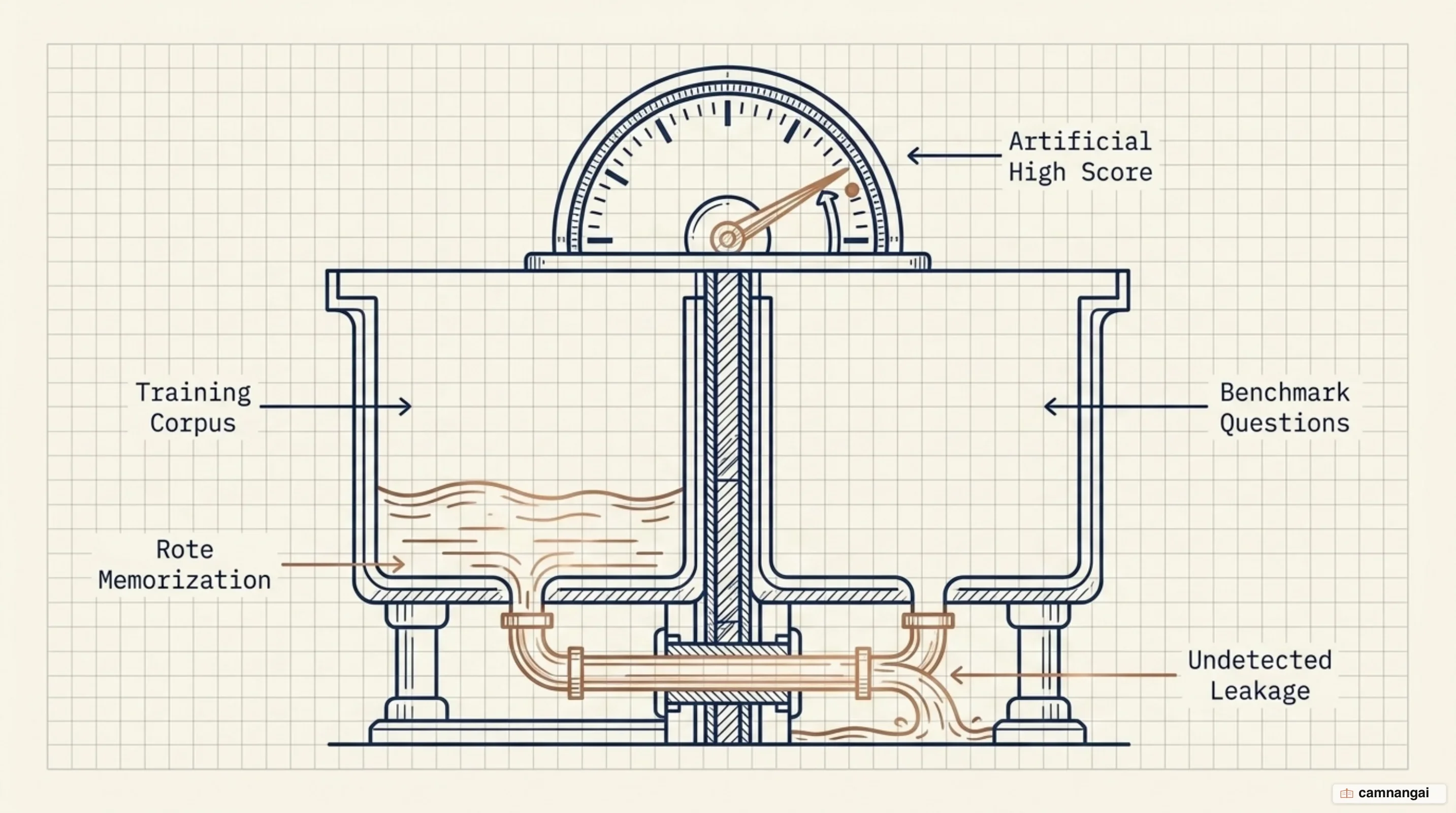
The last gate is compliance, which means PII redaction and task decontamination. Personally Identifiable Information is substituted or eliminated to protect privacy, while task decontamination runs a systematic n-gram search for test-set leakage from benchmarks like MMLU or GSM8K. Skip it and the model memorizes specific evaluation answers, which produces exactly the misleading performance numbers you will later have to explain.
Pre-training: what does a model learn from trillions of tokens?
Pre-training is where broad syntax, general world knowledge, and reasoning structures come from. By consuming trillions of tokens the model learns the likelihood of token sequences, so that it picks up, for instance, the relationship between "moon" and "astronauts." What you want out of this stage is a foundational base model that understands how language works, rather than a specialized assistant.
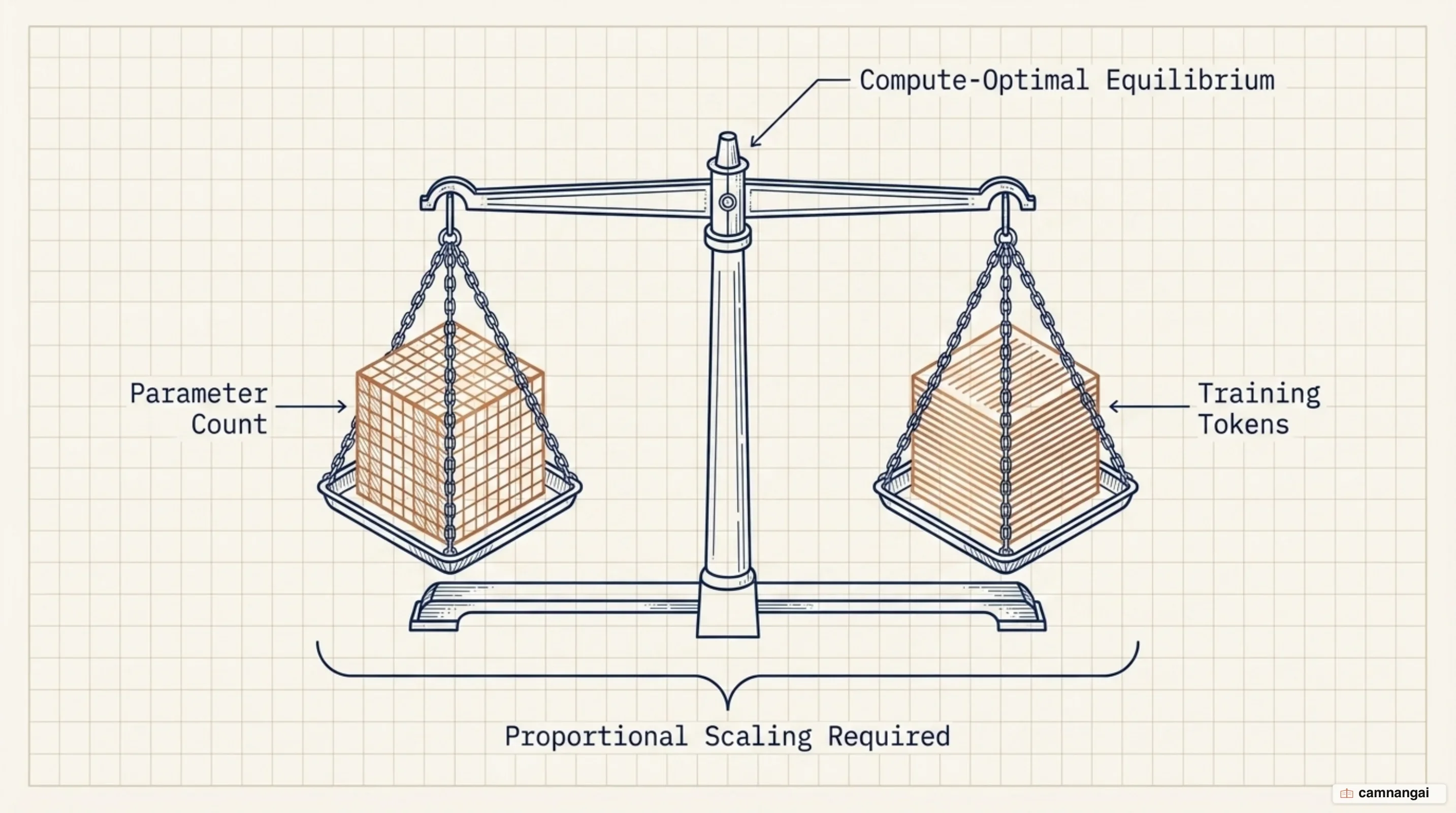
Scaling laws are what keep that stage compute-efficient. The Chinchilla findings establish that model size and training tokens should scale equally, targeting roughly 20 tokens per parameter, so a 70B model should be trained on 1.4T tokens to be compute-optimal. However, modern open-weight models are frequently trained well past that point of optimality, because engineers push the data-intensive ratio higher to squeeze more performance out of smaller architectures and make them more capable for their size once deployed.
The reason a training pass is affordable at all is masked self-attention. Causal masking stops each position from looking ahead at ground-truth tokens, and that single architectural constraint lets you train all T tokens in a sequence of length T simultaneously. Every output embedding in the transformer predicts the subsequent token, so one forward pass yields as many loss terms as there are tokens, while the autoregressive integrity that generation depends on is left intact.
How does supervised fine-tuning turn a raw model into an assistant?
Supervised Fine-Tuning (SFT), or instruction tuning, adapts a pre-trained model to follow user intent. Unlike the unstructured text used in pre-training, SFT relies on high-quality labeled prompt-response pairs, which teach the model to adopt a specific persona, follow formatting constraints such as structured JSON, or handle multi-turn dialogue. Pre-training is about learning language, whereas SFT is a behavioral shift, because what the model is learning here is how to act as a conversational agent.
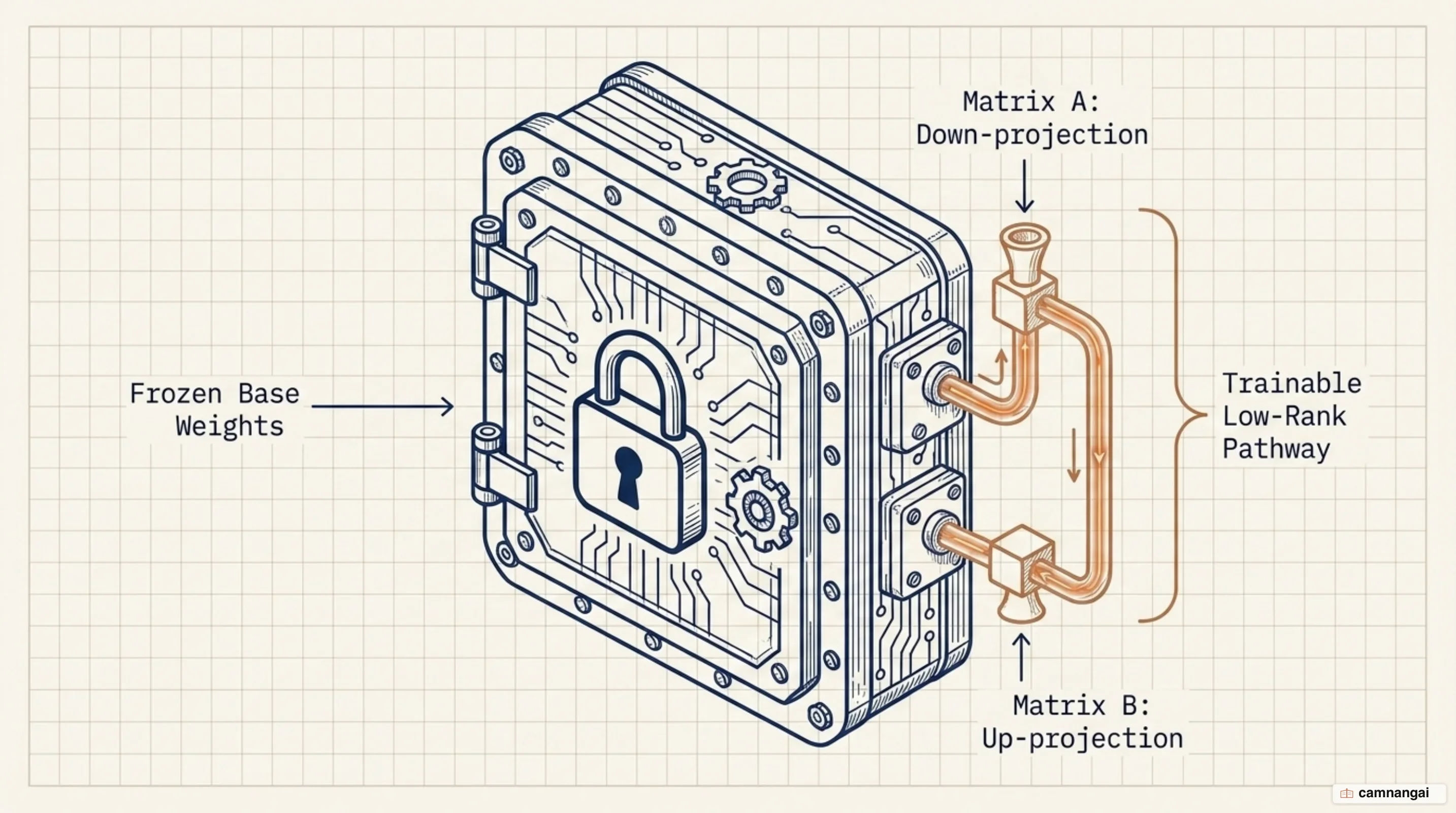
Because fine-tuning a model with billions of parameters would otherwise blow through your memory budget, you reach for Parameter-Efficient Fine-Tuning (PEFT). LoRA (Low-Rank Adaptation) is the standard approach, since it freezes the original pre-trained weights and injects small, trainable low-rank matrices into the transformer layers, which cuts both the number of trainable parameters and the GPU memory requirement without significant performance loss. QLoRA pushes further by quantizing the base model to 4-bit precision, and that is what lets you fine-tune a massive model on a single high-end GPU rather than a cluster.
How do RLHF, DPO and GRPO teach a model how to behave?
Reinforcement Learning from Human Feedback (RLHF) aims a model at preferences nobody can write down as a rule. The pipeline runs in three steps: initial SFT, then a reward model (RM) trained on human rankings through a Bradley-Terry scalar reward model, then policy optimization with Proximal Policy Optimization (PPO). The Kullback-Leibler (KL) penalty is not decoration here, because it keeps the RL policy from drifting too far from the base SFT model, and without it the policy discovers that fluent-sounding gibberish scores wonderfully with the reward model.
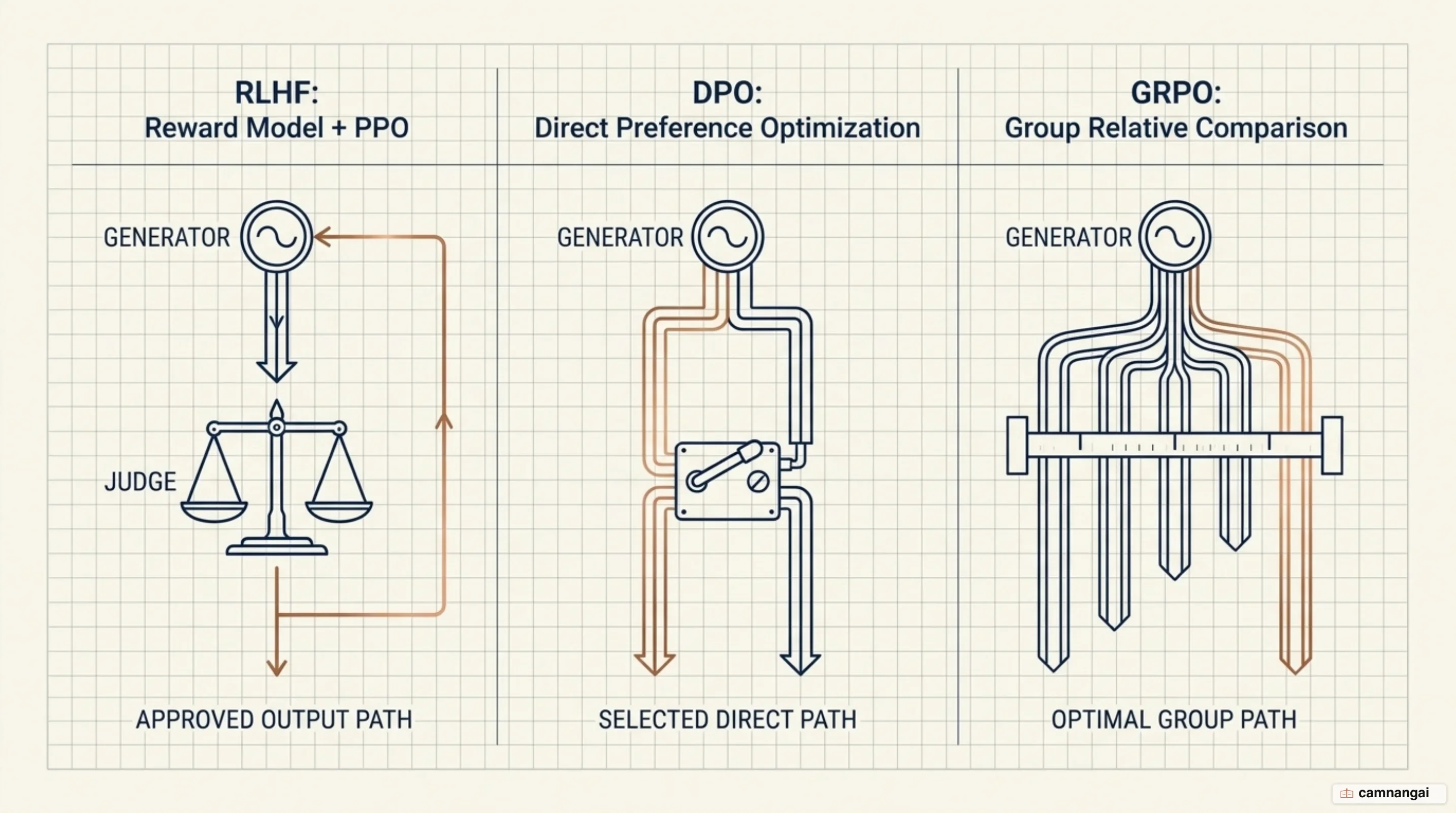
Direct Preference Optimization (DPO) is the simplified alternative, and it bypasses the reward model entirely. Instead it uses a loss function based on the log ratio of the model's probabilities for preferred versus dispreferred responses, so by treating the policy itself as the reward model, DPO ends up more stable and more computationally efficient than the PPO-based RLHF pipeline.
For complex problem-solving, Group Relative Policy Optimization (GRPO) is increasingly the interesting one. Rather than evaluating responses against an absolute scalar, GRPO generates multiple candidate responses for the same prompt and compares them within a group, so the model learns from the relative quality of these reasoning paths. That group-based relative scoring reinforces the better logical steps, which is why it improves consistency on mathematics and multi-step reasoning.
How do you know a trained model is any good?
Evaluation runs on standardized benchmarks, each with a job. MMLU measures general knowledge, while mathematical reasoning is tested through GSM8K and MATH, and coding performance is evaluated on HumanEval and MBPP. You should also look at ARC for reasoning and at Humanity's Last Exam (HLE), which currently shows low accuracy for even frontier models, and that gap is the honest reading of the distance between these systems and expert human performance.
Metrics vary by task, so multiple-choice tests use raw accuracy while coding tasks use the pass@k metric, defined as the probability that at least one of k generated samples passes functional unit tests. Open-ended conversation usually falls to "LLM-as-a-judge", where a frontier model grades a smaller model's output. I would stay skeptical of every one of these scores, because data contamination lets benchmark questions leak into the training corpus, which converts a memorization score into a reasoning score, and the leaderboard will not tell you which one you are reading.
What does it actually cost to train a model?
Compute requirements for frontier models are growing at 4-5x per year, which makes large-scale pre-training an industrial operation rather than a software project. GPT-4 is estimated at 2e25 FLOP, and Gemini Ultra at 5e25 FLOP, so scaling to those levels takes massive infrastructure investment and specialized data engineering before a single training step runs.
Once your compute requirements exceed the 1e22 FLOP threshold, you move from simple GPU clusters to dedicated hardware environments, because those clusters need high-performance interconnects and multinode multi-GPU scaling simply to hold throughput. At that scale you are also trading precision against memory, since 4-bit or 8-bit quantization is often what makes a model viable for real-world inference and deployment at all.
Should you train your own model?
For most engineering teams, pre-training a frontier model from scratch is off the table, because the compute costs and the data engineering overhead are not the kind of thing you grow into. The return sits in fine-tuning an existing open-weight model instead, and with PEFT techniques like LoRA that means one GPU, a modest set of labeled data, and a base model somebody else paid to train.
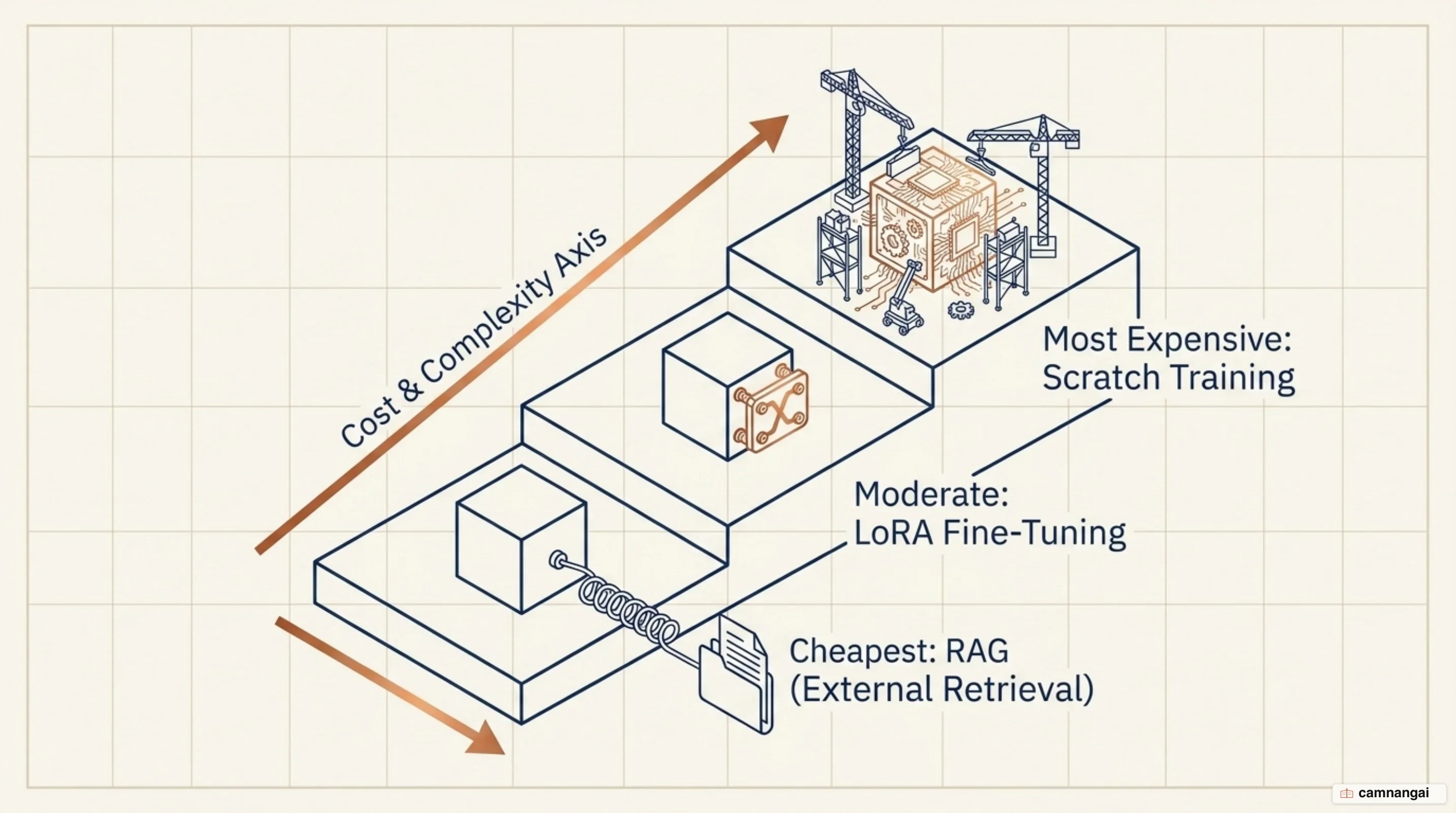
If you do fine-tune, prioritize data quality over quantity, because the current landscape favors smaller, highly specialized models adapted through SFT and DPO over massive general-purpose models for specific enterprise tasks. The decision you will actually spend your time on is the hardware-centric one, between the VRAM capacity your training run needs and the quantization precision your production inference can live with.
References
- Training and fine-tuning large language models — RBC Borealis
- Mastering LLM Techniques: Text Data Processing — NVIDIA Technical Blog
- Training Compute-Optimal Large Language Models
- Illustrating Reinforcement Learning from Human Feedback (RLHF) — Hugging Face
- Supervised Fine-Tuning — Hugging Face LLM Course
- A Technical Deep Dive into the Essential Stages of Modern Large Language Model Training, Alignment, and Deployment — MarkTechPost
- Training compute of frontier AI models grows by 4-5x per year — Epoch AI
- 30 LLM evaluation benchmarks and how they work — Evidently AI
- Training open-weight models is becoming more data intensive — Epoch AI