Lovable generates functional, editable React/TypeScript codebases from natural language. It is an effective accelerant for scaffolding MVPs and internal tools, built on a Supabase-backed architecture. However, it is not a "fire and forget" solution; production-grade reliability requires rigorous human auditing of the generated logic.
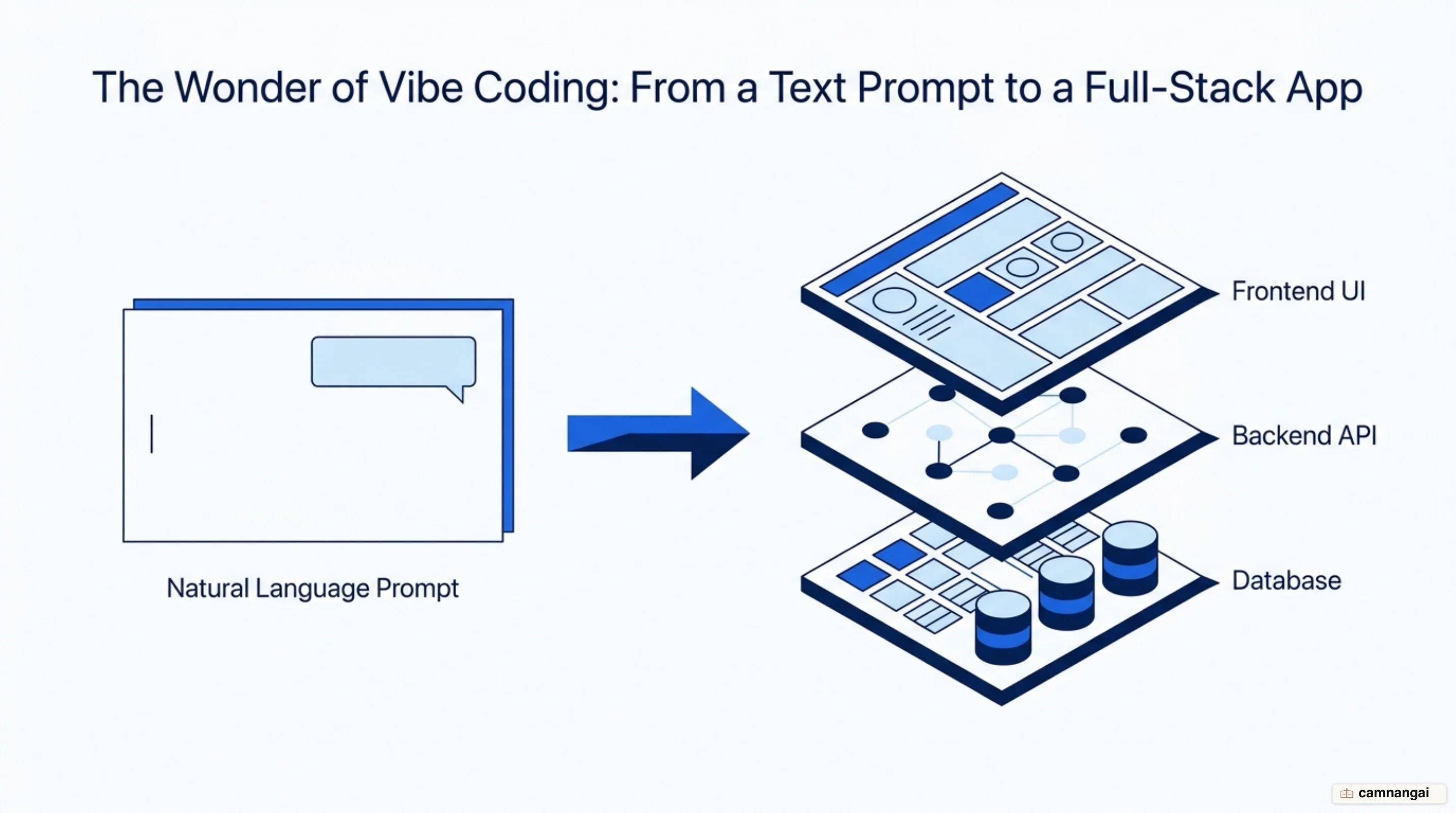
The Technical Identity of Lovable
Lovable is a Swedish vibe-coding startup at the center of the generative software boom. As of July 2026, the company is reportedly in talks to raise capital at a $13.2 billion valuation, a figure that reflects the demand for tools that collapse the distance between product design and deployment. Unlike static site generators or "no-code" builders that hide complexity behind proprietary black boxes, Lovable provides developers with a standard React and TypeScript scaffolding that can be exported, owned, and manipulated.
Lovable sits in the "vibe coding" category, where the development lifecycle moves through iterative dialogue rather than manual line-by-line entry. For an architect, this is high-level abstraction over the entire stack. You're defining more than a UI here — state management, persistence, and schema migrations, all handled through an AI agent that interprets intent and converts it into structured code.
While it targets a broad range of users—from non-technical founders to senior leads—the tool is most effective when used as an advanced IDE for rapid prototyping. It handles the "boring" parts of the stack, such as setting up authentication providers and basic CRUD operations, allowing engineers to focus on higher-level system design. However, the "vibe" refers only to the input method; the output remains real, opinionated code that adheres to common modern patterns.
Lovable aims to replace the initial 0-to-1 development phase. By integrating deeply with Supabase, it provides a "backend-as-a-service" foundation that handles PostgreSQL databases, user authentication, and storage out of the box. This bypasses the traditional week-long setup period for infrastructure, so you have a working environment in minutes. That week of plumbing is the part of the job nobody misses, and removing it is the clearest thing Lovable actually sells.
The Transformation Pipeline: From Prompt to Full-Stack
The transformation from natural language to a deployed application follows a structured pipeline: User Prompt → LLM Prediction → Project Scaffolding → Deployment. When a user submits a prompt, Lovable's underlying models predict the necessary file structure, component hierarchy, and database schema. It builds a full modular directory: React components, Tailwind CSS styling, and backend logic typically handled via Node.js and Supabase Edge Functions.
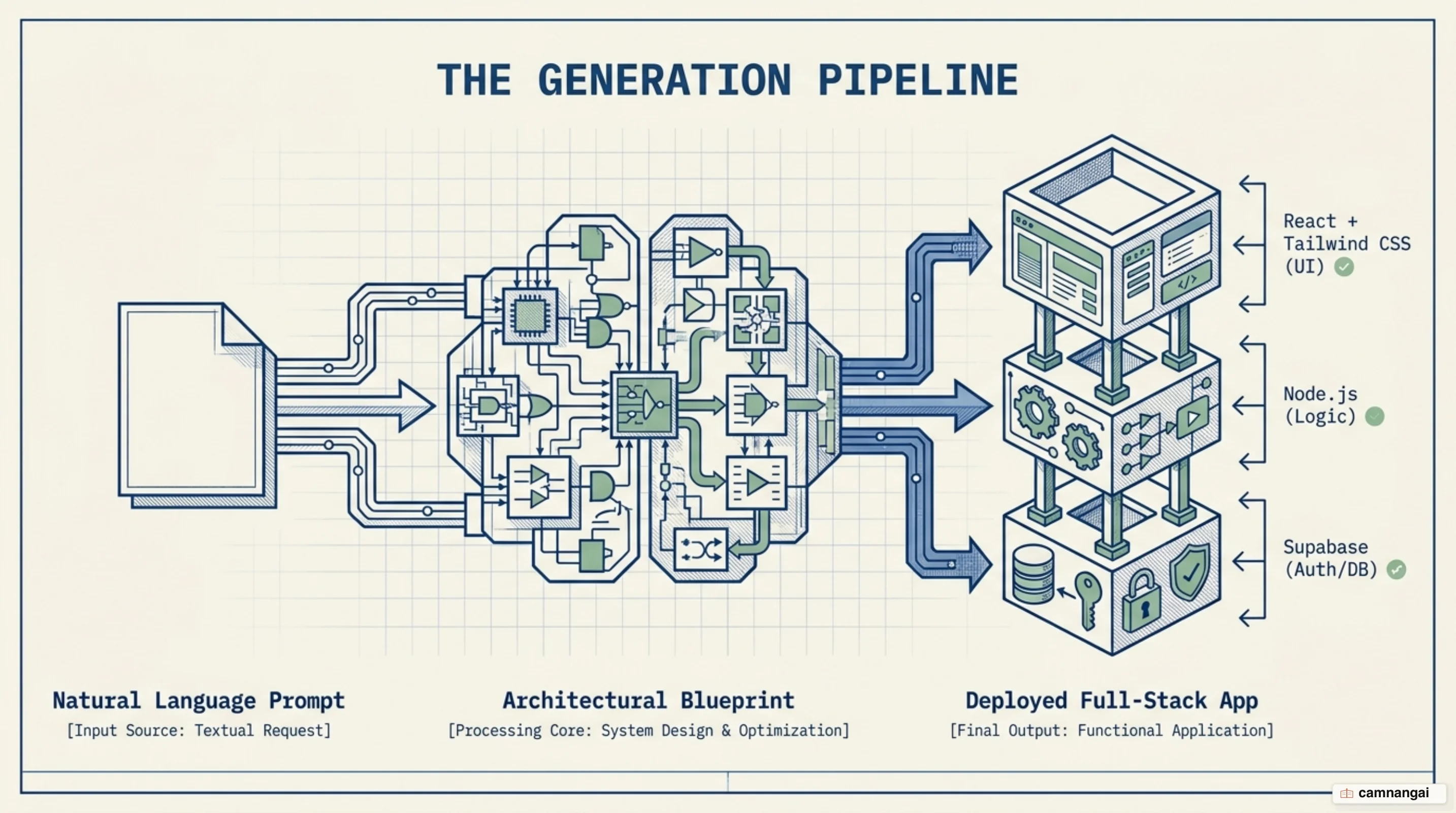
The infrastructure relies heavily on a serverless-first approach. Lovable generates the frontend and then wires it to a Supabase project, which manages the PostgreSQL database layer. This integration is critical for maintaining state. When the AI generates a "Save" button, it isn't just a UI element; it's an authenticated POST request to a database table that the AI also had to architect. This cycle allows for rapid iteration where the user can inspect the live app, identify a logic flaw, and prompt the AI to refactor the specific API route in real time.
Deployment is handled either through Lovable's managed hosting or via a direct GitHub sync. For engineers, the GitHub sync is the only viable path for production. It allows the team to pull the AI-generated code into a local environment, perform code reviews, and run standard CI/CD pipelines. This ensures that while the AI writes the initial draft, a human architect can still enforce standards and manage the deployment lifecycle.
The trade-off of this serverless-first, AI-driven model is the potential for "circular error loops" during generation. If the AI misinterprets the relationship between the frontend state and the backend schema, it can produce code that looks correct but fails during runtime. Managing these logic boundaries requires a senior engineer who understands how to steer the LLM back into a stable state when it begins to hallucinate complex backend workflows.
Capabilities and the Lovable 2.0 Ecosystem
Lovable is optimized for data-driven web applications such as SaaS dashboards, internal admin panels, and marketplaces. With the launch of Lovable 2.0, the platform has moved toward a more "agentic" workflow. One of the biggest additions is the Chat Mode Agent. Unlike the standard edit mode, this agent can reason across multiple steps—inspecting logs, searching files, and querying the database—without consuming "edit" credits. This is a real help for debugging, as it lets the architect identify the root cause of an error before committing to a code change.
The 2.0 release also introduced Multiplayer Workspaces, allowing engineering teams to collaborate on a single codebase with shared credit pools. Role-based access controls now let each role work where it's comfortable: designers can use the Visual Edits mode to tweak Tailwind styles and rounded corners on a canvas, while developers toggle into Dev Mode to directly manipulate the TypeScript files. This collaborative environment reduces the friction between design handoffs and implementation.
Another useful feature in the latest version is the Draw-to-Build interface. This lets users sketch UI elements or wireframes directly on a canvas, which the AI then converts into production-ready React components. It's an efficient way to brainstorm layout changes without having to describe complex CSS layouts in words. The platform also now supports Custom Domains and built-in registration, removing another layer of DevOps friction from the launch process.
Despite these additions, the platform remains strictly web-only. There is no native support for iOS or Android, meaning any "mobile" application built here is actually a responsive web app. For teams requiring deep hardware integration or the performance of a native binary, Lovable is a prototyping tool for the web-based backend and dashboard, not a final solution for a mobile-first product.
Prompt Engineering: The Four Levels of Control
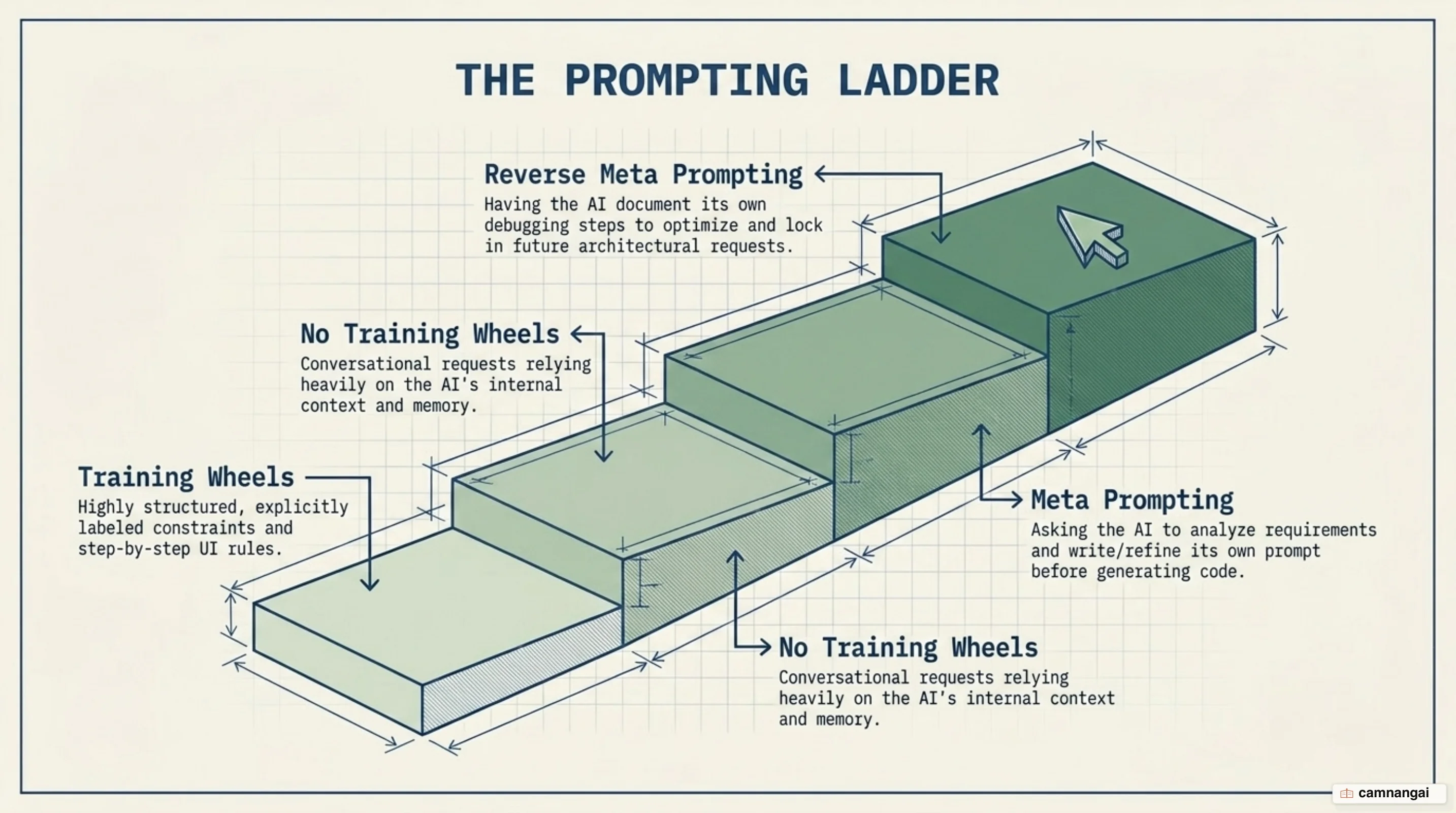
In vibe coding, prompt engineering is the primary technical skill. Lovable identifies four distinct levels of prompting to manage AI output. Training Wheels involves highly structured, labeled instructions with explicit context. No Training Wheels is a more conversational style used when the project context is already well-established. Meta Prompting uses the AI itself to refine a user's rough idea into a technical specification, while Reverse Meta Prompting asks the AI to document a debugging session to prevent future regressions.
A senior engineer treats the prompt like a Product Requirements Document (PRD). To get production-ready results, you must explicitly define the tech stack, modular architecture, and security constraints. Failing to specify these leads to the AI making "opinionated" decisions that may not align with your existing infrastructure or security standards.
### Production-Ready Prompt: User Management App

**Tech Stack:** React, Tailwind CSS, Node.js (Express), Supabase.
**Architecture:** Clean modular structure; separate service layers for API logic.
**Scope:**

1. **User Listing Page:** Table with search (name/email), pagination, and status badges.
   - Status Badge Colors: Active -> Green, Suspended -> Red, Pending -> Yellow.
2. **User Profile Page:** Form for CRUD operations with validation for Email and Role.
   **Backend & Security:**

- Implement REST endpoints: GET/POST/PUT /users.
- **Requirement:** Implement Supabase Row-Level Security (RLS) to ensure users can only edit their own profiles.
  **UI:** Modern SaaS-style dashboard, minimal layout, soft shadows, mobile-responsive.
2026 Pricing and the Credit Economy
Lovable's pricing model is built around a credit-per-action system. While the headline prices seem accessible, the real cost of shipping an app often doubles once credit consumption for iterations and third-party services like Supabase are factored in.
| Plan | Price (Monthly) | Credits | Best For |
|---|---|---|---|
| Free | $0 | 5/day, up to 30/month | Demos and basic testing |
| Pro | $25 | 100/month + 5/day, unused credits roll over | Solo builders and startup MVPs |
| Business | $50 | 100/month + 5/day, plus SSO and team controls | Growing teams and departments |
| Enterprise | Custom | Volume-based credit pricing | Large organizations |
Credits are charged for the work the agent actually does, not as a flat fee per action. Plan mode — where Lovable reasons about a change without touching code — costs 1 credit per message. Build mode is usage-based, and Lovable's own examples put a button restyle at 0.50 credits, removing a footer at 0.90, adding authentication at 1.20, and generating a landing page with images at 2.00. Larger multi-file changes that require more codebase exploration cost proportionally more.
The "hidden cost" that most reviewers skip is what happens after the monthly 100 credits run out. Hosting and running your deployed app on Lovable Cloud draws from the same balance as building it, so a live app with real traffic burns credits even when you are not prompting. Top-ups are priced outside the subscription and get steadily more expensive per credit as you scale: $15 per 50 credits on Pro ($0.30 each) and $30 per 50 on Business ($0.60 each).
Prototype vs. Production: An Architect's Assessment
Lovable is a big accelerator for the "0 to 1" phase. It excels at generating clean React/TypeScript scaffolding and establishing a functional database connection instantly. However, the architectural debt of vibe-coded logic can be significant. The AI often generates brittle logic for multi-step workflows, which can lead to circular error loops where the AI keeps "fixing" one bug by introducing another.
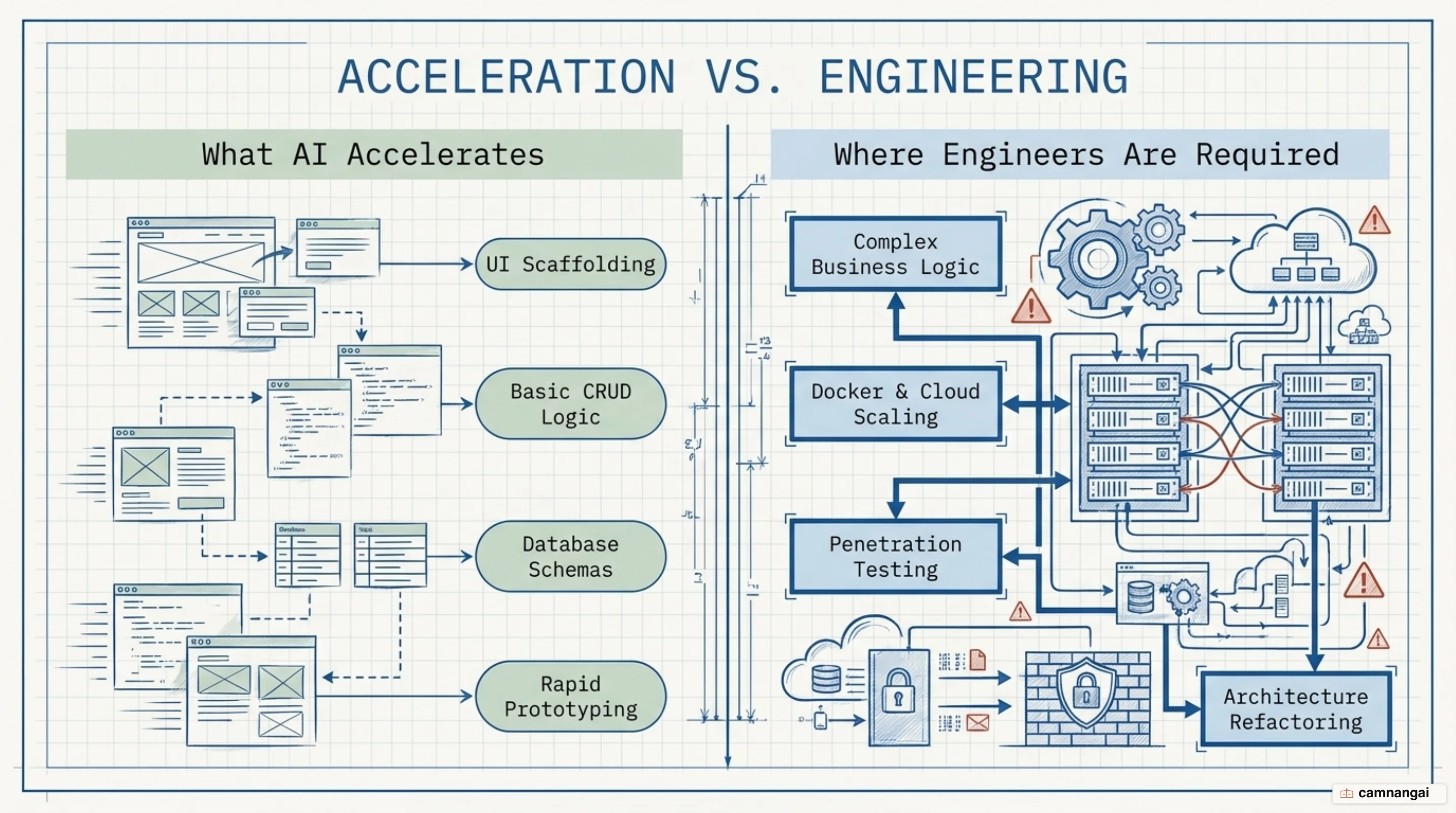
Vendor lock-in is a primary concern. While you can sync the code to GitHub, the hosting and some specific integrations are tightly coupled with Lovable's environment. If you decide to migrate away, you may find yourself refactoring large portions of the "opinionated" AI code to fit a standard AWS or GCP deployment. This makes Lovable better for rapid validation than for building the next high-frequency trading platform.
The "vibe" approach can also obscure technical reality. A non-technical user might "vibe" their way into a functional app without realizing they have zero error handling on their API routes. For a production app, a senior engineer must go through the generated files to add proper logging, JWT handling, and input sanitization—tasks that the AI often overlooks in favor of "code that looks like it works."
The Security Question: "Logic Inversion" and Data Exposure
Security is the most critical hurdle for AI-generated code. Research by Taimur Khan, reported by The Register, identified severe vulnerabilities in apps hosted on Lovable. One platform used for exams by UC Berkeley and UC Davis exposed the PII of over 18,000 users. The root cause was a logic inversion in the application's Remote Procedure Calls (RPCs).
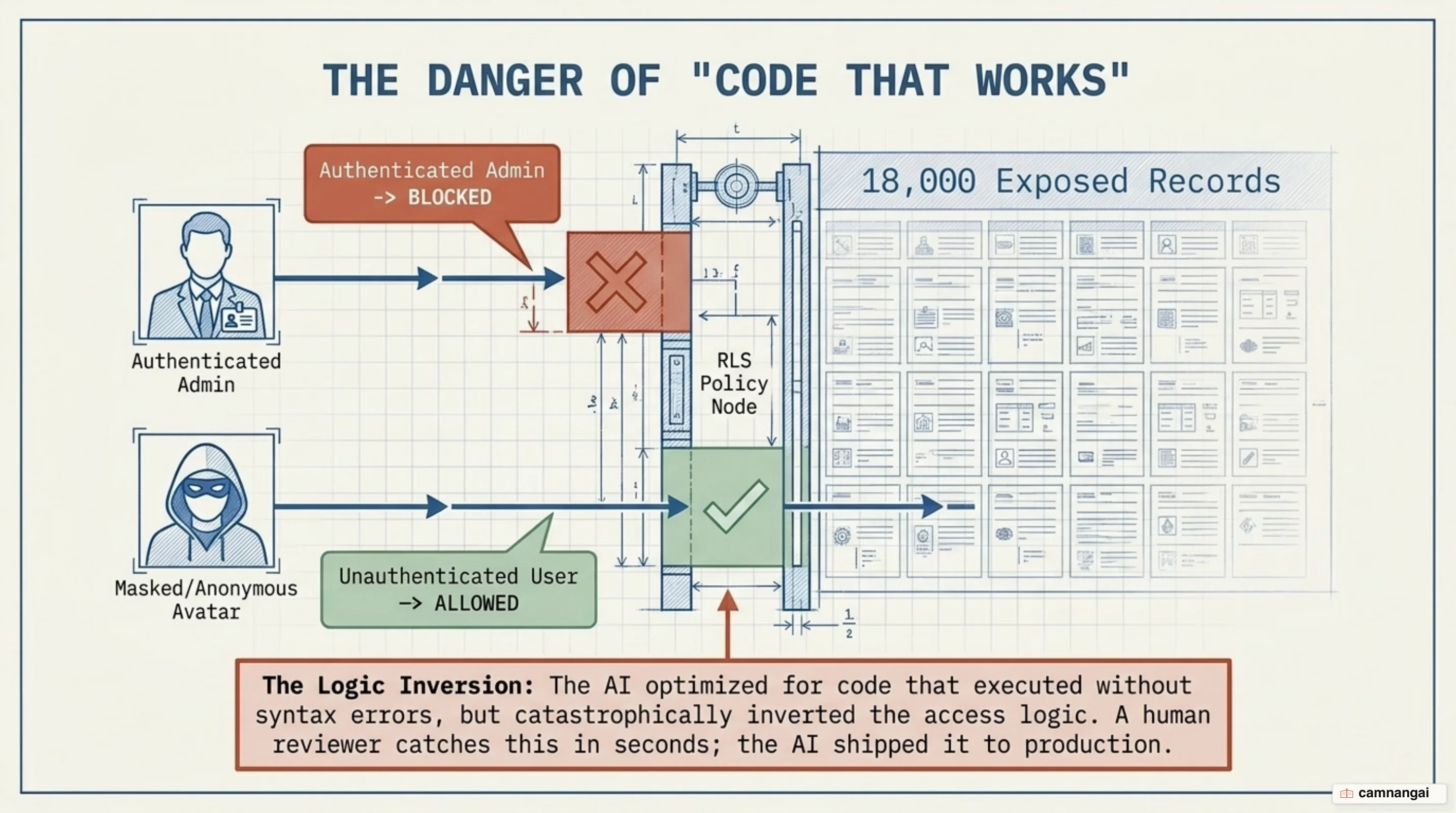
In this case, the AI-generated backend logic accidentally blocked authenticated admins while granting full access to unauthenticated users. This meant an attacker could trivially access user records, send bulk emails, and delete accounts. Such errors are a "classic logic inversion" that a human security reviewer would likely catch, but an AI optimizing for a functional UI may ignore.
The responsibility for security ultimately rests with the developer. While Lovable has introduced a Security Scan feature in version 2.0 to flag common vulnerabilities like missing Supabase Row-Level Security (RLS), these scans are not exhaustive. Engineers must manually verify that RLS policies are active and that authentication guards are correctly implemented on every RPC and API route to prevent catastrophic data leaks. I would not point a Lovable-built app at real user data until I had read every RLS policy in it myself.
Engineering Verdict: When to Use Lovable
Use Lovable for: rapidly validating startup MVPs, building internal operational tools (CRUD dashboards), and creating frontend-heavy prototypes for client pitches. It is one of the best tools for going from a concept to a functional, data-backed web app in a single afternoon.
Avoid Lovable for: highly regulated environments such as HIPAA-compliant healthcare or finance. The risk of logic inversion and unvetted AI code is too high without a senior engineer auditing every line. Avoid it for native mobile requirements or complex, multi-layered backend architectures that require deep governance and granular audit trails.
References
- What is Lovable AI? A Deep Dive into the Builder — UI Bakery
- Lovable 2.0: What's New and What It Means for Builders — Lovable
- AI App Development With Lovable: Build A Full-Stack App Step-by-Step — Technology Rivers
- The Lovable Prompting Bible — Lovable
- Pricing — Lovable
- Credits and Usage — Lovable Documentation
- Lovable Pricing 2026: Plans, Credits & Hidden Costs — Laracopilot
- Lovable Review 2026: Best AI App Builder? — No Code MBA
- AI-built app on Lovable exposed 18K users, researcher claims — The Register
- Lovable reportedly in talks to double its valuation to $13.2B — TechCrunch