Anthropic officially released Claude Opus 5.5 on September 22, 2026, marking the first model in the new Claude 5.5 generation. Specifically architected for long-running agentic coding and complex enterprise knowledge work, the model bridges the performance gap with Anthropic's reasoning flagship, Claude Fable 5.1, while cutting operational expenditure substantially.
Claude Opus 5.5 delivers performance on par with Fable 5.1 across critical software engineering tasks while reducing operational compute costs by 40% compared to Opus 5, backed by an always-on adaptive thinking engine across its full 1M token context window.
For teams maintaining autonomous development loops, Opus 5.5 alters the economics of high-context workflows: output generation speeds are over 30% faster than Opus 5, and prompt caching costs drop by 60%, removing the primary bottleneck for continuous repository scanning and multi-step reasoning pipelines.
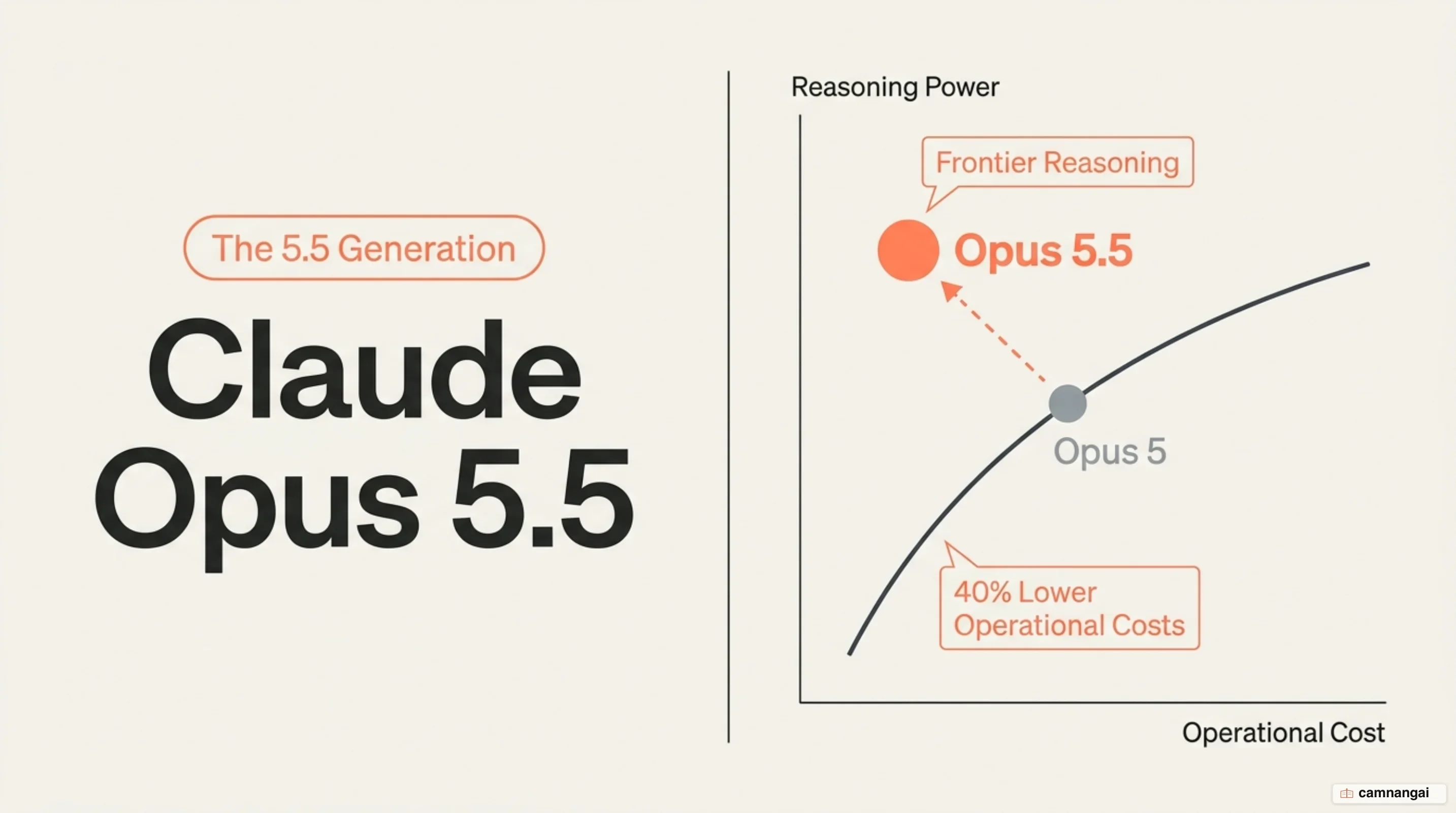
What is Claude Opus 5.5 and where it fits in the Claude 5.5 family
Within the Claude 5.5 lineup, Claude Opus 5.5 is the flagship workhorse for production-grade automation, high-scale codebase management, and intensive enterprise problem solving.
While Fable 5 remains dedicated to niche mathematical proofs and restricted scientific tasks, Opus 5.5 effectively supersedes both Opus 5 and standard frontier baselines for general enterprise deployment. It combines lower latency with high-horizon reasoning, making it the default model for autonomous engineering agents.
The model provides a 1M token context window by default, paired with a 128k maximum output token limit on the Messages API. In daily use, Anthropic retrained the communication style to surface key findings and core architectural decisions first. By cutting unnecessary conversational filler and prioritizing actionable insights, the model makes debugging and reviewing long-running sessions significantly more efficient.
| Specification | Claude Opus 5.5 | Claude Fable 5.1 | Claude Opus 5 |
|---|---|---|---|
| Input / Output Price (per 1M tokens) | $4 / $20 | $10 / $50 | $5 / $25 |
| Context Window | 1,000,000 | 1,000,000 | 1,000,000 |
| Max Output Limit | 128,000 | 128,000 | 128,000 |
| Thinking Architecture | Always-on (Mandatory) | Always-on (Mandatory) | Adaptive (Optional) |
Agentic coding performance and real-world benchmarks
Benchmark evaluations establish Claude Opus 5.5 as a leading model for agentic coding and computer use:
- Terminal-Bench 4.0: Scores 66.4% at
xhigh effort, matching or exceeding GPT-6 Astra (57.9% athigh effort) while operating at roughly 40% of the cost. - FrontierCode v1.1: Reaches 54.4%, surpassing GPT-6 Astra's 53.3%.
- CursorBench 4.0: Scores 57.8%, outperforming GPT-5.6 Sol (41.7%) by 16 points.
- Humanity's Last Exam: Reaches 67.7% when equipped with tool-use capabilities.
- OSWorld 2.0 (Computer Use): Achieves 81.8% partial completion score.
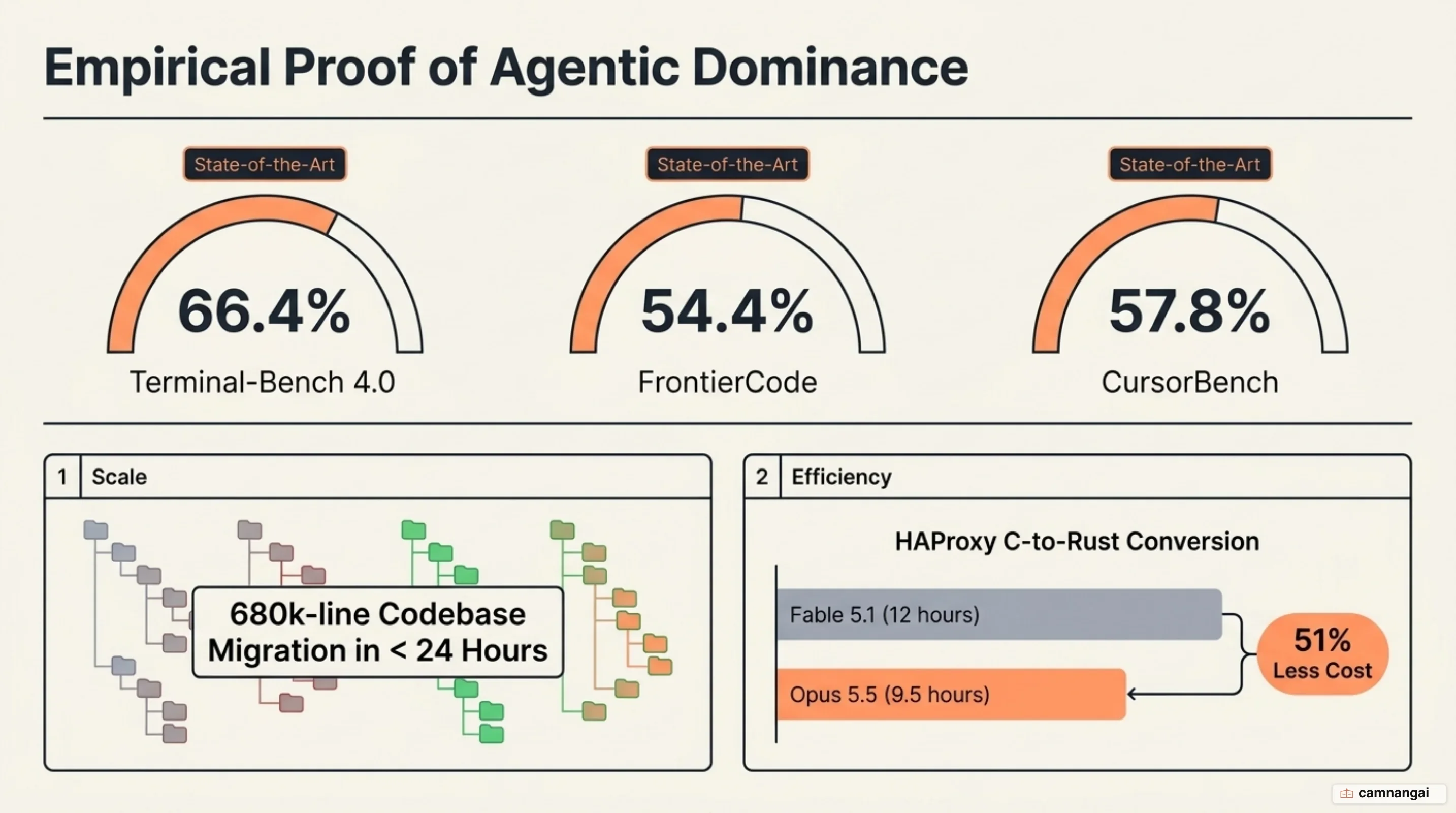
In production modernization tests, an early partner completed a 680,000-line codebase migration in less than 24 hours — an operation that typically demands weeks of engineering manpower. When tasked with eliminating load-time bottlenecks across entire web applications, Opus 5.5 achieved a 39/40 success rate without modifying existing business logic.
In internal systems translation tests converting the HAProxy load balancer from C to Rust, Claude Opus 5.5 completed the entire codebase in 9.5 hours (compared to 12 hours for Fable 5.1) and passed nearly all native regression tests, delivering a 51% reduction in total compute cost.
Always-on adaptive thinking and controlling depth with effort
Claude Opus 5.5 implements an always-on adaptive thinking architecture. Extended reasoning can no longer be toggled off; sending thinking: {"type": "disabled"} via the API will return a 400 Bad Request error.
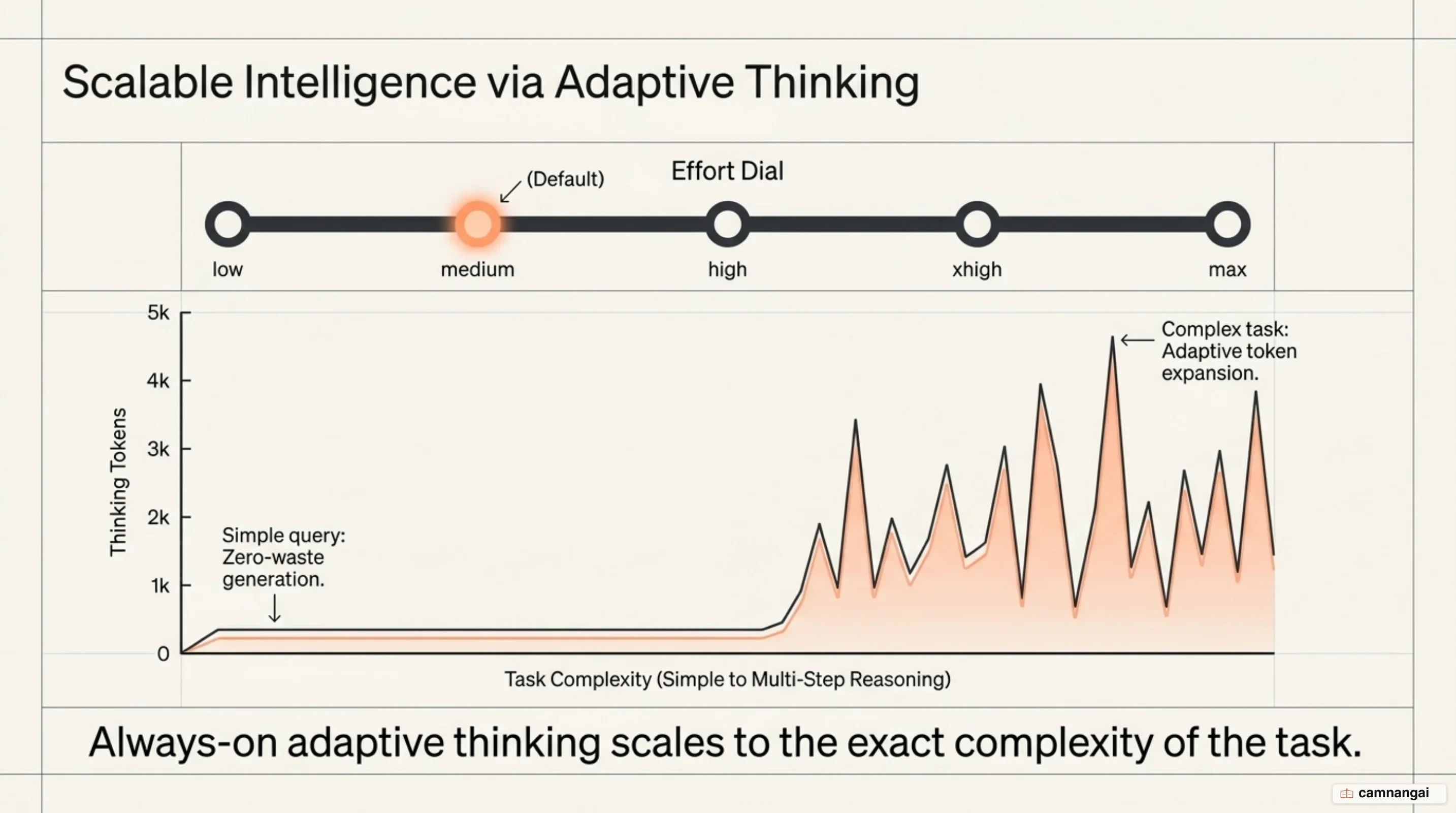
Instead of binary on/off switches, developers govern reasoning compute through the effort parameter. The model automatically evaluates task difficulty to allocate thinking tokens, preventing excessive token consumption on routine requests. Supported levels include low, medium (default), high, xhigh, and max. In practice, the low effort setting matches previous Opus 5 quality while achieving lower latency and cheaper operation.
Example API configuration for Messages API:
{
  "model": "claude-opus-5-5",
  "max_tokens": 4096,
  "messages": [
    {
      "role": "user",
      "content": "Perform an end-to-end security audit and architectural refactoring of this distributed streaming pipeline..."
    }
  ],
  "output_config": {
    "effort": "xhigh"
  }
}
The economics: 40% lower operational cost, 60% cheaper cache reads, and Fast mode
Direct pricing is set at $4 per million input tokens and $20 per million output tokens (a 20% cut from Opus 5). However, higher token efficiency during intermediate reasoning steps drives total workload savings to approximately 40%.
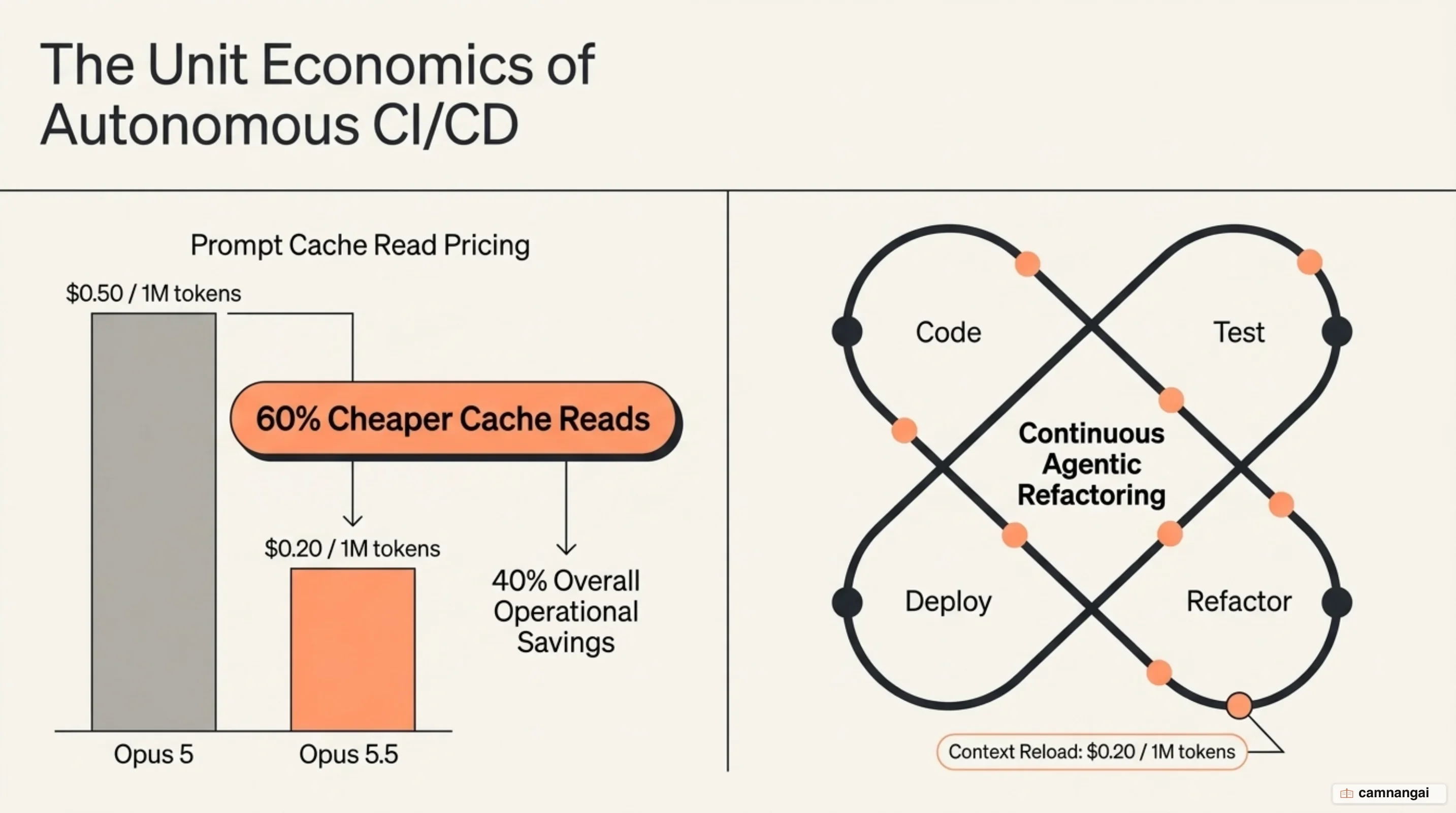
The most consequential financial shift is in prompt caching: Cache reads cost $0.20 per million tokens, representing a 60% reduction compared to Opus 5 ($0.50). For autonomous agents executing frequent loops over a large repository context, prompt cache reads dominate operational expenses. Slashing this cost transforms Opus 5.5 into an economically sustainable foundation for continuous integration workflows.
| Cost Component | Claude Opus 5 (per 1M) | Claude Opus 5.5 (per 1M) | Delta (%) |
|---|---|---|---|
| Input Tokens | $5.00 | $4.00 | 20% Reduction |
| Output Tokens | $25.00 | $20.00 | 20% Reduction |
| Cache Reads | $0.50 | $0.20 | 60% Reduction |
| Cache Writes | $6.25 | $5.00 | 20% Reduction |
Anthropic also introduced a Fast mode on Claude Code and the Claude Platform that provides up to 2.5x speed improvements at $8/$40 per million tokens. Subscribers on Pro, Max, Team, and Enterprise plans receive expanded 5-hour usage windows, along with banked rate limit resets that power users can hold and activate during peak delivery crunch.
Multi-cloud availability and API migration considerations
Claude Opus 5.5 is available immediately across the Claude API (claude-opus-5-5), Amazon Bedrock, Google Cloud (Vertex AI), and Microsoft Foundry.
When planning migration from older deployments, infrastructure engineers should account for three breaking behavioral adjustments:
- Forced Tool Choice Restrictions: Specifying
tool_choiceasanyor naming an explicittoolis unsupported alongside adaptive thinking and returns an API error. Implementations should adoptautopaired with strict JSON schemas. - Computer Use Upgrades: Computer use integrations must target
computer_toolset_20260801. Prior toolsets are deprecated and rejected by the API. - Preserved Thinking Protections: To mitigate distillation and proprietary reasoning extraction, accounts established after August 31, 2026 enforce preserved thinking controls, preventing developers from mutating historical context to expose internal chain-of-thought blocks.
When should you upgrade to Claude Opus 5.5?
If your systems currently run on Opus 5, migrating to Claude Opus 5.5 is an immediate win: you gain reasoning on par with Fable 5.1, superior coding follow-through, and a 40% reduction in operational cost. It is currently the strongest foundation for autonomous refactoring, complex bug localization, and high-consequence data extraction.
The primary constraint to monitor is Anthropic's tightened safety classifiers, which match the strict controls on Fable 5.1. For specialized offensive cybersecurity workflows, the model may return refusal responses. In these scenarios, configure automated fallback pipelines to Opus 4.8 or plan your architecture around Claude Sonnet 5.5, which Anthropic expects to release in the coming weeks.