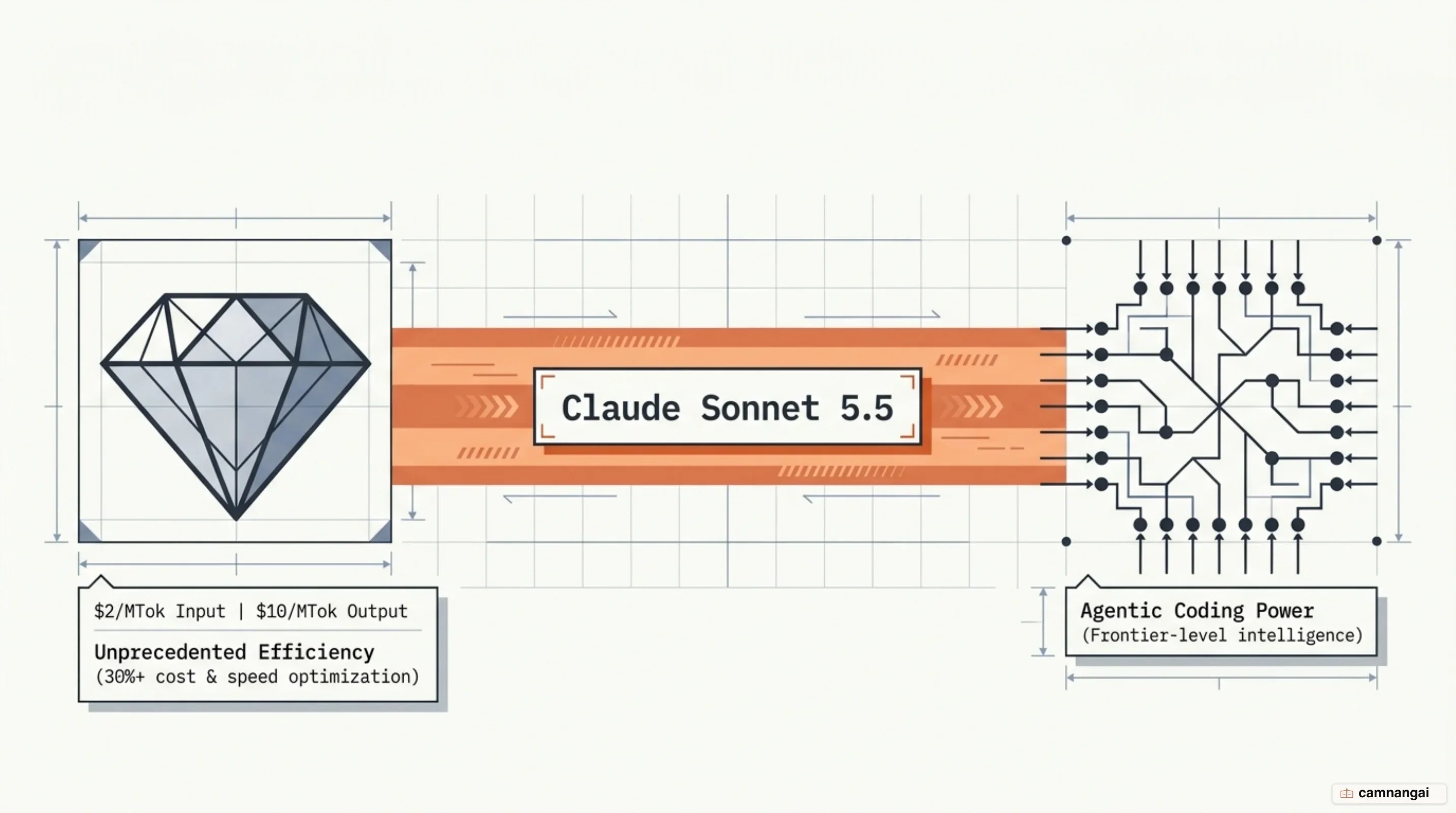
Anthropic officially released Claude Sonnet 5.5 on September 28, 2026, marking the second model in the frontier Claude 5.5 family. Functioning as the high-speed successor to Sonnet 5, it delivers a 30% increase in generation speed and a substantial leap in agentic coding while maintaining the $2 per million input token price floor.
Claude Sonnet 5.5 scores 70.6% on Terminal-Bench 4.0 and cuts effective cost per task by up to 30% through tighter reasoning density and efficient tool batching.
The model is engineered to bridge the gap between operational efficiency and frontier-level intelligence, serving as the fast, everyday workhorse across IDEs, automated terminal workflows, and high-frequency production pipelines.
Sonnet 5.5 shifts the deployment calculus: delivering near-Opus execution quality at a fraction of the operational cost.
What Claude Sonnet 5.5 Is and Its Place in the Claude 5.5 Lineup
Claude Sonnet 5.5 occupies the central position within the Claude 5.5 model family. It is architecturally situated between the high-intelligence Claude Opus 5.5, which handles open-ended orchestration and sustained judgment, and the upcoming Claude Haiku 5.5, which is optimized for high-volume, cost-sensitive applications. Developers should categorize Sonnet 5.5 as the "high-speed workhorse" of the lineup, specifically designed for tasks with well-defined scopes and strict latency requirements.
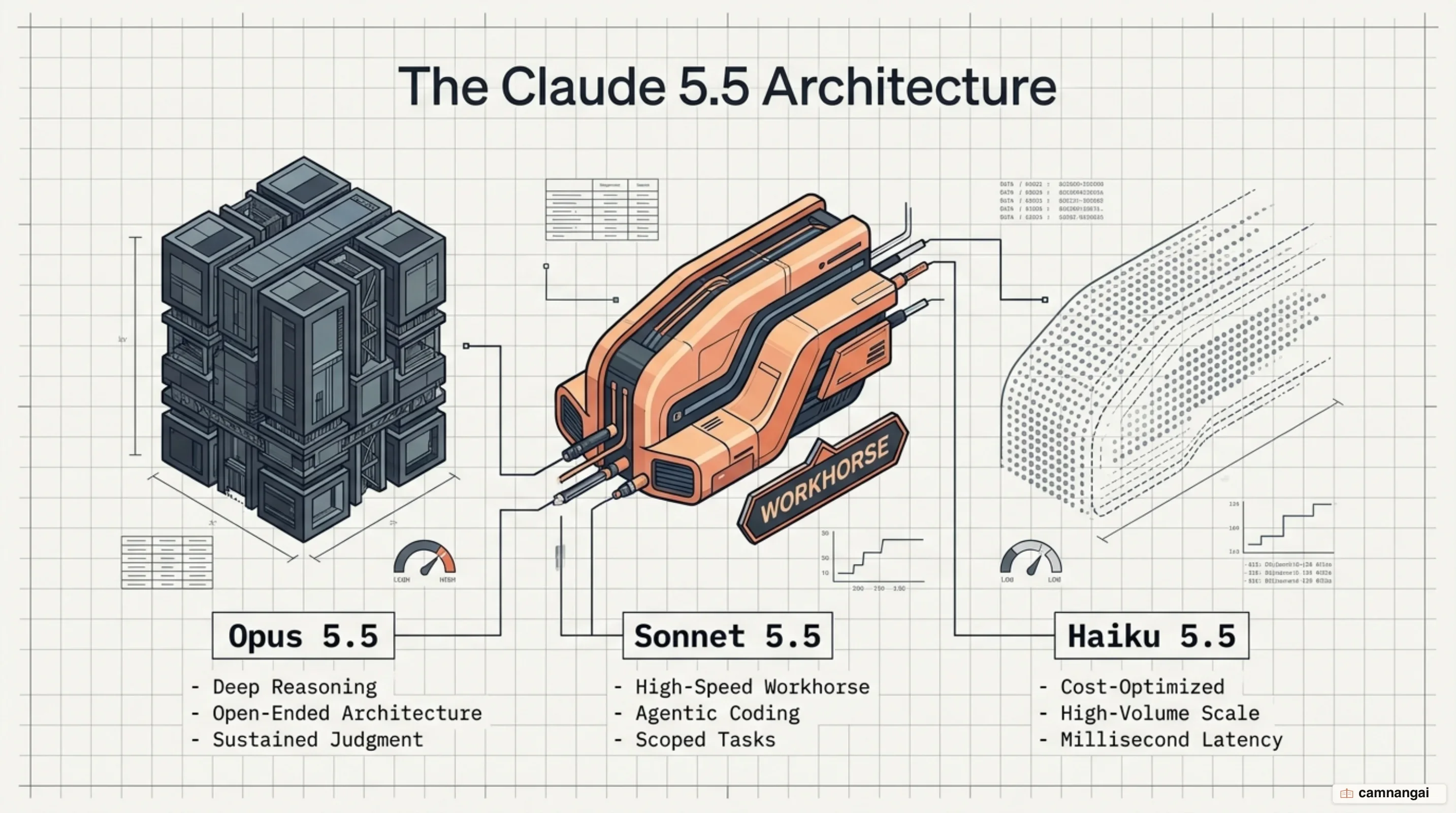
In a production model architecture, Sonnet 5.5 is a faster, lower-cost complement to the Opus tier. While Opus 5.5 remains the standard for tasks requiring complex strategic decisions and long-horizon context retention, Sonnet 5.5 matches or exceeds Opus-level performance on specific engineering benchmarks. Its deployment is recommended for environments where execution speed directly correlates to operational throughput, such as real-time developer workflows and high-frequency CI/CD pipelines.
Availability is immediate across several infrastructure environments. Developers can access Claude Sonnet 5.5 through the primary Claude API and the Claude Console. For enterprise-grade scaling, it is hosted on AWS (Amazon Bedrock and Claude Platform on AWS), Google Cloud (Vertex AI), and Microsoft Foundry. Furthermore, it is the active model for the free tier on the Claude web, iOS, and Android applications, providing a higher capability ceiling than competing free-tier offerings.
Coding Performance and the Major Leap on Real-World Benchmarks
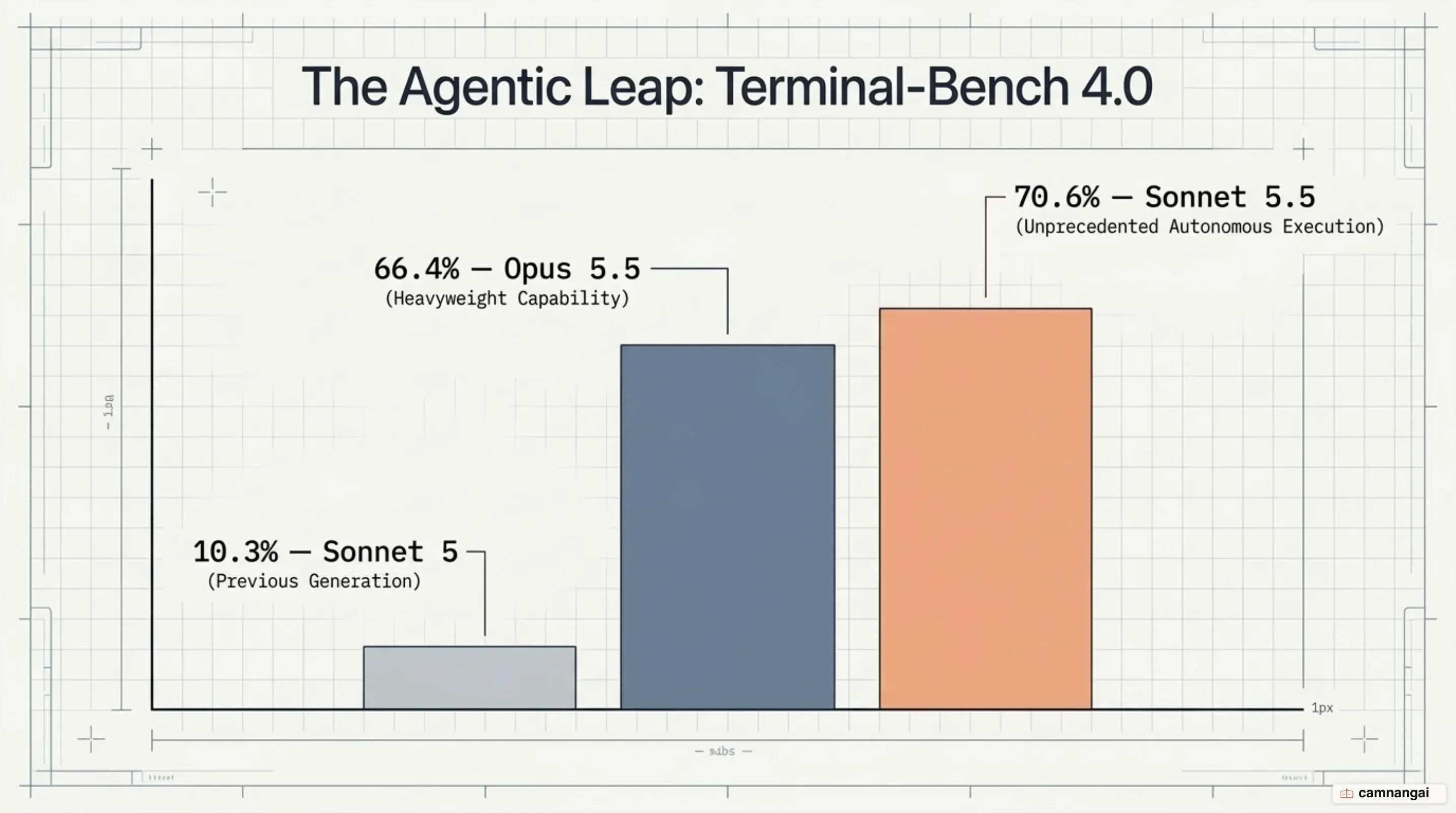
Evaluating the delta in agentic efficiency reveals a significant leap in command-line environments. On Terminal-Bench 4.0, Claude Sonnet 5.5 achieved a 70.6% accuracy rate, representing a dramatic increase from the 10.3% recorded by Sonnet 5. This score benchmarks above the 66.4% recorded by Opus 5.5 at extra-high effort. This performance leap results from the model's ability to batch tool calls and avoid redundant subagent spawning, which keeps task loops optimized and reduces state-tracking errors.
The table below summarizes performance across standard agentic coding and reasoning benchmarks:
| Benchmark | Claude Sonnet 5.5 | Claude Sonnet 5 | Claude Opus 5.5 | GPT-6 Sol |
|---|---|---|---|---|
| Terminal-Bench 4.0 (%) | 70.6% | 10.3% | 66.4% | — |
| FrontierCode 1.1 (%) | 52.1% (Xhigh) | 42.4% | 54.4% | 49.3% |
| CursorBench 4.0 (%) | 55.5% | 34.1% | 57.8% | — |
| GDPval-AA v2.1 (Elo) | 1844 | 1449 | 1846 | 1487 |
| OSWorld 2.1 (% partial) | 80.1% | 57.0% | 81.8% | — |
Testing data from developer platforms confirms that Sonnet 5.5 follows a much steeper efficiency curve. In practical application, the model requires approximately one-third fewer tool calls and 50% fewer shell executions to complete a task. At the medium effort setting—the default for most platform integrations—Sonnet 5.5 exceeds the maximum performance of Sonnet 5 while operating at approximately one-tenth of the effective cost per task.
Visual perception and system automation capabilities have also seen notable gains. Sonnet 5.5 achieved an 80.1% partial pass rate on OSWorld 2.1, evaluating operating system automation via visual interfaces. The model's vision-based reasoning is demonstrated by its success in completing Pokémon Red using only screenshot inputs, a feat not possible on previous Sonnet models.
Adaptive Reasoning and Operating Cost Optimization
The economic model for Claude Sonnet 5.5 centers on reducing the volume of tokens required to resolve a task. Although list prices remain identical to Sonnet 5—$2.00 per million input tokens and $10.00 per million output tokens—the effective cost per task drops by up to 30%. This efficiency stems from tighter reasoning chains and aggressive batching of tool executions.
Engineering teams must account for the updated tokenizer introduced with the 5.5 series. This tokenizer produces approximately 30% more tokens for the same raw text block compared to older generations. However, because the model resolves tasks in substantially fewer steps, net token consumption per session remains lower overall.
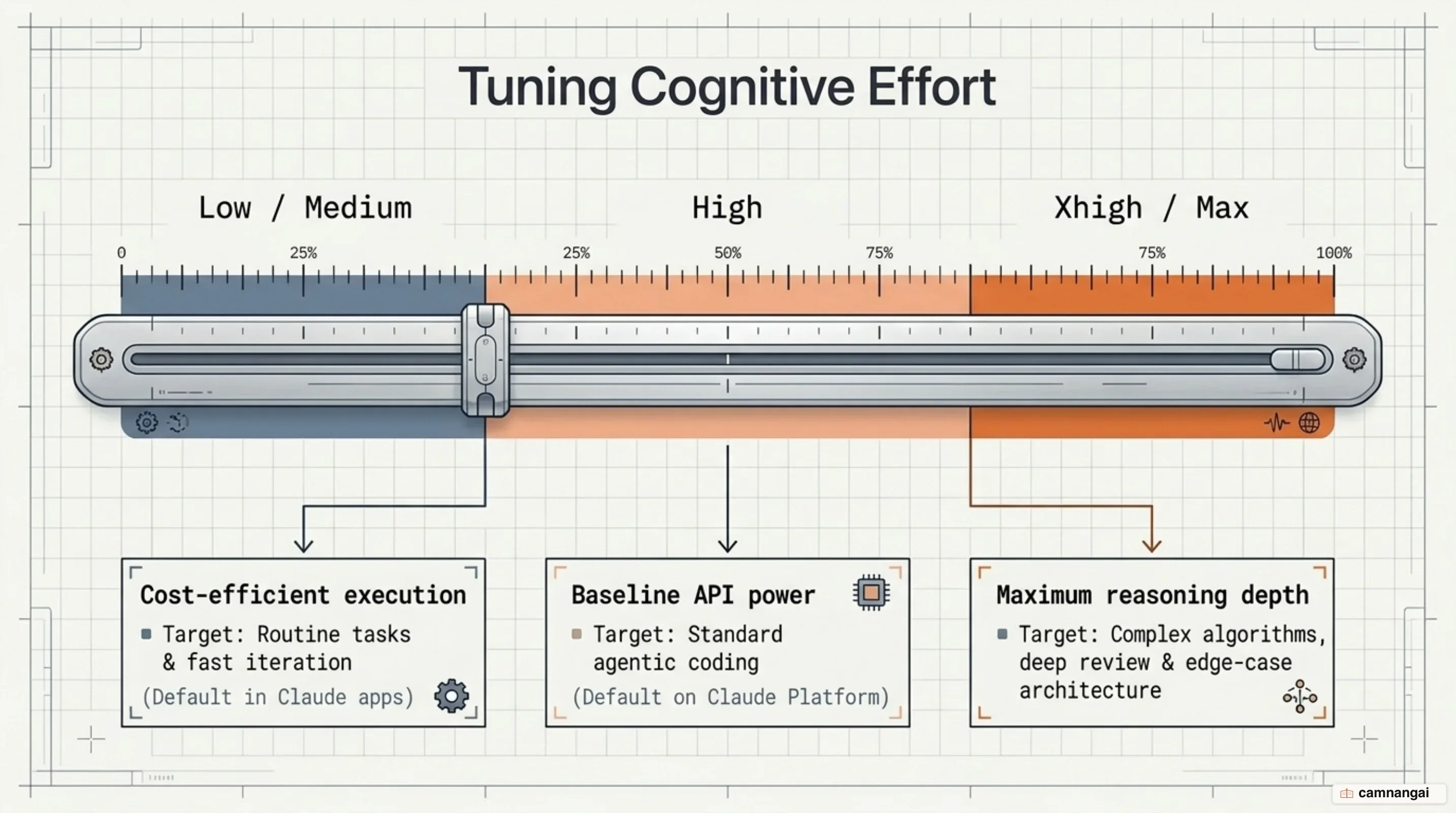
The effort parameter (Low, Medium, High, Xhigh, Max) replaces manual thinking budgets, allowing developers to tune latency against depth of thought. Low and medium effort settings minimize latency and cost for routine work, while higher settings trigger thorough self-verification. On FrontierCode 1.1, teams should note that max effort recorded 46.2% versus 52.1% at xhigh, as excessive reasoning loops can cause timeouts or over-refactoring.
| Cost Component (per 1M Tokens) | Claude Sonnet 5.5 | Claude Opus 5.5 | Variance (%) |
|---|---|---|---|
| Input Tokens | $2.00 | $4.00 | 50% lower |
| Output Tokens | $10.00 | $20.00 | 50% lower |
| Prompt Cache Reads | $0.20 | $0.20 | Parity |
| Prompt Cache Writes | $2.50 | $5.00 | 50% lower |
Technical API Changes and Migration Breaking Changes
Migrating production workloads from Sonnet 5 to Claude Sonnet 5.5 requires addressing five breaking changes to prevent 400 Bad Request errors:
- Thinking Configuration: Disabling up-front thinking at high effort or below now requires explicitly passing
thinking: {"type": "between_tools"}rather than legacy disable flags. - Tool Choice Support: The
tool_choiceoptionsanyandtoolare deprecated and return 400 errors. Workflows must adoptautoalongside structured outputs. - Preserved Thinking Signatures: Thinking blocks are now cryptographically bound to specific API accounts. Submitting a thinking block generated by an unlinked account will cause the API to drop it automatically, preventing multi-account distillation or unauthorized pooling.
- Computer Use Deprecation: The older
computer_20251124tool identifier is no longer supported on the Claude API or Google Cloud. Upgrading tocomputer_toolset_20260801or later is required. - Sampling Parameters: When thinking mode is active,
temperature,top_p, andtop_kmust remain at their default values; passing custom values will trigger validation errors.
Messages API configuration example using the effort parameter:
{
  "model": "claude-sonnet-5-5",
  "max_tokens": 4096,
  "output_config": {
    "effort": "high"
  },
  "thinking": {
    "type": "between_tools"
  },
  "messages": [
    {
      "role": "user",
      "content": "Analyze the codebase and propose a patch for the memory leak in the streaming module."
    }
  ]
}
When to Choose Sonnet 5.5 Over Opus 5.5
Selecting the optimal model depends on task scope, reasoning complexity, and iteration frequency. Deploy Claude Sonnet 5.5 for high-frequency engineering workflows, including code generation, targeted bug mitigation, and automated pull request reviews. It is also the superior choice for real-time customer support implementations and high-throughput document synthesis where latency and cost dictate viability.
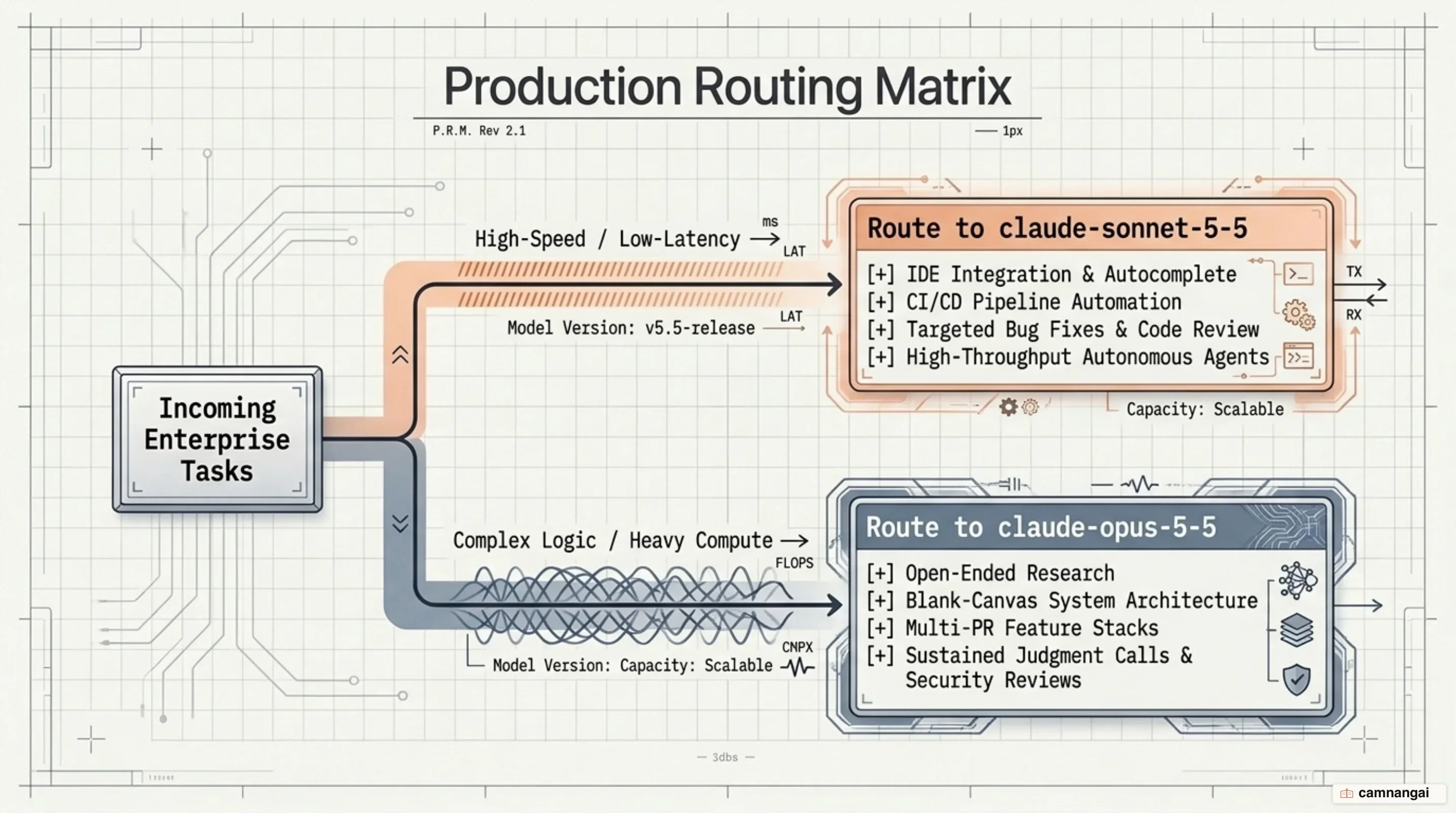
Reserve Claude Opus 5.5 for open-ended research, novel architectural design, and complex multi-agent orchestration where precision outweighs latency. While Sonnet 5.5 matches Opus on well-scoped benchmarks, Opus 5.5 remains unmatched for problems requiring sustained judgment across massive, loosely defined contexts.
References
- Introducing Claude Sonnet 5.5 — Anthropic
- Claude Sonnet Overview & Specifications — Anthropic
- Claude Platform Release Notes — Anthropic API Docs
- Claude Sonnet 5.5 Benchmarks Explained: Coding, Speed & Cost — Vellum
- Sonnet 5.5 vs Opus 5.5 Code Review Benchmarks — CodeRabbit
- Claude Sonnet 5.5 in GitHub Copilot — GitHub Changelog
- Introducing Claude Sonnet 5.5 on AWS — Amazon Web Services
- Claude Sonnet 5.5 Release Analysis — Simon Willison's Weblog