Anthropic released Claude Haiku 5.5 on October 7, 2026, as its fastest, lowest-cost small reasoning model to date. When you design high-throughput software systems or multi-agent pipelines, this model is an optimized engine for high-volume, latency-sensitive operations and subagent execution.
Claude Haiku 5.5 is Anthropic's fastest, lowest-cost small reasoning model, designed for high-volume, latency-sensitive operations and subagent execution.
Haiku 5.5 targets high-volume enterprise workloads including document summarization, data compaction, field extraction, database query routing, and automated classification. In live production environments, you can deploy it to power real-time experiences such as low-latency voice agents, interactive customer support systems, and active in-app assistance.
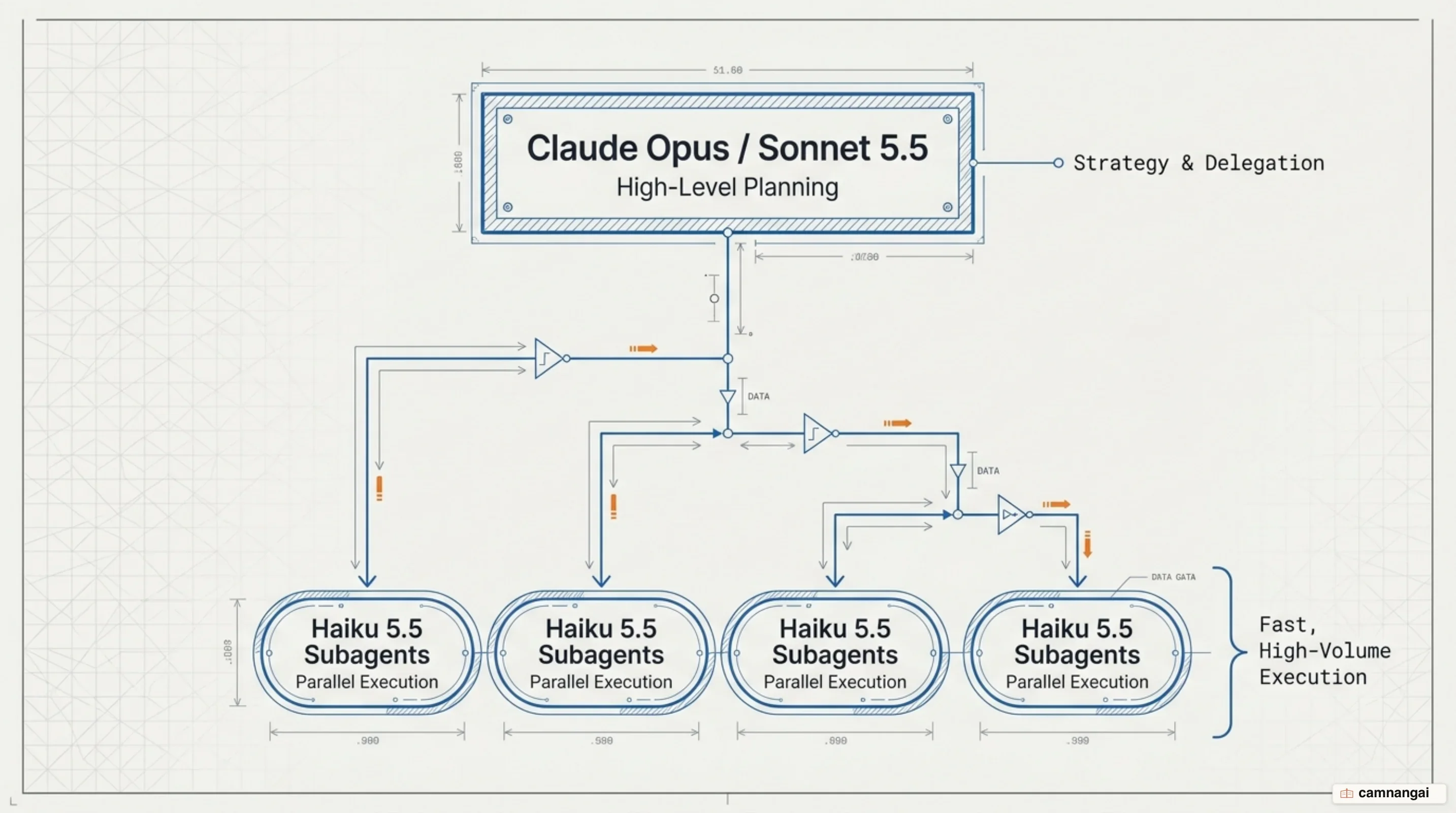
In multi-agent topologies, Haiku 5.5 functions as a rapid, targeted subagent. Parent planning models such as Claude Opus 5.5 or Claude Sonnet 5.5 execute top-level architectural planning and delegate discrete, well-bounded tasks to Haiku 5.5 to achieve maximum execution throughput at minimal cost.
Haiku 5.5 delivers an average 75% operational cost reduction while operating at a sustained 240.5 output tokens per second.
What is Claude Haiku 5.5 and its role in the Claude 5.5 family?
Claude Haiku 5.5 represents the high-speed, cost-optimized tier within the Claude 5.5 model family. Engineered with a native 1M token context window and a maximum output capacity of 128K tokens, the model maintains an explicit training data cutoff and reliable knowledge cutoff of June 2026. For production planning, Anthropic guarantees model lifecycle availability with a retirement date set no earlier than October 7, 2027. When routing traffic through multi-cloud infrastructure, you use the direct API identifier claude-haiku-5-5 across the Claude API, Google Cloud, Microsoft Azure Foundry, and Claude Platform on AWS. If you are calling the model through native Amazon Bedrock APIs, you must explicitly specify the identifier anthropic.claude-haiku-5-5.
Architecturally, Haiku 5.5 is engineered to act as an agile subagent within heterogeneous model worker graphs. Rather than consuming expensive top-tier reasoning budget on routine or repetitive subtasks, parent models such as Claude Opus 5.5 or Claude Sonnet 5.5 maintain the global state graph and pass bounded execution units down to Haiku 5.5. These subagent handoffs include fetching localized 10-K financial metrics, querying CRM databases, invoking API tools, and executing individual browser steps. This separation of planning and execution allows you to run dozens of subagent workers in parallel without overwhelming your API budget or introducing unacceptable system latency.
Pre-deployment safety evaluations indicate that broad misalignment risk remains low, as Haiku 5.5 demonstrates limited capacity to manipulate its chain-of-thought reasoning traces or evade oversight systems when its reasoning is exposed. Its cybersecurity safeguards trigger on significantly lower activity thresholds than prior models, specifically restricting offensive capabilities while permitting defensive tasks. Furthermore, agentic safety evaluations show that Haiku 5.5 achieves its highest prompt injection defense rate to date across terminal and desktop environments.
Benchmark performance and agentic execution capabilities
Across standardized evaluations, Claude Haiku 5.5 delivers a massive structural capability jump over Haiku 4.5 while competing directly against mid-tier models such as GPT-6 Luna in agentic coding, computer use, and professional knowledge work. On the Artificial Analysis Intelligence Index, Haiku 5.5 registers a composite score of 43, operating at a rapid decoding speed of 240.5 output tokens per second.
The transition from Haiku 4.5 to Haiku 5.5 represents a qualitative regime shift in subagent viability rather than a minor incremental gain. Haiku 4.5 was functionally unusable for interactive agentic tasks, scoring 0.0% on Terminal-Bench 4.0 and 15.7% on OSWorld 2.1. Haiku 5.5 crosses critical operational thresholds, scoring 39.2% on Terminal-Bench 4.0 and 72.4% on OSWorld 2.1. This leap turns Haiku 5.5 into a viable execution engine capable of performing multi-step CLI operations, terminal commands, and desktop browser navigation under subagent supervision.
| Benchmark / Metric | Haiku 5.5 | Haiku 4.5 | GPT-6 Luna | Sonnet 5.5 (Ref) |
|---|---|---|---|---|
| Artificial Analysis Intelligence Index | 43 | — | — | — |
| Knowledge Work (GDPval-AA v2.1) | 1620 (Elo) | 735 | 1437 | 1840 |
| Knowledge Work (AA-Briefcase v1.1) | 1578 (Elo) | 614 | 1336 | 1824 |
| Computer Use (OSWorld 2.1 Offline) | 72.4% | 15.7% | 48.9% | 83.9% |
| Agentic Coding (Terminal-Bench 4.0) | 39.2% | 0.0% | 16.4% | 70.6% |
| Agentic Coding (FrontierCode 1.1 Main) | 46.4% | — | 42.4% | 52.1% |
| Multidisciplinary (Humanity's Last Exam - No Tools / Tools) | 45.9% / 57.4% | 10.2% / 18.7% | — | 56.9% / 64.5% |
| Visual Reasoning (Chartography No Tools) | 46.4% | 6.4% | 29.1% | 61.6% |
| Output Speed (tokens/sec) | 240.5 t/s | — | — | — |
Production integration metrics across enterprise early adopters confirm these benchmark evaluations:
- Asana: Measured a >30% reduction in task completion latency and up to 2.5x faster inference per turn across bug triaging and project setup evaluation suites for its AI Teammates product.
- HubSpot: Achieved a 92.8% average score on CRM portal task evaluations, demonstrating the fastest task completion times and highest hit rates on stale record audits across all tested models.
- AlphaSense: Improved accuracy from 0.76 to 0.84 on its "Ask in Document" feature across 8 million weekly production calls.
- Box: Recorded an 11-point evaluation score increase over Haiku 4.5 at approximately half the operational latency.
- Rogo: Validated the subagent architecture pattern in financial platforms, using Haiku 5.5 to extract 10-K segment revenue lines while a primary parent model builds customer presentation decks.
- Cognition: Recorded a 66.2 FrontierCode score in Devin Fusion when running Haiku 5.5 as a sidekick agent paired with a Claude Opus 5.5 lead model.
Effort Controls: Balancing latency, cost, and reasoning depth
Claude Haiku 5.5 introduces user-configurable effort controls to the Haiku model tier, enabling you to dynamically modulate internal reasoning depth based on task SLAs and financial constraints. Supported effort tiers include low, medium (the system default), high, xhigh, and max. Extended reasoning in Haiku 5.5 is adaptive and natively integrated into the model's architecture. Because reasoning cannot be disabled entirely, sending API requests configured with thinking: {type: "disabled"} will trigger an HTTP 400 validation error from the API endpoint.
Modulating effort levels creates dramatic variations in token volume, execution latency, and per-request cost. Empirical SVG generation benchmarks demonstrate that running a prompt on the low effort setting completes in 7 seconds at a cost of 0.0936 cents. Bumping the exact same prompt to max effort invokes an extensive internal chain-of-thought reasoning trace, extending execution time to 5 minutes and 9 seconds at a total cost of 3.3826 cents.
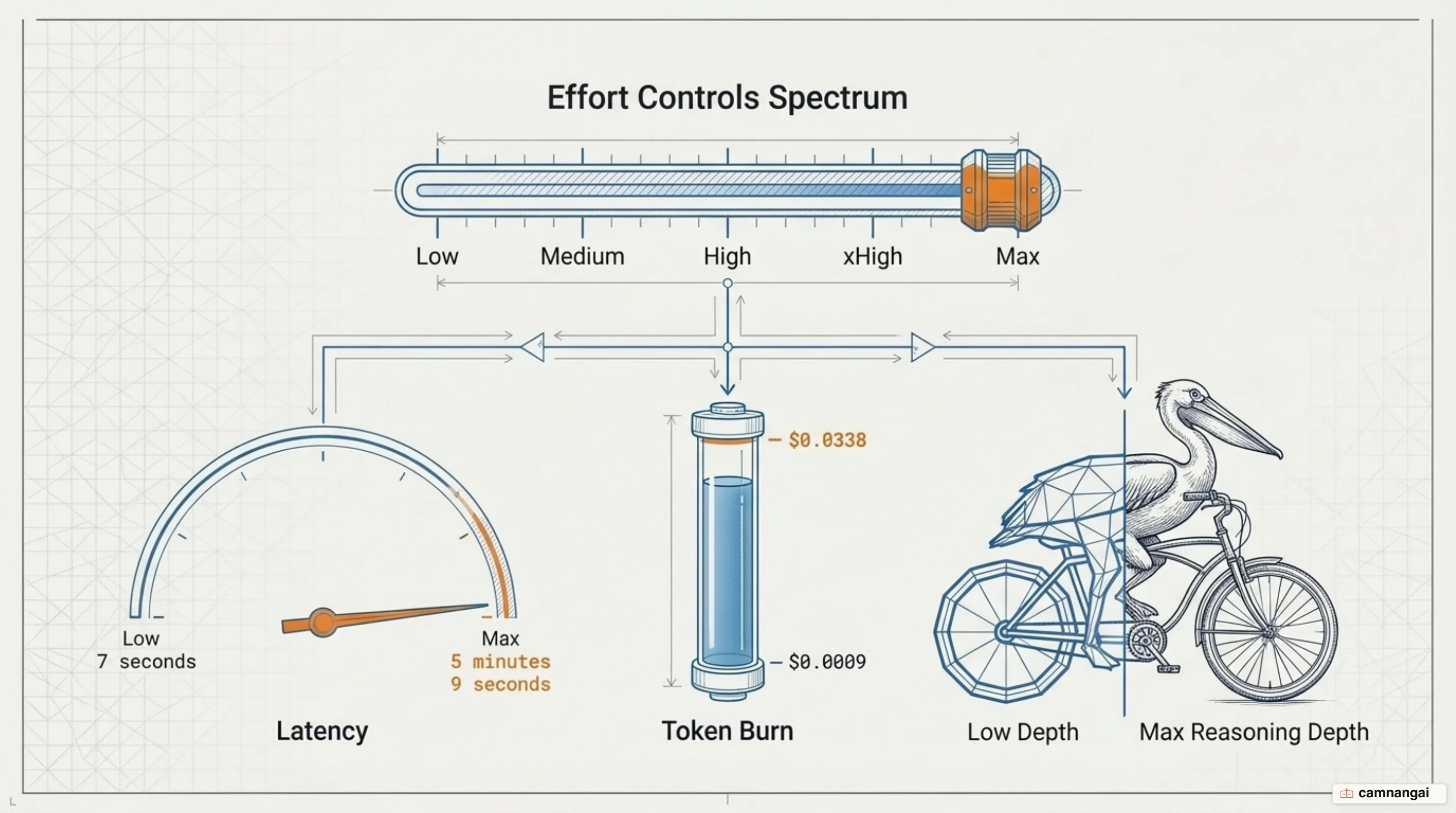
When you architect real-time or streaming pipelines, you must separate raw output generation speed from Time-to-First-Answer-Token (TTFT). Although Haiku 5.5 streams text at a rapid 240.5 tokens per second once output decoding begins, its TTFT averages 295.00 seconds across comprehensive benchmark suites because the model generates internal extended thinking tokens before emitting answer tokens. For immediate routing, classification, and simple extraction tasks, you should set effort to low. For multi-step terminal workflows, complex data manipulation, or computer use tasks, you should configure effort to high or max.
Pricing structure and unit economics for high-volume workloads
Claude Haiku 5.5 implements a tiered pricing model that delivers an average 75% cost reduction compared to Haiku 4.5. Billed rates depend on context prompt length, applying a heavy discount to requests containing up to 100,000 tokens.
| Token Type | Prompts ≤ 100,000 Tokens | Prompts > 100,000 Tokens | Haiku 4.5 (Flat) | Sonnet 5.5 |
|---|---|---|---|---|
| Input Tokens (per MTok) | $0.10 | $0.50 | $1.00 | $2.00 |
| Output Tokens (per MTok) | $0.50 | $2.50 | $5.00 | $10.00 |
| Cache Reads (per MTok) | $0.01 | $0.05 | $0.10 | $0.10 |
| Cache Writes (per MTok) | $0.125 | $0.625 | $1.25 | $2.50 |
This tiered structure offers favorable unit economics for the approximately 90% of production prompts that fit within 100,000 tokens. Within this base boundary, Haiku 5.5 provides a 90% discount on input ($0.10/MTok) and output ($0.50/MTok) relative to Haiku 4.5's flat pricing ($1.00/$5.00 MTok). However, crossing the 100,000-token boundary incurs a severe step-function financial penalty: a prompt of 100,001 tokens immediately triggers a 5x price rate increase across all tokens ($0.50 input / $2.50 output). By comparison, GPT-6 Luna matches Haiku 5.5's base $0.10/$0.50 pricing but maintains its base tier up to 272,000 tokens before scaling to $0.20/$0.75 MTok.
When calculating your total cost of ownership, you must account for tokenizer density shifts combined with context boundaries. Haiku 5.5 uses an updated tokenizer that consumes approximately 1.25x more tokens for a given prompt compared to Haiku 4.5. This compound effect means that a prompt containing ~80,000 tokens under Haiku 4.5 will expand to ~100,000 tokens under Haiku 5.5. Pushing past this threshold triggers both the 1.25x token volume inflation and the 5x price tier multiplier. To optimize system economics, you should implement aggressive prompt-trimming and context-truncation pipelines to ensure requests remain strictly under 100,000 tokens.
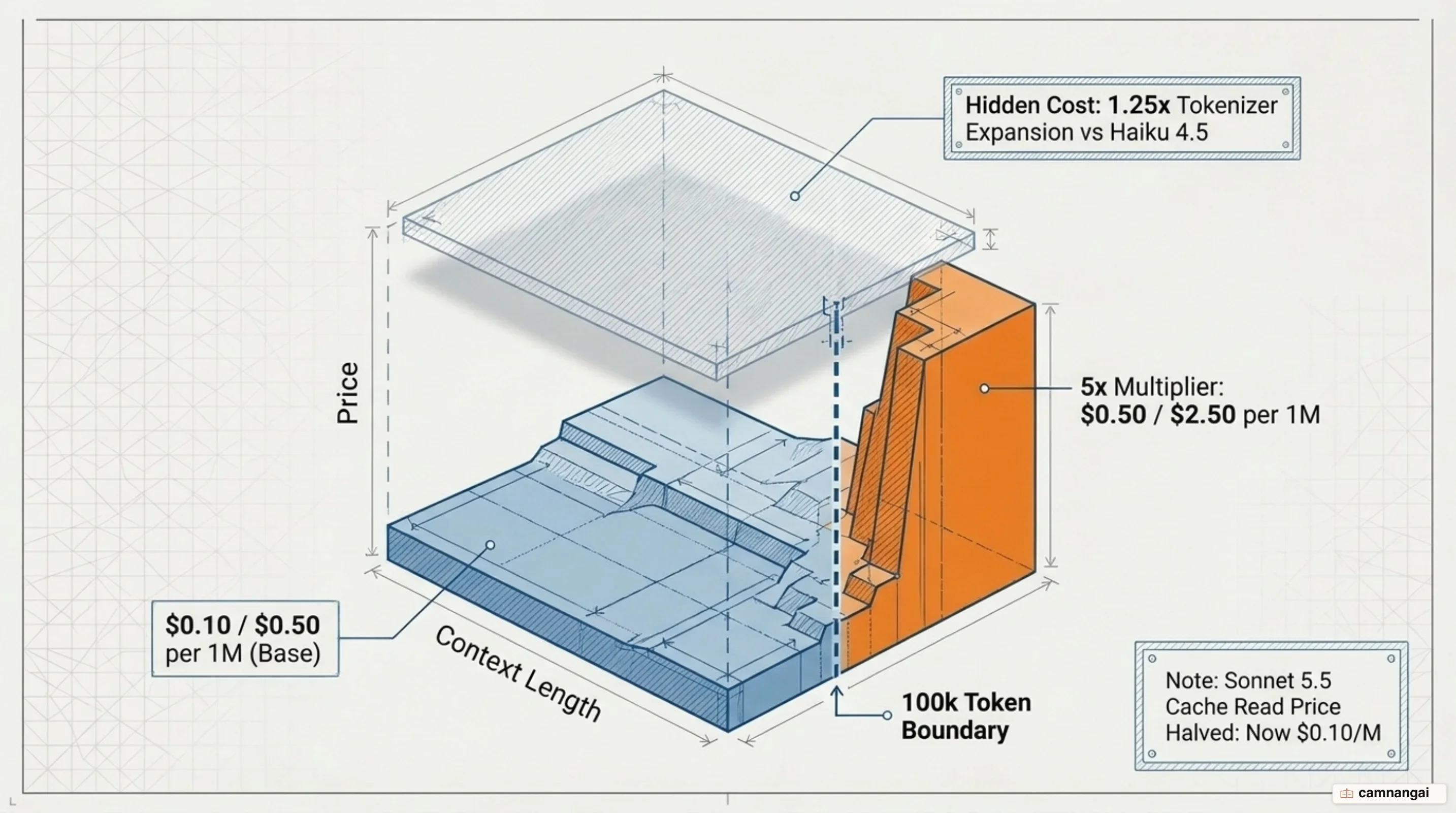
Anthropic also introduced secondary ecosystem price updates alongside Haiku 5.5. Cache read pricing for Claude Sonnet 5.5 was reduced by 50% to $0.10/MTok through prompt caching, lowering Sonnet's operational cost on agentic tasks by approximately 20%. Additionally, Anthropic now allocates monthly API credits to Claude subscriber accounts ($100/month for Max 5x, $200/month for Max 20x, and up to $500/month pooled for Team plans).
Infrastructure and ecosystem: Bedrock, Azure Foundry, and GitHub Copilot
You can deploy Claude Haiku 5.5 across major enterprise cloud provider environments:
- Amazon Web Services: Accessible via Amazon Bedrock (model ID
anthropic.claude-haiku-5-5, providing regional data residency, AWS Guardrails, and Bedrock Knowledge Bases) and Claude Platform on AWS (model IDclaude-haiku-5-5, offering direct API access with unified AWS billing). - Google Cloud and Microsoft Azure Foundry: Available for direct API integration using model identifier
claude-haiku-5-5.
GitHub Copilot offers general availability for Haiku 5.5 across Copilot Pro, Pro+, Max, Business, and Enterprise tiers. You can select claude-haiku-5-5 in the model selector across Visual Studio Code, Visual Studio, Copilot CLI, GitHub Copilot Cloud Agent, github.com, GitHub Mobile, JetBrains IDEs, Xcode, and Eclipse. Usage is billed under usage-based billing at provider list pricing. Enterprise and Business administrators manage organizational access through Copilot model policy settings.
Developer tooling has expanded to support low-cost UI automation. The official Claude Python and TypeScript SDKs now include beta support for computer use and browser use features, enabling you to use Haiku 5.5 as a low-cost, high-speed execution engine for automated browser and GUI tasks.
When should you choose Haiku 5.5 over Sonnet 5.5?
Choosing between Claude Haiku 5.5 and Sonnet 5.5 requires evaluating task complexity, prompt volume, and SLA requirements.
You should select Claude Haiku 5.5 when your architecture requires:
- High-frequency, narrowly scoped tasks where latency and unit cost dominate, such as log compaction, document summarization, field extraction, CRM record updates, and real-time support routing.
- Subagent delegation where a parent model (Opus 5.5 or Sonnet 5.5) executes the primary planning graph and delegates single-tool, well-defined execution tasks to Haiku 5.5.
- Workloads engineered to keep context prompts under 100,000 tokens to remain within the $0.10 input / $0.50 output per million token pricing tier.
You must choose Claude Sonnet 5.5 when your system hits these boundary limits:
- Complex, multi-step agentic coding tasks requiring high CLI proficiency, where Sonnet 5.5 achieves 70.6% on Terminal-Bench 4.0 compared to Haiku 5.5's 39.2%.
- Deep multidisciplinary reasoning or unstructured problem solving where high execution accuracy justifies Sonnet 5.5's base cost ($2.00 input / $10.00 output MTok).
Optimal platform architectures deploy a hybrid structure: run Opus 5.5 or Sonnet 5.5 as the primary lead planner, and pass high-volume execution tasks down to Haiku 5.5 subagents.
References
- Introducing Claude Haiku 5.5 — Anthropic
- Claude Haiku 5.5 System Card — Anthropic
- Models Overview — Claude Platform Documentation
- Claude Haiku 5.5 — Simon Willison's Weblog
- Claude Haiku 5.5 is now available on AWS — AWS What's New
- Claude Haiku 5.5 in GitHub Copilot — GitHub Changelog
- Claude Haiku 5.5 (Max) Intelligence, Performance & Price Analysis — Artificial Analysis