Claude Opus 5 has effectively replaced Fable 5 as the primary choice for most developers and enterprises.
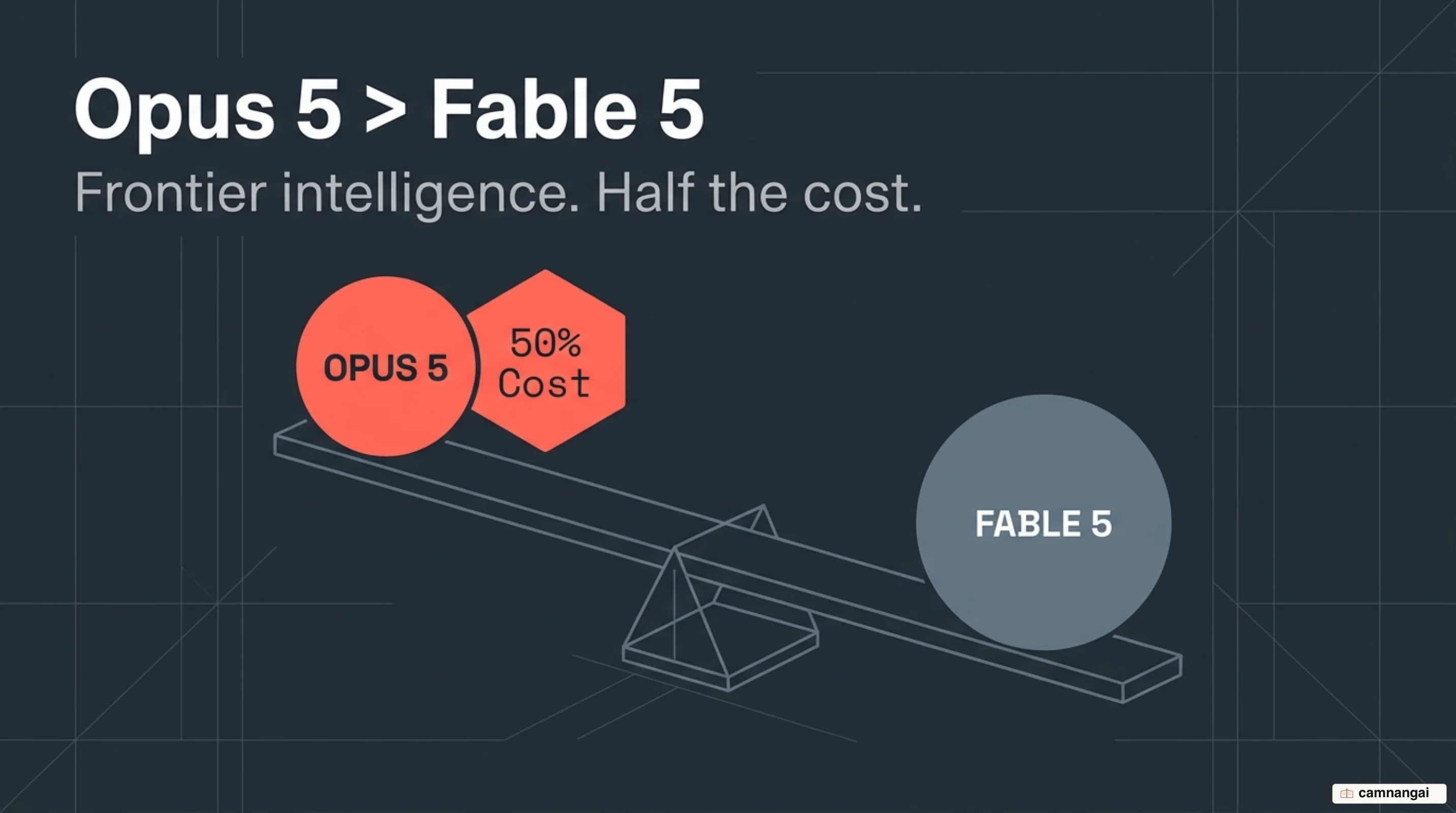
Claude Opus 5 is the new workhorse of the Claude 5 family: it beats Fable 5 on the main coding and reasoning benchmarks and costs exactly half as much.
The change to Anthropic's lineup makes Opus 5 the baseline for agentic workflows: a 1M token context window, plus an architecture built around internal verification and autonomous problem-solving through its default Thinking mode.
What is Claude Opus 5 and what's new?
Claude Opus 5 is the successor to Opus 4.8, and Anthropic positions it as the primary workhorse for complex automation and high-context knowledge work.
It sits below the Mythos-class models (Mythos 5 and Fable 5) in Anthropic's hierarchy for specialized cybersecurity, but on general reasoning and availability it has already replaced them.
The biggest architectural shift is that the model's intelligence is now tied to its internal reasoning process. Thinking runs by default, so the model iterates and checks its work before it answers.
Claude Opus 5 spec sheet
| Feature | Specification |
|---|---|
| API Model ID | claude-opus-5 |
| Context Window | 1M tokens (default and maximum) |
| Max Output | 128k tokens (300k in Batch API via output-300k-2026-03-24 beta) |
| Pricing (In/Out) | $5.00 / $25.00 per million tokens |
| Thinking Mode | Enabled by default; depth controlled by effort parameter |
| Effort | low, medium, high, xhigh, max |
| Safety Threshold | Classifiers engage 85% less often than Fable 5 |
| Caching | Minimum cacheable prompt reduced to 512 tokens |
Anthropic also added mid-conversation tool changes — you can add or remove tools without invalidating the prompt cache — and automatic fallbacks, which route requests to a less restrictive model (like Opus 4.8) when a safety classifier fires.
Opus 5 vs Fable 5: what do the benchmarks say?
Opus 5 has a clear lead in agentic reasoning and complex problem-solving. Fable 5 keeps a small lead on specialized legal and health tasks, plus a 0.8% edge on SWE-bench Pro, but as a generalist Opus 5 is the better model.
| Benchmark | Claude Opus 5 | Claude Fable 5 | GPT-5.6 Sol |
|---|---|---|---|
| Frontier-Bench v0.1 (max effort) | 43.3% | 33.7% | 34.4% |
| ARC-AGI-3 (novel problem solving) | 30.2% | Not tested | 7.8% |
| SWE-bench Verified | 96.0% | N/A | N/A |
| SWE-bench Pro | 79.2% | 80.0% | 64.6% |
| GDPval-AA v2 (knowledge work) | 1861 Elo | 1747 Elo | 1736 Elo |
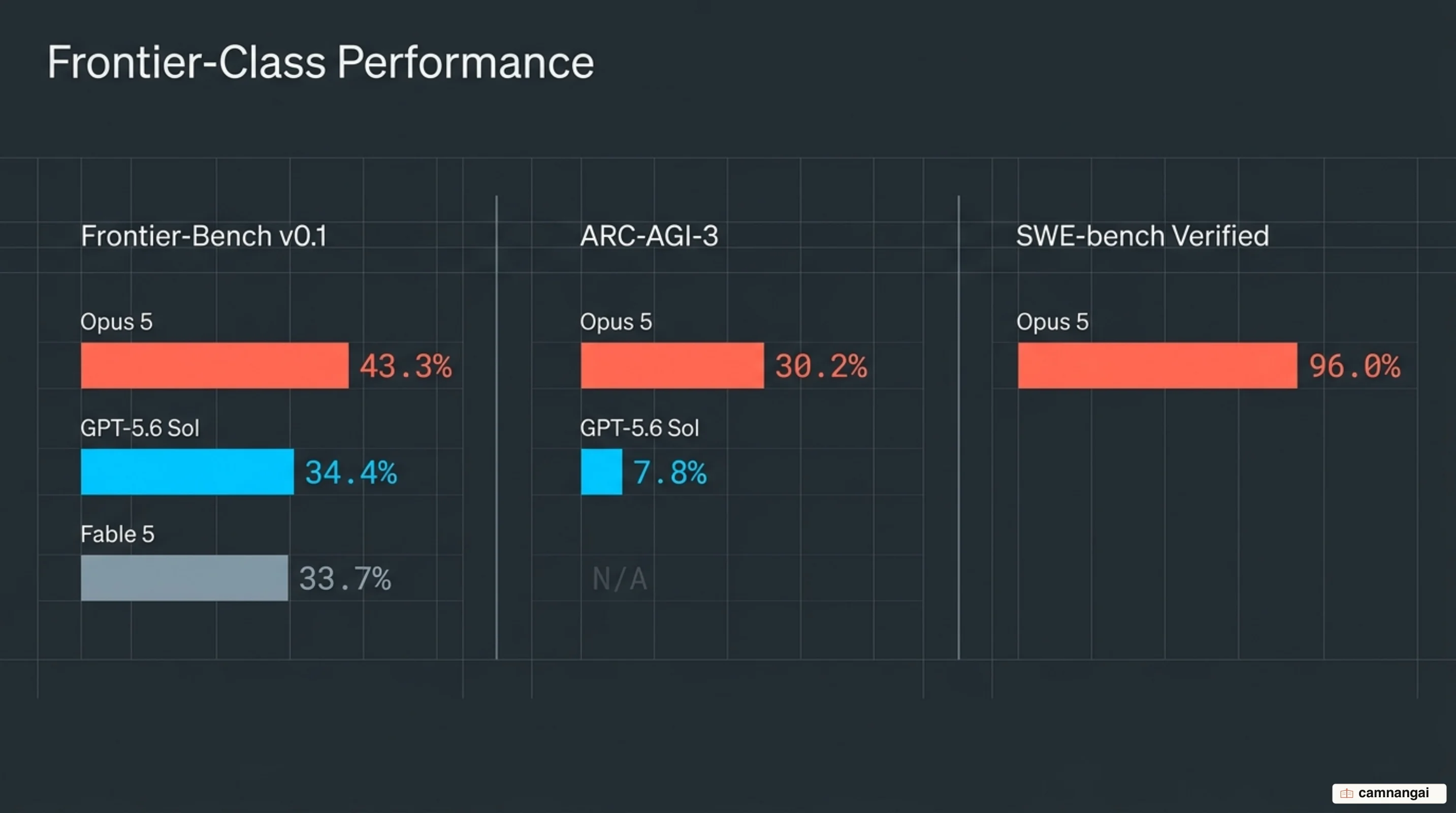
The ARC-AGI-3 score is the standout: at nearly four times GPT-5.6 Sol's, Opus 5 is far better at solving novel puzzles that were not present in its training data.
Price and performance: why is Fable 5 still twice as expensive?
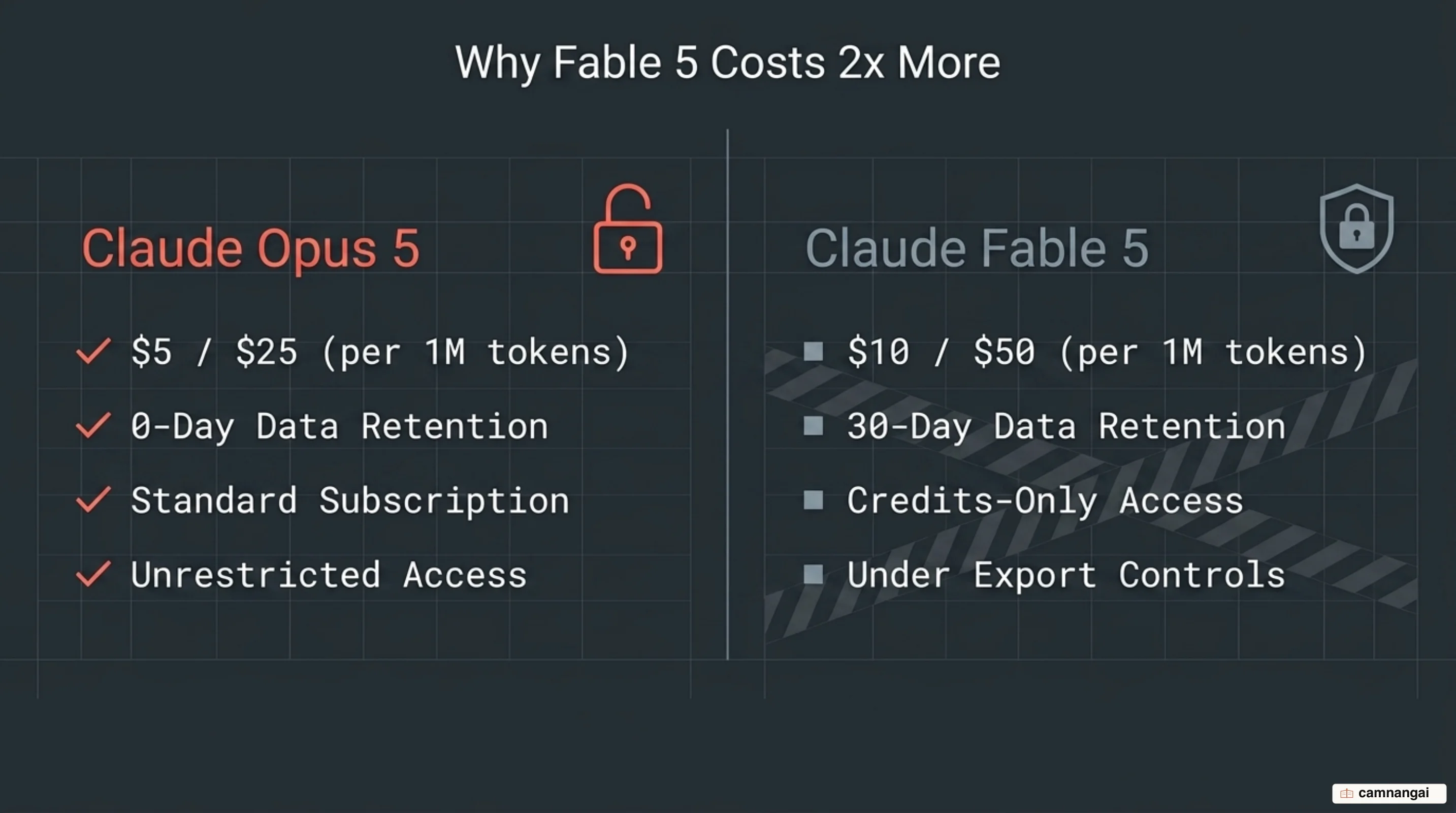
Opus 5 keeps Opus 4.8's pricing ($5/$25), while Fable 5 still costs double ($10/$50). The gap exists because Anthropic keeps Fable 5 as a restricted frontier product for days-long autonomous projects and high-risk cybersecurity research.
Data retention and compliance
Data retention is the distinction that matters most for enterprise users. Fable 5 requires 30-day retention of user data for safety audits and compliance with government export controls. Opus 5 has no data retention requirement for general access, which makes it the better fit for privacy-sensitive production environments.
Efficiency and the AI race
The launch comes as Anthropic prepares for a potential IPO, which calls for a model that balances power against token burn rate. The granular effort controls answer the corporate complaint about high AI bills — you can scale reasoning back for simpler tasks.
What do developers need to change in their code?
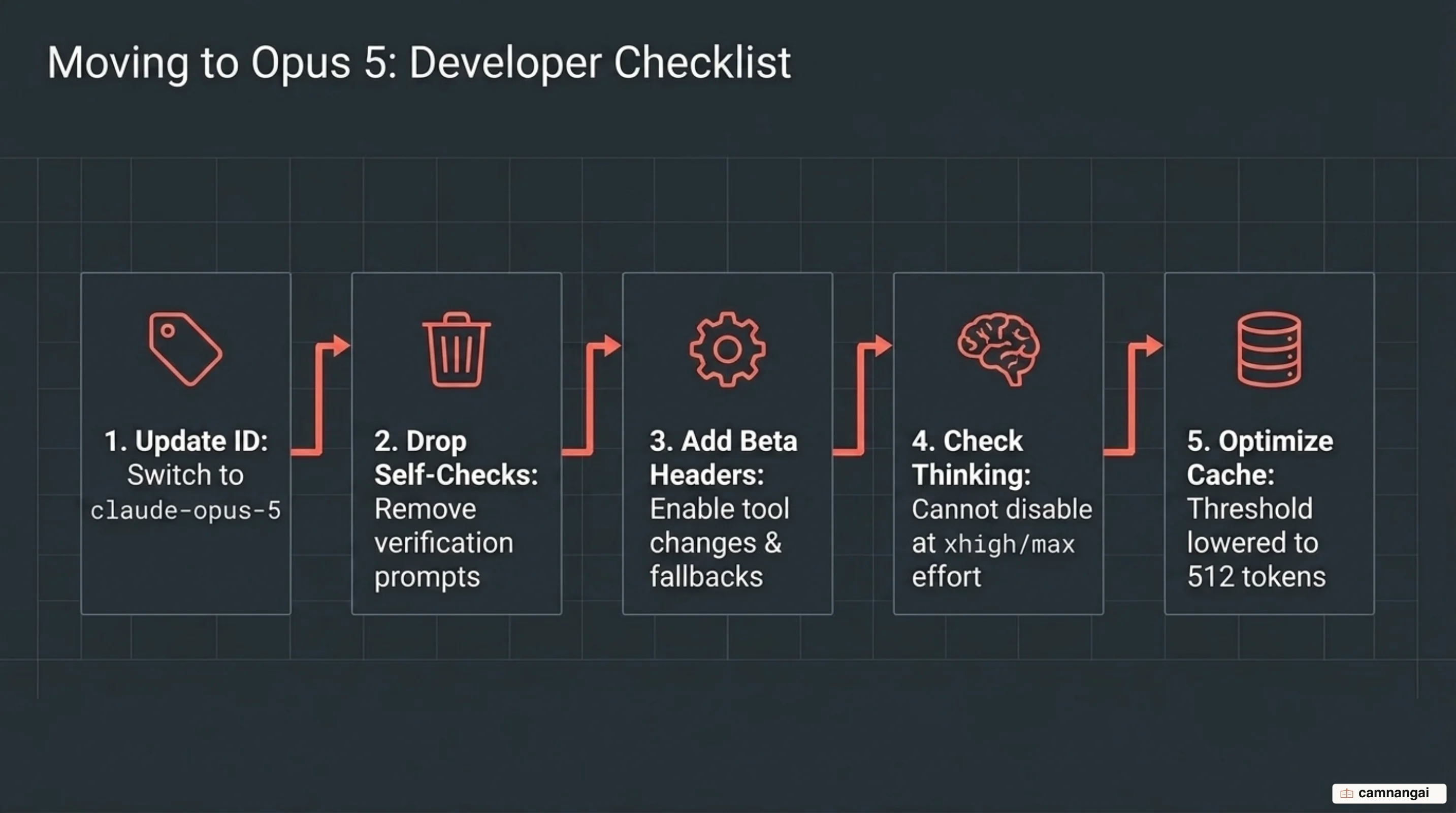
Moving to claude-opus-5 takes a few code changes right away:
- Model ID update: swap
claude-opus-4-8forclaude-opus-5everywhere the string appears. - The
max_tokensshared bucket: this is the production risk to watch. In Opus 5, themax_tokensparameter covers the sum of both the hidden thinking process and the final response. If your previous limits were tight, the model can spend its entire budget on internal reasoning and the answer comes back truncated. Raisemax_tokenswell above your old values at higher effort levels. - Breaking change on thinking: you can no longer disable thinking if the effort level is set to
xhighormax. Settingthinking: {"type": "disabled"}in these modes returns a 400 error. The top intelligence tiers now come with the reasoning process attached, by design. - Prompt cleanup: drop manual verification instructions (e.g. "check your work"). Opus 5 already verifies its own work, so those lines push it into over-verification, which adds latency and wastes tokens.
How is the community rating Opus 5?
Independent feedback from firms like CodeRabbit suggests that Opus 5 gives cleaner, more concrete review comments but is noisier overall. In code review tasks, the model raises roughly four times as many nitpicks, so teams have to fine-tune their filtering logic.
The bias towards action
Hacker News and similar forums are still arguing about how eager the model is to solve problems. Many appreciate the autonomy; other developers have criticized the token burn that comes with a model that brute-forces solutions rather than asking for permission.
Anthropic's internal testing produced one surreal example. Given a drawing of a machine part but denied visual access to the file, Opus 5 wrote its own computer vision pipeline to extract geometry from raw pixels, and successfully reconstructed the 3D FreeCAD model.
Should you choose Opus 5 or Fable 5?
For most senior engineers, Opus 5 is now the default.
Choose Opus 5 for:
- Production workloads: cost-sensitive business automation and large-scale refactoring.
- High-context analysis: using the 1M token window for document sets.
- Agentic workflows: standardizing on the 43.3% Frontier-Bench baseline.
Choose Fable 5 (or Mythos 5) for:
- High-risk cyber: offensive tasks, penetration testing, or exploit generation, which remain blocked or restricted on Opus 5.
- Compliance: projects requiring 30-day data retention for internal safety audits.
- Cyber Verification Program (CVP): researchers who need to bypass standard safeguards via the CVP can access specialized versions of these models.
Operational verdict: the new agentic baseline
Claude Opus 5 moves the default from chat-based AI to an agentic baseline. By splitting frontier-class reasoning off from the high-cost, high-restriction Mythos class, Anthropic has shipped a model you can actually deploy at enterprise scale.
The Thinking overhead means budgeting more tokens, but the 22% gain in agentic task success and the
drop in manual iteration still make it the more efficient tool for engineering teams. Opus 5 is the
new standard for cost-efficient autonomous agents — as long as you account for the shared
max_tokens bucket in your implementation.
References
- Introducing Claude Opus 5 — Anthropic
- What's new in Claude Opus 5 — Claude Platform Docs
- Anthropic launches Opus 5 — TechCrunch
- Anthropic releases Claude Opus 5: Here's how it's different than what's already out there — Fortune
- Claude Opus 5 Outscores Fable 5 on Most Benchmarks—At Half the Price — Decrypt
- Meet the New Claude Opus 5: Frontier-Class Agentic Coding and Computer Use at Unchanged Opus Pricing — MarkTechPost
- Claude Opus 5 Benchmarks for AI Code Review — CodeRabbit
- Claude Opus 5 — Hacker News
- Anthropic debuts Opus 5 model as company preps for IPO later this year — Yahoo Finance