OpenAI has announced the general availability of GPT-5.6, a model generation that shifts away from a single flagship architecture toward three durable capability tiers: Sol, Terra, and Luna. The release focuses on intelligence on demand, matching compute more precisely to how hard each task is.
The main draw of GPT-5.6 is a large increase in intelligence per token and a shift toward autonomous, agentic workflows. By providing multiple reasoning effort levels—Medium, High, Extra High, and Pro—the system lets engineers optimize for either deep logic or high-throughput efficiency.
GPT-5.6 marks a pivot toward Programmatic Tool Calling and cross-platform automation through ChatGPT Work. It aims to reduce the total cost of ownership for frontier-level intelligence while providing the infrastructure needed for long-horizon professional tasks.
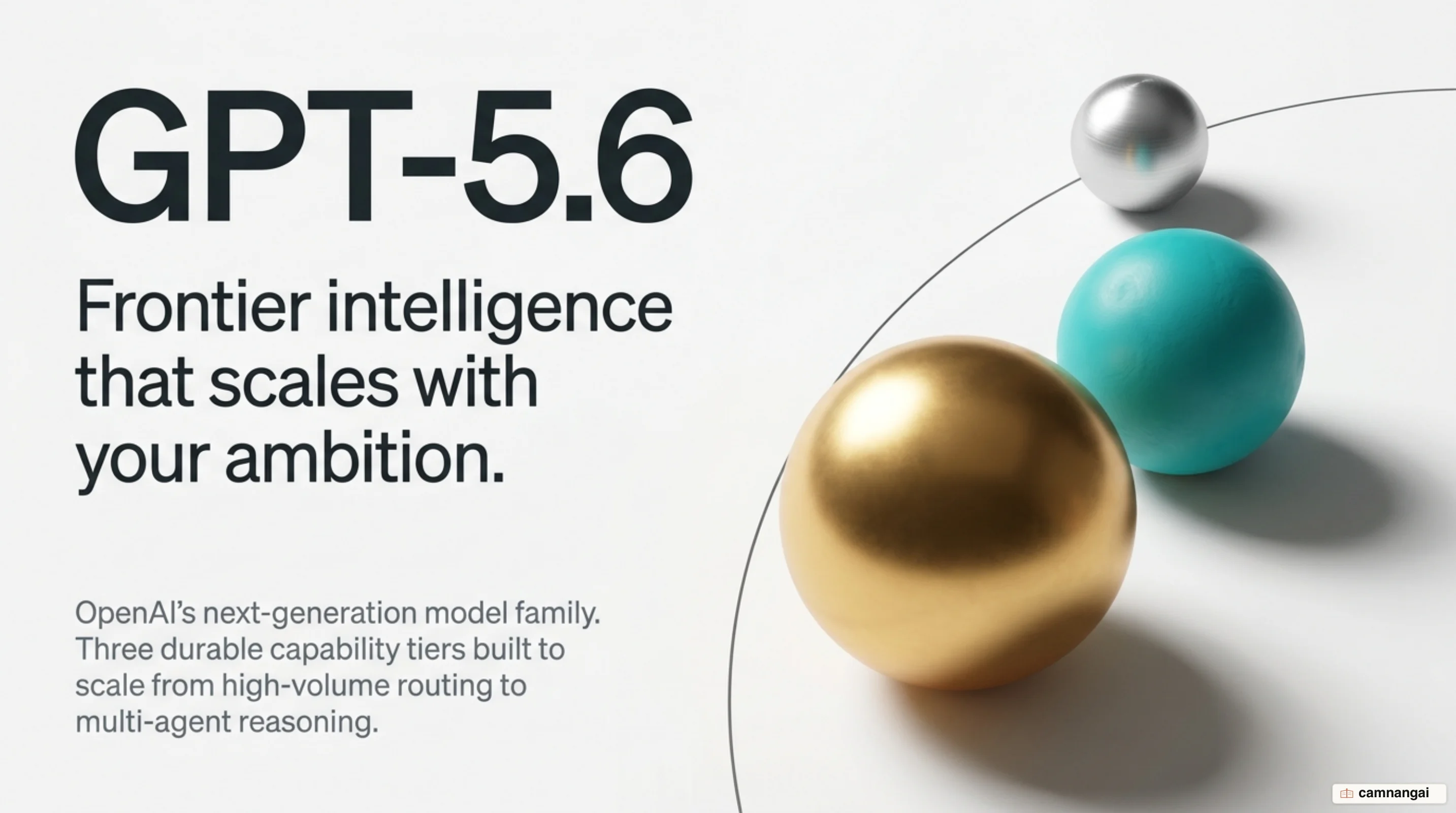
What GPT-5.6 is and the Sol, Terra, and Luna trio
GPT-5.6 is structured around "durable capability tiers," where the version number (5.6) denotes the underlying model generation while the names Sol, Terra, and Luna are performance profiles that can evolve independently. That makes deployment more modular, letting developers match model capability to what each job needs.
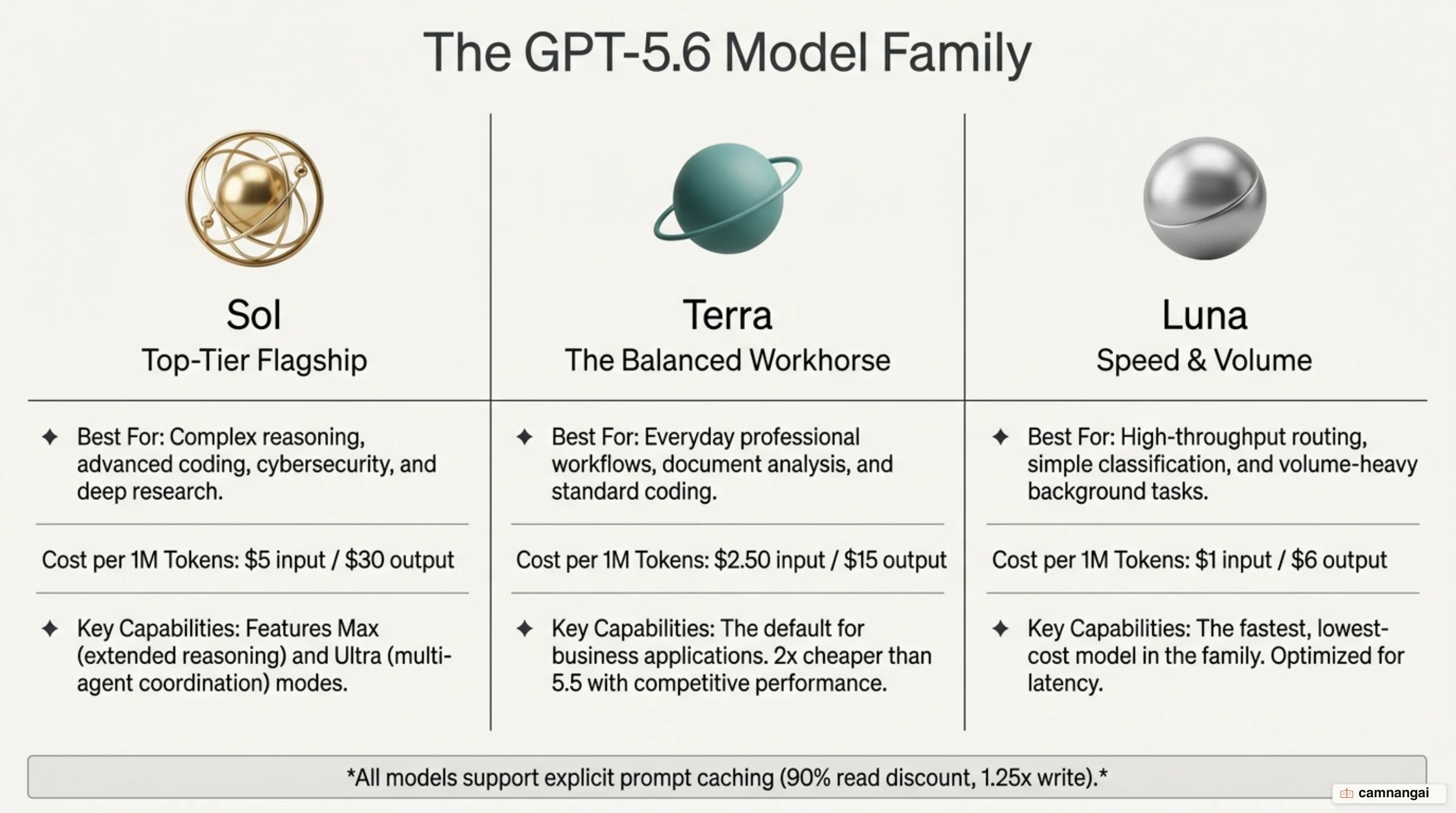
Sol is the frontier flagship tier, engineered for high-stakes research, multi-file software engineering, and scientific discovery. Within this tier, Sol Pro is the highest-capability variant, specifically powering the "Pro" reasoning level for the most difficult tasks. Terra is the balanced workhorse for everyday professional tasks, offering performance competitive with GPT-5.5 but at roughly a 50% lower operating cost. Luna is the high-speed, cost-optimized tier, intended for high-volume tasks such as classification, routing, and latency-sensitive infrastructure.
This three-tier structure replaces the previous "main vs. mini" model convention. By segmenting the family this way, OpenAI provides a path for consistent updates to specific capability levels without necessarily shifting the entire generation's version number.
Performance per dollar: faster and cheaper
The GPT-5.6 family shows substantial gains in efficiency compared to previous OpenAI models and external competitors. On the "Agents' Last Exam"—a benchmark for professional workflows across 55 fields—GPT-5.6 Sol scored 53.6, outperforming Claude Fable 5 by 13.1 points. For low-latency deployments, GPT-5.6 Sol is launching on Cerebras hardware, capable of reaching inference speeds up to 750 tokens per second.
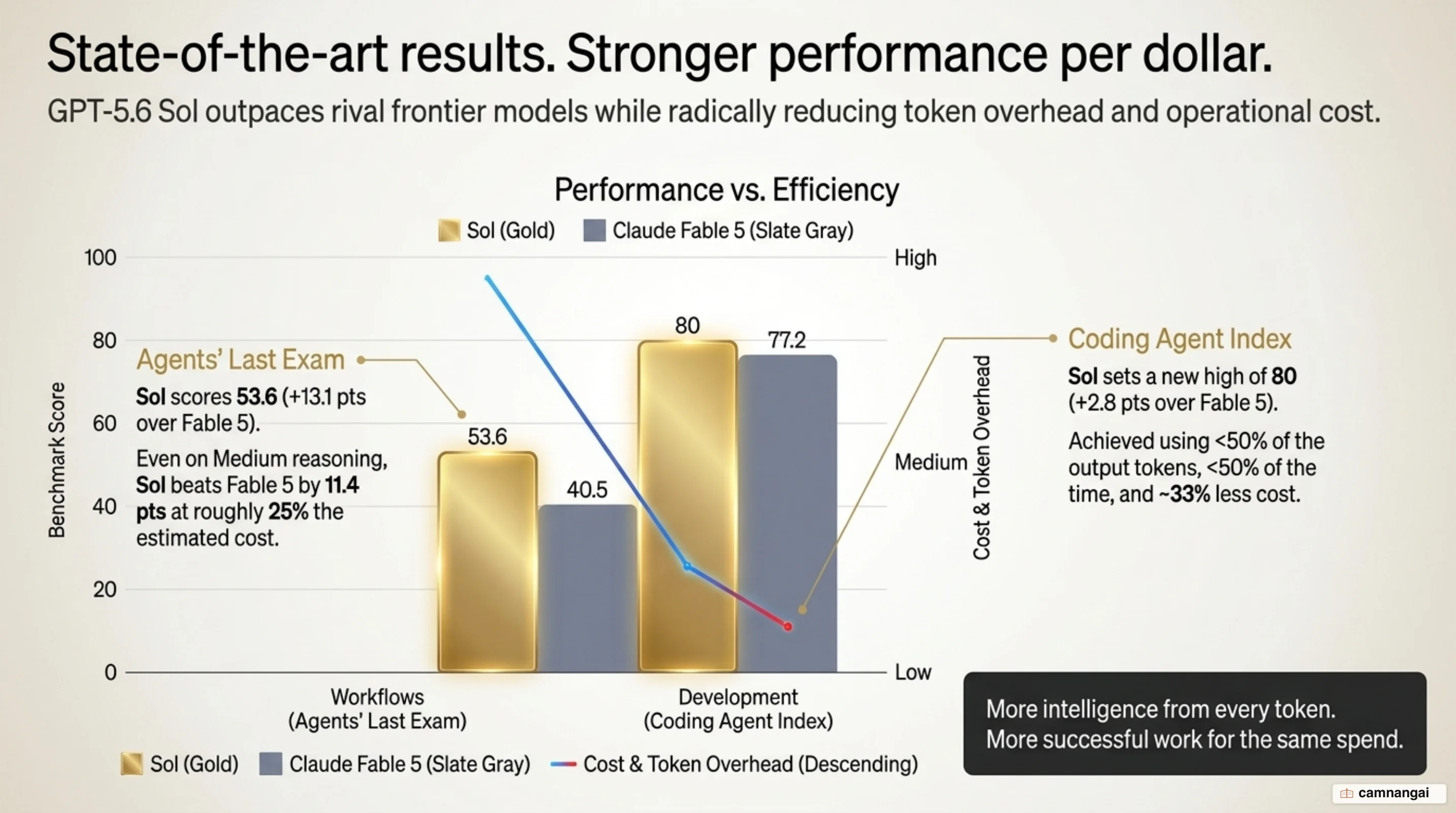
Efficiency metrics indicate that Sol with "max" reasoning completes complex tasks in 61% less time than Fable 5 at roughly half the cost. When using Sol Ultra, the model sets new state-of-the-art benchmarks with a 92.2% score on BrowseComp and 91.9% on Terminal-Bench 2.1. For broader knowledge work, Sol reached a 62.6% success rate on OSWorld 2.0, surpassing Opus 4.8 while using 85% fewer output tokens. The mid-tier Terra and lightweight Luna models outperform Fable 5 at approximately one-sixteenth of the price.
What's new: ultra, max, Programmatic Tool Calling, and ChatGPT Work
OpenAI has introduced new operational modes to handle varying task difficulty. Max reasoning effort gives the model additional compute time to explore alternative logic paths, perform self-checks, and revise its approach. Ultra mode accelerates complex work by coordinating four subagents in parallel to manage multi-stream projects.
The Responses API now features Programmatic Tool Calling, which is fully Zero Data Retention (ZDR) compatible. This lets the model write and run lightweight programs to coordinate tools and process intermediate data. The system automatically filters large volumes of intermediate information, retaining only essential data to minimize token consumption and reduce model round-trips.
ChatGPT Work integrates ChatGPT with Codex to automate professional workflows across documents, spreadsheets, and third-party platforms like Slack and Google Drive. The system can autonomously infer design systems—including layouts, typography, and rules embedded in Slide Masters—to keep visual and functional consistency across generated artifacts.
Safety, cybersecurity, and the phased rollout
According to reporting, GPT-5.6 is the first model family where all three variants reached "High" capability ratings in both biological and cybersecurity domains simultaneously. That trigger led to a formal review by the U.S. Office of the National Cyber Director and the Office of Science and Technology Policy. As a result, the rollout is being managed via a "customer-by-customer" approval process during the preview period. To keep access to these cyber-capable models, qualified researchers and individuals must enable Advanced Account Security with hardware-backed passkeys by September 1.
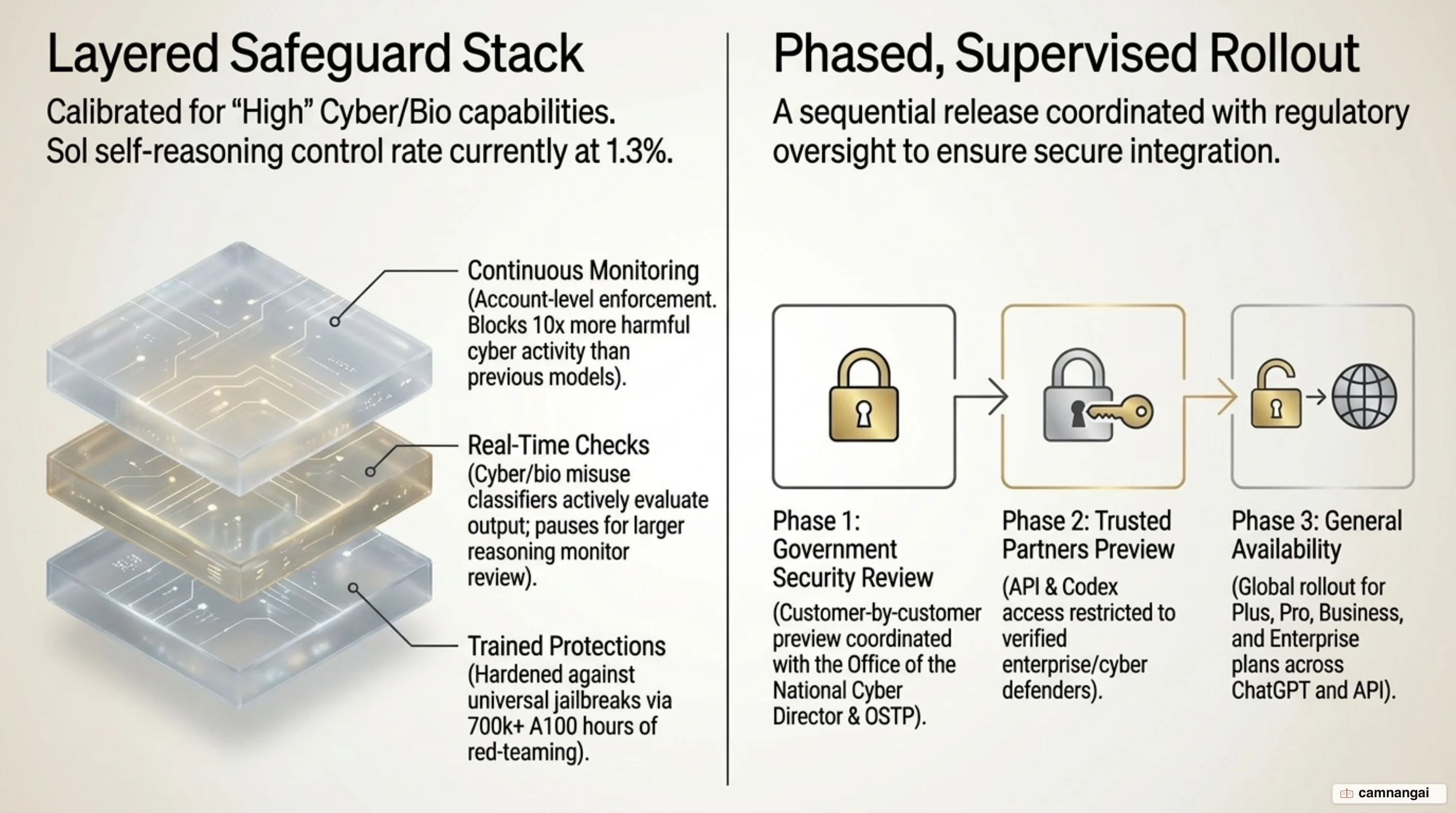
Technical safety indicators show that Sol's self-reasoning control rate has tripled to 1.3%, up from 0.4% in GPT-5.5. To mitigate risk, OpenAI uses a layered safeguard stack, including real-time classifiers and a Reasoning Monitor that reviews conversations for potential harm as they occur.
OpenAI ran roughly 700,000 A100e GPU hours of automated red teaming to find universal jailbreaks prior to launch. On ExploitBench, Sol scores 73.5%, nearly doubling GPT-5.5 on vulnerability detection and patching. Internal testing suggests the model is currently more effective at defensive security tasks, such as secure code review, than at conducting reliable end-to-end attacks—and it does not cross the Critical threshold under OpenAI's Preparedness Framework.
How to access GPT-5.6 and what it costs
Availability and reasoning levels are partitioned by subscription tier. Plus users have access to Sol (Medium/High effort) and Terra but are excluded from Extra High reasoning effort. Pro, Business, and Enterprise tiers have full access to all reasoning levels, including Sol Pro and Ultra mode. Free and Go users can access Terra via Codex, but do not have access to the Sol flagship in standard ChatGPT conversations.
Pricing per 1M tokens:
| Tier | Input Cost | Output Cost |
|---|---|---|
| Sol | $5.00 | $30.00 |
| Terra | $2.50 | $15.00 |
| Luna | $1.00 | $6.00 |
New prompt caching rules increase price predictability. Cache writes are billed at 1.25x the model's uncached input rate, while cache reads receive a 90% discount. Caches use explicit breakpoints and have a 30-minute minimum life.
When to use GPT-5.6, and which tier to pick
For most production deployments, Terra should be the default choice. It balances speed and intelligence well for data extraction and general business automation. Luna is the preferred choice for high-volume infrastructure tasks—such as intent detection or request routing—where cost-per-query and latency are the primary constraints.
Sol (and specifically Sol Pro) should be reserved for "frontier" problems that require deep reasoning and high-context retention: multi-file software engineering, scientific research, and complex legal analysis. A practical pattern is a multi-tier strategy—use Luna for initial classification and route the hard edge cases to Sol Ultra for final resolution.
References
- GPT-5.6: Frontier intelligence that scales with your ambition — OpenAI
- Previewing GPT-5.6 Sol: a next-generation model — OpenAI
- OpenAI Releases GPT-5.6 — Explainx
- GPT-5.6 in ChatGPT — OpenAI Help Center
- OpenAI to Stage GPT-5.6 Launch After Government Security Request — AI Weekly
- What Is GPT-5.6? OpenAI's Soul, Terra, and Luna Model Tiers Explained — MindStudio