Evolving agentic AI systems from loop engineering to graph engineering shifts your system architecture from volatile, bloated context windows to externalized, durable memory layers. Single-pass LLM calls fail complex operational tasks because they lack mechanisms for iteration, state retention, and verification. While iterative reflection loops allow an agent to inspect and revise outputs within a single context window, scaling to multi-step execution and specialized worker networks causes severe transcript bloat, context degradation, and memory loss.
From loop engineering to graph engineering is the architectural evolution of AI agent systems from single-context iteration loops to durable, graph-grounded shared memory layers.
System architectures progress through four structural stages: loops, chains, networks, and graphs. A loop externalizes revision through iterative generation and evaluation cycles (loop engineering). A chain externalizes step ordering into fixed programmatic control paths. A network externalizes role specialization across distinct worker agents. Finally, a graph externalizes shared state, entities, and execution relationships into a queryable memory structure that persists across context window flushes and process restarts.
Your operational objective as an infrastructure architect is to deploy the simplest design pattern that meets target performance metrics. Every added layer of agent autonomy introduces non-determinism, API latency, token consumption, and complex failure modes.
Workflow architecture matters more than model upgrades.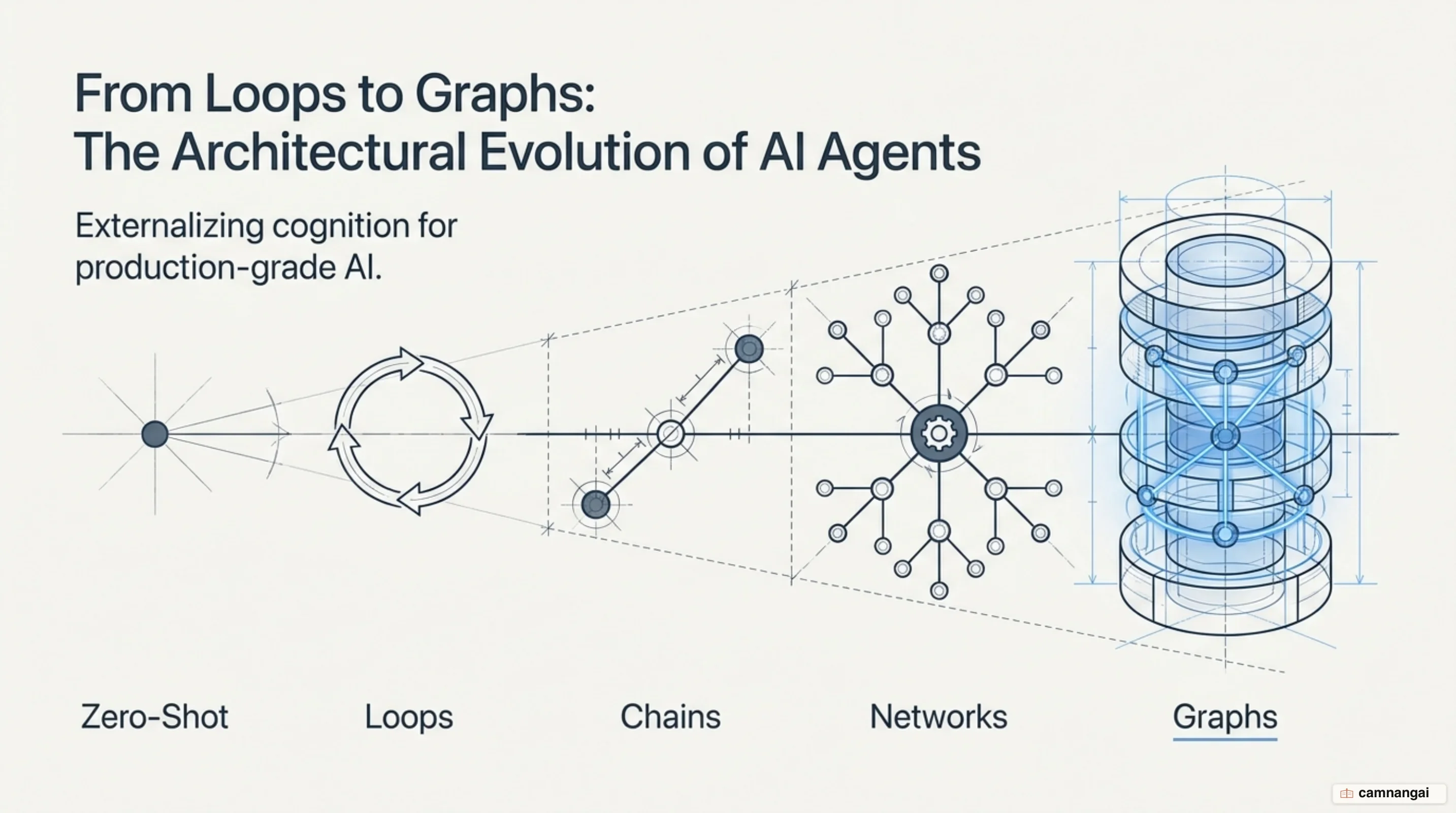
Why Workflow Architecture Beats Model Upgrades
Benchmark evidence proves that iterative workflow design impacts output quality more than scaling model parameter size. On the HumanEval coding benchmark, base GPT-3.5 in zero-shot mode solves 48.1% of tasks, while base GPT-4 in zero-shot mode achieves 67.0%. However, when GPT-3.5 is wrapped inside an iterative agentic workflow, its score rises to 95.1%. The performance delta gained by transitioning from GPT-3.5 to GPT-4 is dwarfed by the gains realized through iterative workflow engineering.
| Configuration | HumanEval Score (%) |
|---|---|
| GPT-3.5 (Zero-shot) | 48.1% |
| GPT-4 (Zero-shot) | 67.0% |
| GPT-3.5 + Agentic Workflow | 95.1% |
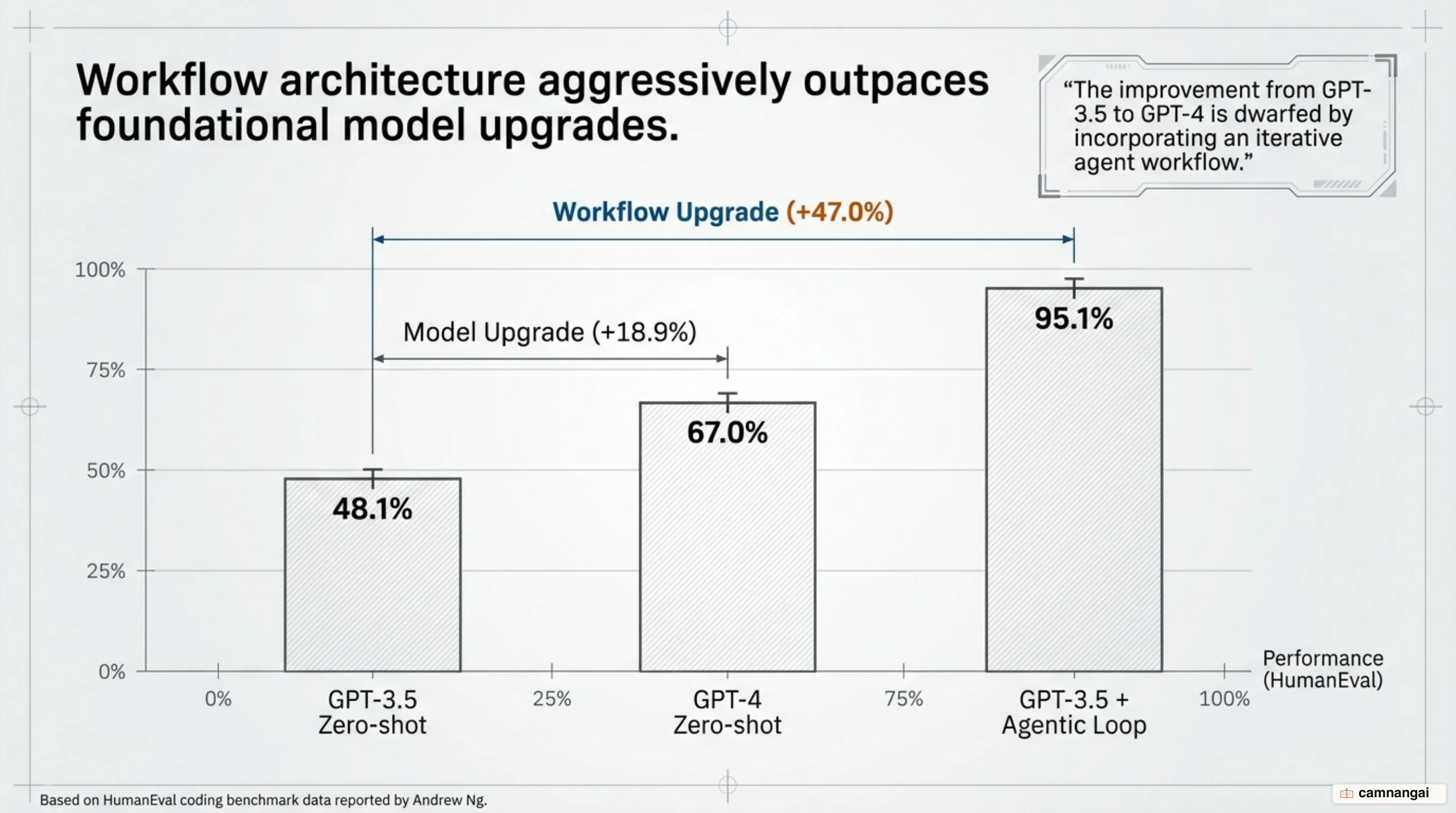
The structural takeaway for infrastructure design is clear: wrapping a weaker base model in a well-defined process easily outperforms a stronger model responding in a single zero-shot pass. System engineers do not need to wait for next-generation foundation models to achieve production-grade accuracy on complex tasks. By implementing structured loops and execution boundaries around current-generation models, you can achieve system performance near or exceeding next-generation zero-shot baselines today.
Fast token generation acts as a direct system multiplier within agentic architectures. In a traditional single-pass deployment, tokens are generated primarily for human consumption at human reading speeds. In an agentic workflow, generated tokens are read by other LLM instances in the loop rather than human end users. Because language models ingest data orders of magnitude faster than humans, high token throughput enables rapid iteration without incurring prohibitive user latency.
Generating high token volumes rapidly from a fast, slightly lower-parameter model allows an agent to execute multiple evaluation and revision loops in the time a slower, larger model takes to execute a single pass. Fast inference, optimized serving stacks, and model quantization directly compound overall system accuracy by increasing the total number of feedback iterations permitted within a fixed execution budget.
Mapping Andrew Ng's 4 Patterns to Anthropic's 5 Workflows
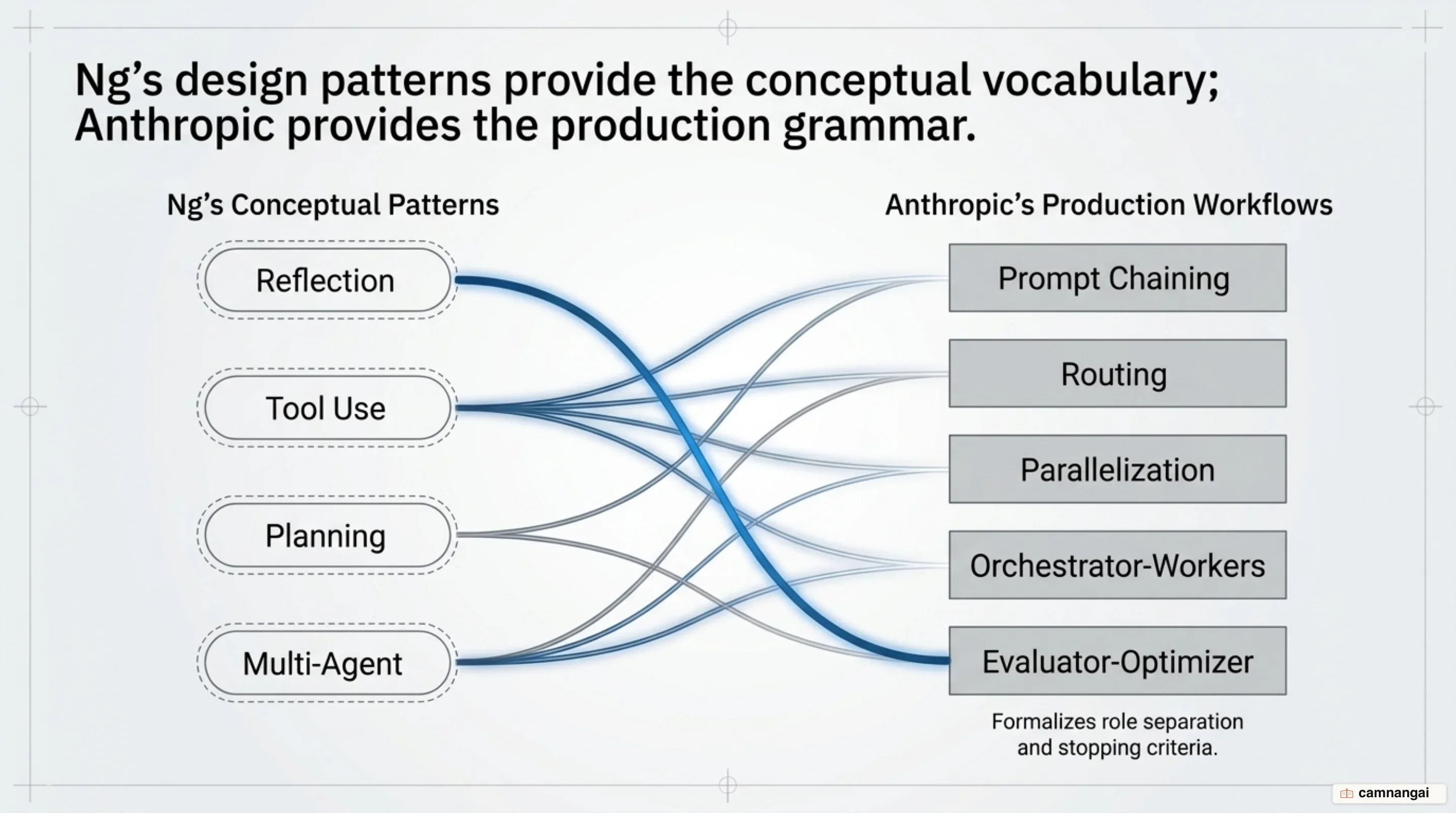
Architectural patterns for AI agents can be unified by mapping Andrew Ng's four foundational design patterns—Reflection, Tool Use, Planning, and Multi-Agent Collaboration—against Anthropic's five production workflow patterns: Prompt Chaining, Routing, Parallelization, Orchestrator-Workers, and Evaluator-Optimizer. Workflows enforce predefined code execution paths, whereas autonomous agents dynamically direct their own tool calls and step choices. System reliability increases when you compose complex behaviors out of simple, deterministic workflows before introducing unconstrained agent autonomy.
Reflection maps directly to Anthropic's Evaluator-Optimizer workflow, where one LLM instance generates an output and a second evaluates it against a structured rubric to drive iterative revisions. Tool Use maps to the Augmented LLM pattern, serving as the foundational primitive for all grounded agentic workflows by providing external context and deterministic execution. Routing classifies incoming requests to direct them to specialized prompts, distinct models, or dedicated workflows, preventing misclassifications through explicit confidence thresholds and fallback paths. Planning maps to both Prompt Chaining for fixed execution paths and Orchestrator-Workers for dynamic subtask decomposition. Multi-agent collaboration maps to Orchestrator-Workers and Parallelization setups, where specialized instances process independent subtasks or conduct multi-agent debate to evaluate competing solutions.
These design patterns exhibit distinct levels of operational maturity. Reflection and Tool Use are classified as mature and ready for immediate deployment; applying structured feedback loops and typed tools yields predictable, repeatable quality gains. Conversely, Planning and Multi-Agent Collaboration remain emerging patterns. While highly capable, dynamic planning loops exhibit unpredictable behaviors—such as rate-limit API errors forcing an agent to pivot dynamically to alternative tools like Wikipedia search, or agents looping indefinitely during dynamic task decomposition. To deploy emerging patterns reliably, you must implement tight programmatic boundaries, strict schema validation, dependency checks, and hard step bounds.
| Ng Pattern | Anthropic Workflow | Maturity Level | Key Functional Addition |
|---|---|---|---|
| Reflection | Evaluator-Optimizer | Mature | Explicit critique loops and stopping criteria |
| Tool Use | Augmented LLM | Mature | Grounding in external data and deterministic actions |
| Planning | Orchestrator-Workers + Prompt Chaining | Emerging | Dynamic vs. fixed step decomposition and execution |
| Multi-Agent | Parallelization + Orchestrator-Workers | Emerging | Role-specialized collaboration and multi-perspective checks |
Steps 1 & 2: From Single Loops to Predictable Chains
Implementing Reflection (Step 1) requires establishing a dedicated generator-critic loop governed by explicit stopping rules and rubric enforcement. The loop operates across four mandatory artifacts: the immutable task statement, the current draft, the structured critique, and the revision decision. Rather than asking a single prompt to optimize its output in place, the system generates an initial draft, evaluates it against explicit scoring criteria using a separate role prompt, and executes a targeted revision step. Iteration continues until the critique satisfies the rubric or the execution hits a hard iteration limit.
{
  "task_id": "case-017",
  "draft_version": 1,
  "rubric_version": "support-v3",
  "issues": [
    { "type": "missing_evidence", "severity": "high" },
    { "type": "tone", "severity": "low" }
  ],
  "decision": "revise",
  "iteration": 1,
  "max_iterations": 3
}
Tool Use (Step 2) extends language models from closed parameter spaces into open, verifiable systems. By providing typed interfaces to external tools—such as database queries, search APIs, or Python code execution sandboxes—the model replaces statistical completion estimates with deterministic execution outputs. For example, an agent tasked with logic generation can run code within a sandboxed interpreter, capture unit test failures, and pass execution errors back into its context to verify functional correctness before returning a result.
Deploying these initial patterns introduces four distinct system failure modes that require active programmatic controls:
- Self-Confirmation Bias: The evaluator agent mirrors the underlying assumptions that produced the flawed draft. Control: Enforce strict role separation using distinct system prompts or distinct model instances for evaluation.
- Rubric Drift: The evaluator rewards stylistic fluency instead of actual task correctness. Control: Require the evaluator to cite concrete line-item evidence from test execution outputs or source documents.
- Wrong Tool Selection or Invalid Arguments: The agent invokes improper APIs or passes malformed parameters. Control: Enforce rigid JSON schemas and execute runtime argument validation prior to tool execution.
- Non-Monotonic Revisions: A revision fixes one target issue while degrading previously correct elements. Control: Retain the immutable baseline task and run automated regression checks against every intermediate version.
When a task can be cleanly decomposed into static subtasks, dynamic loops should be replaced with fixed programmatic chains (Prompt Chaining). Deterministic sequencing enforces known execution paths in code, eliminating unnecessary model decision steps, reducing latency, and eliminating unbounded token consumption caused by open-ended agent loops.
Step 3: Network — Orchestrating Workers and the Context Bottleneck
Network architectures move beyond single-agent loops by establishing multi-agent collaboration topologies. In these setups, a central orchestrator agent analyzes an incoming objective, dynamically creates discrete subtasks, and delegates execution to specialized worker agents—such as dedicated Coder, Reviewer, and QA Tester roles in software development workflows—or manages multi-agent debate setups to evaluate competing hypothesis models.
As worker networks scale, they encounter a major architectural bottleneck: Context Window Saturation. When multiple workers pass raw conversational logs and verbose execution histories back to the central orchestrator, the orchestrator's context window rapidly fills with redundant reasoning, raw tool logs, and formatting artifacts. This transcript bloat inflates token costs, increases processing latency, increases prompt noise, and causes severe degradation in long-term reasoning coherence.
The engineering solution to the Context Bottleneck is enforcing strict artifact contracts across all handoff boundaries. Rather than passing unbounded conversational transcripts between agents, worker nodes must communicate exclusively through typed, structured schemas. The research worker returns a list of verified claims with cited source IDs; the developer worker returns raw code files alongside unit test output logs; the audit worker returns prioritized defect schemas.
By enforcing artifact contracts, worker execution logs are stripped at the handoff boundary. The central orchestrator receives only the structured payload necessary to direct the next processing step, keeping context windows lightweight and focused. This separation of local execution logs from global system state establishes the operational foundation for persistent graph architectures.
Step 4: Graph Engineering — Externalizing Shared State and Durable Memory
Graph Engineering (Step 4) addresses the physical capacity limitations of context windows by migrating state, claims, and relationships out of LLM prompts into an externalized, persistent graph infrastructure. Instead of re-parsing extended conversation histories or re-sending execution logs on every iteration, agents query and update specific subgraphs within a shared knowledge graph. This architecture decouples agent memory from context length, allowing system state to survive context flushes, model changes, and process restarts.
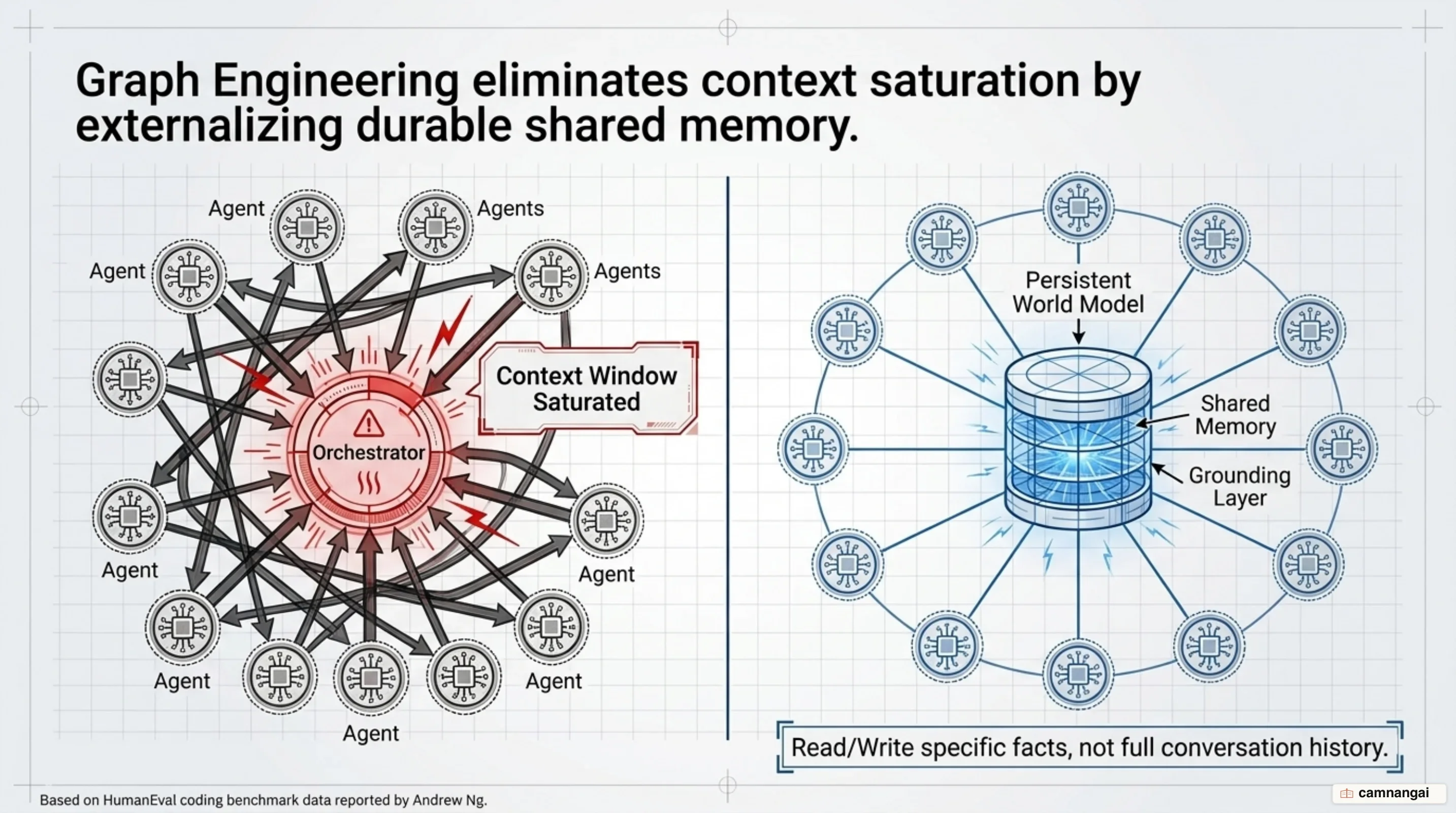
A Knowledge Graph fulfills three structural roles in multi-agent systems:
- Shared Memory for Orchestrator-Workers: Worker nodes query relevant nodes directly and append new output subgraphs without routing raw transcripts back through the orchestrator, keeping central context windows small.
- Grounding Layer for Evaluator-Optimizer: Evaluator agents verify generated statements against explicitly typed graph triples with linked provenance, transforming subjective text evaluation into deterministic edge validation (e.g., confirming whether a specific claim node connects to a valid source node).
- Persistent World Model: The graph functions as a durable system of record that retains system facts across execution sessions and context resets, operating as persistent state that survives system restarts.
{
  "nodes": [
    {
      "id": "ent_01",
      "label": "Entity",
      "properties": { "name": "AuthService", "type": "Microservice" }
    },
    {
      "id": "clm_88",
      "label": "Claim",
      "properties": { "text": "Deprecates OAuth1.0", "status": "verified" }
    },
    {
      "id": "clm_87",
      "label": "Claim",
      "properties": { "text": "Supports OAuth1.0", "status": "deprecated" }
    },
    {
      "id": "src_42",
      "label": "Source",
      "properties": { "uri": "s3://docs/api_v2.pdf", "timestamp": "2026-07-01" }
    },
    {
      "id": "art_09",
      "label": "Artifact",
      "properties": { "type": "Code", "path": "src/auth.py" }
    },
    {
      "id": "run_10",
      "label": "Run",
      "properties": { "execution_id": "exec-9921", "status": "success" }
    }
  ],
  "edges": [
    { "source": "art_09", "target": "ent_01", "type": "mentions" },
    { "source": "src_42", "target": "clm_88", "type": "supports" },
    { "source": "clm_88", "target": "clm_87", "type": "contradicts" },
    { "source": "clm_88", "target": "art_09", "type": "derived_from" },
    { "source": "clm_88", "target": "clm_87", "type": "supersedes" }
  ]
}
To maintain graph integrity over time, you must enforce strict data quality controls. Write operations must be strictly additive: when a new iteration invalidates an earlier statement, the system appends a new claim node connected via a supersedes edge rather than overwriting historical records. System pipelines must enforce schema validation on all node creation inputs to ensure proper property formatting and type consistency.
Production graph engineering requires canonical entity resolution and explicit conflict representation. Canonical entity resolution pipelines parse incoming entity references to merge duplicate nodes (e.g., resolving AuthService and auth-service to a single canonical ID), preventing graph fragmentation. When contradictory claims emerge across worker runs, the system writes explicit contradicts edges between nodes and flags the relationship for evaluation. This mechanism enables agents to navigate conflicting evidence dynamically while preserving a complete historical audit trail of system reasoning.
Decision Framework: When to Evolve from Loops to Graphs
Selecting an agent architecture requires adhering to a fundamental design rule: default to the simplest architectural pattern that satisfies your performance requirements. Adding architectural complexity introduces compounding token costs, API latency, and non-deterministic failure modes. You should introduce more complex orchestration patterns only when a specific, measured system failure mode forces the transition.
The transition between architectural stages involves explicit cost and performance trade-offs. Single-pass prompts offer minimal latency and predictable cost, but fail on multi-step reasoning. Introducing a reflection loop (Step 1) or tool integration (Step 2) improves output accuracy by 10% to 30% with minor latency overhead. However, as tasks expand into multi-step planning (Step 3) and multi-agent network execution, execution costs and latency scale non-linearly due to repeated context re-parsing and inter-agent communication overhead.
Transitioning from network architectures to graph architectures (Step 4) becomes necessary when the cost of context window bloat and state loss exceeds the engineering overhead of maintaining external graph infrastructure. When worker agents generate hundreds of thousands of tokens of conversational logs, passing raw transcripts causes severe context window saturation, increased token bills, and reasoning degradation. Graph engineering eliminates transcript replay by providing indexed, queryable memory, trading prompt context overhead for fast database lookup operations.
To implement this framework efficiently, systematically evaluate system failure modes at each development stage. Measure whether errors stem from single-pass output generation (solved by Reflection), lack of real-world facts (solved by Tool Use), dynamic path branching (solved by Planning), lack of domain specialization (solved by Multi-Agent networks), or context window saturation and session loss (solved by Graph Architecture). Advancing to the next architectural stage without empirical failure metrics leads to unnecessary infrastructure complexity and higher operational costs.
Pattern Decision Matrix
| Trigger / Need | Architecture Pattern | Why Use It |
|---|---|---|
| First-pass output requires structured refinement against a rubric | Reflection | Lowest cost, most reliable quality boost via self-correction loops |
| Task requires private, exact, or dynamic real-world facts | Tool Use | Grounds responses in verified data, database records, or code outputs |
| Task execution path varies dynamically and cannot be hardcoded | Planning | Decomposes objectives into executable subtasks with replanning bounds |
| Task benefits from specialized roles, debate, or independent review | Multi-Agent | Isolates responsibilities and catches errors via specialized perspectives |
| State must persist across sessions, or transcript bloat degrades coherence | Graph Architecture | Externalizes memory into a queryable structure with full provenance |
Staged Implementation Timeline
| Step | Timeframe | Complexity | Expected Lift / Target Benefit |
|---|---|---|---|
| Step 1: Reflection | Day 1 | Low | 10–30% output quality improvement over zero-shot baseline |
| Step 2: Tool Use | Day 2 | Low | Eliminates hallucinated facts by grounding in external APIs/DBs |
| Step 3: Planning | Week 1 | Medium | Enables execution of dynamic, multi-step research or tasks |
| Step 3.5: Multi-Agent | Week 2 | Medium | High verification accuracy through specialized worker roles |
| Step 4: Graph Arch. | Month 1 | High | Scale-stable, persistent memory across multi-agent processes |
Start with the Smallest Loop Before Building Graphs
Begin your implementation by adding a minimal reflection loop to your existing single-prompt setups. Measure task-level quality improvements against an explicit rubric before introducing additional complexity or agent roles.
Avoid building graph infrastructure until context window flushes, transcript bloat, and multi-agent coordination failures explicitly demand externalized, durable state management. Select the simplest architectural pattern that meets your operational metrics, and scale your system architecture only when empirical failure modes require it.