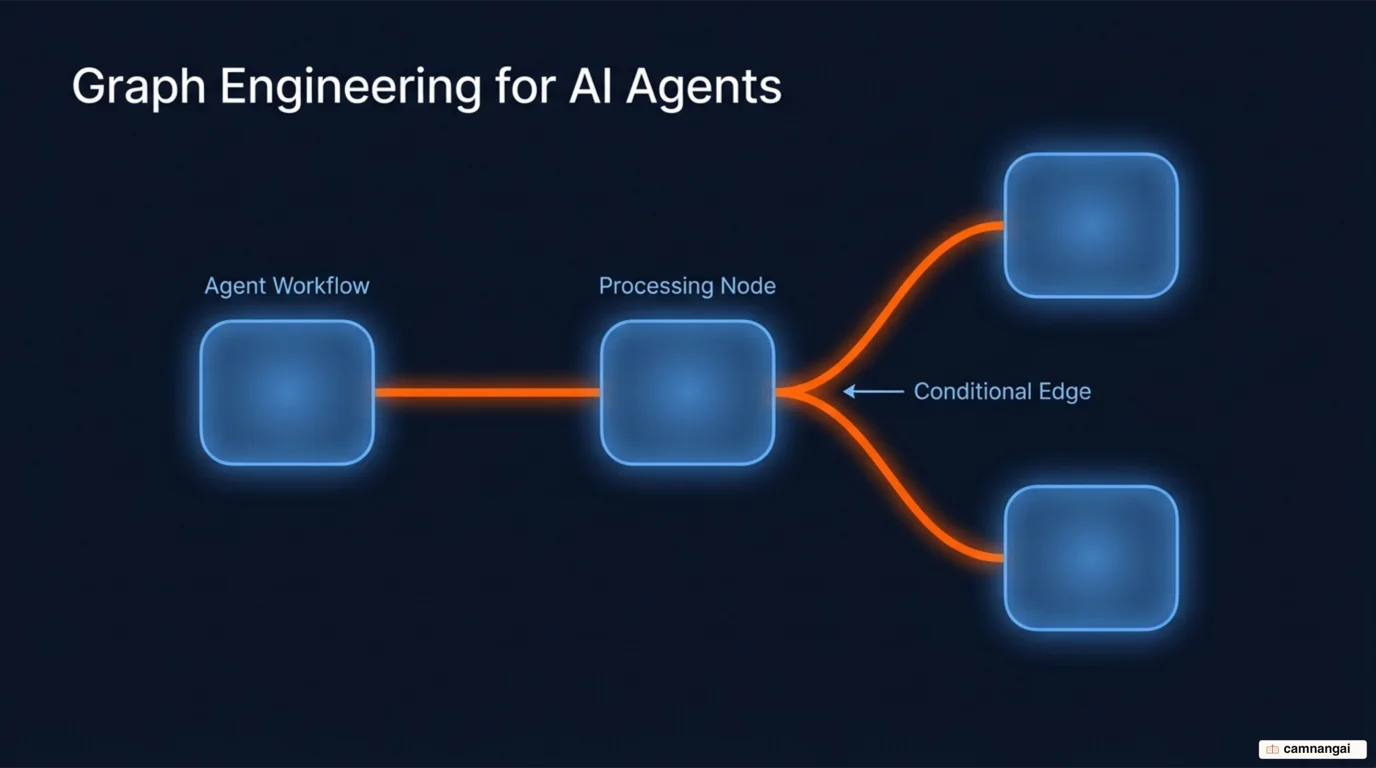
Graph engineering is the architectural practice of designing explicit workflows — composed of nodes, edges, and state — to move agentic systems away from "black-box" monolithic chat contexts.
By representing an AI application as an executable graph, you impose specific domain knowledge and preconceptions on the system's path. The agent then follows predictable, controllable structures rather than relying solely on the probabilistic judgment and internal planning of a large language model (LLM).
In a graph-engineered system, you define the valid transitions, decision boundaries, and state schemas. This lets you coordinate multiple agents, deterministic functions, and human reviewers inside a single orchestrated system. As you move from simple prompting to complex industrial processes, graph engineering provides the low-level control needed to build reliable, maintainable, auditable AI agents.
What is graph engineering?
Graph engineering is the design of nodes, dependencies, state transitions, and execution routes within an agentic system. Unlike "loop engineering" or "harness engineering", which focus on a single agent acting toward a goal in a repetitive cycle, graph engineering focuses on orchestrating multiple agents and deterministic functions into one cohesive, executable system. It treats an AI application as a directed graph where you define the cognitive architecture of the process.
This practice lets you encode your world knowledge directly into the system. Instead of hoping an LLM understands a complex multi-step process, you hardcode the topology: which steps are fixed, where the model is allowed to choose, and where deterministic code must handle the logic. You move from a probabilistic black box to a system that applies model reasoning only at the specific nodes where it adds the most value.
Graph engineering is about controlling the flow of information. Frameworks like LangGraph let you manage this by defining separate schemas for input, output, and internal state. Using an internal state schema that acts as the union of all keys, you can filter what a given node sees and what the final user receives. That structure makes behavior predictable, efficient, and far easier to debug than an unstructured autonomous agent.
Why isn't a single agent loop enough?
A single agent loop operates as a black box where planning, searching, and validation all hide inside one large model context. That opacity makes it hard to debug specific failures or control the escalating costs of token bloat. In a single loop, the model acts as scheduler, database, and project manager at once, which produces hallucinations and logical errors when a task spans multiple repositories or hours of execution.
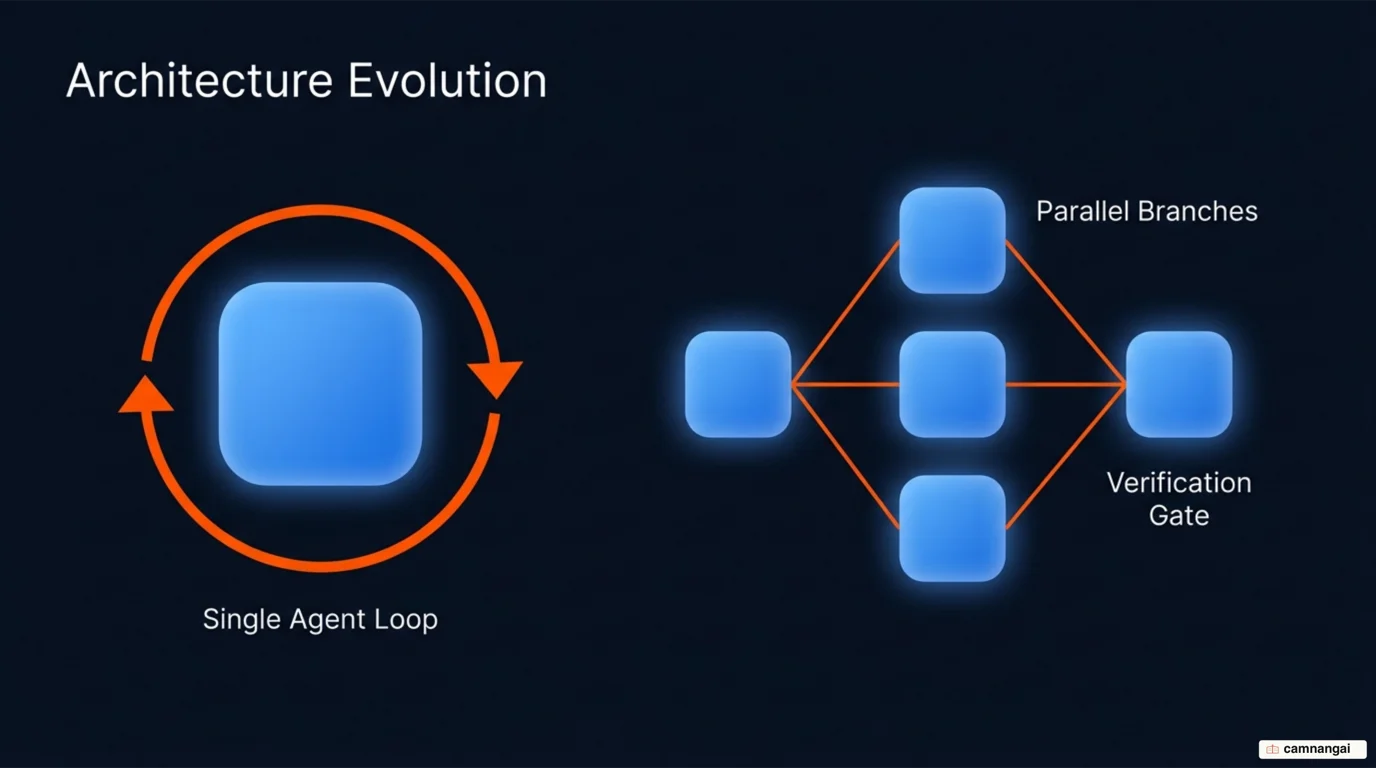
Complex industrial tasks need branching logic a single loop cannot supply reliably. Consider a code review system: a solid implementation fans out multiple audit agents in parallel to inspect a pull request, converges those findings into a verifier node, then routes confirmed issues to a fixer node. A single-agent loop struggles to manage those parallel dependencies or to enforce veto power. In a graph, a security check is a structural barrier — a node that physically prevents the next step from firing — whereas a model-driven loop can simply reason around a security warning sitting in its context.
State management in a single loop is fragile too. The entire history gets passed back and forth, increasing latency and noise. Graph engineering allows explicit state snapshots and persistent checkpoints. That matters for long-running tasks where you need to pause for human approval, or recover from a crash without losing hours of progress and repeating expensive LLM calls.
Nodes, edges and state: the three parts of an agent graph
The mechanics rest on three components. Nodes are the bounded units of execution: a single LLM call, a Python function, a tool call, or a subgraph. Edges are the routing logic that decides which node runs next; they are either normal (static transitions) or conditional (dynamic routing based on current state or model output).
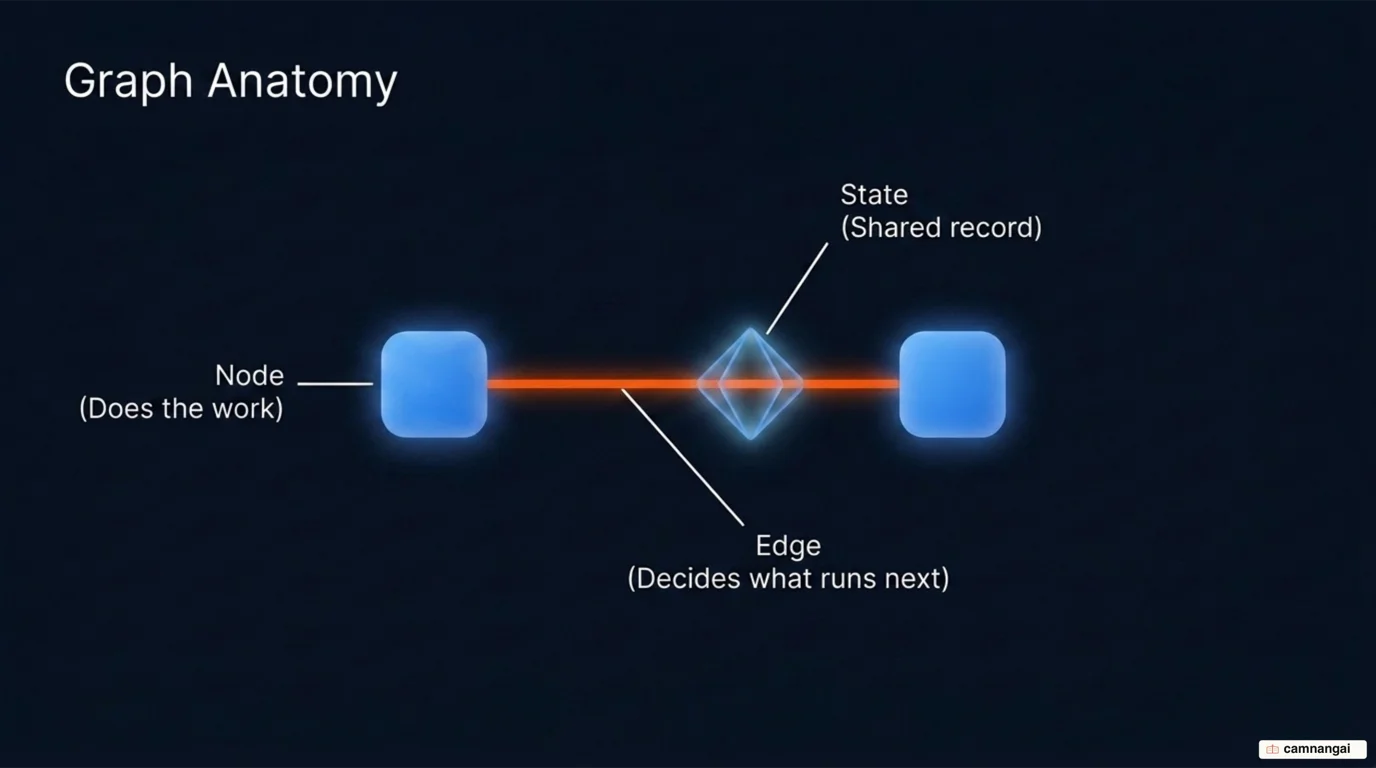
State is the shared record, the snapshot of the application that persists as it moves through the graph. It is the interface between nodes. Each node reads the current state, computes, and returns an update. Here is a typical state schema using TypedDict:
from typing import TypedDict, Annotated
import operator

class OverallState(TypedDict):
    """The shared state structure for the entire graph."""
    user_input: str
    task_plan: list[str]
    # Reducer: appends updates to the list instead of overwriting
    retrieved_evidence: Annotated[list[str], operator.add]
    draft: str
    revision_count: int
Reducers integrate updates into state. A reducer is a binary function taking two arguments: left (the current value in state) and right (the update a node returned). The default behavior for any key is overwrite: the left value is discarded for the right. Specify a custom reducer like operator.add and you can handle simultaneous updates from parallel nodes, so evidence from several agents merges into one list instead of one node clobbering another's work.
Common agent graph patterns
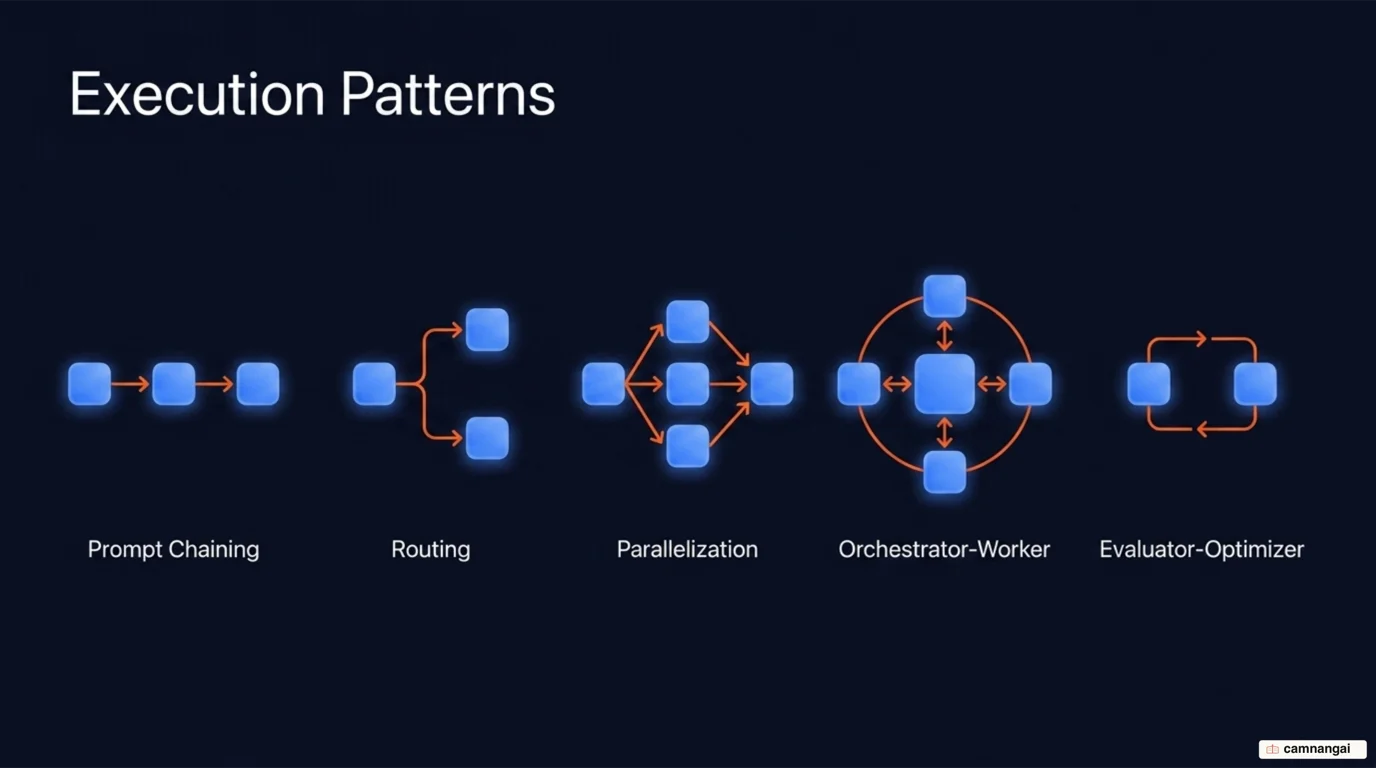
Several orchestration patterns recur. Prompt chaining is the most basic: the output of one node is the direct input to the next. Parallelization runs independent tasks concurrently. In the orchestrator-worker model, a lead node decomposes a task into subtasks and delegates them. That pattern often uses the Send API, which lets the orchestrator spawn a variable number of worker nodes at runtime, a map-reduce shape, rather than relying on a hardcoded node count.
The evaluator-optimizer pattern enforces quality. One node generates an artifact while another evaluates it against specific evidence. When the evaluator finds a failure, the graph routes the artifact back to an optimizer node for revision. The cycle repeats until the evaluator approves or the graph hits a maximum retry limit, and forgetting to set that limit is how a self-correcting graph turns into an expensive infinite one.
Human-in-the-loop patterns use interrupts that pause the graph. Before an agent issues a refund, for instance, the graph hits an interrupt node: state is saved to a checkpointer and execution stops. That structural guarantee means the agent cannot take a consequential action without an external resume signal from a person, which is a safety gate that is hard to enforce in an open-ended loop.
Graphs or loops: what the debate is really about
The graphs-versus-loops argument is a question of how much structure an AI system should carry. One reading is that graph engineering is a rebranding of decades-old software patterns like state machines, where a node is a state and an edge is a transition. On that reading the innovation isn't the graph — it's that the logic inside the nodes is now probabilistic rather than purely deterministic.
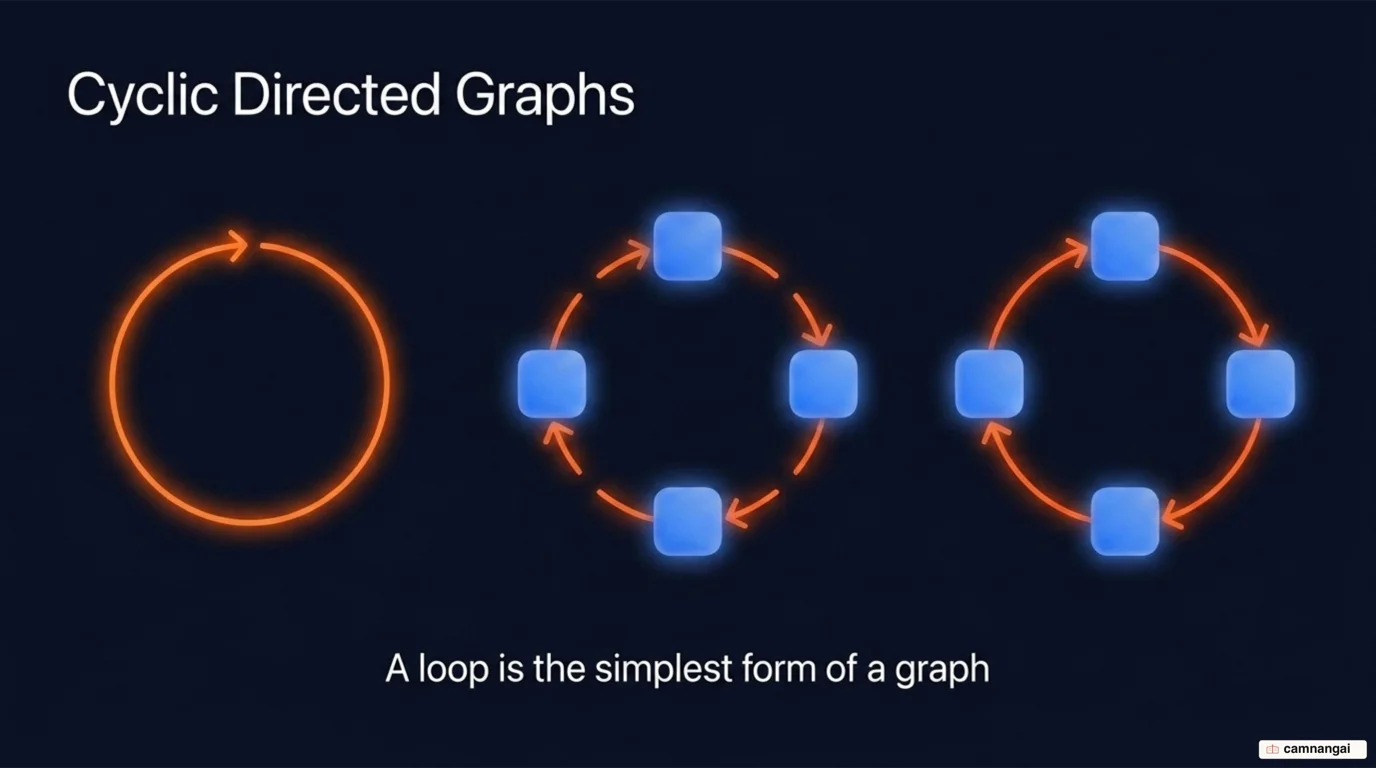
The choice sits between structure-for-its-own-sake and structure-only-when-earned. A basic imperative loop serves simple tasks better, because every layer of graph orchestration adds latency and overhead. As soon as a workflow needs branching, conditional routing, or state that survives across sessions, though, the graph is what stops the system from decaying into an unmanageable pile of if-statements.
A loop is technically just a simple cyclic directed graph, so I read the argument as a question of timing rather than of sides: the work itself tells you when an implicit, model-driven loop has to become an explicit, developer-defined graph, one where the topology of the agent's reasoning is visible, auditable, and constrained.
Is LangGraph the only option?
LangGraph is a dominant framework for graph-based control, not the only one. The main alternative is the model-driven approach, such as Strands Agents. The difference is who drives the loop: in LangGraph the developer defines a state machine, while in Strands the LLM is trusted to drive the loop autonomously from the tools it is given.
| Category | LangGraph | Strands Agents |
|---|---|---|
| Control model | Graph-driven (developer defines flow) | Model-driven (LLM drives loop) |
| Core abstraction | State machine (nodes/edges/state) | Agent + tools |
| Lines of code (basic) | 40+ (wiring state, nodes, edges) | Under 20 (thinner abstraction) |
| State management | Explicit typed state and checkpoints | Model-managed context |
Other frameworks take different architectural positions. Google ADK uses an event-sourcing model where every interaction (user messages, tool calls, state changes) is an immutable event appended to session history. Microsoft Agent Framework supplies a workflow system that separates dynamic agents from explicitly controlled, typed workflows. Which you pick depends on whether you value model-driven simplicity or developer-driven structural guarantees, though once a workflow touches money or customer data that stops being a matter of taste.
What the diagrams don't show you in production
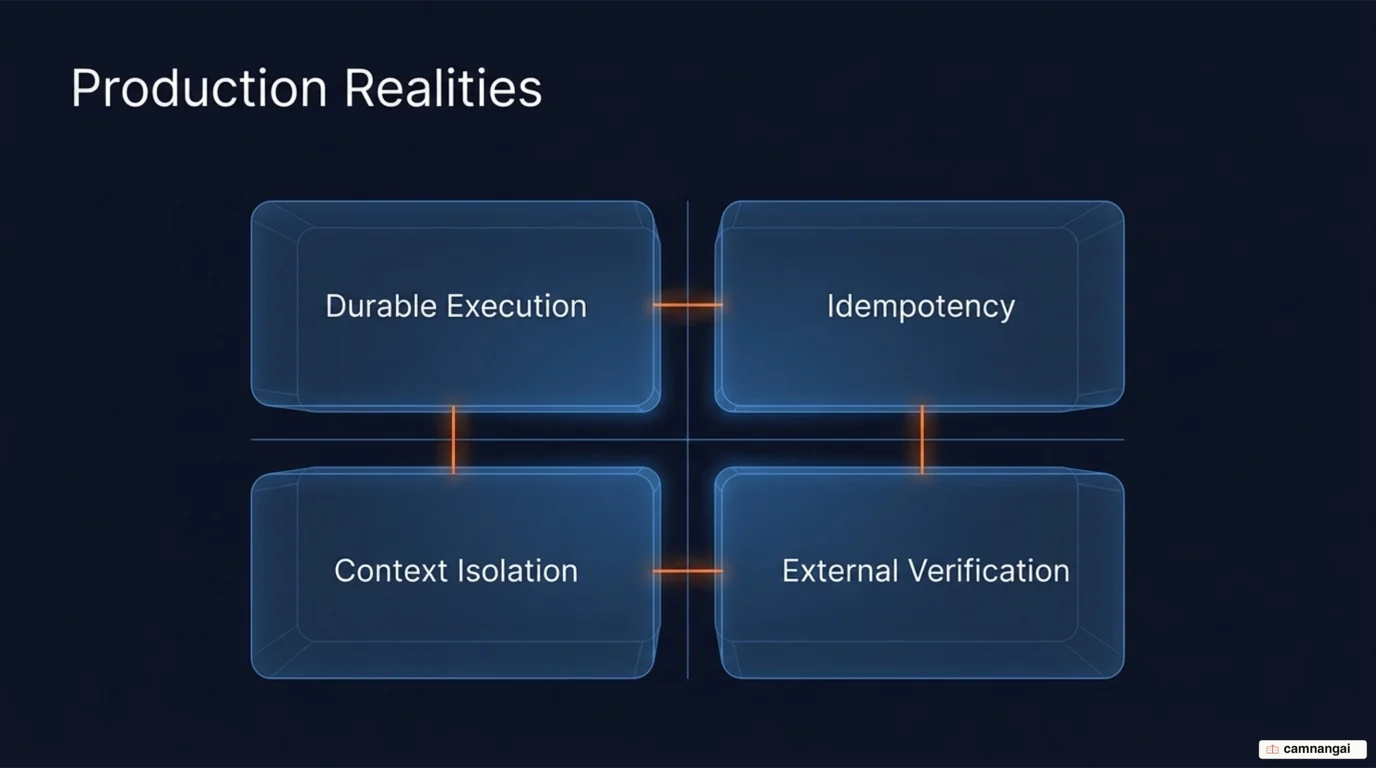
Architecture diagrams gloss over what running agents at scale actually costs. The common misconception is that checkpointing equals durable execution. A checkpointer gives you a save point of the state; it does not detect failure. If a process crashes mid-node, the system stays dead until a developer manually resumes it with the right thread ID. Durable execution means a runtime that guarantees completion through a supervisor or heartbeat that resumes failed workflows on its own.
Idempotency is the next requirement people miss. Graph nodes may be retried after an interrupt or a network failure, so re-running a node must not cause duplicate side effects. A node that talks to a payment gateway needs idempotency keys, upserts, or read-before-write checks, because otherwise a retry charges the customer twice.
Context isolation is what keeps performance and cost under control. Avoid the god-object anti-pattern where every node receives the full graph state. Handing an LLM irrelevant history inflates token usage and raises the risk of hallucination. Isolate nodes so each receives only the keys it needs: a writer node gets the evidence and the plan, not the entire raw search history.
When should you not use graph engineering?
Graph engineering is overkill for simple, linear, single-purpose tasks. If the task is "read this and give me a summary," a basic script or a simple agent loop is more efficient. Over-engineering it into a graph adds latency and testing burden without improving the output.
Highly open-ended work like deep research is the other exclusion: it benefits from dynamic planning where steps emerge at runtime, so a more agentic core loop that lets the model plan and delegate freely usually beats a hardcoded graph. Start simple with a loop, and grow into a graph only when the requirements — human vetoes, parallel branches, auditable transitions — force that structure on you.
References
- 3 Years of Graph Engineering with LangGraph — LangChain
- Graph API Overview — LangChain Docs
- Graph Engineering for AI Agents: Beyond the Single-Agent Loop — Analytics Vidhya
- Graph-Based Agentic AI with LangGraph: Workflow Pathways for Long-Running Stateful Business Processes — arXiv
- Graph Engineering Explained: What Actually Changed — Louis Bouchard
- Graphs vs. Loops: The Agentic AI Orchestration Debate — explainX
- Checkpoints Are Not Durable Execution — Diagrid
- Strands vs LangGraph: 2026 Agent SDK Comparison — fp8.co