Multi-agent architectures are distributed systems where specialized AI entities collaboratively execute complex tasks by segmenting them into discrete, manageable steps.
For production AI, these architectures are the primary method for overcoming the cognitive and physical limits of a single model's context window and toolset. By partitioning a monolithic problem into targeted roles, engineering teams can scale reasoning, minimize latency through parallelism, and maintain strict control over tool access in sensitive environments.
At the architectural level, a critical distinction exists between simple workflows and autonomous agents. Workflows are prescriptive, using predefined code paths to orchestrate Large Language Models (LLMs) and tools for predictable, repeatable outcomes. Conversely, autonomous agents are dynamic; the LLM maintains control over its own trajectory, determining tool usage and reasoning paths on the fly based on environmental feedback and intermediate results.
Production systems necessitate a choice between these agentic patterns based on the requirement for flexibility versus reliability. Most successful implementations prioritize simple, composable patterns over complex, monolithic frameworks that often obscure the underlying prompt logic. In a production system, building the minimum necessary complexity is the goal — adding agents only when the hard limits of a single-model system are reached.
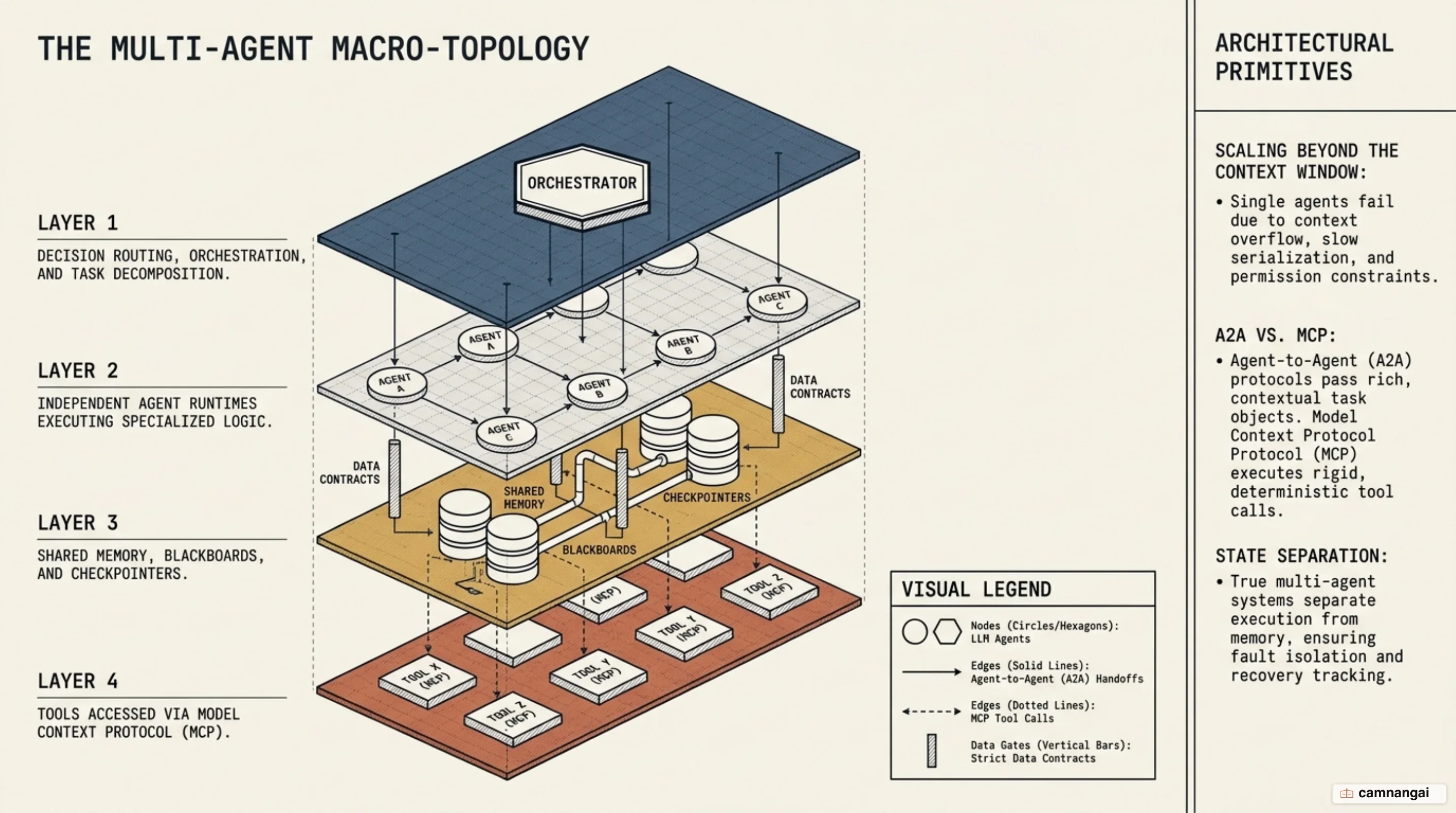
Why Single-Agent Systems Break Down
A single agent operates within a single context window, using a restricted toolset and a serial running loop. While state-of-the-art agents demonstrate significant scale on isolated benchmarks, most production tasks eventually hit the physical and cognitive limits of the underlying model. These limits are not solved by better prompting; they are structural boundaries that require architectural changes:
- Context Overflow: Every LLM context window is finite. As a task progresses, earlier instructions or data points are inevitably evicted or diluted, causing the agent to lose track of its original plan or hallucinate based on incomplete history. When information compression techniques are insufficient to manage this density, the task must be split across multiple agents, each maintaining an isolated and focused context to preserve reasoning quality.
- Parallelism Constraints: In single-agent systems, independent subtasks must be executed sequentially, creating a serial queue that bloats total response time. For example, if a research task requires four independent web queries, a single agent executes them one by one. Multi-agent systems can trigger these queries simultaneously across separate worker nodes, reducing the total execution time to the duration of the slowest single query and scaling system throughput.
- Specialization and Permission Requirements: Complex enterprise tasks often require different models, sandboxed environments, or restricted access levels. A code-execution agent requires a secure, ephemeral container, while a customer-facing agent requires access to user records but must be strictly barred from production databases. Coordinating these distinct roles necessitates a multi-agent approach to prevent privilege creep and ensure that each agent only possesses the tools and context necessary for its specific domain.
Pattern 1: Orchestrator-Workers
In the Orchestrator-Workers architecture, a central coordinator agent receives a high-level objective, decomposes it into discrete subtasks, and delegates them to worker agents. These workers operate in total isolation; they do not communicate directly with each other, and all results are returned to the orchestrator for final synthesis. This pattern is particularly effective for unpredictable research tasks where the number of required steps cannot be determined upfront.
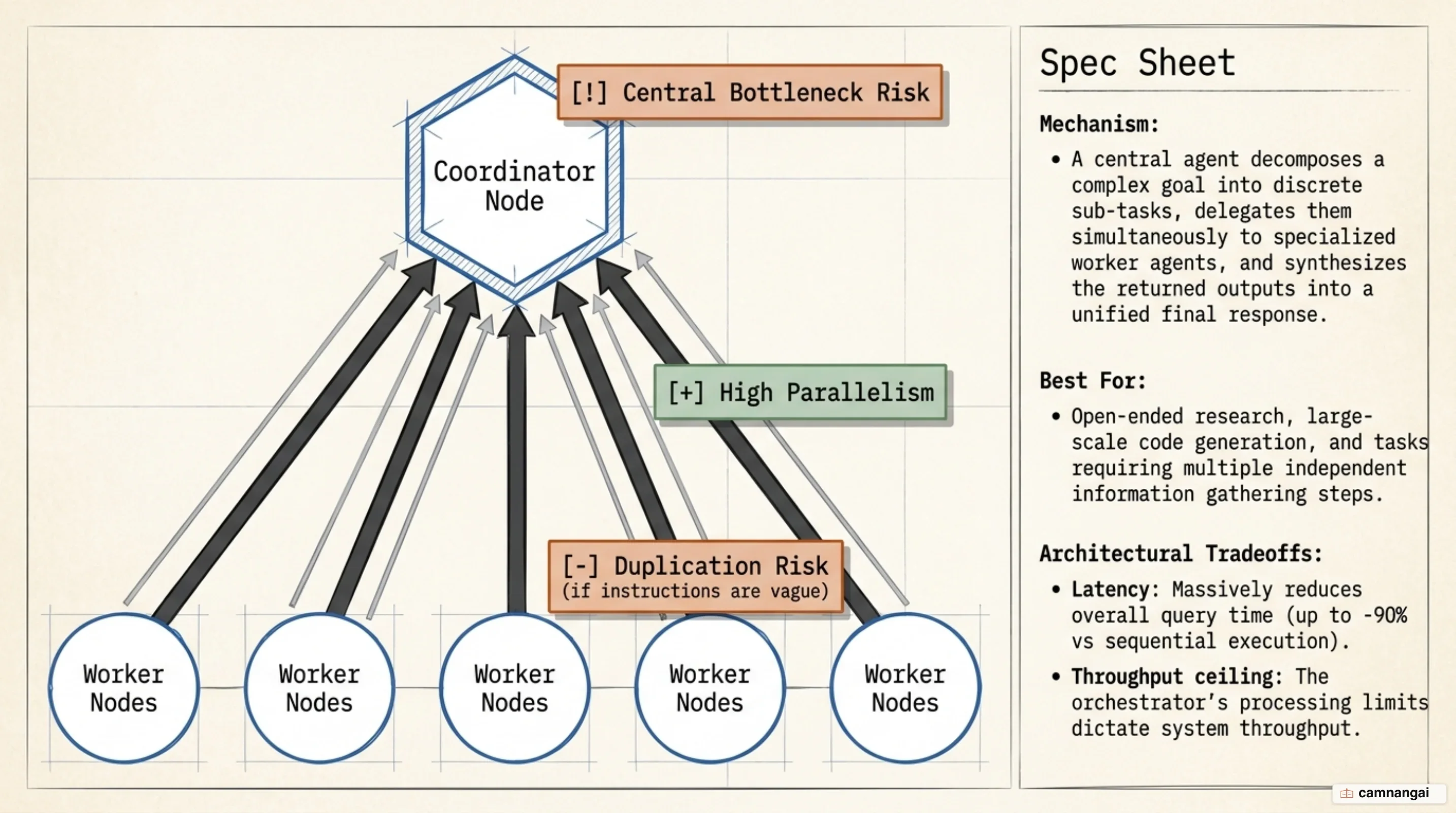
Anthropic's research on building effective agents highlights this model as a primary workflow, employing a high-capability model (such as Claude Opus) as the orchestrator to manage multiple faster worker models (such as Claude Sonnet) in parallel. In internal evaluations, this configuration achieved a 90.2% improvement in research quality over a single-agent baseline. By allowing workers to gather evidence from diverse sources simultaneously, the system avoids the "lost in the middle" phenomenon that plagues single-agent long-context retrieval.
However, the central orchestrator is a significant performance bottleneck. Because the orchestrator must process every worker response, system throughput is capped by the lead agent's processing speed. For instance, if each LLM call takes 3 seconds and the orchestrator manages 20 workers, the architectural ceiling is limited by the sequential coordination overhead.
Worker agents also frequently perform overlapping web searches on identical topics when the orchestrator provides vague task descriptions. This inefficiency significantly increases token consumption and operational costs. Success with this pattern depends entirely on the precision of the lead agent's task-splitting logic and its ability to provide workers with unique, non-overlapping search parameters.
{
  "task_metadata": {
    "orchestrator_id": "lead-orchestrator-01",
    "priority": "high",
    "timeout_ms": 30000
  },
  "subtasks": [
    {
      "worker_id": "researcher-alpha",
      "action": "web_search",
      "params": { "query": "multi-agent coordination patterns", "depth": "detailed" }
    },
    {
      "worker_id": "researcher-beta",
      "action": "sql_query",
      "params": { "table": "system_benchmarks", "filter": "latency_ms < 500" }
    }
  ]
}
Pattern 2: Sequential Pipeline
The Sequential Pipeline follows an assembly line logic where agents are organized in a fixed, predefined order. The output of the first agent serves as the input for the second, moving the work through a directed acyclic graph (DAG). This architecture prioritizes consistency and predictability over dynamic decision-making, making it the standard choice for regulated industries.
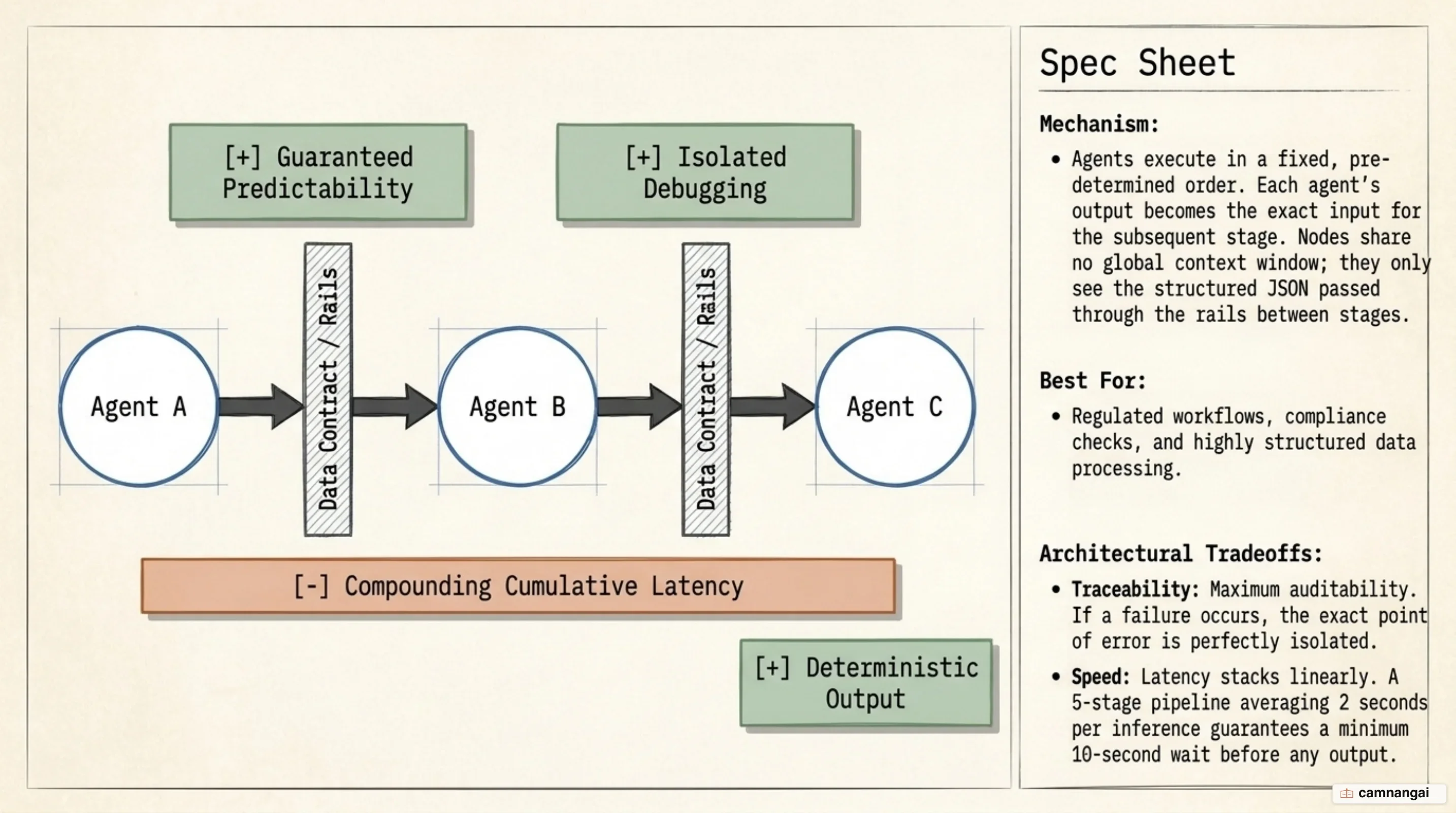
Stripe uses this pattern for business verification, breaking a complex legal review into a series of rigid agent stages. By establishing "rails"—strict data contracts that define exactly what each stage expects and emits—Stripe reduced average handling time by 26%. This predictability is essential for compliance, as it creates an immutable audit trail showing exactly which agent made which decision at every step of the verification process.
The primary engineering tradeoff in pipelines is the latency stack. Because each agent must wait for its predecessor to complete, the total system latency is the sum of every individual LLM call in the chain. Adding an evaluator or refiner agent to the end of a pipeline improves the quality of the final output, but it inevitably adds seconds to user wait time, making pipelines less suitable for real-time interactive applications.
Despite the latency, pipelines offer superior context discipline. Larger context windows do not eliminate the risk of distraction; they often make models harder to steer and evaluate. Pipelines enforce a focused context at each stage, ensuring that the writing agent at the end of a chain is not distracted by the raw, noisy retrieval data handled by the research agent at the start.
Pattern 3: Hierarchical Supervisor
A Hierarchical Supervisor architecture organizes agents into a tree structure, where a top-level supervisor routes work to mid-level managers, who in turn oversee domain-specific child agents. This structure is designed for broad domain coverage, ensuring that no single agent is required to hold the full system context. IBM's watsonx Orchestrate uses this pattern to route requests across dozens of specialized agents for HR, sales, and procurement.
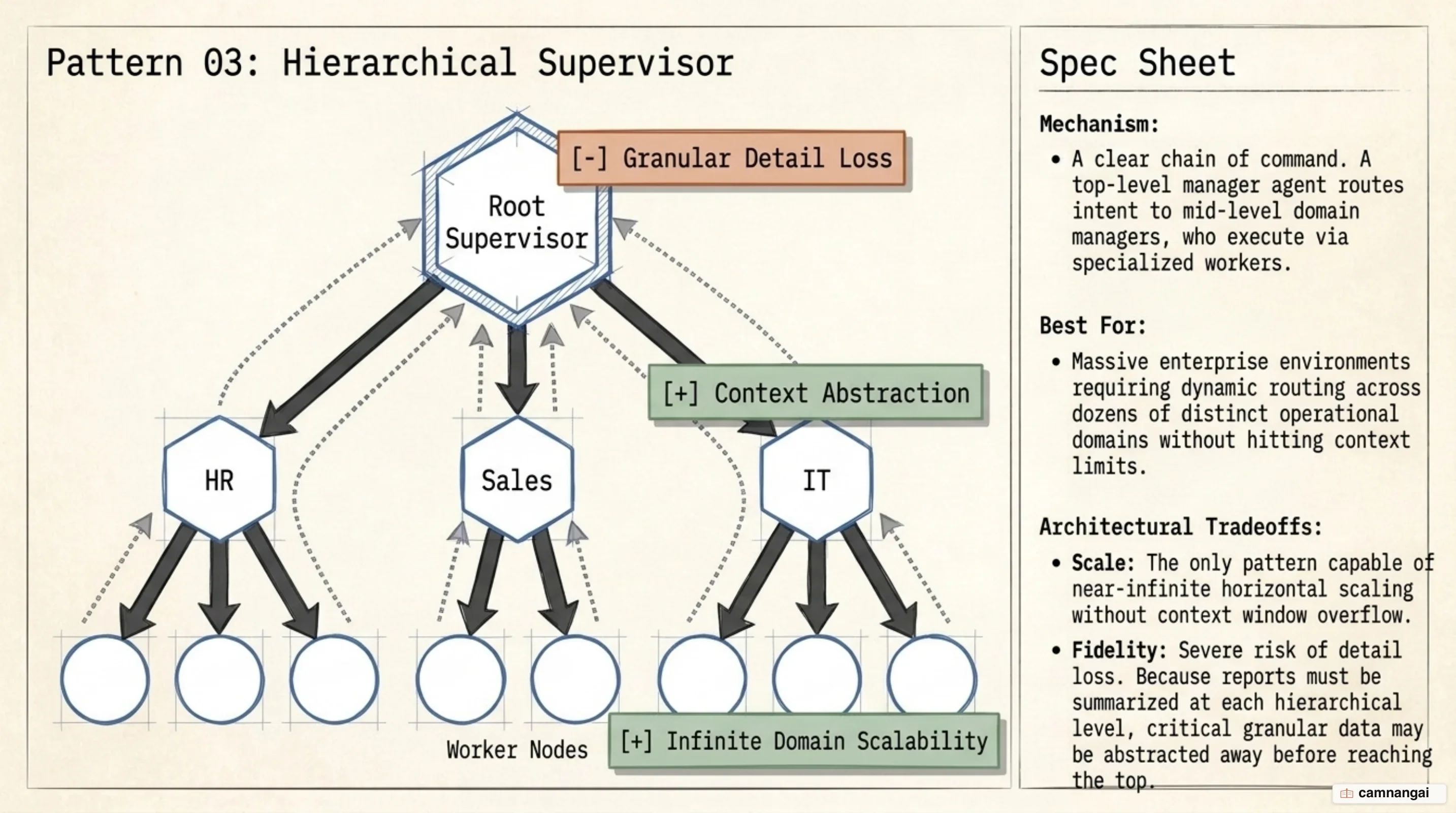
The Bayer PRINCE platform illustrates the power of this hierarchy through its combination of specialized roles:
- Process Reflection: During the planning phase, the supervisor evaluates its own trajectory, asking if the current plan of action is likely to lead to the user's goal. This thinking space allows the system to adjust strategy—such as switching from a vector search to a Text-to-SQL query—without restarting the entire workflow.
- Fail-Fast Intent Clarification: The supervisor identifies whether a user query is ambiguous before expensive research agents are triggered, preventing wasted tokens on misdirected tasks.
- Data Reflection: An independent reflection agent evaluates the content of retrieved data to ensure it is sufficient to answer the query before generating a final response.
The primary risk of the hierarchical model is loss of detail. As information is progressively summarized and filtered across multiple management layers, nuanced technical data gathered at the worker level can be omitted before reaching the top-level synthesizer.
Pattern 4: Collaborative Network and Swarm
Collaborative or Swarm architectures are decentralized systems where agents operate as equals without a central coordinator. In these systems, coordination is managed through direct handoffs or a shared blackboard pattern. Agents read from and write to a shared data store, such as a Redis cache or a vector store, which acts as the collective state of the operation.
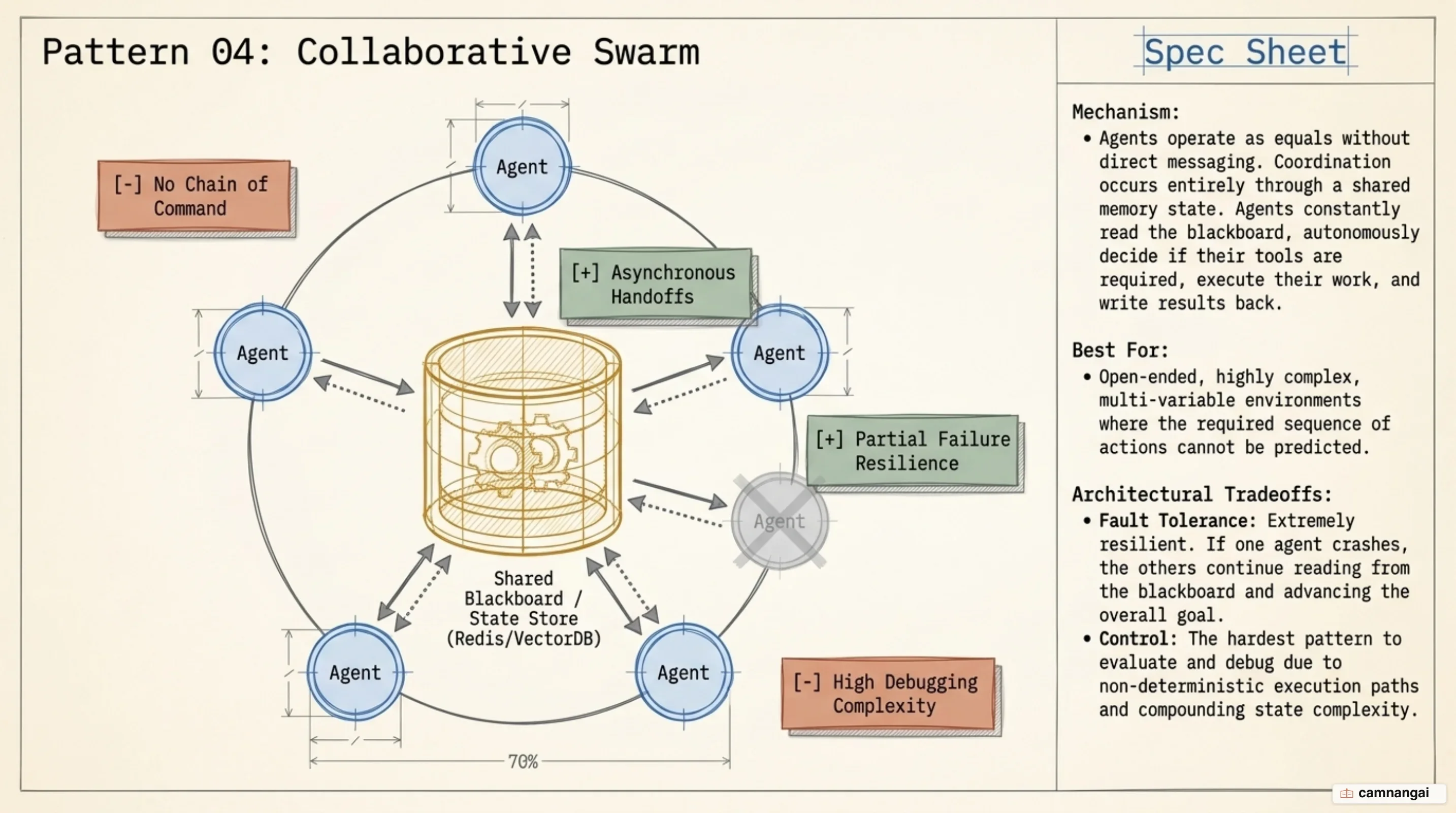
Swarm architectures are resilient to partial failures. Because there is no single central point of control, the failure of one agent does not bring down the entire system; other peers continue to pick up tasks from the blackboard. This makes swarms well-suited for exploratory, high-scale collaboration where the path to a solution is non-linear.
However, swarms are notoriously difficult to debug and trace. Without a central controller, establishing an audit trail or diagnosing why a collective decision went wrong is challenging. The lack of a central coordinator also risks ambiguity loops, where agents pass tasks back and forth indefinitely without arriving at a terminal condition.
Inter-Agent Communication and State Management
Production-grade multi-agent systems rely on structured iteration models like the super-step methodology found in Google's Pregel and the LangGraph framework. In this model, execution proceeds in discrete iterations: a node (agent) becomes active only upon receiving a message, executes its internal logic, and votes to halt by becoming inactive once its update is submitted:
- State and Reducers: State is managed through a typed schema, typically implemented as a
TypedDict. Reducers handle updates to this state, determining whether a new message should append to a list or overwrite specific keys, ensuring conversational integrity. - Selective Context Routing: Rather than dumping the entire execution history into every agent prompt, modern systems route only the specific context slices required for the active subtask. This reduces context noise and token overhead.
- Standardized Protocols: The Model Context Protocol (MCP) standardizes agent-to-tool interfaces, acting as an Agent-Computer Interface (ACI). Simultaneously, emerging Agent-to-Agent (A2A) protocols govern how autonomous systems discover capabilities, negotiate handoffs, and share verified context across system boundaries.
from typing import Annotated, TypedDict
from langgraph.graph.message import add_messages
from langgraph.managed import RemainingSteps

class SystemState(TypedDict):
    # Appends new messages rather than overwriting history
    messages: Annotated[list, add_messages]
    # Tracks remaining steps before recursion thresholds
    remaining_steps: RemainingSteps
    current_phase: str
    active_worker: str
Resilience, Failure Modes, and the Hidden Costs
Operating multi-agent systems in production requires harness engineering—building retries, circuit breakers, and evaluation loops around the models. Reliability does not originate from the LLM in isolation; it stems from the engineering scaffolding that bounds it.
The most severe risk in multi-agent execution is compounding errors: a minor hallucination or incorrect parameter from an early worker amplifies downstream, corrupting the final output. Production architectures mitigate this risk through three core practices:
- State Persistence and Checkpoints: Graph state should be persisted to a relational database (such as Postgres) after every super-step. If an agent crashes or hits a rate limit, the system can resume from the latest checkpoint rather than re-executing previous steps from scratch.
- Defensive Failure Handling: Systems must combine exponential backoff for transient network issues with multi-provider model fallbacks (such as failing over from a primary provider to an alternative LLM during outages).
- Boundary Enforcement: To prevent privilege creep and context contamination, tool access must follow the principle of least privilege, ensuring worker nodes cannot access sensitive credentials or databases outside their explicit domain.
Choosing the Right Architecture for Your System
Selecting the correct architecture is an engineering trade-off between autonomy, predictability, and latency. Use Sequential Pipelines for compliance-driven, auditable workflows. Use Orchestrator-Workers for dynamic research tasks where parallel subtasks require centralized synthesis. Use Hierarchical Supervisors for large enterprise platforms requiring broad domain segregation.
The golden rule of agentic engineering is to start with the simplest viable design. Begin with a single, well-crafted prompt. Progress to a deterministic workflow before introducing autonomous multi-agent patterns. Reliability stems from context discipline, robust state management, and clear system boundaries—not from unnecessary architectural complexity.
References
- Multi-Agent Architectures, Clearly Explained — System Design One
- Building Effective AI Agents — Anthropic
- Multi-Agent Systems — LangGraph Concepts
- Multi-agent AI system architecture — Google Cloud
- Multi-Agent Architectures — AWS Architecture
- Building Reliable Agentic AI Systems — Martin Fowler
- Agent and Multi-Agent Applications — AutoGen