Relying on delegated AI workflows creates agentic skill decay: a rapid erosion of your debugging, code-reading, and system verification abilities caused by offloading critical cognitive steps to automated tools. When you use AI agents to generate solutions, run queries, or refactor code without active involvement, you skip the mental friction required to build persistent technical understanding.
A completed task is fundamentally different from doing a rep. An AI agent can close a ticket, execute a database query, or output syntactically clean code, but unless you actively form hypotheses, inspect diffs, and encounter runtime failures yourself, your mental model of the system remains completely static. Task completion measures output, whereas reps build cognitive capacity. This distinction explains why learning programming fundamentals remains indispensable even as automation tools grow more capable.
While generative tools raise the productivity floor by automating baseline code generation, they simultaneously destroy the feedback loop required to cultivate engineering taste, intuition, and system mastery. Delegating execution without structured engagement produces developers who are skilled at prompting but incapable of verifying complex behavior, diagnosing race conditions, or isolating novel failures in production systems.
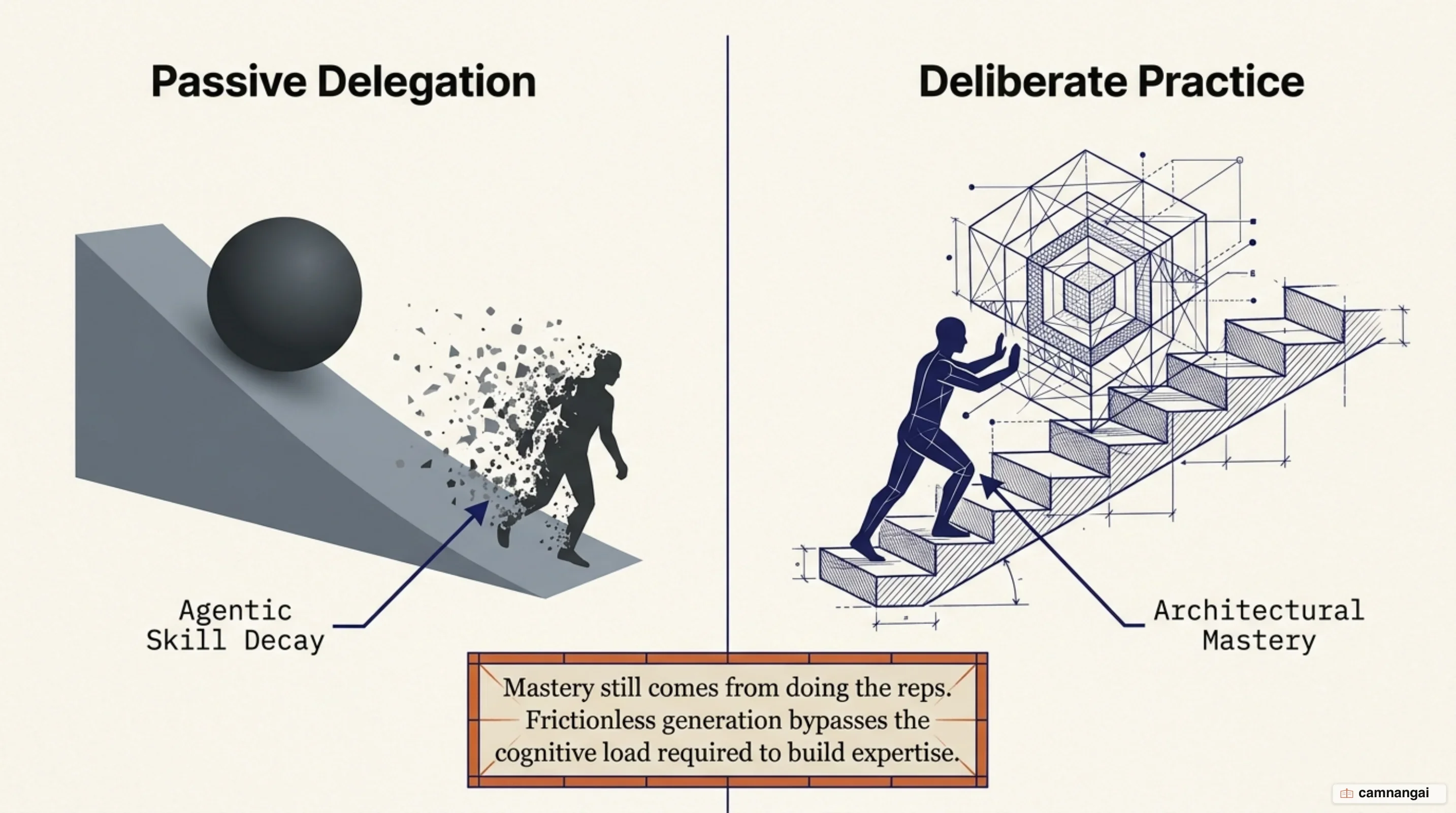
What is agentic skill decay and why does it happen?
Agentic skill decay occurs through a direct short-circuiting of traditional skill acquisition. Learning to engineer software requires experiential loops: formulating a structural hypothesis, writing implementation code, hitting runtime exceptions, digging through documentation, stepping through debuggers, and inspecting diffs. This uncomfortable intermediate process generates "knowledge residue": the mental model that allows you to reason about architectural trade-offs, memory models, and edge-case behaviors. When you prompt an agent for an end-to-end implementation, you jump straight from a problem statement to a green checkmark, bypassing the cognitive friction where structural understanding actually forms.
This decay accelerates in the absence of failure during automated execution. Learning moments are fundamentally triggered by friction, mistakes, and root-cause profiling. When an agent produces working code on the first attempt, no teaching moment occurs; you accept the output and move to the next ticket without absorbing the underlying execution mechanics. Consequently, junior and intermediate developers fail to build internal frameworks for understanding why a specific design holds under load or what subtle failure modes (such as un-awaited coroutines or silent thread starvation) it conceals.
Verification represents the floor of engineering competence, while imagination is the ceiling.
You cannot prompt or verify what you cannot conceptualize or imagine. Because LLM agents deliver plausible code faster than a developer can evaluate its correctness, thread safety, or performance profile, offloading generation without deliberate review degrades your ability to judge quality. Plausible code becomes a liability when your capacity to audit it drops below the threshold required for production safety.
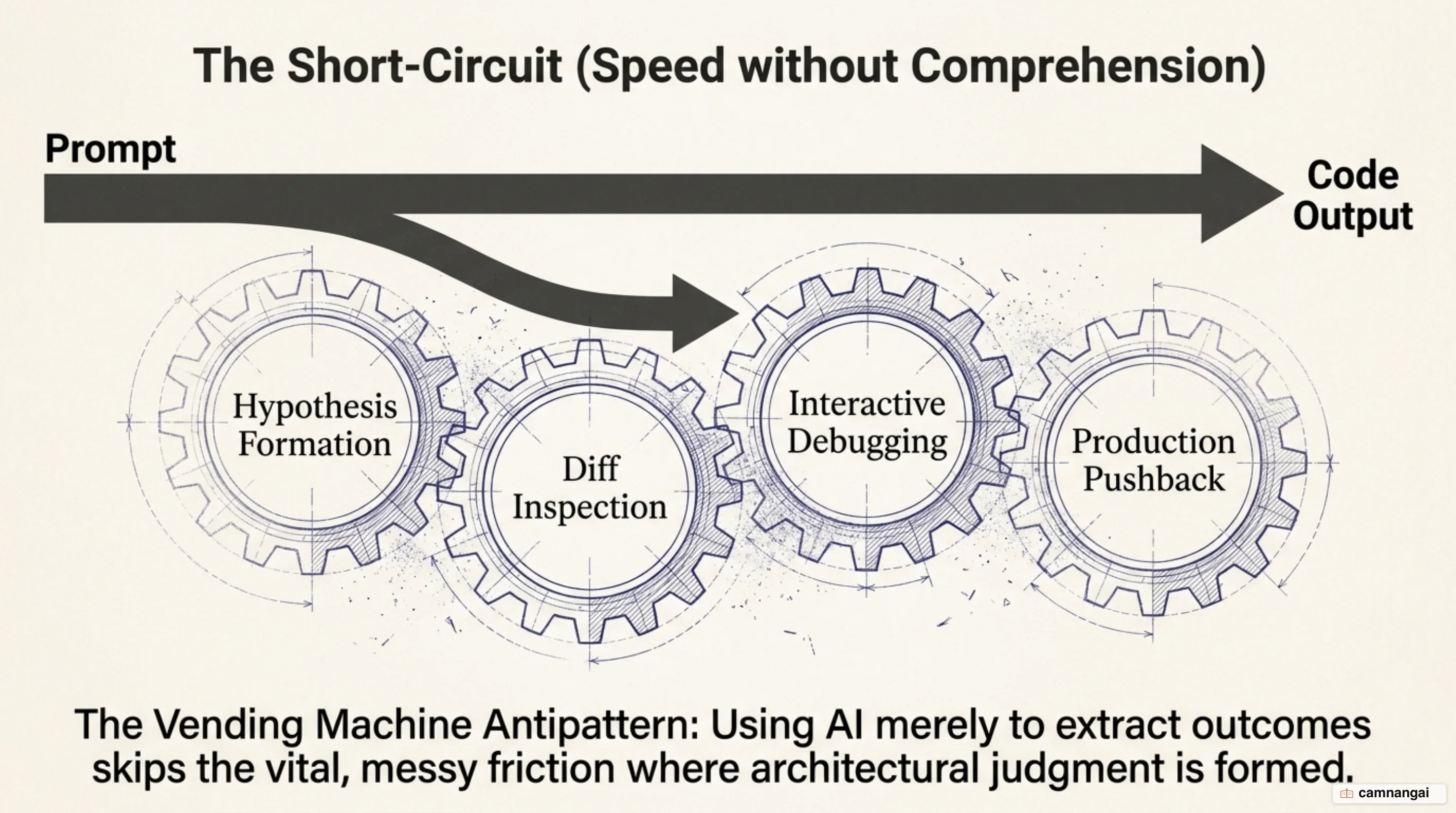
Bad Pattern (Vending Machine):
"Write a background task queue in Python using Trio for record retrieval"

Good Pattern (Pairing):
"Explain how Trio handles child task exceptions in nurseries before generating code, and show me how to test this edge case"
The empirical evidence: the 17% mastery gap and the speed illusion
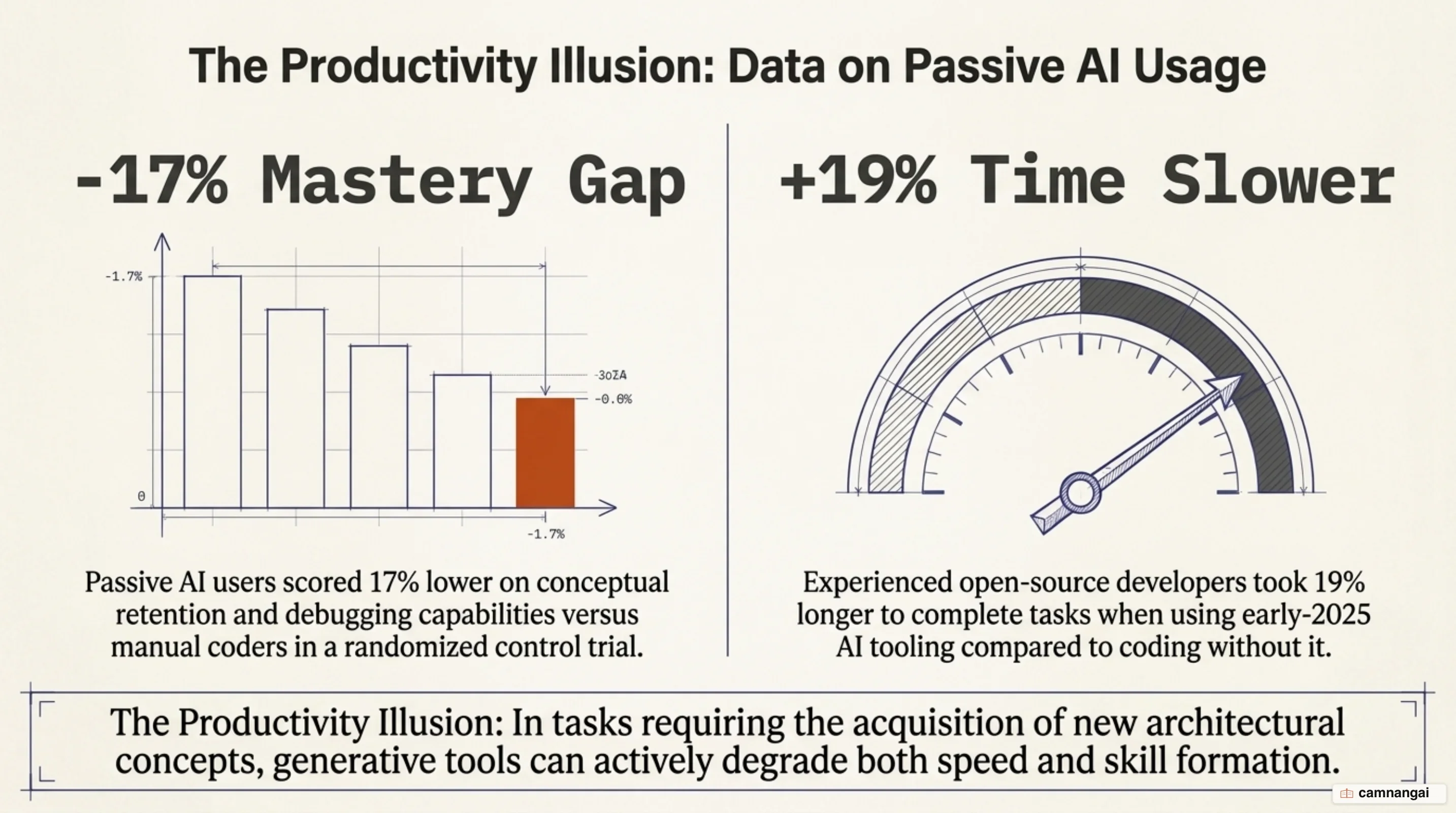
Empirical research confirms that offloading cognitive tasks to AI degrades comprehension and retention. In a randomized controlled trial conducted by Anthropic (Shen & Tamkin, 2026), developers learned a new asynchronous programming library (Trio in Python). The control group, working manually with documentation and web search, scored 67% on a follow-up conceptual and debugging quiz administered without AI assistance. The treatment group, using AI assistance during the learning task, scored 50%, revealing an exact 17% mastery gap (or two full grade points, Cohen's d = 0.738, p = 0.010). Notably, the sharpest score drops occurred in debugging questions. Control participants built durable mental models of structured concurrency because they encountered native library runtime errors, such as unhandled nursery exception groups or un-awaited coroutines, and were forced to resolve them by hand.
Simultaneously, developer perception of AI productivity stands in stark contrast to measured output. A 2025 study by METR (Becker et al.) evaluated 16 highly experienced open-source developers (averaging 5 years of experience and 1,500 commits on mature repositories exceeding 1,100,000 lines of code) across 246 real-world tasks using Cursor Pro and Claude 3.5/3.7 Sonnet. Prior to the tasks, developers forecasted that AI would speed them up by 24%, and post-hoc estimated a 20% speedup. Expert forecasters in economics and machine learning predicted a 38%–39% speedup. In reality, AI usage increased task completion time by 19%, causing a statistically measurable developer slowdown.
This slowdown occurred specifically because the cohort consisted of senior maintainers working on codebases they already knew intimately. High human baseline performance, combined with deep tacit repository context that AI agents could not access, made AI assistance a net bottleneck. Fine-grained screen recording analysis (spanning 143 labeled hours) revealed that while active typing time dropped, developers spent substantial time composing prompts, waiting on generation latency (4% of total time), reviewing and cleaning hallucinated or verbose AI outputs (9% of total time), and context-switching while idling. Over-optimism led developers to repeatedly invoke AI on tasks where manual implementation would have been drastically faster.
| Metric / Study | Perceived / Control Expectation | Actual Observed Outcome |
|---|---|---|
| Trio Conceptual & Debugging Quiz Score (Anthropic, 2026) | 67% average score (Control Group working manually) | 50% average score (AI-Assisted Group; -17% gap, p = 0.010) |
| Developer Task Completion Speedup (METR, 2025) | 24% speedup predicted / 20% post-hoc estimated | 19% slowdown (increase in total completion time) |
| Expert Forecaster Speedup Expectation (METR, 2025) | 38%–39% speedup predicted (ML & Economics Experts) | 19% slowdown (actual RCT outcome) |
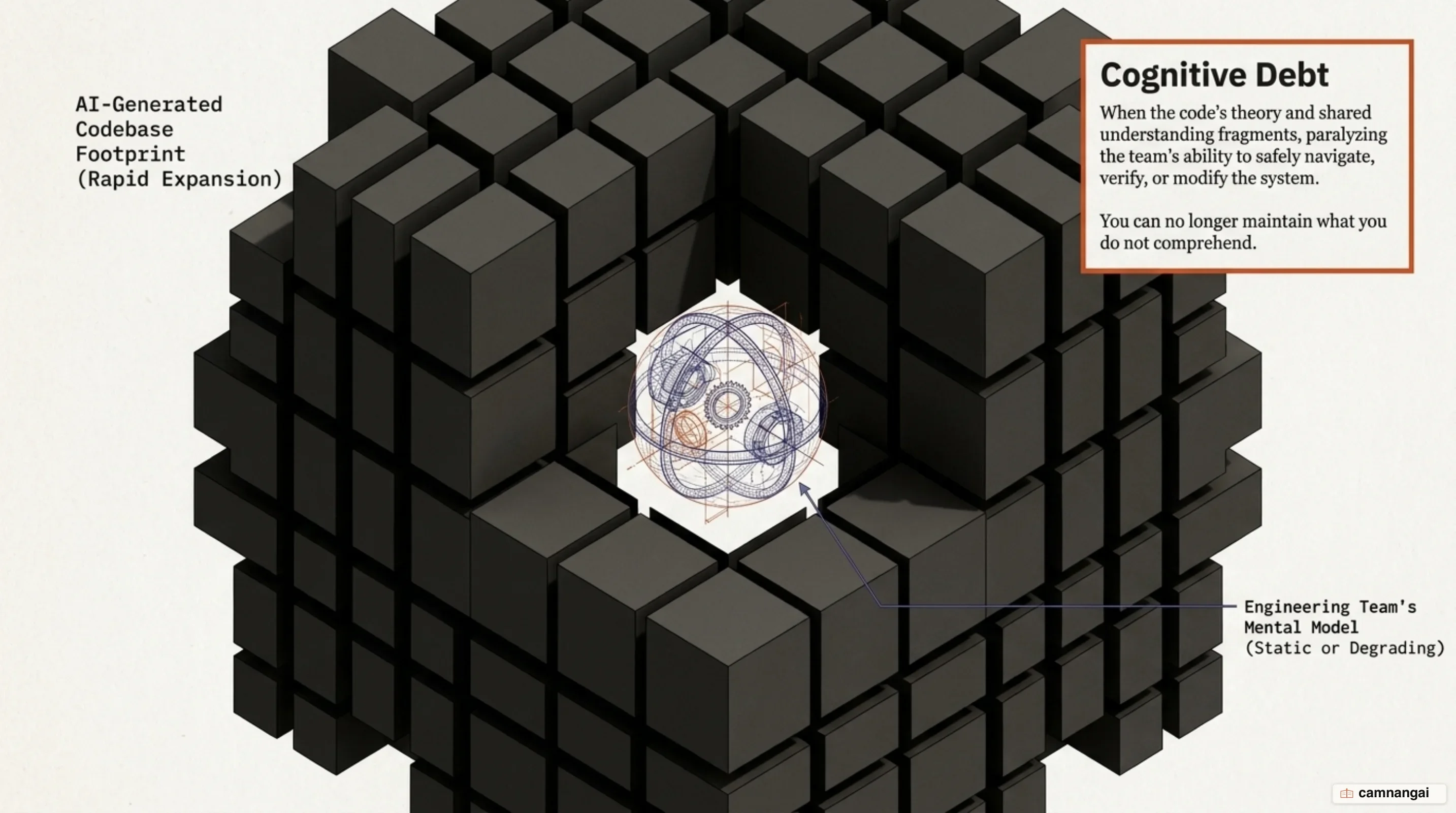
Cognitive debt: when codebase expansion outpaces your mental model
While technical debt lives in messy, unrefactored code, cognitive debt lives in the minds of the engineering team. As defined by Margaret-Anne Storey and highlighted by Simon Willison, cognitive debt represents the rapid accumulation of unabsorbed architectural choices and lost system understanding. When teams rely on vibe coding or aggressive agentic expansion to push reams of code into production without line-by-line comprehension, codebase footprint expands exponentially while the human team's mental model degrades.
This dynamic creates a severe fragmentation in the "theory of the system." Code generated by AI agents may parse, pass basic unit tests, and satisfy acceptance criteria, but if the engineers cannot explain why specific boundaries were drawn or how asynchronous call chains interface, they lose ownership of the software. The application becomes an opaque black box where components interact through unverified side effects.
Compounding cognitive debt inevitably triggers a paralysis point, typically surfacing around weeks 7 or 8 in rapid agent-driven development cycles. Teams find themselves unable to make simple feature adjustments without breaking distant, seemingly unrelated components by introducing unhandled exception groups, memory leak propagation, or event loop blocking. Troubleshooting requires reverse-engineering AI-generated artifacts under production pressure.
Cognitive debt also creates severe operational and governance risks at the infrastructure layer. When engineers delegate database interactions, migration scripts, or service deployments to autonomous agents, auditability breaks down. Granting an agent long-lived, shared Postgres credentials without identity-scoped session credentials makes it impossible to determine which agent executed which query against production environments, compromising system governance and security boundaries.
The apprenticeship crisis: why engineering intuition cannot be skipped
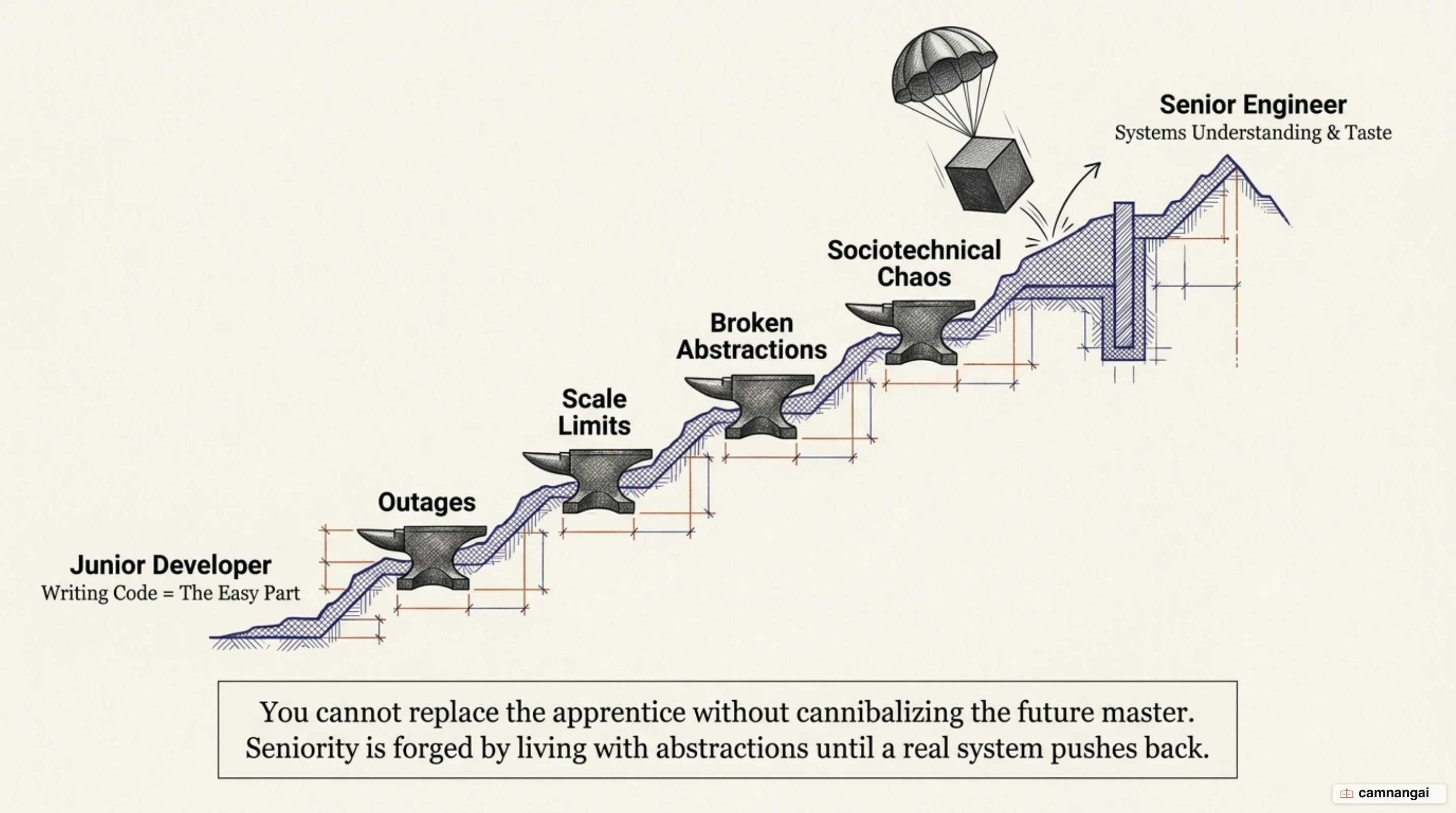
Software engineering operates as an apprenticeship industry. As Charity Majors emphasizes, technical competence cannot be absorbed solely through documentation or prompt windows; it takes roughly seven or more years of daily building, reviewing diffs, breaking production, and operating sociotechnical systems to forge a true senior engineer. Writing code is merely the entry point; the actual difficulty lies in operating, extending, understanding, debugging, and governing complex systems across their lifecycle.
A dangerous executive fallacy has taken hold in tech leadership: halting junior engineer hiring under the illusion that LLMs automate entry-level work. This strategy fundamentally miscalculates team carrying capacity and cannibalizes the industry's talent pipeline. Junior developers evolve into senior architects by executing baseline tasks, encountering edge-case failures, and receiving direct feedback during code reviews.
AI agents do not operate as senior engineers; they function like "an excitable junior engineer who types really fast." Reviewing high-volume AI slop is an un-invested time sink with zero long-term human yield. Conversely, reviewing code written by a human junior engineer is a direct investment in organizational capacity, normalizes asking questions, and forces senior engineers to articulate their implicit architectural knowledge. Senior intuition and technical taste cannot be synthesized by prompt engineering—they are forged exclusively through experience: living with past bad abstractions, diagnosing production outages, and spending 1,000 manual hours in Chrome DevTools flame graphs and heap profilers.
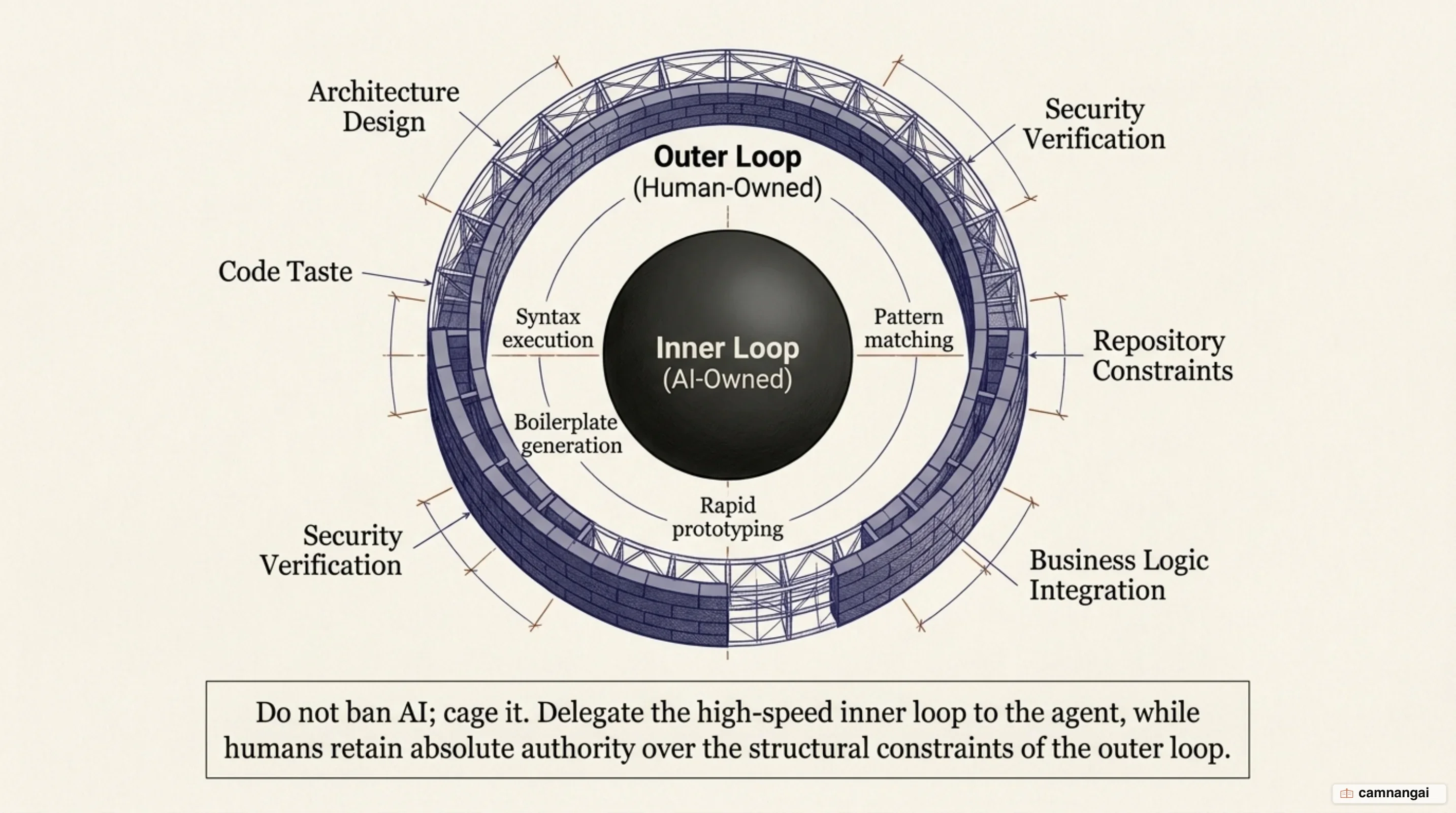
Mastering the outer loop: a deliberate practice playbook for AI engineers
To prevent skill decay while working with modern AI tooling, engineers must maintain absolute ownership over the "outer loop" of architecture, taste, and verification. You must never prompt an agent cold. Before issuing a query, execute a strict 3-step pre-prompting checklist:
- System State Hypothesis: Write out expected inputs, outputs, and edge cases before generating any code.
- Diff Isolation & Failure Prediction: Inspect generated diffs critically and predict where the code will fail before running your test suite.
- Repository Memory Codification: Instantly capture novel runtime failures or architectural corrections into repository-level lint rules or system instruction files.
The empirical data from Anthropic highlights a stark contrast between interaction patterns that preserve technical mastery and those that destroy it. Low-scoring interaction patterns (such as AI Delegation, Progressive Reliance, and Iterative AI Debugging) resulted in post-task quiz scores below 40%. Delegating root-cause profiling to an agent by repeatedly pasting error traces degrades debugging intuition faster than any other behavior. Conversely, high-scoring interaction patterns (yielding 65%–86% mastery) force cognitive engagement:
- Generation-Then-Comprehension. Generate the code, then force the agent to explain non-trivial lines while quizzing your own mental model.
- Hybrid Code-Explanation. Require explicit architectural trade-offs and conceptual breakdowns alongside every generated block.
- Conceptual Inquiry. Prompt the agent exclusively for conceptual hints, API signatures, or documentation summaries, while writing the implementation by hand.
Finally, implement a dual-loop learning process to eliminate agent "amnesia" without sacrificing human skill formation. In the human loop, reflect on root causes whenever errors occur rather than prompting the model to blindly try another fix. In the agent loop, systematically capture discovered edge cases, lint constraints, and domain rules inside repository markdown files (lessons.md).
# lessons.md - Dual-Loop Engineering Constraints

## Human Reflection Checks (Pre-Commit Audit Rules)

- [ ] **Nursery Scope**: Verify that no blocking I/O calls occur inside Trio nurseries; verify `trio.sleep` is used instead of `time.sleep`.
- [ ] **Exception Group Handling**: Audit all child task exception paths to ensure caught exceptions match `ExceptionGroup` structures.
- [ ] **State Isolation**: Confirm that shared memory channels do not leak un-awaited coroutine objects across task boundaries.

## Agent Execution Constraints (System Prompt Rules)

1. **Hypothesis First**: Before emitting any code diff, output a 2-sentence structural hypothesis explaining the concurrency design.
2. **Test-Driven Verification**: Output a isolated unit test snippet verifying failure modes before modifying main package code.
3. **Explicit Explanations**: Provide a conceptual breakdown for any non-trivial asynchronous context managers or nursery blocks.
References
- Mastery Still Comes From Doing the Reps — Addy Osmani
- How AI Impacts Skill Formation — Judy Hanwen Shen & Alex Tamkin, Anthropic Research
- How Generative and Agentic AI Shift Concern from Technical Debt to Cognitive Debt — Simon Willison
- Understand to participate — Simon Willison & Geoffrey Litt
- Generative AI is not going to build your engineering team for you — Charity Majors
- Measuring the Impact of Early-2025 AI on Experienced Open-Source Developer Productivity — Joel Becker et al., METR
- The death of the junior developer — Steve Yegge, Sourcegraph