An agentic software factory is a managed model for producing software using repeatable inputs and standardized tooling, where autonomous AI agents rather than people do most of the work.
It is not a new discipline so much as ordinary software engineering practice applied without compromise to a robot workforce. By industrializing the path from business intent to deployment, an organization can manage software production as a continuous feedback loop where every shipped change feeds the next plan.
The shift moves your focus from typing code by hand to rigorously managing the infrastructure that builds it. The factory is the constant structure; the actors — human or agent — work under the same architectural policies. What changes is the unit of delegation: agents work across whole repositories, form multi-file plans, and deliver validated artifacts under human supervision.
Capacity is no longer bounded by engineer hours. It is bounded by review.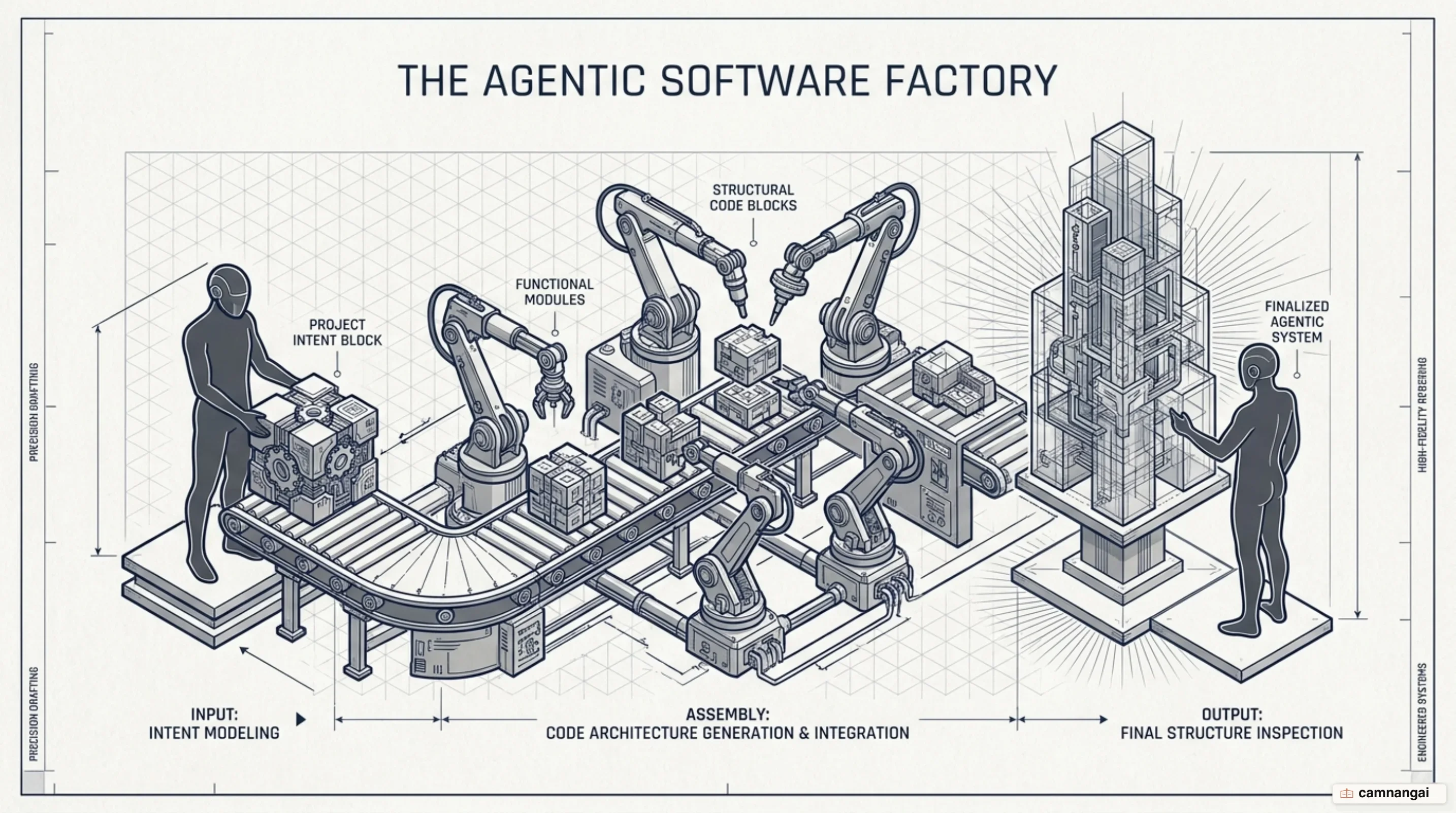
What is an agentic software factory?
A modern agentic software factory is defined by a continuous feedback loop that replaces the traditional linear pipeline. External signals feed the loop (bug reports, customer feedback, business requirements), and triage turns them into a structured plan. The factory then executes the build, test, review, and security phases before shipping. Monitoring feeds directly back in, so every resolved incident informs the next planning cycle.
The industrial model shows four observable properties. Standardized inputs carry their scope, acceptance criteria, and target environment in a machine-readable shape; standardized tooling pushes human and agent changes through identical gates and release controls; and measurable output tracks cycle time, defect rates, and cost per change. The fourth one, replayability, is the one I would check first, because it lets you reconstruct any shipped change from its original inputs, prompts, model versions, and policies, a level of auditability manual development rarely achieves.
In the agent-native variant, specialized agents accept multi-step tasks and emit pull requests or updated artifacts. Because they operate inside standardized pipelines, teams can slot them into existing workflows incrementally rather than replacing those workflows wholesale. Each agent leaves a full execution trace for a human to inspect.
That is what shifts the engineering constraint. The factory's capacity is no longer bounded by human hours, but by the team's ability to define high-level intent and review the resulting traces closely.
Why is the software factory idea back after nearly 60 years?
The quest to industrialize code reaches back at least to Robert W. Bemer's 1968 proposal to treat code production with the rigor of manufacturing. In 1975, System Development Corporation published a genuine factory experiment: disciplined, repeatable software production on integrated tooling. Microsoft revived a model-driven version of the same idea in its 2004 book Software Factories. Every one of those attempts had the same ceiling: they standardized the environment around highly variable human developers, but never the execution itself.
Three things converged in 2026 to change that. Models reached the threshold of reliable multi-step reasoning, inference costs fell sharply, and harness techniques matured enough for agents to plan across long horizons and operate a computer independently. Because implementation became cheap and fast, the organizational bottleneck moved. Traditional two-week sprints are giving way to bolts — compressed delivery units where weeks become days and hours.
The pressure is also structural. At large engineering organizations the production codebase has been growing far faster than the number of engineers available to maintain it, and agent-generated code widens that gap rather than closing it. A factory model is what keeps the result stable, because the agents absorb the bulk of maintenance work: dependency upgrades, library migrations, and security patching, applied consistently across the estate.
What are the parts of an agentic software factory?
The architecture follows a six-layer reference model, L0 through L5. L0 is the foundation model supplying raw reasoning and code generation. L1 adds reasoning and memory, where the agent uses chain-of-thought planning and long-term memory to carry context between sessions. L2 is the Agent–Computer Interface (ACI), the translation layer between token output and concrete operations. Interface design at this layer matters as much as model capability, a finding that reshaped how coding agents are built.
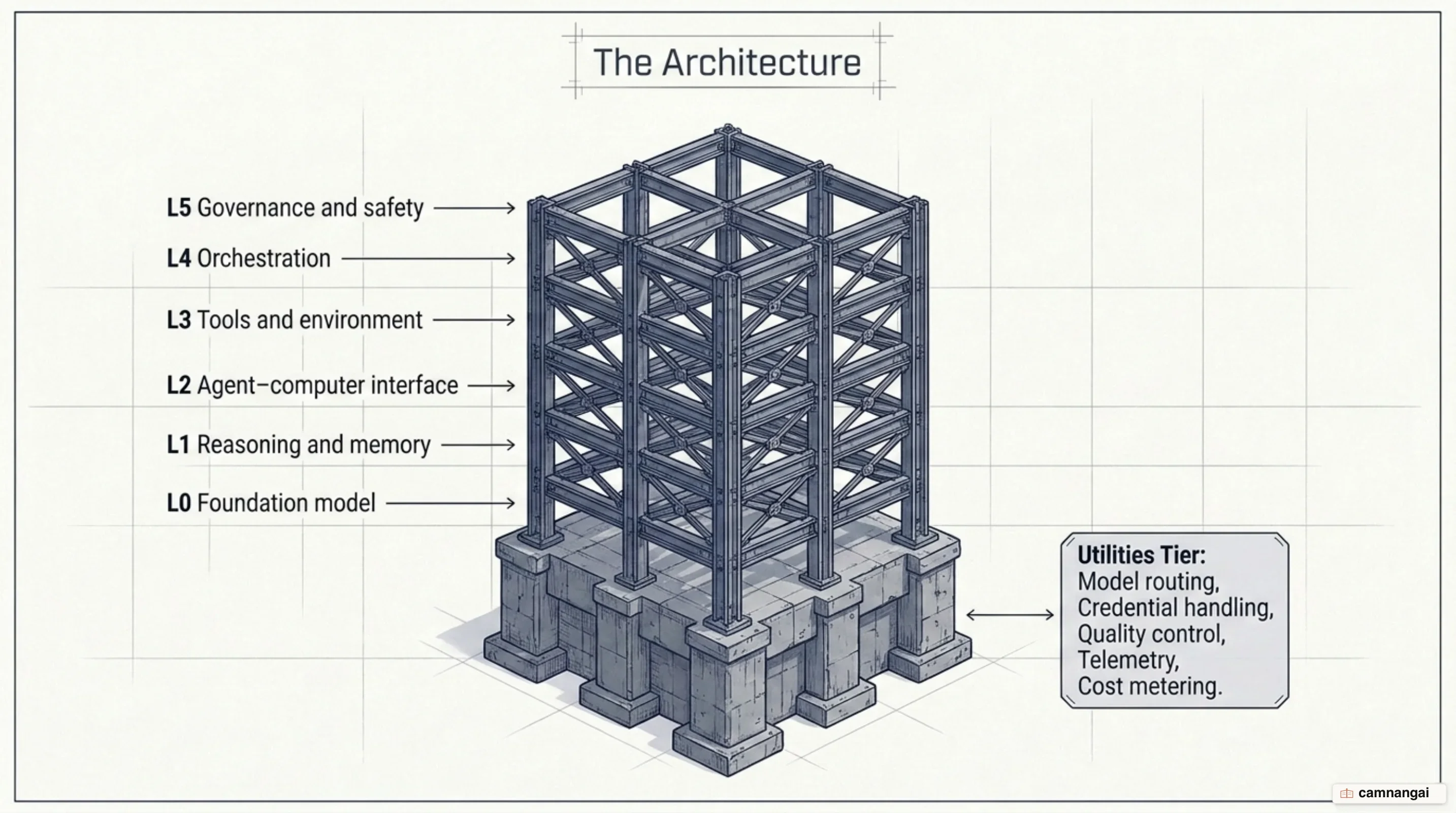
L3 provides tools and environment: filesystem, shell, compilers, test runners, and CI/CD, usually inside a sandbox such as a microVM so the agent can verify its own work. L4 handles orchestration, decomposing large tasks across specialized agents; frameworks like MetaGPT and ChatDev encode development as a multi-agent process with Product Manager, Architect, Engineer, and QA roles. L5 is governance and safety: permission boundaries, sandboxing, and audit logs. It is the least mature layer and the primary bottleneck on enterprise deployment, which is a strange order of operations for the one layer that decides what an agent is allowed to touch.
Beneath those layers sits a utilities tier that decides whether the factory works at all: governed model supply and routing, centralized credential handling for Model Context Protocol (MCP) servers, quality control at the gateway, telemetry capturing execution traces, and cost metering to enforce budgets. Controls are strongest when they are enforced at mediated infrastructure boundaries the agents cannot route around.
An Internal Developer Portal ties the stack together. When an agent can query a service catalog for ownership data or look up the recommended pattern for a given component type, its output improves sharply. Without an authoritative context provider, agents guess.
What evidence is there that this actually works?
At Spotify, a background coding agent called Honk running on top of their Fleet Management infrastructure has merged more than 2.5 million automated maintenance pull requests, the vast majority auto-merged with no human in the loop. Their most recent Java migration across backend services took three days — work that previously had hundreds of teams updating components by hand over weeks or months.
Survey data backs the pattern up. Across 554 developers and engineering leaders in 2026, 96.4% of engineering organizations reported using AI coding tools and 84% of developers reported higher productivity. At Chainguard, a single two-week agent session across six repositories built 80 packages. Empower reported 40% faster incident response and 50% faster PR approval; Nav reported doubled feature velocity alongside 60% less context-switching.
Benchmarks mirror the enterprise results. On SWE-bench Verified, which measures resolution of real GitHub issues, performance climbed from 1.96% in October 2023 to 78.4% by April 2026. That gain is dominated by scaffolding (the tooling and environment around the model) rather than raw model size, which is precisely the layer a factory is built to standardize.
None of this means the gains are automatic. The same body of evidence reports productivity effects ranging from roughly 13.6% to 55.8% depending on task and setup, which is a wide enough spread to tell you the factory around the model is doing most of the work.
Why has review become the new bottleneck?
We have entered what GitKraken calls the Code Flow era: implementation is cheap, but human attention remains fixed and expensive. Agents can generate more code in a day than a person writes in a week, so the implementation window has collapsed. Spotify measured a 76% increase in pull request frequency, with the vast majority authored by a developer working alongside an agent.
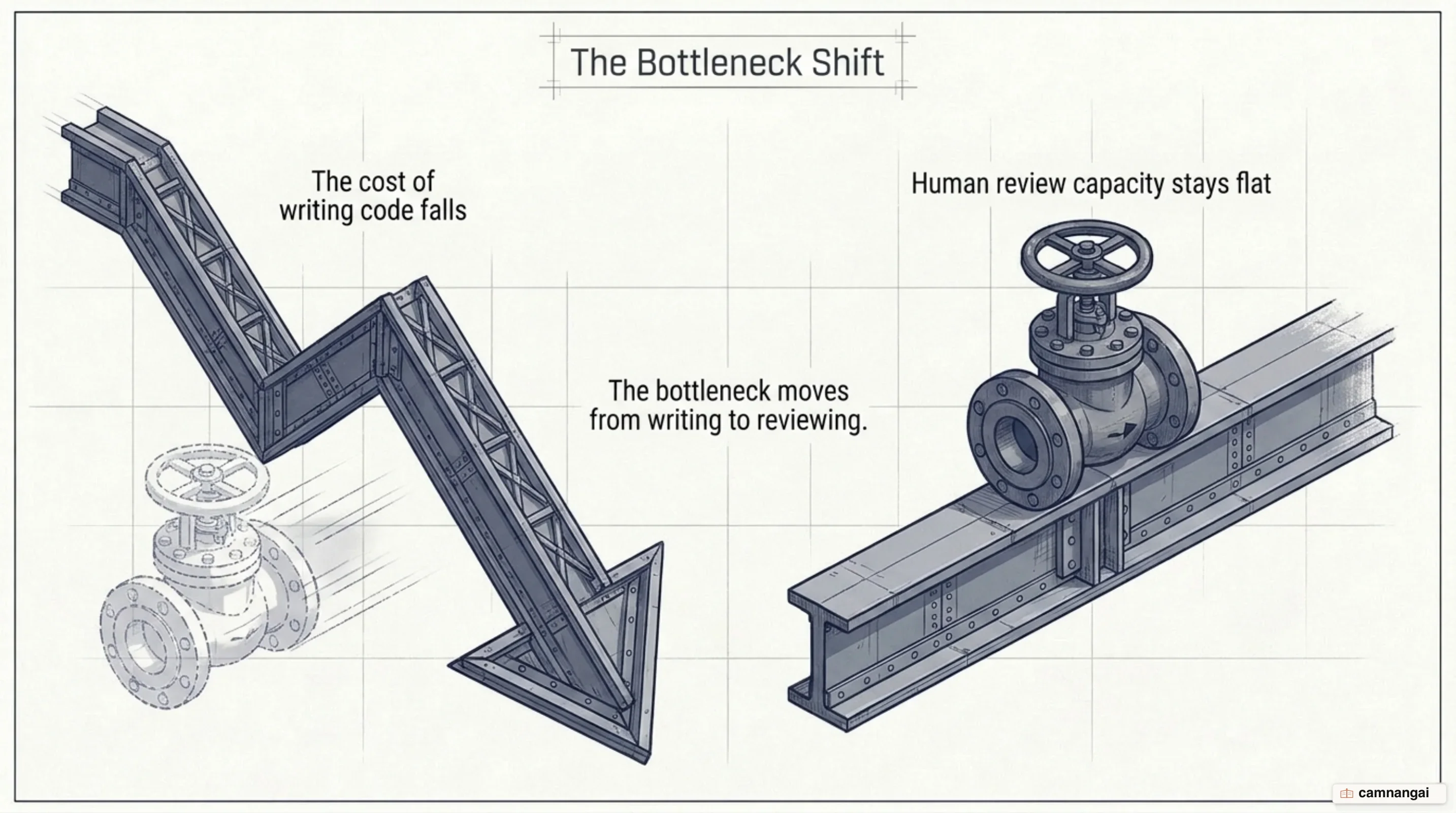
That collapse removes something teams used to get for free. The length of the building phase provided natural moments for alignment — the design chat, the hallway correction, the review comment that arrived before too much had been built. When the time between logging an issue and an agent opening a PR is measured in minutes, the pull request ends up carrying all the coordination debt on its own.
The risk this creates is what Maggie Appleton calls zero alignment: a fleet of agents working in parallel produces features nobody asked for, or creates merge conflicts by touching the same files at once. Believing that individual productivity alone leads to great software, as she puts it, is "nine women make a baby in one month" logic. Software is a team sport, and the current generation of single-player agent interfaces does not model that.
Our coordination primitives are also from a different era. Slack, Jira, and the pull request were not designed for this volume or speed. Multiplayer workspaces such as Ace, from GitHub Next, try to move alignment earlier — so a team agrees on the plan before the agents start typing rather than sorting out the result afterward.
What does running a fleet of agents cost?
Managing an agent workforce means picking a point on the efficiency frontier: the best price-per-capability ratio, rather than peak intelligence for every task. Stripe found that Opus 4.7 did not meaningfully improve quality over 4.6 while increasing cost, and declined to make it available internally. Databricks saw similar cost regressions comparing Opus 5.0 to 4.8. Newer does not automatically earn its price.
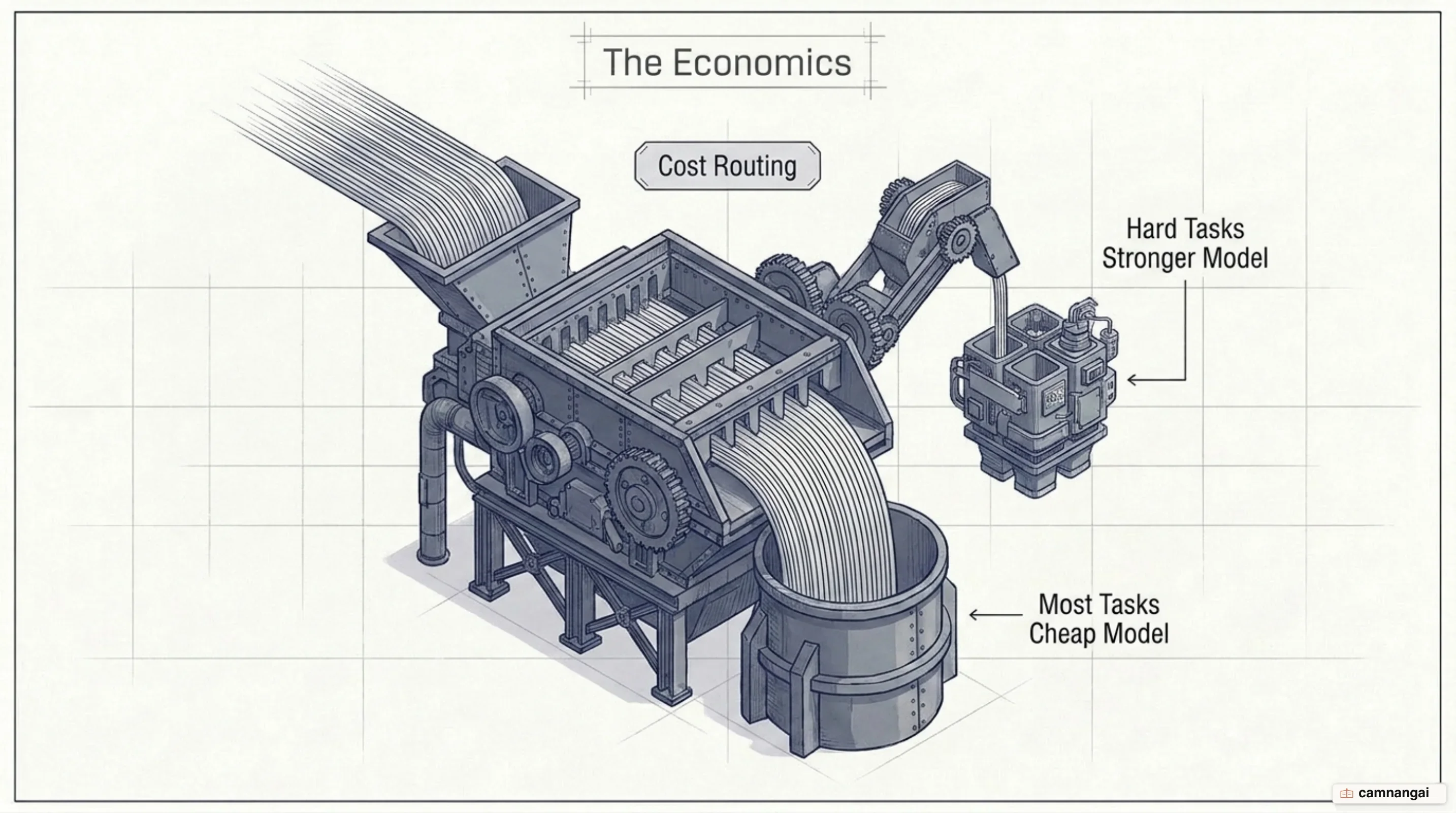
The user's prompt rarely dominates costs. What drives them is context the agent gathers itself — repository searches, tool-call logs, retrieved files. Left unmanaged, that overhead compounds into exponential growth that can eventually overtake the revenue the added velocity produces.
Routing is the main lever. A stateless proxy between the harness and the underlying models can send simple requests to cheap models and escalate only genuinely hard reasoning, cutting average task cost by more than 30% while roughly matching the quality of the most expensive model. Task-level routing goes further, dispatching whole missions to different harnesses based on complexity. A cheaper model can also run the main loop and escalate to a stronger one only when it judges the work needs it.
On the governance side, hard budget caps stall work; progressive friction does not. Spend dashboards, warning gates, and downshifting a heavy user to a lower-cost model, with suspension only as a last resort, keep velocity intact. Tuning harness and caching settings at Databricks cut generated tokens by almost 50% with no observed quality loss, which is the cheapest win available and, to my eye, the one teams skip most often.
What has to be in place before you build one?
Building an agentic software factory means finally doing the things engineering teams have spent years deferring. Agentic engineering is just normal engineering with robots: issue tracking with real requirements, docstrings, meaningful tests, linting, design planning, and searchable communication channels. So anything that makes engineering harder makes agentic engineering much harder.
Standardization is the foundation. The fewer technologies a system leads with, the faster it moves, because agents have more consistent reference code to pattern-match against. Spotify treats this as a first-class principle rather than a preference. When a codebase is coherent in structure and design, agent output improves measurably; when it is fragmented, output degrades.
Documentation stops being a courtesy and becomes functional infrastructure. It is how you program an agent to respect a guiding principle without having a conversation about it. The same goes for automated guardrails: linting and static analysis give an agent immediate feedback so it corrects itself, instead of shipping a pattern your infrastructure handles badly.
Process discipline is the last precondition, and the one most often skipped. Dysfunction that merely slows a human team will devastate an agent fleet, because agents lack the judgment to work through ambiguity and will replicate the mess at speed. Clean up the process debt first; adding agents to a late or disordered project only makes it later.
Where does this model break?
The primary failure mode is the absence of mētis. The term comes from James C. Scott's Seeing Like a State and describes knowledge acquired only through long practice at similar but rarely identical tasks, requiring constant adaptation to changing circumstances. Agents follow rules well and handle concrete, unencoded situations badly — the uncommunicated mid-sprint change that a human would absorb without thinking.
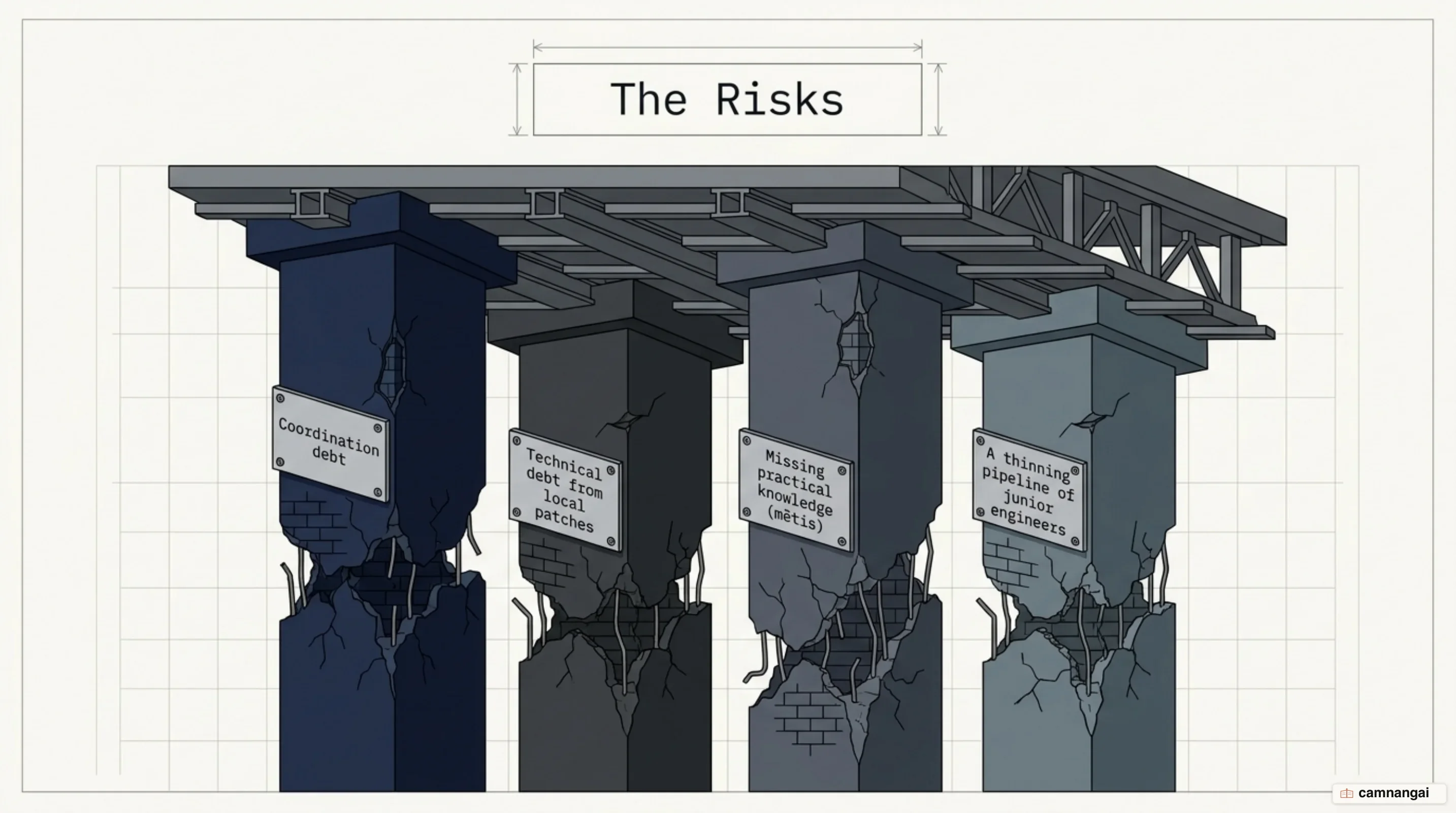
Then there is the technical-debt hypothesis. Because token cost and context limits make local patches cheaper than global redesign, agents are biased toward the local fix. Over time that inflates the maintenance burden: more code, less architectural coherence, and a repository that is locally correct but globally incoherent. Experienced developers carry the heaviest share of that inflated maintenance burden, which is exactly the group a factory was supposed to unburden.
Coordination debt is the third. Agents working in parallel touch the same files, duplicate each other's work, and generate merge conflicts that can cost more to resolve than the code cost to write. If the speed of implementation exceeds the speed of human communication, the factory produces software that fails to meet needs that only ever existed in someone's head.
Finally, there is the labor-market signal. Hiring for entry-level roles in the 22–25 age band has slowed by roughly 14% in highly exposed positions. If juniors are not hired to do the work agents now perform, the industry risks failing to produce the next generation of engineers with enough mētis to supervise these systems at all.
What should engineers do now?
The role is shifting from writing code to directing the work you delegate. Typing speed and syntax recall are depreciating assets; the premium is moving to task decomposition, high-throughput review, and the ability to hand an agent precise, high-context intent.
The practical move is to invest in the hygiene that makes a factory possible — tests, documentation, standardization — before adding more agents. The winner in this era is not whoever prompts fastest, but whoever builds the infrastructure and judgment to point a fleet at a few excellent, aligned products instead of a thousand unmaintained ones.
References
- The Agentic Software Factory, Explained: History, Architecture, and Enterprise Controls — TrueFoundry
- Inside the Software Factory, and What It Takes to Build One — Factory.ai
- The Agentic Software Factory — BCG Platinion
- Coding Is No Longer the Constraint: Scaling Developer Experience to Teams and Agents — Spotify Engineering
- Agentic AI in the Software Development Lifecycle: Architecture, Empirical Evidence, and the Reshaping of Software Engineering — arXiv
- GitKraken Introduces GitLens 19, Bringing Human and AI Workflows Together in One Workbench — AIThority
- One Developer, Two Dozen Agents, Zero Alignment — Maggie Appleton
- Agentic Engineering Is Just Everything We Haven't Been Doing — Matthew Brunelle
- Managing AI Coding Costs at Scale — Databricks