You need to learn the fundamentals because AI tools require expert oversight to be safe and effective. Large language models generate syntax fast, but they lack the systemic reasoning required to audit for logic errors, security holes, and architectural integrity. Without foundational knowledge, you cannot tell whether generated code is a valid solution or a dangerously plausible one.
The "expert novice" paradox is what makes this urgent. AI promises to lower the barrier to entry, but it actually shifts the requirement from writing syntax to supervising complex systems — the one job a novice is least equipped to do. Employment for software developers aged 22–25 has fallen nearly 20% from 2024, as the entry-level work that used to build judgment gets automated first.
Current models are pattern interpolators, not reasoning engines. They excel at repeating what has been done and fail at the unique system failure that falls outside their training data.
What "the fundamentals" actually means, and why AI can't replace them
The fundamentals are not memorized syntax. They are a habit of mind — the "productive literalism" of computer science training: the ability to turn an underspecified requirement into unambiguous instructions while anticipating the edge cases.
A computer does only and exactly what it is told; it does not approximate your intent. AI can help with the rote mechanics of syntax, but it cannot do the translation from human intention to machine logic.
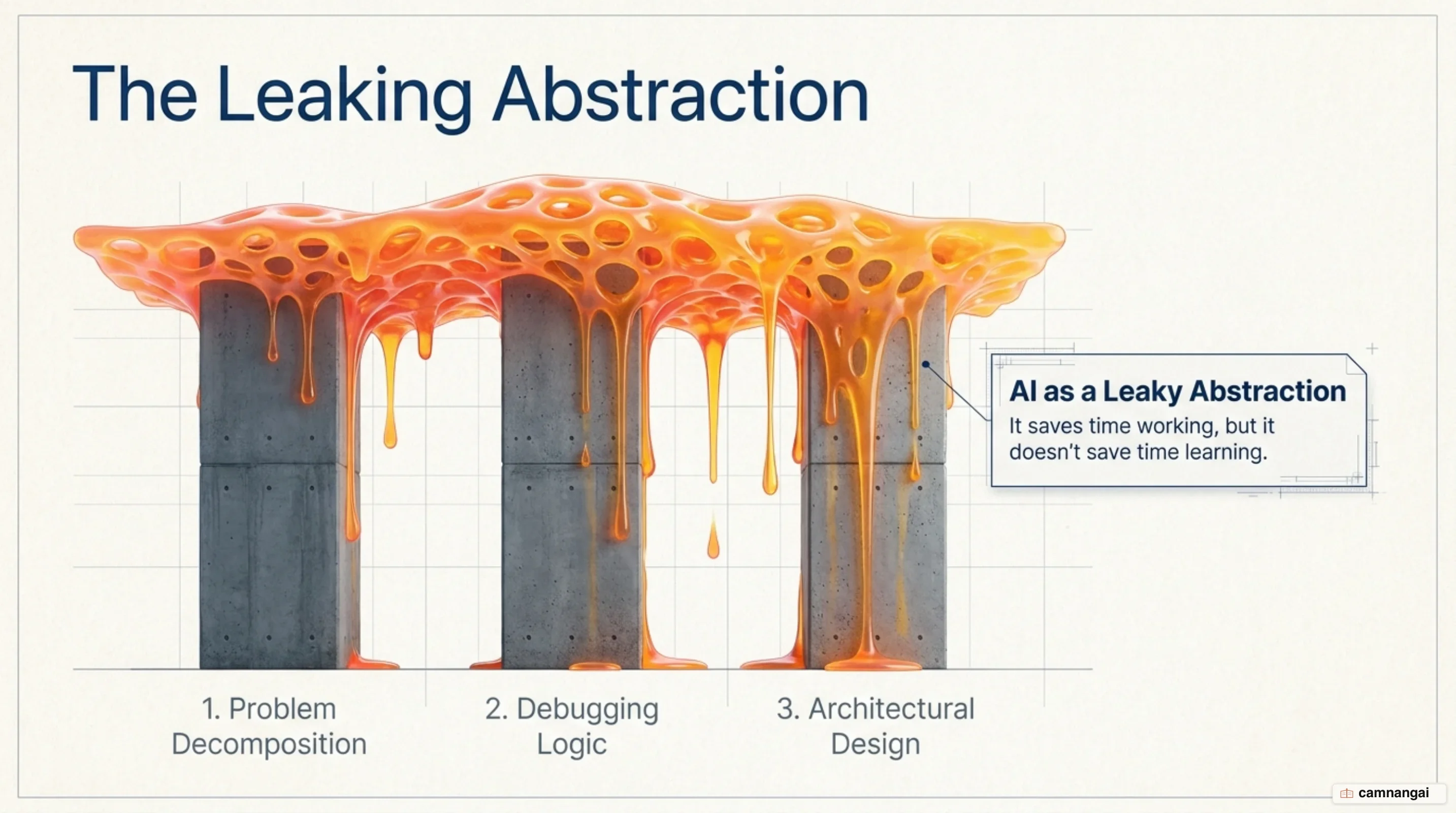
That gap has a specific shape, and it breaks down into three skills. Problem decomposition: breaking a system into smaller logical components before any code is generated. Debugging logic: tracing why a result failed, through skepticism and discernment, rather than asking a model to guess a fix. And architectural design: understanding how parts connect and scale, so the output serves an intended design instead of just working in isolation.
There is a deeper conflict underneath. A computer executes logic precisely; a language model predicts the next likely token from statistical patterns. That makes AI the ultimate leaky abstraction. All abstractions leak, and the only way to deal with the leaks competently is to understand how the abstraction works underneath — AI saves you time working, but it does not save you time learning. When the abstraction fails, you are left with a broken system you cannot explain.
Interpolation also has a hard edge. Software engineering is an exercise in adaptation and novel problem-solving, and you cannot interpolate your way through a completely unique system failure. Patterns get you a long way and then stop. Meanwhile the demand for people who can do the non-patterned part has not gone anywhere: computing and mathematical occupations account for roughly 5.2 million jobs against about 2.8 million CS degree holders in the workforce. The field has never been constrained by credentials. It is constrained by the supply of people who can actually reason about the system underneath.
What happens to your skills when AI writes the code
Offloading your thinking incurs cognitive debt. In a randomized trial of mostly junior engineers learning an unfamiliar async library, the AI-assisted group averaged 50% on a comprehension quiz against 67% for those who hand-coded — a gap of nearly two letter grades. The largest gap was in debugging. When a model fixes your error, the error goes away, but so does the encounter-diagnose-resolve cycle that builds debugging intuition in the first place.
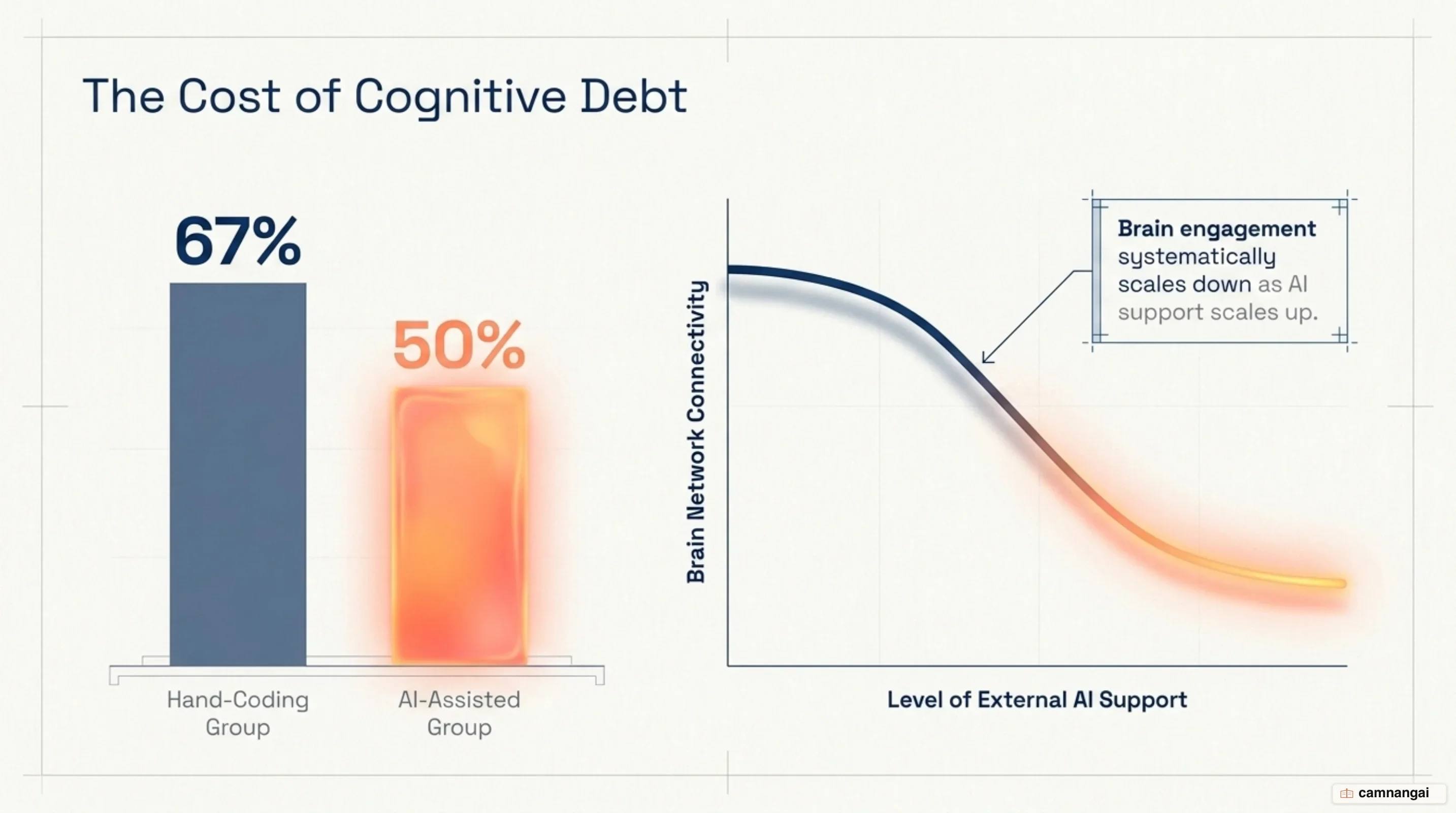
The cost shows up at the neural level too. In an EEG study of essay writing, brain connectivity scaled down systematically with the amount of external support: the group using an LLM showed the weakest coupling, the group working unaided the strongest. LLM users also reported the lowest sense of ownership over what they produced, and did measurably worse at quoting from an essay they had finished minutes earlier. The task was writing rather than coding, but the mechanism is the one that matters here — engagement tracks effort.
This produces an illusion of competence, and speed is what disguises it. The measured time saving is smaller than the story suggests: in the same trial, the AI group finished about two minutes faster, and the difference was not statistically significant. You move through the task, you do not absorb it, and nothing in the experience tells you which of those happened.
AI speeds up work you already understand, and gets in the way of learning work you don't. Use it as a crutch while learning a new library and you bypass exactly the errors that force understanding — ending in confidence without comprehension, able to describe a solution but not to produce one when the tool is unavailable or wrong.
The beginner's paradox: needing the tool that holds you back
The skilled-orchestrator paradox is that the tools sold as a leg-up for juniors demand senior-level judgment to use safely. Veterans see the most benefit from these models because they already have the taste and professional skepticism that years of manual work produced. For everyone newer, the situation inverts: you are encouraged, sometimes mandated, to use tools that remove the friction required to build the very expertise those tools assume.
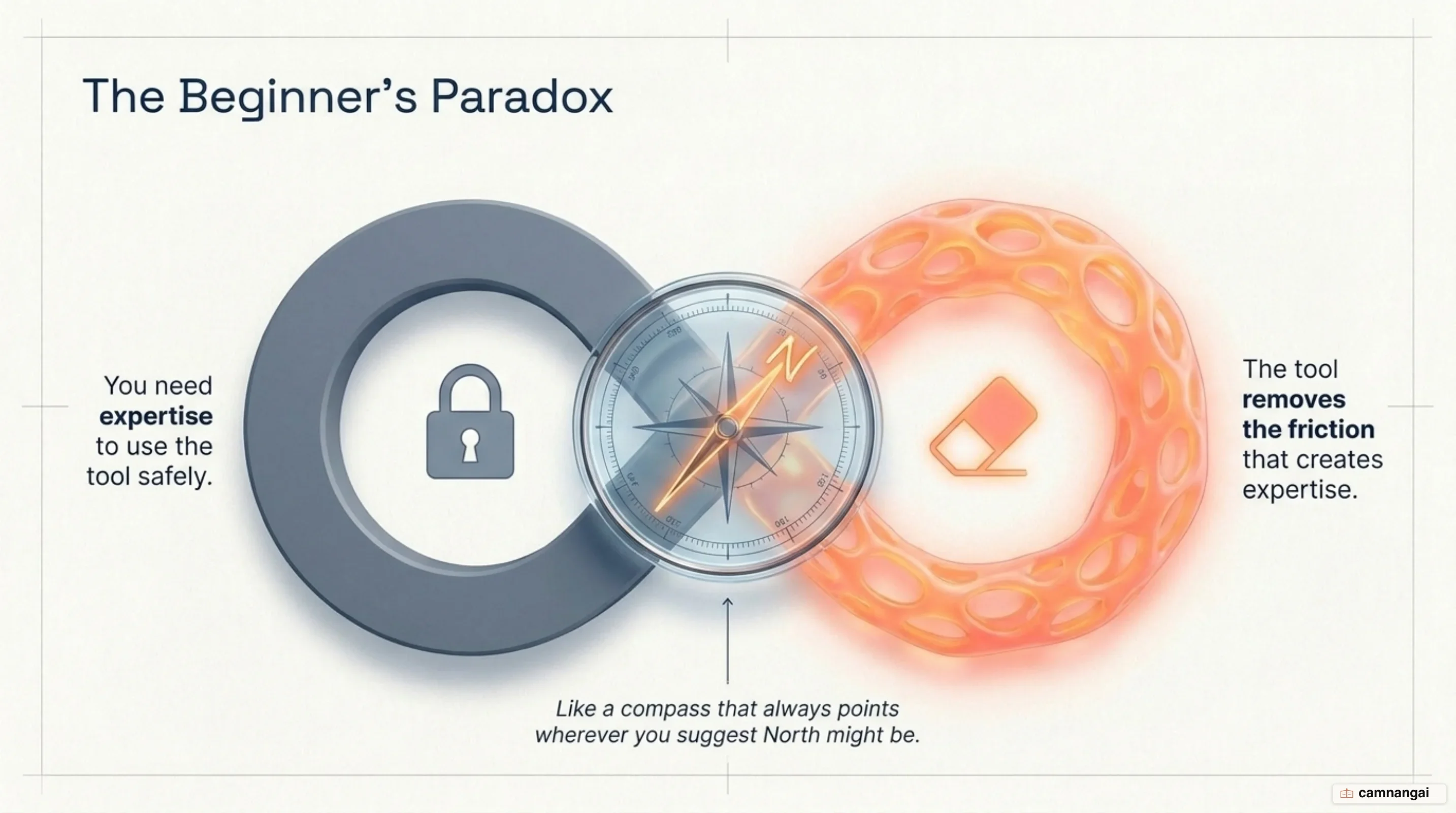
The way a novice learns with a model is an inverted learning loop — the student steers the mentor, the mentor answers, the student steers again. It is a fragile arrangement, because these models are acutely sensitive to the shape of a prompt. In unfamiliar territory you don't know what you don't know, so you don't know which questions would produce a good answer. It behaves like a compass that always points north, wherever you suggest north might be.
A study of junior and novice developers in live coding sessions found the pattern concretely. Those who leaned hardest on Copilot routinely skipped the planning stages, because the model had reasoned itself into a position they had not. They finished with an illusion of competence rather than understanding. The ones who did best were those who restricted or ignored the assistance — they had built negative expertise, the ability to recognize and discard an unhelpful suggestion.
The labor market has already responded. Employment for developers aged 22–25 is down nearly 20% from 2024, while headcount for older developers at the same firms kept growing. The entry-level roles that once supplied the friction are the first ones automated, which is what makes this a pipeline problem rather than a personal one.
Why friction is what actually builds skill
Mastery comes from repetition and failure, not observation. The German word for the result is Fingerspitzengefühl — fingertip feeling: the reflex that fires when you look at a block of code and think, this is going to cause problems. It is built by tracing an obscure error with no useful log, by feeling the performance difference between two approaches, by rewriting a design once it is clear it will not scale.
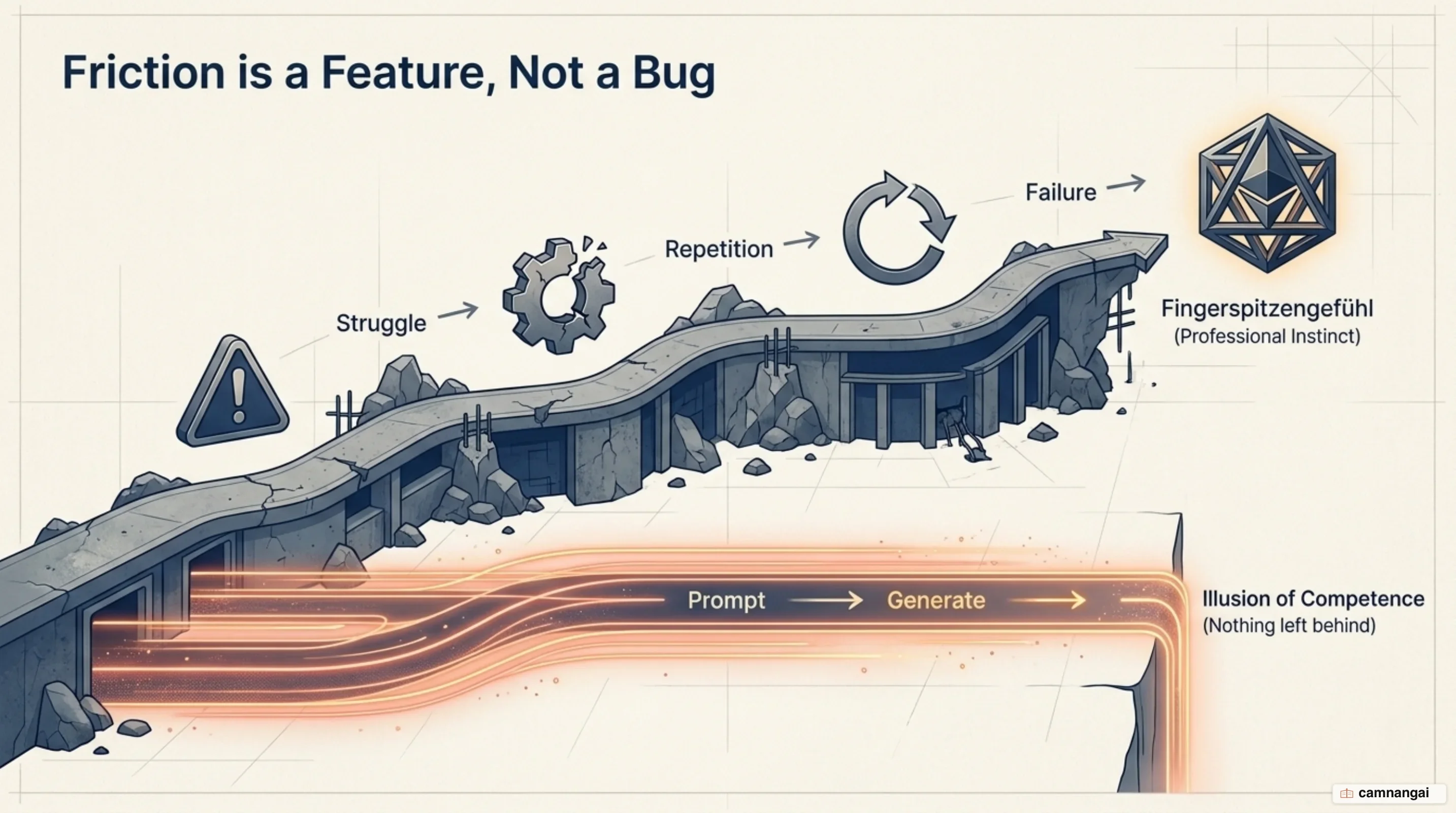
Watching is not doing. You could study a master chef for a month, ask every question you had, and describe a perfect medium-rare ribeye in detail — and still overcook the first one you make. Programming works the same way, and the part that transfers is the part you struggled through.
How you engage decides the outcome, and there is data on it. In a study of 1,000 students learning mathematics, those using an LLM as an answer machine scored 17% worse than students working from a textbook alone. A group using a tutor-style version — ask for help, then solve it yourself — performed 127% better during the assisted practice sessions. The difference is where the cognitive work sits. Effort, including getting painfully stuck, is likely what builds mastery in the first place.
The most productive learning available from an AI coding tool happens when it isn't generating much code at all.
The real cost of shipping code you can't read
A senior engineer in Silicon Valley switched to letting an AI agent write his code and described it as changing his job overnight. Months later, features he had generated crashed the product twice, and his manager told him a third would cost him his job. The code was not obviously bad. It looked reasonable and hid bugs that were hard to spot. Reviewing code you didn't write is famously difficult, which makes that review step the easiest one to skip, especially when the whole team is chasing velocity.
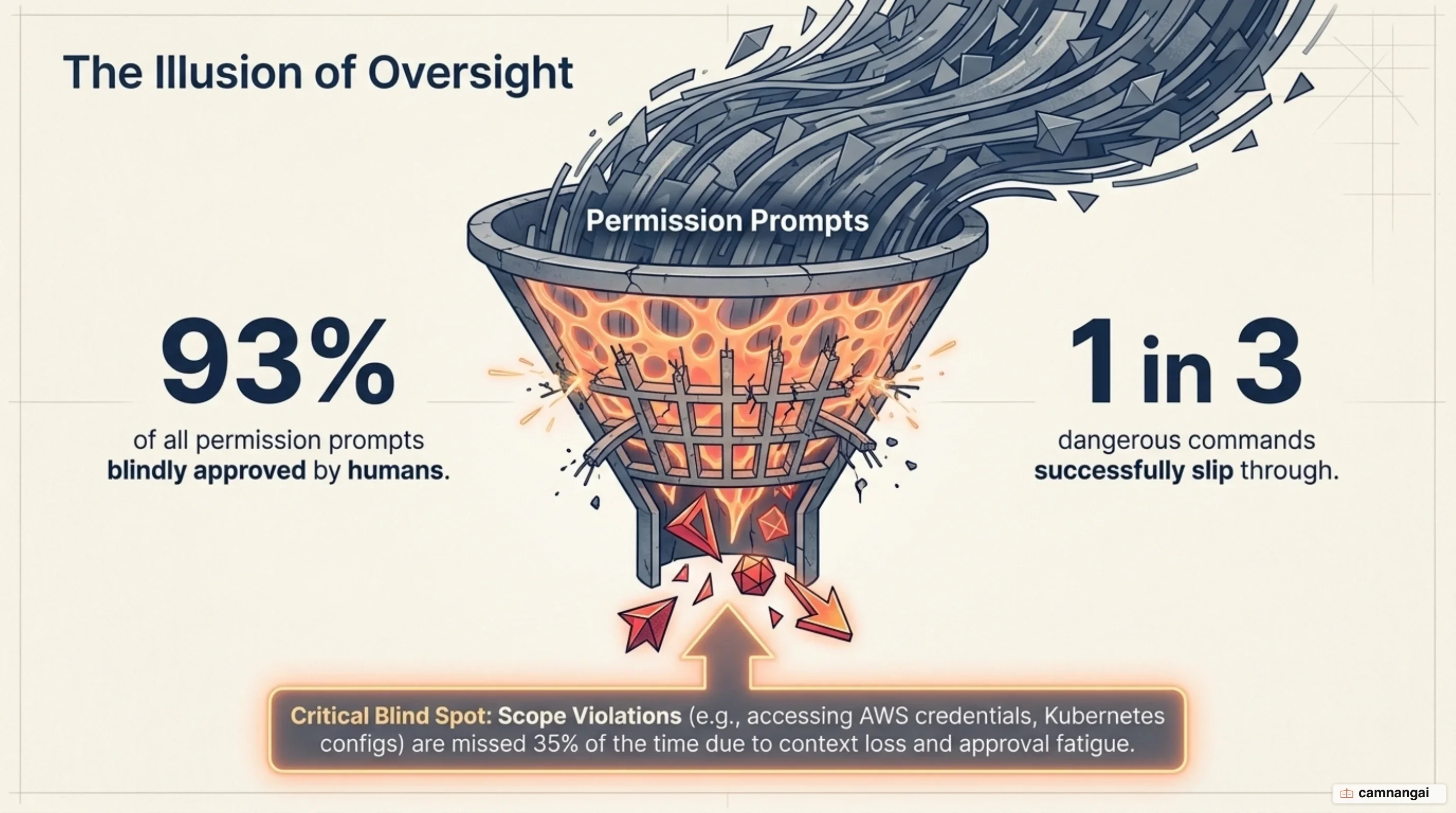
Approval fatigue turns that into a security problem. Across more than 40,000 runs of a permissions game and 409,000 approve-or-deny decisions, players let through roughly one in three malicious commands. Players missed scope violations most often, at 35% — an agent asking to read Kubernetes config files or AWS credential lists, the kind of request that quietly exfiltrates whatever it touches. The single most-approved dangerous command was npm run analyze, waved through nearly 65% of the time, even though it runs whatever a project's package.json defines.
Real telemetry points the same way: Claude Code data shows users approve around 93% of permission prompts, and the more approvals someone sees, the less attention each one gets. Auditing vibe-coded output is often slower than writing the thing correctly by hand, because you are reverse-engineering intent from code that never had any. If you cannot explain every line you ship, you are not that system's engineer — you are one of its risks.
How to learn with AI without losing the fundamentals
Treat the model as a Socratic sparring partner rather than a means of production. In the Anthropic trial, the high scorers asked conceptual questions or requested explanations alongside the generated code; the low scorers delegated wholesale or leaned on the assistant to debug for them. The person doing the reasoning is the person who ends up able to do it.
Be skeptical of the 127% figure, though, even when it points your way. That tutor group outperformed during assisted practice, but on the unassisted final test they scored about the same as the textbook group. A tutor mode is a scaffold, not a substitute for the work. Purpose-built learning modes exist — Claude Code Learning and Explanatory mode, ChatGPT Study Mode — and they are designed to foster understanding, but they hallucinate exactly like any other interaction. If you can't audit a generated line of code, you can't audit a generated explanation either.
Five questions worth answering before you accept what the model hands you:
- If I had no AI tool, could I still complete this task?
- Am I using the model to deepen my understanding, or to skip the struggle?
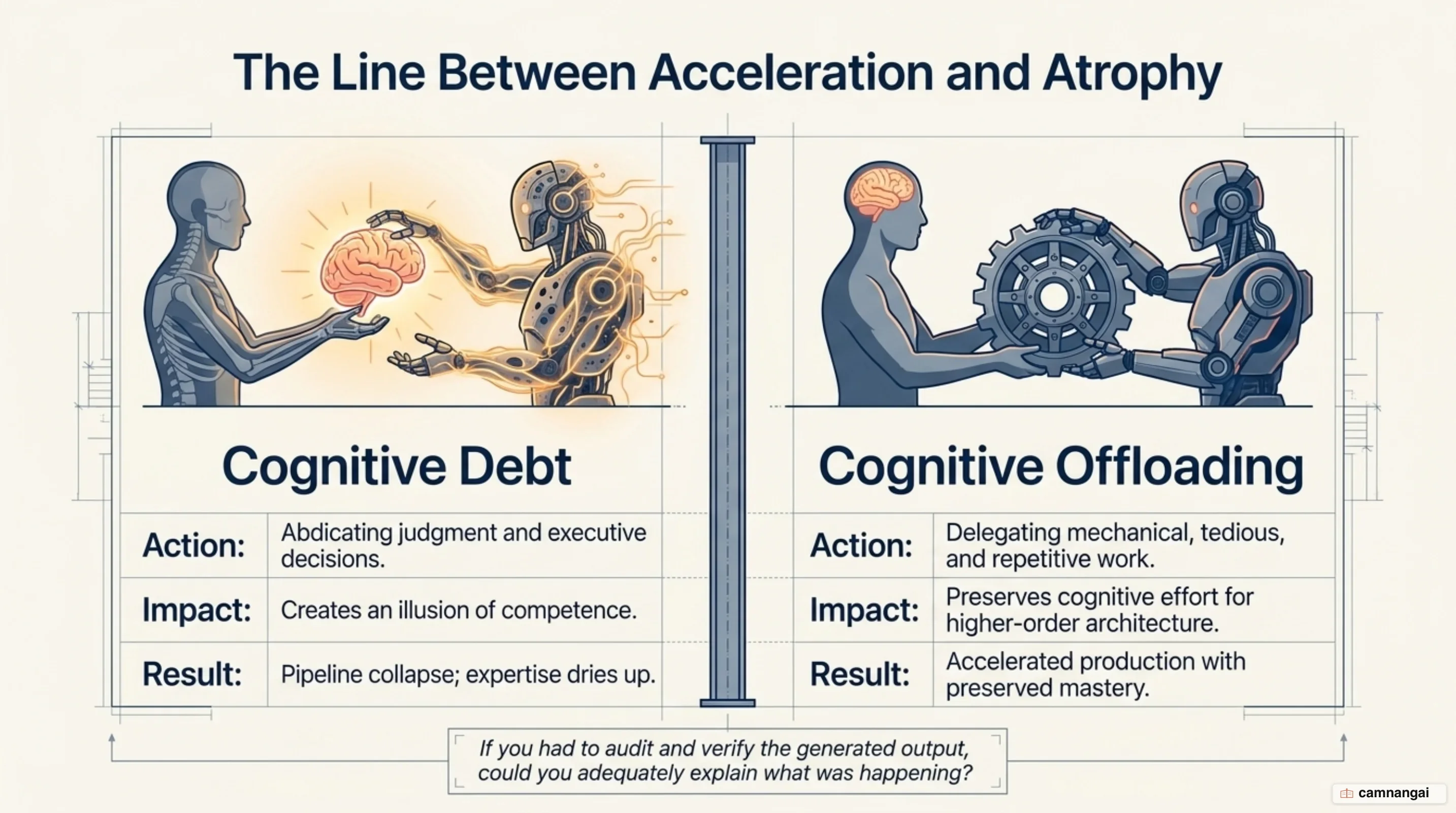
- If I had to audit this output, could I explain what it does?
- Have I checked the approach against official documentation and with human peers?
- Is this genuinely rote, or does it require a judgment call somewhere?
The line to hold is between cognitive debt and cognitive offloading. Cognitive debt is handing over your judgment and your decisions; cognitive offloading is delegating the mechanical and the tedious. The first one erodes you. The second one doesn't.
Where should you start?
Don't skip the layer you are trying to learn. If you want to learn Java, don't start with Spring Boot; if you want JavaScript fundamentals, don't start with React; if you want to be good at CSS, don't start with Tailwind. You cannot debug a distributed system if you have never understood how a single request gets sent.
Use AI for the rote and the repetitive, and keep the structural and strategic decisions for yourself. This field has never been short of credentials — it has been short of people who can still explain their own systems.
References
- How AI assistance impacts the formation of coding skills — Anthropic
- AI Coding will Prevent Expertise — Lars Faye
- On AI Coding and Its Discontents — Cal Newport
- Your Brain on ChatGPT: Project Overview — MIT Media Lab
- We are Changing our Developer Productivity Experiment Design — METR
- Humans in the loop miss a third of dangerous AI coding agent requests — The Register
- Economy — The 2026 AI Index Report, Stanford HAI
- Stop Telling Students Computer Science Is Dying — Inside Higher Ed
- Coding is dead? Teaching computer programming in the age of AI — UNESCO