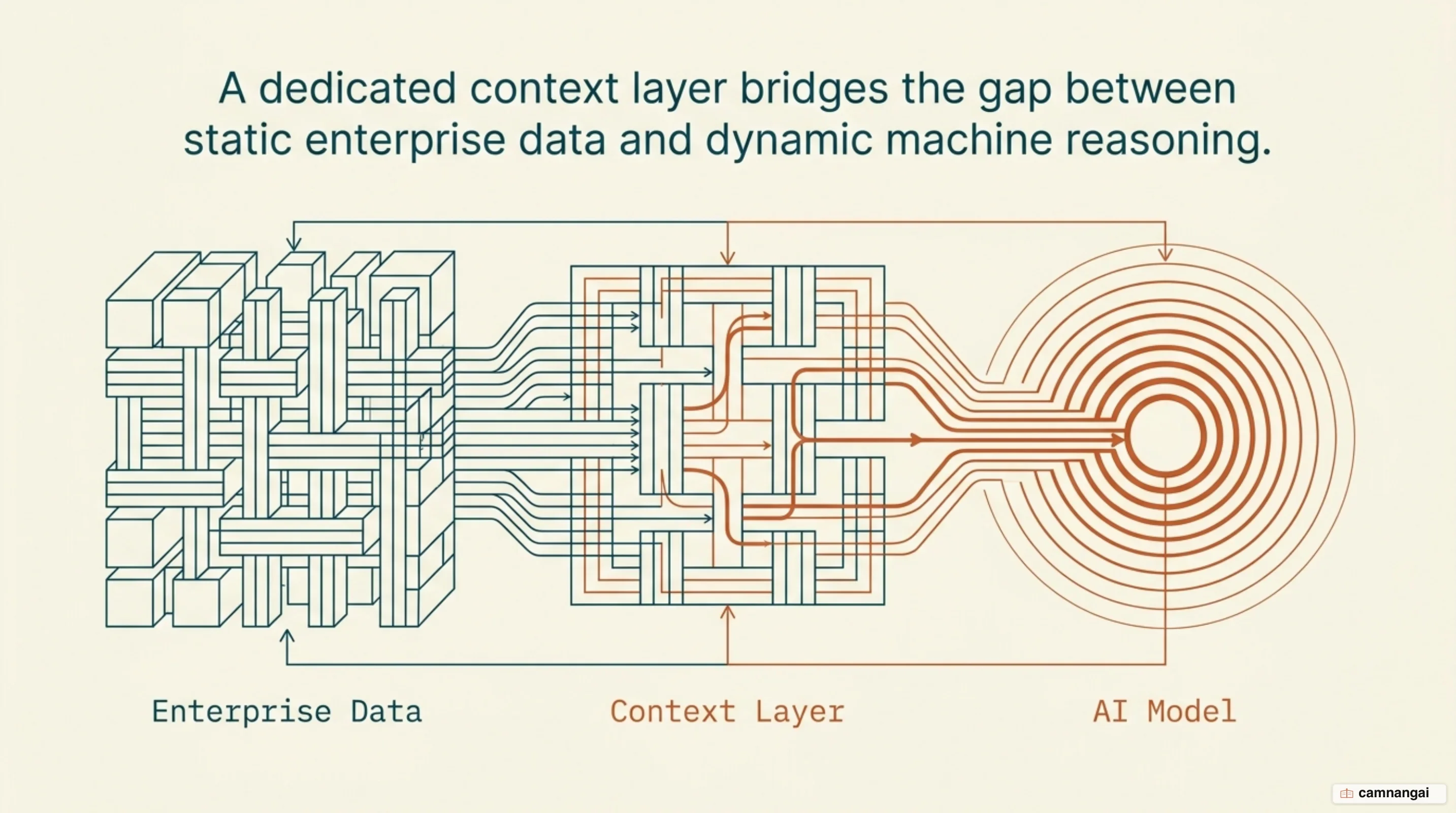
The context layer is the architectural bridge between a foundation model's general intelligence and an organization's specific data, business logic, and governing rules.
Large language models (LLMs) can reason at a high level, but they know nothing about what happens inside your company. This infrastructure layer supplies the "institutional memory" that grounds model outputs in reality, so the system stops filling informational gaps with probabilistic guesses—the polite name for hallucinations.
From a systems perspective, the context layer solves the problem of "intelligence without understanding." It is a curated buffer that gathers, filters, and packages relevant data into a machine-readable state the model can reason from at runtime. By isolating high-signal information before inference, it keeps the model's limited attention budget on authoritative facts rather than raw, noisy history.
What is the context layer?
The context layer is the technical infrastructure sitting between foundation models and the scattered business systems that hold the actual data. It is the operational engine for retrieval-augmented generation (RAG) at scale, because it does the dynamic assembly of facts, documents, and structured data fragments. Unlike a static database, the context layer is transient by design: it builds a fresh "world model" for every query, shaped by whatever the AI agent needs at that moment.
This layer is the enterprise's "institutional memory," because it supplies the "why" behind raw data points by defining what entities represent, how they relate, and which policies apply. For example, it defines not just a user_id column, but the business concept of a "Customer" and the metrics attached to that entity, such as lifetime value. Strip that away and the model is reading your schema the way a stranger reads someone else's filing cabinet: the labels are all there, and none of them mean anything.
The architecture of a working context layer rests on three pillars:
- Discovery: The ability to locate exactly what data exists across the organization, where it lives, and where it came from.
- Understanding: The semantic meaning and business logic behind the data, so the model can reason from definitions instead of guessing at schema from table names.
- Trust: The mechanisms that verify data quality and freshness, so the model does not act on stale or corrupted information.
Why models need a dedicated layer for context
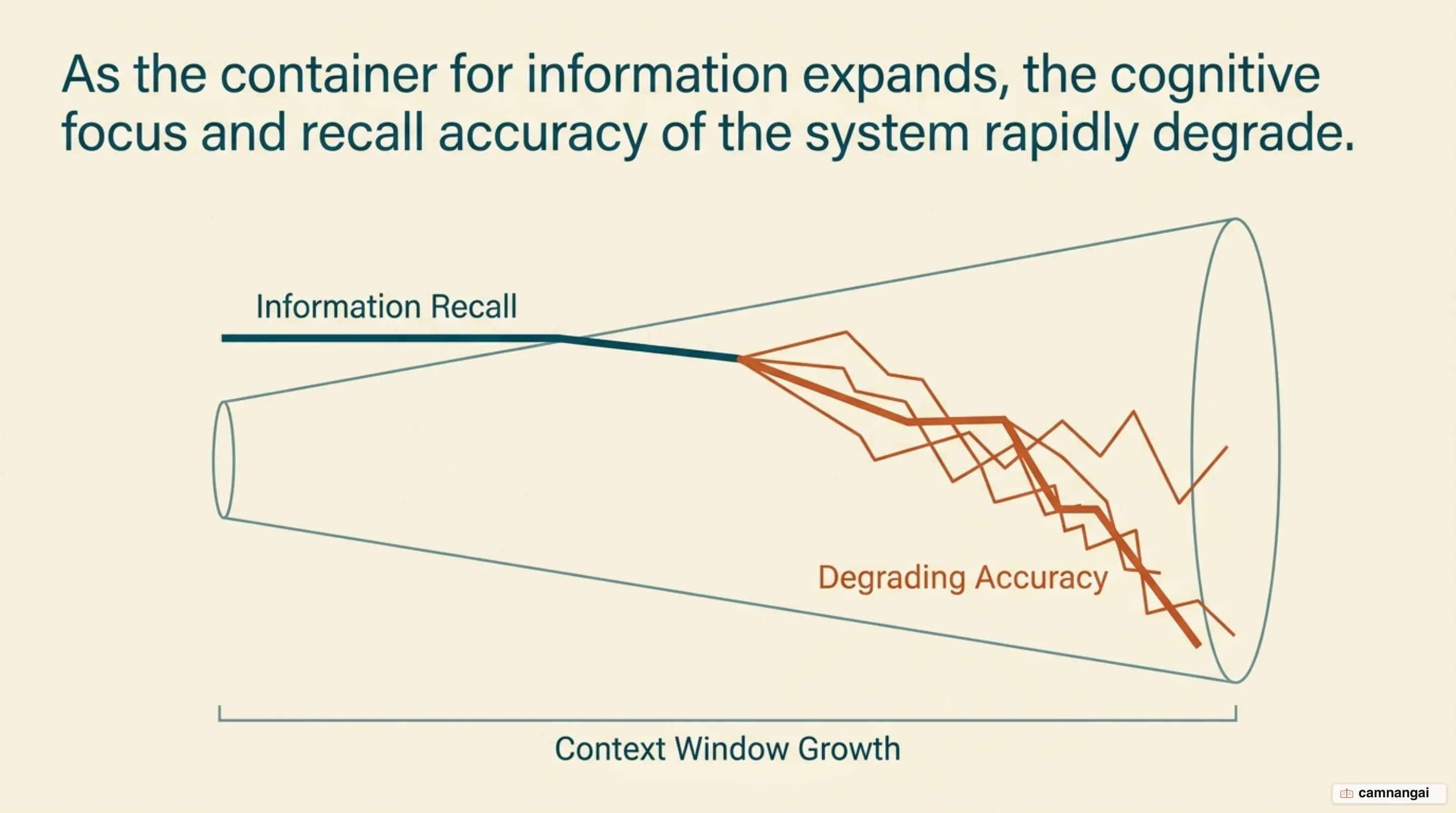
Transformer-based models are constrained by an "attention budget" that comes straight out of their architecture. The transformer relies on an n² pairwise relationship calculation for n tokens, so as context length increases, the model's ability to capture those relationships is stretched thin. That is what produces "context rot," where the model's precision for information retrieval and long-range reasoning degrades as the token count grows. A dedicated context layer handles data curation externally, which keeps the model pointed at high-signal information.
The absence of that layer is a primary driver of project failure. Gartner projects that 60% of AI projects will be abandoned due to poor data readiness, while only 37% of organizations say they are confident in their current data practices. Fragmented context—spread across documentation, tribal knowledge, and disconnected tools—creates a ceiling that model fine-tuning cannot break through, and this is the part teams keep learning the expensive way. Without a unified layer, AI agents cannot reconcile conflicting definitions, such as "revenue" figures that differ from one department dashboard to the next.
A dedicated context layer also cuts operational cost and latency, because isolating the relevant data fragments before they reach the inference stage means fewer tokens get processed. That is how you avoid the "Scaling Wall," where every new agent drags the team back into one-off context engineering. Treating context as infrastructure instead lets "AI-ready data" be served through one consistent pipeline, which reduces token expenses and improves response times.
What the context layer is made of
The structural components of a context layer are defined by the Model Context Protocol (MCP) primitives: Tools (executable functions), Resources (data sources like file contents or API responses), and Prompts (reusable templates). Tools are the executable functions an agent uses to act on its environment, while resources provide the data itself. Prompts are the templates that structure how the model works with those inputs. Together, these three primitives define the action space and the information access an AI gets.
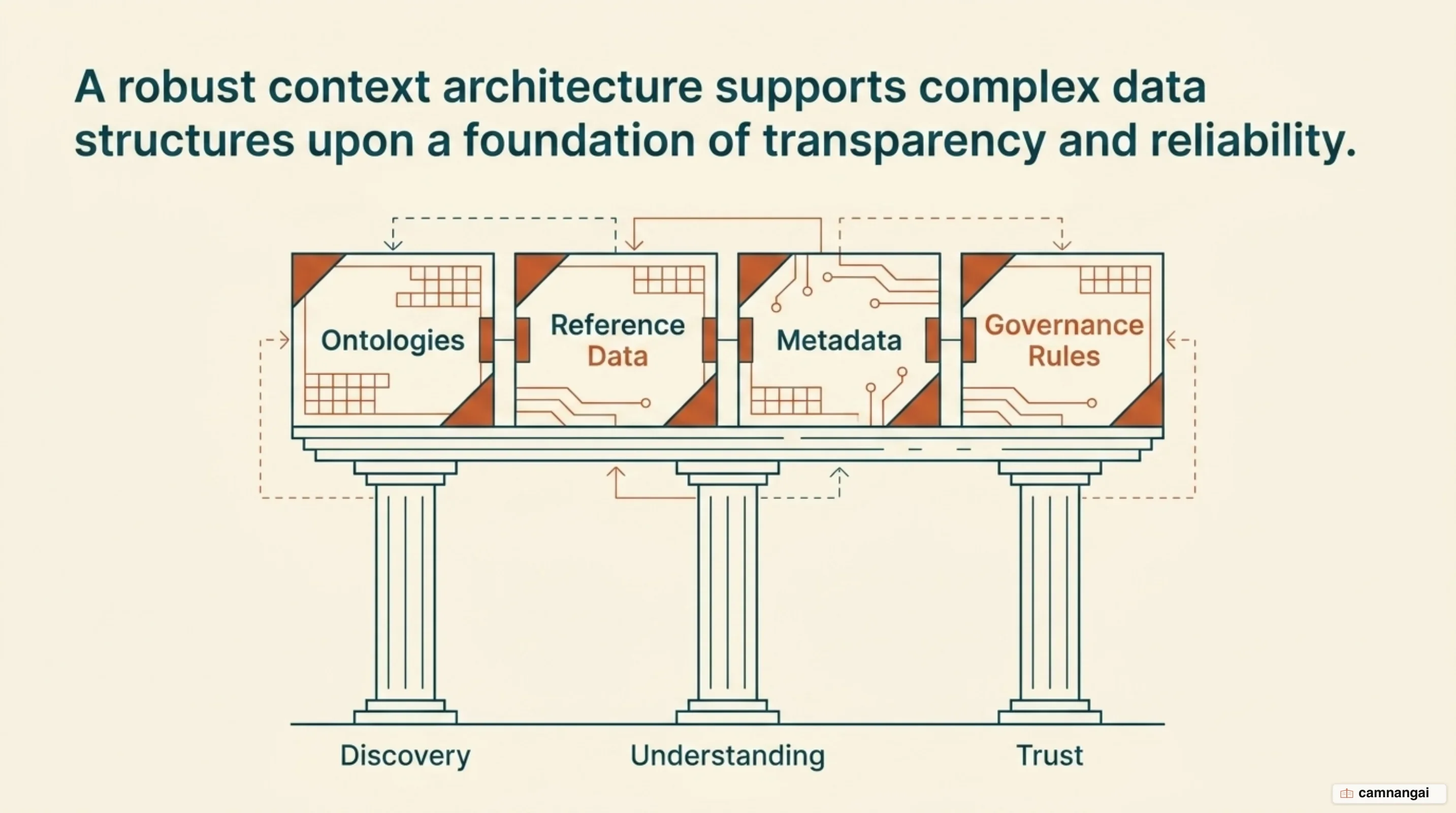
The layer combines technical metadata (schema, lineage, freshness) with semantic definitions to create a machine-readable "shared understanding." Metadata describes the state of the data and tells the AI what exists and where it sits, while the semantic layer formally defines what that data means—for instance, what counts as an "active user" in one product line versus another. That combination is what saves the model from having to guess at the significance of whatever it just retrieved.
Architecturally, the context layer separates two kinds of information:
- Authoritative Context: The stable, foundational truths of the enterprise, including product taxonomies, customer definitions, and regulatory policies.
- Operational Context: The dynamic signals of the organization, such as event logs, decision traces, and workflow activity.
By combining these, the context layer gives AI agents something to reason from about both the "ground truth" and the current state of the organization.
Context layer, semantic layer and knowledge graph
These three get conflated constantly, and they do genuinely different jobs. A Knowledge Graph is a graph-structured store of entities (nodes) and typed relationships (edges), built to answer "who" and "what" questions by holding a static map of how entities connect. A Semantic Layer is a persistent abstraction that translates raw data into business concepts. It answers "what it means" by defining metrics, such as Customer Lifetime Value, in a way that holds consistent across the organization.
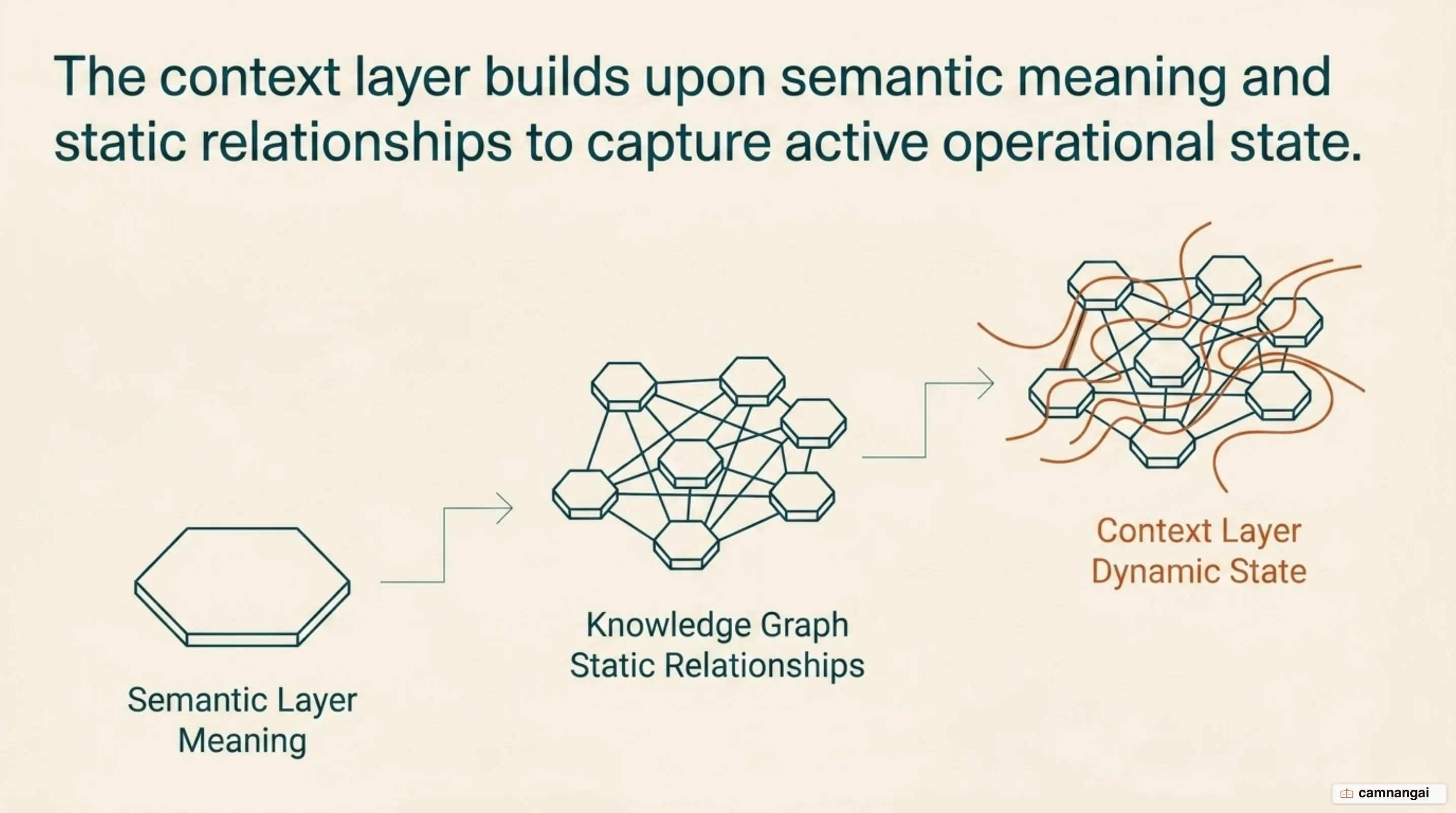
The Context Layer is the dynamic orchestrator on top of both. It pulls fragments from the knowledge graph and the semantic layer at inference time to answer "what is needed right now." Modern architectures are converging these layers into a context graph: where a knowledge graph covers "what" and "who" (static), a context graph captures the "how" and "why" by tracking dynamic decision traces and directional workflows from system execution.
How context reaches the model
Context is delivered through the MCP architecture, which consists of the MCP Host (the AI application), the MCP Client, and the MCP Server. The host coordinates multiple clients, and each client maintains a dedicated connection to one server. That modularity is what lets an AI application pull context from several disparate sources at once.
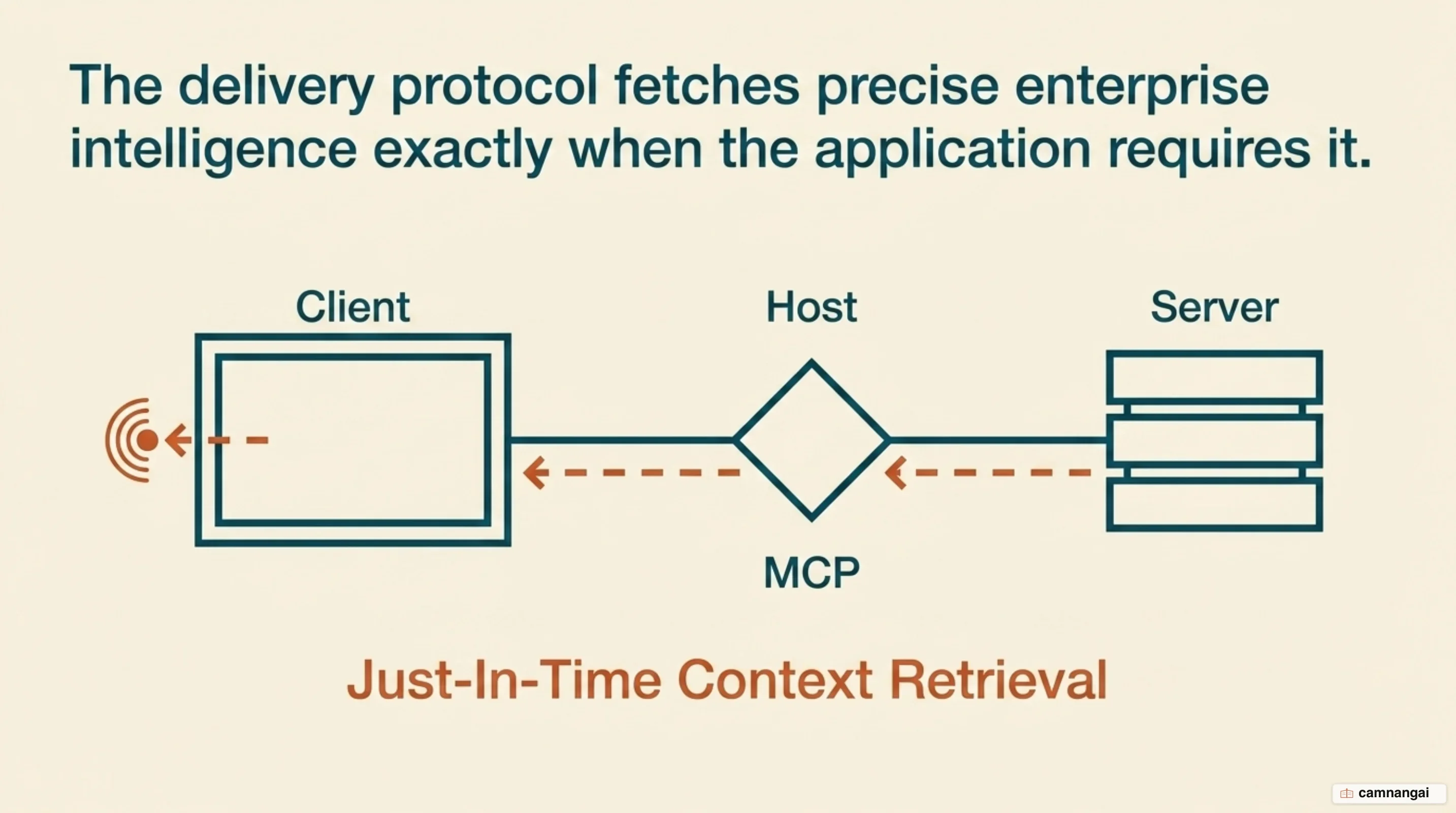
The protocol uses two primary transport mechanisms:
- Stdio transport: Used for local process communication on the same machine, which gives high performance with no network overhead.
- Streamable HTTP transport: Used for remote server connections. For security, OAuth is the recommended authentication on remote HTTP connections.
Whichever transport is in play, the system uses a JSON-RPC 2.0 exchange protocol to handle discovery and tool execution.
Retrieval follows a "just-in-time" methodology. Rather than loading an entire database into a context window, the system uses lightweight identifiers to fetch data at the moment of reasoning. That allows progressive disclosure, where the agent discovers relevant context incrementally through exploration instead of loading full data objects upfront. The model stays on high-signal information, and it stays inside its context window limits.
Memory: the context that survives between sessions
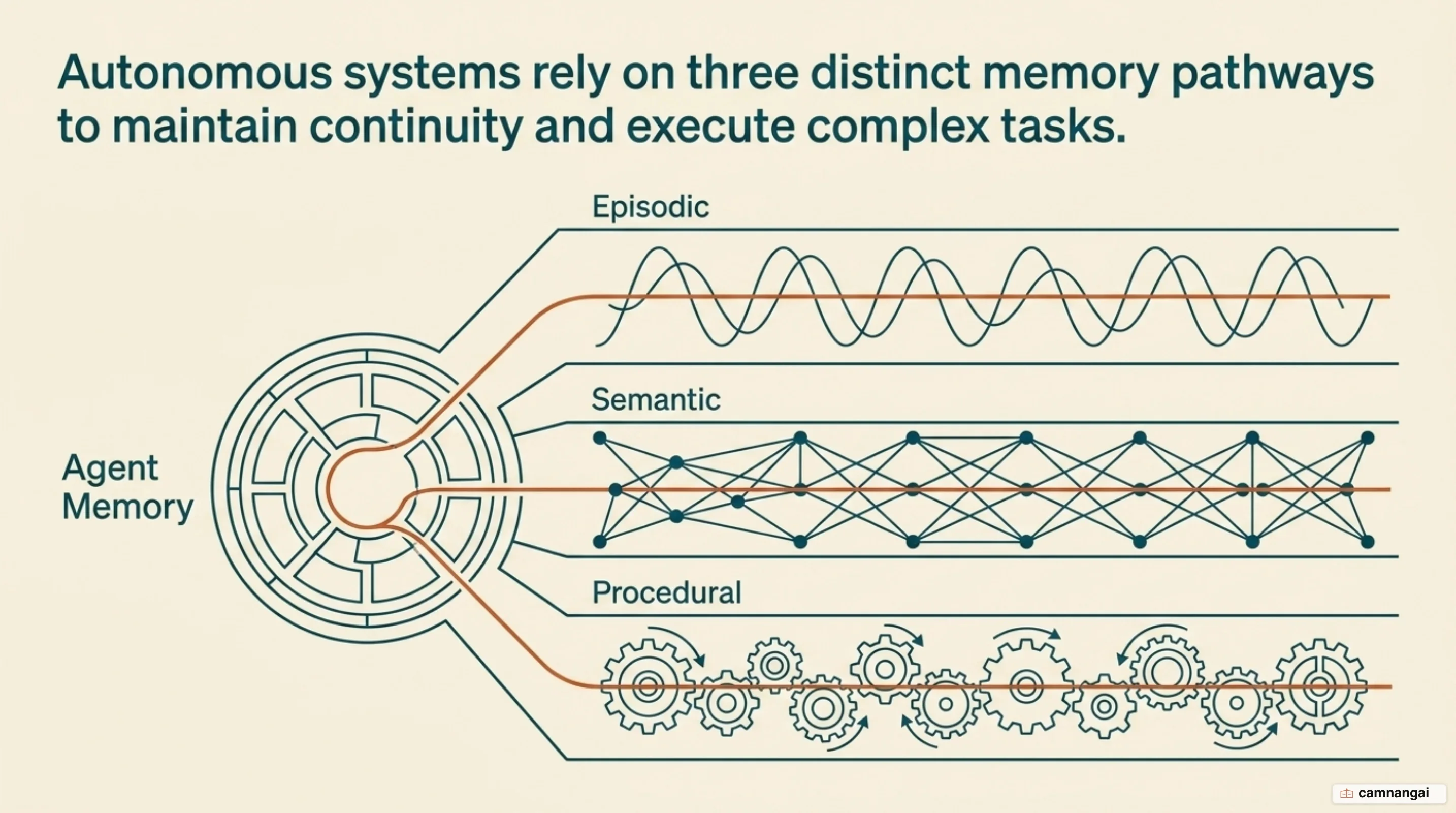
AI agents need persistent memory, and it comes in three types: Episodic (what happened), Semantic (persistent facts), and Procedural (learned workflows and how tasks get performed). Managing it well takes a Multi-Scope Memory model, where every memory is tagged by identifiers: user_id, agent_id, run_id, and app_id. That scoping is what lets the system rank and merge memories automatically, so a long-term user preference is weighted sensibly against whatever just happened in the current session.
Mem0's published benchmarks suggest modern algorithms have made real progress on efficiency. Multi-signal retrieval—combining semantic similarity, keyword matching, and entity matching—achieves high recall using an average of 6,956 tokens per query, while the full-context baseline it is measured against costs roughly 26,000 tokens per conversation. To push relevance further, systems use entity linking to retrieve facts based on specific entities and relationships, without the overhead of hand-managing a full graph store.
Governance: which context an agent may use
Governance inside the context layer is what keeps AI agents operating within legal and organizational boundaries. It is built on Authoritative Context, meaning the trusted definitions and rules that describe how an organization must operate. By encoding those rules in machine-readable forms, such as ontologies, organizations can enforce constraints on AI behavior automatically. This is an infrastructure shift, and the money is starting to follow it: AI governance platform spending is projected to reach $492 million in 2026.
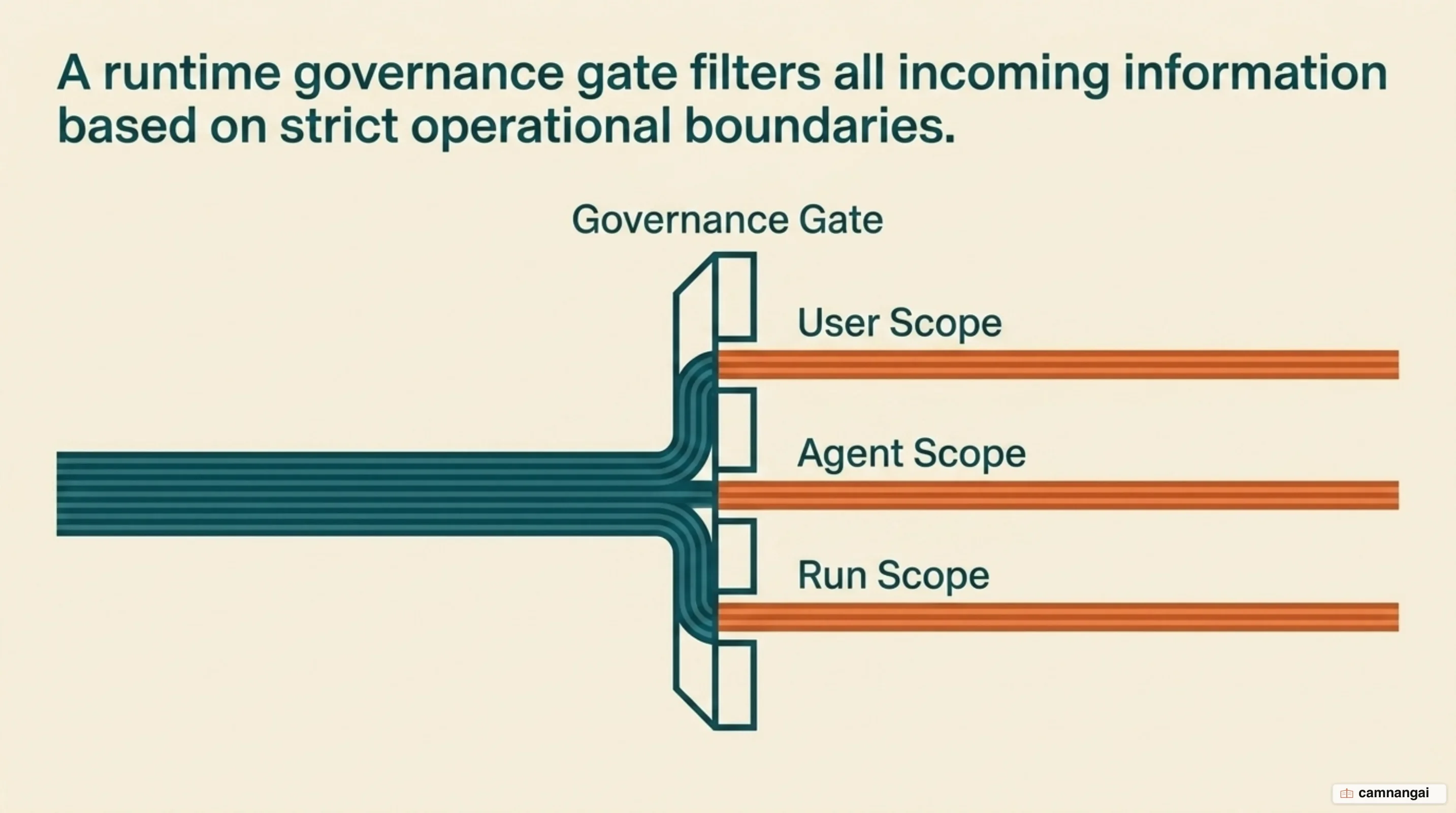
The part of governance I would build first is Data Quality Guardrails, the automated checks that evaluate the state of the data before an agent answers anything. For example, if a user queries a financial dashboard, the context layer can check the metadata to see whether the underlying data pipeline failed overnight. If the data is stale or corrupted, the guardrails stop the agent from delivering a potentially misleading answer, which is the difference between an embarrassing number and a compliance problem.
Context is a finite resource
Despite larger context windows, context remains a finite engineering resource, and that constraint is exactly why context engineering became a discipline of its own. Large volumes of data lead to "context pollution," where model performance degrades because the information density gets too high. To manage it, engineers lean on a few strategies:
- Compaction: Summarizing the message history as it nears the context window limit, so coherence carries over into a new window.
- Structured Note-taking: Agents write critical facts to external memory (a memory tool, or a
NOTES.mdfile) so those facts survive a context reset. - Sub-agent Architectures: Using specialized agents for deep work that return only condensed, distilled 1,000–2,000 token summaries to the lead agent.
Benchmarks back these strategies up. Mem0's algorithm resolves complex queries on an average of 6,956 tokens per query, against a full-context baseline of roughly 26,000 tokens per conversation. The two figures are measured per query and per conversation respectively, so treat them as two cost levels rather than a single ratio. Cutting token volume is not only a cost-saving measure, because it also improves model accuracy directly by reducing the noise the transformer has to parse before it finds the pairwise relationships that matter.
Who builds the context layer, and where to start
Building a context layer is an infrastructure shift, not a documentation project, and the teams that treat it as the latter end up with a beautiful wiki no agent can read. It means moving from business knowledge as static "tribal knowledge" to business knowledge as an operational pipeline. Skip that shift and you inherit the 60% failure rate predicted for agentic analytics projects that lean on MCP alone without a consistent semantic foundation.
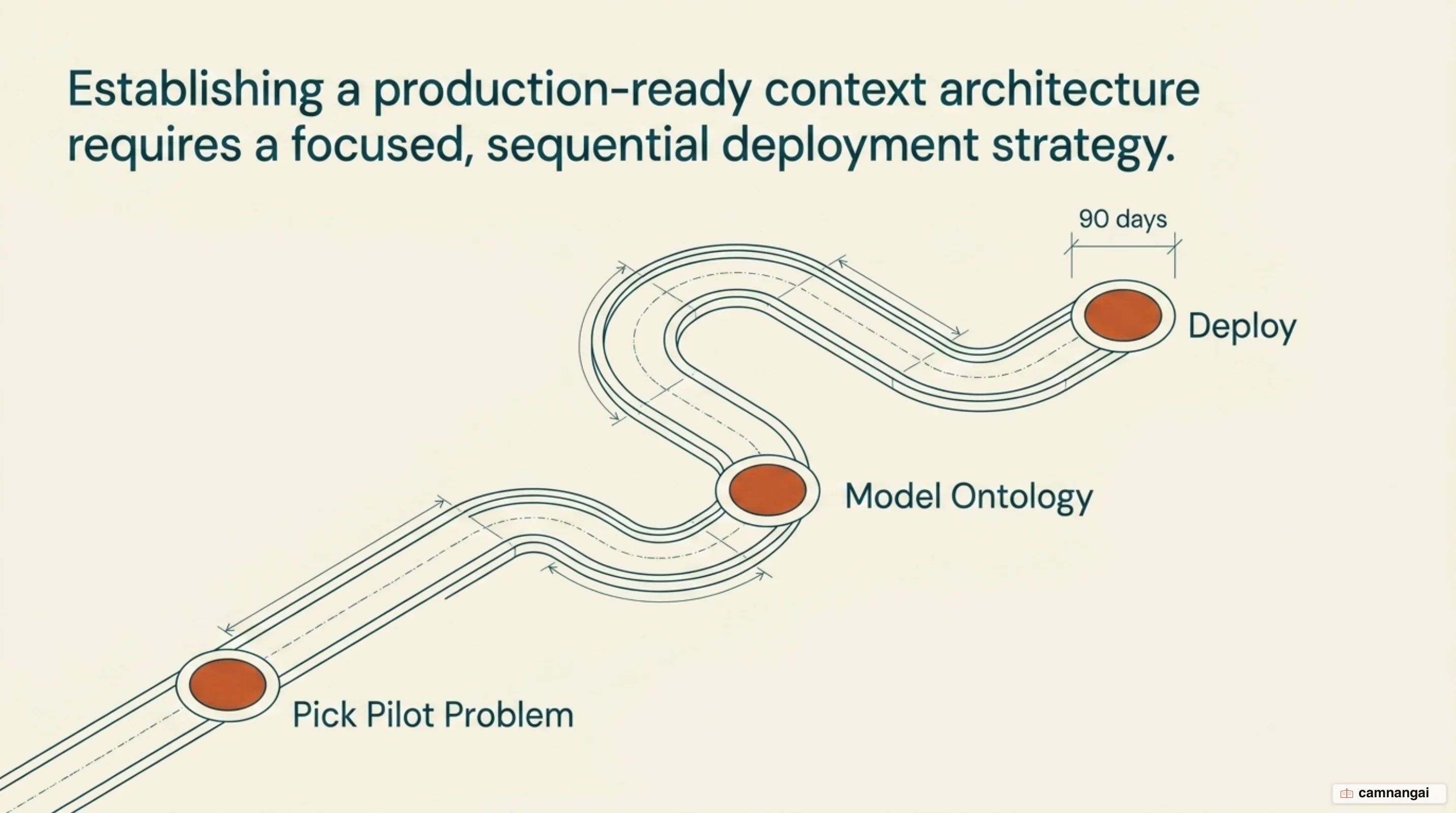
Implementation should follow a 90-day framework for a pilot domain:
- Select a pilot use case: Identify a single high-value domain with clear business impact.
- Assemble a multidisciplinary team: Combine data engineers, domain experts, and governance leaders.
- Audit existing semantic technologies: Model enterprise knowledge, business concepts, and relationships for the pilot domain.
- Establish a persistent enterprise memory layer: Deploy MCP-compatible infrastructure to connect the pilot context layer to AI agents, and measure reliability.
Context is the pipeline for "AI-ready data." Organizations that build unified, automated, live context layers can scale agentic AI, while the ones running on fragmented documentation and one-off engineering for every new agent get inconsistent results and high operational costs instead. Ninety days on one pilot domain is a cheap way to find out which of the two you are.
References
- The Context Layer for AI: What It Is, Why It Matters, and How to Build AI You Can Trust — Precisely
- Context layers, semantic layers, and knowledge graphs: the modern data architecture for AI — SurrealDB
- How Do I Build a Context Layer for AI? Start with Authoritative Context — TopQuadrant
- Effective context engineering for AI agents — Anthropic
- Architecture overview — Model Context Protocol
- State of AI Agent Memory 2026: Benchmarks & Trends Report — Mem0
- Gartner Data & Analytics Summit 2026: Key Takeaways on Context & AI — Atlan
- What is an Enterprise Context Layer? — Alation