Context sources are the specific locations and data systems an AI pulls information from to construct the prompt it sees at inference time. When you architect or deploy a large language model (LLM), you are primarily managing a pipeline of information logistics, and system performance is gated by what reaches the model as much as by the model's weights.
Rather than treating a prompt as a monolithic, static string, modern systems engineering treats context as a dynamic assembly of components pulled from different places. Your job is to optimize the pipeline that retrieves, filters, and formats data from those sources under strict token and latency constraints. Choosing the right sources for a task matters as much as how much data you include.

What are context sources?
Context sources bridge the gap between an LLM's static training data and the real-world state of your system. In a production architecture, context is an orchestrated set of inputs drawn from functional categories: external knowledge, tool definitions, system instructions, and persistent memory.
Designing that environment is an optimization problem. You need a pipeline that selects the most informative data while staying inside the hard constraints of the model's context window. An assembly step handles the logistics: formatting and concatenating disparate data into a normalized, prompt-ready payload.
This reframes the design question. It stops being "how do I word this instruction well" and becomes "what configuration of context is most likely to produce the behavior I need". Context becomes a finite resource you allocate, not an empty space you fill.
The most common types of context sources
To ground an LLM effectively, you pull from five primary kinds of data residence:
- Documents and knowledge bases. Platforms like SharePoint, Confluence, and Google Drive hold settled institutional knowledge. These are typically served through retrieval-augmented generation (RAG) for factual grounding.
- Databases and data warehouses. SQL databases, S3 buckets, and vector stores provide structured grounding, letting the model reach specific data points rather than narrative prose.
- Code repositories. A codebase is a context source that demands structural awareness. Keyword retrieval is insufficient here, because a function's meaning is defined by its call sites and its dependencies across many files, so the index has to map structure rather than just text.
- Chat and support tools. Slack threads and Zendesk tickets act as episodic memory. They carry the current state of a discussion and the history of how past problems were actually resolved.
- Tool outputs and other agents. In agentic workflows, the return value of a tool call — or the payload produced by a secondary agent — becomes a context source for the next step of reasoning.
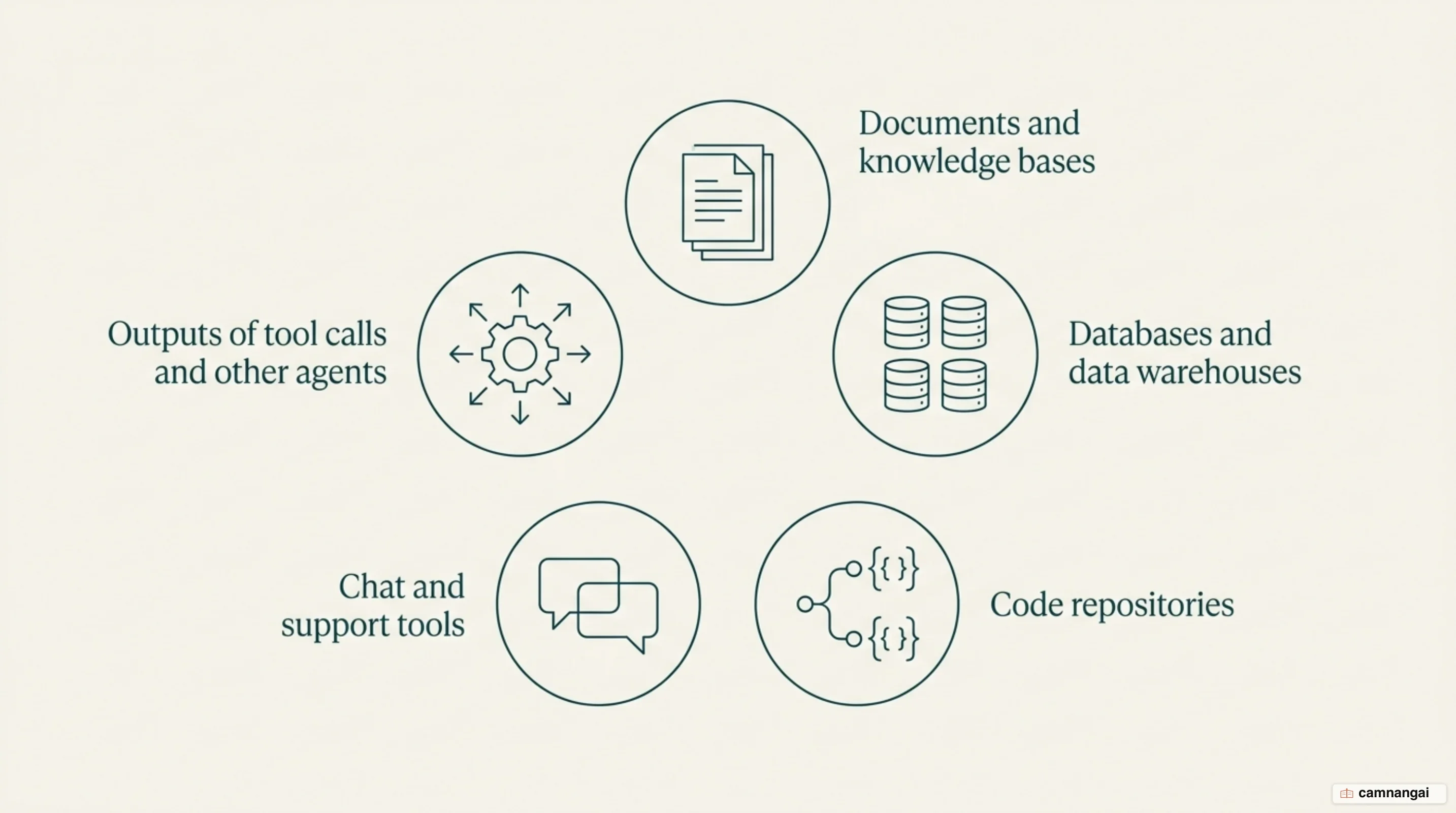
What these five share is that none of them live inside the model. Everything the model knows about your system arrives through one of these paths, and the quality of the path determines the quality of the answer more than parameter count does.
Every source has its own update frequency, access rules, and format
Connecting these sources to a model means standardizing how data is accessed and maintained. The Model Context Protocol (MCP) exists to solve exactly this, providing one way to connect tools and data sources to a model instead of a bespoke integration per database and per API.
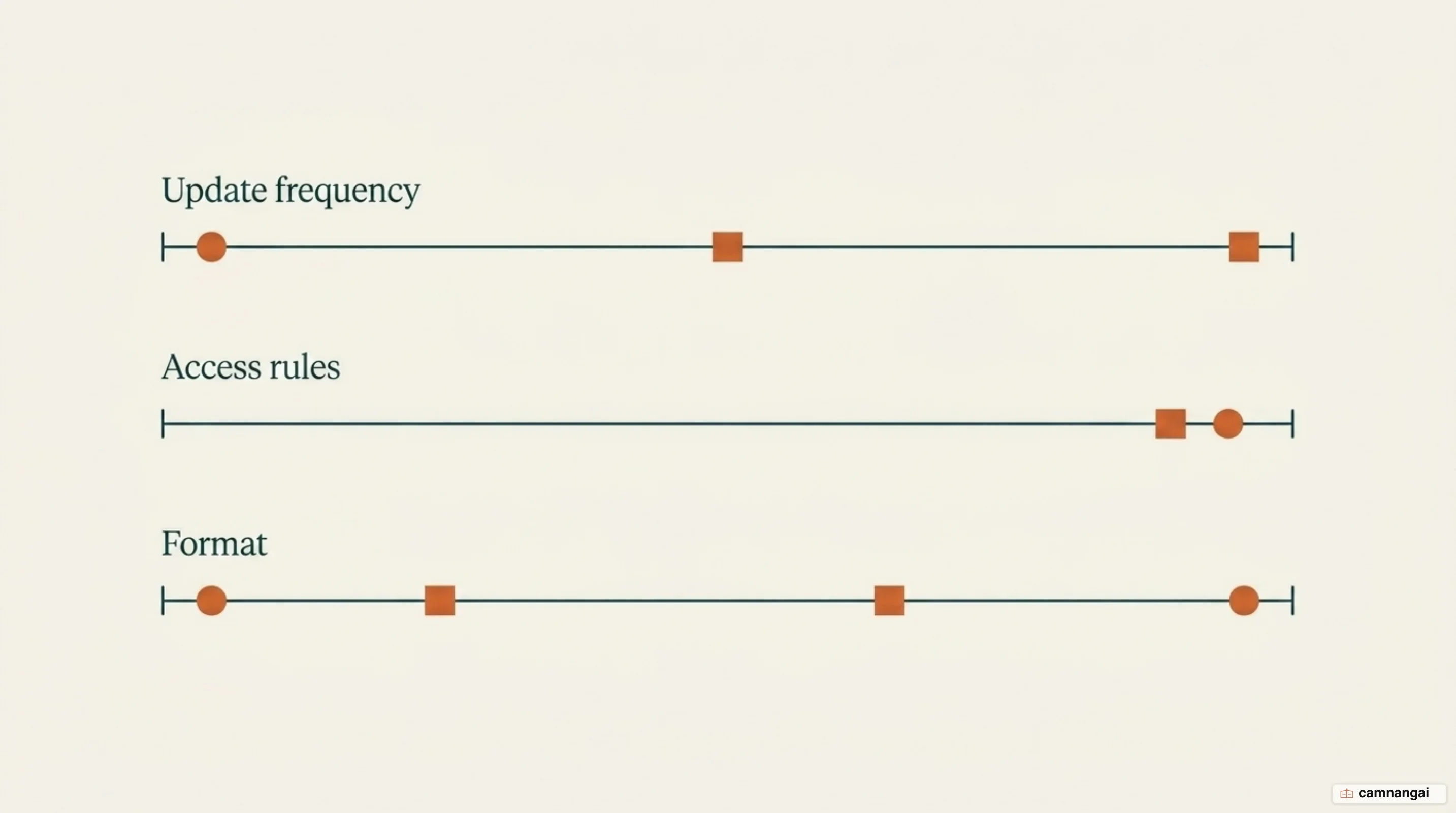
Update frequency is the first axis. A PDF sitting in S3 may not change for a year; Slack changes by the minute. When the index falls behind the documents it mirrors, retrieval returns stale data and the model reasons confidently from information that stopped being true months ago. The fix is operational: trigger incremental re-indexing from document change events rather than running a full re-index on a schedule. This is the part almost nobody staffs properly, because standing a system up for a demo takes a week while keeping the index honest is work that never finishes.
Access rules are the second. The model should only receive context the current user is authorized to see, which means a permission filter sits between retrieval and assembly — without one, grounding leaks data across teams. Format is the third: data arrives as everything from structured JSON to knowledge-graph triples to raw HTML, and all of it needs normalizing before it is prompt-ready.
Normalizing and filtering before the data reaches the model
Raw source data is rarely ready for the model's attention. Cleaning comes first, stripping HTML tags and redundant metadata and deduplicating to save tokens. Then chunking: large documents are broken into manageable pieces, and the strategy has to preserve meaning, because retrieval returns chunks rather than whole documents. A chunk that cuts off mid-argument or splits a table across two segments cannot answer anything on its own.
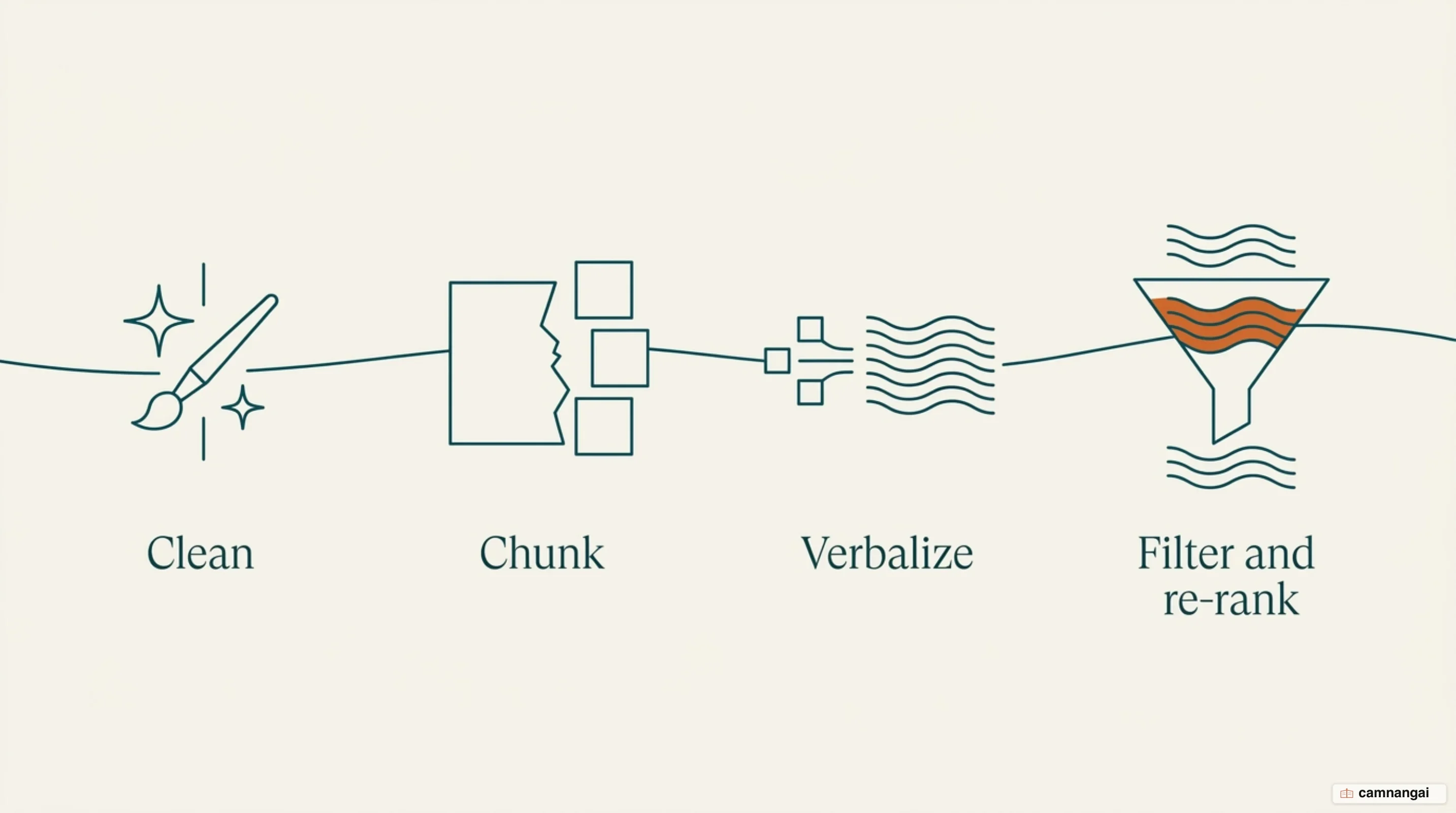
Next is verbalization — converting structured data such as knowledge-graph triples or database rows into natural language the model processes efficiently. The judgment call is knowing when not to. For logical reasoning tasks, keeping a structured format like a Markdown table, a SQL schema, or Python code often outperforms flattening everything into prose.
Finally, contextual filtering. After retrieval, a re-ranking pass scores which chunks genuinely answer the specific query and discards the rest. The goal is not to deliver more data but to deliver the right data at the highest achievable information density.
Why choosing the right sources beats adding more data
Large context windows are not a silver bullet. Testing across 18 frontier models found that every one of them degrades as input length grows — on tasks as simple as retrieving a fact or replicating text, and well before the context window is anywhere near full. This is context rot: reliability falls as you add tokens, not just when you run out of room.
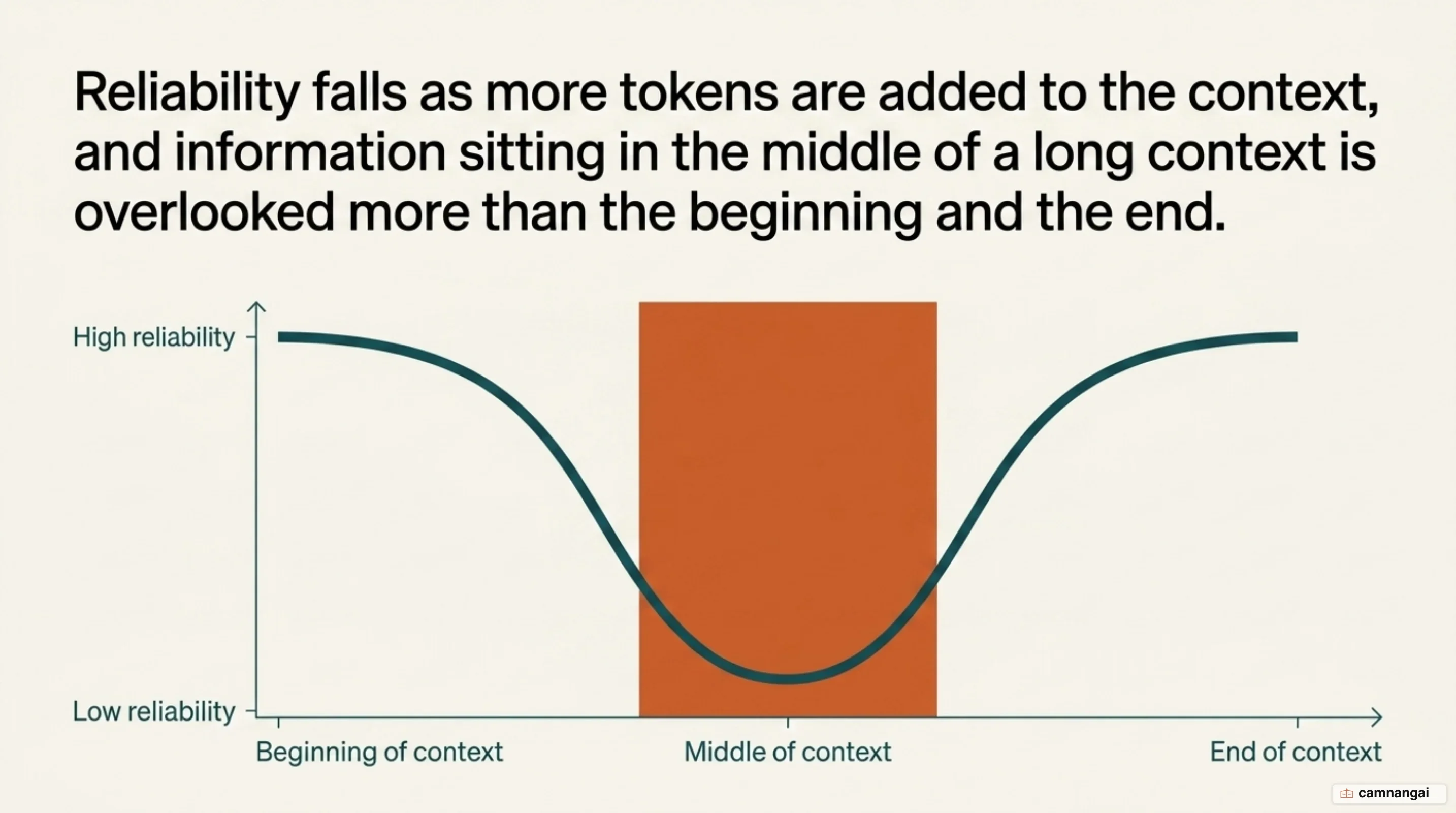
Alongside it runs the lost-in-the-middle effect. Models weight the beginning and end of a context more heavily than the middle, so information buried in the center of a long payload is effectively ignored. If you are passing ten chunks, the most relevant one belongs first.
The goal, then, is to maximize useful information per token rather than to maximize tokens. Filtering out the surplus cuts latency and cost while improving accuracy at the same time. A lean, well-ranked payload beats a huge, noisy context window every time. I think this is where most RAG systems go wrong: the window gets bigger, so the team fills it, and then everyone is surprised when answers get worse than they were on three well-chosen passages.
Where to start when choosing your context sources
Start with your highest-density sources — an indexed codebase, a curated internal knowledge base, a clean SQL database. These carry the highest accuracy and the lowest noise, which makes them the most stable foundation for factual grounding. Get retrieval and the permission filter working against those before expanding into noisier real-time sources like system logs or chat.
Your system's intelligence is gated by the quality of its retrieval and assembly pipeline, not by the parameter count of the underlying model. Knowing what data you actually have and how it changes over time is the hardest part of the job, and it is the part no model will do for you.
References
- Effective Context Engineering for AI Agents — Anthropic
- Context Engineering for Agents — LangChain
- A Survey of Context Engineering for Large Language Models
- What is the Model Context Protocol (MCP)?
- Context Rot: How Increasing Input Tokens Impacts LLM Performance — Chroma
- The Honest Guide to LLM Grounding Data Architecture — Thinklytics
- Codebase Indexing — Cursor Docs
- Grounding Your LLM: A Practical Guide to RAG for Enterprise Knowledge Bases — Towards Data Science