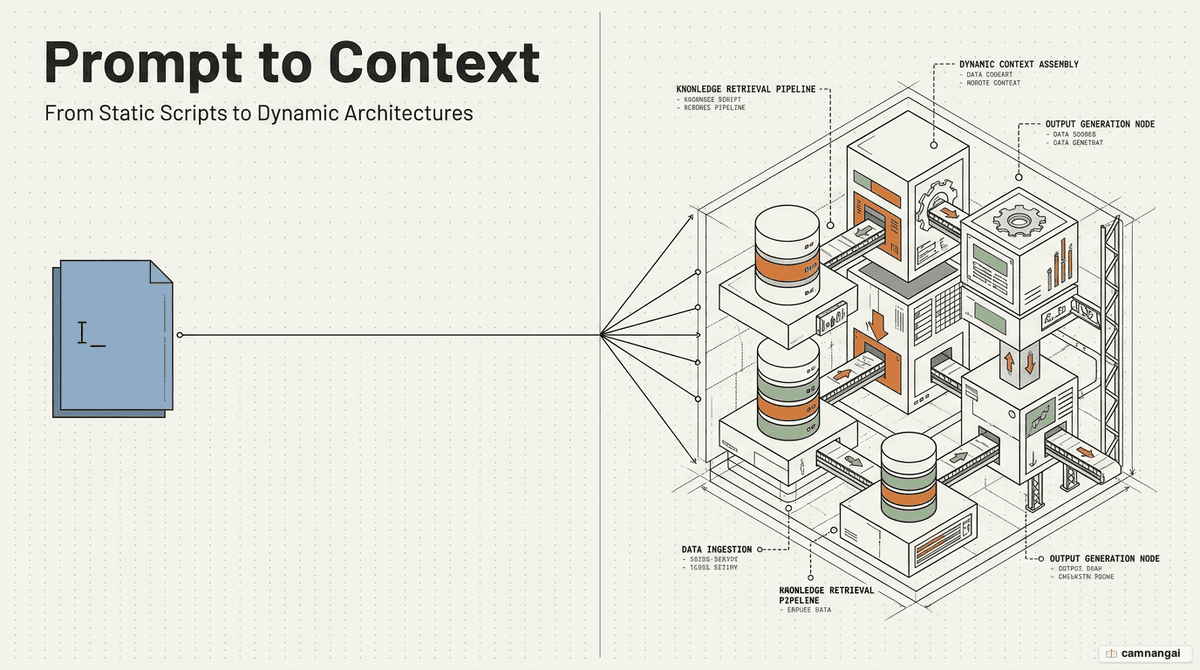
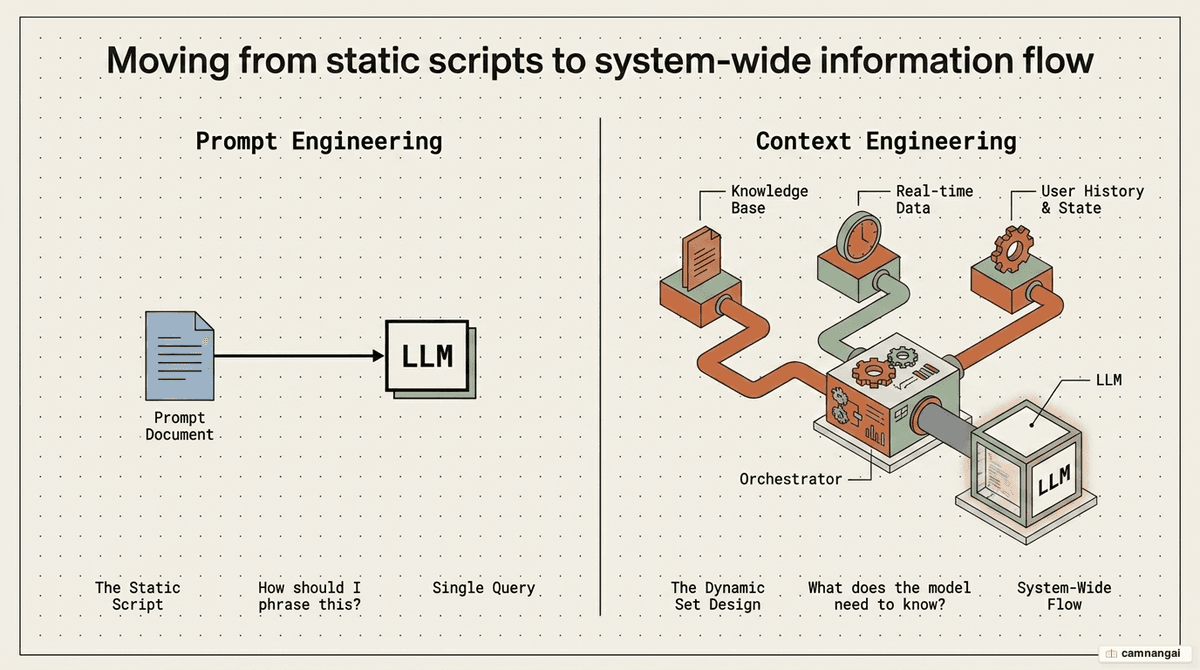
Building production-grade AI takes more than tweaking text inputs. As systems engineers, we have to understand the shift from context engineering vs prompt engineering to build reliable applications. This transition is a fundamental move from "static scripts" (phrasing) to "dynamic set design" (systems architecture). While prompt engineering focuses on optimizing instructions for a single query, context engineering is the programmatic assembly of the entire information environment.
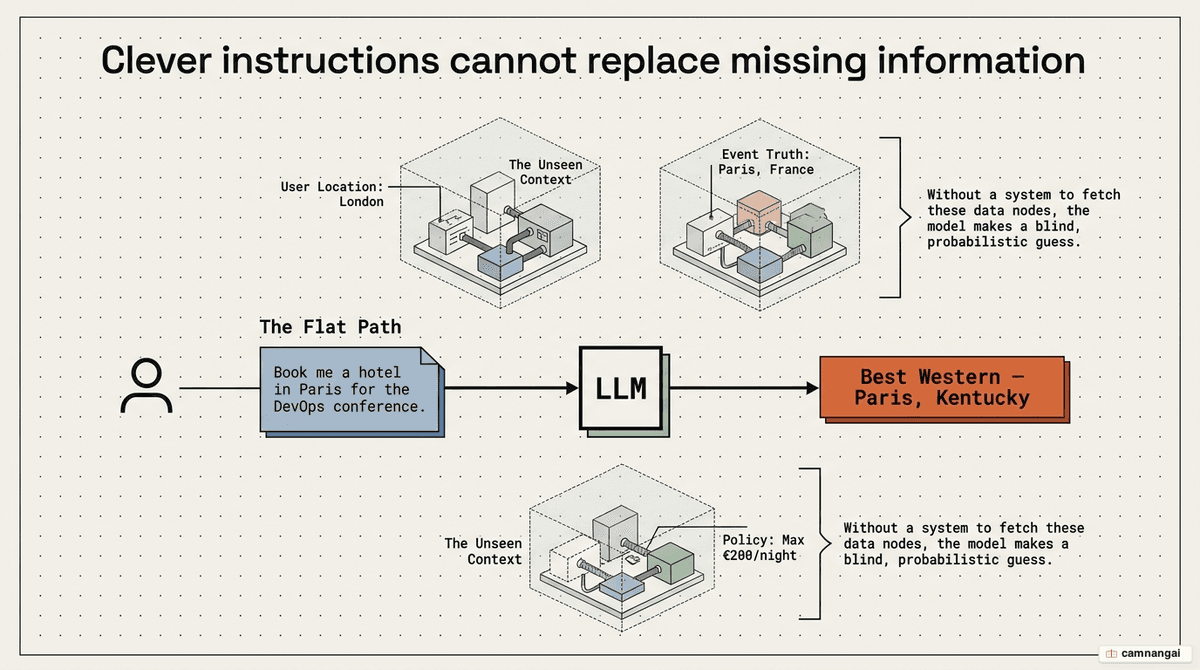
The failure of traditional prompting is most evident in disambiguation. A user might ask a travel agent to "Book a hotel in Paris for the DevOps conference." A prompt-engineered agent, lacking external data, makes a probabilistic guess and books a hotel in Paris, Kentucky, instead of Paris, France. No amount of clever wording can fix this; the agent simply lacks the critical information—such as the user's location, the conference's actual site, and company travel policies—required to resolve the ambiguity.
What is prompt engineering?
Prompt engineering is the "craft of wording," focusing on refining the linguistic input to guide an LLM's behavior. It treats the model as a talented improv actor and provides a script before the curtain rises. In this discipline, developers use techniques like Role Assignment to set expertise, Few-Shot Examples to provide formatting patterns, and Chain of Thought (CoT) instructions (e.g., "Let's think step by step") to prevent logical leaps. Constraint Setting further defines boundaries, ensuring the model adheres to word limits or JSON structures.
A critical challenge here is finding the "right altitude" for instructions. At one extreme, engineers hardcode brittle, complex logic into prompts to anticipate every scenario, which increases maintenance overhead. At the other extreme, vague guidance fails to provide the model with concrete signals. The optimal altitude provides specific behavioral guards while allowing the model enough flexibility to apply judgment based on the provided context.
Ultimately, prompt engineering is limited by its static, single-turn nature. It assumes the model has all necessary information within the instruction itself. When a task requires multi-step reasoning or external "ground truth" data, prompt engineering hits a ceiling. It is a micro-optimization that cannot compensate for a lack of system infrastructure or persistent state.
What is context engineering?
Context engineering is the system-level discipline of programmatically assembling the "Context Package"—the complete bundle of tokens processed by the LLM at inference. Instead of just writing a better sentence, a context engineer builds an Orchestrator Loop that fetches the right data from multiple sources before the model generates a response. This creates a "Runtime Prompt" where the final input is often 80% dynamic content—retrieved documents, tool results, and state—and only 20% static instructions.
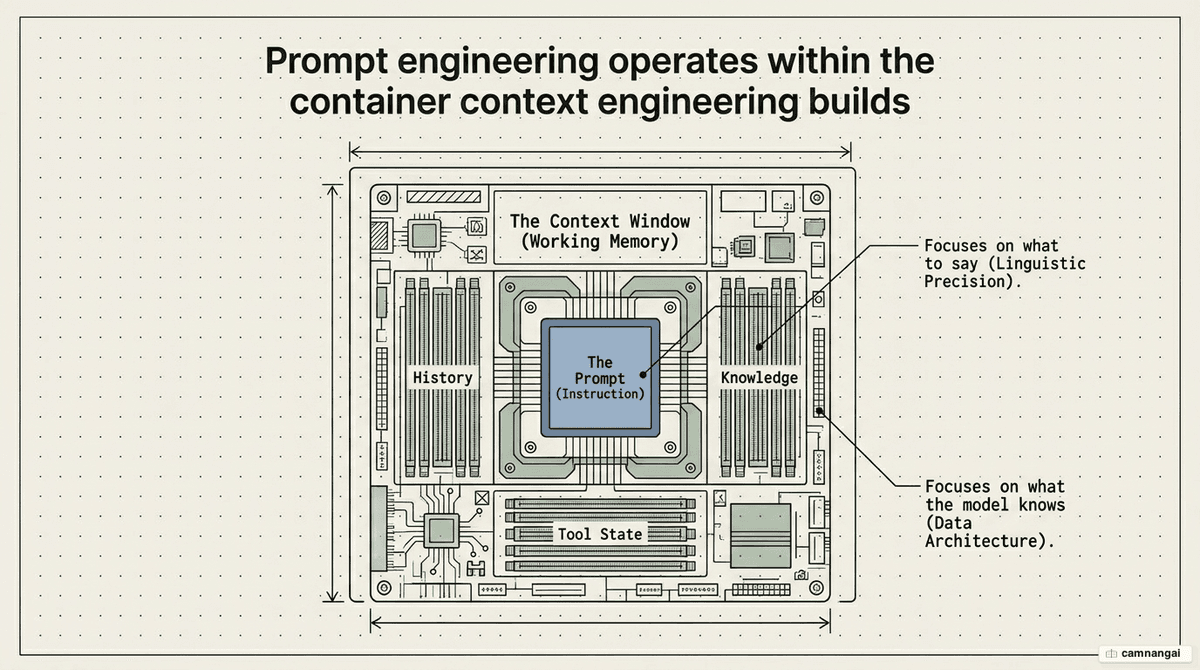
Architecturally, we should view the LLM as a CPU and the context window as RAM or working memory. The context engineer acts as the operating system, loading that working memory with the specific code, data, and state required for the task. This transition shifts the developer's role from "copy-tweaker" to "systems designer," focusing on data pipelines, vector databases, and state machines to ensure the model acts as a reasoning engine constrained by real-world inputs.
This discipline treats the context window as a finite resource that must be actively curated. It involves deciding what information is relevant "just-in-time" rather than dumping all potentially relevant data into a single prompt. By engineering the information flow, we ensure the model is grounded in facts, reducing hallucinations and making the AI's behavior predictable across thousands of sessions and diverse user inputs.
The core differences
| Dimension | Prompt Engineering | Context Engineering |
|---|---|---|
| Core Question | "How should I phrase this?" | "What does the model need to know?" |
| Scope | Single query/interaction | System-wide information flow |
| Failure Mode | Ambiguity and misinterpretation | Retrieval errors, stale data, or overflow |
| Tools | Describes desired output | Selects and sequences tools/APIs |
| Debugging Approach | Linguistic precision and rewording | Data architecture and token flow analysis |
| Effort Type | Creative writing / Copy-tweaking | Systems design / Infrastructure |
Prompt engineering and context engineering exist in a subset relationship. Prompt engineering is the instruction set that lives inside the container built by context engineering. While context engineering decides what fills the window (the information environment), prompt engineering focuses on how to phrase the instructions within that environment to ensure the model executes the task as intended.
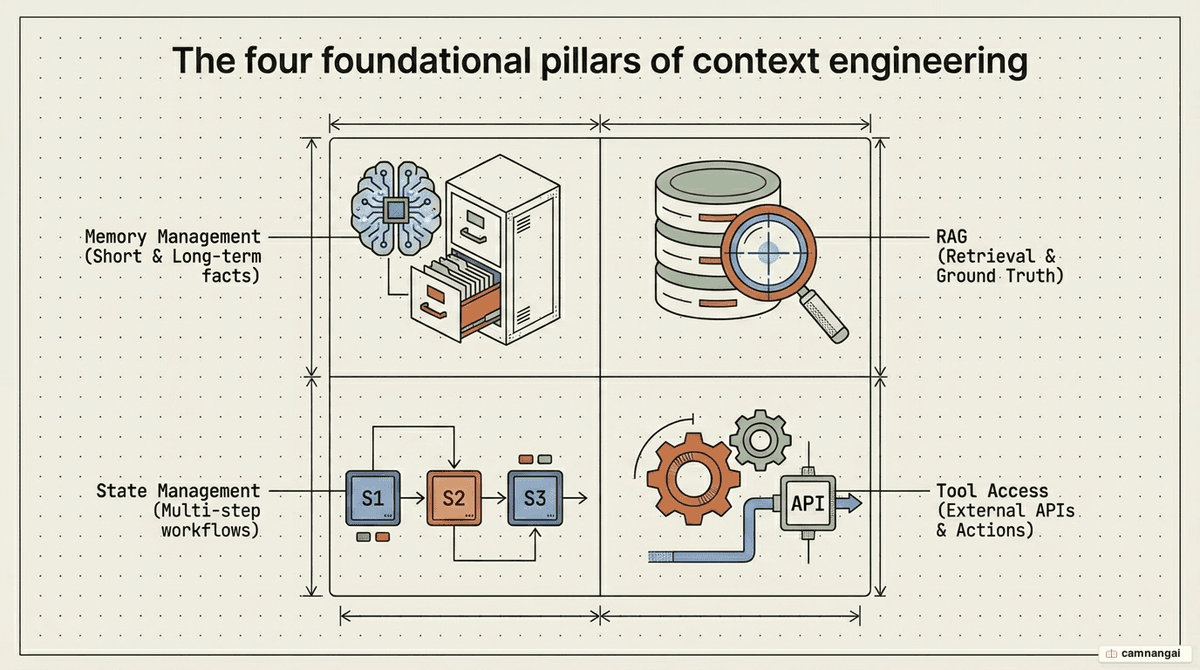
The four pillars of context engineering
Memory management
Memory management involves strategically deciding which parts of a conversation or user history should occupy the limited context window. Dumping entire histories is expensive and increases Time to First Token (TTFT). Instead, engineers use a rolling window for short-term memory to maintain immediate flow, while long-term memory utilizes semantic retrieval from vector databases to pull in persistent facts—like a user's location or seat preferences—only when they are relevant to the current query.
Strategic memory management also prevents the model from losing its "attention span" as a conversation grows. When the window fills, the system must implement summary compression, condensing earlier turns into a concise state description. This keeps the model focused on the current objective without wasting tokens on historical noise that no longer impacts the decision-making process.
To maintain system health over long-running sessions, we must perform "Garbage Collection" on the model's working memory. This involves a context refresh where the essential state is summarized and the instance is spun up fresh. This prevents the accumulation of errors and ensures the model's reasoning remains sharp, avoiding the clutter of failed attempts or tangential exploratory turns.
RAG (Retrieval-Augmented Generation)
RAG connects the model to "ground truth" data, such as real-time pricing or corporate travel policies. A robust context engine uses hybrid search, combining traditional keyword matching (BM25) for exact IDs with semantic vector search for conceptual matches. This ensures the model has access to the specific information it wasn't trained on, transforming it from a probabilistic text generator into a data-driven decision engine.
A critical engineering warning in this pillar is that "bad retrieval is worse than no retrieval." Surfacing irrelevant documents confuses the model and forces it to process "distraction tokens," which increases costs and triggers hallucinations. The context engine must extract and rank only the specific chunks or snippets relevant to the query to maintain the highest signal-to-noise ratio within the window.
In our travel agent example, RAG would query a database to find that the max hotel spend is €200/night and retrieve specific conference location details. By injecting these facts directly into the runtime prompt, the agent is forced to comply with real-world constraints. This grounding is the primary defense against the model making unauthorized or impossible bookings.
State management
State management tracks the agent's progress through multi-step workflows, serving as the "spine" of agentic processes. Because agents are stateful, the context engine must inject state objects that indicate whether the system is in the Discovery, Search, or Booking phase. This prevents the LLM from attempting to confirm a reservation before it has successfully retrieved search results or checked availability.
By maintaining state, the orchestrator can also pass critical variables across operations—such as an arrival time from a flight booking being used to schedule ground transportation. Without this management, the agent loses context mid-task, leading to disjointed actions. State ensures the model understands what constraints have been satisfied and what information is still required to move the process forward.
State management is also vital for handling failures gracefully. If a tool call fails, the state reflects this error, allowing the model to decide whether to retry with different parameters or ask the user for clarification. This systematic tracking of logic ensures that the agent remains coherent across long, complex interactions where a single-turn prompt would inevitably fail.
Tool access
Tool access gives the LLM "hands" by defining interfaces to external APIs and databases via function schemas. Context engineers must define precise JSON schemas that tell the model what tools exist, their purpose, and their required parameters. The orchestrator intercepts the model's structured requests, executes the code, and returns the result to the context window for the next reasoning step.
{
  "name": "get_conference_details",
  "description": "Retrieve the exact location and dates for a specific conference to disambiguate travel destination.",
  "parameters": {
    "type": "object",
    "properties": {
      "conference_name": {
        "type": "string",
        "description": "The name of the conference (e.g., 'DevOps Conference')"
      },
      "year": { "type": "integer", "description": "The year the conference takes place" }
    },
    "required": ["conference_name", "year"]
  }
}
Effective tool orchestration follows the principle of the "minimal viable set." Overlapping or bloated toolsets confuse the model and increase the risk of it selecting the wrong interface. Tools should be token-efficient, returning only the necessary data rather than raw, massive datasets. For example, a search tool should return a summary of results rather than a 100-page document.
Furthermore, the context engine handles tool failures like timeouts or API errors by weaving that feedback into the next prompt. If an API returns "No hotels found matching criteria," the agent sees this as new context and can adjust its search parameters. This dynamic feedback loop, managed by the context engineer, is what allows the system to behave as a reliable agent rather than a simple script.
Trade-offs: tokens, latency, and "context rot"
Context engineering introduces technical costs that require aggressive management. Every token processed has a financial impact, with a benchmark of approximately $10 per million tokens for input. High token counts also negatively affect latency, specifically the Time to First Token (TTFT). Balancing comprehensiveness with responsiveness is a core engineering challenge; too much context leads to "Context Distraction," where irrelevant details cause attention drift.
As a conversation persists, "Context Rot" occurs. This is the degradation of output quality as the window fills with noise, dead ends, and historical failures. This can lead to "Context Poisoning," where a model's earlier hallucination or error remains in the window, causing the model to reference its own poor output and enter a death spiral of confusion. The model's working memory becomes so cluttered that it can no longer distinguish between the current goal and historical noise.
To mitigate these risks, engineers must implement pruning, checkpoint summaries, and context refreshes. Pruning involves removing low-priority information like old few-shot examples when the window nears capacity. Summarizing the state and spinning up a fresh instance—essentially context "Garbage Collection"—clears out accumulated rot while preserving the essential facts needed to complete the user's request.
When to use prompting vs when you need context engineering
The choice between these disciplines depends on the required reliability and complexity of the application. Prompt engineering is suitable for "one-off" tasks, copywriting, and quick demos where the model already possesses the internal knowledge to generate high-quality responses. If the task is straightforward and lacks external dependencies, copy-tweaking the instruction is often sufficient and more cost-effective.
Context engineering is required for production-grade agents and systems that need high predictability. If your application involves multi-turn workflows, relies on proprietary or real-time data (RAG), or needs to execute actions via APIs, context engineering is the essential infrastructure. It is the shift from creative writing to systems design, making the 1,000th output as accurate as the first.
Ultimately, while prompt engineering is how many developers start, context engineering is how they scale. The former provides better questions; the latter provides the better systems required to answer them reliably in complex, real-world environments. By architecting the entire information environment, we transform the LLM from a probabilistic generator into a robust reasoning engine.
FAQ
What is the difference between pre-retrieval and just-in-time context? Pre-retrieval loads all potentially relevant data into the prompt before inference. Just-in-time context allows agents to dynamically discover and load data using tools during the loop. Pre-retrieval is faster but risks context overflow and distraction; just-in-time is more precise but slower due to the multiple turns required for discovery.
How does the system handle tool failure? The context engine captures error messages or timeouts and injects them back into the context window. This allows the LLM to "see" the failure as a new piece of information. The model can then reason through a solution, such as adjusting search parameters or asking the user for missing details.
How does context engineering relate to RAG? RAG is a core pillar of context engineering. While RAG focuses on the specific act of fetching external "ground truth" data, context engineering is the broader orchestration of that data alongside memory, state, and tool outputs to form the final "Context Package" sent to the model.
What are the primary symptoms of context overflow? Context overflow overwhelms the model's attention span, lowering the relevance of the entire window. This causes the LLM to struggle with identifying the most important information, leading to hallucinations or ignored instructions. Additionally, it significantly increases token costs and latency (TTFT) without improving the quality of the output.
Which tokens should I prune first when the window is full? Prioritize system instructions and current state; these should never be cut. Few-shot examples are the lowest priority and should be pruned first once the model understands the task. Conversation history is mid-priority and can be summarized or pruned, while retrieved ground-truth documents and active tool outputs remain high priority.
References
- Context Engineering vs. Prompt Engineering: Smarter AI with RAG & Agents
- Context Engineering vs Prompt Engineering — Data Science in Your Pocket
- Context Engineering vs Prompt Engineering — System Design Newsletter
- Context Engineering: Bringing Engineering Discipline to Prompts — Addy Osmani
- Context engineering vs. prompt engineering — Elasticsearch Labs