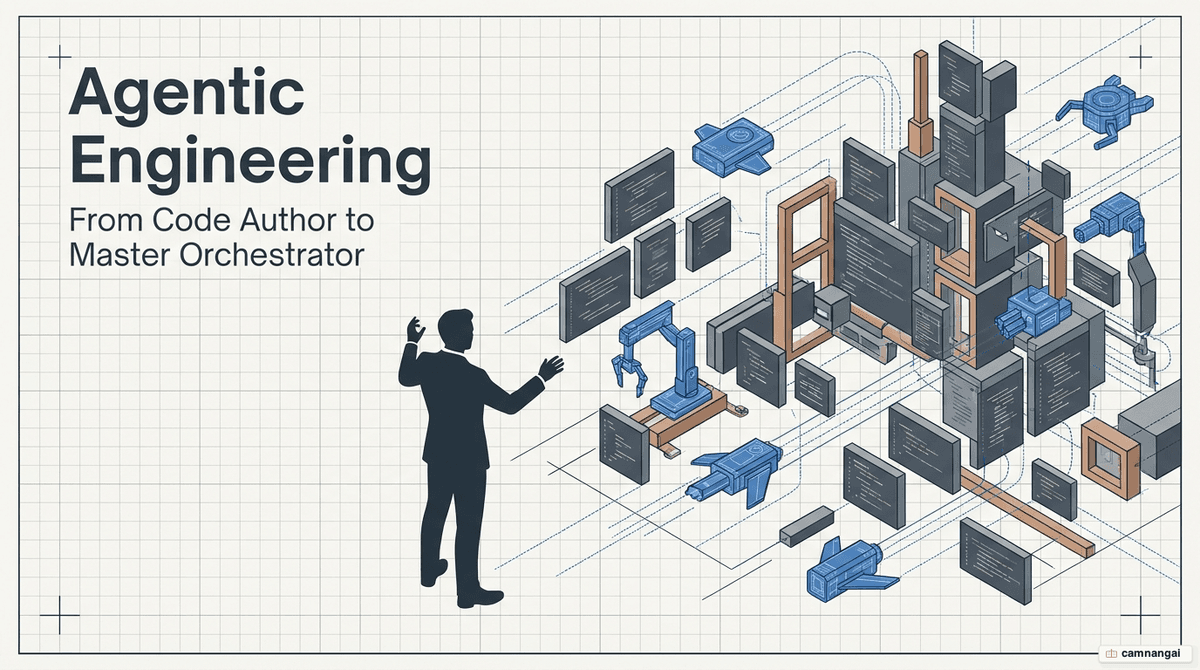
Agentic engineering is the disciplined practice of orchestrating AI agents to handle implementation while the human owns the architecture and correctness.
It moves us beyond vibe coding—the reckless habit of prompting and praying—into a structured environment where agents operate in goal-driven loops. In this model, you aren't a "prompt DJ"; you are a systems architect managing a fleet of high-speed, low-judgment agents.
If you aren't reviewing every diff and running rigorous validation loops, you aren't engineering—you're just gambling with technical debt.
What is agentic engineering?
Technically, agentic engineering is the orchestration of multi-agent systems that can plan, execute, and refine code based on goal-driven execution loops. Andrej Karpathy describes it as a fundamental shift where agents write the code while humans validate the output. This moves us from deterministic logic—where we script every line—to a system where we define the goal, the environment, and the constraints, letting the AI reason through the implementation steps.
The necessity for this discipline is grounded in a stark industry trust gap. While 84% of developers are using AI-assisted tools, as many as 46% don't trust the accuracy of their output. Seasoned engineers know that AI is a probabilistic machine, not a deterministic one. Agentic engineering bridges this gap by maintaining a "human-in-the-loop" model, where the engineer provides the "thinking" that the AI amplifies. It is a transition from prompting for answers to designing ecosystems where agents use tools, call APIs, and iterate based on real-world feedback.
How it differs from vibe coding and prompt engineering
The industry is currently suffering from "vibe coding" being used as a suitcase term for all AI development. We need to draw a clean line.
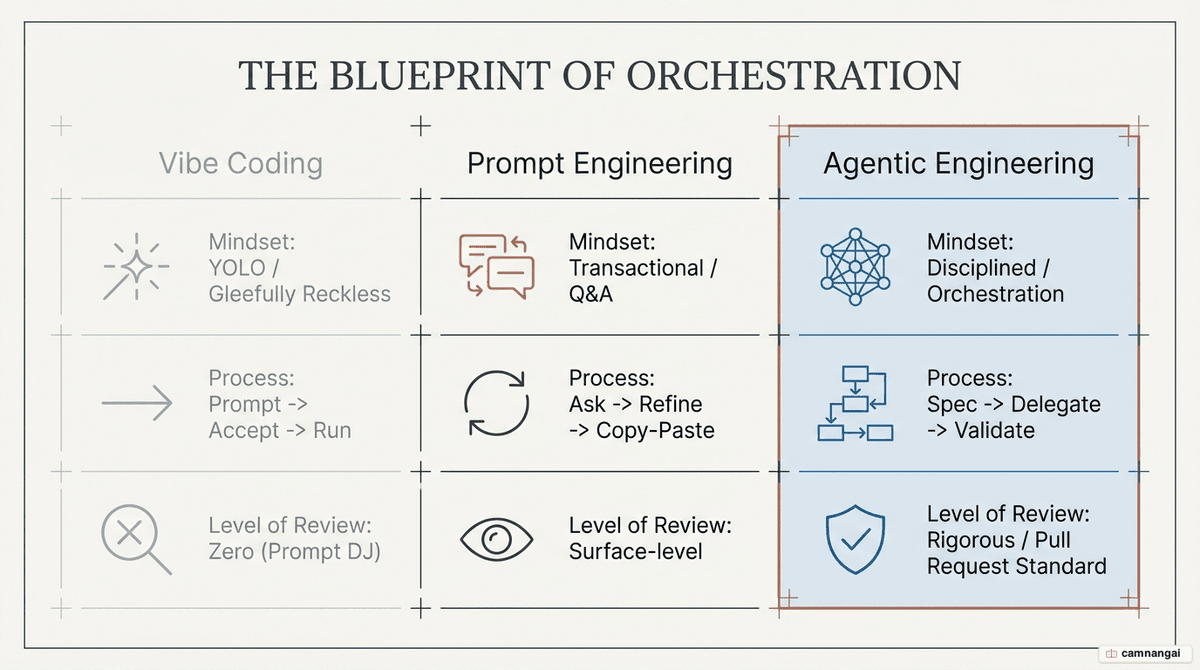
- Vibe Coding: This is "YOLO" programming. It's useful for 3 a.m. hacks or greenfield MVPs where code quality is irrelevant. You prompt, you accept, and you don't read the diffs. It inevitably produces "AI slop"—code that demos well but is impossible to secure, scale, or debug.
- Prompt Engineering: This is a one-question-one-answer model. It relies on massive, fragile instructions to force a specific output. It's a dead end for production systems because it doesn't scale to multi-step execution.
- Agentic Engineering: This is professional orchestration. It's about building a reliable system out of unreliable parts. The human owns the architecture; the AI handles the grunt work.
| Feature | Vibe Coding | Prompt Engineering | Agentic Engineering |
|---|---|---|---|
| Primary Goal | Fast prototyping | Better model responses | Reliable system execution |
| Human Role | Prompt DJ | Input Structurer | Orchestrator & Architect |
| Logic Type | Improvisational | Instruction-based | Goal-driven loops |
| Failure Mode | Technical Debt / AI Slop | Fragile / Non-scalable | Orchestration Overload |
The new role: from code author to orchestrator
Your role has evolved into managing an "enthusiastic, well-read, but confidently wrong junior developer." This AI assistant has read every Stack Overflow post but possesses zero business judgment. Like an intern at a healthcare company who uses Comic Sans in a production app because the wireframe used it, the agent will follow your "spec" literally, even when it violates common sense.
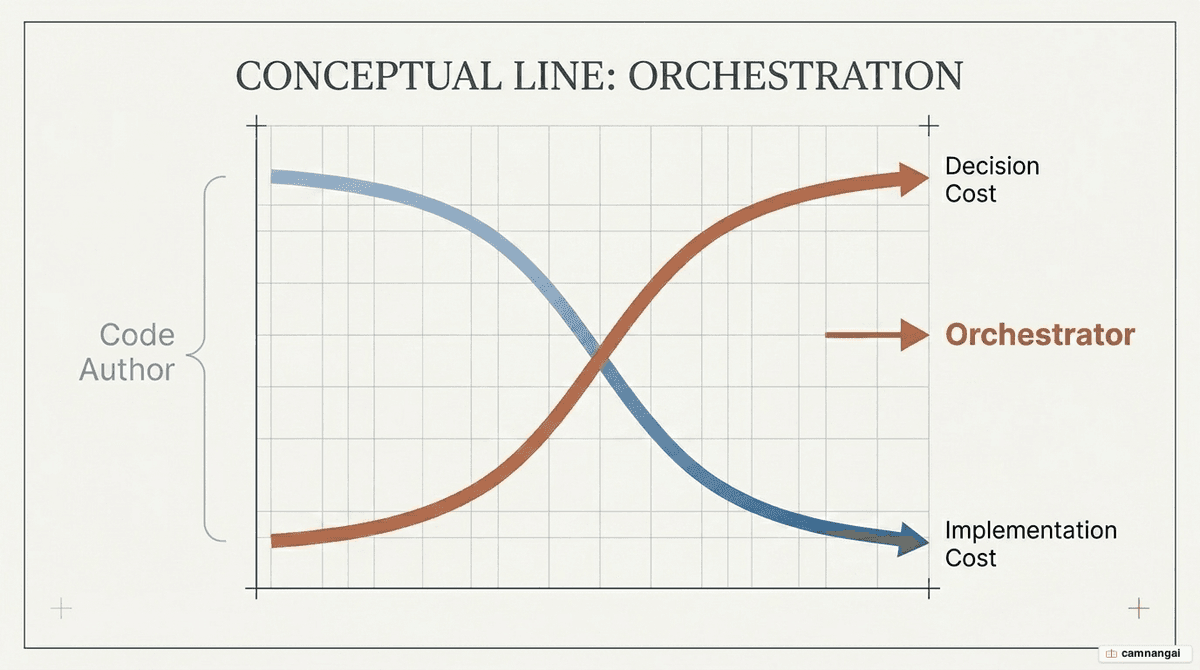
Your value as a senior engineer no longer comes from writing the hardest 500 lines of code. It comes from defining the 50 lines that must never be wrong—the core architectural constraints. You are trading typing time for review time. You must provide the judgment the agent lacks, ensuring that while the AI accelerates the implementation, it doesn't poison the system with contextually wrong decisions.
A real agentic engineering workflow
A professional workflow uses the Research → Plan → Implement loop. This prevents the "garbage in, garbage out" cycle common in lower-tier AI usage.
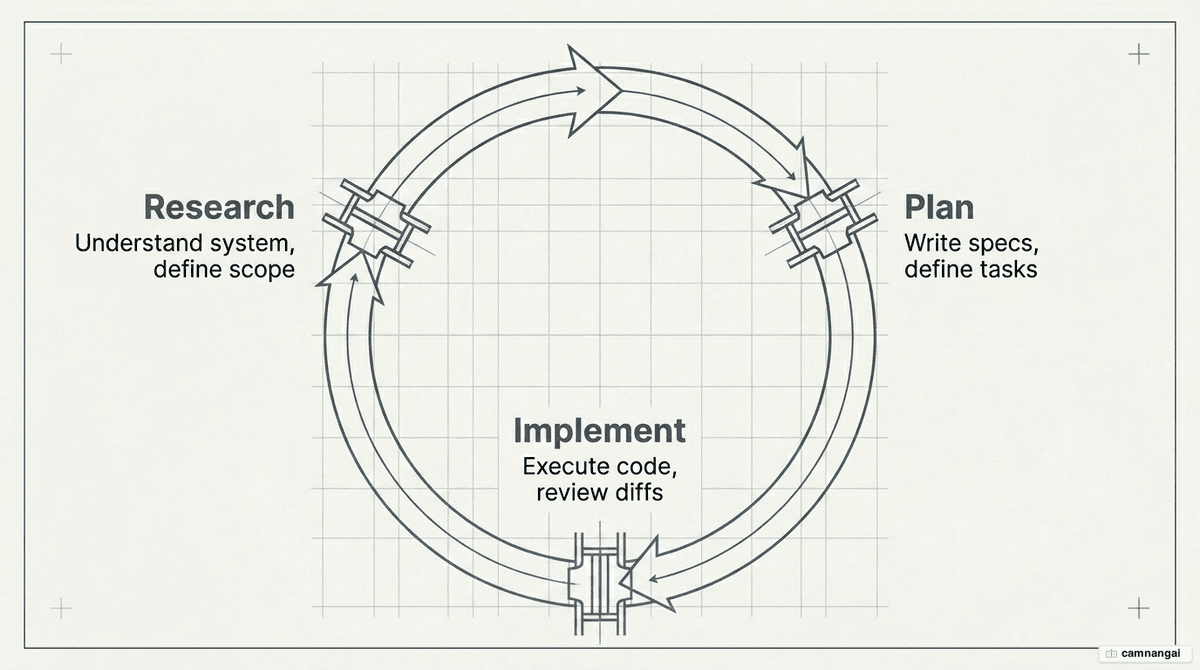
- Research (Ask Mode): Use a tool strictly in "Ask Mode"—where it can read files and chat but cannot write code. This forces you to understand the system and identify paradigms before a single line changes.
- Planning: Write a design doc or task breakdown. The agent should restate the plan to ensure its internal model matches yours.
- Implementation: The agent executes the plan in isolated worktrees or sessions, keeping context "Fresh and Condensed."
Example: Repository Context (agents.md and skills.md)
Mature repos now include structured Markdown files to guide agents.
agents.md (Global rules)
# Repository Rules
- Use functional TypeScript; no classes.
- Error handling must use the Result pattern.
- Every PR requires a corresponding integration test in /tests/integration.
skills.md (Reusable playbooks)
# Skill: Generate-Changelog
1. Read all commits since the last tag.
2. Filter out 'chore' and 'refactor' types.
3. Format output as Markdown for /docs/changelogs.
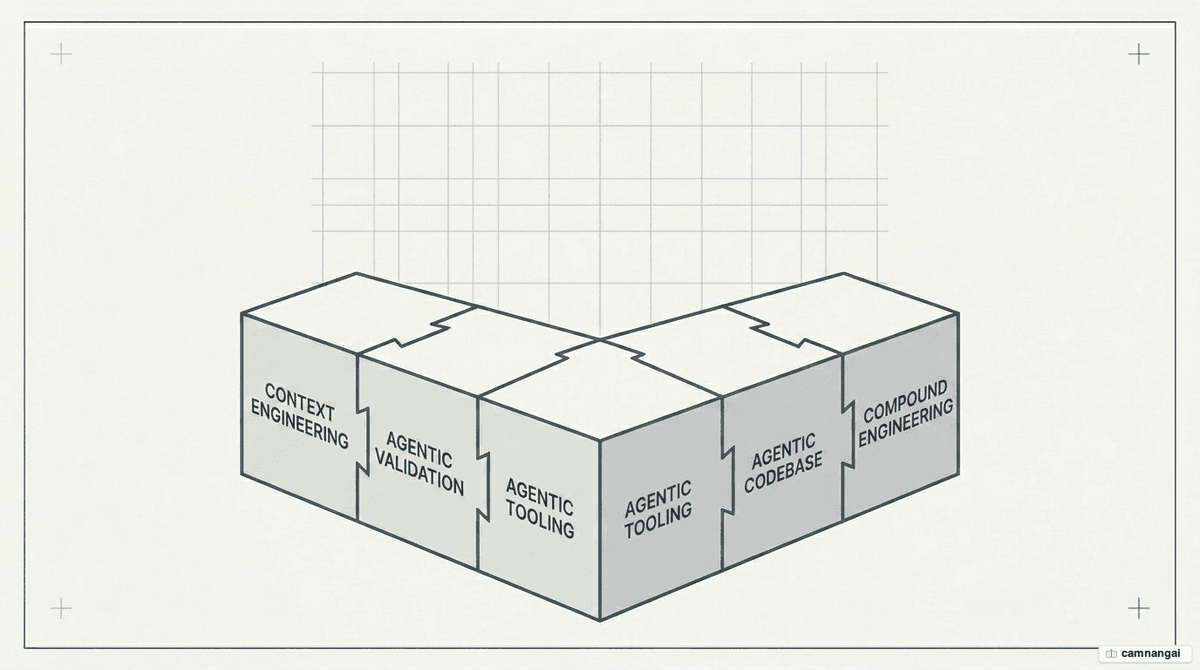
The disciplines that decide success or failure
To scale, you must master three pillars of the agentic stack:
Context Engineering
Context is best served "Fresh and Condensed." Models are probabilistic; as the context window fills past 50% (the "Dumb Zone"), the statistical noise increases, and the model becomes "stupid." Avoid "context poisoning" by starting new sessions once a path goes off the rails. Use MCP (Model Context Protocol) servers to pull in only the specific documentation or database schemas needed for the current step.
Agentic Validation
Testing is the backbone, not a checkbox. In an agentic loop, the agent is given the tools to run its own test suite. It iterates autonomously until the tests pass. This "agentic validation loop" is how you turn an unreliable LLM into a reliable production system.
Agentic Codebases (Harness Engineering)
We are now "optimizing the codebase for the AI, not just the human." This is "Harness Engineering." If a domain rule or architectural decision isn't encoded in the repo (via Markdown or code), it doesn't exist for the agent. Clean your repo: remove dead code and competing patterns (e.g., two different migration styles) that confuse the agent's probabilistic output.
Where engineers should start
- Get Reps: Use integrated tools like Cursor, Claude Code, or Kilo to understand where the model thrives and where it hallucinates.
- Portable Workflows: Don't get locked into a single UI. Build a discipline based on structured phases, reusable commands, and
agents.mdfiles that work across any IDE or CI pipeline. - Implement the Loop: For your next feature, use "Ask Mode" for 15 minutes of research, write a 1-page plan, and only then let the agent touch the files.
FAQ
Is agentic engineering just better prompting? No. Prompting is about input; agentic engineering is about system design. It involves building loops where agents use tools, evaluate their own output via tests, and refine their work autonomously under your orchestration.
Does more context always help the AI? No. Excessive context leads to the "dumb zone." Quality degrades past 50% saturation. Effective context engineering is about being selective—providing the exact right "fresh and condensed" data for the current task.
Will this cause skill atrophy for junior engineers? Yes, if they use AI as a crutch. The risk is a generation that can generate code but cannot debug or reason about it. Juniors must use AI to learn patterns, not just ship features they don't understand.
What is "Ask Mode"? A tool configuration that allows the agent to read and analyze the codebase but prevents it from writing or modifying files. It is the essential guardrail for the Research phase of the loop.
References
- Agentic Engineering: Working With AI, Not Just Using It — Brendan O'Leary
- What is Agentic AI Engineering (Meta Staff Engineer Explains)
- My Experience in Agentic Engineering — Codeaholicguy
- Agentic Engineering — Addy Osmani
- What is Agentic Engineering? — Mehul Gupta
- What is Agentic Engineering? — IBM