Grok AI is a conversational assistant built by xAI (now SpaceXAI) and integrated natively into the X platform. Unlike most large language models (LLMs) that run on a static training snapshot, Grok reads the live X data stream directly, so it tracks breaking news and social sentiment that other models cannot see. It is built for software development, real-time information retrieval, and multi-step reasoning, and is currently headlined by the Grok 4.5 flagship.
In February 2026, SpaceX acquired xAI in an all-stock deal and folded the AI division into SpaceXAI. The model keeps a deliberately "unfiltered" personality inspired by The Hitchhiker's Guide to the Galaxy (direct, blunt, and occasionally sarcastic), a design choice that favors an expansive answer rate over the cautious hedging common in other frontier models. You can reach it on grok.com, the X app, iOS/Android apps, or the SpaceXAI API.
How does Grok work?
Grok's compute is anchored by the Colossus cluster in Memphis, Tennessee, which runs hundreds of thousands of NVIDIA GPUs (its Colossus 2 build reaches roughly 550,000 GB200/GB300 GPUs at about 2 GW). Grok 4.5 itself was trained on tens of thousands of NVIDIA GB300 GPUs, paired with aggressive data filtering (deduplication and quality scoring) to keep the training mixture high-signal.
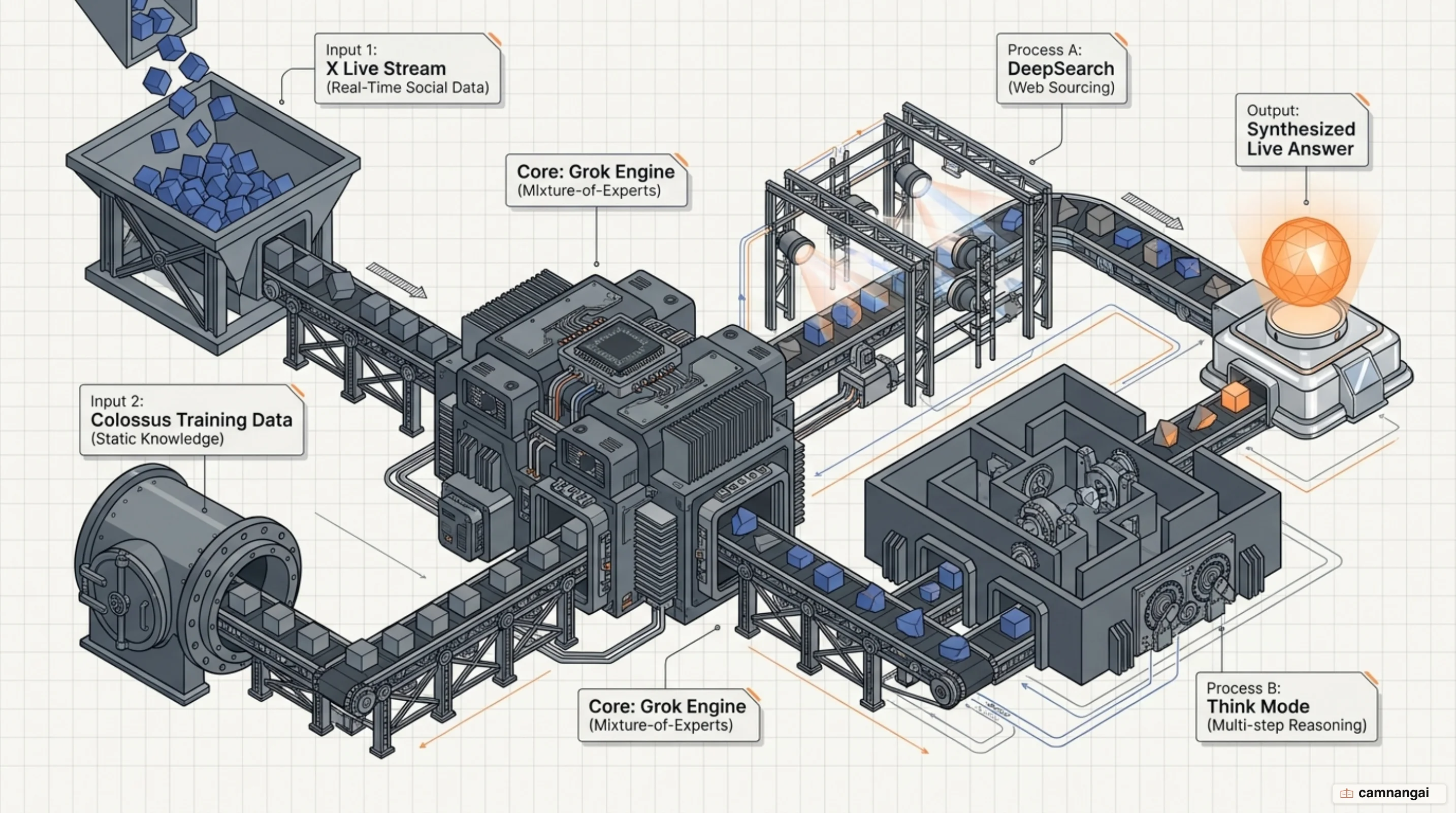
Information retrieval runs through "DeepSearch" and "DeeperSearch." When you submit a query, the system splits it into sub-tasks and runs parallel searches against both the live X post stream and the open web, then synthesizes the results. This is what lets Grok answer from breaking news and social sentiment that a model restricted to a static dataset cannot reach. It is also the part I would not expect a rival to match soon, because the live X stream is not something you can license from someone else.
For harder problems, Grok uses "Think mode," a chain-of-thought (CoT) reasoning path. The model is trained with reinforcement learning (RL) scaled across hundreds of thousands of tasks, teaching it to investigate problems, call external tools, and recover from execution errors — a focus on "per-token intelligence" that pushes it to verify results before answering, especially on multi-step engineering work.
The Grok model lineup
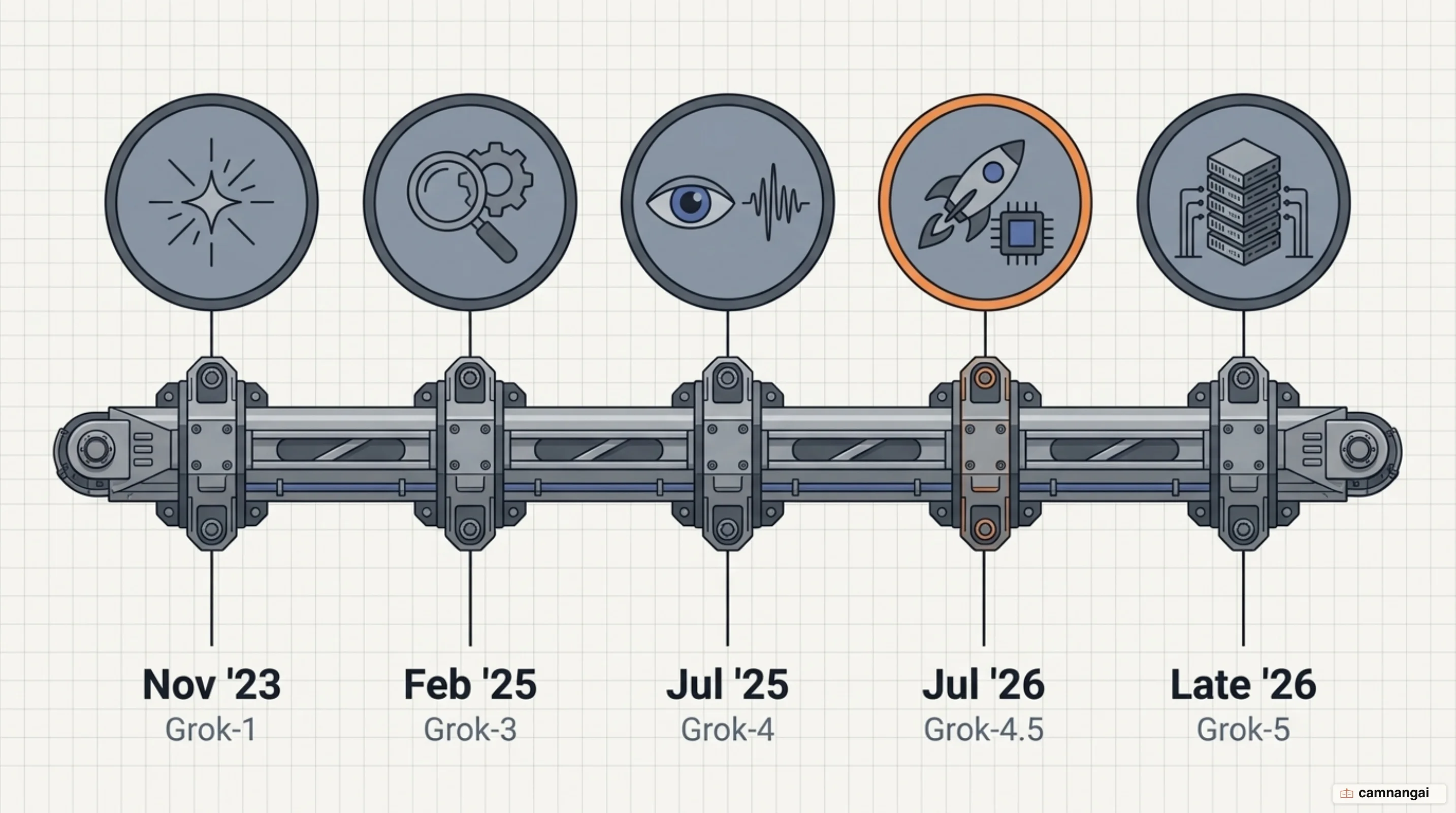
The family has grown from Grok-1, a 314-billion-parameter open-weights release, through Grok-3, the first reasoning-first model, to today's Grok 4 and 4.5. The Grok 4 family expanded context to 256K tokens and integrated RL at pretraining scale, while a Grok 5 training run is now underway on the Colossus 2 cluster.
The Grok 4 family splits into "Fast" and "Heavy" variants. Fast models like Grok 4.1 Fast prioritize low-latency inference (up to 80 tokens/second) with context windows as large as 2M tokens. "Heavy" variants use a multi-agent configuration to push performance on STEM and software-engineering benchmarks. On the AA-Omniscience benchmark from Artificial Analysis, the Grok 4.20 Reasoning variant set a record-low hallucination rate using a 4-agent architecture — though larger models are not automatically more reliable, since broader knowledge tends to come with more confident errors.
The current flagship, Grok 4.5, shipped on July 8, 2026. It is a mixture-of-experts (MoE) model trained jointly with Cursor data to capture developer-agent interactions, following SpaceX's $60 billion acquisition of Anysphere, the company behind Cursor.
Grok's most useful features
Grok's headline capabilities center on coding and office productivity. Through the "Grok Build" agent, you can generate working applications (a Three.js solar-system simulation from a single prompt, for example) and build complex Excel models with multi-sheet formulas and integrated web research. It also generates native shapes in PowerPoint and Word to automate technical diagrams.
Efficiency is a core selling point of the 4.5 architecture. Grok 4.5 averages 15,954 output tokens per SWE Bench Pro task, roughly 4.2× fewer than competing models that need more tokens for similar results, which means faster completion and lower cost by solving problems in fewer steps.
Beyond coding, Grok offers "Projects" and "Workspaces" for persistent, session-based memory, low-latency Voice mode with a real-time Camera mode, and "Companions" — 3D animated characters (such as Ani and Rudy) with persistent memory for personalized interaction. The Companions are the one item on that list I have never found a work use for.
Grok Imagine: image and video
Grok Imagine runs on a dual-engine stack. Still images use a Flux-based engine built for photorealistic generation and multi-turn conversational editing (style transfer, object removal, background swaps) driven by natural-language instructions inside the chat thread rather than manual masks. Flux is strong on prompt adherence and rendering legible text inside graphics.
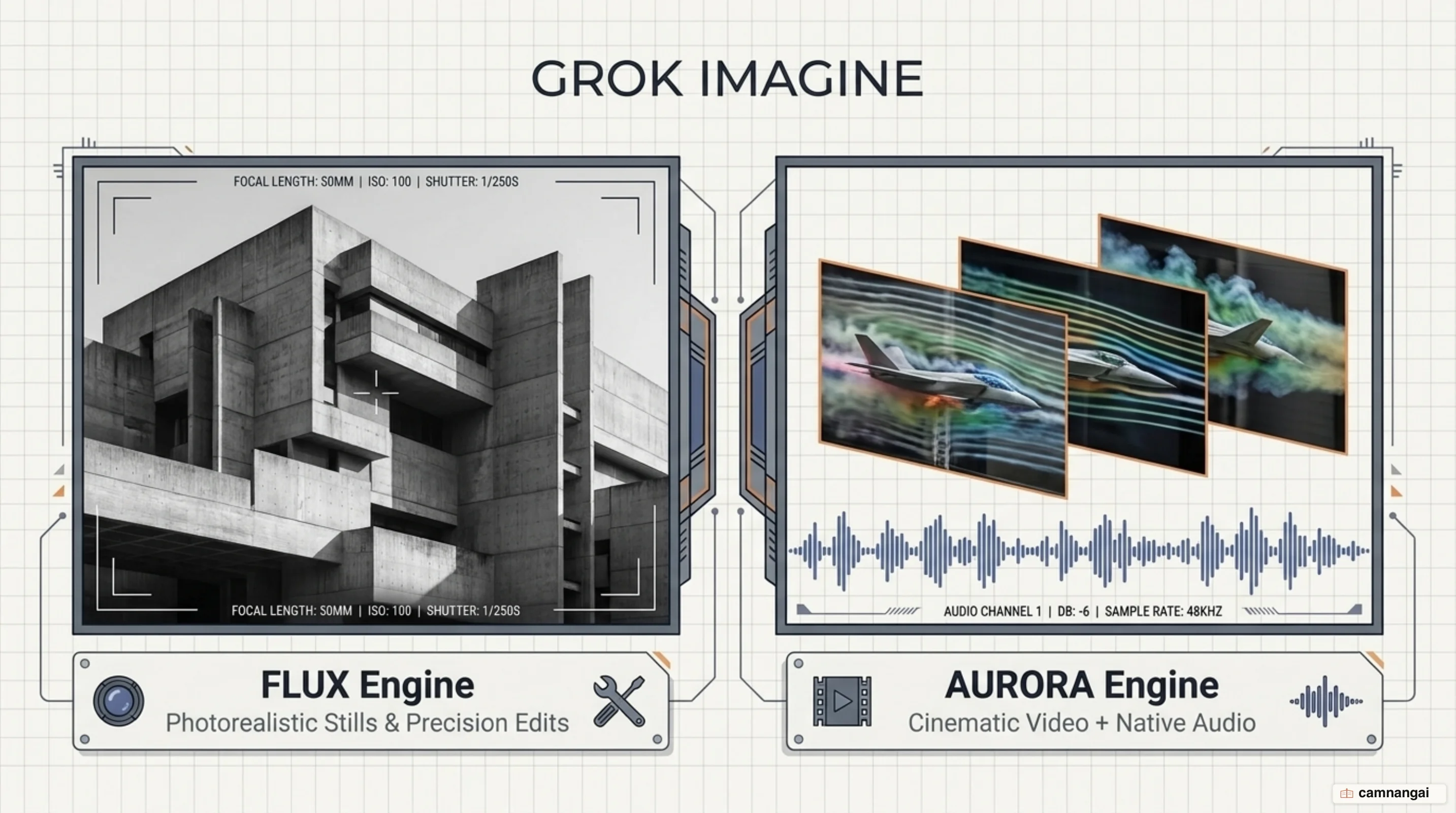
Motion is powered by the "Aurora" autoregressive engine, which produces 15-second cinematic clips with native, synchronized audio generated in the same pass — no post-production dubbing required. Aurora supports both text-to-video and image-to-video, the latter animating a still frame while preserving the original subject, lighting, and composition, and it also handles video-to-video edits. The synchronized audio is the part worth caring about here, because it removes the step where a generated clip and its soundtrack drift apart.
Pricing and how to get started
Access is segmented by prompt volume and model capability. The Free tier gives roughly 10 prompts every 2 hours with basic Grok 4 access and Aurora image generation. SuperGrok ($30/mo) unlocks Grok 4.5 and memory features; SuperGrok Heavy ($300/mo) adds the multi-agent "Heavy" mode and priority queue, which is priced for teams billing by the hour rather than for curiosity. Bundled access also comes through X Premium ($8/mo) and X Premium+ ($40/mo), though those focus on X platform features.
API pricing is usage-based:
| Model | Input (per M tokens) | Output (per M tokens) |
|---|---|---|
| Grok 4.5 | $2.00 | $6.00 |
| Grok 4 Fast | $0.20 | $0.50 |
| Grok 4.20 Reasoning | $2.00 | $6.00 |
To get started: sign in at grok.com or the SpaceXAI console with an X account, pick a tier (or generate an API key for programmatic access), and start prompting or upload a file to the chat.
When is Grok the right choice?
Grok is the strongest pick when your work needs real-time social sentiment, fast coding iteration (at 80 tokens/second), or large-context document processing through its 2M-token window. Its live X integration is a genuine data advantage for tracking events and market shifts as they happen.
What it should not be is your sole citation oracle. A Columbia Journalism Review study found that Grok-3 answered 94% of source-attribution queries incorrectly — so for any task where citation accuracy matters, use Grok to generate signal and ideas, then verify with a second model such as Claude or Perplexity.
References
- Introducing Grok 4.5 — xAI
- SpaceXAI launches Grok 4.5 — Reuters
- xAI Grok: What It Is and How to Use It in 2026 — Voiceflow
- Grok AI: What It Is, How It Works and What's New — CodeForGeek
- Introducing Grok 4.5 — Cursor
- Grok by xAI: Models, Features and Pricing — Suprmind
- Grok Pricing 2026 — FelloAI
- Grok Imagine: Image & Video Generation Guide — AtlasCloud
- AI Search Has a Citation Problem — Columbia Journalism Review
- AA-Omniscience: Knowledge and Hallucination Benchmark — Artificial Analysis