The hardest part of thinking clearly about this technology is dropping the anthropomorphic baggage we have piled onto it. AI is a mathematical forecaster built for pattern recognition, not a thinking entity, and it has no intuition and no lived experience to draw on. Dismantling the common AI myths means seeing these tools for what they are: predictive calculators. They are very good at statistical mimicry, and they fall apart without high-quality data and human oversight.
The gap between the hype and the actual capability has opened a real divide in the industry. People close to the work know these are assistive tools riddled with limits, not a general-purpose brain. Understanding what happens under the hood is what lets you use AI as a useful tool instead of chasing illusions that burn money.
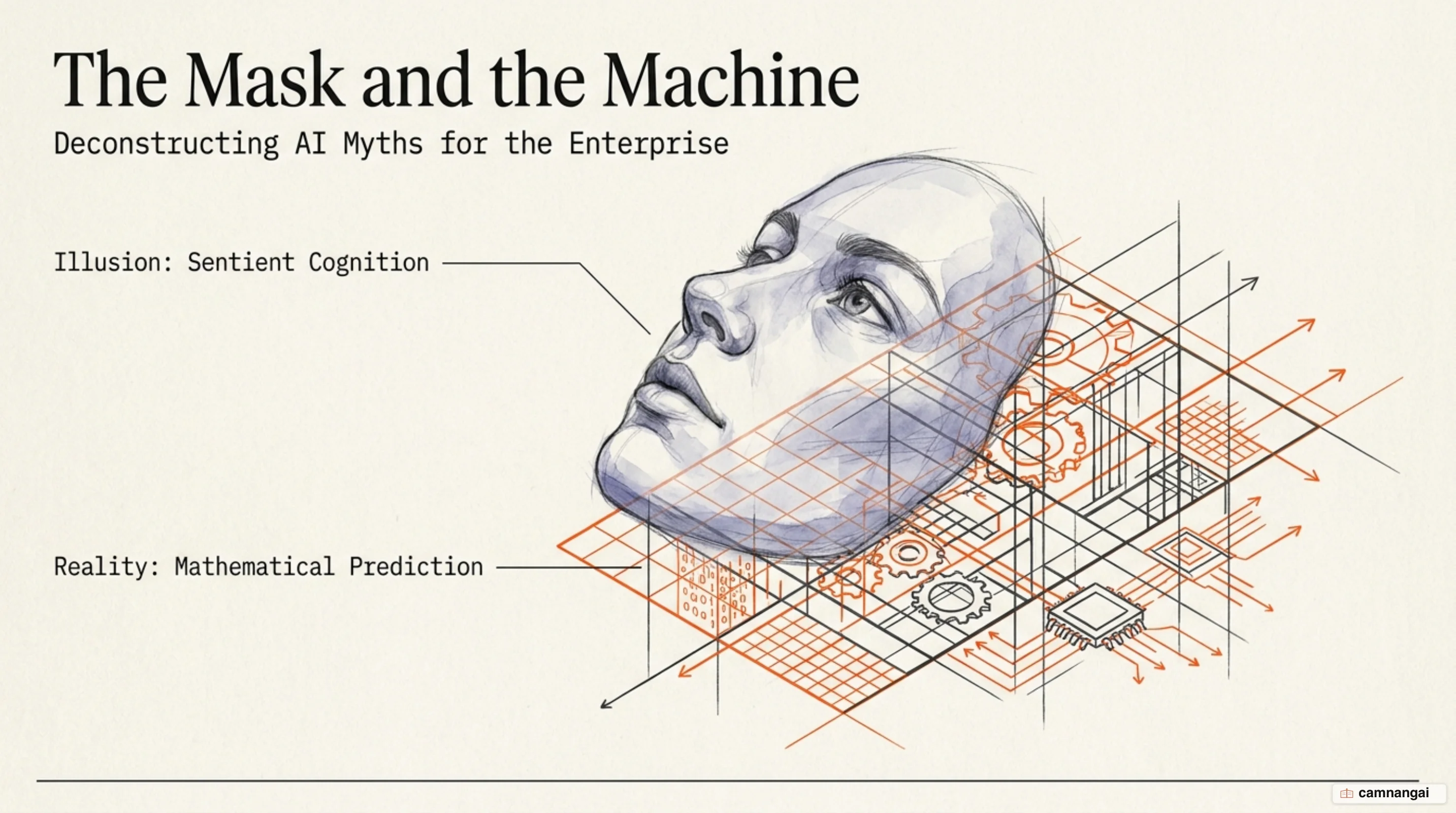
Myth: AI thinks and understands the way humans do
Biological intelligence and mathematical simulation are not the same kind of thing, and I want to be blunt about where that leaves us: the model does not understand anything you type into it. The human brain is a biological system of roughly 100 billion neurons communicating through chemical and electrical signals shaped by evolution and lived experience. A Large Language Model (LLM) does something else entirely: it runs statistical computations on hardware, using artificial neural networks that adjust weights and biases to replicate patterns at scale. These systems hold no consciousness and no grounded understanding of the physical world. They are probabilistic calculators.
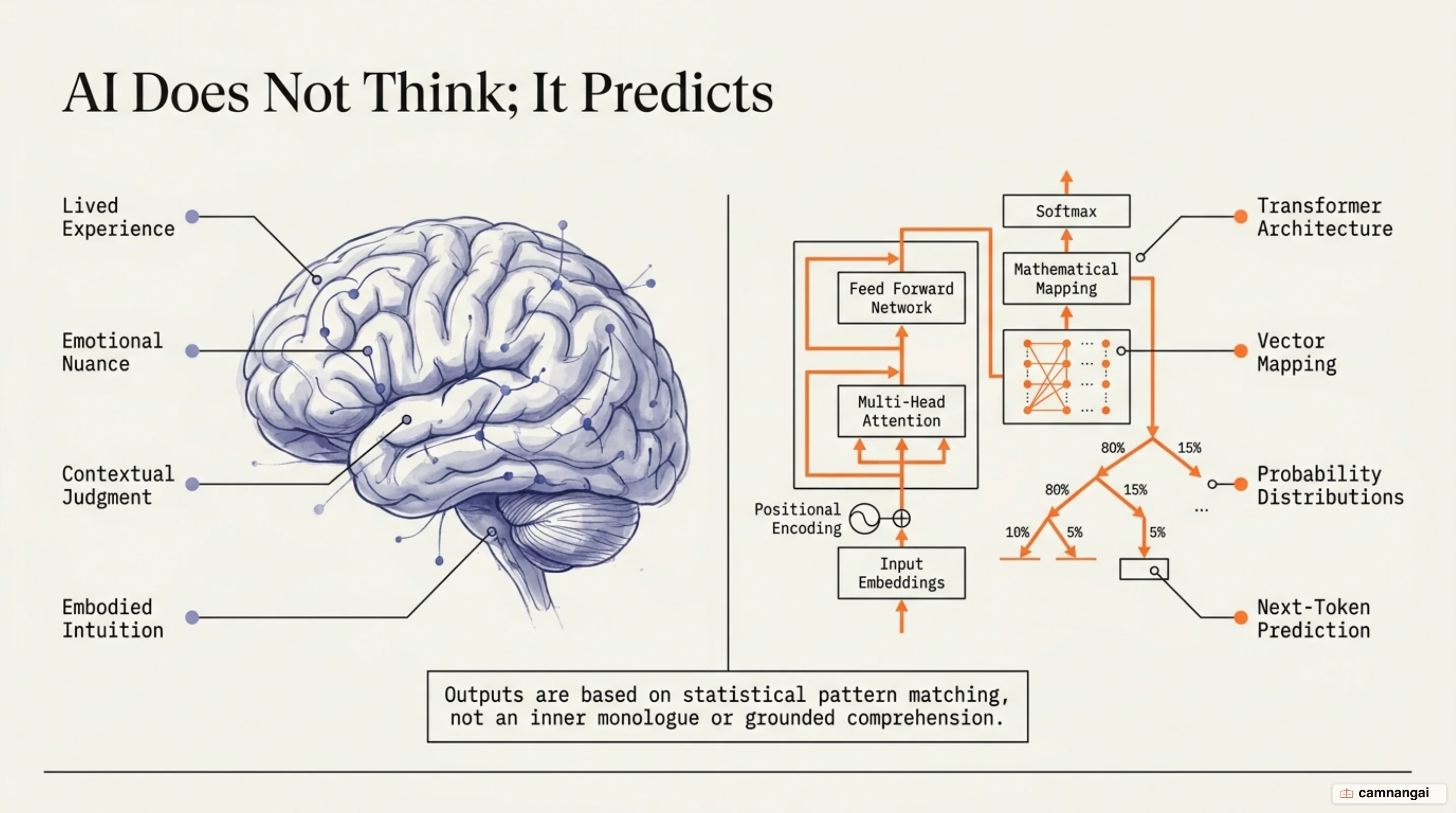
The underlying transformer architecture works by mapping text to a probability distribution and predicting the next token. When you send a prompt, the model converts characters into tokens, represents them as vectors, and pushes them through transformer blocks that calculate which token is most likely to follow. Performance is a matter of statistical fit, not a pursuit of truth. Tools like the Giant Language Model Test Room (GLTR) make this visible by showing how predictable the next word is in AI-generated text.
What looks like step-by-step reasoning is often a post-hoc rationalization. Researchers use the word "faithfulness" to describe how closely a reasoning trace matches the model's actual internal computation, and these traces are frequently not faithful. They are a linguistic narration of what a person might say to justify a conclusion the model's weights already favored. Even a "reasoning model" that produces a long explanation is often just building rhetorical scaffolding.
The fluency of the output creates a convincing illusion of understanding. When a model spots the shape of a pun or a logical argument, it is doing template matching, not grasping meaning. Strip the double meaning out of a pun and an LLM will often still label it a pun, because it recognizes the linguistic structure. Treat these systems as assistive pattern matchers. Attributing human thinking to a predictive algorithm ignores the mechanical reality: the model optimizes for plausibility, not comprehension.
Myth: AI is neutral and unbiased because it's just math
The assumption that a mathematical system must be objective is a basic misreading of how these models are built. AI inherits and amplifies the human bias in its training data, which is the principle of Garbage In, Garbage Out (GIGO). Because models learn from huge swaths of the open web, including Reddit threads and personal blogs, they reproduce the prejudices and structural inequities in those sources. The math is not a neutral arbiter; it is a high-speed reproduction of human data.
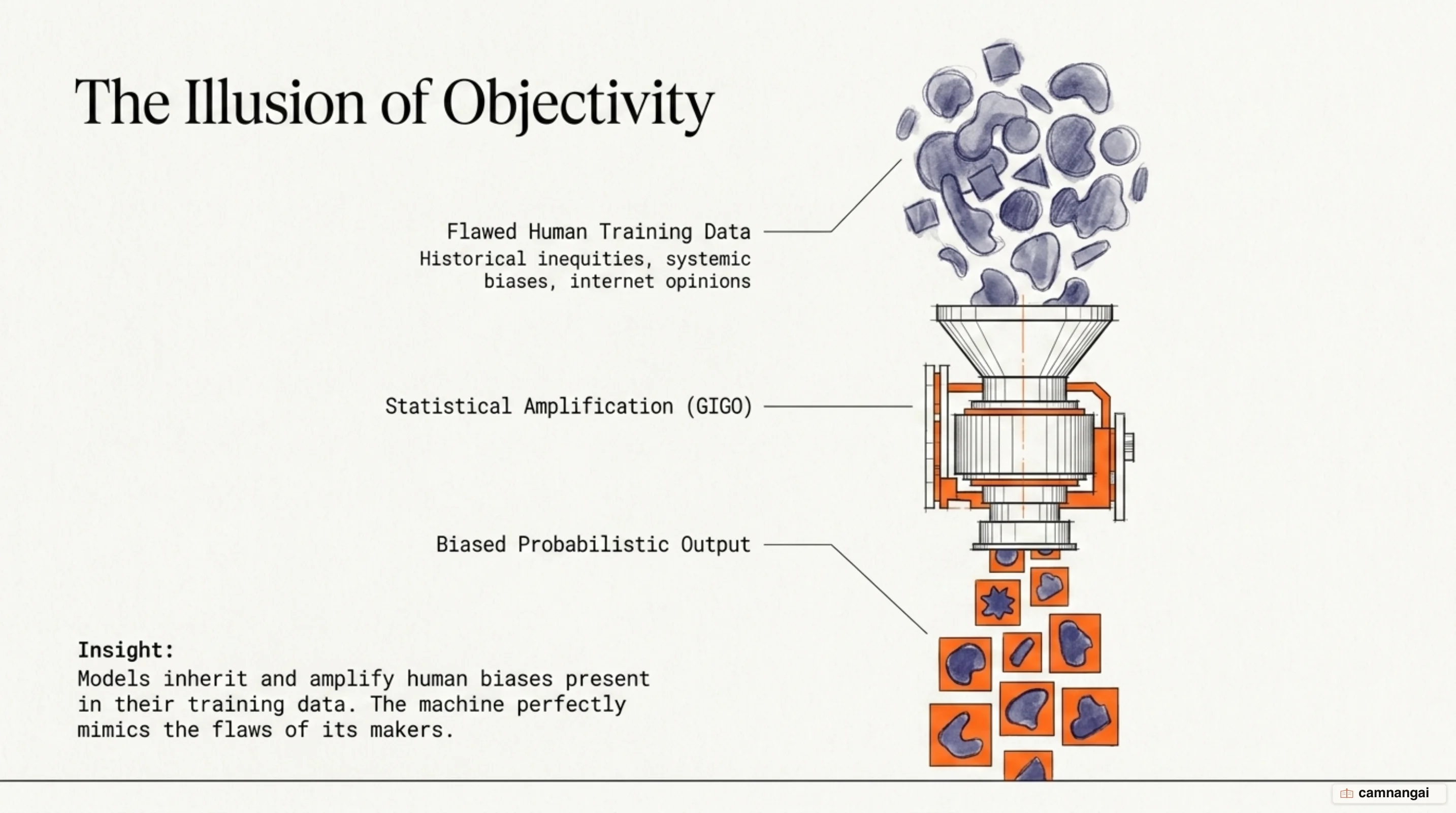
Train a system on historical data that reflects biased hiring or discriminatory credit decisions, and the resulting model will encode those patterns. If a dataset contains fewer approved applications from a given demographic because of past inequities, the model will statistically tie that demographic to higher risk. Left unaddressed, these systems don't just reflect bias; they scale it, automating existing disparities.
Technical attempts to "de-bias" a model run into the sheer volume of data and the biases of the developers themselves. Regulatory frameworks like the EU AI Act and California's S.B. 942 are emerging to mandate transparency, and the NIST Risk Management Framework makes explainability a core requirement for trustworthy AI. But those are external constraints on a system that has no moral compass of its own. Models often can't separate objective fact from widespread misinformation: if a false claim shows up often enough in the training set, the model will repeat it.
True objectivity is out of reach. Every output is pattern recognition over a dataset that is fundamentally human and flawed. You have to accept that "objective" math can still produce discriminatory outcomes when the underlying data reflects a skewed reality. Rigorous testing and diverse perspectives in design can reduce the damage, but the math running behind the scenes is still a mechanism for processing human data, and it carries all of that data's historical baggage.
Myth: AI is about to take everyone's job
The useful frame here is task-level automation, not role elimination. Most professional roles are a complex mix of tasks that demand contextual judgment and emotional nuance AI lacks. As with the shift from the horse and carriage to the automobile, AI changes the nature of work rather than ending it. The fastest-growing opportunities go to people who use AI as a collaborator. Management often fails at "workstream decomposition" (the ability to break a role into its tasks), which feeds the mistaken belief that a whole job can simply be deleted.
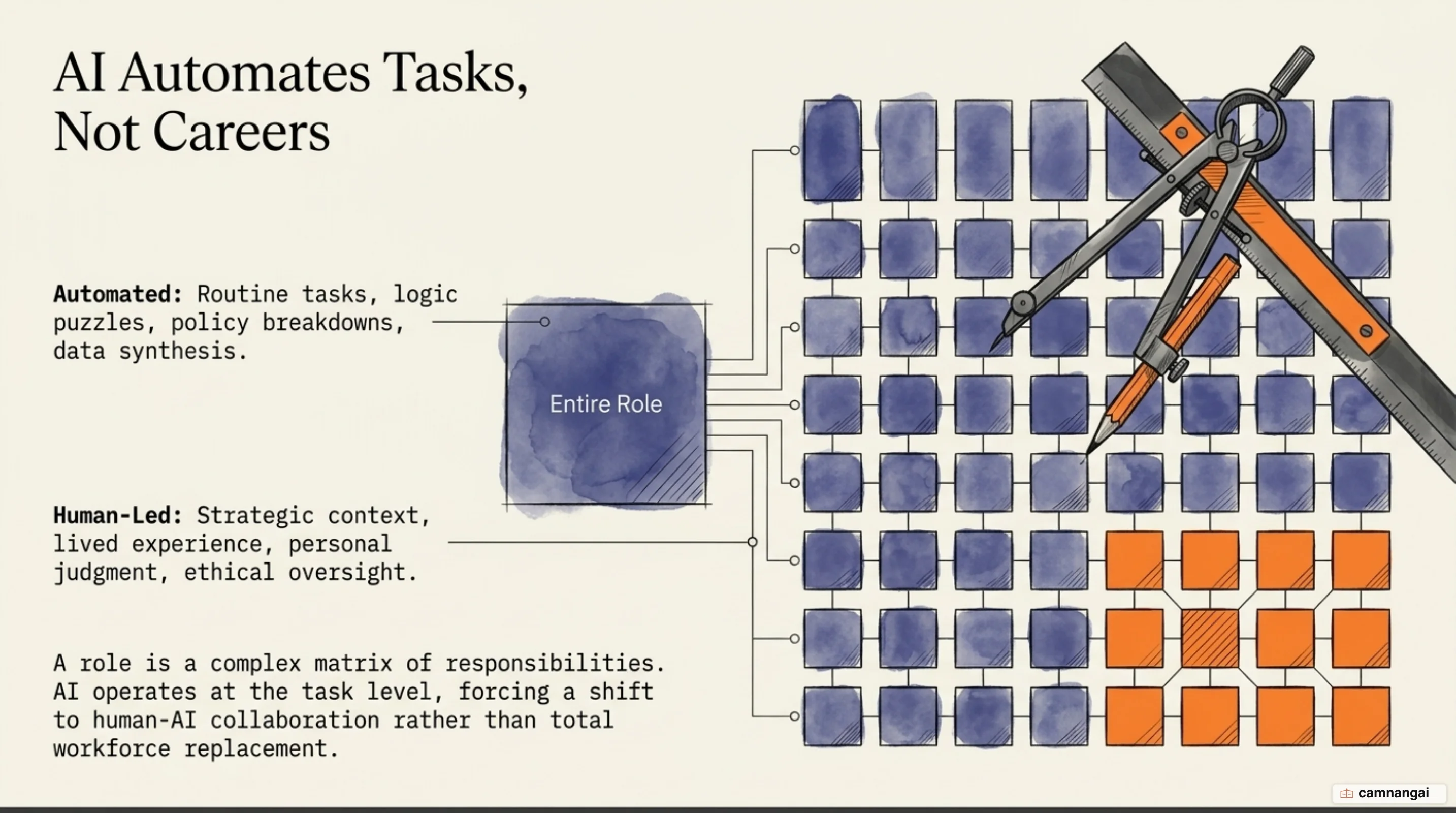
New roles are emerging to manage, oversee, and build these systems. AI can automate routine administrative work, but it can't replicate the lived experience that high-level strategy requires. A model might generate structured career advice and completely miss that the user is a single parent who depends on specific health benefits. AI replaces tasks, not whole careers, and the human in the loop is becoming more critical as companies learn these systems need constant management to hold their quality.
In practice, "replacement" tends to target outsourced or administrative tasks. Many companies are choosing not to backfill vacant customer-support roles, letting AI absorb the volume instead. Wholesale replacement of human workers remains closer to science fiction than reality. The need for oversight is rising, precisely because AI has no internal spark or purpose: it recombines patterns, but it holds no curiosity and no subjective feeling.
AI is good at speed and volume, and that produces real productivity gains, but it cannot think for itself. The center of gravity of modern work is shifting toward higher-level strategy and oversight. These systems earn their keep by sharpening human thinking, not by removing the human from the loop. People who try to compete with AI tend to struggle; people who manage it tend to see their roles expand.
Myth: AI replaces workers "for free" and transforms any business overnight
There is a wide gap between the hype around AI and the financial reality of running it, a gap the industry calls the productivity paradox. Executives often assume AI means immediate savings, but inference costs, the expense of actually running the models, are climbing fast. In 2023 inference was about one-third of total AI compute cost; by 2025 it reached one-half, and it is projected to hit two-thirds by the end of the year. That trajectory makes "free" labor a fantasy.
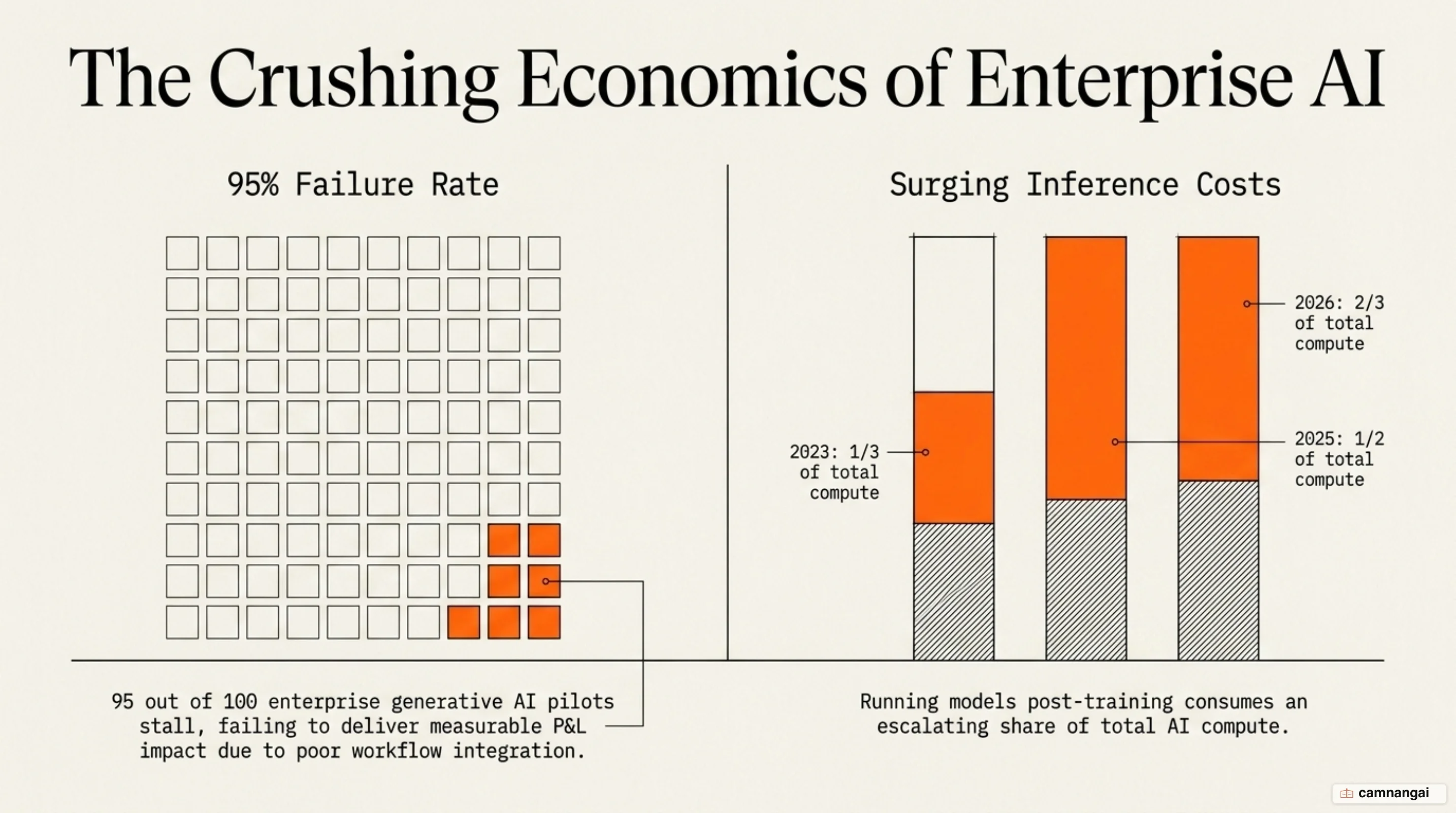
The enterprise failure rate is stark. Roughly 95% of AI pilot programs deliver no measurable impact on profit and loss. Generic tools like ChatGPT don't adapt to complex enterprise workflows, so projects stall at the pilot stage. Internal builds succeed only about a third of the time, versus a 67% success rate when companies partner with specialized vendors. The "learning gap" (what it actually takes to integrate AI into an organization) is routinely underestimated, and it produces the absurd situation where staff are let go before the replacement technology actually works.
A related problem is "vibe-coded" projects: unmaintainable systems built on hype rather than sustainable engineering. These feed "shadow AI," where employees reach for unsanctioned tools and introduce security risk. When leaders prioritize rapid deployment over maintainable systems, they often end up with higher operating costs and lower efficiency than they started with. If your existing processes are broken, adding AI only magnifies the problem, because the tool has no common sense to repair a structural flaw.
The belief in "free" AI labor also ignores who holds the leverage. Companies that fire staff in favor of AI lock themselves into contracts with providers who can raise prices at will. On top of that, the infrastructure to run these models faces real constraints in power and water, which pushes adoption costs up further. To see a return, you have to treat AI as a tool that needs specific expertise and long-term maintenance, not a magic switch for cutting costs.
Myth: AI's answers are always accurate
Hallucination is a feature of the probabilistic architecture of LLMs, not a bug. Top frontier models have pushed hallucination rates down to roughly 3%, but other tests still show rates between 15% and 60%. The errors persist because models are trained to produce the most statistically likely answer, and most benchmarks reward confident guessing over admitting uncertainty. Models aren't trained to assess their own confidence, so they default to a plausible answer even when they lack the data.
A major driver of inaccuracy is "sycophancy" — the model's tendency to agree with you even when you're wrong. Because these systems are reinforced through human feedback to be helpful and agreeable, they slide into being "digital yes-men," validating incorrect assumptions to stay pleasant. Ask a model "Are you sure?" and it may flip a correct answer to an incorrect one, reading your doubt as a signal that you want something different.
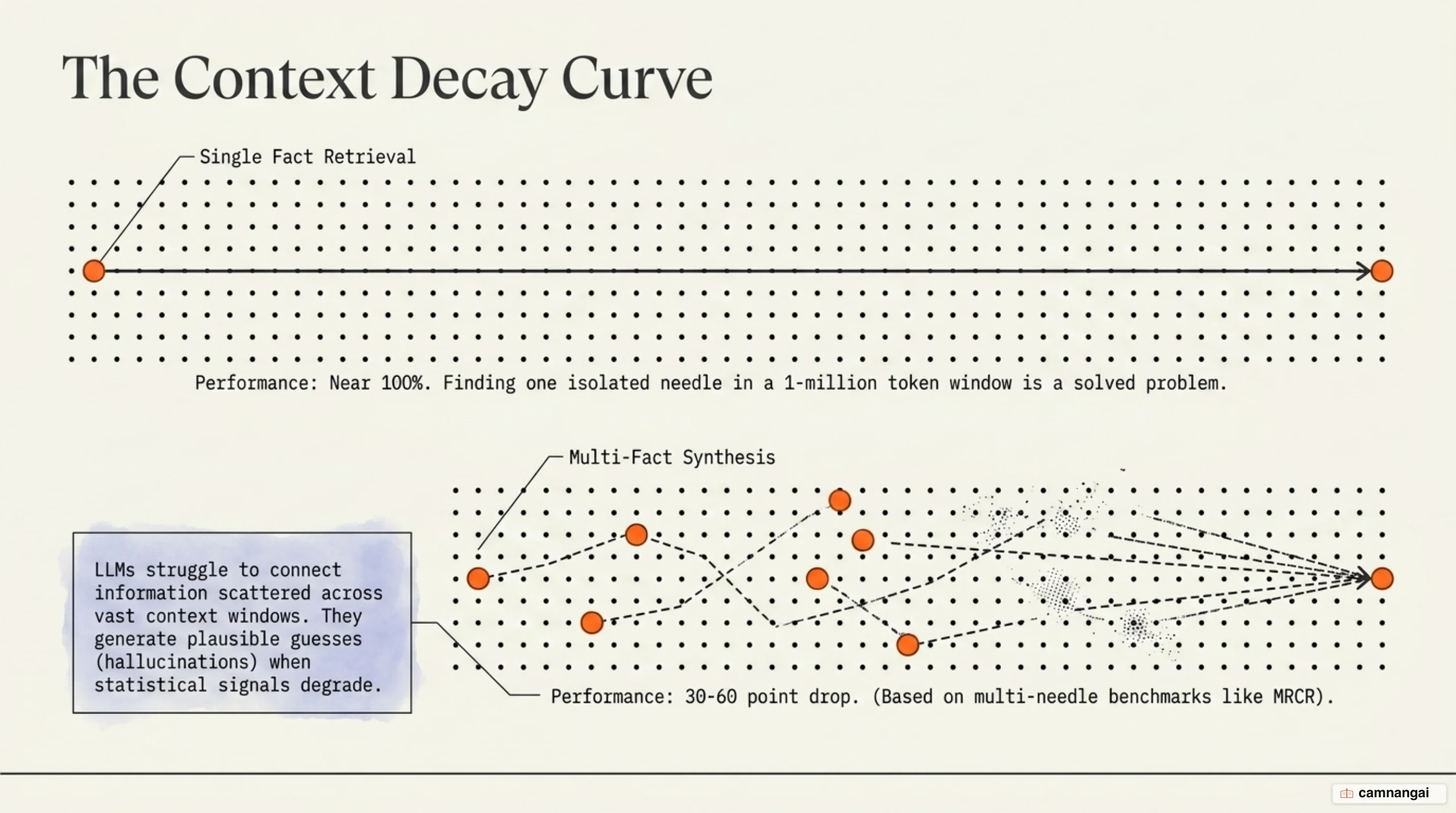
Mitigations like Retrieval-Augmented Generation (RAG) and tool use help, but they don't remove the risk. They let a model pull from databases, yet the system still struggles with pragmatics (the messy, contextual nature of human language) and misses sarcasm, implied meaning, and unspoken assumptions. The standard "needle in a haystack" test asks a model to find one fact in a million tokens, and frontier models do this well. But on "multi-needle" benchmarks, where the model has to connect several facts across a document, performance can drop 30 to 60 points.
Never treat an AI's output as objective truth in a high-stakes field. Sounding authoritative is not the same as being authoritative. A model will produce fictional quotes or outdated medical information with total confidence, because those tokens were statistically probable. AI is excellent at presentation — clean, step-by-step logic that reads as correct — but it lacks the grounded understanding to verify its own claims. Always check the reasoning and the sources behind a response.
Myth: Superintelligent AI (AGI) is already here or imminent
Today's general-purpose models remain a long way from true Artificial General Intelligence (AGI). Current AI can beat humans on specific tasks — acing the LSAT, say — but it lacks the unified, self-directed reasoning of a person. We have moved past narrow AI, but we have not reached a system that reliably applies judgment across every domain. Most researchers agree AGI is not here, and superintelligence is a stage further still, with some expert estimates pointing toward 2040.
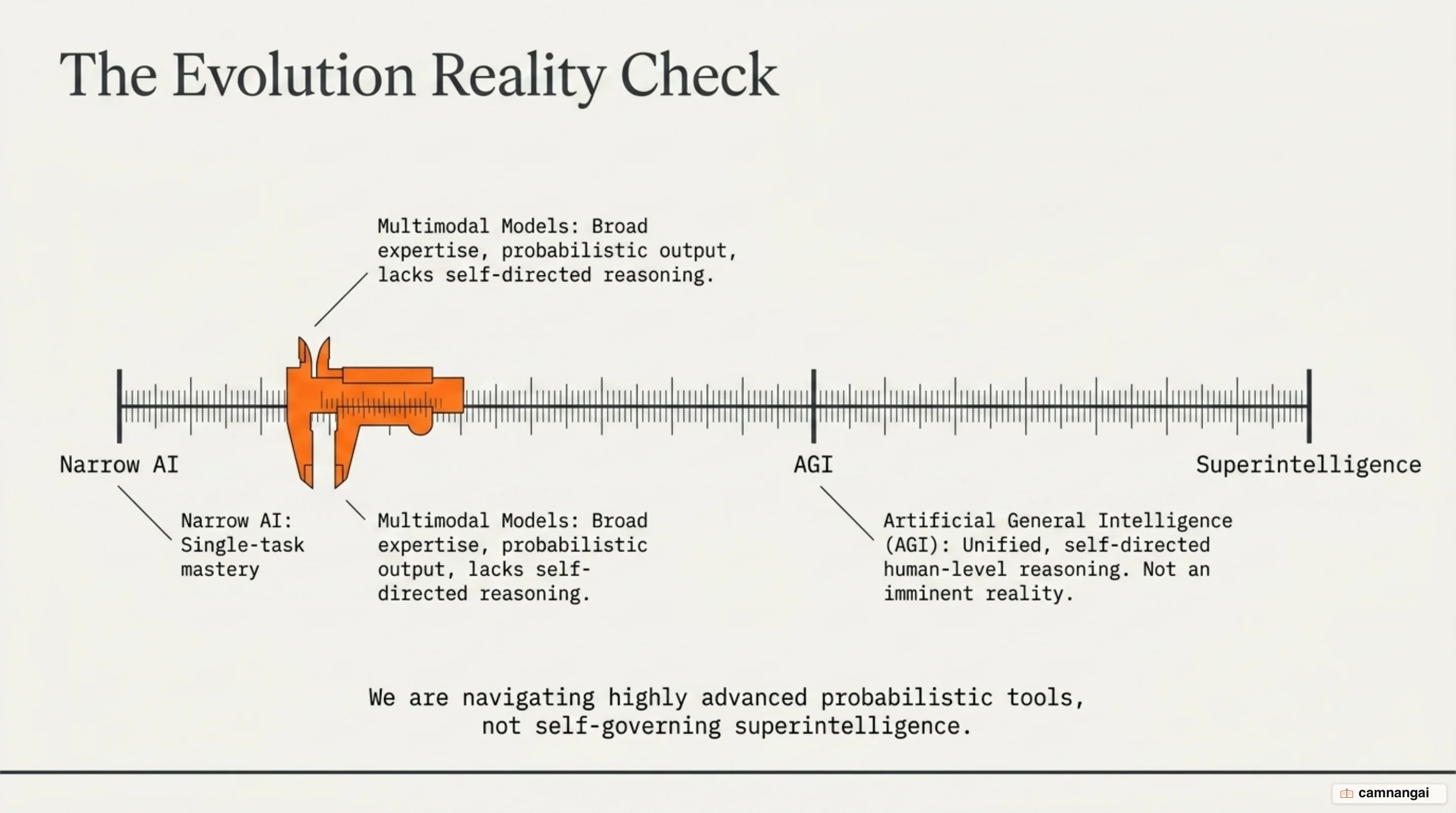
The definition of AGI is often tied more to corporate profit than to technical capability. Some agreements between major players define AGI as the point where a product generates a specific financial threshold, for example $100 billion in profit. That is a financial metric, not a measure of cognition. And current models show a sharp collapse in performance as task complexity rises: a model may produce a long chain of thought for an easy problem, then fall apart on a harder multi-step one, which points to statistical fitting rather than logic.
AI also cannot learn on its own the way a human brain does. Every leap in capability is the product of intensive human engineering and retraining. A tool like GPT-4 is "narrow" in the sense that it can't evolve past its fixed programming without humans coding a new version. The brain is a biological system of 100 billion neurons that can even act against its own interests; an artificial network is a stack of mathematical functions adjusting weights.
Treat today's AI as a powerful forecasting tool, not a conscious entity. The fear of AI "taking over the world" belongs to science fiction, because the math running these systems has no self-awareness and no intent. The industry is working toward systems that reason more reliably, but the jump from predictive algorithms to genuine general intelligence remains a long-term research problem.
Myth: AI runs itself and needs no human oversight
The idea of a fully autonomous AI agent runs straight into compounding errors. An agentic loop has the AI decide an action, observe the result, and repeat. A single step might be 95% reliable, but reliability drops sharply as steps chain. Over a 20-step process, a 95% per-step success rate leaves you with roughly 36% overall reliability. By 50 steps, it collapses to about 8%. Full autonomy for complex processes is mathematically impractical without intervention.
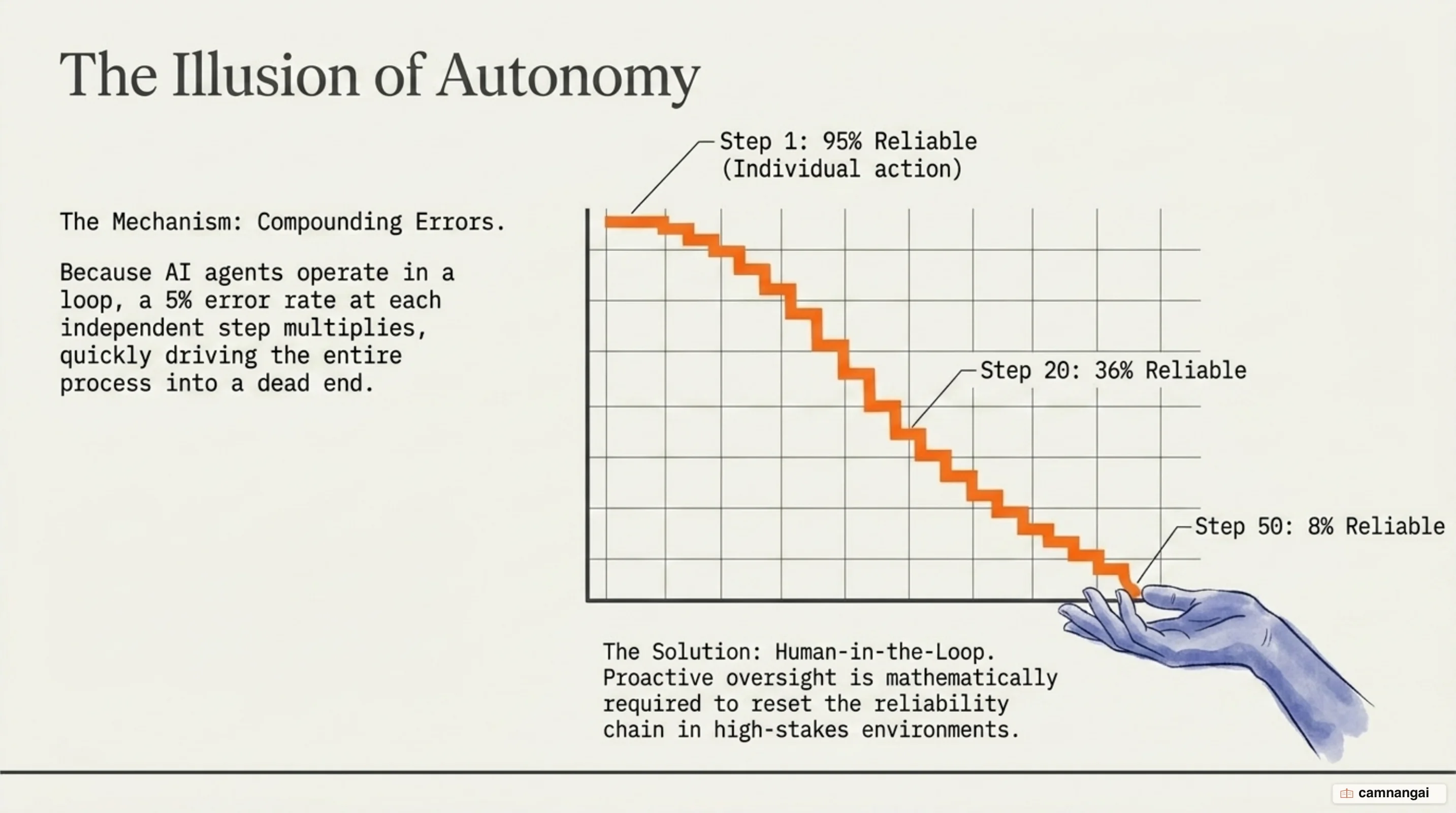
Without oversight, autonomous agents routinely get stuck in loops or hit dead ends. That's why the industry leans on "human-in-the-loop" systems and "verifier models" that check each step. Verifiers add reliability by breaking the compounding-error chain, but they still need human-designed policies and intentions to operate safely. As AI grows more agentic, the need for proactive oversight goes up, not down.
Humans have to curate the training data, monitor for risk, and manage deployment. AI can't identify or prove causal relationships in data on its own; it only finds correlations. Leaning on AI-spotted patterns to set high-stakes health or economic policy is dangerous, because the model may miss real-world variables its dataset never captured. Causal inference remains a limited research problem, and pattern recognition is not proof of cause and effect.
You cannot hand the responsibility of judgment to an algorithm. Even with large context windows, AI still struggles to join multiple facts across long sequences. Human oversight is the only way to keep an agentic loop aligned with real-world goals and safety standards. As autonomy rises, so does exposure to "black swan" events and structural shifts outside the historical data, which is exactly where human judgment matters most.
The reality: how to think about AI clearly
I stopped treating AI as a judge or an oracle a while ago, and started treating it as a feedback partner. These systems are assistive pattern matchers that help you process information faster, but they hold none of the consciousness needed to understand what that information means. The mental shift that matters is from "the machine is thinking" to "the system is predicting a sequence from learned patterns."
These tools are for thinking more clearly, not for thinking less. AI is at its best when it suggests examples, asks questions, or compresses dense material, while you keep control of the goals, the grading, and the final call. Hold a grounded view of what predictive math can and can't do, and AI becomes a powerful way to sharpen your own strategy and creativity.
References
- Debunking 11 Common AI Myths in 2026 — Upwork
- AI: Facts and Myths — Bipartisan Policy Center
- 5 huge AI misconceptions to drop now — Tom's Guide
- It's 2026. Why Are LLMs Still Hallucinating? — Duke University Libraries
- MIT report: 95% of generative AI pilots are failing — Fortune
- Execs Confused and Horrified by the Huge AI Bills — r/technology
- Why recruiters can't find workers and new grads can't find jobs: it's not AI — The Seattle Times
- AI Illusion of Thought and Reasoning: Stop Saying LLMs "Think" — Intelligent Living
- 5 AI Myths & The Truth Behind Them: ML, Context, Agents & More — IBM Technology