If you are watching the labor market for a total system failure or a mass-unemployment crash, you are looking at the wrong data. AI replacing jobs shows up as a structural shift of spending toward automated inference, while total layoffs stay flat. Unemployment holds steady, yet a severe bottleneck is forming at the hiring gate.
The impact sits in hiring patterns rather than dismissals. Firms are quietly automating the entry-level execution layer to skip the cost of training juniors. That has created a sharp split: postings for roles built on repetitive, low-dimensional tasks are drying up, while roles that pair a human with AI on analytical work are in higher demand. The change isn't mass firing — it's a hiring pivot.
Is AI actually replacing jobs right now?
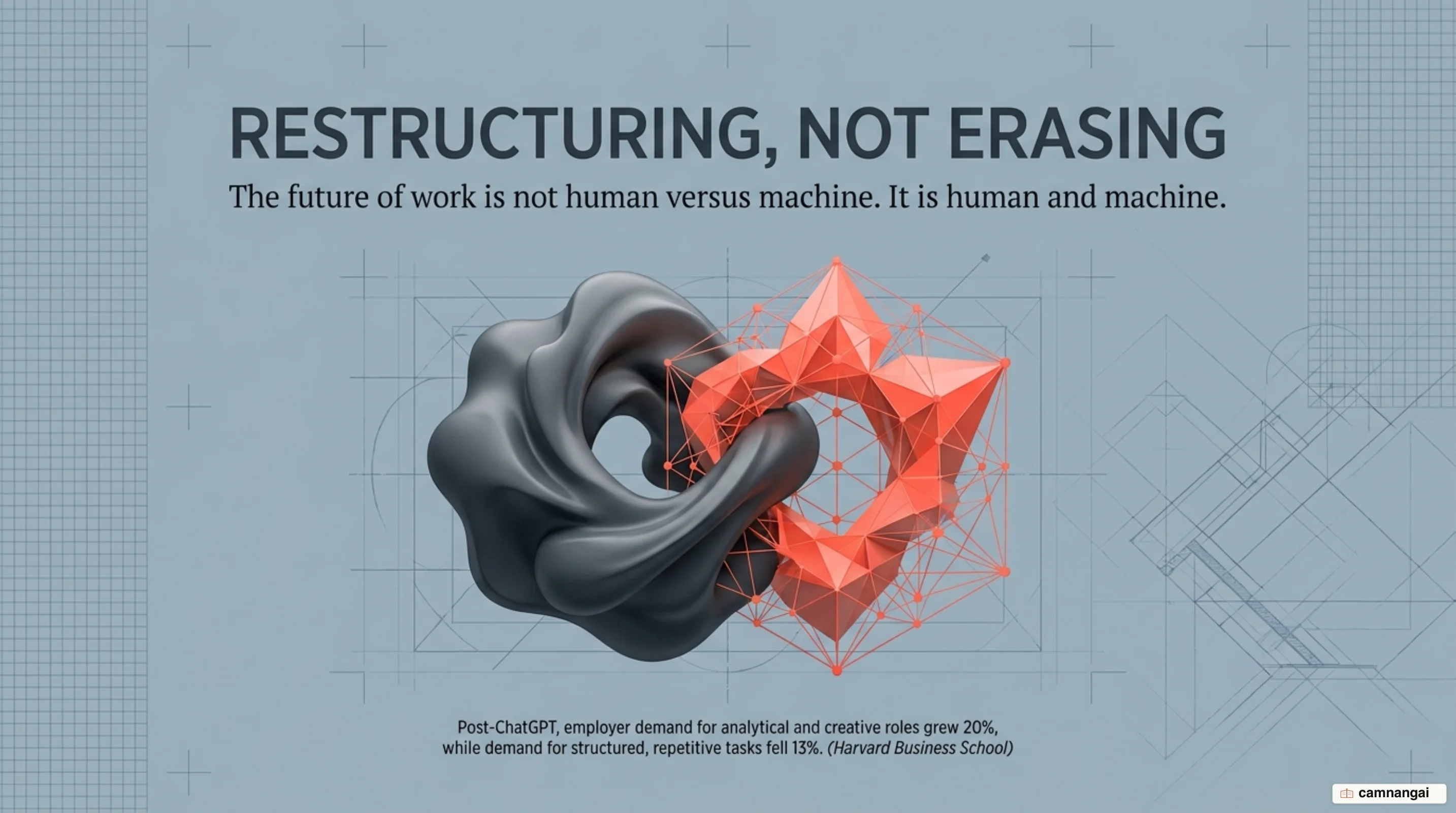
The labor market has split in two. Since ChatGPT launched, job postings for "automation-exposed" roles, the ones built on structured, repetitive tasks, have dropped 13%. Demand for "augmentation-prone" roles, which need analytical and creative synthesis, has grown 20%. Beyond cost-cutting, firms are reshaping roles around human-AI collaboration, which is a slower and far less quotable story than a layoff wave.
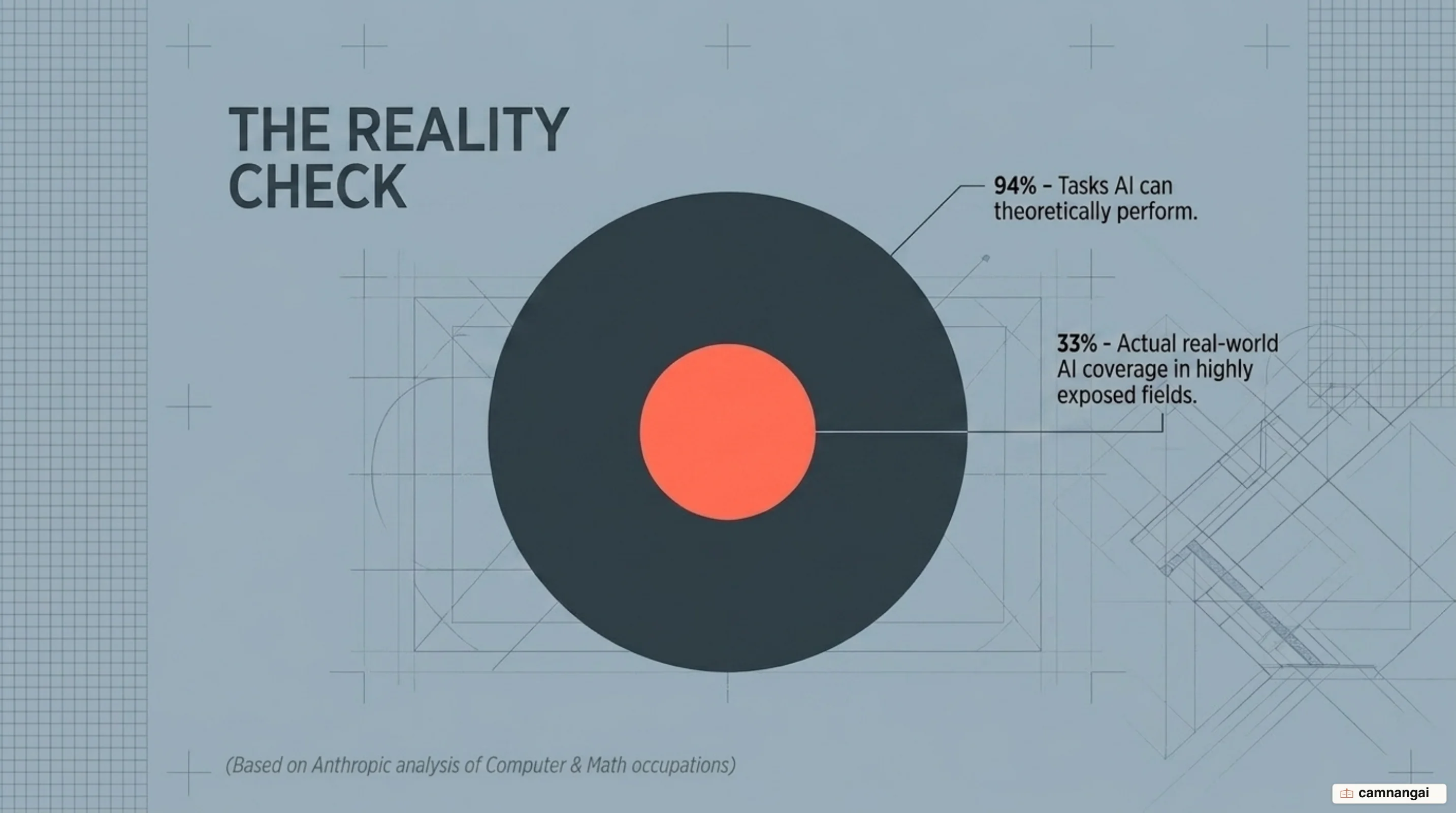
An "observed exposure" measure shows the gap between what AI can theoretically do and what it actually does at work. Large language models (LLMs) theoretically cover 94% of tasks in computer and math occupations, but real professional coverage sits at 33%. That measure counts "fully automated" work more heavily than "augmentative" use, which is why computer programmers show 75% coverage even with high demand. And the exposure is deeply uneven: roughly 30% of the workforce, including mechanics and cooks, has zero coverage, because their physical, context-heavy tasks are still beyond what a model can do. The figure I keep coming back to is that 33%, not the 94%, because the ceiling is not what anyone actually gets at work.
Augmentation or elimination: which work is exposed?
A role's risk comes down to its "dimensionality," which is the number of distinct, interconnected tasks bundled into the job. Low-dimensional jobs, built on one or two repetitive tasks (correspondence clerks, interpreters), are high-risk: automate the single task and the human role is hard to justify. High-dimensional jobs (family physicians, interior designers) are protected, because they lean on social and hands-on skills a model cannot yet copy.
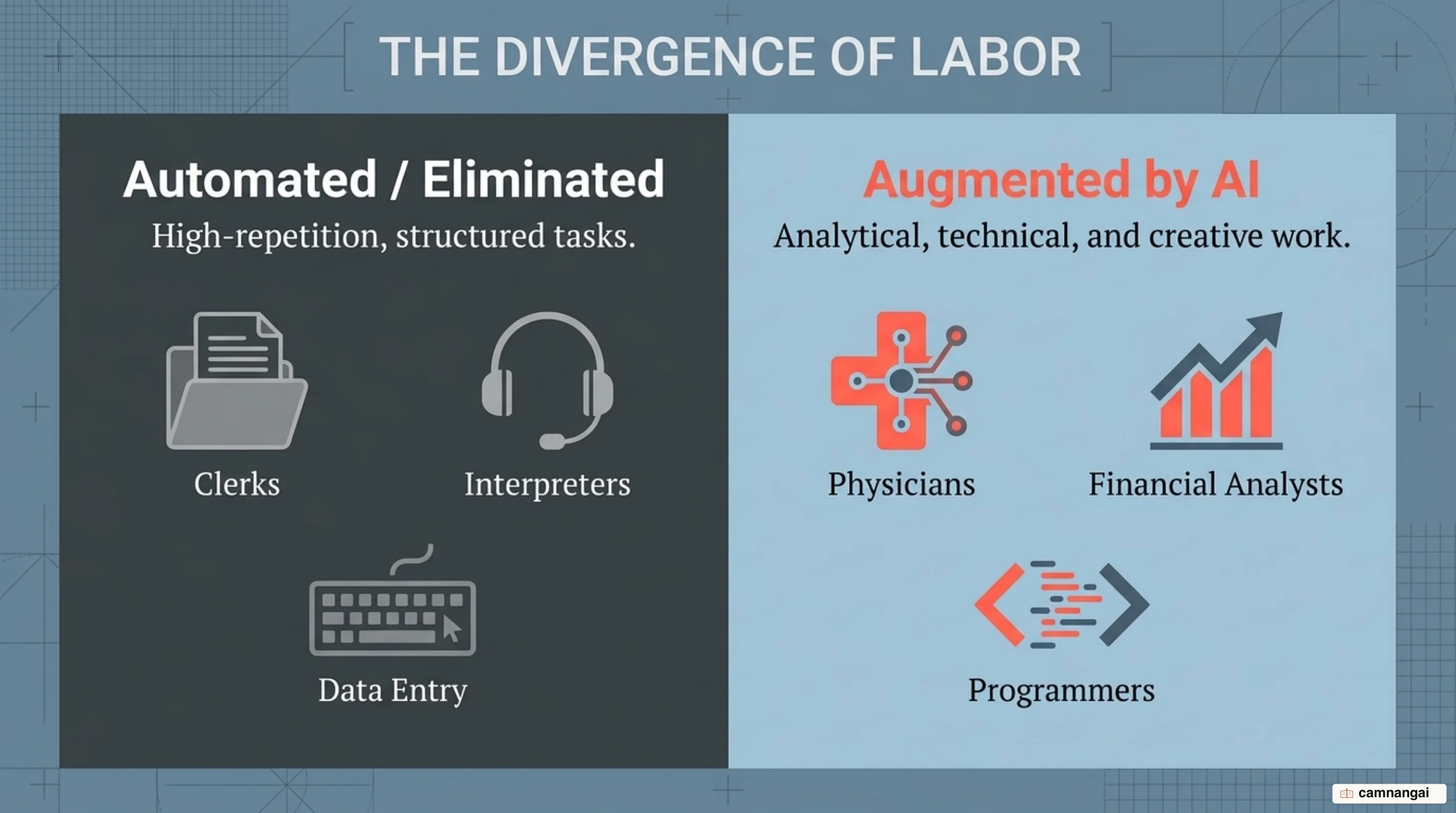
- Most exposed: interpreters, translators, and medical transcriptionists — jobs often treated as a single task in, a result out.
- Most protected: robotics technicians and physicians, who gain from the "focus effect" — AI clears the busywork so the human spends more time on judgment.
Take the management consultant. AI can automate the "meta-work" of data processing and slide formatting, but not the political work, the client conversations, or the accountability for the outcome. Automate one task in a seven-task bundle and the worker's value goes up, because they shift their freed time onto the parts that need judgment.
The entry-level squeeze: are young workers hit first?
A hiring crisis is landing on workers aged 22–27. The job-finding rate for young workers in AI-exposed jobs has dropped 14%. That creates a "lost cohort" problem: by cutting junior hiring to save on execution costs, firms are cutting off their own future senior talent.
Remote work makes the squeeze worse. The cost of training and supervising juniors has spiked, so distance, not just AI, has broken the old apprenticeship model. AI now sits on both sides of the hiring funnel, and the human contact that used to bring juniors up has dropped out of the loop.
Why the fear outruns the numbers
Economic mood stays sour because displacement leaves a lasting "scarring effect." Workers displaced by technology take longer to find new jobs and earn 10% less than their peers a decade later. That insecurity feeds a "vibecession" — the economy looks stable on paper, but the predictable floor under a career has been pulled out.
When the old career path (job to house to retirement) stops feeling reliable, high-risk bets start to look rational. That helps explain why prediction markets and crypto volume surge even as unemployment looks flat. The long-run economy may adjust, but for one person, the displacement can last a lifetime.
What actually protects your career
To protect your career, sort your skills by type:
- Perishable skills: tool-specific know-how (a particular prompt framework, a specific interface) with a half-life under 2.5 years.
- Durable skills: judgment, pattern recognition, and communication, which hold their value for 7.5 years or more.
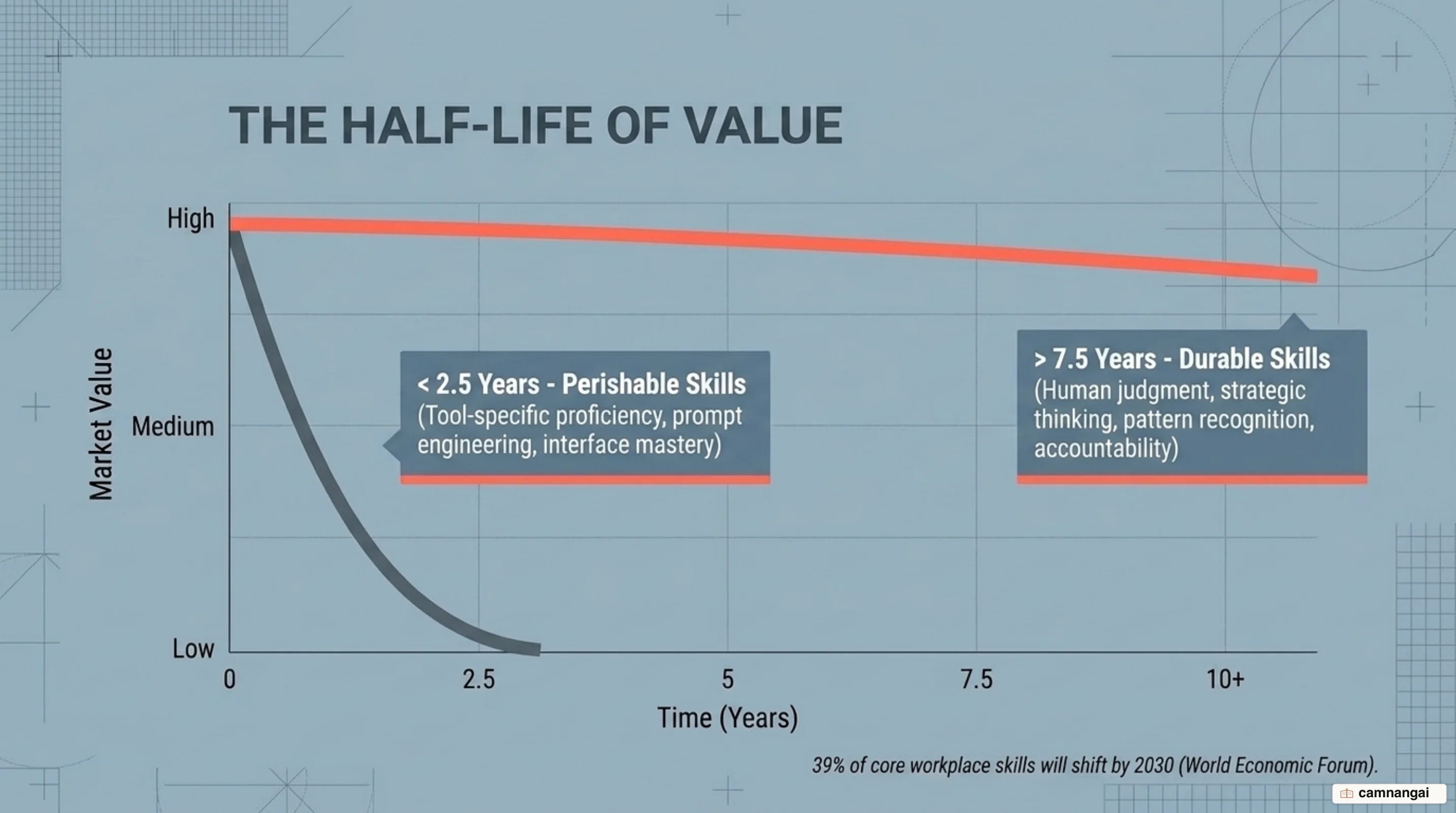
Protection lives in the "relational sector" — the human-heavy, trust-based part of the economy where the person is the value. That means the messy jobs: work that is hard to describe, changes daily, and needs taste and accountability. Those are the tasks that hold up best against automation, and that is the annoying part of the advice, because none of it fits on a certificate.
How to adapt: where to start
Moving into AI leadership takes five kinds of competence:
- AI awareness: keep an accurate mental model of where AI fails.
- Tool proficiency: use the tools hands-on, every day.
- Strategic integration: use AI to pressure-test decisions, not just to execute them.
- Human-AI collaboration: treat AI as a thinking partner and ask it to disagree with you.
- Change leadership: guide a team through the shift.
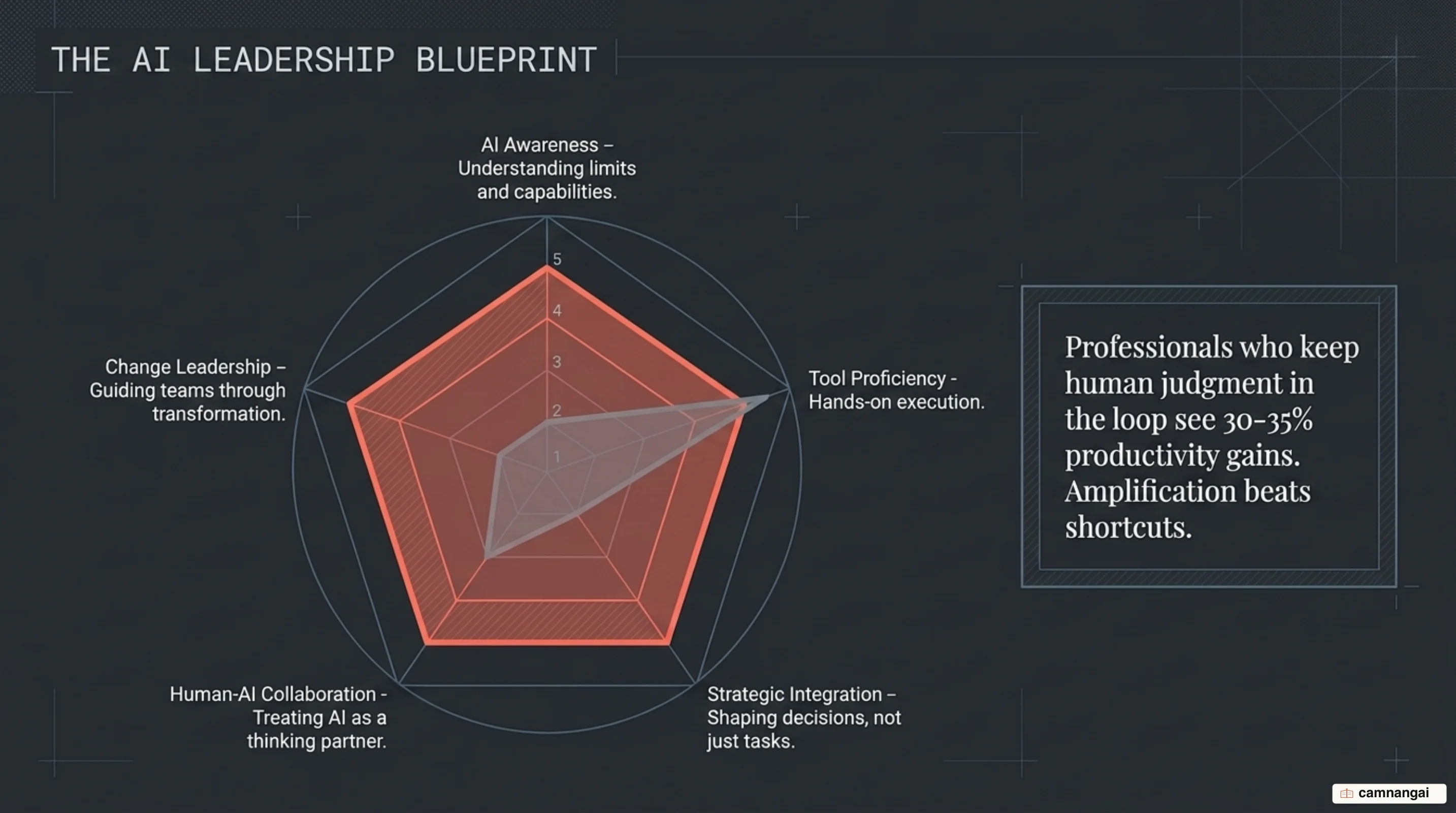
The direct move is to find your weakest of the five and raise it. If you have tool mastery but weak strategic integration, spend your next session asking an LLM to poke holes in your quarterly roadmap instead of having it draft an email.
A few habits compound over time:
- Pick the manager over the company. With training pipelines gutted, your growth depends on direct mentorship.
- Build a living portfolio. Show your judgment and original thinking in public.
- Be AI-native, not AI-proof. Use the tools relentlessly for execution while you strengthen your judgment.
References
- Labor market impacts of AI: A new measure and early evidence — Anthropic
- Enhance or Eliminate? How AI Will Likely Change These Jobs — Harvard Business School
- Is AI Going to Destroy Our Lives or Not? — Kyla Scanlon
- Stop Learning AI Tools, Start Strengthening What AI Can't — Joel Salinas
- The 5 AI Skills That Determine If You're Becoming More Valuable or More Replaceable — Joel Salinas