Tokenmaxxing is the deliberate practice of maximizing AI token consumption across coding agents, chat interfaces, and automated workflows
under the assumption that high token volume equals higher developer productivity and AI-native status. Because tokens represent the fundamental unit of text processed and generated by large language models, software developers began inflating prompt lengths, agent execution loops, and context windows to burn through API allocations as aggressively as possible.
In early 2026, internal leaderboards at major technology firms institutionalized this trend by turning raw API consumption into a gamified corporate status symbol. Engineering management initially celebrated high token throughput as concrete evidence of software delivery velocity and organizational AI readiness.
However, prioritizing raw volume over verified code output rapidly triggered a severe budget and productivity backlash across the tech industry by mid-2026. As corporate AI budgets collapsed and software quality metrics degraded, enterprises were forced to replace blind consumption with strict financial governance and outcome-based engineering metrics.
What Is Tokenmaxxing and Where Did It Come From?
The term borrows the "-maxxing" internet suffix—originally popular in online subcultures like "looksmaxxing"—and applies it to enterprise software delivery. In an AI context, it describes pushing raw token usage as hard as possible, treating compute consumption as its own justification regardless of the underlying business output. Rather than optimizing prompts for speed or cost efficiency, you intentionally maximize input context and output generations to prove how deeply integrated AI tools are in your daily engineering workflow.
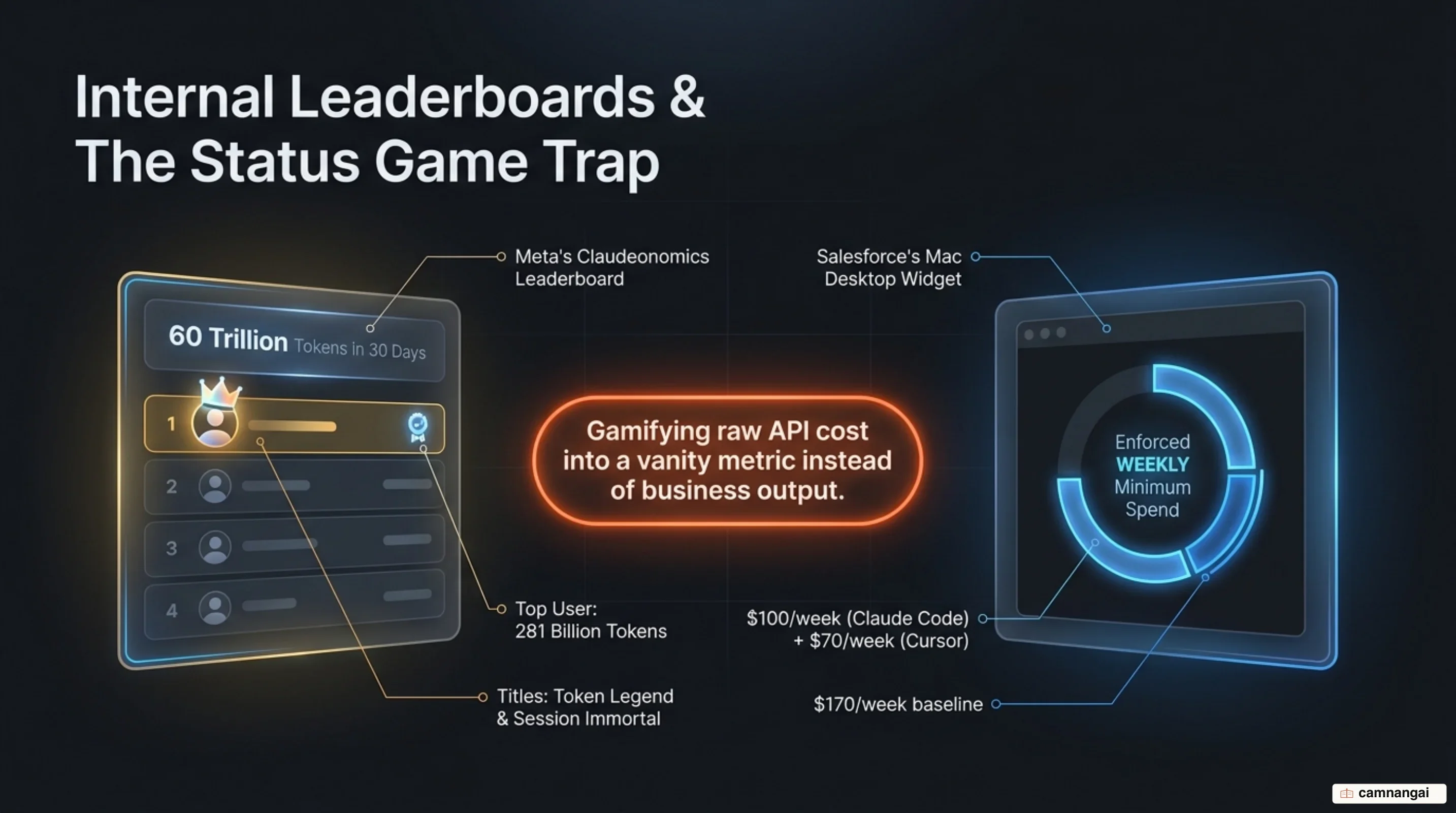
The culture surrounding tokenmaxxing escalated rapidly in early 2026, anchored by Meta's internal "Claudeonomics" dashboard deployed across its intranet. Built to track AI usage across more than 85,000 employees, the leaderboard ranked the top 250 power users and awarded gamified titles such as "Session Immortal," "Cache Wizard," and "Token Legend." Within a single 30-day window, Meta employees burned through 60 trillion tokens. At standard Anthropic public API rates, this consumption represented a theoretical $900 million bill, which would still exceed $100 million under enterprise volume discounts. The company's top individual user logged 281 billion tokens in one month, while CEO Mark Zuckerberg failed to break into the top 250 rankings before public exposure forced Meta to shut the dashboard down.
Public declarations from high-profile technology leaders and venture capitalists fueled this hyper-consumption mindset. NVIDIA CEO Jensen Huang stated on the All-In podcast that he would be "deeply alarmed" if a $500,000 engineer did not consume at least $250,000 in AI tokens annually, floating the idea of dedicated six-figure token budgets per developer. Former OpenAI co-founder Andrej Karpathy noted on the No Priors podcast that "the name of the game is tokens," confessing that he feels nervous whenever subscription quota is left unused on Codex or Claude. Y Combinator CEO Garry Tan publicly claimed he gave up alcohol to "sling 10k LOC a day" using Claude Code while averaging 100 pull requests per week, a sentiment echoed by Paul Graham's anecdote of a startup founder generating 10,000 lines of functional code daily. Corporate leadership quickly converted these public statements into internal policy; Shopify CEO Tobi Lütke issued a company-wide memo establishing "reflexive AI usage" as a mandatory baseline expectation for all employees.
How Token Consumption Became an Accidental Productivity Metric
You can draw a direct historical parallel between raw token tracking and legacy "lines of code" (LOC) metrics from previous software engineering eras. Because LLM providers meter API usage at the infrastructure level, raw token counts offered non-technical leadership an easily quantifiable, automated metric to prove enterprise "AI readiness" and adoption without needing to evaluate the underlying architectural complexity. Executive management adopted API burn rates as a convenient proxy for developer velocity, assuming that higher token throughput correlated directly with feature delivery speed.
To enforce adoption, executive leadership embedded consumption monitoring directly into operational management structures. Microsoft established internal dashboards tracking token spend, active prompt counts, and the exact percentage of AI-generated code versus handwritten code across engineering organizations. This dynamic resulted in Vice Presidents and distinguished engineers placing in top-10 usage ranks despite spending minimal hours manually writing code. At Salesforce, management deployed a Mac desktop widget updating every 15 minutes to track developer spend against explicit weekly minimum targets—specifically $100 per week on Claude Code and $70 per week on Cursor, establishing a mandatory $170 weekly baseline target—alongside open internal web tools displaying peer spend to flag under-utilized accounts.
This management approach relied on treating raw token throughput as a direct signal of employee engagement and productivity. Speaking at Semafor's World Economy Summit, investor Reid Hoffman endorsed monitoring token usage dashboards as a metric for broad organizational experimentation. By evaluating team engagement purely through the volume of interactions flowing through AI model routers, executive management systematically incentivized token volume while completely ignoring whether those API calls produced verified, maintainable production software.
When Goodhart's Law Distorts Engineering: The AI Vanity Trap
When token consumption became the operational target, Goodhart's Law executed precisely as expected: the measure immediately ceased to be a good metric. To meet mandatory weekly spend thresholds, protect job security, or climb internal rankings, developers systematically gamed their AI toolchains. Instead of using local documentation platforms like ReadTheDocs, engineers deliberately submitted complex code queries to frontier LLMs, forcing models to ingest massive repositories and run 10 times slower while burning hundreds of thousands of tokens per query. Developers routinely prompted autonomous coding agents to build complete, unneeded prototype features and throwaway projects with zero intention of shipping them to production. You saw engineers default to multi-turn agentic workflows for basic code edits or simple search queries that could be executed manually in seconds, while leaving OpenClaw-like background agents running continuously on local hardware to generate artificial trace volume solely to maintain an active profile on usage leaderboards.
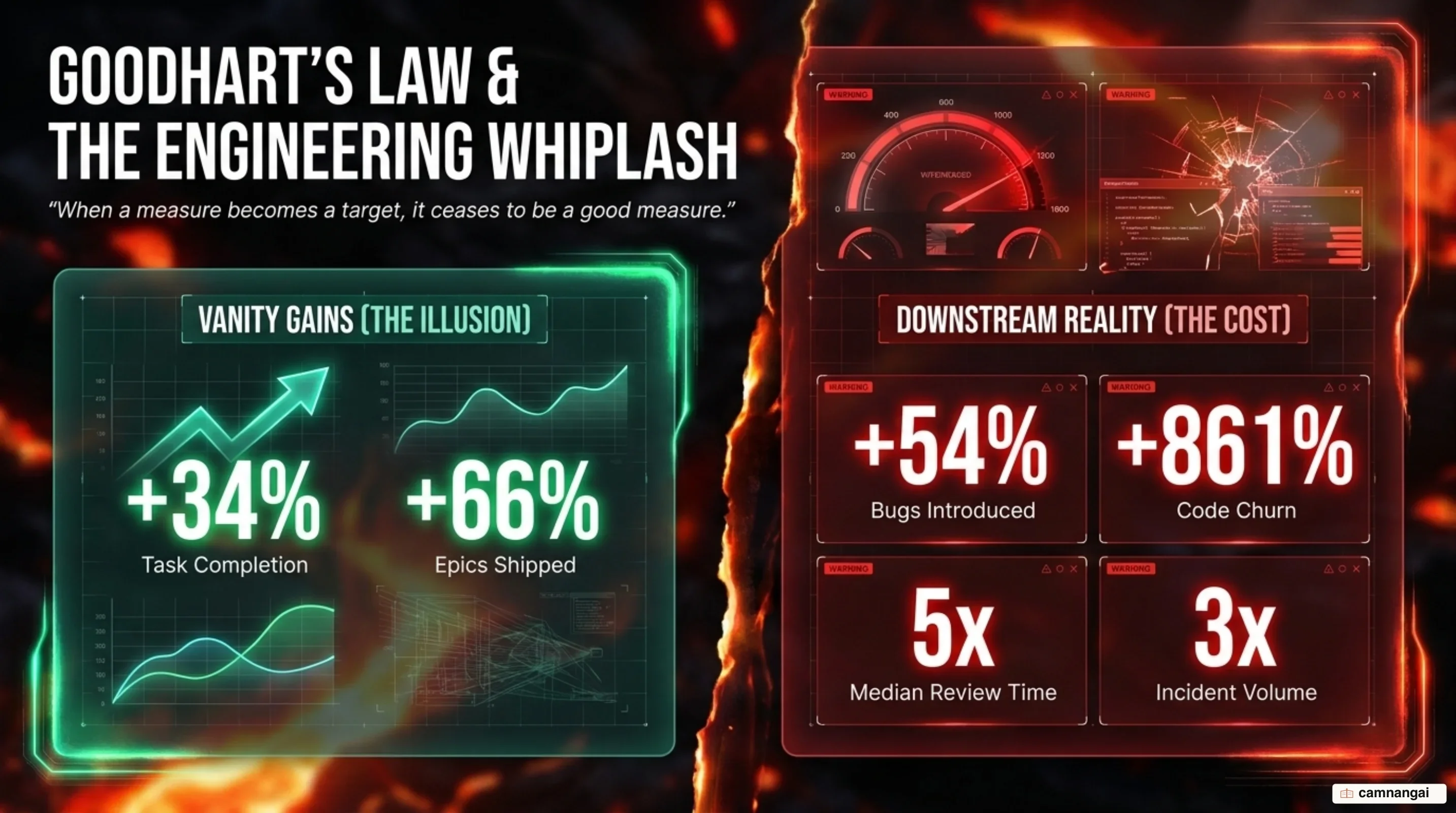
The empirical consequences of this volume-first approach were disastrous for software maintainability and system stability. Empirical data across 22,000 developers and 4,000 teams demonstrated that while AI usage increased initial task completion rates by 34%, epics completed per developer by 66%, and code-specific tasks by 210%, downstream code quality metrics collapsed. Bugs per developer jumped 54%, the overall incident-to-PR ratio more than tripled across enterprise codebases, median code review times surged 5-fold, and 31% more pull requests merged into master branches without any human code review. Code churn—the ratio of lines deleted to lines added in a given quarter—spiked by 861% in high-AI environments, revealing that rapid token burn was generating massive volumes of unstable code that failed to survive in production.
This structural disconnect between code generation velocity and human review capacity directly compromised system reliability. Engineers at Meta reported that multiple internal site availability incidents (SEVs) were directly caused by careless AI code generation from developers prioritizing rapid token throughput over fundamental testing, code verification, and architectural review. When you evaluate software engineers on token burn rather than shipped stability, your engineering org accelerates the delivery of defect-heavy code directly into production environments.
The Budget Reckoning: Why Enterprises Are Pushing Back
By mid-2026, the financial reality of unconstrained token consumption forced a severe executive retreat across the tech industry. Uber provided the most visible corporate budget collapse after exhausting its entire $3.4 billion 2026 R&D and AI compute budget in just four months, driven primarily by unchecked developer usage of Claude Code. Speaking on the Rapid Response podcast, Uber President and COO Andrew Macdonald publicly admitted that the assumed link between massive AI token spend and customer-facing product delivery was non-existent, forcing the company to halt open-ended consumption quotas and re-evaluate its AI investment strategy.
In response to public scrutiny, metric gaming, and internal compute waste, major tech firms moved swiftly to dismantle their gamified usage tracking platforms. Meta discontinued and deleted its "Claudeonomics" dashboard following external press exposure and social media backlash regarding metric gaming. Amazon deleted its internal developer token leaderboard in May 2026, issuing an explicit corporate directive mandating that engineers must "don't use AI just to use AI."
As you look across the broader tool vendor ecosystem, market dynamics quickly adjusted to curb unconstrained compute burn. GitHub Copilot transitioned toward strict usage-based and token-metered billing models to disincentivize unprofitable power users, while LLM vendors instituted aggressive rate limits on runaway agentic connections. Industry leadership openly abandoned consumption-based vanity metrics in favor of strict financial discipline; HubSpot CEO Yamini Rangan summarized the transition by declaring "Outcome maxxing >> token maxxing," pointing out that teams generating billions of tokens without shipping accepted product changes were operating as nothing more than expensive compute burners.
From Tokenmaxxing to "Valuemaxxing": Prioritizing Efficiency over Waste
When you transition your organization away from raw token consumption, you adopt "valuemaxxing"—a term coined by Nebius Chief Revenue Officer Marc Boroditsky. Valuemaxxing redirects your engineering evaluation from API input volume to unit financial performance, measuring AI efficacy by cost-per-accepted-outcome, resolved security vulnerabilities, completed pull requests, and reduced code rework. You must avoid blunt token minimization, as stripping critical business context or architectural constraints to lower initial token costs creates instruction ambiguity, triggering expensive model retries, agent execution loops, and manual developer rework that ultimately increases total spend.
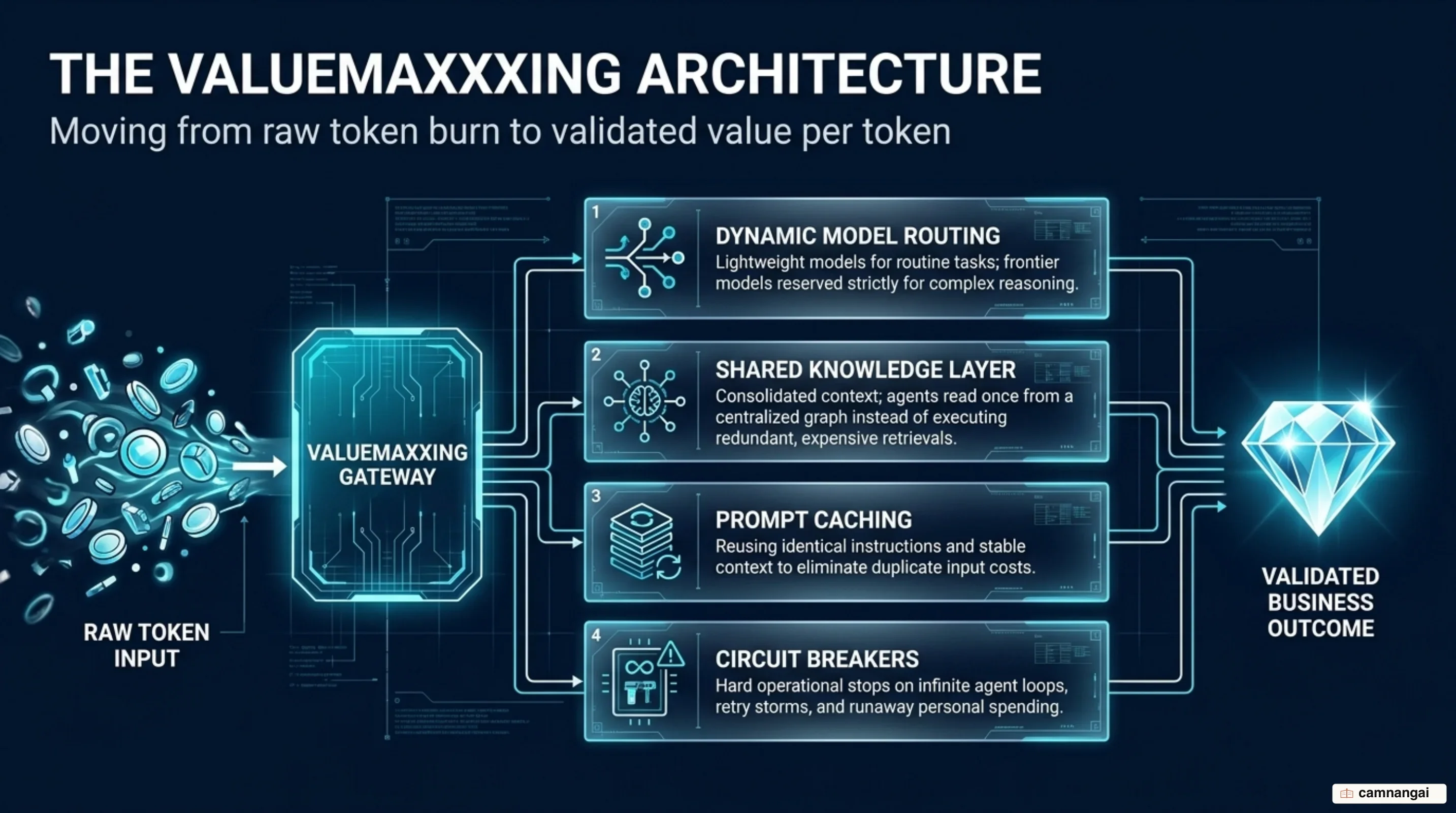
To achieve cost-efficient scale, you must decouple your infrastructure from single-model dependencies and implement dynamic model orchestration. IDC predicts that by 2028, 70% of leading AI-driven enterprises will dynamically manage model routing across multiple providers based on task complexity rather than defaulting to top-tier reasoning engines. Frameworks like LiteLLM and platforms like IBM Bob enforce this strategy by automatically routing routine classification, file retrieval, and code formatting to low-cost models like Claude Haiku or open-source alternatives, reserving expensive frontier models like Claude Opus strictly for high-level architectural reasoning. Operating mixed-model architectures reduces your total token spend by up to 60% on typical enterprise workloads without degrading output quality.
At the systemic level, token waste is primarily caused by stateless agent loops that lack persistent memory. When independent agent threads execute, they re-parse raw codebase trees, ticket histories, and Slack threads on every invocation, burning hundreds of thousands of tokens re-deriving facts your organization has already discovered. Implementing shared engineering knowledge layers like Falconer resolves this redundant retrieval problem by persisting verified codebase conclusions and documentation outside individual sessions; your agents pay once to index system state, amortizing input costs across every subsequent call. To prevent runaway cost spikes, you must combine shared context layers with operational safety controls, such as Shopify's daily spend circuit breakers that automatically terminate runaway agent loops and isolate underlying infrastructure bugs before invoice delivery.
When Heavy Token Usage Makes Sense (and When It Doesn't)
When you evaluate AI compute allocations, heavy token usage represents high-ROI leverage when directed at complex, high-value engineering transformations: executing deep automated refactoring across legacy codebases, generating comprehensive technical documentation for unmaintained systems, or running multi-agent test execution environments that deliver verified, merged pull requests. Conversely, heavy token usage is toxic operational waste when generated by unchecked context bloat, prompt redundancy, agentic execution loops lacking stop conditions, or gamified internal usage targets.
Treat tokens strictly as a raw infrastructure cost input to optimize—like database IOPS or cloud compute hours—never as a performance scorecard to celebrate. Your objective as a technical architect is to maximize the business value delivered per dollar spent, eliminating compute waste while delivering resilient, maintainable production software.
References
- Tokenmaxxing: Plain-English Definition, Origin & What It Means — Tokenmaxxing
- The Pulse: 'Tokenmaxxing' as a Weird New Trend — The Pragmatic Engineer
- Tokenmaxxing: Why AI Token Consumption Isn't Engineering Productivity — Faros AI
- Tokenmaxxing is Dead, Long Live Valuemaxxing — IBM
- Tokenmaxxing: The AI Token Status Game Taking Over Tech — Mr. Prompts
- Tokenmaxxing vs. Token Efficiency: What Changes When Agents Share a Knowledge Layer — Falconer Guides
- Tokenmaxxing: How CIOs Can Extract Maximum Value from AI Tokens — TechTarget