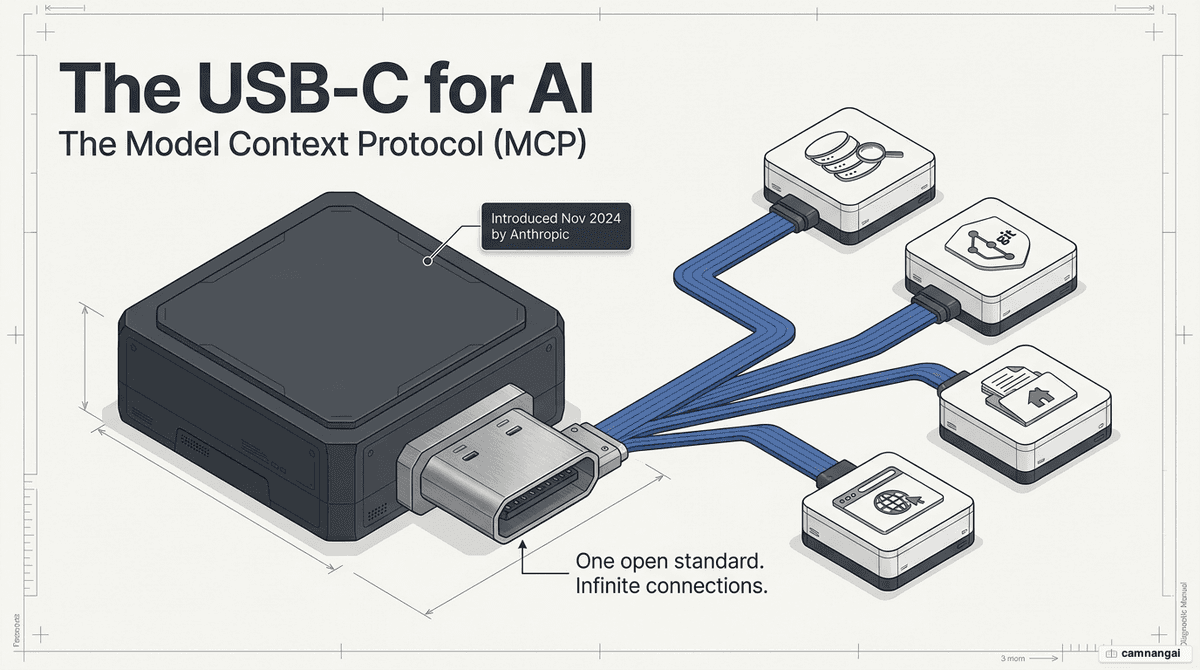
The Model Context Protocol (MCP) is an open-source standard introduced by Anthropic that enables a "plug-and-play" connection between AI models and external data sources.
Think of it as the "USB-C for AI," designed to standardize the fragmented integrations between models and the systems where your data lives.
By providing a universal protocol, you replace custom, one-off connectors with a single, reusable interface that lets AI assistants securely access real-time context and execute actions across diverse software ecosystems.
What is MCP?
Open-sourced in November 2024 by Anthropic and developed by David Soria Parra and Justin Spahr-Summers, the Model Context Protocol (MCP) was created to end the isolation of frontier AI models. Traditionally, capable models are trapped behind information silos and legacy systems, needing custom glue code for every new data source. MCP gives the industry a universal standard that lets you connect AI systems to data sources once, rather than building a separate implementation for every interaction.
MCP works as a "common language" that lets AI assistants talk to content repositories, business tools, and complex development environments. By standardizing how a model requests and receives information, the protocol helps AI agents produce more relevant, accurate responses grounded in real-time data. For technical leads, this means the infrastructure you build today stays compatible with future models as they arrive.
The protocol is vendor-agnostic and language-agnostic, which opens up a broad ecosystem of "plug-and-play" tools. When a server advertises its capabilities through MCP, any compatible client can use those features right away. To speed up your development cycle, note that Claude 3.5 Sonnet is specifically recommended as being good at quickly generating these server-side implementations from existing API specifications.
Why was MCP created?
MCP was designed to solve the "N × M integration problem" that has long plagued AI engineering. In a legacy environment, if you have N different AI applications (such as Cursor, Claude Desktop, or custom internal agents) and M data sources (such as GitHub, Slack, or a Postgres database), you would in theory need to build and maintain N × M separate integrations. This fragmentation results in heavy maintenance debt and high barriers to entry for developers.
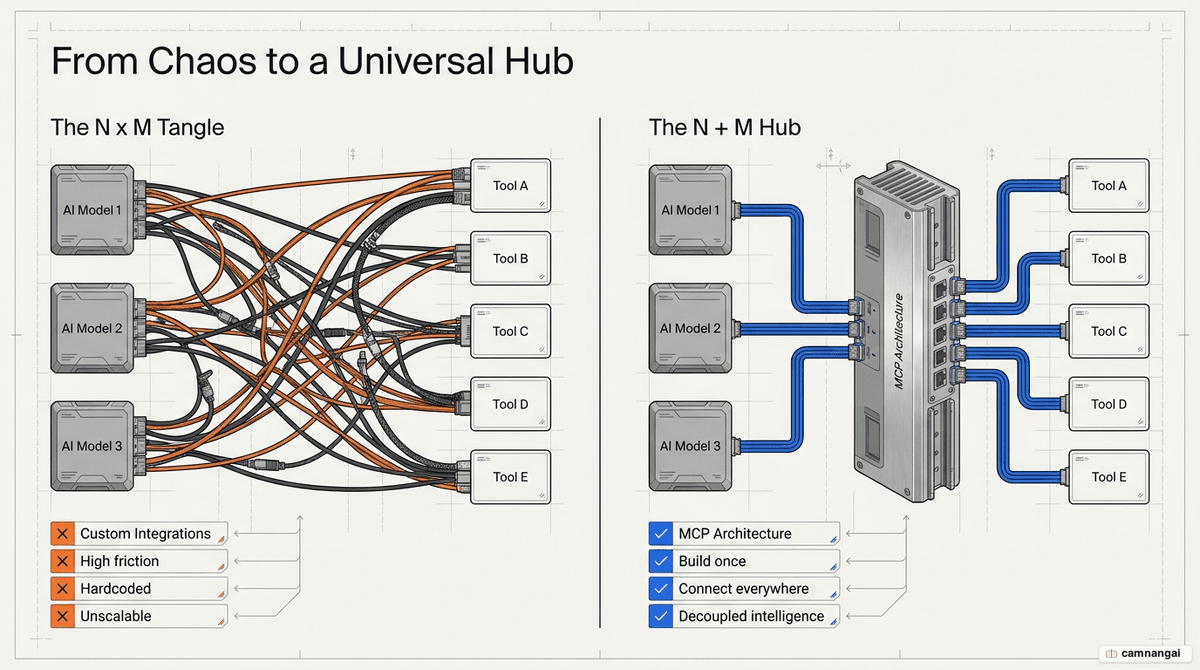
This broken ecosystem meant progress was often bottlenecked by the tedious work of reinventing authentication and data formatting for every new connection. If an underlying API changed its response format, every integration tied to that API would break, forcing manual updates across all connected applications. Developers ended up spending more time on the mechanical work than on the creative side of AI application design.
With a standardized protocol, the total integration effort drops from N × M to N + M. You only need to build an MCP server for your data source once to make it reachable by every MCP-compatible client. This architecture decouples the "thinking" (the AI model) from the "knowing" (the data sources), so your context layer stays stable even as you swap out underlying language models.
MCP architecture: Host, Client, Server
The MCP architecture relies on a three-layer model to separate concerns and stay scalable across local and remote environments.
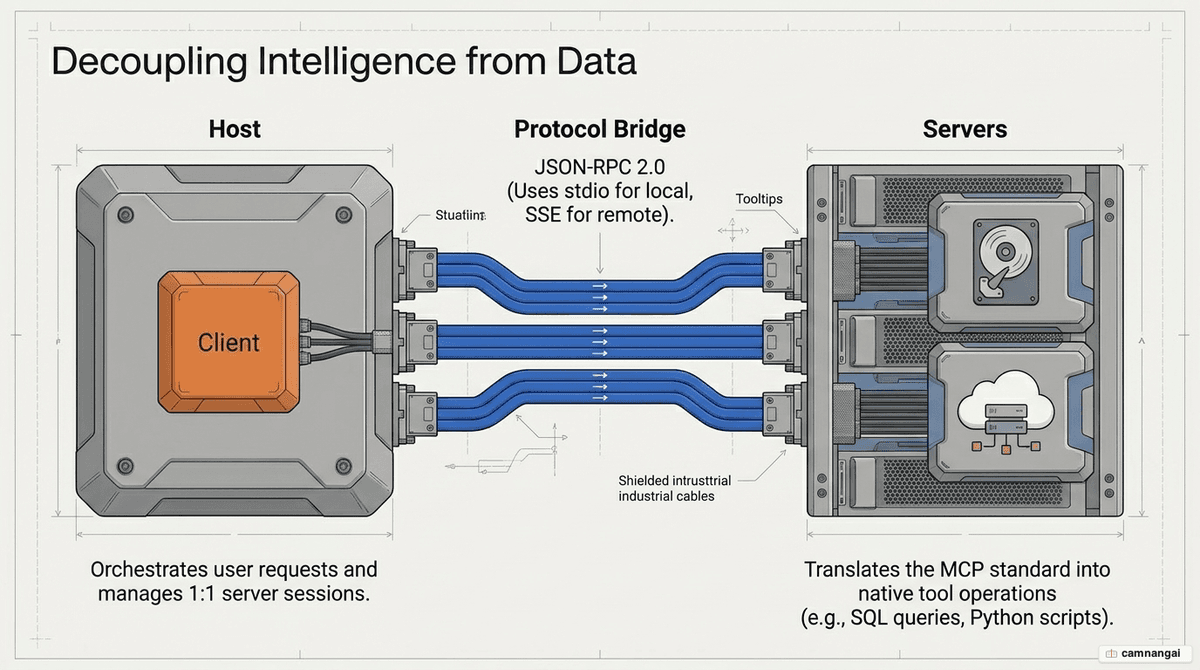
The host. The host is the user-facing application that orchestrates the overall experience. Examples include the Claude Desktop app, IDEs like Cursor, or specialized agentic frameworks. The host interprets your prompt, decides whether external data is needed, and manages the internal clients that connect to specific servers. It is the primary orchestrator of the session lifecycle.
The client. The client is the protocol-speaking component that lives inside the host. Its main job is to maintain 1:1 connections with servers and act as the translation layer. It converts high-level AI intents into structured MCP messages, such as tools/call. The client also handles capability negotiation, asking the server "What can you do?" the moment a connection is established.
The server. The server is a lightweight adapter that translates a system's native API — such as a SQL database or a SaaS platform — into the MCP standard. Communication between the client and server runs over JSON-RPC 2.0. Choosing a transport is an architectural trade-off: use stdio for local processes to get minimal latency and maximum security, while SSE (Server-Sent Events) is preferred for remote servers that need asynchronous, event-driven streaming over HTTP.
The three core primitives: Resources, Tools, Prompts
MCP defines three fundamental building blocks — primitives — that servers use to expose their data and behavior to AI models.
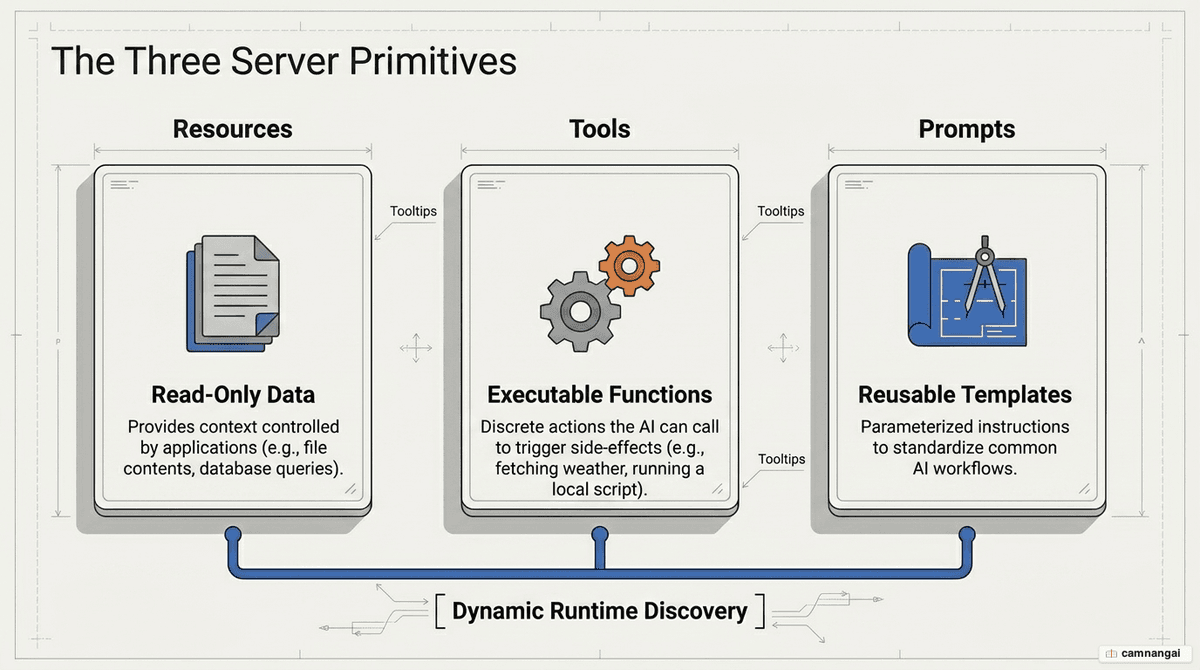
Resources. Resources are read-only data items that give the model context on demand. They work much like files an AI can read but cannot modify. Examples include database schemas, text files, or documentation articles. They let you feed the AI specific, static information from your local or remote systems to ground its reasoning.
Tools. Tools are executable functions that let the AI perform actions with side effects. Unlike resources, tools let the AI act on the world by calling functions like "send an email," "run a web search," or "update a Jira ticket." When the model invokes a tool, the server runs the underlying code — often wrapping a traditional REST API — and returns the result to the model.
Prompts. Prompts are reusable, parameterized instruction templates that standardize common workflows. They let you share effective prompting techniques across different applications. For instance, a server might provide a prompt template for "code review" or "data summary." Servers advertise all three primitives through machine-readable catalogs (e.g., tools/list), so the AI can discover new capabilities at runtime without code changes.
How does MCP work?
The operational lifecycle of MCP begins with a handshake and capability negotiation. When your AI application connects to a server, the client asks for a list of available primitives. The server responds with its machine-readable catalog of resources, tools, and prompts. This lets the AI model adapt to the server's specific capabilities on the fly, so you never have to hard-code tool definitions into your application logic.
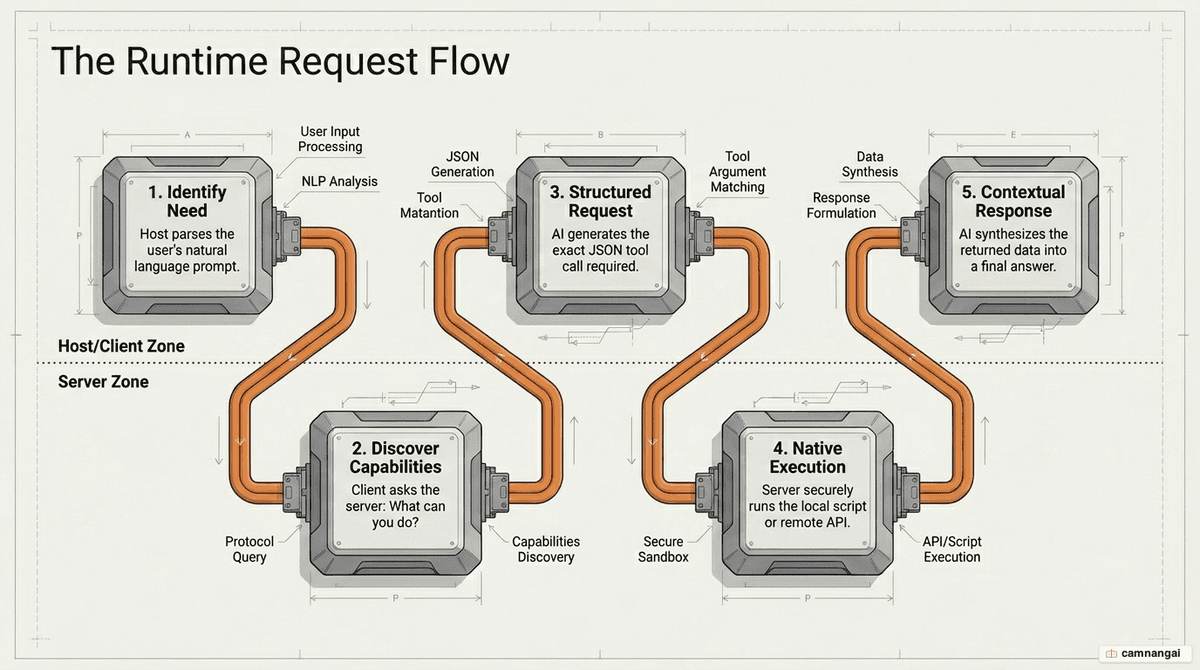
Once discovery is complete, the request-response cycle drives the interaction. If you ask an AI to "find the sales report in Postgres and Slack it to the team," the model figures out which tools it needs. It generates a tool call, which the client sends to the server via JSON-RPC. The transport layer handles three JSON-RPC message types: requests, responses, and notifications — the last being specialized messages that don't need a server response.
In the final phase of the cycle, the server translates the MCP request into a native operation (like a SQL query), runs it, and returns the result to the client. The model then processes this data to decide its next action. This two-way communication lets the AI work as a dynamic agent that can observe, plan, and act on real-time data, rather than just predicting the next word in a sentence.
MCP vs API, function calling, and RAG
While MCP shares technical DNA with other AI integration methods, it plays a distinct role as a standardization layer.
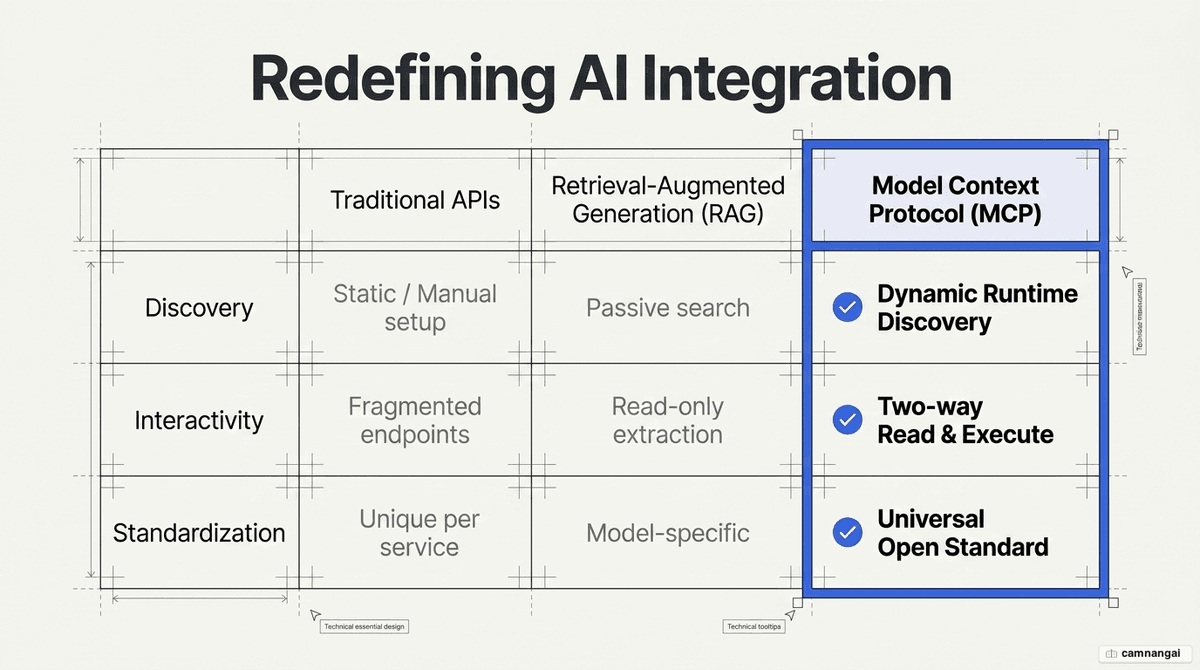
MCP vs REST APIs. Traditional REST APIs are general-purpose and unique to every service, needing custom adapters for every connection. MCP, by contrast, is purpose-built for AI agents. An MCP server is often a wrapper for a traditional API, but it translates unique endpoints and parameter formats into a standardized "grammar" that any MCP-compliant AI understands right away.
MCP vs RAG. Retrieval-Augmented Generation (RAG) is mainly used for passive information retrieval, pulling text from a knowledge base to inform a response. MCP is a broader system for active interaction. You can use MCP to connect to a vector database as a tool, but its main value is its ability to run functions and interact with external applications in real time.
MCP vs function calling. Function calling is a model-side capability, while MCP is the protocol that standardizes how those functions reach the model. MCP's dynamic discovery means the model can pick up new tools automatically when a server is updated, whereas traditional function calling often needs manual updates to the application code to support new capabilities.
Security when using MCP
The MCP security model is grounded in user consent and the "human-in-the-loop" principle. Because MCP servers can run code and access private data, you must stay in control of the permissions granted to the AI. Critically, the protocol specification itself currently lacks a formal, native authentication layer for remote or multi-tenant scenarios; authentication and authorization are usually handled by the host application or by the user directly.
A real security advantage of the architecture is its support for local servers. With the stdio transport layer, the server runs as a local process on your machine. This keeps sensitive data, such as local file contents or database schemas, on your hardware, shared with the model provider only when you explicitly request it via a tool call.
Remote execution through the SSE transport carries higher risks, since it involves sending data over the network. For any critical or destructive actions — such as deleting a database record or processing a payment — MCP-enabled applications are designed to require explicit user confirmation. This keeps the AI from taking irreversible actions without a human verifying the intent and the parameters of the call.
The MCP ecosystem and real-world uses
The MCP ecosystem is growing fast, with both enterprise connectors and specialized community-driven servers. Anthropic maintains pre-built servers for core enterprise systems, including Google Drive, Slack, GitHub, and Postgres, letting you connect your most critical datasets to AI tools with minimal configuration.
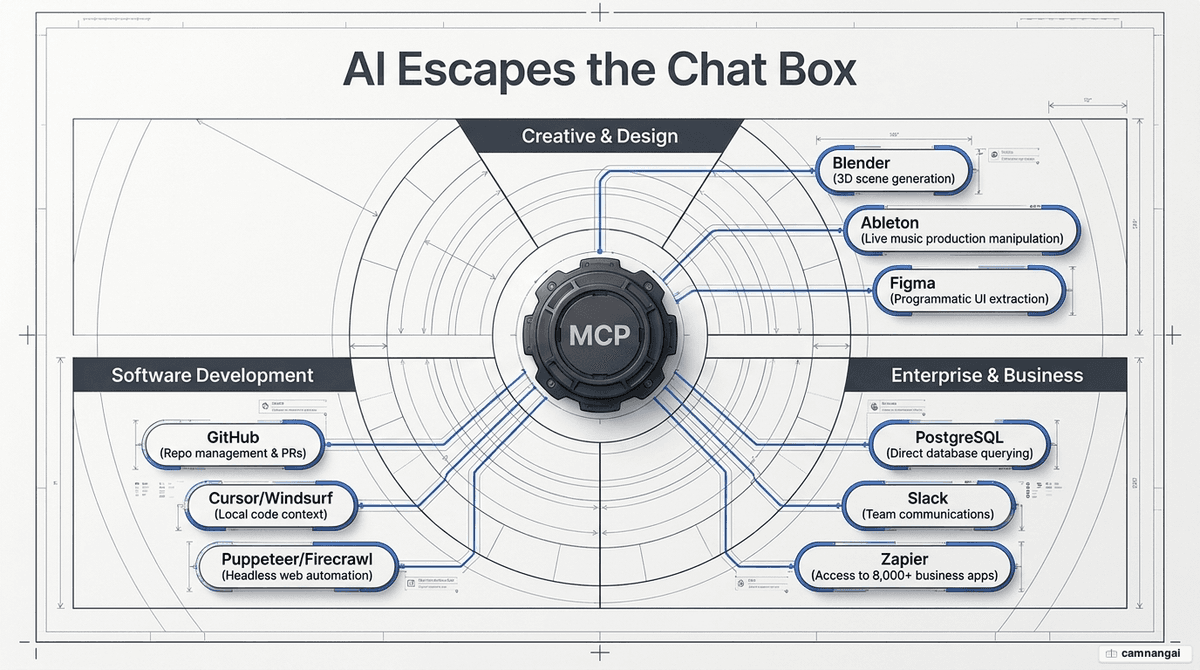
Creative and technical communities have built specialized servers that show off the protocol's flexibility:
- Creative production: an Ableton Live server lets AI control music production, while a Blender server generates 3D scenes from natural language.
- Design and game dev: a Figma server powers design-to-code workflows, and a Unity server lets AI drive the editor for rapid game prototyping.
- Global automation: Zapier has introduced an MCP server that opens up its catalog of 8,000+ apps, in effect giving an AI agent a "universal remote control" for the web.
This network effect means that as more tools adopt the MCP interface, they become instant skills for any MCP-compatible AI, building a unified mesh of interoperable software.
Getting started with MCP and what's next
To start building with MCP, you can use SDKs available in TypeScript, Python, Java, Kotlin, and C#. For early testing, the MCP Inspector gives you a debugging environment to verify your server, while the Claude Desktop app offers native support for local server testing. Remember that Claude 3.5 Sonnet is the recommended model for generating the server-side boilerplate from your existing documentation.
You can connect to a pre-built reference server or initialize your own with simple CLI commands. For a quick test, run:
npx @modelcontextprotocol/server-everythingThe future of the protocol points toward native application support, where software like VS Code or enterprise SaaS platforms ship with built-in MCP servers. The roadmap also prioritizes standardized authentication layers and enterprise-grade multi-tenancy. As the standard matures, it aims to become the de facto interoperability layer for AI agents, removing the mechanical burden of integration and letting you focus on building intelligent, context-aware systems.
FAQ
Is MCP limited to use with Anthropic's Claude? No. MCP is an open-source standard designed to be vendor-agnostic. Any AI model or application, including ChatGPT or open-source LLMs, can implement the protocol to connect with any MCP server.
Does MCP replace frameworks like LangChain? No. MCP is an integration layer, not an orchestration framework. It complements LangChain or crewAI by standardizing how those frameworks access tools and data, but it doesn't handle the higher-level logic of when to call a tool.
Is MCP limited to a specific programming language? No. Official SDKs exist for TypeScript, Python, and Java, but the protocol is language-agnostic. Because it communicates via standard JSON-RPC 2.0, you can implement an MCP server in any language.
What is the difference between stdio and SSE transport? stdio runs a server as a local process for low-latency, high-security local integrations. SSE (Server-Sent Events) is used for remote resources, handling communication with cloud-based APIs over HTTP.
References
- MCP: What It Is and Why It Matters — Addy Osmani
- How MCP Works — System Design Newsletter
- What is the Model Context Protocol (MCP)? — modelcontextprotocol.io
- Introducing the Model Context Protocol — Anthropic
- What is Model Context Protocol (MCP)? A guide — Google Cloud
- What is Model Context Protocol (MCP)? — IBM
- MCP vs API: Simplifying AI Agent Integration with External Data — IBM Technology